INTRODUCTION
Gastric cancer is the fourth most common cancer and the sec-ond leading cause of cancer - related deaths worldwide (1). Surgical resection for gastric cancer is the only therapeutic modality for cure (2), and regional lymphadenectomy is recommended as part of radical gastrectomy (3). Laparoscopic gastrectomy is an emerg-ing surgical approach that offers significant advantages with re-spect to short- term outcomes, such as less postoperative pain, earlier postoperative recovery of gastrointestinal function and ability to move, and shorter postoperative hospital stay, when compared with open gastrectomy. Recently, laparoscopic surgery has come to be regarded as the treatment of choice for early gastric cancer (EGC), but the indications and outcomes of laparoscopic gastrectomy for advanced gastric cancer (AGC) are still contro-versial due to its technical difficulties and the lack of long - term results. The purpose of this study was to evaluate the oncologic outcomes of laparoscopic distal gastrectomy (LDG) for AGC.
METHODS
PatientsBetween April 2003 and March 2014, laparoscopic distal gas-trectomy (LDG) was performed for 392 patients with gastric can-cer, 91 (23.2%) of those were histopathologically diagnosed as AGC beyond T2 depth. The clinicopathological features, postoperative outcomes, mortality, morbidity, recurrence, and survival of the pa-tients who underwent LDG for AGC were reviewed retrospectively.
The eligibility criteria for LDG in our hospital are cT1 - 3N0 - 1 (Union Internationale Contre le Cancer 7thedition (4)) gastric cancer in the lower or middle body of the stomach. In the case of cT2 -3N1 gastric cancer, D2 lymphadenectomy was performed. All patients were informed that LDG is regarded as experimental treat-ment by the Japanese gastric cancer treattreat-ment guideline (5), and a written, informed consent was obtained from all patients. Patient anonymity should be preserved.
In our hospital, laparoscopic surgery for gastric cancer was in-troduced in April, 2003, and the indication for LDG for gastric can-cer was cT1N0 according to the 6thedition of the UICC staging criteria (6). Laparoscopy - assisted distal gastrectomy (LADG), which means reconstruction under minilaparotomy, was performed. We extended the indication to cT3N1 based on development of the operative procedures with D2 lymphadenectomy, and performed totally laparoscopic gastrectomy, which included intracorporeal an-astomosis, from April, 2012. If the tumor depth was obviously beyond T4, LDG was converted to open surgery. In the case of suspicious T4 depth, washing cytology was performed twice (just after laparotomy and before closure the wound) during the sur-gery and evaluated postoperatively.
Gastrointestinal fiberscopy, barium fluoroscopy, and contrast-enhanced computed tomography were performed for preopera-tive staging. All patients provided their written, informed consent. Data obtained for each patient included the followings : age, sex, body mass index (BMI), histological type, tumor invasion (T stage), nodal status (N stage), gastric cancer stage classified according to the 7thedition of the UICC staging criteria, postoperative out-comes, postoperative morbidity, recurrences, adjuvant therapy, and survival. The classification of lymph node dissection was done according to the 2014 Japanese gastric cancer treatment guide-lines (ver.4) (5). All values are expressed as means!standard de-viations.
ORIGINAL
Short-Term Outcomes of Laparoscopic Distal Gastrectomy for
Advanced Gastric Cancer
Masakazu Goto, M.D., Hiroshi Okitsu, M.D., Ph.D, Yasuhiro Yuasa, M.D., Ph.D, Shunsuke Kuramoto, M.D., Atsushi Tomibayashi, M.D., Daisuke Matsumoto, M.D., Yuri Masuda, M.D., Hiroshi Edagawa, M.D., Ryotaro Tani, M.D., Osamu Mori, M.D., and Yuta Matsuo, M.D.
Department of Gastroenterological Surgery, Tokushima Red Cross Hospital, Tokushima, Japan
Abstract : The purpose of this study was to investigate the oncologic outcomes of laparoscopic distal gastrectomy (LDG) for advanced gastric cancer (AGC). Between April 2003 and March 2014, LDG was performed for 392 pa-tients, 91 patients (23.2%%) had histopathologically diagnosed AGC beyond T2 depth. The clinicopathological fea-tures, postoperative outcomes, mortality, morbidity, recurrence rate, and survivals of those patients were reviewed. The TNM stages of the tumor were!B in 26 patients (28.5%%),!!A in 20 (21.9%%),!!B in 18 (19.7%%),!!!A in 13 (14.2%%),!!!B in 6 (6.5%%),!!!C in 6 (6.5%%), and!"in 2 (2.1%%). Major morbidity occurred in 14 patients (15.3%%), with no postoperative mortality. Median follow-up was 24.5 months ; 10 patients developed recurrence during the follow-up period, and 10 patients died, including 6 cancer deaths. The 5-year overall and disease-free survival rates were 76.8%% and 72.6%%, respectively. By stage, OS/DFS was 92.3%%/91.8%% in stage!B, 85.4%%/85.4%% in stage!!, and 49.3%%/26.9%% in stage!!!.Oncologic outcomes were good in patients with AGC, especially with stage !B-!!B, who underwent LDG. LDG appears to be an effective approach for treating stage!B and !!gastric cancer. J. Med. Invest. 63 : 68-73, February, 2016
Keywords : Advanced gastric cancer, Gastrectomy, Laparoscopic surgery
Received for publication July 21, 2015 ; accepted October 20, 2015. Address correspondence and reprint requests to Masakazu Goto, M.D., Department of Gastroenterological Surgery, Tokushima Red Cross Hos-pital, 103 Azairinokuchi, Komatsushima - cho, Komatsushima - City, Tokushima 773 - 8502, Japan and Fax : +81 - 885 - 32 - 6350.
Surgery
All patients were placed in the lithotomy position under general anesthesia. The surgeon stood on the patient’s left, with the first assistant on the patient’s right and the camera assistant between the patient’s legs. Routinely, an umbilical trocar (12 mm) was in-serted using the open method. Carbon dioxide pneumoperitoneum was created through the umbilical port, and the pressure was main-tained around 10 mmHg. A 10 - mm flexible laparoscope was then introduced through the umbilical port. Under laparoscopic guid-ance, five trocars were introduced, consisting of bilateral subcostal (5 mm), bilateral mid - abdominal (12 mm), and epigastric (5 mm) ports.
First, the gastrocolic ligament was divided at the mid position of the transverse colon about 5 cm from the gastroepiploic arcade toward the lower pole of the spleen using laparosonic coagulating shears (LCS).
Next, the right gastrocolic ligament and lymph nodes were dis-sected along the right gastroepiploic vessels (No.4d). The infrapy-loric nodes (No.6) and the nodes along the superior mesenteric vein (No.14v) were dissected. A gauze was placed on the common hepatic artery, and the hepatogastric ligament was cut using LCS toward the esophagogastric junction on this gauze, and the right crus was revealed. After the suprapyloric nodes along the right gastric vessels (No.5) and the nodes along the proper hepatic artery (No.12a) were dissected, the duodenum just distal to the pyloric ring was transected by a linear stapler. Then, the nodes along the common hepatic artery (No.8a) and the proximal splenic artery (No.11p) were dissected. The left gastric vein and artery were cut. After dissecting the nodes along the left gastric artery (No.7) and the nodes around the celiac artery (No.9), dissection of the right cardial nodes (No.1) and the nodes along the lesser curvature (No.3a) was performed. Billroth!gastroduodenostomy or Billroth!!gastrojejunostomy reconstruction was performed to-tally under laparoscopy, using flexible laparoscopic stapling de-vices. Finally, the resected specimen in the collection bag was removed from the umbilical port, which was extended 3 cm.
Postoperative treatment and follow up
In AGC cases with stages beyond stage!!,adjuvant chemother-apy with S - 1 alone for 33 cases (7) and S - 1 and cisplatin for 4 cases (8 - 9) was performed.
Adjuvant chemotherapy was to be started within 4 to 8 weeks after surgery, following sufficient recovery from the intervention. All patients were followed according to an established protocol in our hospital, which includes medical history, physical examination, and laboratory studies, such as tumor markers. Multi - Detector CT examinations was performed every 3 - 6 months, and gastro-intestinal fiberscopy was performed annually.
Complications
Morbidity was classified according to the revised version of the Clavien - Dindo classification suggested by Dindo et al. (10).
Statistical analyses
All results were presented as near!SD and analyzed with the log - rank test. P - value of 0.05 or less was considered significant. All statistical analyses were performed using Stat View version 5.0 for Windows (SAS Institute Inc., Cary, NC)
RESULTS
Clinicopathological characteristics
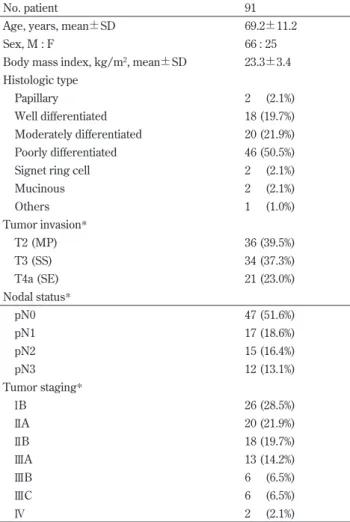
The clinicopathological characteristics of the patients are pre-sented in Table 1. The mean age was 69.2!11.2 years (range, 38 - 88
years). Of the 91 patients who underwent LDG, 66 were men (72.5%), and 25 were women (27.4%). The mean body mass index was 23.3!3.4 kg/m2(range, 14.0 - 33.2 kg/m2). The most common histologic type was poorly differentiated adenocarcinoma (50.5%). The TNM stages (UICC, 7thedition) were : stage!B in 26 (28.5%) patients ;!!A in 20 (21.9%) ; !!B in 18 (19.7%) ; !!!A in 13 (14.2%) ; !!!B in 6 (6.5%) ; !!!C in 6 (6.5%) ; and !"in 2 (2.1%). Two patients were in stage!"due to liver metastases and peritoneal dissemi-nation. Liver metastasis, which was very small, was first found in-traoperatively and gastrectomy was performed to control tumor bleeding. Peritoneal dissemination, which existed only around the tumor, was not detected with intraoperative rapid histological examination and was found postoperatively.
Postoperative Outcomes
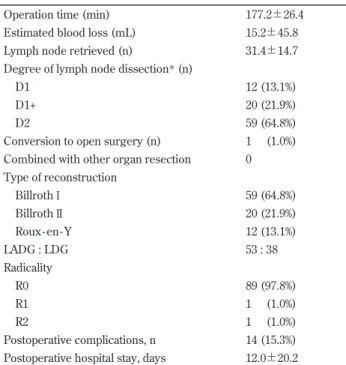
For all 91 patients, the mean operation time was 177.2!26.4 min (range, 119 - 258 min), and the mean estimated blood loss was 15.2!45.8 ml. A total of 59 patients (64.8%) received over D2 dis-section according to the 2014 Japanese gastric cancer treatment guidelines (ver.4) (5). The mean number of retrieved lymph nodes during LDG was 31.4!14.7. The most frequent type of reconstruc-tion was Billroth!(64.8%). Conversion to open surgery was done in one patient (1.0%), as a result of suspected T4 wall invasion. Table 1. Clinicopathological features of patients undergoing LDG
No. patient 91
Age, years, mean!SD 69.2!11.2
Sex, M : F 66 : 25
Body mass index, kg/m2, mean!SD 23.3!3.4 Histologic type
Papillary 2 (2.1%)
Well differentiated 18 (19.7%) Moderately differentiated 20 (21.9%) Poorly differentiated 46 (50.5%) Signet ring cell 2 (2.1%)
Mucinous 2 (2.1%) Others 1 (1.0%) Tumor invasion* T2 (MP) 36 (39.5%) T3 (SS) 34 (37.3%) T4a (SE) 21 (23.0%) Nodal status* pN0 47 (51.6%) pN1 17 (18.6%) pN2 15 (16.4%) pN3 12 (13.1%) Tumor staging* !B 26 (28.5%) !!A 20 (21.9%) !!B 18 (19.7%) !!!A 13 (14.2%) !!!B 6 (6.5%) !!!C 6 (6.5%) !" 2 (2.1%)
Where appropriate, data are given as means!SD or as numbers of pa-tients with percentages given in parentheses.
Radicality of the operation was R0 in 97.8%, R1 in 1.0%, and R2 in 1.0%. The R1 operation was decided because of peritoneal dissemi-nation revealed by pathological examidissemi-nation postoperatively, and the R2 case was due to liver metastases (patient in stage!"). The mean postoperative hospital stay was 12.0!20.2 days (range, 6 -177) (Table 2). There were 14 postoperative complications (15.3%), and no surgery - related deaths occurred (Table 3). Most compli-cations could be treated conservatively, but complicompli-cations beyond Clavien - Dindo classification grade!!!occurred in three cases. Grade!!!a was duodenal stump leakage, which was successfully treated by single drainage. Grade!"a complications were anasto-motic leakage and pancreatic fistula, which required reoperation and intensive care for 34 days and 39 days respectively.
Follow -up Results
The median follow - up period was 24.5 months (range, 0.3 - 114 months). Tumor recurrence was detected in 10 patients (10.9%) during follow - up. The sites of recurrences are shown in Fig 1. Liver metastasis occurred in five patients (stage!B, two patients ; stage !!!A, one patient ; stage !!!C, two patients), peritoneal dissemina-tion in four patients (stage!!!A, one patient ; stage !!!B, one pa-tient ; stage!!!C, two patients), paraaortic lymph node metastasis in three patients (stage!!!A, two patients ; stage !!!C, one patient), lung metastasis in one patient (stage!!!C), and ovarian metastasis in one patient (stage!!!B) (there is some overlap). There were no recurrences in regional lymph nodes around the stomach.
In AGC cases with stages beyond stage!!,adjuvant chemother-apy based on S - 1 or other drugs was given (Table 4). The most common regimen was S - 1 alone (76.7%). S - 1/cisplatin was given for the patients with stage!"and stage !!!with extensive lymph
node metastasis, S - 1/docetaxel was given for the patients with stage!!!as clinical trial. Other patients didn’t received adjuvant chemotherapy for advanced age, postoperative complications (Clavien - Dindo classification grade!"a ), renal dysfunction and Table 2. Postoperative outcomes
Operation time (min) 177.2!26.4 Estimated blood loss (mL) 15.2!45.8 Lymph node retrieved (n) 31.4!14.7 Degree of lymph node dissection* (n)
D1 12 (13.1%)
D1+ 20 (21.9%)
D2 59 (64.8%)
Conversion to open surgery (n) 1 (1.0%) Combined with other organ resection 0 Type of reconstruction Billroth! 59 (64.8%) Billroth!! 20 (21.9%) Roux - en - Y 12 (13.1%) LADG : LDG 53 : 38 Radicality R0 89 (97.8%) R1 1 (1.0%) R2 1 (1.0%) Postoperative complications, n 14 (15.3%) Postoperative hospital stay, days 12.0!20.2
Where appropriate, data are given as mean!SD or numbers of patients with percentages given in parentheses.
LADG Laparoscopy - assisted distal gastrectomy LDG Laparoscopic dis-tal gastrectomy.
*According to the 2014 Japanese gastric cancer treatment guidelines (ver.4).
Table 3. Posto perative morbidity
Complications n %
Grade!*
Delirium 3 3.3
Dumping syndrome 1 1.1
Grade!!*
Surgical Site Infection 1 1.1 Urinary tract infection 1 1.1
Drug rash 1 1.1
Aspiration pneumonia 2 2.2 Anastomotic stricture 2 2.2 Grade!!!a*
Duodenal stump leakage 1 1.1 Grade!"a*
Anastomotic leakage 1 1.1 Pancreatic fistula 1 1.1
Total 14 15.4
Where appropriate, data show the numbers of patients, with percent-ages.
*According to the Clavien-Dindo classification.
Fig 1. Sites of recurrence There is some overlapping.
Table 4. Adjuvant therapy
Initial chemotherapy regimen n %
S - 1 33 76.7 S - 1 + cisplatin 4 9.3 S - 1 + docetaxel 2 4.6 Others 4 9.3 CPT - 11/CDDP 1 2.3 UFT 1 2.3 5 - FU (oral) 1 2.3 Docetaxel 1 2.3 Total 43
patients’ hope.
During this observation period, ten patients died, including six cancer deaths (stage!B, one patient ; stage !!!A, two patients ; stage!!!B, one patient ; stage !!!C, two patients).
According to TNM stage, the overall 5 - year OS and DFS rates were 92.3% and 91.8% with stage!B, 85.4% and 85.4% with stage !!, and 49.3% and 26.9% with stage!!!,respectively (Fig. 2). Since the two patients with stage!"had not yet been followed for over one year, OS or DFS could not be calculated for these patients.
DISCUSSION
Since LADG for EGC was first performed in 1991 and first re-ported in 1994 (11), improvements in instruments and laparoscopic technique have allowed for widespread acceptance (12 - 13). The laparoscopic approach is used in approximately 39% of gastric cancer surgeries in Japan (14). This approach offers important advantages when compared with open surgery, such as a better cos-metic effect, improved quality of life, less intense pain, shortened hospital stay, early rehabilitation, and early return to social activity (15 - 17). The safety of LADG for clinical stage!cancers (including patients with T3(SS)N0) was demonstrated in a multicenter, con-trolled trial (JCOG 0703) (18), and a randomized, concon-trolled trial
to compare long - term survival after LADG and open distal gastrec-tomy for clinical stage!cancers is ongoing in Japan (JCOG 0912) (19), and the results are awaited. Recently, some surgeons have been concerned about laparoscopic surgery for AGC (20). Since Uyama et al. (21) reported laparoscopy - assisted total gastrectomy with D2 lymph node dissection and distal pancreaticosplenectomy for advanced upper - third gastric cancer, there have been several studies to determine the technical feasibility of D2 lymph node dissection in AGC. Gordon et al. (22) demonstrated that LDG with D2 dissection for AGC was feasible and could match the survival rate of open distal gastrectomy using a cohort in which 67.2% had a tumor of stage!!B or higher with an average follow-up period of 49.2 months. Fukunaga et al. (23) reported that oncologic out-comes were good in patients with T1N0 - 1 and T2N0 gastric can-cer who underwent LADG with extended lymph node dissection. Extended lymph node dissection has been reported in Japan and Europe to improve outcomes of gastric cancer (24). However, the use of laparoscopic surgery with extended lymph node dissection for AGC still continues to be controversial because of the technical difficulty of lymphadenectomy and the lack of data on the proce-dure’s oncologic adequacy. Laparoscopic extended lymph node dissection should be performed by an expert. In our hospital, the operators are limited to experts who have passed an endoscopic surgical skill qualification system (25). We have established the procedure of D2 lymphadenectomy in LDG, which is needed for standard surgery with AGC, so the eligibility criteria for LDG were extended to cT3N1 gastric cancer.
With regard to accuracy, analysis of many cases of advanced can-cer in which open surgery was performed have found that retrieval of a sufficient number of lymph nodes is important to improve the diagnostic accuracy and prognosis, and retrieval of 25 lymph nodes is recommended in T2 (26). In the present study, 31.4 lymph nodes were retrieved, which does not seem to be a problem in terms of accuracy compared with open surgery.
With regard to safety, conversion to open surgery was done in 1 patient (1.0%) because of advanced stage disease, T4 depth, in the present study. There were no specific complications attribut-able to laparoscopic surgery.
Several studies presented mortality and morbidity data associ-ated with laparoscopy - assisted gastrectomy. In the KLASS -!trial (27), the authors reported mortality of 1.1% and morbidity of 10.5%. In the present study, there were 14 cases (15.3%) of postoperative morbidity and no mortality. Complications that required reopera-tion and intensive care, Clavien - Dindo classificareopera-tion grade!"a, occurred in two cases. In one case, anastomotic leakage occurred seven days after operation, and drainage was performed under la-parotomy. In another case, a pancreatic fistula occurred that caused secondary anastomotic leakage. There two cases finally recovered and were discharged.
Several authors have shown no difference in recurrence or sur-vival following laparoscopic surgery and open surgery for EGC. However, in the case of AGC, the difference has remained contro-versial. Recently, Song et al. (28) reported on their multicenter, retrospective analysis of recurrence following laparoscopy - assisted gastrectomy. They stated that the incidence of recurrence was 3.5% in all patients, 1.6% in EGC, and 13.4% in AGC. During the present follow - up period, ten patients (10.9%) were found to have tumor recurrence. They reported that the peritoneum and liver were the most common recurrence sites. In the present study, liver metastasis occurred in five patients (50.0%), which was the most common recurrence site. There were no recurrences in re-gional lymph nodes. Peritoneal dissemination occurred in four patients (T3, one patient ; T4a, three patients), but there were no cases with port site recurrences. Effects of pneumoperitoneum manipulations on progression of the cancer and effects of the ma-nipulation on tumor dissemination have been reported (29), so Fig 2. Overall survival and disease - free survival
Kaplan - Meier overall survival (A) and disease - free survival (B) curves according to tumor stage, based on the 7thedition of the TNM classifi-cation. Stage!"disease was omitted because of the small sample size.
continued follow - up and are needed.
Kitano et al. (15) reported on the long- term outcomes of scopic gastrectomy in a retrospective, multicenter study of laparo-scopic gastrectomy for EGC that analyzed 1294 patients from 16 institutions. They reported that the 5 - year DFS rates were 99.8%, 98.7%, and 85.7% for stages!A, !B, and !!,respectively. In the case of laparoscopic surgery for AGC, some authors reported their short- term and long - term outcomes. Lee and Kim (30) presented the long - term outcomes of AGC, with OS of 81.4% and DFS of 72.4%. In all of the present cases, the 5 - year OS and DFS rates were 76.8% and 72.6%, respectively.
This study has the drawbacks that there was no comparative analysis with open gastrectomy, and the follow - up period was short. For the elucidation of oncologic safety and clinical feasibil-ity of laparoscopic distal gastrectomy for AGC, a comparative study of short- term and long - term results with the open method will be necessary. Although further study comparing laparoscopic distal gastrectomy to open gastrectomy for AGC is needed, laparoscopic distal gastrectomy with adequate lymph node dissection for AGC appears to be an oncologically safe, feasible, and curative proce-dure. A large - scale, randomized trial is needed to confirm the on-cological safety and feasibility of laparoscopic distal gastrectomy for patients with advanced gastric cancer.
CONFLICT OF INTERESTS-DISCLOSURE
The authors declare that they have no conflict of interest.REFERENCES
1. Crew KD, Neugut AI : Epidemiology of gastric cancer. World J Gastroenterol 12 : 354 - 362, 2006
2. van de Velde CJ, Peeters KC : The gastric cancer treatment controversy. J Clin Oncol 21 : 2234 - 2236, 2003
3. Sano T, Sasako M, Yamamoto S, Nashimoto A, Kurita A, Hiratsuka M, Tsujinaka T, Kinoshita T, Arai K, Yamamura Y, Okajima K : Gastric cancer surgery : Morbidity and Mortality Results From a Prospective Randomized Controlled Trial Com-paring D2 and Extended Para- Aortic Lymphadenectomy - Japan Clinical Oncology Group Study 9501. J Clin Oncol 22 : 2767 -2773, 2004
4. TNM classification of malignant tumors, 7thedition. New York : Wiley - Liss ; 2009
5. Japanese Gastric Cancer Association : Japanese gastric cancer treatment guidelines 2014 (ver.4). Japan, 2014
6. TNM classification of malignant tumors, 6thedition. New York : Wiley - Liss ; 2002
7. Sakuramoto S, Sasako M, Yamaguchi T, Kinoshita T, Fujii M, Nashimoto A, Furukawa H, Nakajima T, Ohashi Y, Imamura H, Higashino M, Yamamura Y, Kurita A, Arai K for the ACTS -GC Group : Adjuvant Chemotherapy for Gastric Cancer with S 1, an Oral Fluoropyrimidine. N Engl J Med 357(18) : 1810 -1820, 2007
8. Takahari D, Hamaguchi T, Yoshimura K, Katai H, Ito S, Fuse N, Konishi M, Yasui H, Terashima M, Goto M, Tanigawa N, Shirao K, Sano T, Sasako M : Survival analysis of adjuvant che-motherapy with S - 1 plus cisplatin for stage!!!gastric cancer. Gastric Cancer 17 : 383 - 386, 2014
9. Asami Y, Miyanaga T, Hosokawa O, Nishida Y, Matsunaga T, Shimizu S, Nanaka N, Ito T, Sato Y, Hirano Y, Maeda K, Ota K, Doden K, Hattori M, Hashizume Y : Effectiveness of post-operative adjuvant chemotherapy using S - 1 plus CDDP for type 4 gastric cancer. Gan To Kagaku Ryoho. 40 : 323 - 325, 2013
10. Dindo D, Demartines N, Clavien PA : Classification of surgical complications : a new proposal with evaluation in a cohort of 6336 patients and results of a survey. Ann Surg 240 : 205 - 213, 2004
11. Kitano S, Iso Y, Moriyama M, Sugimachi K : Laparoscopy - as-sisted Billroth!gastrectomy. Surg Laparosc Endosc 4 : 146-148, 1994
12. Uyama I, Sugioka A, Matsui H, Fujita J, Komori Y, Hatakawa Y, Hasumi A : Laparoscopic side - to - side esophagogastrectomy using a linear stapler after proximal gastrectomy. Gastric Can-cer 4 : 98 - 102, 2001
13. Tanaka N, Katai H, Saka M, Morita S, Fukagawa T : La-paroscopy - assisted pylorus - preserving gastrectomy : a matched case - control study. Surg Endosc 25 : 114 - 118, 2011 14. Kurita N, Miyata H, Gotoh M, Shimada M, Imura S, Kimura
W, Tomita N, Baba H, Kitagawa Y, Sugihara K, Mori M : Risk Model for Distal Gastrectomy When Treating Gastric Cancer on the Basis of Data From 33,917 Japanese Patients Collected Using a Nationwide Web - based Data Entry System. Ann Surg 262 : 295 - 303, 2015
15. Kitano S, Shiraishi N, Uyama I, Sugihara K, Tanigawa N and Japanese Laparoscopic Surgery Study Group : A multicenter study on oncologic outcome of laparoscopic gastrectomy for early cancer in Japan. Ann Surg 245 : 68 - 72, 2007
16. Kitano S, Shiraishi N, Kakisako K, Yasuda K, Inomata M, Adachi Y : Laparoscopy - assisted Billroth-!gastrectomy (LADG) for cancer : our 10 years’ experience. Surg Laparosc Endosc Percutan Tech 12 : 204 - 207, 2002
17. Kim YW, Baik YH, Yuu YH, Nam BH, Kim DH, Choi IJ, Bae JM : Improved quality of life outcomes after laparoscopy -assisted distal gastrectomy for early gastric cancer : results of a prospective randomized clinical trial. Ann Surg 248 : 721 -727, 2008
18. Katai H, Sasako M, Fukuda H, Nakamura K, Hiki N, Saka M, Yamaue H, Yoshikawa T, Kojima K, the JCOG Gastric Cancer Surgical Study Group : Safety and feasibility of laparoscopy -assisted distal gastrectomy with suprapancreatic node dissec-tion for clinical stage!gastric cancer : a multicenter phase !! trial (JCOG 0703). Gastric Cancer 13 : 238 - 244, 2010
19. Nakamura K, Katai H, Mizusawa J, Yoshikawa T, Ando M, Terashima M, Ito S, Takagi M, Takagane A, Ninomiya M, Fukushima N, Sasako M : A phase!!!study of laparoscopy-assisted versus open distal gastrectomy with nodal dissection for clinical stage!A/!B gastric Cancer (JCOG0912). Jpn J Clin Oncol 43(3) : 324 - 327, 2013
20. Shinohara T, Satoh S, Kanaya S, Ishida Y, Taniguchi K, Isogaki J, Inaba K, Yanaga K, Uyama I : laparoscopic versus open D2 gastrectomy for advanced gastric cancer : a retrospective co-hort study. Surg Endosc 27 : 286 - 294, 2013
21. Uyama I, Sugioka A, Fujita J, Komori Y, Matsui H, Hasumi A : Laparoscopic total gastrectomy with distal pancreatosplenec-tomy and D2 lymphadenecpancreatosplenec-tomy for advanced gastric cancer. Gastric Cancer 2 : 230 - 234, 1999
22. Gordon AC, Kojima K, Inokuchi M, Kato K, Sugihara K : Long -term comparison of laparoscopy - assisted distal gastrectomy and open distal gastrectomy in advanced gastric cancer. Surg Endosc 27 : 462 - 470, 2013
23. Fukunaga T, Hiki N, Kubota T, Nunobe S, Tokunaga M, Nohara K, Sano T, Yamaguchi T : Oncologic outcomes of la-paroscopy - assisted distal gastrectomy for gastric cancer. Ann Surg Oncol 20 : 2676 - 2682, 2013
24. Sonqun I, Putter H, Kranenbarg EM, Sasako M, van de Velde CJ : Surgical treatment of gastric cancer : 15 - year follow - up results of the randomized nationwide Dutch D1D2 trial. Lancet Oncol 11 : 439 - 449, 2010
laparoscopic gastroenterologic surgeons in Japan. Minim In-vasive Ther Allied Technol. 19 : 18 - 23, 2010
26. Liu C, Lu Y, Jun Z, Zhang R, Yao F, Lu P, Jin F, Li H, Xu H, Wang S, Chen J : Impact of total retrieved lymph nodes on staging and survival of patients with gastric cancer invading the subserosa. Surg Oncol 18 : 379 - 384, 2009
27. Kim HH, Hyung WJ, Cho GS, Kim MC, Han SU, Kim W, Ryu SW, Lee HJ, Song KY : Morbidity and mortality of laparoscopic gastrectomy versus open gastrectomy for gastric cancer : an interim report- a phase!!!multicenter, prospective, random-ized Trial (KLASS Trial). Ann Surg 251 : 417 - 420, 2010 28. Song J, Lee HJ, Cho GS, Han SU, Kim MC, Ryu SW, Kim W,
Song KY, Kim HH, Hyung WJ, Korean Laparoscopic Gastroin-testinal Surgery Study (KLASS) Group : Recurrence following laparoscopy - assisted gastrectomy for gastric cancer : a mul-ticenter retrospective analysis of 1417 patients. Ann Surg Oncol 17 : 1777 - 1786, 2010
29. Lee SW, Southall J, Allendorf J, Bessler M, Whelan RL : Trau-matic handing of the tumor independent of pneumoperito-neum increases port site implantation rate of colon cancer in a murine model. Surg Endosc 12 : 828 - 834, 1998
30. Lee J, Kim W : Long - term outcomes after laparoscopy - assisted gastrectomy for advanced gastric cancer : analysis of consecu-tive 106 experiences. J Surg Oncol 100 : 693 - 698, 2009