Mixture
著者
KADER Md. Abdul, BULBUL Mahbuba, HOSSAIN Md.
Sakhawat, YOKOYAMA Saichiro, ISHIKAWA Manabu,
KOSHIO Shunsuke
journal or
publication title
南太平洋研究 = South Pacific Study
volume
34
number
1
page range
1-12
Improved Utilization of a Plant By-Products Mixture
by Supplementing Dietary Bamboo Charcoal
for Juvenile Amberjack Seriola dumerili
Kader Md. Abdul*, **, BulBul Mahbuba, Hossain Md. Sakhawat,
YoKoYama Saichiro, isHiKawa Manabu and KosHio Shunsuke
Laboratory of Aquatic Animal Nutrition, Faculty of Fisheries, Kagoshima University, Shimoarata 4-50-20, Kagoshima, 890-0056 Japan
*Present address: Faculty of Fisheries and Aquaindustry, University Malaysia Terengganu, Kuala Terengganu, 21030 Malaysia.
**Corresponding author
E-mail: [email protected], [email protected]
Abstract
A 3×2 factorial experiment was carried out to investigate the effects of a plant by-products mixture (PBM; shochu distillery by-products: okara, 4:1) and bamboo charcoal (BC) on growth performance, feed utilization, carcass composition and hematological parameters of juvenile amberjack (Seriola dumerili) by feeding low fishmeal based diets. Six isonitrogenous and isolipidic diets were prepared by adding three levels of PBM at 0, 5 and 10% and two levels of BC at 0 and 4%. Triplicate groups of juvenile amberjack (3.00 g, 20 fish per tank) were fed the respective test diets twice daily to apparent satiation for 45 days. Results indicated that PBM had no significant (P>0.05) effect on growth performance and feed utilization of fish. Inclusion of BC significantly (P<0.05) improved the performance of fish. However, no interaction was found between PBM and BC. Survival was not affected by PBM, BC or their interaction. Whole body proximate composition was also significantly influenced by BC supplementation. Blood chemistry showed some differences but the values were comparable among the dietary groups. The present study demonstrated that BC supplementation is effective for improving the utilization of a plant by-product mixture in low fishmeal and comparatively higher level of plant protein based diet for juvenile amberjack. It is assuming that BC could absorb the noxious substances present in PBM which might improve the utilization of diets. Based on the present experiment, it is concluded that 5-10% PBM along with 4% BC in 25% fishmeal based diet is effective supplementation for better performances of juvenile amberjack.
Key words: amberjack Seriola dumerili, bamboo charcoal, okara, shochu distillery by-products
―――――――――――――――――――――――――――――――――――――――――――――― Received: 18 April, 2013
Introduction
Charcoal is the carbonaceous residue of wood, bamboo, cellulose, coconut shells or various industrial wastes left after heating organic matter in the absence of oxygen. This very fine and tasteless black powder is an adsorbent for many toxins, gases and drugs without any specific action (moe tHu et al. 2010). Charcoal has an extraordinarily large
surface area and pore volume that gives it a unique adsorption capacity (BaKer et al. 1992).
Commercial food grade charcoal products range between 300 and 2000 m2/g (B
urdocK
1997). Nowadays, charcoal has been used in animal feed formulation as an additive because it absorbs ammonia and nitrogen, and activates the intestinal function through eliminating the poisons and impurities from the gastrointestinal tract of different animals (meKBungwan
et al. 2004, Van et al. 2006, moe tHu et al. 2010). Supplementation of charcoal significantly
increased feed intake, body weight and feed utilization in chicken (Kutlu et al. 2001).
Addition of 0.5-4.0% bamboo charcoal (BC) significantly improved growth, feed utilization and ammonia nitrogen excretion of Japanese flounder, Paralichthys olivaceus and tiger puffer, Takifugu rubripes (moe tHu et al. 2009, 2010). BC is considered more economical
than activated charcoal and it possesses a higher surface area and adsorption capacity than the standard wood charcoal (Van et al. 2006, moe tHu et al. 2009). However, very limited
information is currently available on the effectiveness of the BC for use as a feed additive for the commercial aquaculture industry.
Shochu is traditional Japanese liquor made from rice, sweet potato, barley, fruits and other ingredients (Yamamoto et al. 2004, sasaKi et al. 2005). Sweet potato shochu is
popular in the southern region of Japan and shochu industries generate a huge amount of shochu distillery by-products (SDBP). In 2005, about 480,000 tons of SDBP were produced in Japan. Only a small part of these by-products is utilized for animal feed production. Most of them are treated as waste products and then incinerated, dumped into the sea or deposited on land, causing serious environmental problems (teramoto et al. 1994). However, SDBP
contains valuable nutrients such as protein, carbohydrate, vitamin and some other bioactive compounds. maHfudz et al. (1996) have found that SDBP contains unidentified growth
promoting factors for broiler chicken. SDBP have been tested as dietary feedstuff for chicken (maHfudz et al. 1996), pig and cattle (Yanagita et al. 1999) and fish (moKolensang
et al. 2003a, 2003b). As SDBP is a wet by-product, their utilization in formulated feed and
long time storage is difficult. Therefore, in the present study, SDBP was mixed with a by-product from the tofu industry called “okara” at a ratio of 4:1 and co-dried to produce a plant by-products mixture (PBM). As PBM is the mixture of two plant sources, there is high possibility that it contains some anti-nutritional factors, toxins etc. Moreover, SDBP is a distillery product and it might contain some organic acids, antinutritional factors and an alcoholic smell.
The amberjack, Seriola dumerili, is one of the commercially important species in Japan because of its delicacy and comparatively higher market value. It is distributed throughout the tropical and subtropical seas except the Pacific Ocean (larocHe et al. 1984). Nowadays,
et al. 2006). However, nutritional studies of this species are scarce. The present study was
conducted to evaluate the interactive effect of BC and PBM on growth performance, feed utilization, whole body composition and hematological parameters of juvenile amberjack,
Seriola dumerili.
Materials and Methods
Experimental design and test diets
A 3×2 factorial design was used to study the effect of PBM and BC levels in a low fishmeal based diets on growth performance, feed utilization, whole body carcass composition and hematological parameters of juvenile amberjack. The formulation of the experimental diets is shown in Table 1. Six isonitrogenous and isolipidic diets were prepared
Table 1. Ingredients and chemical composition of the test diets. Ingredients
(g kg-1 diet) Test diets
D1 D2 D3 D4 D5 D6
Fishmeal1 250 250 250 250 250 250
Soybean protein isolate2 150 150 150 150 150 150
Squid meal1 130 130 130 130 130 130
Krill meal1 60 50 30 60 50 30
PBM3 - 50 100 - 50 100
Pollack liver oil4 80 80 80 80 80 80
Soybean lecithin4 50 50 50 50 50 50 HUFA5 10 10 10 10 10 10 α-Starch 60 40 20 40 20 -Vitamin mixture6 43 43 43 43 43 43 Mineral mixture7 40 40 40 40 40 40 Lactoferrin8 1 1 1 1 1 1 Seaweed powder9 16 16 16 16 16 16 BC10 - - - 40 40 40 Attractants11 10 10 10 10 10 10 Activated gluten 50 50 50 50 50 50 α-Cellulose 50 30 20 30 10
-Proximate composition (g kg-1 diet)
Dry matter 888 909 894 905 899 904
Crude protein 504 498 509 496 514 518
Total lipid 194 190 196 197 201 203
Ash 120 124 125 123 124 125
1Nippon Suisan Co. Ltd., Tokyo, Japan. 2Fuji Pro Company, Tokyo, Japan. 3Plant by-products mixture. 4Riken Vitamin, Tokyo, Japan.
5Poweash A, Oriental Yeast Co, Ltd., Tokyo, Japan.
6Vitamin mixture (g kg-1 diet): ß-carotene 0.13; Vitamin D3 0.01; Menadione NaHSO3.3H2O (K3) 0.06; DL-α-Tochopherol Acetate (E) 0.51; Thiamine-Nitrate (B1) 0.08; Riboflavin (B2) 0.26; Pyridoxine-HCl (B6) 0.06; Cyanocobalamine (B12) 0.0001; d-Biotin 0.01; Inositol 5.13; Niacine (Nicotic acid) 1.03; Ca Panthothenate 0.36; Folic acid 0.02; Choline choloride 10.49; ρ-Aminobenzoic acid 0.51; L-Ascorbyl-2-phosphate-Mg 3.0; Cellulose 2.57.
7Mineral mixture (g kg-1 diet): MgSO4 5.07; Na2HPO4 3.23; K2HPO4 8.87; Fe Citrate 1.10; Ca Lactate12.09; Al (OH)3 0.01; ZnSO4 0.13; CuSO4 0.004; MnSO4 0.03; Ca (IO3)2 0.01; CoSO4 0.04. 8Morinaga Milk Industry Co. Ltd., Japan.
9Marui Products Co. Ltd., Japan. 10Ishiyama Co. Ltd., Japan. 11Attractants: alanin: betaine (1:1).
by adding three levels of PBM (0, 50 and 100 g kg-1) and two levels of dietary BC (0 and
40 g kg-1). The diets were designated as D1 (PBM 0, BC 0); D2 (PBM 5, BC 0); D3 (PBM
10, BC 0); D4 (PBM 0, BC 4); D5 (PBM 5, BC 4) and D6 (PBM 10, BC 4). PBM was received from a local shochu production company of Kagoshima Prefecture, Japan. It was prepared by mixing a sweet potato distillery by-product or SDBP and okara supplied by a local industry in Kagoshima Prefecture, Japan at 4:1 ratio. The resulting PBM contains 267, 48, 61 g kg-1 of crude protein, total lipid and ash respectively on dry matter basis. All other
ingredients used in the present study were received commercially. Brown fishmeal, soy protein isolate, squid meal and krill meal were used as protein sources. Krill meal was used to keep the diets isonitrogenous. The lipid sources were Pollack liver oil, soybean lecithin and HUFA.
All the dietary ingredients were first ground to a small particle size in a hammer mill and passed through a 100 μm mesh sieve. The diets were prepared by thoroughly mixing all the dry ingredients in a food mixer for 15 min. Pollack liver oil, soybean lecithin and HUFA were premixed with a sonicator (CA-4488Z, Kaijo Corporation, Tokyo, Japan), added to the dry ingredients and mixed for another 15 min. The required amount of water (35-40% of the dry ingredients) was then added to the premixed ingredients and mixed for another 15 min. The pH of the diets was adjusted to 7.0 – 7.5 with 4N sodium hydroxide. The mixture was then passed through a meat grinder with an appropriate diameter (1.2 to 2.2 mm) to prepare pellets which were then dried in a dry-air mechanical convection oven (DK 400, Yamato Scientific, Tokyo, Japan) at 60 oC for 120 min. The moisture content of each diet was
checked with a moisture detector (MM30 Yamato Co., Japan). The test diets were stored at –28 oC in a refrigerator until use.
Experimental fish and feeding protocol
Juvenile amberjack were obtained from Kinki University, Wakayama Prefecture, Japan and transferred to the Kamoike Marine Production Laboratory, Faculty of Fisheries, Kagoshima University, Japan. The fish were maintained on a commercial formulated diet (Higashimaru Foods, Kagoshima, Japan) for two weeks prior to the feeding trial. One hundred liter polycarbonate circular tanks were used for the experiment. Six groups of fish with an initial average weight of 3.04 ± 0.05 g (mean ± S.D.) were stocked in triplicate in 18 tanks at a density of 20 fish tank-1. The tanks were equipped with continuous aeration and
flow through sea water system (1.5 l min-1). Natural illumination conditions were followed
during the feeding period. The fish were supplied the respective test diets to apparent satiation. Daily ration size was divided into two equal feedings at 9.00 and 17.00 h. Uneaten feed was collected and fecal matter was removed from the tank by siphoning after each feeding. The duration of the feeding trial was 45 days. Every 10 days, fish were counted and weighed in bulk to adjust the ration size. During each sampling, all the experimental tanks were cleaned and the water was totally renewed. The water quality parameters (mean ± SD) monitored during the experimental period were temperature 24.9 ± 1.9 oC, pH 8.0 ± 0.3,
salinity 33.5 ± 0.6 ppt and dissolved oxygen 6.1 ± 0.5 mg l-1 . These ranges are considered
Sample collection
During stocking a sample group of 15 fish was stored at −20 oC for initial whole
body analysis. At the end of the feeding trial, all fish were left fasted for 24 h prior to final sampling. The total number, and individual body weight of fish in each tank was measured. Five fish from each replicate tank were randomly collected and stored at −20 oC for final
whole body analysis. Blood was drawn by puncturing the caudal vein of individual fish. Plasma samples were collected after spinning down the heparinized blood at 3000 × g for 15 min at 4 oC and kept at −80 °C until analysis.
Analytical procedure
The ingredients, diets and fish whole body were analyzed for moisture, crude protein, total lipid and ash, in triplicates, using standard AOAC methods (aoac 1990). Moisture was determined by drying the sample at 105 °C to a constant weight. The Kjeldahl method was used to determine nitrogen levels and crude protein was calculated multiplying by 6.25. Total lipid was analyzed using the BligH and dYer (1959) method and ash by
combustion at 550°C in a muffle furnace. Plasma chemical parameters were measured spectrophotometrically with an automated analyzer (SPOTCHEM™ EZ model SP-4430, Arkray, Inc. Kyoto, Japan).
Statistical analysis
Data were tested using two-way analysis of variance (Package Super ANOVA, Abacus Concepts, Berkeley, CA). Percentage survival data were arcsin-square-root transformed before statistical analysis. Comparison between two treatments (P < 0.05) was evaluated by Duncan's new multiple range test (Package Super ANOVA, Abacus Concepts, Berkeley, CA).
Results
Growth performance
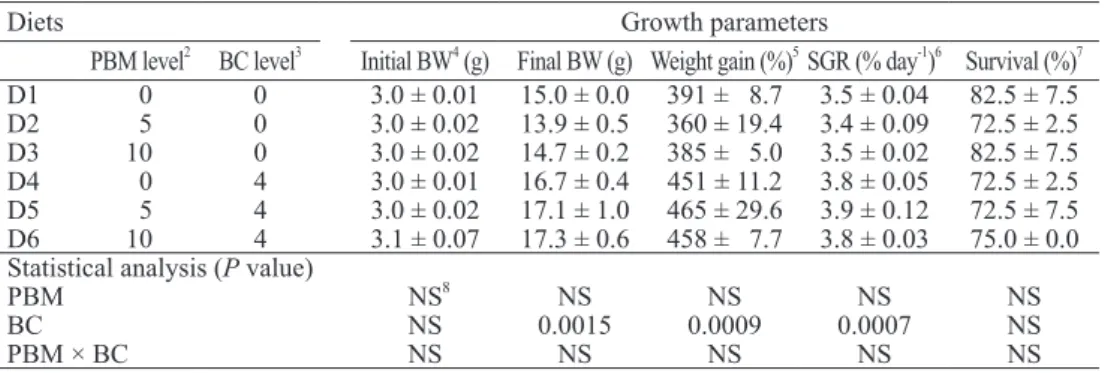
The effect of test diets on growth performance and survival of juvenile amberjack are summarized in Table 2. Mean survival of fish in all the treatments ranged between 72.5% and 82.5% and was not significantly (P > 0.05) affected by the dietary levels of PBM, BC or the interaction between PBM and BC. At the end of the feeding trial, fish attained a weight gain of 360% to 465%. Only BC was a significant factor on weight gain of fish. Significantly higher weight gain was found in fish fed with diets supplementing 4% BC regardless of dietary PBM levels. The highest weight gain was obtained from the fish fed with diet containing 5% PBM and 4% BC levels. Specific growth rate (SGR, % day) of fish followed the similar trend as with weight gain.
Feed utilization
Feed utilization parameters are given in Table 3. Feed intake (FI) was significantly influenced by the inclusion of dietary BC. Although PBM was not a significant factor,
there was a decreasing trend in FI of fish with the increasing level of PBM in diets. Supplementation of BC with PBM significantly improved FI in all the respective groups. Similar effects were also found in the cases of feed efficiency (FE) and protein efficiency ratio (PER). However, no significant interaction was determined between PBM and BC level on feed utilization parameters.
Whole body proximate composition
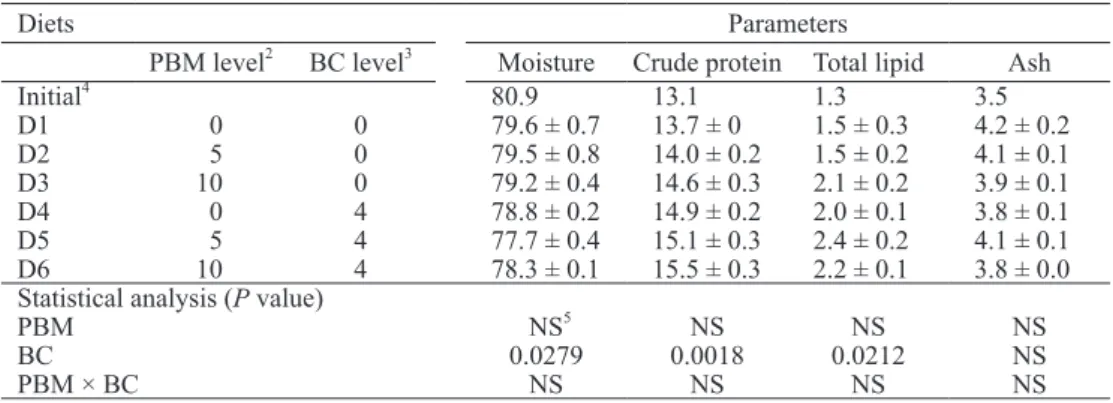
Table 4 represents the whole body proximate analysis of fish. There were no significant effects of PBM or BC on whole body ash content. However, dietary BC was a significant
Table 2. Growth parameters in juvenile amberjack fed test diets for 45 days1.
Diets Growth parameters
PBM level2 BC level3 Initial BW4 (g) Final BW (g) Weight gain (%)5SGR (% day-1)6 Survival (%)7 D1 0 0 3.0 ± 0.01 15.0 ± 0.0 391 ± 08.7 3.5 ± 0.04 82.5 ± 7.5 D2 5 0 3.0 ± 0.02 13.9 ± 0.5 360 ± 19.4 3.4 ± 0.09 72.5 ± 2.5 D3 10 0 3.0 ± 0.02 14.7 ± 0.2 385 ± 05.0 3.5 ± 0.02 82.5 ± 7.5 D4 0 4 3.0 ± 0.01 16.7 ± 0.4 451 ± 11.2 3.8 ± 0.05 72.5 ± 2.5 D5 5 4 3.0 ± 0.02 17.1 ± 1.0 465 ± 29.6 3.9 ± 0.12 72.5 ± 7.5 D6 10 4 3.1 ± 0.07 17.3 ± 0.6 458 ± 07.7 3.8 ± 0.03 75.0 ± 0.0 Statistical analysis (P value)
PBM NS8 NS NS NS NS
BC NS 0.0015 0.0009 0.0007 NS
PBM × BC NS NS NS NS NS
1Values are means of triplicate groups ± S.E.M. (standard error of the mean) . 2Plant by-products mixture.
3Bamboo charcoal. 4Body weight.
5Weight gain (%) = (final body weight – initial body weight) / initial body weight × 100.
6Specific growth rate (%, day-1) = (ln final weight – ln initial weight) × duration / ln initial weight. 7Survival (%) = (final no. of fish / initial no. of fish) × 100.
8No significant difference.
Table 3. Feed utilization in juvenile amberjack fed test diets for 45 days1.
Diets Feed utilization
PBM level2 BC level3 FI (g dry fish-1)4 FE (%)5 PER6
D1 0 0 20.4 ± 1.1 57.5 ± 1.7 1.2 ± 0.04 D2 5 0 19.1 ± 0.3 56.9 ± 2.0 1.1 ± 0.04 D3 10 0 18.6 ± 0.5 62.9 ± 0.6 1.2 ± 0.02 D4 0 4 21.8 ± 0.6 62.8 ± 3.2 1.3 ± 0.07 D5 5 4 21.0 ± 0.4 67.1 ± 3.4 1.3 ± 0.07 D6 10 4 20.0 ± 0.8 70.9 ± 0.1 1.4 ± 0.00
Statistical analysis (P value)
PBM NS7 NS NS
BC 0.0297 0.0048 0.0078
PBM × BC NS NS NS
1Values are means of triplicate groups ± S.E.M. 2Plant by-products mixture.
3Bamboo charcoal.
4Feed intake (g dry fish-1) = (dry diet given – dry remaining diet recovered) / no. of fish. 5Feed efficiency (%) = {weight gain (g) / feed intake, dry (g)} × 100.
6Protein efficiency ratio = weight gain (g) / protein intake, dry (g). 7No significant difference.
factor on moisture, crude protein and total lipid contents. Comparatively low moisture and high lipid and protein contents were found in all the groups received 4% BC level supplemented diets.
Blood parameters
Blood parameters are presented in Table 5. PBM had significant effect on hematocrit and plasma glucose content. Total protein (T-Pro), total cholesterol (T-Cho) and glucose were significantly affected by BC. Moreover, significant interaction was only found in plasma glucose level of fish.
Table 4. Whole body proximate composition (% wet basis) in juvenile amberjack fed the test diets for 45 days1.
Diets Parameters
PBM level2 BC level3 Moisture Crude protein Total lipid Ash
Initial4 80.9 13.1 1.3 3.5 D1 0 0 79.6 ± 0.7 13.7 ± 0.2 1.5 ± 0.3 4.2 ± 0.2 D2 5 0 79.5 ± 0.8 14.0 ± 0.2 1.5 ± 0.2 4.1 ± 0.1 D3 10 0 79.2 ± 0.4 14.6 ± 0.3 2.1 ± 0.2 3.9 ± 0.1 D4 0 4 78.8 ± 0.2 14.9 ± 0.2 2.0 ± 0.1 3.8 ± 0.1 D5 5 4 77.7 ± 0.4 15.1 ± 0.3 2.4 ± 0.2 4.1 ± 0.1 D6 10 4 78.3 ± 0.1 15.5 ± 0.3 2.2 ± 0.1 3.8 ± 0.0
Statistical analysis (P value)
PBM NS5 NS NS NS
BC 0.0279 0.0018 0.0212 NS
PBM × BC NS NS NS NS
1Values are means of triplicate groups ± S.E.M. 2Plant by-products mixture.
3Bamboo charcoal.
4Data were not included in statistical analysis. 5No significant difference.
Table 5. Blood parameters in juvenile amberjack fed the test diets for 45 days1.
Diets Blood parameters
PBM level2 BC level3 Hematocrit (%) T-pro4 T-cho5 Glucose6
D1 0 0 33.5 ± 2.5 3.7 ± 0.1 245 ± 10 103 ± 2 D2 5 0 32.5 ± 0.5 3.1 ± 0.0 235 ± 10 085 ± 7 D3 10 0 29.5 ± 2.5 3.5 ± 0.3 229 ± 16 105 ± 4 D4 0 4 40.0 ± 1.0 4.4 ± 0.1 297 ± 60 100 ± 1 D5 5 4 32.0 ± 1.0 3.8 ± 0.3 264 ± 20 092 ± 6 D6 10 4 32.5 ± 1.5 3.9 ± 0.2 267 ± 20 077 ± 3
Statistical analysis (P value)
PBM 0.0319 NS7 NS 0.0456
BC NS 0.0110 0.0010 0.0478
PBM × BC NS NS NS 0.0297
1Values are means of triplicate groups ± S.E.M. 2Plant by-products mixture.
3Bamboo charcoal. 4Total protein (g dl-1). 5Total cholesterol (IU l-1). 6Glucose (IU l-1). 7No significant difference.
Discussion
The present study demonstrated that supplementation of BC with PBM is effective to improve growth performance, feed utilization, whole body composition and blood parameters of juvenile amberjack. The results are in harmony with previous reports by moe
tHu et al. (2009, 2010) showing that supplementation of BC significantly improved the
performance of Japanese flounder and tiger puffer fish.
At the end of the feeding trial, survival of the juvenile amberjack was not significantly affected (P > 0.05) by PBM, BC or their interaction. Inclusion of PBM had no significant effect on growth performance, feed utilization, whole body carcass composition and most of the hematological parameters of fish. moe tHu et al. (2009) also found that inclusion
of 10% SDBP had no negative effect on the normal growth rate of fish. However, higher inclusion levels might have detrimental effect on the performance of fish as SDBP might contain phenolic compounds since sweet potato storage root have high content of phenolic compounds (YosHimoto et al. 2004). Moreover, moKolensang et al. (2003a, 2003b)
reported that common carp, Cyprinus carpio L. shows better growth performance than the control when fed 4.2% SDBP as dry basis. On the other hand, present experiment showed slightly lower (P > 0.05) growth performance in fish fed with diets supplementing 5 and 10% PBM (SDBP contains at 3.3 and 6.6% respectively on dry matter basis) compared to the diet without PBM. Supplementation of BC with PBM significantly improved growth performance and feed utilization of fish to the extent of being approximately equal to the fish fed high fishmeal based diet (taKeucHi et al. 1992). Several studies reported that growth was
significantly improved by the inclusion of dietary BC in goat (Van et al. 2006), tiger puffer
(moe tHu et al. 2009) and Japanese flounder (moe tHu 2010); wood charcoal in chickens
(Kutlu et al. 2001) and dietary charcoal with wood vinegar in piglets (meKBungwan et al.
2004) and Japanese flounder (Yoo et al. 2005).
Improved growth of fish in BC supplemented groups might be attributed by the increased feed intake in all the respective groups. Charcoal has been used as an adsorbent and detoxifier since long. Previous studies showed activated carbon is effective in removing various mycotoxins such as aflatoxin, ocharatoxin A, etc. (dalVi and ademoYero 1984,
rotter et al. 1989). Natural toxins from plants are also removed or attenuated by activated
charcoal treatment or supplementation (Banner et al. 2000, Bisson et al. 2001). Charcoal
also acts as sequestering agent for some toxins and anti-nutritional metabolites which have detrimental effects on animals (moe tHu 2010). Dietary wood charcoal and vinegar
compound activated the intestinal functions and increased feed efficiency of piglets and chicken (samanYa and YamaucHi 2001, meKBungwan et al. 2004). Activated charcoal not
only binds toxins or organic acids but it also controls pathogenic bacteria (almagamBetoV
et al. 1992) and complexes with phenolics in the gastrointestinal track in order to prevent
hydrosable tannins interfering with enzyme function and protein digestion (murdiati et al.
1991). In the present study, PBM were used which contains two by-products from plant based industries: SDBP and okara. As a distillery product, SDBP might contain some organic acids, polyphenolic compounds, toxins and strong alcoholic smell. It was assumed
that supplementation of BC might adsorbed these noxious substances of PBM which facilitated to increase feed intake, growth performance and feed utilization of fish.
Inclusion of PBM had no significant effects on whole body proximate composition of amberjack. Whole body moisture was decreased; and crude protein and lipid were significantly increased by the supplementation of BC with PBM in all the respective groups. There was a strong negative correlation between the percentages of body lipid and moisture in fish (JoBling 2001). Increased whole body protein and lipid content could be a reflection
of higher feed intake which would also increase the amount of protein and lipid intake and subsequent accumulation in the carcass. Moreover, increased nitrogen retention by BC supplementation might be one of the reasons for increasing carcass protein content of fish (moe tHu et al. 2010). In the present experiment, there was no significant effect on whole
body ash content. Yoo et al. (2005) also found similar results by feeding dietary charcoal
and wood vinegar mixture to Japanese flounder. In contrast, Kutlu et al. (2001) reported
that charcoal increased the mineral retention which ultimately increased the whole body ash content in broiler chicken.
Blood parameters are important tools for the indication of the physiological stress response as well as the general health condition of fish. Blood parameters obtained in the present study are considered to be within the normal range for juvenile amberjack although some variations were found among treatments (iKeda and minami 1982, sHimeno et al.
1992a, 1992b, watanaBe et al. 1998).
Conclusion
The observations in the present study on growth performances, feed utilization, whole body carcass composition and hematological parameters therefore indicated that BC supplementation was necessary for the effective utilization of PBM in low fish meal based diet for juvenile amberjack. The research concluded that 5-10% PBM along with 4% dietary BC in 25% fishmeal based diet could be effectively utilized by juvenile amberjack.
Acknowledgement
The first author would like to thank for the Ministry of Education, Culture, Sports, Science and Technology (MONBUKAGAKUSHO), Japan for the scholarship provided to perform this research.
References
almagamBetoV, K. K., BondarenKo, V. M., gorsKaia, E. M., PaVloVa, L. A., sudzHan, E. V.
and grigor’eV, A. V. 1992. The Prevention of the Translocation of Intestinal Microflora
after the Rescue of an Organism from a Terminal State. Zhurnal Mikrobiologii, Epidemiologii, i Immunobiologii, 5-6: 11-14 (in Russian with English Summary).
aoac 1990. Official Methods of Analysis of the Association of Official Analytical Chemists, 15th ed., 1298 pp., Association of Official Analytical Chemists, Arlington, Virginia, USA.
BaKer, F. S., miller, C. E., rePiK, A. J. and tolles, E. D. 1992. Activated Carbon.
Kirk-Othmer Encyclopedia of Chemical Technology, 4: 1015-1037.
Banner, R. E., rogosic, J., Burritt, E. A. and Provenza, F. D. 2000. Supplemental Barley
and Charcoal Increase Intake of Sagebrush by Lambs. Journal of Range Management, 53: 415-420.
Bisson, M. G., scott, C. B. and taYlor, C. A. Jr. 2001. Activated Charcoal and Experience
Affect Intake of Juniper by Goats. Journal of Range Management, 54: 274-278.
BligH, E. G. and dYer, W. J. 1959. A Rapid Method of Total Lipid Extraction and
Purification. Canadian Journal of Biochemistry and Physiology, 37: 911-917.
BurdocK, G. A. 1997. Encyclopedia of Food and Color Additives, 3153 pp., CRC Press,
Boca Ratton, Florida, USA.
dalVi, R. R. and ademoYero, A. A. 1984. Toxic Effects of Aflatoxins B1 in Chickens Given
Feed Contaminated with Aspergillus flavus and Reduction of the Toxicity by Activated Charcoal and Some Chemical Agents. Avian Disease, 28: 61-69.
iKeda, Y. and minami, T. 1982. Hematological and Hemochemical Assessment on
Streptococcal Infection in Cultured Yellowtail. Bulletin of the Japanese Society of Scientific Fisheries, 48(10): 1383-1388.
JoBling, M. 2001. Nutrient Partitioning and the Influence of Feed Composition on Body
Composition. In: Food Intake in Fish (Eds. HouliHan, D., BouJard, T. and JoBling,
M.), 354-375, Blackwell Science Ltd., Osney Mead, Oxford OX2 0EL, UK.
Kutlu, H. R., unsal, I. and gorgulu, M. 2001. Effects of Providing Dietary Wood (Oak)
Charcoal to Broiler Chicks and Laying Hens. Animal Feed Science and Technology, 90: 213-226.
larocHe, W. A., smitH-Vaniz, W. F. and ricHardson, S. L. 1984. Carangidae: Development.
In: Ontogeny and Systematics of Fishes, Special Publication No.1 (Ed. moser, H.
G.), 510-522, American Society of Ichthyologists and Herpetologists, Allen Press, Lawrence, Kansas, USA.
maHfudz, L. D., HaYasHi, K., iKeda, M., Hamada, K., oHtsuKa, A. and tomita, Y. 1996. The
Effective Use of Shochu Distillery By-Products as a Source of Broiler Feed. Japanese Poultry Science, 33(1): 1-7.
meKBungwan, A., YamaucHi, K. and saKaida, T. 2004. Intestinal Villus Histological
Alterations in Piglets Fed Dietary Charcoal Powder Including Wood Vinegar Compound Liquid. Anatomia, Histologia, Embryologia, 33: 11-16.
moe tHu, KosHio, S., isHiKawa, m. and YoKoYama, S. 2009. Effects of Dietary Bamboo
Charcoal on Growth Parameters and Nutrient Utilization of Tiger Puffer Fish, Takifugu
rubripes. Aquaculture Science, 57: 53-60.
moe tHu, KosHio, S., isHiKawa, m. and YoKoYama, s. 2010. Effect of Supplementation of Dietary
Bamboo Charcoal on Growth Performance and Body Composition of Juvenile Japanese Flounder, Paralichthys olivaceus. Journal of the World Aquaculture Society, 41: 255-262.
moKolensang, J. F., YamasaKi, S. and onoue, Y. 2003a. Utilization of Shochu Distillery
By-Products for Culturing the Common Carp Cyprinus carpio L. OnLine Journal of Biological Science, 3: 502-507.
moKolensang, J. F., YamasaKi, S. and onoue, Y. 2003b. Utilization of Sweet Potato
Distillery By-Products as a Feedstuff for Red Carp Cyprinus carpio L. Journal of the World Aquaculture Society, 34: 512-517.
murdiati, T. B., mcsweeneY, C. S. and lowrY, J. B. 1991. Complexing of Toxic
Hydrolysable Tannins of Yellow-Wood (Terminalia oblongata) and Harendong (Clidemia hirta) with Reactive Substances: An Approach to Preventing Toxicity. Journal of Applied Toxicology, 11: 333-338.
rotter, R. G., froHlicH, A. A. and marquardt, R. R. 1989. Influence of Dietary Charcoal
on Ochratoxin A Toxicity in Leghorn Chicks. The Canadian Journal of Veterinary Research, 53: 449-453.
samanYa, M. and YamaucHi, K. 2001. Morphology Changes of the Intestinal Villi in
Chickens Fed the Dietary Charcoal Powder Including Wood Vinegar Compounds. Journal of Poultry Science, 38: 289-301.
sasaKi, T., aBe, M., naKaYama, S., moriYama, K., taHara, H. and taKita, T. 2005. Novel
Application of Shochu Distillery By-Products to Prohylaxis against Mammary Carcinogenesis Induced by 7,12-Dimethylbenz[a] Anthracene in Rats. Bioscience, Biotechnology and Biochemistry, 69: 1898-1904.
sHimeno, S., HosoKawa, H., Yamane, R., masumoto, T. and ueno, S. 1992a. Change in
Nutritive Value of Defatted Soybean Meal with Duration of Heating Time for Young Yellowtail. Nippon Suisan Gakkaishi, 58: 1351-1359.
sHimeno, S., HosoKawa, H., Kumon, M., masumoto, T. and uKawa, M. 1992b. Inclusion of
Defatted Soybean Meal in Diet for Fingerling Yellowtail. Nippon Suisan Gakkaishi, 58: 1319-1325.
taKaKuwa, F., fuKada, H., HosoKawa, H. and masumoto, T. 2006. Optimum Digestible
Protein and Energy Levels and Ratio for Greater Amberjack Seriola dumerili (Risso) Fingerling. Aquaculture Research, 37: 1532-1539.
taKeucHi, T., sHiina, Y., watanaBe, T., seKiYa, S. and imaizumi, K. 1992. Suitable Protein
and Lipid Levels in Diet for Fingerlings of Yellowtail. Nippon Suisan Gakkaishi, 58: 1333-1339.
teramoto, Y., tatsumi, N., ueda, S. and SHiota, S. 1994. Ethanol Fermentation with Shochu
Distillery Waste and Aromatic Red Rice Bran. Journal of the Institute of Brewing, 100: 65-68.
Van, D. T. T., mui, N. T. and ledin, I. 2006. Effect of Method of Processing Foliage of
Acacia mangium and Inclusion of Bamboo Charcoal in the Diet on Performance of
Growing Goats. Animal Feed Science and Technology, 130: 242-256.
watanaBe, T., aoKi, H., sHimamoto, K., Hadzuma, M., maita, M., Yamagata, Y., Kiron, V.
and satoH, S. 1998. A Trial to Culture Yellowtail with Non-Fishmeal Diets. Fisheries
Yamamoto, M., saleH, F. and HaYasHi, K. 2004. A Fermentation Method to Dry and Convert
Shochu Distillery By-Product to a Source of Protein and Enzymes. Journal of Poultry Science, 41: 275-280.
Yanagita, K., KaJiYama, Y., IKeda, H. and ucHimura, T. 1999. Utilization of Poultry Waste
and Shochu Distillery By-product Fermented with Indigenous Microorganisms as Feed Resources for Pigs and Cattle. Bulletin of the Experimental Farm, Faculty of Agriculture, Kagoshima University, 24: 29-33.
Yoo, J. H., Ji, S. C. and Jeong, G. S. 2005. Effect of Dietary Charcoal and Wood Vinegar
Mixture (CV82) on Body Composition of Olive Flounder Paralichthys alivaceus. Journal of the World Aquaculture Society, 36: 203-208.
YosHimoto, M., Kurata-azuma, R., fuJii, M., Hou, D., iKeda, K., YosHidome, T. and osaKo,
M. 2004. Phenolic Composition and Radical Scavenging Activity of Sweetpotato-Derived Shochu Distillery By-Products Treated with Koji. Bioscience, Biotechnology and Biochemistry, 68: 2477-2483.