The Household Fisheries Management in the
North Coast of Java, Indonesia
著者
TAUFIQ Muhammad, IWAKIRI Shigero
journal or
publication title
南太平洋研究=South Pacific Study
volume
10
number
1
page range
211-234
The Household Fisheries Management
in the North Coast of Java, Indonesia
Muhammad TAUFIQ* and Shigero IWAKIRI*
Abstract
In this study we analyzed the characteristics of household fisheries and their man
agement in the north coast of Java. An urban area (Muara Angke of Jakarta),
semi-urban area ( Pekalongan of Central Java), and rural area (Brondong of East Java) were
included.Household fisheries always face the uncertainty of the catch. Their daily-life de
pends on their catch which could be estimated only through subjective evaluation basedon the long experience of the fishermen and their ancestors.
The north coast of Java serves as the largest market for fish and alternative sources
of income. In reality, however, alternative employment opportunities for fishermen is very limited with the large size population of landless agricultural laborers. The fisher men can not compete with the others, because of their limited skill in other professions. They can reduce some of the uncertainty of income by entering into agreements with each other, usually in relationships among owners, crewmen, and "pengambek" (middle men) which is based on mutual trust.
In household fisheries, the relationship between owners and crewmen is organized around a core of household members or kinsmen. Integration of fishermen's power in
the family group may gain strength in their bargaining position and could improve their
fishing activity and efficiency in business. They will have a better chance to collect their
collateral to obtain formal credit or to interact with other sectors for alternative source of income.
Key Words : Household Fisheries, Ownership of Productive Tools, Peasant Economy,
Source of Income.* The Department of Marine Social Science, Faculty of Fisheries, Kagoshima University, 50-20 Shimoarata
Introduction
Java is an economically powerful island in Indonesia's vast archipelago. Many indus
tries and the major cities are located in this region. The area of Java is only 7% of the
total area of Indonesia, but about 61% (more than 100 million people) of the population
lives there. About 60% of which live near the coast where population densities range
from 650 to more than 1,300 people per km2 (Anonymous, 1986). It is not only the
largest market for fish, but also for alternative employment for fishermen who have
skills in other professions. In 1986, the number of fishermen who operated in the north
coast of Java accounted for about 300,000 people or 22% of the total Indonesian fishermen.Indonesian fisheries are basically small-scale, yet they are a predominant sub-sector
producing about 95% of the total catch. The number of fishermen/fishfarmers engaged
in this sub- sector is nearly two million, together with their families, a total of about sixmillion people depend on fisheries for their livelihood (SOESANTO,1985).
Since the First Five Year Development Plan (REPELITA I) commenced in 1969, the government policy on fisheries has focused mainly to increase productivity of house hold fisheries thus elevating their income and standard of living. Priority was given to small-scale fishermen whose dwellings are located along the coastal area that were well
known as the poorest class of the society.
Several strategies such as extension programs, motorization of fishing boats, fisher ies cooperatives, and fish auction facilities have been successively implemented in the last two decades. A few parts of the programs was successful in some fishing communi ties, but other parts had drastically failed. The main cause of failure was because the
policies were enforced by the western concepts with very litlle modification (Emmerson,
1980), or if any, the modification was based on the knowledge of rural farming sociolo gy. The personal temperament and social behavior of fishermen is considerably differentfrom that of farmers. The difference is based on the nature of primary resources drawn
on, not of basic organization. The farmer, receiving the majority of his crop in bulk at one time, needs more space, while the fishermen's catch is uncertain from day to day. If
the catch is to be stored, it needs more labour and outlay in equipment for its preserva tion. However, their responsibility to do that is usually shouldered by the middlemen.
In addition, according to Mantjoro (1988), fishermen with their high risk and re
latively dangerous livelihood, due to bad weather and unforecastable yield, supposedly
have unstable temperaments and attitudes. On the other hand, farmers with their visible
tangible and relatively stationary life, as well as forecastable yield of their arable land,
might have relatively calm personal and social attitudes. Therefore, any policy or prog ram which was successfully implemented with farmers would not always succeed in a similar degree for a fishing society.
fishing communities and institutions. This is considered to be the main obstacle in the
effort to elevate the standard of living of small-scale fishermen. It must be kept in mind
that the development policy and programs are designed to be implemented through local
organizations and not individual fishermen (Mantjoro, 1988). However, Bilsborrow
(1976) argues that policy makers should consider the importance of household level
analysis, especially if this deals with changing the patterns of economic or demographic
behavior where household decision making is relevant. He also states that it is impera
tive to understand individual behavior to see the interrelated aspects of household deci
sion making.
Household fishery is the primary unit of social organization in the fishing commun
ity. This is not only the basic social unit for most of the economic and social activities,but also the object of the terminal goal of the fisheries development policy. Therefore,
investigation and analysis of the characteristics of the household fishery may be of the
most importance.
Framework of Household Fisheries
1. Definition
According to WOLF (1986), researchers have been careful to recognize that family and household can be different units. In some cultures family and household may be dis
tinctly different groups. Family is defined as a "kinship grouping that need not be local
ized" or a "unit of procreation or of generative reproduction". This is distinguished from household which can be defined as a "task-oriented residence" or a unit "for regenera tive production, for the maintenance of the existing members of a society". Different de finition of household have been adopted such as a co-residential group, an
income-pooling group, a production and consumption unit, and the like. Definitions differ as to whether the basis of household is perceived to be in the realms of production, distribu tion or circulation, i.e., income pooling.
Previous studies in one village in central Java conducted by Geertz (1961) sug gested that nuclear family and household were almost synonymous, forming the basic
unit of village society. However, according to White (1980) nuclear families were not
found to be the predominant form in his rural research. Therefore, it is not assumed that
rural Javanese households in Java are also nuclear families.
In his research, White (1980) used the criterion of the domestic group in order to define household. If people cooked and ate together, they were considered general
though not necessarily total pooling of day-to-day resources, work opportunities and so
cial obligations, even though the individuals concerned may retain separate control of landholdings and other forms of wealth. In his study, household was not necessarily a
co- residential group but a group that shared the budget to some degree.
In this study, household fishery defined in a similar manner to White "as a group of
people who are actively involved fisheries as a source of income, sharing accommoda
tions and resources, particularly the kitchen and food, which is meant to be a proxy for
general consumption and income-pooling". According to IWAKIRI and Ram (1988),
household fishery is one where the production and management of fishery is carried out by the members of the household. The definition of household members used by the Directorate General of Fisheries (DGF) includes non-related persons if they shared the same dwelling and kitchen facilities. These members consist of wife and children as a
nuclear and relatives or extended families such as grandparents, parents and other rela
tives and in several cases they have a servant. This pattern is common on the north coast of Java.
2. Household Fishery as a Peasant Economy
According to FlRTH (1946), the Malay or Indonesian fishing economy has close structural analogies to a peasant economy. In many cases of Indonesian fisheries, the same man may be a farmer at one season of the year and a fisherman at another. Even when people in the two occupations are not identical, farmers and fishermen are often so closely linked by economic and social processes of exchange, intermarriage, common
residence and institutions, and values that they constitute a single unit.
The distribution system of the peasant economy tends to take quite a different form
from that of a capitalistic economy in which institutional wage relationships assume great importance. In a peasant economy, the manner of apportioning the product of the eco nomic process is in some cases not defined in an overt way such as when the producing unit is an individual family; in other cases it may be laid down by definite rules of cus
tom and be quite complex.
The household economy is based upon the household member's production and the putting-out system. Due to declining returns on agriculture, most peasant or semi-proletarianized families turn to part or full-time labor intensive craft production linking to the world market through trade. This development of domestic industry was tied to
internal dynamics of rural artisan households within a context increasingly determined by
market and monetary relationships and by the capitalistic organization of trade, putting-out and marketing. The initial transition to social relations of capitalistic production
occur within the nexus of rural families and merchant capital, not within the first factor
ies of industrial capitalism (Medick, 1976).
According to Iwakiri and Ram (1988), although the society may be referred to as one in transition, a large part of the households is characterized by subsistence produc tion. The subsistence fishery comprises a large part of the production volume which is
members of the household where the labor and productivity vary according to the con sumption requirements of the household and their social obligations. The
artisanal-commercial fishermen are also dominated by household production with employment of
family labor, relatives and friends.
In all cases, the broad principle operates, that units of resources are evaluated and participants receive income directly or indirectly equivalent to their participation in pro
duction. But the difficulty which is recognized in the analysis of a capitalistic economy,
of dividing these equivalents into clear-cut categories of rent, interest, profits and wages. is much greater in that of a peasant economy. Again, inequalities in the possession of capital goods are often leveled out or at least lessened by free borrowing or the exercise of communal rights, on a scale or of a kind not ordinarily operative in a capitalistic eco nomy (Firth, 1946).
Chayanovian theory posits that all principles of capitalistic activities have been
formed in the framework of an economy based on wage labor and seeking to maximize
profit. Nevertheless, a wide area of economic life is based, not on a capitalistic form, but on a non-wage family economic unit. Depending upon the consumer-worker ratio within the family, family members (household members) often must work for long hours with low marginal returns to their labor in order to obtain the means for daily production. While a capitalistic firm might choose to cease production with such low returns, house hold fishery can not entertain such choice because their existence depends on their daily catch. This process of self- exploitation parallels the sociologists term "traditional family values and practices" which may include working long hours for low returns to labor for the good of the collective (domestic unit), assisting kin and neighbours, and mutual
self-help (WOLF, 1986).
As a unit economy, normally the household fishery has a unique conception of pro fitability which is not to search for the highest net profit, but the satisfaction of their needs. Their economic activities depend solely on the work of their own household members. The net income or net produce to be divided for their consumption, capital
formation for raising the fishing potential level and saving.
In capitalistic firms, quantitative evidence of the net profit can be estimated by de ducting from gross product the outlays on materials and wages. While the household fishery proceeds by subjective evaluation based on long experience in the fishing activity of the living generation and their ancestors. Most of the household members are in a position either to work more hours or more intensively, sometimes even both. In calcu lating the household's decision making processes, we must take into account of the in
teraction of a very large number of factors including member size and structure, access to markets and possibility of getting extra jobs in the off-season.
In many cases household fisheries can survive and work better than capitalistic
fishing enterprises, because their business is relatively more diverse adaptive to seasonal
fluctuation of fish catch and prices, they use simple and appropriate technology for their activity, and are more flexible in orientation and resistance to the economic depression.Therefore, capitalistic fishing enterprises can not compete with these businesses because of different motivation (of profit), market and fishing operations.
Characteristics of Household Fisheries
1. Data Sources
The following characteristics of household fishery in some selected fishing communi
ties was obtained from both primary and secondary sources. The primary data was obtained through a questionnaire interview survey in July and August of 1986. One hun dred thirty eight fishermen were surveyed in three coastal regions, namely Muara Angke
(Jakarta), Pekalongan (Central Java), and Brondong (East Java), representing urban,
semi-urban and rural communities, respectively. Out of these samples, 31 were heads of fishing owner household (FOH) and 107 were heads of fishing labor household (FLH).Break down of the samples by area is as follows: 11 FOH and 26 FLH from Muara
Angke, 10 FOH and 53 FLH from Pekalongan and 10 FOH and 28 FLH from Bron
dong. Almost all fishermen sampled in both Muara Angke and Pekalongan were gill net
operators, while in Brondong they operated small seine and gill nets.The secondary data was based on literature survey from research publications, gov
ernment reports and other related documentary materials. Other information was
obtained from discussion with local leaders, and local and central government officers
related to fisheries development.
The focus of the analysis differentiates between owners of boats and tools of pro
duction, who are usually called "juragan" or FOH and the crew, who possess nothing
except the skill to catch at sea, i.e., the "pandega" or FLH. Actually the FOH does not
necessarily possess all the necessary equipment consisting of a boat and fishing equip
ment (including engine) and the FLH is considered to have nothing but his muscles.
There are several steps of economic status based on ownership of productive tools.
The first step represents the FLH with nothing. The second step is the FOH who has a
boat, but no fishing equipment. The third step is the FOH who possesses a boat without
an engine, but almost certainly owns fishing equipment. The highest step is the FOH
who possesses an engine, boat and equipment. In several cases, FOH who possesses
only fishing equipment or an engine are found who would join operations with others orsimply borrow.
2. Member Size of Household Fisheries
Comparison on member size of household fisheries in the three communities
ranging from 3 to 11 persons, and the FLH with an average of 5 members ranging from
1 to 11 persons. This means that all of the FOH (n = 10) had been married and live
together with their families. However, not all of the FLH had been married. Some of
them were still single, but usually they also live together with their families (parent and/
or relatives).
The average members in Muara Angke was 6 members for the FOH ranging from 3
to 9 persons and 4 members for the FLH ranging from 1 to 10 persons. While Brondong
was the smallest with 4 members for both the FOH and the FLH ranging from 2 to 7
persons for the FOH and from 1 to 11 persons for the FLH. The low member size inBrondong is most probably due to the migration of many household members to urban
areas for other jobs.
Results of the DGF survey in 1980, shows that the average household size of fisher
men in the north coast of Java is 5 members for the FOH and 4 members for the FLH.This is lower than for both Muara Angke and Pekalongan, but not too differ from the
household sizes of fishermen in Brondong.
3. Age Groups and Classification of Experience
Age groups and their experience in fishing activity shows that 42% of the FOH are
over 45 years of age compared to the FLH with only 13% for the same age. On the
other hand, 66% of the FLH are under 35 years old compared to 35 % for the FOH
(Table 1). This pattern is similar to the age structure found by the socio-economic survey
in 1980, where 40% of the FOH are above 40 years old compared to only 27% for the
FLH (DGF, 1982).
Age group (years)
Table 1. Age Structure of Head of the FOH and FLH
Muara Angke FOH FLH Pekalongan FOH FLH Brondong FOH FLH Total FOH FLH 1. < 25 11 (43) ' 9 (17) - 1 (4) " 21 (20) 2. 26 - 35 3 (27) 7 (27) 5 (50) 30 (57) 3 (30) 12 (43) 11 (36) 49 (46) 3. 36 - 45 3 (27) 4 (15) 1 (10) 8 (15) 3 (30) 11 (39) 7 (23) 23 (22) 4. > 45 5 (45) 4 (15) 4 (40) 6 (11) 4 (40) 4 (14) 13 (42) 14 (13) Total 11 (100)
Source : Visiting interview (1986) 26 (100) 10 (100) 53 (100) 10 (100) 28 (100) 31 (100) 107 (100)
The FOH have more experience than the FLH and less in urban areas than in
semi-urban and in rural areas. On the average the FOH in Brondong had about 26 years of
experience in fisheries, while 24 years in Pekalongan and 21 years in Muara Angke. The
FOH in Brondong started in fishing activity at around age 15, while in Pekalongan they
started at around 18 years of age and at Muara Angke at 22 years. Most of the FOH in
Muara Angke normally had tried working in other jobs before going into fishing.
However, a lack of skill and strong competition in other jobs brought them back to the
fishery sectors.4. Educational Level
Generally, the educational level of both the FOH and the FLH are low. About 10%
of all samples had never gone to school, 59% dropped out during elementary school,
and only 19% completed elementary school. Of the 9% attended junior high school, and
only 1% completed their study. In Muara Angke 3% of the fishermen completed senior
high school and 24% completed elementary school, it is the highest in the three areas
surveyed. While in Pekalongan none reached senior high school.Generally, the educational level of the FOH was higher than that of the FLH. Of
the FOH, almost 13% had never attended school, usually the older FOH, about 26%completed elementary school, and 3% completed senior high school. While the FLH
who never attended school was only 9%, but those who completed elementary school was only 15%, junior high school 1% and senior high school 1%.Many older fishermen had no opportunity to attend a government school, because
before the independence in 1945, educational facilities were very limited, especially in
rural areas. Since the independence, particularly the past 20 years, educational opportu nities in rural areas has expanded, except for the most isolated fishing communities. However, secondary school are still located in small towns or cities rather than in ruralareas. As a results, fishermen in urban areas such as Muara Angke received a higher
level of formal education than fishermen in semi-urban and rural area such as Pekalon
gan and Brondong.
Due to the higher educational level, the basic literacy of fishermen in Muara Angke is relatively higher than in Pekalongan or in Brondong. The basic literacy of the fisher men affects their aspirations, ability and quickness to innovate, i.e., acceptance and adoption of new fishing technology, and consequently increases their catch and income.
Educated fishermen are able to communicate better with representatives of fisheries de
velopment agencies than those without an educational background. Such an advantage will give them a greater chance to benefit any development programs such as subsidized loans.
5. Occupational Structures
The occupational structure of the families of respondents from older generations to
younger generations are quite different. Most of the older generation appears to have a
stronger interaction with fishermen. Table 2 shows that the occupational structures of
the older generations of the respondents are dominated by fishermen, i.e., 72% of the respondent's father, 68% of his father's relative, 61% of his mother's relatives, 62% ofhis fathers-in- law, 53% of his fathers-in-law's relatives and 67% of his rerpondent's rela
tives were fishermen.
Table 2. Occupational Structure of Family Ties
Relationship Muara Angke Pekalongan Brondong Total
(n) (%) (n) (%) (n) (%) (n) (%) 1 . Father : 37 100 63 100 38 100 138 100 - Fishermen 21 57 47 76 31 82 99 72 - Others 16 43 16 24 7 18 39 28 2 . Relative on the father side : - Fishermen 19 51 48 77 27 71 94 68 - Others 18 19 15 23 8 29 44 32 3 . Relative on the mother side : - Fishermen 17 46 41 66 26 68 84 61 - Others 20 54 22 34 9 32 54 39 4 . Relative on the father in law side :
- Fishermen 10 31 38 70 28 79 76 62
- Others 22 69 16 30 8 21 46 38
5 . Relative on the mother in law side :
- Fishermen 8 25 39 72 18 50 65 53 - Others 24 75 15 28 18 50 57 47 6 . Respondent's relatives : - Fishermen 25 68 51 84 28 76 104 67 - Others 12 32 10 16 9 24 31 23 7 . Respondent's son: - Fishermen 6 33 12 32 13 68 31 41 - Others 12 67 26 68 5 32 44 59 8. Respondent's son in law : - Fishermen 10 46 12 39 10 83 32 49 - Others 12 56 19 61 2 17 33 51
Increasing communication facilities gives the younger generation a better chance to
interact with other sectors. As a result, the proportion of the younger generation bothrespondent's son and son-in-law are working in other sectors is higher than in the fisher
ies sector, particularly in Muara Angke and Pekalongan. Therefore, it can be concluded
that the younger generation of fishermen in both Muara Angke and Pekalongan have
better alternative sources of income than fishermen in Brondong.In Brondong, however, due to the lack of communication and interaction with other sectors, both the older and the younger generations are still working in the fishing sec tor. The occupational structures in the family ties of household members are also re flected by the higher dependency on fishing activities. The relationship among family
members of household fisheries in Brondong appears to be stronger than in both Muara
Angke and Pekalongan. If the family group of household fisheries could improve their fishing activity and efficiency in business, the family ties should be encouraged. If it is
possible, they will have a better chance to increase their collateral to obtain formal bank credit. It is important to improve their business by rearranging their organization, parti cularly in their cooperative business.
6. Dependence on Fisheries and Alternative Sources of Income
All of the sample fishermen had been asked whether fishing is their sole, main, or
minor source of income. Due to the seasonal nature which leads to serious under
employment among many fishermen, particularly in small scale fisheries, the questions
were continued on alternative sources of income.
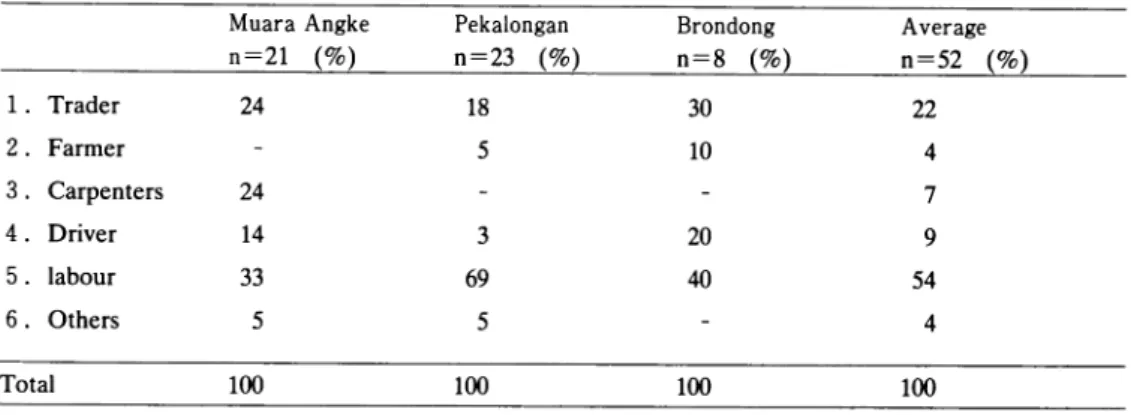
From the total sample, about 46% were full-time fishermen, 49% mainly fishermen and 5% are part-time minor fishermen. The latter groups were mainly traders for Muara Angke and Brondong, or laborers in textile factories (batik) in Pekalongan. The percen tage of full-time fishermen in Brondong was 66%, in Muara Angke 40% and in Pekalon gan only 36%. The percentage of mainly fishermen was recorded in Pekalongan at 62%, while Muara Angke it was 57%, and in Brondong it was 21%. It is due to the alterna tive source of income in Pekalongan is highest followed Muara Angke and Brondong (Table 3).
Table 3. Dependenceof Small Scale Fishermen <Dn Marine Fisheries
Muara Angke n=37 (%) Pekalongan n=37 (%) Brondong n=38 (%) Average n=138* (%) 1. Full-time 40 2. Mainly 57 3. Minor 3 36 62 2 66 21 13 46 49 5 Total 100 100 100 100
The construction or manufacturing industry is the most important alternative source
of income for the mainly fishermen. The importance of labor for mainly fishermen in
Pekalongan accounts for 69%. It is the highest, compared with Muara Angke (33%) and
Brondong (40%). Trading is the second alternative source of income for mainly fisher
men in Brondong (38%), in Muara Angke (23%) and in Pekalongan (18%). Carpentry
is also an important alternative in Muara Angke (24%) while driving in Brondong
(20%). Farming is an inferior alternative both in Pekalongan (5%) and in Brondong
(10%) and none in Muara Angke (Table 4).
Table 4. Alternative Source of Income for Small-scale Fishermen
Muara Angke Pekalongan Brondong Average
n=21 (%) n=23 (%) n = 8 (%) n=52 (%) 1. Trader 24 18 30 22 2 . Farmer - 5 10 4 3 . Carpenters 24 - - 7 4 . Driver 14 3 20 9 5. labour 33 69 40 54 6. Others 5 5 - 4 Total 100 100 100 100
Source : Visiting interview (1986)
During the off-season, almost half of the full-time fishermen had no alternative source of income. In rural communities such as Brondong, this phenomenon was clearly seen. For 72% of the full-time fishermen in Brondong were unemployed, while in Peka longan and Muara Angke only 30% and 33%, respectively. Usually, for their daily-life they depend on their patrons. The activity of full-time fishermen during the off- season is usually repairing nets and boats. For this activity they have additional income, particu larly to the labor fishermen of gill nets in Muara Angke and Pekalongan.
7. Status Mobility in Fishing Activity
Changes of a fishermen's status in the fishing sector affects their share of remunera tion, consequently to their income. Since the remuneration depends upon to the status of the fishermen, the income level of the FOH is always higher than the captain or motorist and the income of the captain or motorist is higher than ordinary crewmen.
From the total sample, about 25% of the ordinary crewmen became captains/motor ist and 13% became owners, while the change from captains/motorist to owners was 6%. The percentage of owners who changed to captains/motorist was 5% and to ordinary crewmen was 4%. The status mobility of ordinary crewmen in Muara Angke was better
than in Pekalongan and Brondong, as 41% of the ordinary crewmen become captains/
motorist and 19% become owners. Change in status from captain/motorist to owners and vice versa stood at 3% (Table 5).
Table 5. Status Mobility in Fishing Activity
Change status Muara Angke Pekalongan Brondong Total
(n=37) (%) (n=62) (%) (n=38) (%) (n=137) (%) 1. OC to CM 15 41 13 21 6 16 34 25 2. OC to OW 7 19 3 5 7 19 17 13 3. CM to OW 1 3 3 5 4 11 8 6 4. OW to CM 1 3 1 2 5 13 7 5 5. OW to OC - - - - 6 16 6 4 6. CM to OC - - - -7. OT to F I - - 27 43 - - 27 20 8. OC to 0 C 8 27 16 25 8 21 31 23 9. CM to CM 2 5 - - 2 5 4 3 10. OW to OW 3 8 - - - - 3 2
Note : OC = Ordinary Crewmen CM = Captain/motorist
OW = Owner OT = Others FI = Fishermen Source : Visiting interview (1986)
Improved status of crewmen in Muara Angke may be related to their higher educa
tional level, so their ability to adopt new fishing technology is better than those in Peka
longan and Brondong. While the decreased status of owners was mainly due to the li mited capability to reinvest and rebuild vessel, engine or gears. Beside this, it is very dif
ficult for them to obtain formal credit due to the lack of collateral.
EMMERSON'S study (1979) in Demak Regency of the north coast of Central Java shows that the larger scale and more modern businesses in the form of boats, equipment and number of crew, the smaller net percentage obtained by the crewmen (whether the crewmen has a special task as a captain the ordinary crewmen). To be exact, crewmen who usually work on stationary lift net has an income of 25% of the net income, 17% in
gill net with small boat, 8% in trawl net with medium sized boat, 4% in seine net with a
large boat, and only 2% in mini purse seine with a large boat. Nevertheless, this should
present no problem, because production is usually increased as a result of modernization
so as to increase the income of the crew, even though percentage share is reduced. For instance, when the crew moves to a large motorboat equipped with a mini purse seine, the net income may increase by 12.5 times. Motorization and modernization of the equipment of small boats also requires multiplication of net income to the crew. While the process of change is similar to the process of modernization resulting in
mechaniza-tion and efficiency (economic scale); things which very often are desired by development planner as well as the fishermen themselves.
Household Fisheries Management
1. Organization of Household Fisheries
It is well known that household fisheries have a unique conception of profitability which does not search for the highest net profit, but to satisfy the needs of the house hold members. Therefore, modernization of boats does not necessarily mean decreased
crews. Indeed if the boats become larger, the crew might increase by one or two, for in stance, a motorist or a vice captain. Also motorization of small or medium boats does not push away manpower from the boats. Sometimes as a result of social pressures, members of the FOH/FLH are also included, even though they serve no special purpose. There are many types of relationship between owners and crewmen. Particularly in the small scale fisheries, this relationship is organized around a core of household mem bers or kinsmen. A few cases consist primarily of friends and non-kinsmen. Where crews are composed mainly of household members or kinsmen, it is typical that the boat own ers are granted great flexibility in recruiting them. Gladwin (1970), notes that crew built around cores of kinsmen are more stable than crews without kin linkages. Howev er, LOFFGREN (1972), emphasized the great 'shock absorbing' capacity of family fishing firm faced with uncertain, fluctuating incomes, problems obtaining crews and difficulty obtaining capital.
In some cases in Muara Angke, Pekalongan, and Brondong, the FOH and FLH are joint ownerships and/or operations with their families are observed among FOH and FLH For example, one FOH in Pekalongan explains that he and his eldest son are joint
owners of a gill net. His son have married and received money from his father-in-law as
starting capital for equipment. Help to the son-in-law may take the form a gift to the daughter. This father-in-law is a captain of gill net boat and previously, his son-in-law is an ordinary crew member of it. Due to the existence of a new fishing unit, the status of his eldest son changes from an ordinary crew member to a captain. Although, the vari able cost of operation are paid by him, the handling cost and selling of the fish are man
aged by his eldest son's wife.
Usually, there is a clear-cut division of labour between men and women. All activi
ties at sea are regarded as men's work, and almost all dealings with fish on shore are women's work. Once ashore, the men usually go home to sleep, leaving the handling of the fish to women. On land, men would only take charge of maintenance and repair of
2. Financing of the Fishing Operation
In fact, it is very hard to find real data on cost of fishing operation. To collect
adequate cost and earning data from a household fishery is a time-consuming and labo rious task, because their activity in a year is uncertain in term of both their catch and
gear used. On the other hand, when interviewing fishermen it was found that almost none of them had recorded any of their costs and earning data. It is very difficult for them to estimate cost and earning due to the uncertainty which depends upon season and fluctuation of fish price and catch.
In addition, average cost data cannot be used to represent the typical capital invest ment existing in small scale fishery because of the wide variability of cost. Capital invest ments for vessel, engine and nets (if any), or other materials used are inconsistent.
Variation in catch depends on the number of fishing trips made and stock availabil ity. The more frequently fishing trips are made, the more profitable it will be, even-though, this will result in an increase of operating cost, especially for fuel. However an upward trend of the price of fish ensured an increase in the total gross earning.
Based on interviews and a University of Indonesia's analysis (1986), the cost and earning of gill net boats of less than 5 gross tons in Muara Angke, Pekalongan and Brondong shows that proportion of estimated cost component in Pekalongan is very
different from those in both Muara Angke and Brondong. Operating cost in Pekalongan
is considered to be fixed and is estimated at about 30% of gross earning. This estimation depends upon the agreement between captain and owners. In other cases, fixed costs amount for 25% to 35% of the gross earning. While in Muara Angke and Brondong, fixed cost account for 7% and 6% respectively and usually included the owner's share. Labor cost in Pekalongan is the lowest and is estimated at only 27% of gross earning. While Muara Angke and Brondong are estimated for 43% and 53% respectively (Table 6).
Because of the high price of the boat, engine and fishing equipment, it stands to
reason that the owner is assisted in paying for it. Therefore, the owner receives a share
of 50% if his boat is large, or 40% - 50% if his boat is small, of the total net income. Gradually, as a result of this large share, the owner is expected to be able to for his in vestment. Sometimes, fuel and repair cost are deducted from the gross income before the sharing is made. This means that the working capital is partly paid by the crewmen. And later on when the owner's debt is paid, he can go on enjoying the 40% - 50%
share.
3. Earning Distribution
Measurement of the profit should take account the share system used between crew men and the owner, since this system varies between type of gear and location and
Table 6. Estimation of Annual Cost and Earning for Gill Net Fishing with less than 5 GT Boat
unit '. Rp. X
1000,-Earning, cost and Muara Angke* Pekalongan Brondong profitability (Rp.) (%) (Rp.) (%) (Rp.) (%) 1 . Gross earning 20,554 16,738 14,720 2 . Fixed cost : 1,155 7 3,690 30 695 6 - depreciation 680 4 3,013 25 496 4 — interest 475 3 677 6 199 2 3 . Variable cost : 14,699 93 8,609 70 11,110 94 - operating cost 7,231 50 4,710 38 4,865 41 - labor cost 6,768 43 3,899 32 6,245 53 4. Total cost 15,854 100 12,299 100 11,805 100 5. Net profit(l-4) 4,700 4,440 2,916 Profitability (5/1) 30 % 36 % 25 %
Note : * adapted from Universitas Indonesia (1986) Rp. = Rupiah (unit of Indonesian money)
Source : Personal interview (1986)
number of shares are fixed even though the price of fish change. Therefore, variations in catch price and share ratio directly affect the profitability of a fishing operation. Another phenomenon affecting earnings of fishermen is the seasonality of fishing activity arising from the monsoon period, particularly for those operated without boat or use boat with
out engine.
Generally, the proportion of share between owner and crewman is half and half.
Share distributions among crewmen also differ, depending on their respective functions. A captain usually receives a half to two shares more than ordinary crewman. In Muara Angke, a captain receives one share more than ordinary crewman, while in Pekalongan
he receives a half share more and in Brondong two shares more.
The sharing system for seagoing and non-seagoing vessel owners is also slightly different. Seagoing owners normally lead the crew and perform other useful tasks. While non-seagoing owners in Pekalongan usually employ a family member to be a manager to handle operating costs and the selling of fish.
Economic Circumstances of Household Fishery
1. Structure of Fish Marketing
The marketing of fish in Muara Angke, Pekalongan and Brondong is a complex issue involving a chain of activities from the fish landing to the consumer. The marketing chain is predominantly controlled by middlemen who determine the quality and price of the fish. This is a serious problem by itself where fishermen are always at the mercy of the middlemen. A more acute problem of fish marketing prevails in remote small loca tions such as Brondong where fishermen have to preserve their catch (salting, drying, or
boiling) before they can sell their catches. This is due to a lack of ice and transportation
or a distribution system of fresh fish directly to commercial centers. As a result, the
fishermen tend to receive a lower price for their catch. This situation will keep the fishermen in constantly low financial state. Apparently, poor handling and processing of the catch decrease the value by the middlemen, while they take considerable profit from the whole business.
Middlemen, as they are more respectable, enter the scene as an economic and social
buffer between the fishermen and fish merchant. Initially they take a payment in fish from the fishermen and chase after the merchant for service rendered mainly through
auctioning. Gradually, however, they begin to perform the role of financiers to fisher
men. The advance money for buying craft and gear or for immediate consumption, to avail themselves of this, fishermen have to pledge to sell their fish only through the mediation of this financier. The fishermen thus lose their independence to sell their fish through any auctioneer on the shore. They are thus not even sure of a 'fair price'. Even if fishermen are not tied down to any middlemen, they constantly face the possibility of being cheated by the middlemen. The initial fish sale on the beach is on a partial pay
ment and partial credit basis. Recovery of the latter part is always a problem. The mid dlemen always say they incurred losses and expect the fishermen to share the burden.
The price levels on the shore are generally low. The high perishability of the pro
duct and a lack of organized infrastructure facilities at the command of the fishermen
put them in a very weak bargaining position. The fishermen whose labour power is what
really has created the value, is subjected to a process of systematic deprivation of a fair
return for their produce. Except in these cases where members of the fishermen's family sell the catch directly to local consumers, both fresh and processed fish typically change
hands several times between landing site and point of retail sale.
Often overlooked are risks borne by middlemen, who give loans to fishermen de manding only little collateral, and without strict repayment plans that characterize bank
fishermen to the middlemen. Furthermore, the success of fishermen-middlemen rela
tionship is based on mutual trust. Agreements are rarely broken because of thoughts ab
out the future, since most fishermen believe the repercussion of defying an agreement
could be more painful than the short-run gains accruing to fishermen who defaults.
In addition, motivations for lending by fish traders are not, on the whole, for the
extortion of a high interest rate but mainly for the specific purpose of securing regular
supplies of fish and for ensuring a continued business relationship. Very few traditional
small-scale fishermen seriously complain about this, since they realize the value of the
system to them. Their landings are generally too small to give employment to more than
a few traders, and fishermen themselves are too exhausted once they reach the shore to
search for fish buyers (Lawson 1984).2. Credit Facilities
The fundamental characteristic of the source of credit for household fisheries on the
north coast of Java is the important position of a "pengambek" (middlemen) as a pro
vider of capital. Many FOH are in fact deeply in debt to "pengambek" who lend them a
part of the capital needed. The "pengambek" usually not only provide capital for build
ing a boat and buying an engine or fishing equipment, but also act as a broker for selling
the fish. By combining these functions, the "pengambek" occupies a strategic position in
the coastal fishing communities. The interest rates of credit from "pengambek" range
from 2% to 15% per month and the loans are all short term.
It is frequently stated that fishermen are not free to determine their own marketing
outlets since they are tied to a "pengambek". Most fishermen, are forced to borrow money for consumption purposes during the off-season, but the incidence of debt is
highly seasonal and much consumption credit may be given by shopkeepers and general
traders, not connected with the fishing industry. The necessity for short-term finance
which is small in amount and frequently needs to be given at short notice is characteris
tic of all societies where production is small scale and seasonal, and no alternative source of income is available. Since most borrowing is undertaken within the traditional sectoritself and is based on mutual trust and respect between members of the community.
However, there are few bad debts encountered. Those responsible for giving credit or
making loans generally know exactly how much they can safely give. To replace this sys
tem with institutional lending would be costly, risky, cumbersome, and would probably
also slow down the lending process by the introduction of bureaucracy (Lawson, 1984).
The complicated documentation and collateral required by formal credit sources are
disincentives to potential borrowers. Institutional credit policies which incorporate as
many desirable characteristics of formal lending as possible, are likely to be most effec
tive in servicing household fishery's needs. At the present, there are five institutional
credit programs for small scale fisheries: small investment credit, working capital credit,
in-terest rates of the loans average 12% per year which are well below the commercial bank rates of 18-30% for loans of relative size and risk.
3. Fisheries Village Cooperative Unit
The Koperasi Unit Desa Mina (KUD Mina) or Fisheries Village Cooperative Unit is a local cooperative unit which is encouraged by the government to provide the basic facilities. These facilities include the provision of credit, supply of technical equipment, and provisions for the marketing and processing of fishery products.
As a local unit, KUD Mina is supported by the villagers themselves. For a KUD Mina to exert a stimulating economic influence, its operational area should be sufficient ly large, and therefore it usually comprises the territory of a sub-district (Kecamatan). Until now, there are more than 15 government agencies involved in the establishment of KUD Mina. Each department or agency has it's own tasks relating to their responsibili ties. For example, the Ministry of Cooperatives is responsible for the overall organiza tion and management of KUD Mina. The Ministry of Agriculture, through the Directo rate General of Fisheries is primarily charged with matters of technical implementation. While grants and other financial payments are extended by the Ministry of Finance or the Bank of Indonesia through the Bank of Indonesian People (BRI = Bank Rakyat In donesia) or Cooperative Bank of Indonesia (BUKOPIN = Bank Umum Koperasi In donesia). Ideally, their services should be worked out in close coordination and coopera
tion.
KUD Mina involved in fisheries credit was greatly enhanced after the mass guidance pattern fishery credit (Bimas Fishery Credit) was created in 1980, entitling only coopera tives to obtain credit. This arrangement substantially helped to strengthen the coopera tive movement by encouraging fishermen to seek cooperative membership and dis couraging them from seeking loans from money-lenders. There is no doubt that the establisment of KUD Mina is one of the possible ways of mobilizing rural savings. It is anticipated that KUD Mina might in the long run stimulate savings and capital forma tion in fishing villages. In addition, the role of KUD Mina in the provision of credit is to act as an intermediary agency between the fishermen and the government bank which
extends the credit.
Running the fish auction by KUD Mina is to ensure the reimbursement of credit. It is stipulated that lenders of credit sell their fish through the fish auction. Repayment and interest will be subtracted from the proceeds and the amount of repayment is not speci fied but must be fixed on the basis of mutual agreement between KUD Mina and the
fishermen concerned.
Repayment and interest rates for credit should be distinguished from the expenses that are charged by KUD Mina for its services as an intermediary agent in the marketing of fish. These expenses are known as "retribusi" which is based on a percentage of the selling price, depending upon the provincial government's regulation. "Retribusi" in
KUD Mina Jaya Muara Angke was 5%, i.e., 3.5% from fishermen who sell their fish through the fish auction and 1.5% from the buyer. "Retribusi" in KUD Makaryo Mino Pekalongan is higher at 8%, i.e., 5% from fishermen and 3% from fish traders. While in KUD Mina Tani Brondong, "retribusi" only 3.5% and all of this is from the fishermen.
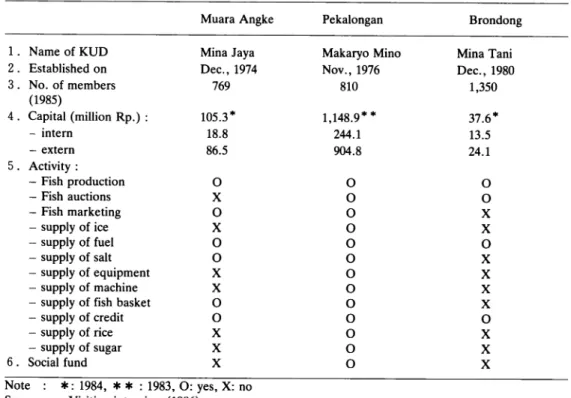
From the general performance of KUD Mina in Muara Angke, Pekalongan and Brondong, as presented in Table 7, the activities of the KUD Makaryo Mino Pekalon gan are relatively better than both KUD Mina Jaya Muara Angke and KUD Mina Tani Brondong. Almost all the basic needs of the fishermen in Pekalongan are provided by KUD Makaryo Mino, for instance fishing equipment, engine, ice, fuel, salt, rice, sugar,
fish baskets, credit facilities, social funds, etc. KUD Mina Jaya Muara Angke only pro
vides fuel, salt, fish baskets and credit, while in KUD Mina Tani Brondong only fuel,
and credit.
Table 7. General Performance of KUD Mina
Muarai Angke Pekalongan Brondong
1. Name of KUD Mina ^Faya Makaryo Mino Mina Tani
2. Established on Dec, 1974 Nov., 1976 Dec, 1980
3. No. of members (1985) 769 810 1,350 4. Capital (million Rp.) : 105.3* 1,148.9** 37.6* - intern 18.8 244.1 13.5 - extern 86.5 904.8 24.1 5. Activity : - Fish production O O O - Fish auctions X 0 O - Fish marketing o o X - supply of ice X o X - supply of fuel o o o - supply of salt o o X - supply of equipment X o X - supply of machine X o X
- supply of fish basket o o X
- supply of credit o o o
- supply of rice X o X
- supply of sugar X o X
6. Social fund X o X
Note : *: 1984, * * : 1983, O: yes, X: no Source : Visiting interview (1986)
Discussion and Summary
From the three selected fishing communities differences in performance between the FOH and the FLH were determined. Generally, the FOH tended to be older than the FLH. Bailey (1987), argues that higher proportions of the FLH are still in their
child rearing years. Moreover, on an average the children of crewmen are likely to be younger than those of owners. This is a factor of particular importance regarding male
offsprings who in their middle adolescence often begin their careers as fishermen and
contribute their earnings to the household economy (MUBYARTO et.al., 1984). A fisher men who marries at age 20, for example, will be in his mid- to late thirties or early for ties before he will have a son able to join him at sea. It is at this stage in a household's development when increasing income makes investment in boat and gear, practically
enabling some fishermen to shift form the status of crewmen to owner.
Educational level of the FOH is relatively higher than that of the FLH and the basic
literacy rate of fishermen in urban areas is relatively higher than that in semi-urban or
rural areas. Before the independence of the country in 1945, many older fishermen had
no opportunity to attend a government school due to the limited educational facilities
which were concentrated only in urban areas. Since independence, however, particularly over the past 20 years, educational opportunities had been expanded not only in urban
area, but also in rural areas.
Improved status of crewmen in Muara Angke may be related to their higher educa
tional level, so their ability in adopting a new fishing technology is better than those in Pekalongan and Brondong. While the lowering of status of owners is mainly due to a li mited capability to reinvestment in vessel, engine or gear. Besides this, it is very difficult for them to obtain formal credit due to a lack of collateral.
In many cases, the educated fishermen are able to communicate better with repre sentatives of fisheries development agencies than those who have no educational back ground. Such advantage will give the former a greater chance to be benefit from any de velopment assistance program such as subsidized loans to expand their business. Accord ing to FAWUMI (1983), education also affects people's aspirations to seek alternative opportunities outside the fishing industry, if and when they possess the skills that can be
gainfully utilized in other sectors of the economy. A realization of such dreams will limit
the number of recruits into fishing, thereby, reducing potentials for overfishing and in creasing the share of catch to the fishermen remaining.
Due to limited alternative sources of income in rural areas, fishermen in Brondong have a relatively higher dependency on fisheries. There are plenty of alternative sources of income in urban areas. However, dependency on fishery in urban area is also relative ly high (in Muara Angke about 41%). It might be due to a lack of skill and the fisher
men's ability to compete with other urban laborers.
According to COLLIER et.al., (1982) alternative employment opportunities for
fishermen in Java are limited because of the large number of landless agricultural labor ers. Since out- migration from this communities is increasing due to population pressures and the introduction of new rice production technology which limits employment oppor
tunities. The implication to the fisheries sectors are:
1. there are few alternative employment which can lead to the existence of 72 % full-time fishermen in Brondong, 33 % in Muara Angke and 30% in Pekalongan;
2. number of fishermen, particularly in small scale fisheries are increasing as skill and
capital requirements are minimal; and
3. fisheries resources are becoming increasingly scarce due to the result of a combination
of several factors such as irrational exploitation of the resources, pollution and de gradation of the environment in coastal areas.
Nevertheless Emmerson (1979), argues that as a result of decreased yield because of competitions and over exploitation of the resources on the north coast of Java, the
small fishermen who are considered as a surplus have to leave the fishery. So it is not quite a realistic hope that the fishing industry could absorb the surplus of manpower in agriculture. Indeed the opposite is true; if the fisheries are really to be modernized, so that it becomes capital intensive, the government will have to create work opportunities on land to accommodate the surplus manpower from the coast. Or they have to transmi grate to the coasts of Kalimantan, Sulawesi and the other islands to the east.
Increasing dependence on fishing, may also cause the introduction of improved
boats and gear which are designed to increase the effective fishing range and choice of
available target species. Insofar, as these development are successful in reducing season
al limitations in catch, they will reduce the need for secondary employment during the
off season and encourage full-time rather than part-time fishing. Moreover, the relatively
large capital investment in such new fishing units compared with existing boat and gear
will also favor occupational specialization. Those fishermen who invest in new boat andgear tie up a large proportion of their financial resources which are no longer available
for other economic activities (Bailey 1987).On the other hand, economic and social relationships with other areas are fairly
common, since many families have had kinship or marriage connections in the last few generation. In addition, relationships arise primarily through the movements and the re
quirements of the fishermen. These relationships are opening their chance to provide an
extra income to the community and facilitate the acquisition of boats of different types
or of superior build and the spread of improved fishing techniques. FlRTH (1946),
pointed out that the economic life of fishermen in coastal areas is not static andself-contained; market relationships with the outside world are frequent and complex, and
the economy of the community depends on them.
The organization power of fishermen may constitute the basic problems for develop
ment of household fisheries on the north coast of Java. If it is true, integration power of
family group may gain strength in their bargaining position and could could improve
their fishing activity and efficiency in business. It is important to improve their business
by rearranging their organization particularly in their cooperative business. Through
their organization they will have a better chance to increase their collateral to obtain for mal bank credit from the government's facilities or to interact with other sectors for alternative sources of income.
The organization of household fisheries should be made for a more equitable dis
tribution of material and non-material benefits of production, and for greater equality in
access to services and social security. Moreover, household fishery's organization could
be an instrument for promoting a balanced regional development policy with the parti
cipation of a large number of household members in the development process, including
a relevant decision-making process.
Acknowledgments
We are grateful given to Mr. Muslimin Nasution, Head of the Agency for Coop
erative Research and Development (ACRD), Ministry for Cooperatives the Republic of
Indonesia for his financial support and recommendations. We also extend our thanks to
Mr. Darwin L. Harianja, a staff member of the ACRD, Mr. Prayudi at the KUDMina Jaya Muara Angke, Mr. RiYANTO, Mr. Setiaji Lawi and Mr. Tasmad ILYAS at
KUD Makaryo Mino Pekalongan, and Mr. Soewardi OELONGGONO, Head of the
Fisheries Services of Brondong for their kind cooperation in data collection. And lastly
we thank Dr. Chikashi KATAOKA and Dr. Yoshiaki MATSUDA for their constructive cri
ticism and help in preparing this manuscript.
References
ACHESON, J.M., 1981. Anthropology of Fishing. Ann. Rev. Anthropol. 10: 275 - 316
ANONYMOUS, 1986. Statistical Yearbook of Indonesia. Central Bureau of Statistics.
Jakarta.
Bailey, C, 1987. Social Consequences of Excess Fishing Effort. RAPA Report. FAO
the United Nations. Bangkok.BlLLSBORROW, R., 1976. Population in Development Planning: Background and Bib
liography. Technical Information Service, Carolina Population
Center. Chapel Hill, N.C.: University of North Carolina.
CHAYANOV, A., 1966. The Theory of Peasant Economy.(Ed. THORNER, D.,
KARB-LAY B., and SMITH, R. Homewood, III.). American EconomicAssociation (original 1923)
Collier, W.L. et.al., 1982. The Acceleration of rural develop- ment on Java: from vil
lage studies on a national perspective. Occasional Paper No. 16,
Rural Dynamics Study, Agro-Economic Survey, Bogor.Directorate General of Fisheries (DGF), 1982. Results of a Socio-economic Survey of
Marine Fisheries of The north coast of Java, 1980. DGF, Ministryof Agri- culture, Jakarta.
, 1984. Fisheries Statistic of Indonesia, 1982. DGF, Ministry of
, 1986. Fisheries Statistic of Indonesia, 1984. DGF, Ministry of
Agriculture, Jakarta.
Emmerson, D.K., 1979. How to Raise the Standard of Living of the Poor in Coastal Village. Temporary material of consideration presented to the Provincial Area Development Program, Central Java, Semarang. , 1983. Rethinking of Artisanal Fisheries Development: Western
Concepts, Asian Experience. World Bank Staff Working Paper No. 423. The World Bank Washington D.C.
Fawumi, J.S., 1983. Coastal Fisheries Management in Nigeria : A Bio-Economic Analy sis of the Bonny Artisanal Canoe Fishery. Doctor thesis. Michigan State University.
Firth, R., 1946. Malay Fishermen: Their Peasant Economy. (2nd edition) Hamden CT: Archon.
Geertz, H., 1961. The Javanese Family. New York: The Free Press of Glencoe.
Gladwin, H., 1970. Decision Making in the Cape Coast (Fante) Fishing and Fish Marketing System. Ph.D thesis. Stanford Univ. California.
Hart, G., 1985. (Forthcoming) Power, Labor and Livelihood Process of Change in Ru
ral Java. Berkeley: Universit of California Press.
Iwakiri, S. and Ram, V., 1988. Types and Activities of Small Fishing Economies in the South Pacific, A case study of Fiji. Mem. Fac. Fish. Kagoshima
Univ. Vol. 37, pp 57-96 (1988).
Loffgren, O., 1972. Resorce Management and Family Firms: Swedish west coast
fishermen. In North Atlantic Fishermen: Anthropological Essays
on Modern Fishing. Ed. R. Andersen, C.Wadel. pp. 82-110. St. Jhons. Mem. Univ. Newfoundland Inst. Soc. Econ. Res.
Lawson, R., 1984. Economics of Fisheries Development. Frances Piter (Publishers),
London.Mantjoro, E., 1988. Social and Economic Organization of Rural Japanese Fishing
Community as case of Nomaike. A Study conducted under the cooperation of the Japan Foundation, Samratulangi University, Indonesia and Kagoshima University, Japan.
MEDICK, H., 1976. "Proto-Industrial Family Economic: The Structure and Function of Household and Family during the Transition from Peasant Society
to Industrial Capitalism Social History 3:291-315.
Mubyarto, SUTRISNO, L. and Dove, M., 1984. Nelayan dan Kemiskinan : Studi
eko-nomi antropologi di dua desa pantai. Diterbitkan untuk Yayasan
Agro Economika, CV Rajawali, Jakarta.
Soesanto, V., 1985. Indonesia Small Scale Fisheries Development. South China Sea
Fisheries Development and Coordinating Programme. Manila.
SCS/85/WP/22.
Pembi-naan dan Pengembangan Usaha Perikanan Koperasi Mina Jaya, DKI Jakarta. Lembaga Managemen Fakultas Ekonomi,
Universi-tas Indonesia, Jakarta.
White, B.N.F., 1980. Rural Household Studies in Anthropological Perspective in Rural Household Studies in Asia. (Ed. Hans B., Robert E. E. et.al.) Singapore: Singapore University Press.
WOLF, D. L., 1986. Factory Daughters, Their Families, and Rural Industrialization in Central Java. Ph.D thesis. Cornell Univ. America.