Comparative Biochemical Studies on Carotenoids
in Aquatic animals
著者
TANAKA Yoshito
journal or
publication title
鹿児島大学水産学部紀要=Memoirs of Faculty of
Fisheries Kagoshima University
volume
27
number
2
page range
355-422
別言語のタイトル
水産動物におけるカロテノイドの比較生化学的研究
Vol. 27, No. 2, pp. 355-422 (1978)
Comparative Biochemical Studies on Carotenoids
in Aquatic animals*1
Yoshito Tanaka*2
Abstract
The distribution of carotenoids in aquatic animals, crustacean, fresh-water red fish, marine red fish, sea sponge and starfish were confirmed in order to elucidate their metabolic pathways to their main carotenoids.
During identification of these carotenoids, three new carotenoids were isolated and their
structural formulae were proposed. Two were isolated from Tedania digitata and Tethya amamensis, and their structures were proposed to be 3-hydroxy-7, 8-didehydro-^S, %-carotene and 3, 4-didehydro-£, ^-carotene. The other new carotenoid, an astaxanthin-like pigment, was isolated from Onihitode, Acanthaster planci, and its structure was established to be 7, 8-didehydro-astaxanthin.
In these aquatic animals, the most abundant pigment is astaxanthin, which is the main
substance of their coloration. Therefore, the present investigations were undertaken to
pursue the biochemical pathways to astaxanthin through the distributions of carotenoids in tissues and feeding tests applying various kinds of carotenoids.
In these studies, it was found {hat aquatic animals could be classified into three types based on the biochemical oxidation pattern of carotenoids.
I. Prawn-type carotenoid oxidation: Most of crustacean belong to this type. They can oxidize carotenoids at the 3- and 3'-positions of £-ionone rings with oxo groups at the 4- and
4'-positions, and also at the 4- and 4'-positions of 0-ionone rings with hydroxy groups at the
3- and 3'-positions. This implies that they can convert ^-carotene, canthaxanthin and zeaxanthin to astaxanthin. Therefore, crustacean should be fed diets supplemented with
^-carotene, canthaxanthin, or zeaxanthin for preventing the fading of their coloration. II. Goldfish-type carotenoid oxidation: Most of fresh-water red fish in Japan belong to
this type. They can oxidize carotenoids at the 4- and 4'-positions of /9-ionone rings with
hydroxy groups at the 3- and positions, but can not oxidize carotenoids at the 3- and
3'-positions of £-ionone rings with oxo groups at the 4- and 4'-3'-positions. They can convert
zeaxanthin and lutein to astaxanthin, but not canthaxanthin and ^-carotene. Therefore, these fresh-water red fish should be fed diets mixed with either zeaxanthin or lutein for main taining or restoring their bright red color.
III. Sea bream-type carotenoid oxidation: Most of marine red fish belong to this group. They cannot oxidize carotenoids at the 3- and 3'-positions of ^-ionone rings with oxo groups at the 4- and 4'-positions, and also at the 4-and 4'-positions of jS-ionone rings withhydroxy groups at the 3- and 3'-positions. They cannot convert ^-carotene, canthaxanthin, or zeaxanthin to astaxanthin. They can only transfer zeaxanthin, lutein, canthaxanthin, and astaxanthin from feed to their own tissues. Therefore, astaxanthin should be supplemented
to their diet for maintenance of color or improvement of faded color during culture.
*l Dissertation for Doctor of Agriculture (Kyushu University).
*2 Laboratory of Marine Biochemistry, Faculty of Fisheries, Kagoshima University, Kagoshima,
In porifera, sea sponges could be divided into two groups; one group is unable to oxidize carotenoids as exemplified by Tethya amamensis, but the other is capable of oxidation. In the latter group, Haliclona permollis can be included, and this sponge was presumed to have the ability to oxidize the 4- and 4'-positions of £-ionone rings with hydroxy groups at the
3- and 3 '-positions.
One of the echinoderms, Onihitode, Acanthaster planci, appears to belong to organisms with
Prawn-type carotenoid oxidation, because its distribution of carotenoids was similar to that of tigar prawn.
In the course of the studies described above, it was found that Micro-Cel C has a certain catalytic hydroxylation of ^-carotene and can produce isocryptoxanthin with slight amounts of isozeaxanthin and echinenone. This forewarns investigators engaging in the study of
carotenoid chemistry.
Contents
Page
I. Introduction 356
II. Extraction, purification and identification of carotenoids from aquatic animals 358
II—1. Extraction of carotenoids 358
II—2. Saponification of the extracts 359
II—3. Purification of carotenoids .. 360
Special caution concerning hydroxylation of ^-carotene due to Micro-Cel C.... 360
II-4. Identification of carotenoids 363
II—5. Quantitative determination 366
III. Carotenoid distribution in aquatic animals 366
III-l. Crustacea 367
III-2. Fresh-water red fish 370
III-3. Marine red fish 372
III-4. Porifera 375
III—5. Echinodermata 392
IV. Metabolic pathways of carotenoids in specialized aquatic animals 397
IV-1. Crustacea 398
IV-2. Fresh-water red fish 405
IV-3. Marine red fish 409
IV-4. Porifera 412 IV-5. Echinodermata 413 V. Conclusion 415 Acknowledgments 417 References 417 I. Introduction
The beautiful yellow, orange and red pigments found in the skin, shell or exoskeleton of aquatic animals have always attracted biochemists because of their diversity of colors as compared with those present in terrestrial animals. It has been commonly considered that aquatic animals, like all other animals, do not possess any ability to synthesize carotenoids from mevalonic acid, but they can alter alimentary carotenoids by oxidation or deposit them
in their tissues without modification. In common with other animals, these organisms must be provided with carotenoids in their feed, during their cultivation from juveniles for keeping
their color in natural.
In Japan many kinds of aquatic animals are being cultured and their annual production
amount to more than one hundred thousand tones: these species are rainbow trout, Salmo
gairdnerii irideus (Gibbon), red sea bream, Pagrus major Temminck and Schlegel, crimson
sea bream, Evynnis japonica Tanaka, tiger prawn, Penaeus japonicus Bate, spiny lobster,
Panulirus japonicus, goldfish, Carassius auratus, carp, Cyprinus carpio Linne, fancy red carp,
Cyprinus carpio Linne v.
The Japanese have been traditionally used red sea bream, tiger prawn and spiny lobster for
such ceremonies as a wedding ceremony, a new year ceremony and so on. If their proper
reddish colors are faded, their values must be almost lost. The Japanese are a folk of eating
much and many fish and discriminate their freshness by their colors. Therefore, the colors of
fish can not be neglected. Those aquatic animals only with high market prices are now being
cultured on the basis of economical balance.
If their bright red colors are lost, their prices
will be seriously discounted and these discounts can not support any more these fish cultures
as enterprises. By accumulating the knowledges of aqui-culture through the present cultural
management, those necessary technology can be attained for increasing production of marine
foods really needed by human being. The present studies are, thus, very important to main
tain the knowledge sources of aqui-culture for developing these cultures toward the real
object.
The present studies concern the sense of the Japanese to color of aquatic organisms which
can not be neglected in situ. The demand is now being concentrated to the maintenance of
their proper color through cultivations. Since these aquatic animals are devoid of the capa
bility of synthesizing these bright red color pigments, the necessary pigments must be supplied
in their diets.
In these aquatic animals, the most abundant pigment is astaxanthin which is the main causal substance of their coloration.
For this reason, the present investigations were undertaken for pursuing the biochemical
pathway of carotenoids through their distribution of carotenoids in tissues and the feeding
tests applying various kinds of carotenoids or those in natural resources.
Through these studies, the present author found the facts that there are three types of bio
chemical oxidation of carotenoids:
i) Prawn-Type carotenoid oxidation ii) Goldfish-Type carotenoid oxidation iii) Sea bream-Type carotenoid oxidation
From these metabolic pathways of carotenoids, the maintenance of coloration of crustacean
such as tiger prawn and spiny lobster was concluded to be realized by supplying ^-carotene,
canthaxanthin, zeaxanthin or astaxanthin through their diets. The maintenance of coloration of fresh-water red fish should be attained by supplying zeaxanthin, lutein or astaxanthin with their diets. However, the maintenance of coloration of marine red fish was clarified to be achieved only by supplying astaxanthin through their diets.
On the way of studying the biotic alteration of relating carotenoids toward astaxanthin in these important aquatic animals, it became interesting to elucidate the metabolic route of the carotenoids in such members of the aquatic animals as starfish or sea sponges in which the existence of astaxanthin had been reported.
The present author isolated astaxanthin which had been considered as a main carotenoid in Onihitode, Acanthaster planci, but in the reality, this carotenoid was a new carotenoid, 7, 8-didehydroastaxanthin, and proposed the metabolic pathway toward this carotenoid from the other carotenoids.
The present author also isolated two kinds of new carotenoids from sea sponges, tedania-xanthin from Tedania digitata Schmidt and tethyatene from Tethya amamensis Fhiele, and proposed their structures to be 3-hydroxy-7, 8-didehydro-£, %-carotene and 3,
4-didehydro-j8, %-carotene, respectively. On the basis of the distribution of carotenoids in four species of
sea sponge, the metabolic routes to their main carotenoids were proposed.
For developing the carotenoid chemistry, the separation and the purification of carotenoids are extremely important and various kinds of adsorbents are, thus, applied for column chroma tography. Micro-Cel C is one of the most important adsorbents and many investigators utilize this as adsorbent. Through the present studies, it was found that the catalytic action
of Micro-Cel C induces hydroxylation of ^-carotene and produces mainly isocryptoxanthin
and slight amounts of isozeaxanthin and echinenone. This forewarns the investigators in this field unless erroneous conclusions should be drawn by using Micro-Cel C.
n. Extraction, purification and identification of carotenoids from aquatic animals
Methods of isolation of carotenoids and their reaction have been reviewed by Jensen1), the spectroscopic methods by Vetter2), the total syntheses by Mayer and Isler3), enzymes of biosynthesizing carotenoids by Britton and Goodwin45 and identifications of carotenoids by
Davies5). It is the author's intention to cover some of these methods that are pertinent to the subject, since carotenoids occur in a variety of aquatic animals and no method of the extraction can be applied satisfactory to the others.
II-l. Extraction of carotenoids
In the present study, fresh samples from a local fish hatchery or market were separated into
integuments with fins in the case of fish or carapaces in the case of Crustacea, internal organs and the other parts, and were subjected to the extraction in repeated way with acetone by using Waring blender until these tissues became colorless. Acetone extracts of the pigments were collected in a separating funnel and petroleum ether was added to acetone extracts. By adding water, the pigments were transferred from acetone aqueous layer to petroleum ether
layer and acetone aqueous layer was discarded. The petroleum ether layer was washed with newly added water to remove trace of acetone according to the procedure shown in Fig. 1. The petroleum ether solution of these pigments was concentrated under vacuum and dehydrated
Sample
homogenate with acetone
Acetone extracts Residual solids
Aqueous layer
Aqueous layer
add petroleum ether and mix well
separate petroleum ether layer by adding water
Petroleum ether layer wash well with water
Petroleum ether layer free from acetone
concentrate keeping below 40°C dry with anhydrous NaaS04
Crude carotenoids Fig. 1. Extraction of the carotenoids.
II-2. Saponification of the extracts
Saponification of the extracts is essential for separating carotenoids from unwanted lipids
in the extracts and for purification of carotenoids from aquatic animals with tissues contain ing abundant oil. If such carotenoids as astaxanthin, astaxanthin ester and fucoxanthin are contained in samples, the saponification should be avoided, because of the tendency of de naturing the original carotenoids.
For saponifying the extracts in this study, sufficient amount of absolute ethanol was added
to the pigment extracts for dissolving them completely, then 60% (W/V) aqueous potassium
hydroxide was added at the rate of 1 ml to every 10 ml of the ethanol solution. The alkaline mixture was left in the dark at room temperature under nitrogen for 12 hrs. Three volumes of water and one of petroleum ether were prepared in a 1 liter separating funnel, then the alkaline solution of this pigments was so added to separating funnel as not to exceed more than 10 ml at one time and mixed gently, but not vigorously and allowed to stand until two layers are clearly separated. Then the carotenoids were recovered from the upper layer of petroleum ether. If the separation of two layers could not occur, two or three drops of abso lute ethanol or a slight amount of solid sodium chloride should be added to resolve the offensive emulsion. The extraction with petroleum ether was repeated twice, then the petroleum ether extract was washed gently with water to make free of alkali. The washing was repeated until the washing waste indicated no longer alkali to phenolphthalein. The petroleum ether extract was concentrated under vacuum and dehydrated with anhydrous sodium sulphate by leaving it an hour or more.
II-3. Purification of carotenoids
The most important technique of all in the separation, purification and identification of the
carotenoids is that of the column chromatography. In this work, the petroleum ether extract was applied on the top of the column and column was eluted at first with non-polar solvent, successively with those gradually increasing in polarity. In this way, the pigments were successively eluted from their proper bands on the column. In general, various kinds of
adsorbents can be used for separating and purifying carotenoids. The adsorbents used for the column chromatography in this study are listed below in the order of the increase in the
capability of adsorbing carotenoids.
Starch<Sucrose<CaC03<Al203 (deactivated)<Micro-Cel C<Silica gel<MgO<Al203 Starch and sucrose were used for separating polar carotenoids such as astacene,
phoenico-none and tedanin, CaC03, A1203 (deactivated) and Micro-Cel C for intermediate polar carotenoids such as zeaxanthin and a-doradecin, and Silica gel, MgO and A1203 for non
polar carotenoids such as a-carotene, ^-carotene, ^-carotene and e-carotene.
Special caution concerning hydroxylation of ^-carotene due to Micro-Cel C.
The adsorbents are useful for the separation and the purification of carotenoids, but there
can be troublesome on the denaturation of carotenoids provided that no caution was paid for
selecting these adsorbents to special carotenoids. The author found hydroxylation of
fi-carotene occurring on column chromatography. Table 1 indicates the conversion of ^-carotene on columns packed with various kinds of adsorbents.
This table shows apparently that the column of Micro-Cel C converts ^-carotene to
re-Table 1. Conversion of ^-carotene by contacting with various kinds of adsorbents.
Adsorbents Amount of carotenoid (fig)
Carotenoids induced
Silica Kiesel- r-oi^o Hyflo- w,,^ Aln • „
Micro-gel
guhr
Cdlte
supercel
M*°
Alumma
Cel C
Original amount of j8- 1,564 1,300 1,300 carotene After exposure to adsorbent: j8-carotene 1,099 880 1,048 Mutatochrome 6 9 11 Isocryptoxanthin 6 11 10
Mixture with epoxides
predominating (Rf values
lower than that of isocryptoxanthin)
11 3 3
Mixture with epoxides
predominating (Rf values
equal or higher than that of isocryptoxanthin) 1,828 1,828 1,524 1,591 1,468 982 819 24 537 69 16 4
markable amount of isocryptoxanthin with some mutatochrome and the other carotenoids. The columns of silica gel, kieselguhr and celite also convert ^-carotene to isocryptoxanthin and
the other carotenoids, but their amounts are negligible. Isocryptoxanthin was not detected
on Hyflosupercel, MgO and alumina.
Hsu et al.48) showed that ^-carotene could be converted to isocryptoxanthin, echinenone or isozeaxanthin in goldfish, however, the conversion of /3-carotene to these carotenoids seemed
suspicious, because no report certified the existence of these carotenoids in goldfish was pro
vided without using the column of Micro-Cel C. Therefore, the present author examined
the hydroxylation of ^-carotene by making ^-carotene to contact with Micro-Cel C in
petroleum ether solution. There were produced several hydroxy-, epoxy- and keto-carotenoids. The first product had the absorbance at Xmas 404, 425 and 450 nm in petroleum ether, characteristic of mutatochrome, and was adsorbed at above position of echinenone on the silica gel sheets. The absorption spectrum was not affected by the addition of dilute HC1 to the ethanol solution of this pigment, but this pigment on the chromatogram turned from yellow to deep bleu when exposed to HC1 gas. The second product, a ketocarotenoid was co-chromatographed with authentic echinenone and exhibited an asymmetric peak with the maximum at 453 nm and a shoulder at 474 nm in petroleum ether. The reduction of the pig ment with NaBH4 changed the color from orange to yellow and transformed the single peak in the original spectrum to three peaks at Zm&x 424, 447 and 475 nm. The reduced compound was identified as isocryptoxanthin. The third product, the major constituent of the products, was identified as isocryptoxanthin through its absorbance at ^max 424, 447 and 475 nm in petroleum ether and the co-chromatography with the authentic isocryptoxanthin. The fourth product showed absorbance at Zm&x 437, 463 and 490 nm in petroleum ether and move on silica gel sheets with the solvent front of benzene containing methanol at 3 %, showing that this carotenoid is devoid of any substituents. These properties are consistent with a
certain dehydro-£-carotene. The fifth product, which had the absorbance at ^max 404, 425
and 450 nm, appeared to be 4-hydroxy-5/, 8'-epoxy-jS-carotene. The sixth product was the characteristic spectrum with the absorbance at ^max 425, 447 and 474 nm in petroleum ether. The Rf value on the co-chromatography was identical with that of authentic isozea
xanthin.
As shown in Table 2, it is clear that ^-carotene decreased outstandingly by a 1 hr-contact
with Micro-Cel C and converted mainly to isocryptoxanthin and some to mutatochrome,
echinenone, isozeaxanthin and the other carotenoids under the condition of increase in Micro-Cel C in petroleum ether solution of ^-carotene. The effect of time length of exposuring ^-carotene to Micro-Cel C was not shown clearly because of invariable yields of isocrypto xanthin regardless of extending the contact period.
This tells us that the caution should be taken for choosing these adsorbents by confirming the existence of such a catalytic action as that of Micro-Cel C, otherwise we may have such
misunderstanding as Hsu's results. It is the first time for the present author to propose the mechanism of the hydroxylation reaction of jS-carotene through a Micro-Cel C column as shown in Fig. 2. Generally, the adsorbents should be chosen according to the type of carotenoids to be separated. For avoiding such kinds of mutation of carotenoids as mentioned
Table 2. Conversion of ^-carotene when contacted with Micro-Cel C in various amounts*
and contacting times*.
^"^^
Adsorbents
Amount of carotenoid (fig)Carotenoids "\^ induced ^>. 10 g Micro-Cel 20 g Micro-Cel 30 g Micro-Cel
15 minutes 30 minutes 1 hour
Original ^-carotene 1,093 1,093 1,093 1,077 1,077 1,077 After exposure to Micro-Cel C: ^-carotene 531 59 25 510 418 262 Mutatochrome \ Echinenone J 20 28 34 17 24 30 Isocryptoxanthin 246 437 714 234 304 314
Dehydro-£-carotene )
Isozeaxanthin 14-OH-5', 8'-epoxy- f
^-carotene J 35 43 52 43 45 69 % yield of isocryptoxanthin 23 40 65 22 28 29a: Mixtures consistingof an equal amount of /5-carotene, the specified amount of Micro-Cel C, and enough petroleum ether to cover were allowed to stand for 15 min. The carotenoids were then extracted and separated on a MgO-Hyflosupercel column with 25% acetone in petroleum ether as solvent. The values listed are the averages of two trials.
b: Mixtures consisting of 1077 jug of 0-carotene, 10g of Micro-Cel C, and 50 ml of petroleum ether were allowed to stand for the specified time period. The carotenoids were then ex tracted and separated as described above.
4-Hyd roxy- 5j8- epoxy- £ - carotene Echinenone Fig. 2. Proposed reactions of ^-carotene on Micro-Cel C.
above, MgO column was used for preliminary separations of carotenoids in this study. II-4. Identification of carotenoids
Identification of carotenoids was based on the nature on elution from column and the characteristic colors, the visible absorption spectra, the special chemical tests, the partition coefficients and the co-chromatography with authentic carotenoids.
a. Nature on elution from column and characteristic color.
When carotenoid mixture is subjected to column chromatography using MgO, alumina, Micro-Cel C or sucrose as a stationary phase and petroleum ether-acetone as a mobile phase, individual carotenoids initiate to move making bands on the column, then these are eluted from the column. The pattern of elution of these carotenoids are dependent on the acetone content in petroleum ether as shown in Table 3. Therefore, the nature of carotenoids on elution from columns can be applicable to identifying them with their characteristic color.
In this study, these two natures of carotenoids were utilized for their identification.
Table 3. Acetone content (v/v%) in eluant** for carotenoid column chromatography.
Carotenoids
MgO*
Adsorbents
Alumina Micro-Cel C Sucrose
Characteristic color on adsorbents a-Carotene 0 0 0 Yellow . ^-Carotene 0-1 0-1 Yellow-Orange ^5-Zeacarotene 0-1 Yellow Echinenone 4-5 4 5 Pink Isocryptoxanthin 5-6 Yellow-Orange Cryptoxanthin 5-6 6 Yellow-Orange Canthaxanthin 12 7-10 Pink 4-Hydroxy-echine-n o 4-Hydroxy-echine-n e 15 Pink 3, 3'-Dihydroxy-s-carotene 15 15 8 Yellow Lutein 10-15 10 Yellow Zeaxanthin 20-30 10 Yellow-Orange Isozeaxanthin 20-30 8 Yellow-Orange Violaxanthin 20-30 8 Yellow Neoxanthin 10 Yellow a-Doradecin 20-30 10 0 Pink-Red /S-Doradecin 25-30 10 0 Pink-Red Phoeniconone 30 10 0-1 Pink-Red Astacene 30 0-2 Pink-Red 7, 8, 7\ 8'-Tetrade-hydroastaxanthin 20-30 0 Pink-Red 7, 8-Didehydro-astaxanthin 20-30 0 Pink-Red * MgO: Hyflosupercel (1: 2 W/W) ** petroleum ether
b. Characteristic absorption spectra
The wave length of characteristic absorption bands of carotenoids shift toward the region of
longer wave length, when the number of conjugated double bonds in the molecule increases. Similarly, their absorption bands also move depending on the kinds of solvent used from the
shortest in w-hexane to the longest in carbon disulfide.
On the contrary, the introduction
of hydroxyl groups into the molecule has little effect on the band shift as mentioned. The
introduction of oxo groups has also similar effect provided that its position is not conjugated
to the polyene chain5).
These variations on the characteristic absorption spectra wereconfirmed by using automatic
spectrophotometer (Shimazu UV-200S) and utilized for identifying carotenoids in this study.
c. Special chemical tests c-1. Reduction
Keto groups of carotenoids can be reduced by adding sodium borohydride to its 95%
ethanol solution and standing overnight in a refrigerator. After transferring the reduced
carotenoids into petroleum ether from ethanol solution by adding water, their natures can be
confirmed. In this way, various types of carotenoids were identified in this study.
c-2. Methylation
Methylation of carotenoids can be accomplished by adding 5 drops of 2N HCl to 5 to 10 ml
methanol solution and leaving it at room temperature for 3 hours. After transferring methyl
ated carotenoids into petroleum ether from its methanol solution by adding water, their natures
can be confirmed.
In this study, various carotenoids were identified after methylation in such
a way.
c-3. Epoxide tests
This test is useful to identify various carotenoids. The reason is that if a few drops of 0.1N
HCl are added to the ethanol solution of carotenoids and allowed to stand for 3 minutes, such spectral shift as 18-25 nm or 40 nm to shorter wave length from the original wave length was provided with a 5, 6-epoxide or 5, 6 and 5', 6'-epoxide as exemplified by Krinsky6).
In this study, various types of carotenoids were identified through this test.
d. Partition coefficients between solvents
Partition test between w-hexane and aqueous methanol proposed by Petrack and
Zech-meister7) can be applicable to identifying carotenoids. In this test, each solvent layer is
saturated at first with the other and an isolated carotenoid is dissolved in the layer with high
solubility, then its optical density at ZmaLX is measured. This solution is shaken with an equal
volume of another solvent in a separating funnel and the optical density of the first solution is measured. By subtracting the optical density of the latter from that of the former, the con centration of this carotenoid in the latter solvent can be obtained. The partition coefficient of this carotenoid between w-hexane and aqueous methanol can be thus calculated.
The partition coefficients of carotenoids are very useful to know the numbers of hydroxy
group and keto group in carotenoid molecules. In this study, the partition coefficients were obtained for identifying carotenoids.
e. Co-chromatography
sub-jecting it to chromatography with an authentic compound which should be presumed to be
identical with that substance. If this co-chromatography is used, and both compounds give one band on the column or one spot on the sheet of thin layer, it can be confirmed that both are identical.
In this study, the co-chromatography was applied to the thin layer chromatography for
identifying carotenes such as a-carotene, ^-carotene and f-carotene using silica gel sheets
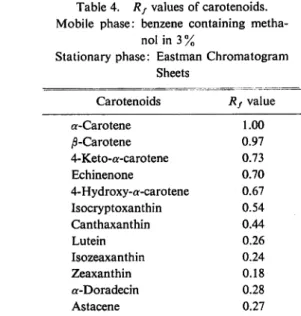
(Eastman chromatogram sheets) with petroleum ether as a developing solvent. The same sheets and the developer of benzene containing methanol in 3 % were also satisfactory used for identifying such xanthophylls as lutein, zeaxanthin, astaxanthin and so on. The Rf values of these carotenoids in thin layer chromatography are shown in Table 4 and the origins of the authentic carotenoids are listed in Table 5.
Table 4. Rf values of carotenoids.
Mobile phase: benzene containing metha nol in 3 %
Stationary phase: Eastman Chromatogram Sheets Carotenoids Rf value a-Carotene 1.00 /9-Carotene 0.97 4-Keto-a-carotene 0.73 Echinenone 0.70 4-Hydroxy-a-carotene 0.67 Isocryptoxanthin 0.54 Canthaxanthin 0.44 Lutein 0.26 Isozeaxanthin 0.24 Zeaxanthin 0.18 a-Doradecin 0.28 Astacene 0.27
Table 5. Authentic carotenoids.
or-carotene Echinenone Canthaxanthin Isocryptoxanthin Isozeaxanthin Lutein Zeaxanthin Tunaxanthin a-Doradecin
Astaxanthin and astacene
Synthetic compound (F. Hoffmann La Roche Co
and Ltd. Basle Switzerland)
Reduced echinenone Reduced canthaxanthin
Isolated from spinach, Spinacia oleracea Isolated from Chinese lantern plant, Physalis
alkekengi
Isolated from tuna fish, Neothunnus albacora Isolated from goldfish, Carassius auratus Isolated from prawn, Penaeus japonicus
II-5. Quantitative determination
In this study, quantitative determination was made with automatic spectrophotometer and the relative amount of each carotenoid was given as percentage of the total based on its mo lecular extinction coefficient at ^max. However, the molecular extinction coefficient are not necessarily determined for all carotenoids. In this study some of them had to be estimated in approximation for knowing their concentrations from optical densities. Thus, the molecular
extinction coefficient of such carotenoids were presumed from those of carotenoids with similar structures.
III. Carotenoid distribution in aquatic animals
Karrer and Jucker9> in 1948, Goodwin10^ in 1952 and Fox11} in 1953 have reviewed the
literatures on the carotenoids in aquatic animals up to the respective dates. More recent information was given by Weedon12) in 1971. This list is mostly concerned for their chemical structures of carotenoids and main resources based on more recent informations.
More specialized reviews have also been published: Goodwin, Carotenoids in Fish13),
1951: Fox, Pigments of Fishu>, 1957: Goodwin, Pigments of Crustacea15), 1960: Goodwin,
Algal Carotenoids16^, 1971.
No attempt was made by those authors to clarify the biochemical correlation between
internal organ carotenoids and integument or carapace carotenoids in aquatic animals. For this object, the present author separated carotenoids from their internal organs and integuments or carapaces and made clear their distributions.
Even though the carotenoid distribution may be clarified in these tissues, there must remain
some ambiguities that may confuse us to confirm whether these carotenoids found in these tissues have been originated from their feed or their own capabilities of converting carotenoids toward astaxanthin.
However, a red carotenoid, astaxanthin is seldom detected from both terrestrial plants and algae. Echinenone and canthaxanthin are pink carotenoids found in both plants and animals. Phoenicoxanthin is a red carotenoid proper to animals as well as astaxanthin. Therefore,
phoenicoxanthin and astaxanthin must be derived from these carotenoids in algae. Small
shrimps are really herbivora but they contain astaxanthin. This tells us the fact that shrimp can convert algal carotenoids to astaxanthin.
The present author was able to clarify the distribution of carotenoids including astaxanthin and phoenicoxanthin in aquatic animals, and the possible metabolic pathways could be pre sumed through these carotenoids in making use of their structural formulae and their abun dance. More accurate consideration of the metabolic pathway among these carotenoids could be performed later through feeding tests of carotenoids employing aquatic animals.
The present author separated carotenoids from a species of starfish, Onihitode, Acanthaster planci and isolated individual carotenoids through a column chromatography. The absorption spectrum of astaxanthin isolated from this starfish, gave somewhat different pattern from that
its purification to have two shoulders at 442 nm and at 512 nm differing from no such shoulders
of authentic astaxanthin. This stimulated the study to pursue much more in detail. Then one new ketocarotenoid was isolated and confirmed to be 7, 8-didehydroastaxanthin.
During investigating the species of aquatic organisms possessing astaxanthin, the author believed that astaxanthin was separated from orange sea sponge, Clathria frondifera (Bower-bank) because this carotenoid gave ^max at 471 nm close to ^max at 473 nm of astaxanthin. However, the author became soon aware of the difference between both carotenoids because of the existence of the shoulder at 493 nm when the carotenoid from sea sponge was purified. When astaxanthin is reduced, its ^max shift to 450 nm from 473 nm. Therefore, if the carote noid from sea sponge is identical with astaxanthin, its ^max shift to 450 nm from 471 nm by reduction. The author thus tried to reduced this sponge carotenoid, confirmed the new ^max to be 458 nm and concluded both not to be identical. After trials of various procedures of identification, this carotenoid was confirmed to be 2, 3-didehydro-^S, £-carotene-4-one
(tedanin) which was recently discovered by Okukado67).
On the way of studying the distributions of carotenoids in sea sponges, two new carotenoids were found and confirmed their structures to be 3-hydroxy-7, 8-didehydro-jS, x-carotene and 3, 4-didehydro-^S, ^-carotene.
III-l. Crustacea
Davies et al.17), Krinsky18), Czygan19) and Hata and Hata20) investigated the carotenoids in Anemia salina and have shown that Artemia is capable of converting ^-carotene into cantha
xanthin. The carotenoids in Decapoda were studied by Czeczuga and Czerpak21), Gilchrist
and Lee22). The carotenoids in Copepoda were studied by Czeczuga and Czerpak23), and
and carotenoids in Daphnia were reported by Thommen and Weckernagel24) and Herring255.
The carotenoids in Amphipoda were also reported by Czerpak26) and Czeczuga27). The
distribution and relative abundance of the carotenoids in Branchipoda were investigated
by Gilchrist285. Wolf and Cornwell29) isolated ^-carotene, lutein and astaxanthin in
cavernicolous cray fish. Bodea et al.30'31) reported the isolation of astaxanthin, ^S-carotene,
cryptoxanthin and three unidentified pigments from Copepoda and they observed a close bio chemical correlation between astaxanthin and three minor carotenoids.
The pigments of three variant of the marine isopoda, Idotea montereyensis were investigated
by Lee32) who isolated ^-carotene, echinenone, canthaxanthin, 4-hydroxy-4/-keto-j9-carotene,
lutein and lutein ester, but no astaxanthin. He also isolated j9-carotene, canthaxanthin,
isozeaxanthin, echinenone, isocryptoxanthin, 4-hydroxy-4/-keto-£-carotene and lutein, but
no astaxanthin in another isopoda species, Idotea granulosa.
Gilchrist and Lee22) isolated ^-carotene, ^-carotene, echinenone, isocryptoxanthin,
canthaxanthin, lutein, lutein-5, 8-epoxide, astaxanthin and 4-hydroxy-4'-keto-i6-carotene in Carcinus maenas.
Herring33) studied the carotenoids in Daphnia magna and isolated ^-carotene, echinenone, canthaxanthin34), a ketocarotenoid (probably 3-hydroxy-4-keto-£-carotene) and astaxanthin.
Alloxanthin has been isolated from the commensal crab, Pinnotheres pisum35^ and the sand crab, Emerita analoga and its origin can be traced to the algae consumed by these crabs.
Similarly, a common algal pigment, fucoxanthin, was isolated from the barnacle, Lepas
fas-cicularis and Lepasanacles and from their faecal pellets (Herring37)) and peridinin,a characteristic dinoflagellate carotenoid, has been isolated from Lepas fascicularis38).
The carotenoids in spiny lobster, Panulirus japonicus39\ tiger prawn, Penaeus japonicus40*41),
a swimming crab, Portunus trituberculatus42-* were identified.
In these Crustacea, ingested
labelled ^-carotene was converted into astaxanthin through the steps of echinenone cantha
xanthin and 3-hydroxy-canthaxanthin43"46).
The present author attempts to describe about the types and location of the carotenoids in various Crustacea native to southern Japan for aiding the establishment of their metabolic pathways.
Materials and Methods
Fresh sample of Neomysis intermedia, Ibacus cilatus, Metapenaeopsis sp., Penaeopsis sp.,
Penaeus orientalis and Squilla oratoria were purchased at a local fish market. The internal
organs and the carapaces were separately collected and the carotenoids were repeatedly ex
tracted with acetone, using the same method as already mentioned.
The pigments were dissolved in about 10 ml of petroleum ether for chromatography using
MgO, silical gel and sucrose columns. The carotenoids were separated by the column
chromatography and identified by the absorption spectra, the nature on elution from column
and the characteristic colors, the special chemical tests and the co-chromatography with
authentic carotenoids as already mentioned.
Results and Discussion
The carotenoid pigments in the carapaces and in the internal organs are listed in the order
of elution from the columns and the relative amounts of carotenoids are given as percentage
(Table 6). Astaxanthin (recovered as astacene) is a by far important pigment than the other,
because its abundant occurrences in carapaces give nice market prices. Their concentration are especially high in the carapaces.
Beta-carotene, lutein and zeaxanthin are yellow or orange carotenoids usually found in algae as in the other plants. Therefore, it is natural that these carotenoids are detected from tissues of Crustacea from marine environment.
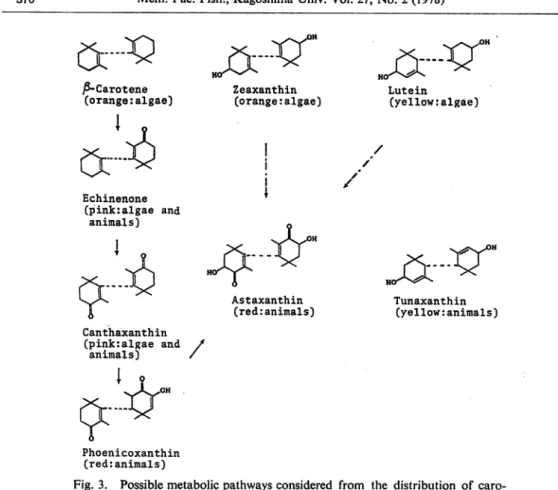
From carotenoids detected in tissues of these Crustacea, three possible metabolic pathways to astaxanthin are considered as follow: 0-carotene-^astaxanthin, zeaxanthin—>astaxanthin, lutein—>astaxanthin (Fig. 3).
One kind of yellow carotenoid, 3, 3'-dihydroxy-e-carotene (tunaxanthin) are proper to
animals. It is quite difficult to put it in these metabolic pathways, because the structure of this carotenoid is remarkably different from those of other carotenoids.
Katayama43) certified the pathway from ^-carotene to astaxanthin through echinenone,
canthaxanthin and phoenicoxanthin using tiger prawn, Penaeus japonicus.
cantha-Table 6. Relative abundances of the carotenoids in <Crustacea. Carotenoids Relative abundances (%) Penaeus japonicus Panulirus japonicus Portunus tri-tuberculatus Ibacus cilatus Squilla oratoria
^-Carotene trace — trace — —
Tunaxanthin 3 — — — —
I
s.Echinenone trace — trace 6 1
Canthaxanthin trace 12 14 2 1 2 Lutein trace — — — — 6 Zeaxanthin trace — — — — Phoenicoxanthin 5 2 2 1 trace Astaxanthin 90 84 84 90 95 j8-Carotene 10 2 2 2 30 Tunaxanthin 2 — — — — c CO Echinenone 3 8 8 trace — 2? o Canthaxanthin 6 — — — — *3
6
Lutein Zeaxanthin trace trace — — 1 1 — Phoenicoxanthin 3 — — • — — Astaxanthin 70 88 88 92 70 Carotenoids Relative abundances (%) Metapenae-opsis sp. Penaeopsis sp. Neomysis intermedia Penaeus orientalis ^-Carotene — 5 3 — Tunaxanthin — — — 3i
Echinenone — 2 7 — Canthaxanthin — 4 5 —a
Lutein — — — — Zeaxanthin — — — — Phoenicoxanthin — 3 3 — Astaxanthin 99 83 81 97 ^-Carotene — — CO Tunaxanthin Echinenone — — uO Canthaxanthin — Whole Whole —
73
e Lutein — bodies bodies —
a
Zeaxanthin— trace
Phoenicoxanthin 8 4
Or^
JSrST
J5-XT
^-Carotene (orange:algae)'i
&
Echinenone (pink:algae and animals)'i
<?
Canthaxanthin (pink:algae and / animals) /i
?
&
Zeaxanthin (orange:algae) Astaxanthin (red:animals)/
Lutein (yellow:algae) / Tunaxanthin (yellow:animals) Phoenicoxanthin (red:animals)Fig. 3. Possible metabolic pathways considered from the distribution of caro tenoids in Crustacea.
: already confirmed : not yet confirmed. in parentheses, the color and the origins are indicated.
xanthin in 7 species out of 9 species and zeaxanthin in 3 species out of 9 species. Therefore, the precursor of astaxanthin must be phoenicoxanthin. Probably the main pathway of carotenoids is expressed as ^-carotene—>echinenone—^canthaxanthin—^phoenicoxanthin—•
astaxanthin. This is in accord with the pathway proposed by Katayama. However, another metabolic pathway toward astaxanthin in Crustacea seemed to start from zeaxanthin or lutein.
ffl-2. Fresh-water red fish
Katayama47) found a-doradexanthin from skin of goldfish and proposed the metabolic pathway, lutein-»a-doradexanthin—>£-doradexanthin—>astaxanthin. Hsu48) also proposed
the same metabolic pathway through feeding tests of goldfish with 14C-lutein. However,
Hata and Hata49> denied the pathway from lutein to astaxanthin and emphasized that lutein can be converted to a-doradexanthin, but the further oxidation of a-doradexanthin can not occur. Instead, they reported that astaxanthin abundantly found in skin of goldfish can be
attributable to the bio-oxidation of zeaxanthin through /3-doradexanthin.
The object of this study is to judge which metabolic pathway is correct between those pro
posed by Katayama47^, Hsu48.) and Hata et al.49) through the distribution of carotenoids
in fresh water red fish. . \ :..
:\-Materials and Methods
Goldfish, Hibuna, fancy red carp and golden yellow carp were purchased at a fish hatchery
and killed. The carotenoids in their internal organs and integuments were separately extracted with acetone in a working Waring blender as already stated in II—1. The crude carotenoids thus obtained were dissolved in 10 ml of petroleum ether and subjected to chromatography on a MgO column (magnesium oxide-Hyflosupercel=l: 2). The carotenoids of each band
were eluted from the column with acetone and saponified, using the same method as already
mentioned in II-2. The saponified pigments were purified on the same MgO column and a sucrose column. Each purified carotenoid was identified by their absorption spectra, the nature on elution from these columns and the characteristic colors, the special chemical tests and the co-chromatography with authentic carotenoids as already mentioned in II-4.
Results and Discussion
The carotenoid pigments in the integuments and the internal organs of fresh water red fish are listed in the order of the elution from the columns and the relative amounts of carotenoids recovered are given as percentage in Table 7.
Table 7. Spectral characteristics and relative abundances of the carotenoids in goldfish, Hibuna, fancy red carp and golden yellow carp.
Pigments
Spectral characteristics Relative abundances (%)
4ax (nm) in ^max (nm) in
(
. .
petroleum
ethanol after '»" inm; m
,u , A. chloroform
ether reduction
c ,,
Fancy Golden
fi ,
Hibuna
red
yellow
carp carp CO
I
9 Lutein Zeaxanthin a-Doradexanthin Astaxanthin 422, 446, 475 — 432, 459, 487 421, 451, 481 — 433, 461, 490 455,471 422,446,476 — 473 427,451,480 — 14 11 15 45 5 4 5 5 25 24 31 20 55 60 50 30 "c3 «« Canthaxanthin Lutein Zeaxanthin 465 425,451,476 — 425, 446, 476 — 433, 458, 487 429, 451, 480 — 434, 461, 490 20 25 25 23 63 61 60 61[ 17
14
15
14
Hsu and Hata utilized silica gel or MgO for fractionating ^-doradexanthin from carotenoids in goldfish. The present author, thus, endeavored to separate ^-doradexanthin using both
column packed with the same adsorbents. In spite of such endeavor as mentioned,
in integuments, lutein, zeaxanthin and canthaxanthin in internal organs of these freshwater red fish. The major carotenoids in their integuments were found to be astaxanthin (50-60%) except golden yellow carp (30%) and lutein (60-63 %) in internal organs, respectively. Lutein and zeaxanthin were common carotenoids in internal organs and integuments. The carote noids proper to their integuments were a-doradexanthin (20-31%) and astaxanthin. The characteristic carotenoid of their internal organs was canthaxanthin (20-25 %).
Thus, the present author proposed the possible metabolic pathways of canthaxanthin, lutein and zeaxanthin to astaxanthin as shown in Fig. 4.
Canthaxanthin (pink:algae and animals) \
j*r*r
jx-^r
\ Zeaxanthin (orange:algae)-~xr
yS- Doradexanthin (red:animals)-ir-- Y
Lutein (yellow:algae).J3QT
<&- Doradexanthin (red:animals) Astaxanthin (red:animals)Fig. 4. Possible metabolic pathways considered from the distribution of carotenoids in fresh-water red fish.
: already confirmed : not yet confirmed. in parentheses, the color and the origins are indicated.
ni-3. Marine red fish
Thommen and Gloor50) reported the presence of canthaxanthin in addition to astaxanthin and ^-carotene in sea trout, Salmo trutta. Tunaxanthin was first isolated from the Pacific blue fin tuna by Hirao51), and its structure was confirmed to be 3, S'-dihydroxy-s-carotene by Crozier52). Tsukuda et al.53) studied the contents of the carotenoids in marine red fish from
the point of view of their coloration. The present author deals with the carotenoids in several marine red fish through their quantitative analyses for contributing to the confirmation of their metabolic pathways.
Materials and Methods
Red sea bream, Pagrus major Temminck and Schlegel and crimson sea bream, Evynnis
japonica Tanaka were purchased at a local fish hatchery and Akaamadai, Branchiostegus
japonicus japonicus, Kinmedia, Beryx splendens Lowe, Sasanohabera, Pseudolabrus japonicus, Hachibiki, Erythrocles schlegeli (Richardson) and Barahata, Variola louti (Forskal) were
obtained at a local fish market. The internal organs, dorsal and ventral sections and integu
ments were collected separately and extracted with acetone as already mentioned in II-l. Thecrude pigments thus obtained were subjected to chromatography using columns of MgO,
Micro-Cel C, silica gel and sucrose.
The carotenoids wereidentified through their absorption
spectra, nature on elution from columns, colors, special chemical tests and co-chromatographywith authentic carotenoids as already mentioned in II-4.
Results and Discussion
The carotenoid pigments in the internal organs and the integuments of marine red fish are
listed in the order of elution from columns, and relative amounts of each pigment are given as
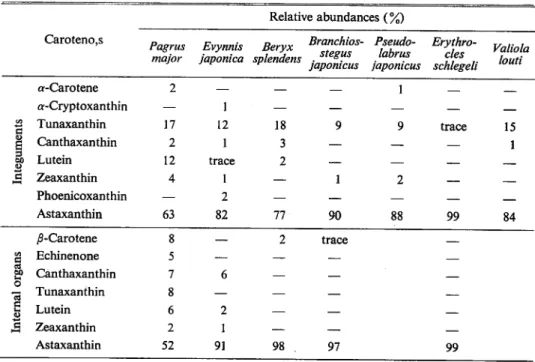
percentage in Table 8.From Table 8, it is clearly shown that astaxanthin is the most abundant carotenoid in
marine red fish such as red sea bream, crimson sea bream, Kinmedai, Akaamadai,
Table 8. Relative abundances of the carotenoids in marine red fish.
Caroteno,s Relative abundances (%) Pagrus major Evynnis japonica
Beryx
Bmnchios'
Pseudo labrus japonicus Erythro cles schlegeli Valiola louti a-Carotene 2 — — — 1 — or-Cryptoxanthin — 1 — — — — 00 Tunaxanthin 17 12 18 9 9 trace 15§
Canthaxanthin 2 1 3 — — 1 3 Lutein 12 trace 2 — — — Zeaxanthin 4 1 — 1 2 Phoenicoxanthin — 2 — — — — Astaxanthin 63 82 77 90 88 99 84 ^-Carotene 8 — 2 trace — a Echinenone 5 — — — Canthaxanthin 7 6 — — o "c3 Tunaxanthin 8 — — — e Lutein 6 2 — — G Zeaxanthin 2 1 — — Astaxanthin 52 91 98 , 97 99Sasanohabera, Hachibiki and Brahata. Secondary abundant carotenoid in the integuments of
those fish was tunaxanthin, 3, 3'-didehydroxy-s-carotene. The red sea bream sample con
tained a-carotene, /3-carotene, lutein and zeaxanthin in either internal organs or integuments.
Canthaxanthin was isolated from red sea bream, crimson sea bream, Kinmedai and Barahata
though phoenicoxanthin was only isolated from crimson sea bream.
As shown in Table 8, red sea bream and crimson sea bream, which are taxonomically close each other and inhabit in similar waters, contain various kinds of carotenoids, but they always
contain tunaxanthin, canthaxanthin, lutein, zeaxanthin and astaxanthin. Katayama found
that jS-carotene was not converted to astaxanthin in redsea bream through j8-carotene feeding
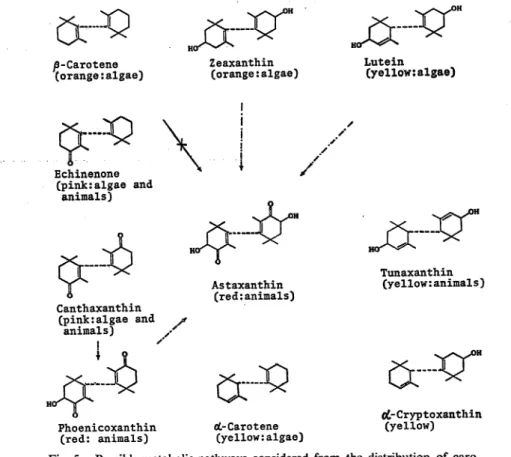
test. If 3, carotene can be a precursor of astaxanthin, 3, 3'-dihydroxy-£-carotene must change into lutein or zeaxanthin through isomerization reaction prior to the
oxidation reaction. However, lutein could not be converted to astaxanthin, because no a-doradexanthin was found in these carotenoids separated. Therefore, 3, 3'-dihydroxy-e-carotene seems not to be converted to astaxanthin. There are some possibilities that
cro
jx~xr
j^cr
/3-Carotene (orange:algae)~K>
$
Echinenone (pink:algae and animals) Zeaxanthin (orange:algae) / Lutein (vellow:algae)-J&
H°J
-ir
j^r
Tunaxanthin(yellow:animals) Canthaxanthin (pink:algae and * animals) ,S ! 4 Phoenicoxanthin (red: animals) Astaxanthin (red:animals)
..JQ
(L-Carotene (yellow:algae)&*r
drCryptoxanthin (yellow) Fig. 5. Possible metabolic pathways considered from the distribution of carotenoids in marine red fish.
: already confirmed : not yet confirmed. in parentheses, the color and the origins are indicated.
canthaxanthin and zeaxanthin convert to astaxanthin in these marine red fish according to the pathways as shown in Fig. 5.
Since only 3, S'-dihydroxy-e-carotene and astaxanthin are common carotenoids in these marine red fish, it seems that these fish have no ability to synthesize astaxanthin from plant
carotenoids.
Those marine red fish are carnivorous and eat such as crustacean which contain abundantly astaxanthin. Therefore, astaxanthin could be the major carotenoid in their internal organs and integuments of marine red fish.
IH-4. Porifera
Karrer et al.54) recognized the existence of astaxanthin in red sea sponge, Axinella
crista-gilli.
Czeczuga55) also isolated astaxanthin from Verongia aerophoba.
Drumm56) reported
the existence of echinenone, ^-carotene in Hymeniacidon sanguineum. In 1957, Yama-guchi57_62) first isolated the aromatic carotenoids, renieratene, isorenieratene and reniera-purpurin from Reniera japonica.
After that, the existence of some aromatic carotenoids in such sea sponges as Cyamon neon
and Renierajaponica63-6® was reported.
In 1974, Aguillar-Martinez et al.66) found a new keto-carotenoid from a sea sponge,
Trikentrion helium and decided the structural formula to be 3-hydroxy-7, 8-dihydro-/c, %-carotene-6, 8-dione which was named trikentriorhodin by them. The present author endeavored to know carotenoids in sea sponges, Clathria frondifera and Tedania digitata and found an abundant unknown carotenoid, then investigated its structural formula through the mass, the NMR and the IR spectrographs and was able to know this carotenoid to agree with trikentriorhodin later, but when this studies had finished in 1975, the Aguillar-Martinez's paper was not available. However, no investigator studied the abundance of this carotenoid in porifera, because of no availability of the information concerning about trikentriorhodin. The author was able to clarify its abundance in both sea sponges, Clathria frondifera and Tedania digitata in making use of the new knowledges which were obtained directly by the author.
In 1975, Okukado67) isolated a new keto-carotenoid from Tedania digitata Schmidt, decided its structural formula to be 3-hydroxy-2, 3-didehydro-/3, £-carotene-4-one and named tedanin. However, he saponified the carotenoids from this sea sponge for removing fatty materials. Since the saponification of astaxanthin (3-hydroxy-j9-carotene-4-one) tends to lose hydrogens from the 2- and 3-positions of this carotenoid, it is ambigious whether tedanin is an artifact or a natural product. The present author, therefore, purified this carotenoid from Clathria
frondifera (Bowerbank) omitting the saponification and was able to confirm its structural
formula to be really 3-hydroxy-2, 3-didehydro-j8, x-carotene-4-one.
The present author confirmed the existence of two new carotenoids, tedaniaxanthin and tethyatene, and proposed the structure of each carotenoid by measuring its mass, IR or NMR spectra. Also, the author elucidated the various types of the carotenoids in Clathria frondifera (Bowerbank), Tedania digitata Schmidt, Haliclona permollis (Bowerbank) and Tethya amamensis Fhiele, and discussed their metabolic pathways.
Materials and Methods
Four kinds of sea sponges were collected at Kinko bay, Kagoshima. The carotenoids were extracted with acetone by using Waring blender as already mentioned in II-l. The crude carotenoids thus obtained were initially separated through a MgO column (magnesium oxide: Hyflosupercel=l: 2) and then purified according to the procedure shown in Fig. 6, 7, 8. The carotenoids were identified by the absorption spectra, the nature on elution from column
and the characteristic colors, the special chemical tests and the co-chromatography with authentic carotenoids as already stated in II-4.
Isolation of new carotenoids and unidentified carotenoids i) Tedanin and Trikentriorhodin
The procedure of separation of tedanin and trikentiorhodin in Clathriafrondifera (Bower bank) was shown in Fig. 6. A main reddish band (Fr-6) was eluted with ethyl ether-acetic
Crude carotenoids
separate by MgO column
Fr-1~4 a-Carotene /9-Carotene Unknown carotenoids Fr-5 Tedaniaxanthin Fr-6 purify through sucrose column purify through sucrose column Tedanin Fr-7 purify through sucrose column saponify purify through sucrose column Trikentriorhodin
Fig. 6. Isolation of tedanin and trikentriorhodin from the crude carotenoids of Clathria
frondifera (Bowerbank).
acid (9: 1) from the MgO column. Carotenoids from the band were transferred from this eluant to petroleum ether by adding water. The petroleum ether solution of the carotenoids was repeatedly washed with water to remove trace of acetic acid, concentrated under reduced pressure, and dehydrated with anhydrous sodium sulphate. The concentrated carotenoids were purified on a dried powered sucrose column, using petroleum ether as a developing solvent. The main pinkish band was eluted with acetone. The carotenoids were transferred from acetone to petroleum ether by adding water. The aqueous layer was discarded. The petroleum ether extract was dehydrated with anhydrous sodium sulphate and evaporated under reduced pressure. The isolated pigment was crystallized from w-hexane-ethyl ether in re frigerator.
By using the same procedure, the pigment of Fr-7 was also purified and crystallized from «-hexane-ethyl ether.
The structural formula of individual pigments were confirmed by mass, IR and NMR spectra.
The NMR spectrum of each pigment was measured in CDC13 applying internal TMS at 100 MHz (Nihondenshi MH-100). Each crystalline pigment was ground with potassium bromide, pressed to make a disc and its IR spectrum was measured by using an IR-Spectro-photometer (Shimazu, Type IR-270).
ii) Tedaniaxanthin
The isolation procedure of tedaniaxanthin from Tedania digitata Schmitd is shown in Fig. 7. Tedaniaxanthin was crystallized from «-hexane-ethyl ether and its structural formula was proposed from not only the mass, the NMR and the IR spectrographs but the methylation and epoxide tests of this carotenoid.
iii) Tethyatene
The isolation procedure of tethyatene from Tethya amamensis Fhiele is shown in Fig. 8.
Crude carotenoids
separate by MgO column
Fr-1~5 Fr-6 Fr-7-8 saponify purify through MgO column purify through sucrose column a-Carotene Tedaniaxanthin ^-Carotene Isorenieratene
Fig. 7. Isolation of tedaniaxanthin from the crude carotenoids of
Tedania digitata Schmidt.
Fr-1~4
e-Carotene a-Carotene ^-Carotene
Unknown carotenoids
Fig. 8. Isolation of tethyatene and renieratene from the crude caro tenoids of Tethya amamensis Fhiele.
Tedanin Trikentriorhodin
Crude carotenoids
separate by MgO column
Fr-5 saponify purify through MgO column purify through sucrose column Tethyatene Fr-6 saponify purify through MgO column purify through sucrose column Renieratene
Also tethyatene was crystallized from «-hexane-ethyl ether and its structural formula was proposed by visible absorption spectrum, mass and IR spectra.
Results and Discussion i) Tedanin
The purified pigment has following characteristics: m.p. 172-173°C, the absorption spectra and the wavelength at ^max in several solvents are shown in Fig. 9 and Table 9.
The pigment was reduced by adding sodium borohydride as already mentioned in II-4-c-l. The absorption spectra of the reduced pigment was also shown in Fig. 9.
400 450 500
Fig. 9. Characteristic absorption spectra of tedanin. -, in petroleum ether; , in ethanol; , after reduction.
Table 9. Wave length at the maximum ab sorption of tedanin in several sol
vents. Solvents 4az (nm) Petroleum ether 471 Benzene 486 Carbon disulfide 506 Pyridine 489 Toluene 485 Chloroform 486 Ethanol 468.
The high resolution mass spectrographs of this pigment indicated such an empirical formula
as C4oH4802= 560.36543 (sample: 560.36183).
Mass spectrograph shows the peaks at m/e
values of M-15 (-CH3), M-79, M-92, M-106, M-133, M-152, M-158, M-165, M-186,
M-198, M-205, M-217, M-231, at high mass region and 43, 69, 91, 133,157,173 at low mass
region (Fig. 10, 11). too 5- Q <0
li I •
ILL
400 "»/• 450 500 Fig. 10. Mass spectrum of tedanin.50 100 150 ro/0
Fig. 11. Mass spectrum of tedanin in low mass region.
600
M-15 (-CH3) shows the elimination of a CH3 fragment. There is a significant M-79 peak
which is evidently due to a fragment formed by elimination of a C6H7, possibly a methyl
cyclopentadienyl radical from the polyene chain68). The peaks at M-92 and M-106 are
typical ones of carotenoids: M-92 represents the loss of toluene, M-106 the loss of xylene
and M-158 the loss of Ci2H2o (presumably the precursor of 2, 6-dimethylnaphthalene) (Fig.
,106 ,158 106
Fig. 12. Schematic representation of the possible ways of formation of M-92, M-106 and M-158 from tedanin.
The fragments of toluene (91), xylene (106) and dimethylnaphthalene (157) can also be detected in the low mass region. As a rule the peaks at M-92, M-106 and M-158 are mainly
due to fragments of thermal decomposition products70).
The compounds possessing the aromatic end groups such as chlorobactene and okenone all exhibit the m/e 133 as an intense peak in the low mass region and the M-133 in the high mass
region, while this is not observed in any of the other spectra69'70). The peaks at M-173 and
M-186 also show the cleavage of 9'-10' and ll'-12' bonds (Fig. 13).
The peaks at M-152, M-165, M-205, M-217 and M-231 show the presence of astacene type
end group68'70) (Fig. 13).
M-152 M-205 M-231 M-186 M-133
M-165 M-217 M-173
Fig. 13. Schematic representation of the possible ways form ation of M-133, M-173, M-186, M-152, M-165, M-205, M-217 and M-231 from tedanin.
The NMR spectrum of this pigment was measured in CDC13 using internal TMS at 100 MHz
(Fig. 14). There are signals at z 8.74 (6H), z 8.05 (6H), z 8.02 (3H), r 7.98 (3H), z 7.95
(3H), z 7.84 (3H), r 7.75 (6H) and z 4.00-2.70 (ca. 18H). Signals in spectral range between
r 4.00-2.70 were not clear, so these signals were not discussed.