Chemical Structures of Quinolinol Compounds
Produced by Marine Pseudoalteromonas sp.
A1-J11
著者
SAKATA Taizo, del CASTILLO Carmelo Segovia,
YOSHIKAWA Takeshi, HASHIMOTO Masahito
journal or
publication title
鹿児島大学水産学部紀要=Memoirs of Faculty of
Fisheries Kagoshima University
volume
57
page range
29-35
別言語のタイトル
海洋性シュードアルテロモナス属A1-J11株が産生す
るキノリノール化合物の化学構造
1
㣮 ఽ ፉ ᄢ ቇ ᳓ ↥ ቇ ㇱ 㘩 ຠ ⾗ Ḯ ↪ ቇ ಽ ㊁ (Department of Biochemistry and Technology of Marine Food and Resources, Faculty of Fisheries, Kagoshima University, 4-50-20 Shimoarata, Kagoshima 890-0056, Japan)
2
㣮 ఽ ፉ ᄢ ቇ ᄢ ቇ 㒮 ㅪ ว ㄘ ቇ ⎇ ⓥ ⑼ (The United Graduate School of Agricultural Sciences, Kagoshima University, 1-21-24 Korimoto, Kagoshima 890-0065, Japan)
3
㣮ఽፉᄢቇᄢቇ㒮ℂᎿቇ⎇ⓥ⑼࠽ࡁ᭴ㅧవ┵᧚ᢱᎿቇኾ (Department of Nanostructure and Advanced Materials, Graduate School of Science and Engineering, Kagoshima University, 1-21-24 Korimoto, Kagoshima 890-0065, Japan)
* Corresponding Author, Email: sakata@fi sh.kagoshima-u.ac.jp
Chemical Structures of Quinolinol Compounds Produced by Marine
Pseudoalteromonas sp. A1-J11
Marine Pseudoalteromonas and Pseudomonas spp. are well known to produce various antibiotic and biologically active substances extracellularly.1-5)
They are frequently found to be associated with eukaryotic hosts in the marine environments and synthesize biologically active agents against a variety of target organisms. Marine Pseudoalteromonas sp. A1-J11 isolated from sea water in Kagoshima Bay, Japan was also reported to produce three kinds of quinolinol compounds showing anti-bacterial activity against Vibrio strains in previous papers.6-8) The chemical structure of AVS-03d among them was identifi ed as 2-n-pentyl-4-quinolinol on the basis of mass spectrometry and NMR spectroscopy.8) In this study, the authors describe 13
C and 1
H data and HMBC (Heteronuclear multiple bond correlation) for major quinolinol compounds produced by Pseudoalteromonas sp. A1-J11 based on NMR analysis and growth inhibitory activity against a diatom strain, Chaetoceros ceratosporum C-16.
Materials and Methods
Test strains and media
Antagonistic strain Pseudoalteromonas sp. A1-J11 was isolated from sea water in Kagoshima Bay, Kagoshima Prefecture, Japan as described in the previous paper.7) Diatom strain Chaetoceros ceratosporum C-16 was provided by Dr. K. Fukami of Kochi University.
Bacterial strains were cultured in a modifi ed ZoBell medium (Z-CII)9) containing Polypepton (Nippon Seiyaku, Tokyo, Japan) 5 g/l and yeast extract (Nippon Seiyaku) 1g/l in 3/4 strength artifi cial seawater (ASW, Herbst’s formula composed of NaCl 30.0 g, KCl 7.0 g, MgCl2·6H2O
10.8 g, MgSO4·7H2O 5.4 g, and CaCl2·2H2O 1.0 g per l).
Chaetoceros ceratosporum C-16 was cultivated in 300 ml of Provasoli’s modifi ed liquid medium (ESS) with aeration under illumination of 5,000 lx (12L:12D light cycle). Diatom cells were harvested with centrifugation after 2 weeks of incubation and then resuspended in fresh ESS liquid medium at a density
Abstract
Three kinds of quinolinol compounds were produced extracellularly by a marine anti-bacterial strain, Pseudoalteromonas sp. A1-J11. The NMR spectra of 13
C and 1
H and HMBC for major two compounds among them were measured by using a NMR spectrometer (JEOL ECA 600). The chemical structures of these compounds, AVS-03a and AVS-03d, were identifi ed as 2-n-butyl-4-quinolinol and 2-n-pentyl-2-n-butyl-4-quinolinol, respectively. AVS-03d showed algicidal activity against a diatom strain Chaetoceros
ceratosporum as well as Vibrio strains.
Taizo Sakata,
1*Carmelo Segovia del Castillo,
2Takeshi Yoshikawa,
1and Masahito Hashimoto
330 Mem. Fac. Fish. Kagoshima Univ., 57, (2008)
of 10 times higher than the culture medium. Double layer agar plates were prepared by mixing one ml of the diatom cell suspension with 2 ml of ESS soft agar (0.8% of agar concentration) maintained 50oC to be poured on an ESS basal agar plate as described in the previous reports.10, 11)
Purifi cation of anti-
Vibrio substances from strain
A1-J11
The extraction and purifi cation of anti-Vibrio substances was made by use of the same procedure as described in the previous papers.6,8)
The supernatant of 4 day culture (300 ml x 4 fl asks) of strain A1-J11 was separated by centrifugation at 10,000 x g for 15 min and extracted with an equal volume of ethyl acetate (EtAc). Ethyl acetate fraction was applied to a silica gel column (Silica Gel 60, Merck, Darmstadt, Germany, 260 x 25 mm column) and eluted with mobile phase of chloroform: ethyl acetate: acetone (12:1:1, v/v/v). After visible yellow fractions were eluted, about 200 ml of eluent mixture was collected and concentrated. Then, the silica gel purifi ed fraction concentrated and dissolved in methanol was applied to high performance liquid chromatograph (HPLC) column (Mightsyl RP-18GP, 250 x 10 mm, Kanto Kagaku, Tokyo, Japan) and eluted with 25% aqueous acetonitrile at a fl ow rate of 2.5 ml/min. Eluted fractions were monitored by UV absorption at 325 nm.
NMR analyses
Two isolated compounds and one standard compound, 2-methyl-4-quinolinol (Sigma-Aldrich, St. Louis, USA) were dissolved in methanol-d4 (Wako Chemical, Osaka, Japan) and applied to a NMR spectrometer (JEOL ECA 600, JEOL, Tokyo, Japan). The chemical shifts were expressed as δ values with methanol (13
C; δ 49.0) as the internal standards.
Algicidal activity assay
Algicidal activity against diatom cells of Chaetoceros ceratosporum C-16 was conducted by disk diffusion assay in which the test substances dissolved in methanol (MeOH) were put onto a paper disk (50 µg/8 mm paper disk), dried, and applied to an algal double-layer plate. Algicidal activity was confi rmed by observing growth inhibition zone around the paper disks on the double-layer agar plate.
Results
NMR chemical shifts and HMBC correlation for
quinolinol compounds
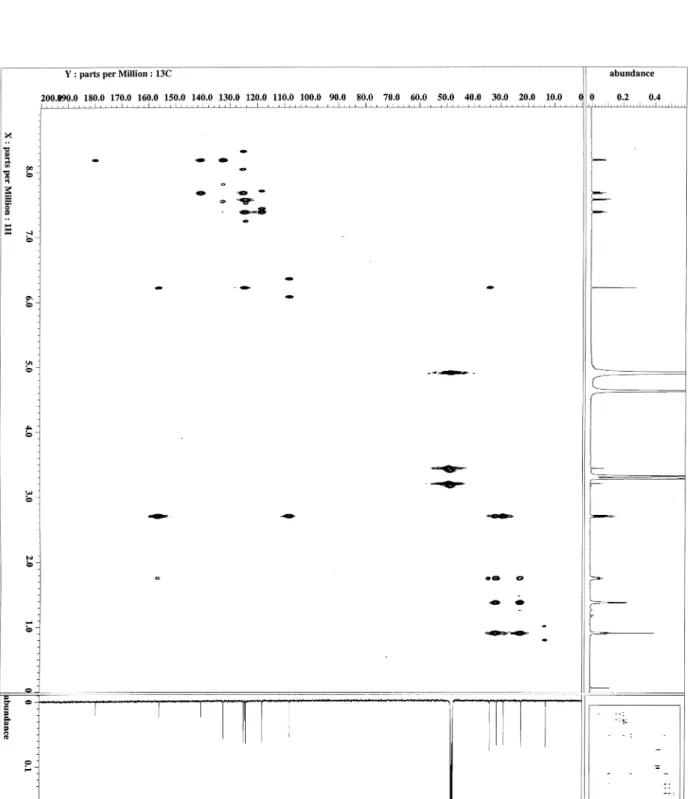
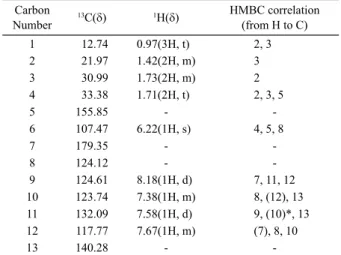
The NMR spectra of major two anti-bacterial compounds (AVS-03a and AVS-03d) isolated from Pseudoalteromonas sp. A1-J11 and 2-methyl-4-quinolinol (2MQ) were measured by using a NMR spectrometer. A butyl group (C4) with lower chemical shifts than δ 49.0 (methanol) was observed for 03a, while a pentyl group (C5) was done for AVS-03d in 13
C NMR spectra as shown in Figs 1, 2 and 3. From the chemical shifts and HMBC data of these compounds (Tables 1, 2 and 3), AVS-03a and AVS-03d were deduced to be 2-n-butyl-4-quinolinol (BQ) and 2-n-penthyl-4-quinolinol (PQ), respectively. The chemical structures of three quinolinol compounds are shown in Fig. 4.
Algicidal activity of quinolinol compounds
The algicidal activity of quinolinol compounds was tested by using the paper disk method. The result shown in Fig. 5 indicates that only AVS-03d (2-n-pentyl-4-quinolinol) has algicidal activity against Chaetoceros ceratosporum C-16, but other two quinolinol compounds do not.
Discussion
Three anti-bacterial substances against V. harveyi from the culture supernatant of a marine Pseudoaltermonas sp. A1-J11 were purifi ed and the chemical structures of major two compounds were identifi ed in the previous paper.8) In this paper, 1
H and 13
C NMR spectra and HMBC data were obtained for these compounds dissolved in methanol-d4. The authors compared the chemical shifts and HMBC correlation of three test compounds. These analytical data reconfi rmed that isolated compounds are 2-n-butyl-4-quinilinol (BQ) and 2-n-pentyl-4-quinolinol (PQ). Two isolated compounds were shown to strong inhibitory activity against Vibrio harveyi strains. The result obtained in this experiment indicates that only AVS-03d (2-n-pentyl-4-quinolinol) has algicidal activity against Chaetoceros ceratosporum C-16 as well as anti-bacterial activity against V. harveyi. Recently, synthetic 2-n-pentyl-4-quinolinol (PQ) has been reported to be useful as an antifoulant agent which inhibits growth of diatoms, Amphora and Navicula spp.5, 12) However, other quinolinol compounds have not been examined on algicidal activity.
Fig. 1. HMBC analysis of synthetic 2MQ in methanol-d4 as deduced from 1H NMR (vertical) and 13
32 Mem. Fac. Fish. Kagoshima Univ., 57, (2008)
Fig. 2. HMBC analysis of AVS-03a in methanol-d4 as deduced from 1H NMR (vertical) and 13
Fig. 3. HMBC analysis of AVS-03d in methanol-d4 as deduced from 1H NMR (vertical) and 13
34 Mem. Fac. Fish. Kagoshima Univ., 57, (2008)
Table 1. The data of 13C and 1H and HMBC correlation for 2MQ in methanol-d4 Carbon Number 13C(δ) 1H(δ) HMBC correlation (from H to C) 1 18.50 1.17(3H, t) 2, 3 2 151.72 - -3 108.21 6.21(1H, s) 1, 2, 5 4 179.22 - -5 123.99 - -6 124.63 8.17(1H, d) 4, 8, 9 7 123.70 7.38(1H, m) 5, (8), 9 8 132.06 7.55(1H, d) 6, (7), 10 9 117.65 7.66(1H, m) (4), 5, 7 10 140.23 -
-Table 2. The data of 13C and 1H and HMBC correlation for AVS-03a in methanol-d4 Carbon Number 13C(δ) 1H(δ) HMBC correlation (from H to C) 1 12.74 0.97(3H, t) 2, 3 2 21.97 1.42(2H, m) 3 3 30.99 1.73(2H, m) 2 4 33.38 1.71(2H, t) 2, 3, 5 5 155.85 - -6 107.47 6.22(1H, s) 4, 5, 8 7 179.35 - -8 124.12 - -9 124.61 8.18(1H, d) 7, 11, 12 10 123.74 7.38(1H, m) 8, (12), 13 11 132.09 7.58(1H, d) 9, (10)*, 13 12 117.77 7.67(1H, m) (7), 8, 10 13 140.28 -
-Table 3. The data of 13C and 1H and HMBC correlation for AVS-03d in methanol-d4 Carbon Number 13C(δ) 1H(δ) HMBC correlation (from H to C) 1 12.94 0.91(3H, t) 2, 3 2 22.09 1.38(2H, m) 3 3 28.56 1.38(2H, m) 2 4 31.09 1.75(2H, t) 2, 3, 5, 6 5 33.62 2.70(2H, t) 3, 4, 6, 7 6 155.85 - -7 107.48 6.22(1H, s) 5, 6, 9 8 179.31 - -9 124.13 - -10 124.62 8.18(1H, d) 8, 12, 13 11 123.74 7.38(1H, m) 9, (12)*, 13 12 132.08 7.68(1H, m) 10, (11), 14 13 117.73 7.57(1H, d) (8), 9, 11 14 140.27 -
-Fig. 4. Chemical structures of 2-methyl-4-quinolinol (A), AVS-03a (B), and AVS-03d (C). Numbers indicate assignment of carbon positions based on 13
C NMR signals.
Fig. 5. Growth inhibitory activity of isolated quinolinol compounds on a double layer agar plate containing Chaetoceros
ceratosporum C-16 cells. Arrow indicates growth inhibition
zone around a paper disk. M, methanol; 2MQ, 2-methyl-4-quinolinol (synthetic); BQ, 2-n-butyl-4-2-methyl-4-quinolinol (isolated); PQ, 2-n-pentyl-4-quinolinol (isolated).
Further work is needed to determine the action mechanisms of quinolinol compounds as anti-bacterial and anti-algal agents
References
1. Wratten, S. T., M. S. Wolfe, R. J. Andersen, and D. J. Faulkner (1977). Antibiotic metabolism from a marine pseudomonad.
Antimicrob. Agents Ch., 11: 411-414.
2. Leisinger, T. and R. Margraff (1979). Secondary metabolites of the fl uorescent pseudomonads. Microbiol. Rev., 43: 422-442. 3. Gauthier, M. J. and V. A. Breittmayer (1979). A new
antibiotic-producing bacterium from seawater: Alteromonas aurentia sp. nov. Int. J. Syst. Bacteriol., 29: 366-372.
4. H o l m s t r ö m , C . a n d S . K j e l l e b e r g ( 1 9 9 9 ) . M a r i n e
Pseudoalteromonas species are associated with higher organisms
and produce biologically active extra-cellular agents. FEMS
Microbiol. Ecol., 30: 285-293.
4. I s n a n s e t y o , A . a n d Y. K a m e i ( 2 0 0 3 ) . M C 2 1 - A , a bactericidal antibiotic produced by a new marine bacterium,
Pseudoalteromonas phenolica sp. nov. O-BC30, against
methicillin-resistant Staphylococcus aureus. Antimicrob. Agents
Ch., 47: 480-488.
5. Long, R. A., A. Qureshi, D. J. Faulkner, and F. Azam (2003). 2-n-pentyl-4-quinolinol produced by a marine Alteromonas sp. and its potential ecological and biogeochemical roles. Appl.
Environ. Microb., 69: 568-576.
6. Sakata, T., C. S. del Castillo, Y. Demizu, M. Matsuzaki, and T. Yoshikawa (2007). Purifi cation and characterization of anti-Vibrio substances from marine Pseudoalteromonas sp. A1-J11. Mem.
Fac. Fish. Kagoshima Univ., 56: 63-68.
7. del Castillo, C. S., M. I. Wahid, T. Yoshikawa, and T. Sakata (2008). Isolation and inhibitory effect of anti-Vibrio substances from Pseudoalteromonas sp. A1-J11 isolated from the coastal sea water of Kagoshima Bay. Fisheries Sci., 74: 174-179.
8. del Castillo, C. S., T. Yoshikawa, M. Hashimoto, and T. Sakata (2008). Correlation between chemical structures and inhibitory activities of anti-bacterial substances from marine
Pseudoalteromonas sp. A1-J11. Fish Pathol., 43: 65-71.
9. Sashihara, N., T. Sakata, and D. Kakimoto (1975). Study on the proteases of marine bacteria. Mem. Fac. Fish. Kagoshima Univ., 24: 149-160.
10. Sakata, T. and K. Iwamoto (1995). Isolation of marine algicidal microorganisms on diatom double layer agar plates. Fisheries
Sci., 61: 173-174.
11. Sakata, T., T. Fujisawa, and T. Yoshikawa (2000). Colony formation and fatty acid composition of marine labyrinthulid isolates grown on agar media. Fisheries Sci. 66: 84-90.
12. Wigglesworth-Cooksey, B., K. E. Cooksey, and R. Long (2007). Antibiotic from the marine environment with antimicrobial fouling activity. Environ. Toxicol., 22: 275-280.