ORIGINAL
Establishment of an evaluation system for non-technical skills
in surgery : Surgeon and paramedical staff assessments
Kozo Yoshikawa, Mitsuo Shimada, Jun Higashijima, Tomohiko Miyatani, Takuya Tokunaga, Masaaki Nishi, Chie Takasu, Hideya Kashihara, Toshiaki Yoshimoto, and Takashi Iwata
Department of Surgery, Tokushima University, Tokushima, Japan
Abstract : Purposes : Non-technical skills contribute to safe and efficient team performance. The aim of this study was to clarify the importance of non-technical skills by a questionnaire and the usefulness of feedback to the operator. Method : A questionnaire was administered to the operator and paramedical staff for 404 operations. Total and individual scores were compared, and the effect of feedback was analyzed by comparison between pre-feedback and post-feedback. Results : The total score of the paramedical staff was 100 [full score] [n = 186], 90-99 [n = 133], and 80-89 [n = 47]. In all cases, the score of the paramedical staff was significantly better than that of the operator. After feedback, the rate of a score less than 80 was significantly decreased. In junior doctor cas-es with laparoscopy, feedback tended to have a positive effect. Conclusions : Qucas-estionnaircas-es completed by both surgeons and paramedical staff are useful for identifying problems with non-technical skills. J. Med. Invest. 67 : 83-86, February, 2020
Keywords : non-technical skill, questionnaire, surgical education
INTRODUCTION
Non-technical skills such as task management, leadership, sit-uational awareness, communication, and decision-making refer to cognitive, behavioral, and social skills that contribute to safe and efficient team performance (1).
Adverse events occur in up to 10% of all hospitalized patients, considerable numbers of these occur in the operating theater, and studies and root cause analyses have shown that 70% of adverse events are caused by human error. Most often, these errors are due to communication breakdowns, poor leadership, or a reluctance to speak up, which can be considered failures in non-technical skills (2).
Analyses of adverse events in health care have found that many underlying causes originate from failures in the non-tech-nical aspects of performance rather than a lack of technon-tech-nical expertise (3). Coordinated performance of interventions within cardio pulmonary resuscitation teams requires more than mas-tering the technical skills (1). Deficiencies in teamwork, rather than simply poor technical ability, continue to be identified as important contributors to adverse events in the operating room (4).
In a recent study, communication was found to be a causal factor in 43% of errors made in surgery. Another study reported that 27% of claims against a health care organization resulted from cognitive and diagnostic errors in the operating room. These findings support the argument that technical skills are necessary but not sufficient to maintain high levels of mance over time. To achieve and maintain high surgical perfor-mance, attention needs to be paid to non-technical skills such as team work, leadership, situational awareness, decision-making, task management, and communication (3).
The aim of this study was to clarify the importance of non-tech-nical skills by a questionnaire survey and of the usefulness of feedback to operators.
MATERIALS & METHODS
Patients and objectivesThe questionnaire survey was performed from July 2015 to March 2017 in Tokushima University, and 404 operations were examined. Both paramedical staff and the operators answered the questionnaire. The evaluator was one assistant nurse who dominantly served. After 76 cases, the first analysis was performed, and feedback was provided to the operators. This feedback was done by supervisor. By informing the bad score, supervisor advise to improve the bad behavior in operation room. Total and individual scores were compared between paramedi-cal staff and operators, and total and individual scores were com-pared between senior and junior operators. The effect of feedback was analyzed by comparing scores between pre-feedback and post-feedback. A junior doctor was defined as having less than 10 years of experience (n = 8), and a senior doctor was defined as having over 10 years of experience (n = 6).
Questionnaire
The questionnaire consisted of 20 parts, including situation-al awareness, decision-making, communication, leadership, teamwork, and coping with fatigue (Table 1). Each question was evaluated by scoring form 0-5. 5 means excellent and 0 means too bad. The full score was 100.
Statistical analysis
Statistical analyses were carried out using the JMP 10 statis-tical software package [SAS Institute Inc, Tokyo, Japan]. Stu-dent’s t-test was used to compare continuous variables. A P-value
of less than 0.05 was considered significant.
The Journal of Medical Investigation Vol. 67 2020
83
Received for publication November 20, 2019 ; accepted December 10, 2019.
Address correspondence and reprint requests to Kozo Yoshikawa, MD. PhD, Department of Surgery, The University of Tokushima, 3-18-15 Kuramoto, Tokushima City, Tokushima 770-8503, Japan and Fax : +81-88-631-9698.
84
K. Yoshikawa, et al. Evaluation system for non-technical skillsRESULTS
Patients’ characteristics
Operations were performed by open [n = 187] and laparoscopic [n = 217] approaches ; senior doctors performed 110 cases, and junior doctors performed 294 cases. The operative procedures included colorectal resection [n = 103], gastrectomy [n = 78], liver resection [n = 77], cholecystectomy [n = 52], hernia [n = 41], and pancreatectomy [n = 37].
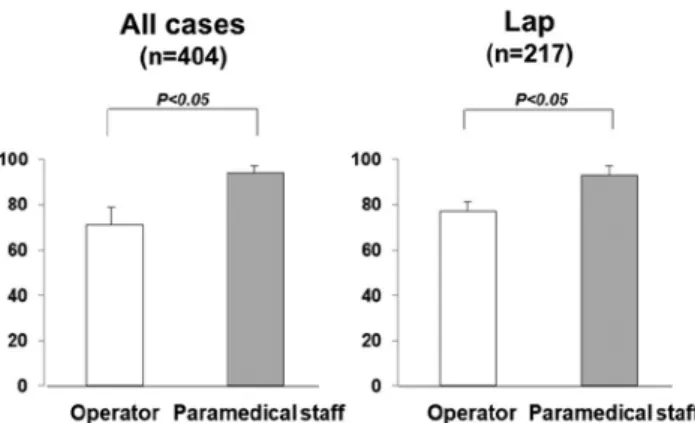
Questionnaire score [comparing operators with paramedical staff] The total scores of the paramedical staff were 100 [full score] [n = 186], 90-99 [n = 133], and 80-89 [n = 47]. In all cases, the score of the paramedical staff was significantly better than that of the operators [71 vs 94 p < 0.05]. Especially in laparoscopic surgery, the score of the paramedical staff was significantly better than that of the operators [77 vs 93 p < 0.05] (Figure 1). In the individual questionnaire, concerning irrelevant talk, the score of the paramedical staff was worse than of the operators [4.85 vs 4.69 p < 0.05].
Next, in the comparison between junior and senior doctors, junior doctors showed better scores from the paramedical staff in all cases [94 vs 92 p < 0.05] and in laparoscopic cases [95 vs 93 p < 0.05] (Figure 2). Furthermore, in the individual section, senior doctors had significantly better decision-making scores [4.88 vs 4.73 p < 0.05].
The effect of feedback to doctors
After feedback, the total score from the paramedical staff did not improve in all cases and in laparoscopy cases. On the other hand, the rate of a score less than 80 was significantly decreased after feedback [14% vs 7% p < 0.05]. In junior doctor cases with laparoscopy, feedback tended to have a positive effect [97 vs 99 p = 0.09] (Figure 3). In individual sections, feedback significant-ly improved the score for teamwork [13.3 vs 13.8 p < 0.05]. Table 1. Details of the questionnaire
Skill Questionnaire
Situational awareness Precise order (instrument) Keep the situation appropriate Precise orders (procedure) Decision-making Cope with unexpected situation Communication Using polite words
Offensive attitude
Excessive anger with teammate Suggest without hesitation Share information Irrelevant conversation Leadership Show leadership
Pass instruments carefully Use instruments carefully Help with the gauze count Cope with infection
Team working Making a situation appropriate Educational
Feedback to teammate Coping with fatigue Teammate change
Cope with fatigue in teammate
Figure 1. The scores of the paramedical staff and operators for all questions
Figure 2. The scores of the senior doctors and junior doctors
85
The Journal of Medical Investigation Vol. 67 February 2020
DISCUSSION
In this study, non-technical skills were checked and analyzed. By using this questionnaire, problems can be identified, and feedback can improve non-technical skills.
Non-technical skill analysis found that workflow was ob-structed by poor teamwork and a lack of planning, which in-creased operating times and the number of errors. On the other hand, strong leadership reduced operating time, and greater situational awareness limited errors. These results applied for both minimally invasive surgery and open surgery. Minimally invasive surgery procedures seemed to require more commu-nication regarding equipment and patient-related topics than open surgery (2). Failures in nontechnical skills [especially in situational awareness among surgeons] are associated with a higher rate of technical errors (4). Coping with the deleterious impact of excessive levels of stress in the operating room is the key to maintaining optimum technical proficiency. This finding complements a recent systematic review that highlighted the significant impact of stress on surgical performance. The impact of stress depended on the level of expertise of the surgeon and the nature of the task. This is particularly true for nontechnical assessments, because behaviors are harder to assess than tech-nical performance. It detected improvements in non-techtech-nical skills after specific training and was congruent with improve-ments in attitudes to teamwork and scores for technical skills and technical performance skills (5).
Non-technical skills consist of various compartments, and there is no evidence that poor communication in the operating room negatively affects technical performance. The fact that communication is not explicitly included in all nontechnical assessment tools may contribute to the lack of a relationship (4). Furthermore, increased levels of fatigue are associated with dec-rements in particular aspects of surgical performance.
Compared to open procedures, minimally invasive surgery is more technically complicated from the equipment to the technical skills required due to utilization of a shadowless, two-dimensional projection of a three-dimensional operating space. In laparoscopic cholecystectomy, the junior surgeon takes a long operating time, and the complication rate is higher in the junior surgeon group. These results are correlated with the poor scores of junior surgeons (6). The communication skills of young surgeons are worse, and this skill is very important to establish a good relationship between doctors and the paramedical staff. This lack of ability is correlated with the poor scores in the junior group (7).
Non-technical skills are an important issue in other fields such as anesthesia (8). The use of high-fidelity immersive simula-tions to provide non-technical skill training is widespread, cost-ly, and, in some jurisdictions, mandatory for anesthesia training or recertification. It is thus essential that debriefing as a critical component of this training is evidence-based. The essential ele-ments of effective debriefing after simulation during non-techni-cal skills training in healthcare remain largely guided by expert opinion, and they are heavily weighted by the assumed gold standard of debriefing undertaken by a skilled facilitator. How-ever, the need for a skilled instructor was challenged by most of the studies examine (9).
Concerning the method and timing of feedback, verbal and face-to-face are extremely important to surgical trainees. If intraoperative feedback is given, it is likely to increase pressure on the surgeons. Time pressures for clinical productivity have been previously reported as a main barrier to feedback delivery, aggravated by a lack of protected time for faculty training. In the present study, feedback was performed face-to-face and after the operations, so doctors tended to accept the results, especially
young surgeons (10). Provision of feedback on performance has a beneficial effect on certain aspects of technical performance. The effect, however, appears to be task-dependent.
Case-irrelevant conversation was also associated with poorer team performance. Without further cognitive testing, we cannot infer a mechanism for this effect, but a possible explanation is that a lapse of concentration during moments of distracting conversation may have led to a decreased awareness of the needs of the wider team. This highlights the importance of remaining vigilant throughout a case so as to maintain a high-functioning team (11).
The limitations of this study were that only a questionnaire was used, and surgical errors and surgical results were not com-pared, though the scores were compared between the operators and paramedical staff in all cases. The comparison should be performed based on the difficulty of surgery, and the present study contained various degrees of surgical difficulty. Further-more, scoring of non-technical skills is needed.
In conclusion, questionnaires of both surgeons and paramed-ical staff are useful for identifying problems with non-technparamed-ical skills.
COMPLIANCE WITH ETHICAL STANDARDS
This study was approved by The Ethics Committee of the Tokushima University Hospital, and patient information was obtained from their medical records [Approval number : 2463].
CONFLICT OF INTEREST STATEMENT
Author Kozo Yoshikawa declares that he has no conflict of in-terest. Author Mitsuo Shimada declares that he has no conflict of interest. Author Jun Higashijima declares that he has no conflict of interest. Author Tomohiko Miyatani declares that he has no conflict of interest. Author Takuya Tokunaga declares that he has no conflict of interest. Author Masaaki Nishi declares that he has no conflict of interest. Author Chie Takasu declares that he has no conflict of interest. Author Hideya Kashihara declares that he has no conflict of interest. Author Toshiaki Yoshimoto declares that he has no conflict of interest. Author Takashi Iwata declares that he has no conflict of interest.
INFORMED CONSENT
Informed consent was obtained from all individual partici-pants included in the study.
REFERENCES
1. Krage R, Zwaan L, Tjon Soei Len L, Kolenbrander MW, van Groeningen D, Loer SA, Wagner C, Schober P : (2009) Relationship between non-technical skills and technical performance during cardiopulmonary resuscitation : does stress have an influence? Emerg Med J 34 : 728-33, 2017 2. Gjeraa K, Spanager L, Konge L, Petersen RH, Østergaard
D : Non-technical skills in minimally invasive surgery teams : a systematic review. Surg Endosc 30 : 5185-99, 2016 3. Yule S, Flin R, Paterson-Brown S, Maran N : Non-technical skills for surgeons in the operating room : a review of the literature. Surgery 139 : 140-9, 2006
4. Hull L, Arora S, Aggarwal R, Darzi A, Vincent C, Sevdalis N : The impact of nontechnical skills on technical
86
K. Yoshikawa, et al. Evaluation system for non-technical skills performance in surgery : a systematic review. J Am CollSurg 214 : 214-30, 2012
5. Mishra A, Catchpole K, McCulloch P : The Oxford NO-TECHS System : reliability and validity of a tool for mea-suring teamwork behaviour in the operating theatre. Qual Saf Health Care 18 : 104-8, 2009
6. Kauvar DS, Braswell A, Brown BD, Harnisch M : Influence of resident and attending surgeon seniority on operative performance in laparoscopic cholecystectomy. J Surg Res 132 : 159-63, 2006
7. Falcone JL, Claxton RN, Marshall GT :Communication skills training in surgical residency : a needs assessment and metacognition analysis of a difficult conversation objec-tive structured clinical examination. Surg Educ 71 : 309-15, 2014
8. Boyle E, O’Keeffe DA, Naughton PA, Hill AD, McDonnell
CO, Moneley D : The importance of expert feedback during endovascular simulator training. J Vasc Surg 54 : 240-8, 2011
9. Garden AL, Le Fevre DM, Waddington HL, Weller JM : De-briefing after simulation-based non-technical skill training in healthcare : a systematic review of effective practice. Anaesth Intensive Care 43 : 300-8, 2015
10. Bello RJ, Sarmiento S, Meyer ML, Rosson GD, Cooney DS, Lifchez SD, Cooney CM : Understanding Surgical Resi-dent and Fellow Perspectives on Their Operative Perfor-mance Feedback Needs : A Qualitative Study. J Surg Educ 75 : 1498-503, 2018
11. Wheelock A, Suliman A, Wharton R, Babu ED, Hull L, Vincent C, Sevdalis N, Arora S : The Impact of Operating Room Distractions on Stress, Workload, and Teamwork. Ann Surg 261 : 1079-84, 2015