Bull. Mar. Sci. Fdsh Kochi Uni'v. .J
No. 17, pp. 63-68, 1997
Effect of ration level on non-fecal nitrogen excretion of
juvenile yellowtail
(Seriola quinqueradiata)
Toni RucmMAT, Toshiro MAsuMoTo, Shinji MoRI, Hidetsuyo HosoKAwA
and Sadao SHIMENO
Faculty ofAgriculture, Kochi University, Monobe, Nanhoku, Kochi 783, JaPan
Abstract: Pest-feeding non-fecal nitrogen excretion was determined for juvenile yellowtail in a closed tank sys-tem. The highest amrnonia excretion value was noticeable 2 hr post-feeding, while the urea excretion rate was highest at 4 hr post-feedmg. The amrnonia excretion rate of fish fed the lowest ration (1.49obw) was a half of that of fish fed the highest ration (4.19e bw). The equivalent energy value from ammonia was in the range of 8.7 to 18.0 (KJIkg bwfday) under present feeding condition.
Keywords: Yellowtail, non-fecal nitrogen excretion, arnmonia, urea
INTRODUCTION
The rnain end product of protein metabolism in almost all teleosts studied so far is ammonia (Smith, 1929; Fromm, I963) and usually represents 75-909o of the nitrogen excretes (Wood, 1958). One of the research interests on nitrogen excretion measurement in fish is nutritional
energetics. Nitrogen excretion increases as fish ingest low quality proteins (i.e., imbalance
ami-no acid profue) compared to good quality ones. Therefore, nitrogen excretion is considered as
"loss" of ingested nitrogen which is not used for growth and maintenance in fish.
The post-feeding changes in ammonia excretion has been studied (Brett and Zala, 1975; Kaushik and Dabrowski 1983; Kaushik 19801; Rychly and Maima, 1977; Kikuchi et al 1991;
Harris and Probyn 1996; Chakraborty et al 1992; Ogino et al 1973; Ming 1985), yet no such research has been reported on yellowtail, Sertola quinquearadiata. The purpose of this study is to investigate the post-feeding nitrogen excretion pattern of yellowtail with different ration
levels and to investigate the endogenous nitrogen loss from non-fecal origin.
MATERIALS AND METHODS
Fish and diet
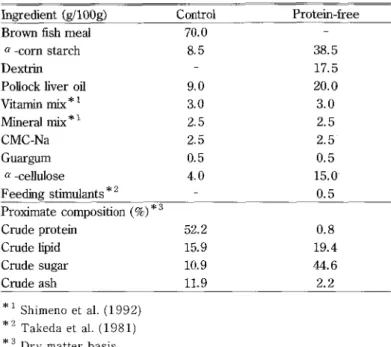
The experiment was carried out at the Usa Marine Biological Center, Kochi University. Juve-nile yellowtail (Sertola quinqueradiata) was used in the experirnents. Juvenlle yellowtni1 from natural stock were obtained from a commercial fish farmer in Usa, Kochi. These fish were kept indoor facility at natural light cycle. These fish were fed a commercial feed (Marubeni Co. Kobe, Japan) for 2 weeks to acclimate them to the experimental conditions. The experirnental diets are shown in Table 1. A fish meal based control diet and protein-free diet (PFD) were formulated. These diets were made by thoroughly mixing the dry ingredients with oil and then
added with cold water. The mixture was then passed through a pelleter and the resulting
noodle-like materials were cut into appropriate size. These diets were stored in -200C freezer untill used.
64 Toni RUCHIMAT, eg to>
Table 1. Composition of the experimental diets
ingredient ig/100g) Control Protein-free Brown fish meal
a -corn starch Dextrin
Pollock liver oil Vitamin mix * i Mineral mix'i
CMC-Na
Guargum
a -cellulose Feeding stirnulants " 2 70.0 8.5 9.0 3.0 2.5 2.5 O.5 4.0 38.5 17.5 20.0 3.0 2.5 2.5 O.5 15.0 O.5 Proximate composition (ge)"3Crude protein Crude lipid Crude sugar Crude ash 52.2 15.9 10.9 ll.9 O.8 19.4 44.6 2.2 "i Shimeno et aL (1992) '2 Takeda et aL (1981) *3
Dry matter basis
Nitrogen excretion
Yellowtail with average body weight of 31.7g were stock into 6 aquaria with 10 fish each. Daily
ration levels were planned for 1, 2, 2.5, 3, 4 9o of body weight and satiation. The fish were fed
two times daily (8:OO and 16:OO). The PFD was fed to the separate group of fish until satiation in order to deterrnine endogenous nitrogen excretion level. , Fish were fed for 9 days. In the
10th day, they were fed at a half of the daily ration at 8:OO only and one fish in each group was
placed in 50L capacity of an Artemia hatching tank (Earth Co., Japan). Water was filled 30L in the tank. At 2, 4, 8, 12, 18, and 24 hours, haif of the water (15L) was exchanged with new
water. The ammonia concentration was measured before and after these water exchange. The
water sample was taken 500ml. For each expetmental group, excretion measurement was
conducted three times and these results expressed as an average. A 24h urea excretion pat-tern was sepafately measured only for the fish fed PFD and control diet both at satiation feed-ing. The water temperature during the experiment was in the range of 22-250C.
Analytical methods
Ammonia and urea concentrations were determined by phenolhypochlorite reaction (Strickland and parsons, 1972). Water sarnple was filtered with O.45 ym filter paper. For the ammonia-N determination, 10ml of water sample was analyzed for ammonia-N by adding with O.4ml of 109o phenol-ethyl alcohol solution (959o), O.4ml of O.59o sodium nitroprusside solution, and 1.0mi of
alkali hypochlorite solution, respectively, then incubating at room temperature for 1 hr, and
re-corded the absorbance at 640nm by means of a spectrophotometer (Hitachi U-1000). For the
urea, 10ml of seawater sample was hydrolyzed by addition of 1.0ml of O.19o urease solution,
incubated at 500C for 20min, then analyzed as ammonia-N as the same procedure described
above. For each sample, duplicate measurements were carried out. Total ainmonia-N
Effect of ration level on nitrogen excretion of yellowtai1 65
mg NH3-N 1 h - V x ( [NH3-N]ti - [NH3-N]tO)
where, [NH3-N]ti = ammonia-N concentration (mgll) at time ti; tO == beginning of the
measurement after water exchange; tl = end of the same measurement period (h) just before water exchange. V = total volume (liters) of water in the aquarium.
RESULTS
The originalIy planned dally ration levels were 1, 2, 2.5, 3, 49o of body weight and satiation
though, the overal1 ration levels during the feeding expetment shifted to 1.4, 2.0, 2.2, 2.5, 3.2
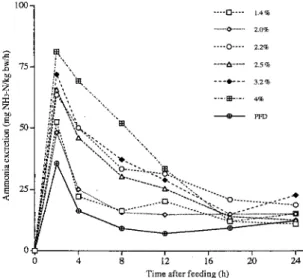
and 49e. The ammonia nitrogen excretion patterns of yeilowtail is shown in Fig. I. For each ra-tion Ievel, a single peak was noticeable at 2 hrs post-feeding. Although amplitude of the peak was not function of the ration level, the satiation feeding group was the highest among the group examined. All peak values became fairy constant after 8-12 h post-feeding. The PFD-fed fish also had a single peak at 2 hrs post-feeding. The time of appearance for the peak of PFD-fed fish synchronized to other control diet-PFD-fed groups, nevertheless nitrogen intake of PFD-PFD-fed
fish was virtually zero. We suspected this peak was induced by stress, because stress is
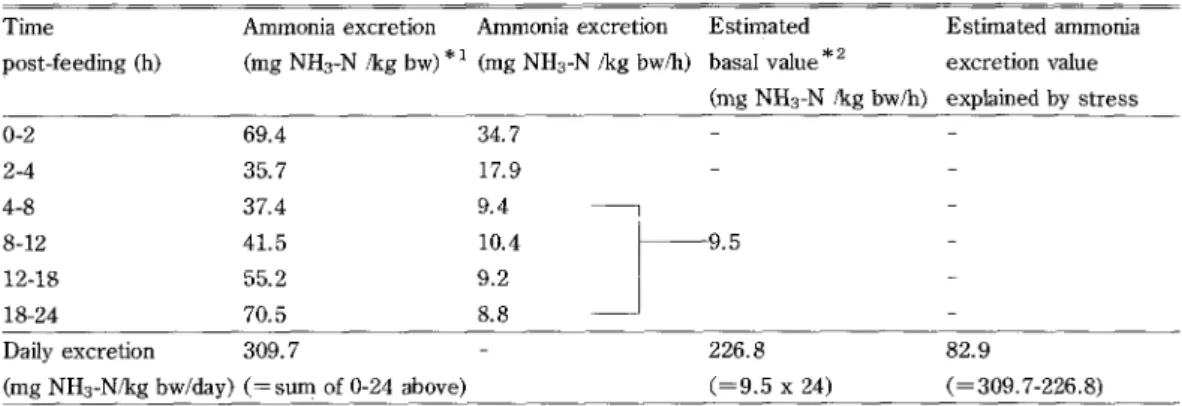
known as one of the factors that increase ammonia excretion rate (Smith, 1971). It is probable that fish had gotten stress when they were moved into the Artemia tank. Since this procedure was applied to all experimental fish, all ammonia excretion values may have been overesti-mated. Therefore, stress related ammonia excretion levels were estimated by subtracting an estimated basal level from actually measured levels (Table2). For the basal level estirnation, the values from 4-8h, 8-12h, 12-16h and 18-24h were taken as the average and the estimated
value becomes 9.5 (mg NH3-Nlkg bwlh). This value was converted to daily excretion value
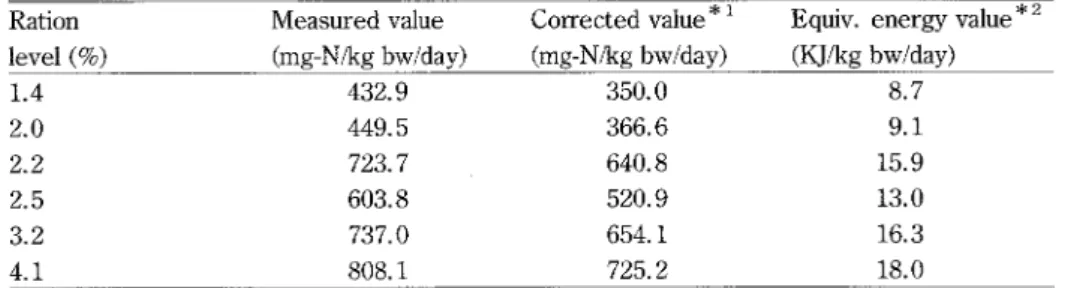
multiplied by 24h and it resulted in 226.8 mg NH3-Nlkg bwlday. The difference of this value (226.8) and the actually measured daily excretion value (309.7) assumed to be explained by stress (82.9). In order to correct this stress effect, daily ammonia excretion values are sub-tracted by 82.9. These corrected values and the!'r equivalent energy values are listed in Table 3. The difference between un-corrected and corrected values are in the range of IO-209o.
Fig. 1. Mean daily variation in ammonia-N excretion in yellowtail fed different feeding levels of control diet and satia-tion feedmg of protain-free diet.
100
g
g 7s yop 2 sk
s se •g g• •g E 2s < o ----n---- IA% •--••e••--- 2.o% ----O---- 2.2% pt. .s f "' --fi--- 2.5%lt
S 'i //111",,l'/'i.3h'"'x,.. Ii;Ii L2%iltllSP{ 'X`ittKt... 'q•... + piD
/ix/"LEr 's"xbo 'L":"tL llStx-- .:$,&H.v-..--;t
o 4 8
12 16 20
Time after feeding (h)
66 'roni RucHIMAT, ez Jb)
Table 2. Estimation in PFD-fed fish for ammonia excretion value explained by stress
Time post-feeding (h) Ammonia excretion (mg NH3-N lkg bw) Ammonia excretion *i (mg NH3-N fkg bwlh) Estimated basal value * 2 (mg NH3-N /kg bwlh) Estimated ammonia excretion value explained by stress O-2 2-4 4-8 8-12 12-18 18-24 69.4 35.7 37.4 41.5 55.2 70.5 34.7 17s9 9.4 10.4 9.2 8.8 .5
Daily excretion 309.7
-(mg NH3-Nlkg bwfday) (== surr1 of O-24 above)
226.8 (=9.5 x 24)
82.9
(=309.7-226.8) * 1 Average of triplicated experiments
*2 Mean of 4-8, 8-12, 12-16 and 18-24 values in the ammonia excretion
Fig. 2. Mean daily variation in urea-N ex-cretion in yellowtail satiatory fed either control of protein-free diet.
g
2s
s kg
g 'g ts as 8 5 20 IS 10 5 o .S"'."'"'-,.,.,,,,.." -•-- e----•-Centrol FH]) or "' e-••••-•••••-•• '''"'' e-""H-•-•-•-•-.H,..,, o .48 12 t6
Time after feeding <h)
20 24
The urea excretion was only measured in PFD- and control diet-fed fish both at satiation feeding level (Fig. 2). The both group of fish had peaks at 4 hrs post-feeding, which was slow-er appearance than the ammonia excretion peaks. The peak value of controi diet-fed fish was higher than that of PFD-fed fish. A daily urea excretion was estirnated based on the excretion pattern shown in Fig. 2, and these values were 25.3 in PFD-fed fish and 61.2 in control diet-fed fish, respectively. The concomitant measurement of ammonia in these groups were 334.5 in PFD and 585.4 in control diet. Thus the daily urea excretion was about 109o of the ammonia
excretion in both groups.
DISCUSSION
In the present study,ing in this study (Fig. 1),
a single peak was noticeable in ammonia excretion at while two peaks were observed in flounder (Dosdat,
2 hrs
post-feed-1995' Kikuchi et ,
Effect of ration level on nitrogen excretion of yellowtail 67
aL, 1991). The discrepancy of excretion patterns in two fish species may be related to the dif-ferences in food passing time. The food passing tirne of warrn water fish (e.g., yellowtail) is
faster than that of cold water fish (e.g., flatfish). The slower passing tirne might result in dis-contmuous ammonla excretlon.
Single peak was observed in daily ammonia excretion of fish fed PFD at 2 hrs post-feeding, while stable excretion patterns has been reported by other researchers (Rychly, 1977; Kikuchi et al., 1991; Dosdat, 1995). We suspected the peak seen in our study may be attributed to stress, so recalculati6n was made (Table 2, Table 3). Based on this recalculation, it was found out that about 10-209o of ammonia excretion was overestimated. ln order to minimize stress effect during fish transfer, Kaushik and Dabrowski (1983) used anesthesia (ethylene glycol monophenyl ether, O.3mlfL) before moving and measuring ammonia of fish. This approach may
worthwhile to apply for yellowtail as well.
Table 3. Ammonia excretion value for yellowtai1 at different feedmg levels
Ration level (9o) Measured value (mg-Nlkg bwlday) Corrected value * i (mg-Nlkg bwlday)
Equiv. energy value"2 (Kllkg bwlday) 1.4 2.0 2.2 2.5 3.2 4.1 432.9 449.5 723. 7 603.8 737.0 808.1 350.0 366.6 640.8 520.9 654.1 725.2 8.7 9.1 15.9 13.0 16.3 18.0 * i Measured value - estimated ammonia excretion value explained by stress (see Table 2) *2 Corrected value x caloric value of arnmonia (=5.95K]lg)
In detemining an endogenous amrnonia excretion, it is a general practice to use starved fish
instead of protein free-diet fed fish because fish generally refuse intake of protein-free diet. In
the present study, however, inclusion of feeding stirnulants to the protein-free diet made it
possible to have voluntary intake of the protein-free diet in yellowtail. This approach should be
useful for estimating nutritive qualities of protein and feed, since precise endogenous nitrogen excretion measurement is necessary for that purpose.
Urea excretion peak was noticeable at 4 hrs post-feeding. This finding is interesting in two points. The first point is earlier study of Brett and Zala (1975) on salmonid and other studies on fresh water fish did not follow a definite pattern in urea excretion, while in the present study as well as studies conducted in flatfish, these sea water fish species showed post-feedmg urea excretion peak. Different nitrogen excretion mechanism may exist in fresh water and sea water fish. The second point is the slower appearance of urea excretion peak compared to the arrimonia peak. Such time difference of two nitrogen metabolites was also observed in flatfish (Kkuchi et al., 1991). It has been proposed that there are three possibie pathways for the formation of urea (omithine-urea cycle, catabolism of arginine and purine breakdown) and the
latter seems to be the main source of urea synthesized by teleosts (Kaushik and Cowey,
1991). The time require for the urea synthesis may take longer than that for deamination. The daily urea excretion rate was estimated to be about 109o of ammonia excretion rate in the pre-sent study and it has been reported as 5-159o of total nitrogen excretion (Kaushik and Dab-rowski, 1983). Therefore, the percentage of urea excretion in the total non-fecal nitrogen can be negleeted. However, the significant post-feeding excretion patterns were noticeable in the
68 Toni RUCMMAT, tXrbN
present study as well1 as other workers (Kikuchi et al., 1991; Dosdat, 1995), suggest that urea excretion pattern may be an important indication for protein nutrition such as dietary protein
quality in marine fish species.
REFERENCES
BRE[['r, J. R., and C. A., ZALA, l975. Daily pattern of nkrogen excretion afid oxygen consumption of sockeye mon (Oncorhynctes nerlea) under controlled conditions. f. Fish. Res. Board Can. 32: 2479-2486.
CHAKRABoRTy, S. C., L. G., RossAND and- B., Ross, 1992. The effect of dietary protein level and ration level on excretion of ammonia in common carp (CyPrinus carpio). ComP. Biochem. Physiot., 103 A: 801-808.
DosDAT, A., R. METAILLER, N. TETu, F. SERvAIs, H. CHARTois, C. HuELvAN and E. DEsBRuyEREs, 1995. rogenous excretion in juvenile turbot, Scophthalmus maximus (L.), under controlled conditions. Aquaculture
Res., 26: 639-650.
FRoMM, P. O., 1963. Studies on renal and extra-renal excretion in a freshwater teleost Salmo gairdneri ComP. Biochem. Phystot. 10: 121-128.
HARRIs, S. A., and T. PRoByN, 1996. Nitrogen excretion and absorption ethciencies of white steenbrass, nathus tithogmathus Cuvier (Sparidae), under experimenta1 culture conditions. Aquac"lture Res., 27: 43-56. KAusHiK, S. J., 1980. Influence of nutritional status on the daily patterns of nitrogen excretion in the carp nus carpio L.) and rainbow trout (Salmo gairdnen). ReProd. AIutr. DeveloP., 20: 1751L1765.
KAusHiK, S. J., and C. B. CowEy, 1991. Dietary factors affecting nitrogen excretion by fish. In C. B. Cowey and C. Y. Cho (ects.), Nutritional Strategies and Aquaculture Waste. Fish Nutrition Research Laboratory, ty of GuelPh, GueIPh, Ontarto, pp. 3-19.
KAusHIK, S. J., and K. DABRowsKI, 1983. Postprandial metabolic changes in larval and juvenile carp (Cmprinus carpio). ReProd. IVutr. DeveloP., 23: 223-234.
KIKticHI, K., S. TAKEDA, H. HoNDA, and M. KiyoNo, 1991. Effect of feeding on nitrogen excretion of Japanese flounder Paraiichthys olivaceus. IVipt,on Suisan Galeleaishi, 57: 2059-2064.
MiNG, F. W., 1985. Amrnonia .excretion rates as an index fer cornparing ediciency of dietary pretein utilization among rainbow trout (Salmo gairdnert) of dfierent strains. Aquaculture, 46: 27-35.
OGiNo, T., J. KAKiNo, and M-S. CHEN, 1973. Protein nutrition in fish-ll . Determination of metabolic fecal rogen and endogenous nitregen excretion of carp. IVipPon Suisan Gakkaishi, 39: 519'523.
RycHLy, J. and B. MARINA. 1977. The ammonia excretion of trout during a 24-hour period. Aquaculture, 11: 173-178.
S-MENo, S., H. HosoKAwA, H. MoRIE, M. TAKEDA, and M. UKAwA. 1992. Inclusion of defated soybean meal to diet for young yellowtail. Suisan2oshoku, 40: 51-56. (m Japanese).
SMiTH, H. W., 1929. The excretion of ammonia and urea by the gills of fish. 1. Biol. Chem., 81: 727-742. SMiTH, R. R., 1971. A method for determining the metabolizable energy for fish feeds. Prog. Fish-Cult, 33: 132-136.
STRicKLAND, J. D. H. and T. R. PARsoNs, T. R. 1972. A practical handbook of seawater analysis. Fish. Res. Bd. Canada 167: 87-93.
'
TAKEDA, M., 1981. Application of feeding stimulants for capture and culture fish. In Japanese Society of Scientfic Fisheries (Ed), Chemical Sense of Fish and Feeding Stimulants. Koseisya-Koseikaku, Tokyo, pp. 109-118. (in Japanese).
WooD, J. D., 1958. Nitrogen exeretion in some marine teleosts. Can. 1. Biochem. Physiol., 36: 1237-1242.