JAIST Repository
https://dspace.jaist.ac.jp/Title
Horizontal Localization of Sound Image and Source
in Monaural Congenital Deafness
Author(s)
Takahashi, Kyoko; Morikawa, Daisuke
Citation
2017 RISP International Workshop on Nonlinear
Circuits, Communications and Signal Processing
(NCSP'17): 437-440
Issue Date
2017-03-02
Type
Conference Paper
Text version
publisher
URL
http://hdl.handle.net/10119/14741
Rights
Copyright (C) 2017 Research Institute of Signal
Processing, Japan. Kyoko Takahashi and Daisuke
Morikawa, 2017 RISP International Workshop on
Nonlinear Circuits, Communications and Signal
Processing (NCSP'17), 2017, 437-440.
Horizontal localization of sound image and source in monaural congenital deafness
Kyoko Takahashi and Daisuke Morikawa
Graduate School of Advanced Science and Technology, Japan Advanced Institute of Science and Technology 1–1 Asahidai, Nomi, Ishikawa 923–1292 Japan
E-mail:{ kyoko.takahashi, morikawa } @jaist.ac.jp
Abstract
It is well known that interaural time difference, interaural level difference and spectral cue are used to determine 3D sound localization in binaural hearing. In the case of monau-ral hearing, interaumonau-ral time difference and interaumonau-ral level ference are not used. Therefore, it is assumed that there is dif-ferent perception of sound localization between binaural and monaural hearing. In this study, we investigate the difference in the horizontal localization of sound image and source in monaural hearing. An experiment involving horizontal sound localization was performed with one female participant suf-fering from congenital complete hearing loss in the left ear. The experimental system consisted of 12 loudspeakers placed horizontally on the circumference of a circle having a radius of 1 m at 30-degree intervals. Four experimental sessions were performed (including 60 white noise stimuli per ses-sion). Excluding the instances with no localization (12%), all sound images were localized on the right side (0∼180 de-grees). It appeared that sound images were localized on the side with the well-hearing ear, but not on the side with deaf ear. Sound source localization was possible generally over 360 degrees (in± 30-degree allowance, 90.8%). As a result, we confirmed that the localization of sound image and source was discrete in congenital monaural hearing.
1. Introduction
In the field of spatial hearing,“ sound image ”is defined as a perceived image from sound signals and“ sound source ” is defined as something that generates sound signals. How-ever, in the case of sound localization in binaural hearing, sound image and source are almost indistinguishable owing to localization in the same dimension. This is because inter-aural time difference, interinter-aural level difference and spectral cue are available to determine sound localization in binaural hearing. By contrast, in monaural hearing, it is assumed that localization of sound image and source are different result because monaural-hearing listeners only use spectral cues.
Several studies on sound localization in monaural hearing have been conducted. However, in these studies, only a few studies have been able to clearly distinguish sound image
from sound source. It is predicted that there are the result of localization of sound image and the result of localization of sound source.
In this study, we investigate the difference in the horizontal localization of sound image and source in monaural hearing and perform two experiments on the localization of sound im-age and sound source by monaural congenital monaural deaf participant who is used to the perception of sound direction in monaural hearing.
2. Experiment
2.1 Experimental system and stimuli
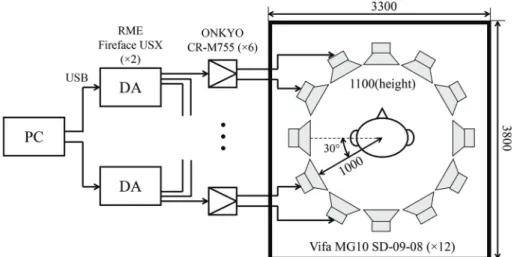
Figure1shows the experimental setup. The system com-prised a Windows-based PC, two digital-to-analog convert-ers (DACs) (RME, Fireface USX), six power amplificonvert-ers (ONKYO, CR-M755), and 12 loudspeakers (Vifa, MG10 SD-09-08). Sampling rate of the DACs was 48 kHz, and the quan-tization bit length was 24 bit. The loudspeakers were placed horizontally on the circumference of a circle having a radius of 1-m at 30-degree intervals in a the soundproof room. The height of the loudspeakers was 1.1 m. The participant sat on a chair set at the center of the circle of loudspeakers such that the height of the opening of the external acoustic canal was the same as the height of the loudspeakers, and perceived stimuli.
White noise was used as stimuli. The stimulus duration and interval time were both 3 s. A 30-ms linear taper window was applied at the beginning and the end of stimuli application. The sound pressure of stimuli was 70 dB at the head center position.
2.2 Participant and experimental method
The participant was a female (23 years old) suffering from monaural congenital deafness: normal hearing in the right side ear, deafness in the left.
The experiment of horizontal localization of sound image was carried out over four sessions. One session sequence was included five stimuli from each loudspeaker at random. The
2017 RISP International Workshop on Nonlinear Circuits, Communications and Signal Processing (NCSP'17) Guam, USA, February 28th to March 3rd, 2017
Figure 1: Experimental system
total number of stimuli was 60 in four sessions. The partic-ipant was instructed to face the front and keep her head still while the stimuli were presented, and to answer after presen-tation of the stimuli was complete. Next, the experiment on horizontal localization of sound source was performed by fol-lowing the same procedure.
The questionnaire forced a choice among one of 12 direc-tions as the response, and the participant’s responses men-tioned the directions in which the sound image and the sound source were localized.
3. Result
Figure2illustrates the introspective perception of the par-ticipant in localization of sound image and source. The two circles made of dashed lines represent the localized posi-tions of the sound image and the sound source. As shown in this figure, the participant perceived introspective differences between the localization of sound image and that of sound source.
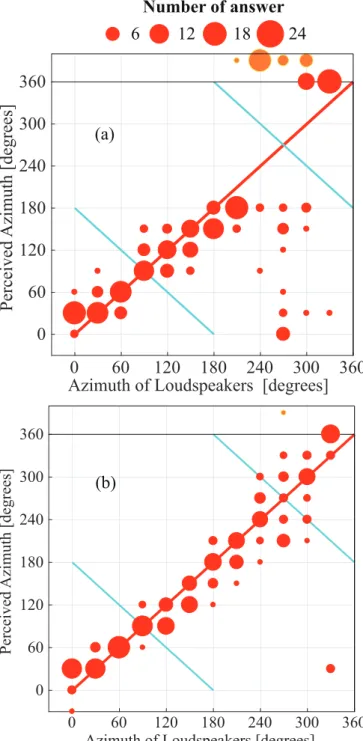
Figure3(a)shows the result of localization of sound im-age over four sessions, and Fig. 3(b)shows the result of lo-calization of sound source over four sessions. In each fig-ure, the ordinate represents the perceived azimuth, and the abscissa represents the azimuth of the loudspeakers present-ing the stimuli. The front of the participant is 0 degrees in the counterclockwise direction. The red points denote the answers related to external-head localization, and the yellow ones indicate that the participant could not localize a given stimulus. The size of each point represents the number of re-sponses. The upward right direction of the red diagonal line means the case that the perceived azimuth is in line with the azimuth of the loudspeakers. Front-back confusion did not
Localize position of sound source Localize position of sound image loudspeaker
The monaural congenital deaf participant
Figure 2: Perception of sound image and sound source in monaural congenital monaural deafness
appear in the results of the experiment on the localization of sound image and source.
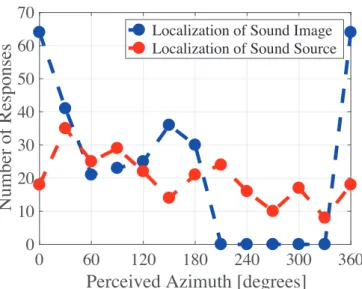
Figure 4 shows the number of responses in the horizon-tal localization of sound image and source over four sessions for each sound image and source. The ordinate represents the number of responses where sound image and source were localized, and the abscissa is the azimuth of the loudspeak-ers presenting stimuli. The blue dashed line and the circular plots represent the result of localization of sound image, and the red dashed line and circular plots represent the result of localization of sound source. As shown in Fig. 4, all sound images were localized over 0∼ 180 degrees (i.e., on normal-hearing side), except the unlocalized responses (12%), and
sound images were not localized on the deaf side.
Figure5 shows the concordance rate of horizontal local-ization of sound image and source at ± 0 and at ± 30 de-grees allowance. The group of bars on the left side repre-sents the conductance rate of localization of sound image, and the one on the right side represents the localization of sound source. In this figure, the yellow bars denote the rate of total responses, blue ones denote the responses from the deaf side, and the red ones denote responses from the normal-hearing side. The concordance rate of localization of sound image on the normal-hearing side was 95.7% with± 30-degree al-lowance, according to the left side of Fig. 5. According to the right side of Fig. 5, the concordance rate of localization of sound source was 90.8% with± 30-degree allowance. On the normal-hearing side, the concordance rate was 99.3%. On the deaf side, it was 81.7%.
4. Discussion
From the result of the experiment on localization of sound image, the direction of localization of sound image was al-most concordant with the direction of stimuli on the normal-hearing side, and it was not concordant with the direction of stimuli on the deaf side: In some cases, there were no local-ization, and in other cases, there was a difference between the direction of localization of sound image and the direction of stimuli. In contrast, in the result of the experiment of local-ization of sound source, the direction of locallocal-ization of sound image was concordant with the direction of localization of sound source generally over 360 degrees. These results sug-gest that in monaural hearing, the horizontal localization of sound image is possibly different from that of sound source.
The trend that sound images of stimuli presented on the deaf side were localized on the normal-hearing side agrees with the results of Wightman et al. [1] and Slattery et al. [2]. However, the result that sound images were localized on the normal-hearing side when the stimuli were presented on the normal-hearing side is not in accord with the these results, but it agrees with the result of Butler, who emploved broadband noise [3]. The same trend can be seen in the result of hori-zontal localization of sound image by Kojima et al. [4]. The agreement of the present study with those of Butler and Ko-jima et al. in terms of monaural hearing seems to stem from the fact that the latter experiments employed participants with the binaural hearing to test monaural hearing without provid-ing them localization trainprovid-ing. The participants of those stud-ies did not localize sound source but sound image. The du-ration of stimuli in Wightman et al. and Slattery et al. were short (250 ms), and the experiments included advance local-ization training, which may have led to confusion between localization of sound image and source, as well as front-back confusion.
Strelnikov et al. reported the effect of previous localization
0
60
120
180
240
300
360
Azimuth of Loudspeakers [degrees]
0
60
120
180
240
300
360
Perceived Azimuth
[degrees]
(a)
6
12
18
24
Number of answer
0
60
120
180
240
300
360
0
60
120
180
240
300
360
Perceived Azimuth
[degrees]
(b)
Azimuth of Loudspeakers [degrees]
Figure 3: Result of horizontal localization, (a) sound image and (b) sound source
training on monaural hearing [5], and Slattery et al. reported that a few congenitally monaural deaf people are able to lo-calize sound generally over 360 degrees [2]. These reports are agreed with our result that the participant was able to lo-calize the sound source over 360 degrees. It is believed that
0
60
120
180
240
300
360
Perceived Azimuth [degrees]
0
10
20
30
40
50
60
70
Number of Responses
Localization of Sound Image Localization of Sound Source
Figure 4: Number of responses in horizontal localization of sound image and source
0 10 20 30 40 50 60 70 80 90 100 Concordance Rate [%] Enteir of 360 degrees Deaf Side Normal-hearing Side ±0 degrees ±30 degrees
Localization of Sound Image
±0 degrees ±30 degrees
Localization of Sound Source
Figure 5: Concordance rate of horizontal localization of sound image and source with± 0 and ± 30 degree allowance
this correspondence appears because congenitally monaural deaf people often train in sound localization naturally over the course of their life. However, the result of localization of sound image in this study does not agree with the results of the aforementioned previous reports.
Therefore, it is assumed that Butler and Kojima et al. pre-sented the result of localization of sound image, while Strel-nikov et al. and Slattery et al. presented the result of local-ization of sound source.
With these results, it appears that possibly, congenitally monaural deaf people use different information in localiza-tion of sound image and source. In the localizalocaliza-tion of sound image, they use spectral cues, and in the localization of sound source, they use spectral cues and sound level. The informa-tion that the localizainforma-tion of sound image and source are based on different information, can possibly be used for prediction of localization of sound source in monaural experiments. 5. Conclusion
Experiments on horizontal localization of sound image and source were carried out with a congenitally monaural deaf participant for investigating differences in horizontal local-ization of sound image and source in monaural hearing. As a result, it was found that the localization of sound image and source was different result from each other in congeni-tal monaural hearing. This suggests that it will be necessary to distinguish between sound image and source when con-ducting sound localization experiments with monaural hear-ing objects.
Acknowledgement
Part of this study was supported by the Cooperative Re-search Project Program of the ReRe-search Institute of Electri-cal Communication, Tohoku University (H27/A13), and The Telecommunications Advancement Foundation. We would like to thank Professor Tatsuya Hirahara of the Toyama pre-fectural University, for his cooperating in carrying out these experiments.
References
[1] F. L. Wightman and D. J. Kistler: Monaural sound local-ization revisited, The Journal of the Acoustical Society of America, Vol. 101, No. 2, pp. 1050-1063, 1997.
[2] W. H. Slattery III and J. C. Middlebrooks: Monaural sound localization: Acute versus chronic unilateral im-pairment, Hearing Research, Vol. 75, No. 12, pp. 38-46, 1994.
[3] R. A. Butler: The bandwidth effect on monaural and binaural localization, Hearing Research, Vol. 21, No. 1, pp. 67-73, 1986.
[4] D. Kojima and T. Hirahara: Monaural horizontal sound localization in head still and head movement conditions, IEICE Technical Report, EA2014-44, Vol. 114, No. 358, pp. 25–30, 2014 (in Japanese).
[5] K. Strelnikov, M. Rosito and P. Barone: Effect of Audio-visual Training on Monaural Apatial Hearing in Horizon-tal Plane, PLoS ONE, Vol. 6, No. 3, pp. 1–9, 2011.