China’s Non-intervention Policy in UNSC Sanctions
in the 21st Century: The Cases of Libya,
North Korea, and Zimbabwe
Ren, Mu*
Abstract
In rhetoric, China has insisted on the principle of non-intervention in the domestic affairs of other countries but, when participating in the United Nations, has demonstrated that its non-intervention policy is flexible. The disjuncture of word and deed, of policy pronouncements and actual diplomatic behavior, can be explored by examining China’s attitude and behavior toward international sanctions in the United Nations Security Council [UNSC]. Although China remains skeptical about coercive measures authorized by the UNSC, it has been open to certain sanctions. China’s approval of any given sanctions depends on the country’s adherence to the international consensus. The principle of non-intervention gives rise to Chinese concerns about the conditions for imposing sanctions. This article posits three situations of Chinese concerns about these conditions, which result in the country’s response to affirm, to abstain from, and to veto, UNSC sanctions.
Keywords:
International sanctions; Non-intervention principle; China; Libya; North Korea; Zimbabwe
Ritsumeikan International Affairs Vol.12, pp.101–134 (2014).
* PhD Candidate, Graduate School of International Relations, Ritsumeikan University.
** The author is grateful to professors Ryoji NAKAGAWA and Sachio NAKATO as well as two anonymous reviewers for their extremely valuable comments on previous drafts of this article.
Introduction
A belief in absolute sovereignty has meant that China has long insisted on the principle of non-intervention in the internal affairs of other states. This concept presents a dilemma for Chinese leaders who conceive foreign policy from contradictory imperatives. During the last decade, China has undoubtedly become a rising power in the international arena. It has declared its intention to engage proactively in international affairs, thereby gaining a reputation as a responsible power that fulfills its obligations to the international community. However, it is unlikely that a country can remain completely isolated from participation in the contemporary international system with its high degree of interdependence, thereby making absolute non-intervention inevitable. Moreover, intervention in certain circumstances is justified as a necessary method or a last resort to deal with domestic and international problems. Hence, China’s pronouncement of the non-intervention principle belies its motivation to exercise diplomatic influence in the international system. It is plausible that China poses intransigence toward external interventions and refrains from interference in other countries’ domestic affairs,1) but Beijing’s attitudes and behavior toward international intervention
are flexible,2) especially its participation within international organizations.
Hence, it is worth analyzing China’s non-intervention policy by its reactions to international interventions.
This article focuses on China’s diplomatic behavior regarding the non-intervention principle through the country’s participation in international sanctions in the UNSC. Firstly, the UNSC is an appropriate vehicle to examine China’s non-intervention policy since it provides a universally recognized forum for mandating interventions, wherein approved interventions, which are sometimes controversial, usually embody the perspectives of different countries. As one of the five permanent members [P5] of the UNSC with veto power, China is privileged to use the UNSC as a mechanism to manifest ideas on the rights and limitations of international conduct and to block certain interventionist proposals. Undeniably, the UN framework has proved inadequate and ineffective when confronting some issues that threaten international peace and security. Regional organizations or individual countries have bypassed the UNSC and
1) This does not mean that China has never engaged in interventionist activities.
2) This article adopts the definition of international intervention argued by Gene Lyons and Michael Mastanduno (1995, p.12) that it may be understood as the crossing of borders and infringements of sovereignty carried out by, or in the name of, the international community.
conducted military interventions in Iraq, Kosovo, as well as Afghanistan, etc. From China’s perspective, however, only those interventions authorized by the UNSC have legitimacy. Furthermore, China has begun to play an active role in the international community to project itself as a responsible power, but its opinions of disapproval have hardly affected interventionist actions beyond the UN framework.3) Therefore, studying China’s behavior at the UN could
demonstrate how the non-intervention principle influences China’s involvement in international organizations and international interventions.
Secondly, UNSC sanctions are a critically interventionist institution under the UN apparatus.4) It is considered an important tool in the maintenance and
restoration of international peace and security (UNSC, 2006, June 22). Essentially coercively interventionist, sanctions logically conflict not only with the principle of state sovereignty but also with the principle of non-intervention on which the Chinese government intransigently insists, at least at the verbal level. Although UNSC sanctions are not taken as a violation to the norm of non-intervention and are thus generally accepted by the members of international community,5)
the Chinese government has firmly articulated that an act of coercion and isolation is counterproductive in gaining the cooperation of targeted countries. Moreover, one of the legitimate roles of the UNSC is that its authorization may bring a sine qua non of major powers’ intervention since the P5 countries are capable of steering or capturing sanctions to meet their particular foreign policy objectives, which may or may not match the goals of the broader UN community6) (Cortright & Lopez, 2000, p. 6). Hence, China’s reactions to UNSC
sanctions could be investigated to determine the extent to which the Chinese government implements the non-intervention policy to resist or comply with the
3) The UN is important to China, and possible reasons have been discussed by Kim (1999) and Tieh (2004). China’s White Paper on Peaceful Development specifies that it is important to give full play to the UN’s role in maintaining world peace and security and in establishing a fair and effective mechanism for upholding common security (Information Office of the State Council, September, 2011).
4) Although the term, sanction, is not explicitly written in the UN Charter, the Chapter empowers the Security Council to order any combination of non-military measures against a wrongdoer. In Article 41 of Chapter VII, the Security Council may decide what measures, not involving the use of armed force, are to be employed to give effect to its decisions, and it may call upon the Members of the United Nations to apply such measures.
5) Even the US wants to use the Security Council to apply sanctions against specific states as sanctions bear the diplomatic appeal of being “international” rather than “US- imposed”.
6) This does not mean that the P5 members do not constrain themselves from pursuing their objectives irrespective of international norms. It only provides a possibility that P5 countries could take advantage of the UNSC to serve their own interests.
international community.
Prior research focusing specifically on this area is rare, and only a small subset of comprehensive studies across different issue areas has been conducted. Zhao Tong (2010) compared China’s historical experiences as a sanction target and as a sanction initiator and thus argued that China has been much more open to using or threatening to use tactical sanctions in its own practice. In terms of degrees of sanctions, Zhao provided an inspiring perspective from which to examine China’s behavior toward sanctions by dividing sanctions into two categories, namely, strategic and tactical sanctions. However, Zhao only focused on unilateral economic sanctions imposed by China and paid little attention to China’s behavior toward international sanctions. It is difficult to define whether sanctions employed by the UNSC are strategic or tactical. There are some previous works on Chinese foreign policy toward specific countries, such as Iran and North Korea, with respect to sanctions.7) These works presumed that Chinese
foreign policies was in opposition to other Western countries, in particular, the US, which fails to capture the full picture of China’s behavior in the UNSC.
This article addresses this academic oversight and examines China’s attitude and behavior toward international sanctions by discussing these questions: (1) given that China has been cautious and skeptical about adopting sanctions as an effective method of achieving UNSC targets, why was it relatively open to certain international sanctions in practice? (2) Under what conditions was China inclined to endorse sanctions instead of other approaches? (3) Why has China decided to vote in different ways - e.g., affirmation, abstention, or veto- regarding certain issues? This article is constructed as follows. The first section analyzes China’s votes on sanctions-related resolutions in the UNSC. The second section evaluates the implications of China’s responses to international sanctions. In some cases of unanimous international consensus, China has relinquished the non-intervention principle entirely and has chosen a compromise to international sanctions. But its concerns on the non-use of force, reasonable intentions, and promising prospects of specific cases can be seen as China’s resistance to UNSC sanctions. This section then lists three situations in which China’s decisions on international sanctions have varied. The following section moves to case studies in which China’s decisions relating to international sanctions on Libya, North Korea, and Zimbabwe prove the presumptions of the preceding section. The conclusion provides an overview of the flexibility of Chinese attitudes and
behavior toward international sanctions in various situations and outlines further research by the author.
I. Chinese attitudes and behavior toward UNSC
sanctions
China generally emphasizes its concerns about sanctions as a method, but it has seldom exerted its veto power to alter the original sanctions-imposing proposals. China has had a relatively positive attitude toward sanctions-related resolutions since entering the UNSC. In the 21st century, the UNSC has passed 178 sanctions-related resolutions, of which, China supported 170 and abstained from eight. During this period, China cast fewer abstention votes than it did in the entire decade of the 1990s, though it used the veto four times. (See Table 1)
Table 1: Chinese Sanctions-related Votes in the UNSC in the Post- War Era
Years Aye Abstention Veto
1990–1999 78 20 0
2000–2009 133 5 1
2010–2013.04 37 3 3
Sources: Official Document System [ODS] of the United Nations; UN Bibliographic Information System [UNBISnet]; UN Security Council Sanctions Committees.
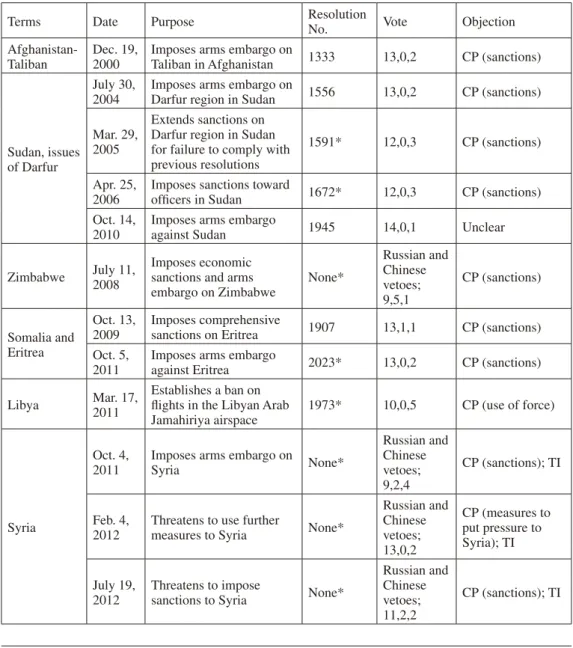
During this period, negative votes by China, which consisted of abstentions and vetoes, were closely associated with sanctions against countries in the regions of Africa and the Middle East, including Sudan, Somalia and Eritrea, Libya, Zimbabwe, and Syria. (See Table 2) Abstentions are used for more than simply sideline expressions of neutrality. China’s abstentions could be seen as dissenting from other Western countries in the UNSC and as expressions of China’s preferences, perspectives, or even its attitude in the face of international pressure.
It appears that Chinese abstentions and vetoes have been cast against resolutions targeting states in which China has broad interests. Accordingly, James Traub (2006) argued in the New York Times Magazine that China used its power to “protect abusive regimes with which it is on friendly terms,” and that “China is prepared to play the role of spoiler” on issues discussed in the UNSC. Similar judgments of Chinese assertiveness have prevailed in the Western media
as well as academia.8) Consequently, China has been portrayed as an anti-status
quo power that pushes back against Western countries. To some extent, these arguments are partly true and convincible because China has agreed with the sanctions against those countries, such as Côte d’Ivoire, Sierra Leone, with which China itself has relatively loose economic or military connections.
Table 2: Chinese Negative Votes on Sanctions-Related Resolutions (2000- present)
Terms Date Purpose Resolution No. Vote Objection
Afghanistan-Taliban Dec. 19, 2000 Imposes arms embargo on Taliban in Afghanistan 1333 13,0,2 CP (sanctions)
Sudan, issues of Darfur
July 30,
2004 Imposes arms embargo on Darfur region in Sudan 1556 13,0,2 CP (sanctions) Mar. 29,
2005
Extends sanctions on Darfur region in Sudan for failure to comply with previous resolutions
1591* 12,0,3 CP (sanctions) Apr. 25,
2006 Imposes sanctions toward officers in Sudan 1672* 12,0,3 CP (sanctions) Oct. 14,
2010 Imposes arms embargo against Sudan 1945 14,0,1 Unclear Zimbabwe July 11, 2008 Imposes economic sanctions and arms
embargo on Zimbabwe None*
Russian and Chinese vetoes; 9,5,1 CP (sanctions) Somalia and Eritrea Oct. 13,
2009 Imposes comprehensive sanctions on Eritrea 1907 13,1,1 CP (sanctions) Oct. 5,
2011 Imposes arms embargo against Eritrea 2023* 13,0,2 CP (sanctions) Libya Mar. 17, 2011 Establishes a ban on flights in the Libyan Arab
Jamahiriya airspace 1973* 10,0,5 CP (use of force)
Syria
Oct. 4,
2011 Imposes arms embargo on Syria None*
Russian and Chinese vetoes; 9,2,4 CP (sanctions); TI Feb. 4,
2012 Threatens to use further measures to Syria None*
Russian and Chinese vetoes; 13,0,2 CP (measures to put pressure to Syria); TI July 19,
2012 Threatens to impose sanctions to Syria None*
Russian and Chinese vetoes; 11,2,2
CP (sanctions); TI
Sources: ODS; UNBISnet
Note1: “Purpose” describes only the aspects of the proposal relevant to sanctions; some are omnibus proposals that also deal with other subjects, such as peacekeeping. The resolution with * means both of China and Russia cast the negative votes.
Note2: Vote is written as “aye, veto, and abstention.”
Note3: Objections: CP= measure in question would be counter-productive; CS= principled stand on invoking Chapter VII of the UN Charter; NA= the UNSC is not appropriate venue for settling problem in question; TI= does not respect territorial integrity/ sovereignty.
In terms of its voting record, however, it is difficult to infer that China’s passive responses to all these cases associated with pariah countries are for its own benefit in the UNSC. In other words, the judgment that China is on the opposite end in relation to Western countries in the UNSC only considers confirming evidences while ignoring disconfirming examples. First, the states targeted after the year 2000 in Figure 1 are not economically important to China, except for Iran and Sudan whose resource exports take up a large part of China’s bilateral trade.
Figure1: The Shares of Bilateral Values of Targeted States in China’s Foreign Trade (2000–2011)
Furthermore, China had varied interests in these countries. Table 3 roughly depicts the economic and military relationships between China and the targeted states. China transferred large-scale weapons to Iran and Sudan but had lesser or no recorded transactions of arms with Zimbabwe, Eritrea, North Korea, Syria, etc. The scale of China’s economic trade with Iran, Sudan, North Korea, Libya and Syria at the time of the sanctions was larger than those with Eritrea, Ethiopia, the Democratic Republic of the Congo [DRC] and Zimbabwe.
China favored sanctions that targeted countries that were economically and strategically important to it, such as North Korea and Iran. On the other hand, China did not completely support the punitive measures on the states that were seemingly unbeneficial to it, e.g., Eretria. Material interests are, therefore, not the single motivation for China’s negative voting in the UNSC to protect specific countries.9) As the second largest economy in the world, China has economic
partners spread all over the world, and therefore, few countries are of no benefit to mercantilist China. Besides, Chinese disagreements on specific issues are not a new phenomenon; the rate of its abstentions in the 2000s and thereafter, as it has been seen as a rising and assertive power, has been far lower than that of the 1990s. Since material interests fail to explain all Chinese actions relating to UNSC sanctions, other factors underlying the votes that influence China’s decision-making, as well as the situations in which China has specific preferences, need to be investigated.
Table 3: China’s Economic and Military Relations with Targeted States (2000–2013)
Country Years Bilateral trade (first instance) (US$ 10,000) Bilateral trade (end or in 2011)
Arms transfers (during or before the sanctions)
Rate of TIV of arms exports from China (first instance) Rate of TIV of arms exports from China (1990- 2012) Sierra Leone 1997-2010 (1997)409 10,912 (2010)
Patrol craft; Type- 83 122mm towed gun (2006
and 2010 delivery) 2% 0.11% Eritrea and
Ethiopia 2000-2001 (2000)5,857 (2001)8,057 No record No record No record DRC present2003- (2003)5,166 398,721 (2011) ZFB-05 (2009 delivery)APC (2007 delivery); No record 0.01%
9) For instance, China has a larger economic interests in Iran than in Syria. China did not obstruct sanctions against Iran, while it had cast vetoes on sanctions against Syria.
Liberia present2003- (2003)6,814 500,793 (2011) No record No record No record Sudan present2004- 252,176 (2004) 1,153,615 (2011) Tank (2003 delivery); aircraft (2004 delivery); IFV (2004 delivery); portable SAM (2005 delivery) 1.54% 3.16% Côte
d’Ivoire present2004- 23,147 (2004) 70,273 (2011) No record No record No record North Korea present2006- 170,009 (2006) 564,149 (2011) Towed MRL (1964– 1990); APC (1972–1992); Type-6633 (1973–1995); portable SAM (1985– 1994) No record 1.96% Iran present2006- 1,444,741 (2006) 4,510,340 (2011)
Anti-ship missiles, IFVs, portable SAMs (various types, delivery dates and
quantities)
8.67% 11.84%
Zimbabwe None 28,131 (2008) 87,437 (2011) K-8 combat ac (2006 delivery) No record 0.32% Eritrea present2009- (2009)3,992 14,903 (2011) No record No record 0.05% Libya present2011- 278,395 (2011) applicableNot No record No record No record
Syria None 244,640 (2011) applicableNot Air search radar (2010 delivery) No record 0.11% Sources: National Bureau of Statistical of China(2001–2012); SIPRI Arms Transfer Database.
Note: The targets, which are non-states, are not included in this table. These abbreviations of weapons can be found at URL <http://www.sipri.org/contents/armstrad/at_data.html>.
II. Implications of China’s responses to the sanctions
It is notable that due to its weak position among the P5, China has never been an agenda-setter within the UNSC. Its behavior at the UN can be seen as a responsive engagement. China seldom hinders sanctions-related initiatives, but it has a relatively low level of convergence with the other four members, especially with the Western group, including the US, France, and the UK. The disagreements are mainly concentrated on the incongruity between the coercive measures advocated by Western countries in the name of maintaining
international order and the foreign policy principles to which China has adhered.
A. Conceding to the international community
China’s support for the principle of absolute sovereignty, which comprises the equality of sovereign states, non-intervention, and mutual respect for the integrity of territoriality and sovereignty, has affected Beijing’s behavior at the UN. Beijing’s insistence on these principles is based on a state-centered ontology, which highlights the security of countries in the international system rather than the security of individuals in international society. In the case of paramount state sovereignty, if an agenda is to become a necessary act, it must be supported by legitimate reasons on the basis of state consent, normally constituting the requirements of the power proposing it and the demands of other states approving it. Therefore, China’s approval of specific UNSC sanctions to some extent reveals that Beijing compromises on its principle and interests in international order, thereby benefiting the majority of the UNSC member states.10)
The Chinese government has supported the majority of the international sanctions in the UNSC, but it generally does not rhetorically approve coercive measures imposed on sovereign states. China’s behavior demonstrates that it recognizes that when one country must be subjected to international intervention on the basis of international consensus, the sacredness of sovereignty must be subordinate to the demand of international order. At the international level, China admits that the UNSC has legitimate power to employ international sanctions on behalf of the international community.11) However, this does not
mean that sanctions are the most appropriate measures in Chinese worldview. China considers that sanctions should be applied with prudence and under the precondition that all peaceful means have been exhausted (Ministry of Foreign Affairs of the People’s Republic of China [CFM], 2005). In addition, the UN must set strict criteria and explicit time limits for the sanctions mechanism and should minimize the possibility of humanitarian crisis arising from sanctions and
10) Avoiding possible isolation or condemnation, the impact of transformation of international norms as well as moral judgments possibly propel China’s compliance.
11) Article 2(7) of the UN Charter provides that enforcement under Chapter VII overrides domestic jurisdiction. Nothing contained in the present Charter shall authorize the United Nations to intervene in matters which are essentially within the domestic jurisdiction of any state or shall require Members to submit such matters to settlement under the present Charter; but this principle shall not prejudice the application of enforcement measures under Chapter VII.
its impact on other countries. China’s hesitant attitude toward sanctions exhibits its concerns about the apropos conditions and methods to implement sanctions.
Non-use of force
To maintain international order, China has a preference for political negotiation and coordination as opposed to using coercive measures against targeted states; this preference is based on China’s belief in non-interference combined with its commitment to mutual respect of the integrity of territoriality and sovereignty. As a consequence, China hesitates to support resolutions that permit the use of armed force by the UNSC or other organizations. The UN Charter defines international sanctions as a punitive measure without the use of force, but the contents of some sanctions imply the possibility of military action, illustrative in its authorization of states “to take all necessary measures”. Regarding the principle of non-use of force, China advocates that the Security Council is the only authorizing organ on the use of force and regional arrangements or organizations must obtain UNSC authorization prior to any enforcement action (CFM, 2005). Nevertheless, UNSC authorization on the use of force is based on the consent of the SC members. From China’s perspective, the use of force is a last resort measure and should not be imposed as long as alternatives exist. Hence, China is inclined to carry on a continuous dialogue aimed at convincing targeted states to accept UNSC intervention in managing conflicts, and it also pursues resolutions by the UNSC with the consent of the governments of targeted states. In short, China is cautious about advocating a draft on the use of force without the consent of targeted states or the unanimous approval of all UNSC members and other stakeholders.
Reasonable intentions
China’s insistence on the effective control of absolute sovereignty affects its interpretation of international intervention, which relies on justification and reasonable intention. China acknowledges the legitimacy of the UNSC, but does not take this regime as an impartial forum, since international consensus comes from individual states that naturally pursue their own interests. China is hesitant to associate itself with traditional Western countries and remains skeptical about the latter’s underlying intentions and the actual benefits from international interventions. China continually denounces that some Western countries force other countries to follow their value and political systems. Particular countries may use the authorized UNSC intervention to topple a local government and to
acquire the targeted state’s obedience or compliance. Therefore, regime change is China’s gravest concern, especially given that the so-called intervention might be an excuse by a certain country that might be taking advantage of civilian protection or international order to change the troublesome regime of a targeted state.
Promising prospects
China favors cooperation with governments of targeted states that are seen as legitimate representatives of the population in addressing domestic issues. Sanctions can be limited pressure serving as a political signal that compels the targeted state to reconsider its policies, especially if combined with inducements and opportunities for progress through dialogue. China continues to oppose harsh sanctions aimed at forcing policy changes by inflicting injury to a country’s economy and the livelihood of the people. China has different criteria and principles toward international issues from that of Western countries. Beijing even applies a strict criterion on the emerging norm “Responsibility to Protect”12)
in order to avoid military intervention that may derive from the vested interests of a particular country or to avoid a humanitarian catastrophe.
B. China’s decisions on UNSC sanctions: three situations
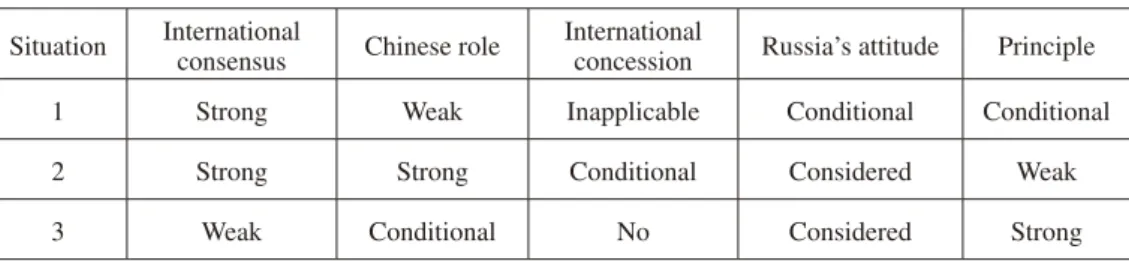
China conveys its views and concerns on different cases through its votes on UNSC sanctions-related proposals. Various factors, or combinations thereof, affect China’s responses to sanctions, including compromising of international consensus, China’s role and interest, issue area, concerns about non-intervention principle, etc. As intricate as it might be, there are three basic situations that summarize the record of Chinese votes on sanctions, through which one can assess the conditions under which China is willing to make a compromise or resist international intervention.
Situation 1: International consensus has been reached, but China does not play an important role in addressing the target’s problem. Under these conditions, China tends to concede to the proposal on sanctions.
China’s assessment of whether the contents of sanctions contradict its non-intervention principle yields two outcomes: affirmation or abstention. In this
12) China officially states that any response to a massive humanitarian crisis should strictly conform to the UN Charter and the opinion of the country and the regional organization concerned should be respected. The action should lead to a peaceful solution (CFM, 2005).
situation, the targeted state is usually not located in a pivotal geographic zone, which means that a sanction against the targeted state will not threaten regional and international stability. If sanctions are proved to be a necessary method and do not involve military means, China has no reason to block the sanctions that have been approved by the major powers and other stakeholders. Few countries like to become involved in the affairs of another country that is geopolitically distant and does not serve their strategic and economic interests. Furthermore, China might lack diplomatic leverage to mediate the crisis. In this context, the non-intervention principle is never the normative reason for restraining international intervention, which was evident in China’s response to the sanctions against Serra Leone, Côte d’Ivoire, Liberia, Ethiopia, etc.
On the other hand, China is inclined to cast an abstention when taking sanctions does not coincide with the non-intervention principle. Abstention signals China’s opposition to interference in the internal affairs of sovereign states, while allowing Beijing to avoid alienating allies and the wider international community (Shichor, 2006). The non-intervention principle is technically used as China’s explanation for abstentions. This excuse may obscure China’s real intentions, but in consequence, China concedes its interests by participating and addressing international issues. China’s abstentions to the sanctions against Afghanistan, Libya, and Ethiopia and Eritrea arguably reflect its struggle with balancing its foreign policy principles and its international behavior.
Situation 2: China’s diplomatic efforts in persuading a targeted state’s cooperation are ineffective. Beijing thus minimizes the negative outcome before the sanctions are put on the agenda in the UNSC.
With respect to the countries with which China has strong economic or strategic interests, Beijing can play an important role in mediating between the targeted state and the sanctions-initiating countries. In order to guarantee the approval of the sanction, the P5 and other stakeholders communicate with each other to maintain formal unity before the draft resolution is discussed in the UNSC. When the coercive measure has been proved as the last resort, and is strongly advocated by the international community, China may seek international concessions by negotiations with great powers, or threaten to use its veto power, to moderate a harsh draft. If China succeeds, a watered-down resolution can thereafter be presented to the Council, which is a way of reducing the risk of losses suffered by both the targeted state and China. The relevant sanctions against Iran and North Korea are appropriate examples. If not, China may cast an abstention. Chinese votes on the issues concerning Sudan are cases in point.
Situation 3: When the international community has not reached a consensus, China is disposed to pursue the Sino-Russian convergence.
If the P5 cannot reach consensus on a resolution, they may choose to adopt a presidential statement [PRST] or other measures that are non-binding in international law, which constitute less radical changes in existing regimes. Under conditions of international dissent, China pursues similar political stands as Russia. As Russian foreign minister stressed, in the global context, Russia and China are close partners in the UNSC (Lavrov, 2012, December 9). In some cases, the targeted states are of more strategic significance to Russia than to China. China historically concentrates on its existence in East Asia. Conflict-affected regions like the Middle East and Africa are not within China’s security concerns. Russia and other Western countries traditionally compete with each other for maintaining their power presence in these regions. When Russia and other Western countries encounter divergence regarding a targeted state, China often sides with Russia since it is also skeptical of the real intentions of Western countries.
China is reluctant to use its veto power, but it has cast vetoes on some sanctions that yield no benefits to Beijing. A compelling convergence in veto employment exists between China and Russia. Using Syria as an example, the Security Council started addressing the issue of Syria when it was still knee-deep in the quagmires of Libya. It provided China with a good pretext that measures against Syria might repeat Libya’s tragedy. It was reasonable that chronological subsequence was a factor in China’s concern with the problem. However, while China acquiesced in the sanction on Libya, it vetoed the proposal of sanctions against Syria, which was a less significant partner than Libya for the Chinese government. China and Russia coordinately proposed a draft resolution and formed a group sharing the same political stand regarding Syria. By acting in concert with Russia, China not only expresses its concerns about the tension between its foreign policy principles and the normative reasons for international order, but also takes no responsibility in obstructing international actions for its own stake.
Table 4: Descriptive Factors of Situations
Situation International consensus Chinese role International concession Russia’s attitude Principle 1 Strong Weak Inapplicable Conditional Conditional 2 Strong Strong Conditional Considered Weak
3 Weak Conditional No Considered Strong
Note1: International consensus is categorized into two groups, strong and weak, which respectively represent sanctions that have not been vetoed by all member states of the UNSC, and have been vetoed by at least one P5 member or stakeholders associated with the specific issue.
Note2: “Inapplicable” means that the factor did not exist or was not considered in that situation. “Conditional” means that the factor shows different possibilities in specific cases; in some cases that factor may be contributing but is not the determinant.
III. Case Studies
China’s reactions to UNSC sanctions are analyzed with respect to the cases of the Libyan humanitarian crisis caused by the government’s use of force to suppress protests, North Korea’s missiles and nuclear program, and Zimbabwe’s election violence. All these cases are related to the issue of UNSC sanctions in the twenty-first century, but China has different corresponding responses. It is meaningful to investigate these cases based on proposed situations and to clarify their characteristics and the patterns of Chinese responses. Hence, the cases are designed to assess the situations in which China acceded to UNSC sanctions and what factors were of concern to China and affected its decisions. The three cases represent various issue areas and are not only important on the UNSC agenda but are also typical in China’s foreign policy since they are all associated with China’s non-intervention policy and are important concerns for China. The case of Libya was promoted as a UNSC proposal by regional organizations and some P5 members. It involved the question of UNSC positions on issues of human rights abuse, China’s dilemma between humanitarian intervention favored by the international community and its non-intervention principle, and Beijing’s concerns about using military force. The case of North Korea in the UNSC is a significant issue concerning missile launches and nuclear programs, which pose a threat to regional and international stability and security. It involves China’s balancing between self-interest and international order. The case of
Zimbabwe was promoted as a UNSC agenda item by the US and did not result in international consensus. It involved China’s negative attitude toward the UNSC agenda relating to issues of civil and political rights and Beijing’s veto for other countries’ interests.
Case 1: The Libyan conflicts (2011)
The Libyan crisis is a direct consequence of the Arab Spring, referring to the democratic uprisings that arose and spread across the Arab World in 2010–2011. In February 2011, the former Libyan colonel Muammar Gaddafi chose a robust response to the protest movement by not only describing the anti-government civilians as “cockroaches” but also declaring war on the Libyan uprising. Soon, more than a thousand protestors were killed. After the Gaddafi forces gained the territory of Benghazi, which was at the epicenter of the rebellion, a mass cleansing of the discontented population was foreseen. In response to the rapidly strenuous situation and the possible humanitarian crisis, the UN initiated interventions in a series of condemning statements, and the UNSC passed seven sanctions-related resolutions.
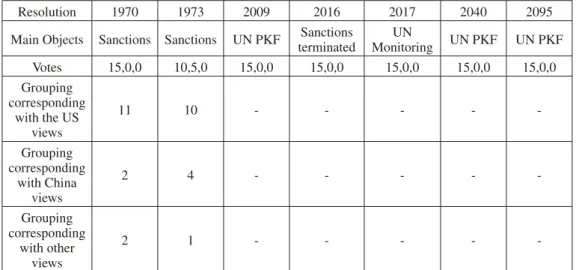
Table 5: Voting in the UNSC on Sanctions against Libya
Resolution 1970 1973 2009 2016 2017 2040 2095 Main Objects Sanctions Sanctions UN PKF terminatedSanctions MonitoringUN UN PKF UN PKF
Votes 15,0,0 10,5,0 15,0,0 15,0,0 15,0,0 15,0,0 15,0,0 Grouping corresponding with the US views 11 10 - - - - -Grouping corresponding with China views 2 4 - - - - -Grouping corresponding with other views 2 1 - - - -
-Sources: Odgaard (2013, p.33) the items of Resolution 1973 adjusted by author UN; UNSC (2013).
Note: Voting is written as “aye, abstention, veto”. PKF stands for Peace-keeping Force. Member states are grouped according to their statements following their UNSC votes on resolutions.
Regarding these resolutions, China cast several votes, which exhibited the country’s concerns and priorities. China did not oppose draft Resolution 1970, which imposed sanctions against Libya, and even abstained rather than blocked the more severe sanctions contained in Resolution 1973, which established a no-fly zone over Libya and all necessary measures to protect civilians from attacks by forces led by Gaddafi. This case is unique because the sanctions implied the potential of using force and the Western target of overthrowing the then regime, which lay at the heart of China’s foreign policy principles.
China had extensive ties with Libya before the Libyan conflict broke out; there were more than 50 Chinese investment programs in Libya, mainly infrastructure and oil programs. In his first official visit to Libya in April 2002, the former Chinese president, Jiang Zemin, signed agreements, which included a $ 40 million deal for a Chinese company to extend Libya’s rail network and a Libyan commitment to open its hydrocarbon sector to Chinese firms (St John, 2008). Before the UNSC lifted the sanctions against Libya in September 2003, Chinese oil companies vigorously entered the Libyan crude oil market and the China Petroleum Pipeline started the program of construction of oil and gas pipelines in Western Libya (Wang, 2007, p. 47). The bombing of Libya placed Chinese investments, worth billions of dollars along with the lives of 35,860 Chinese nationals working in Libya, at risk. According to the report of the Ministry of Commerce, the full value of China’s engagement with Libya was attacked on at least 27 Chinese construction projects, resulting in a 45% fall in contract projects (Ministry of Commerce of the People’s Republic of China [MOC], 2012). Although Libyan oil imports were attractive to China, they only accounted for three percent of Chinese oil imports before the crisis (China Industrial Map Editorial Committee; China Economic Monitoring and Analysis Center, 2013, p. 65), which did not provide a sufficient reason for China to help Gaddafi in the UNSC. Furthermore, China could not play a role in mediating the discrepancies between the Libyan government and other stakeholders.
From a Chinese perspective, the consent of the international community provided the necessary backing for the UNSC’s decisive actions. In the Libyan case, the views of regional stakeholders, including the Arab and African organizations, were taken into account. Between February 20 and February 23, the Security Council of the League of Arab States, the Secretary- General of the Organization of Islamic Cooperation [PIC] and the Peace and Security Council of the African Union [AUPSC] all issued statements condemning Libya’s descent into violence; the Arab League subsequently went a step further
and suspended Libya’s membership of the League (UNSC, 2011, February 22; OIC, 2011, February 22; AUPSC, 2011, February 23). Former Chinese Foreign Ministry spokeswoman, Jiang Yu, expressed Chinese opinions on the principles behind the Libya crisis during a regular press conference on March 03, 2011; she emphasized that “The UNSC should pay attention to and respect the opinions of the Arab and African countries (Huanqiu Net, 2011)”. On July 21, Former Chinese President Hu Jintao communicated with the President of South Africa and acknowledged the important role that South Africa and the AU had played in the political resolution of the Libyan issue, which showed the determination of African countries to solve an African issue in an African way. He stated, “China highly appreciates your efforts and would like to maintain close consultation and coordination on the Libyan issue” (Reuters, 2011). In addition to the regional organizations, other countries supported the resolution against Libya, which led to a guarantee of China’s affirmative vote for Resolution 1970. Li Baodong, China’s UN representative, highlighted the safety of foreign nationals in remarks at the UNSC meeting. Li urged the immediate end of violence to restore stability “to avoid future bloodshed and civilian causalities,” and “the safety and interests of the foreign nationals in Libya must be assured” in the process. Under the condition of international consensus, China supported the punitive measures against Libya and rhetorically underlined the emergency of protecting human rights.
Regarding Resolution 1973, while China abstained, it virtually acquiesced to the military intervention by allowing the passage of the resolution. With the escalation of the Libyan crisis, Western countries considered a more serious and effective measure to combat it. The US Secretary of State Hillary Clinton conferred in Paris with European leaders on the possibility of establishing a no fly-zone over Libya as a means to addressing the unrest. A week before the discussion on Resolution 1973, the Arab League stated its support for a no-fly zone (IBTimes, 2011). Resolution 1973 shared the same intention with Resolution 1970, that is, humanitarian aid, which regional stakeholders had advocated. Although China was concerned that the approval of the use of military force in Resolution 1973 would contradict its principles, it decided against the veto because of the endorsement of sanctions associated with the use of military force from the AU and the Arab League (UNSC, 2011, March 17). Notwithstanding, China was still cautious about the military measures and thus abstained from Resolution 1973. After the resolution was passed, Li Baodong explained, “The state sovereignty, independence, unity and territorial
integrity of Libya should be respected and the peaceful means should be used as the priority option to resolve the Libyan issue”. He added that in handling international relations, “China has remained opposed to the use of military force. Many problems remain un-clarified and un-answered. Thus, China found serious difficulties with some parts of the resolution” (Permanent Mission of the PRC to the UN, 2011). Some Chinese scholars argued that the pace of the events in Libya propelled China’s acquiescence (Duowei Net, 2011). Hence, China’s abstention, to some extent, succumbed to demands by other UNSC members.
The other four abstentions were cast by Russia, Brazil, India and Germany. Except Germany, the other abstentions were from members of the BRICS (Brazil, Russia, India, China, and South Africa). There was little information on whether the countries had reached consensus on the Libyan issue before the draft resolution was tabled. However, one month after Resolution 1973 was passed, the BRICS meeting opened in China’s Hainan Province. There is a significant possibility that the five countries had discussed the Libyan problems at the meeting, and it became obvious that the BRICS members did not share the West’s enthusiasm for the Arab Spring and saw more troubles than gains ahead, which was a follow-up episode responding to the voting record on Resolution 1973 (The Telegraph, 2012). During the debate on the Libyan issue, the Permanent Mission of the PRC to the UN clearly stated, “We oppose any discretionary view toward Resolution 1973 and foreign countries purposely overthrowing the current regime of a sovereign state or becoming involved in an internal war in the name of protecting civilians” (Xinhua News Agency, 2011, May 11). In addition, Chinese President Hu expressed his disquiet about the multinational coalition’s air attack on Libya, which might have caused additional civilian human rights disasters. He once said, if the air attack caused civilians causalities in Libya, this would probably breach the original intention of UNSC Resolution 1973 (Xinhua News Agency, 2011, March 30).
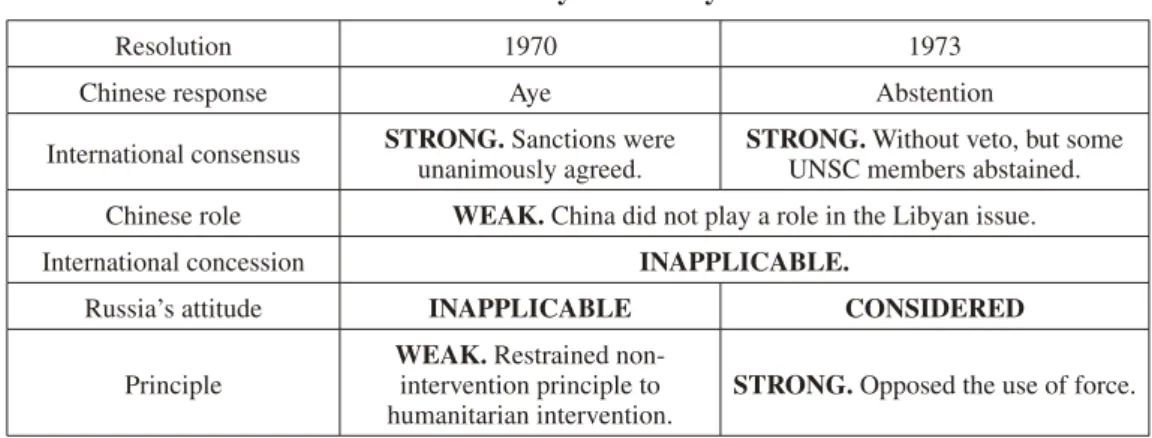
In conclusion, under the condition of international consensus, China chose to approve the sanctions embodied in the UNSC resolutions. China approved Resolution 1970 since the international community had taken sanctions against the Libyan government as an appropriate method to resolve the humanitarian crisis. In contrast, China abstained from Resolution 1973 because of the possible use of military force. Notwithstanding, Beijing’s emphasis on adhering to international norms under the UN Charter was also shared by other UNSC members. Therefore, the Libyan case is categorized as situation 1.
Table 6: Summary of the Libyan Case
Resolution 1970 1973
Chinese response Aye Abstention
International consensus STRONG. Sanctions were unanimously agreed. STRONG. Without veto, but some UNSC members abstained. Chinese role WEAK. China did not play a role in the Libyan issue.
International concession INAPPLICABLE.
Russia’s attitude INAPPLICABLE CONSIDERED
Principle WEAK. Restrained non-intervention principle to
humanitarian intervention. STRONG. Opposed the use of force. Case 2: The North Korean sanctions (2006–2009)
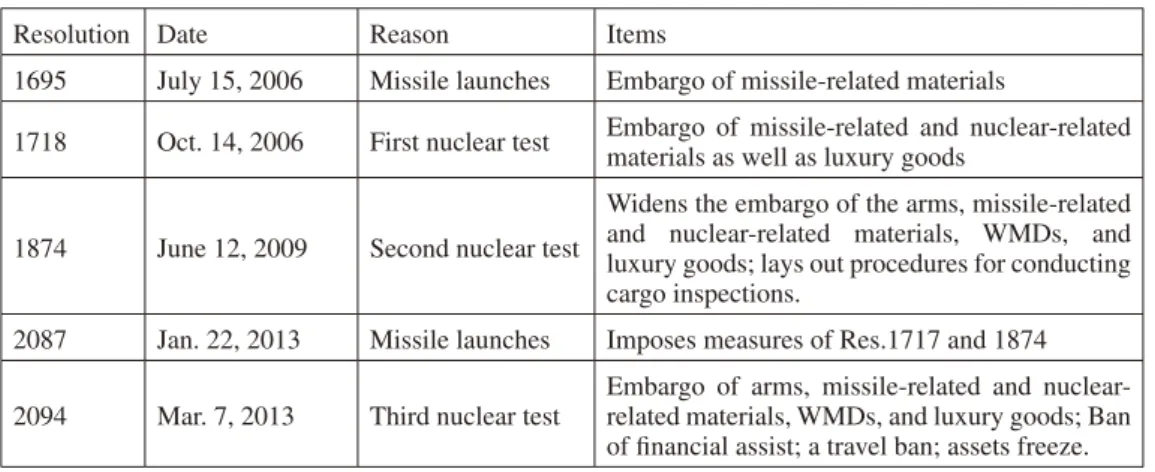
The UNSC intervened in the issues of North Korea eight times in forms of PRSTs and resolutions since Pyongyang declared its withdrawal from the Nuclear Non-Proliferation Treaty [NPT] and started to develop nuclear capability in 1993. But the UNSC did not impose sanctions against North Korea until Pyongyang launched the Taepodong-2 missile in 2006. Table 7 lists five main UNSC sanctions on North Korea. The North Korean crisis reached a deadlock when international sanctions had little effect on Pyongyang’s continual missile launches and nuclear tests. China’s role in the process of confronting this crisis went through a transformation from a passive onlooker to a reticent host and, ultimately, a chief mediator (Glaser & Wang, 2008, p. 166). Although critics charged that China had indulged North Korea’s provocations, Beijing did make an effort to address the nuclear crisis and even supported almost all sanctions against Pyongyang. China was concerned about the stability of the Korean peninsula due to the geopolitical significance of North Korea. Therefore, China tried to avoid the precipitating collapse of the North Korean regime by promoting dialogues between Washington, Pyongyang, and other regional stakeholders. As North Korea was sensitive to international sanctions,13) the reason for China’s
approval of these interventions at the expense of stirring Pyongyang’s outrage needs to be analyzed.
13) North Korea viewed the international responses, especially international sanctions imposed by the UNSC, as infringing upon its sovereignty and hurting the dignity of the Korean people (Nakato, 2012).
Table 7: China Voting on the Main Sanctions against North Korea (2006–2013)
Resolution Date Reason Items
1695 July 15, 2006 Missile launches Embargo of missile-related materials
1718 Oct. 14, 2006 First nuclear test Embargo of missile-related and nuclear-related materials as well as luxury goods
1874 June 12, 2009 Second nuclear test
Widens the embargo of the arms, missile-related and nuclear-related materials, WMDs, and luxury goods; lays out procedures for conducting cargo inspections.
2087 Jan. 22, 2013 Missile launches Imposes measures of Res.1717 and 1874 2094 Mar. 7, 2013 Third nuclear test Embargo of arms, missile-related and nuclear-related materials, WMDs, and luxury goods; Ban
of financial assist; a travel ban; assets freeze. Source: UN Security Council Sanctions Committees
Weakened Resolution 1695
North Korea launched a series of seven ballistic missiles that landed in Japanese territorial waters in July 2006, which cast a shadow over the security of North East Asia. The Taepodong-2 rock, one of the missiles, was suspected of being capable of reaching the territory of the US. The UNSC consequently passed Resolution 1695, which demanded that North Korean suspend all missile-related programs, and called on member states to exercise vigilance in terms of arms transfers to and from North Korea (UNSC, 2006a, July 15). China did not block the resolution and made a regular statement that Beijing was gravely concerned about the emerging situation on the Korean peninsula and was opposed to any further tension (UNSC, 2006b, July 15, p. 5). China originally intended to alleviate this crisis.14) A CFM spokesman said in a statement that
China urged all parties to remain calm and hoped parties would not take actions that might complicate the situation (Xinhua News Agency, 2006). Japan and the US attempted to exert pressure on North Korea through the UNSC sanction, but China, backed by Russia, hoped to propose a PRST following the model of the 1998 missile tests (The International Herald Tribune, 2006). The UN agreed with China’s plan of attending to the North Korean missiles issue through bilateral
14) It is notable that one day before the missile test, China released the news of its high-ranking officials’ visit to North Korea, during which China would have persuaded Pyongyang to abandon the missile launch.
dialogue (Abramowitz & Lynch, 2006). At the same time, China dispatched Wu Dawei, China’s Six Party Talks representative, to Pyongyang on July 8 to persuade North Korea to exercise restraint, but he returned to China without agreement on July 14.
China reconsidered measures to address the missile test although it had not given up on diplomatic negotiation with North Korea during Wu’s visit. One important factor was that UNSC members, except China and Russia, had reached a consensus on imposing sanctions against North Korea. US ambassador, John Bolton, said the Council was making “good progress” on a resolution, backed by 13 of the 15 council members (Globe and Mail, 2006). On July 10, the P5 and Japan convened a meeting to discuss the resolution against North Korea. China strongly opposed the Japanese draft but had changed its attitude to a possible resolution. The Japan-sponsored draft would have allowed military enforcement under Chapter VII of the UN Charter and would have banned all UN members from acquiring North Korean missiles or weapons of mass destruction (Fox News, 2010). After the meeting, Wang Guangya, the Chinese permanent representative to the UN, said that if other member states wanted a resolution, they should have a modified one instead of the current one. The following day, China and Russia proposed a draft resolution on North Korea in the UNSC, which did not include strong measures such as sanctions. Although Japan could not accept this new draft, it still made a compromise.15) The second day after Wu’s return from North
Korea, China ultimately approved the watered-down draft resolution, which did not invoke Chapter VII of the UN Charter and excluded calling Pyongyang a threat. Instead, it called on states to exercise vigilance in their arms transactions with North Korea. In this process, China kept the same political stand with Russia, but Russia did not play a role in engaging North Korea and followed China’s actions. South Korea’s stance, disagreeing on coercive measures,16) on
North Korean missile testing might have affected China’s behavior in opposing the Japan-sponsored draft. Therefore, the international consensus, Japan and the US’ compromise, and China’s unsuccessful negotiation with North Korea jointly constrained Beijing from wielding its veto power.
15) Kenzo Oshima, Japanese ambassador to the UN, said in New York that the Chinese-Russian draft resolution would be very difficult for Japan to accept (BBC , 2006, July 13).
Watered-down sanctions under Resolution 1718
Contrary to that of the missile launch crisis, China’s reaction to North Korea’s nuclear test was forceful and straightforward. On October 9, the very day of North Korea’s second nuclear test, China swiftly issued a statement condemning North Korea for defying the international community and calling the nuclear test a “flagrant” act (CFM, 2006). The Chinese government had rarely applied the Chinese word “hanran,” equivalent to “flagrant,” in its diplomatic parlance unless the issues deeply hurt Chinese people’s feeling.17) In addition
to the wordplay, China was ready to agree to actions against North Korea. Wang Guangya responded that there had to be some punitive actions in the draft resolution presented to the UNSC by the US on October 9 (BBC, 2006a). China had directly and indirectly conveyed its position on denuclearization of the Korean peninsula to North Korea, but Pyongyang ignored it. The nuclear test became a deep embarrassment and an intolerably grave provocation to China.18)
China did not send a special envoy to North Korea for negotiation and did not submit an alternative draft resolution against Pyongyang.
However, it did not completely uphold the draft resolution proposed by the US. The US considered keeping the military option on the table, but China did not agree with using military force (Straits Times, 2006). The discrepancy between China and the US focused on one provision in the draft resolution - the authorization of international inspections of cargo leaving and arriving in North Korea to detect weapons-related material. China rejected the revision due to a likely escalation of North Korean provocations induced by the inspections. In order to dissolve objections from China, the US modified the draft and excluded the measure of using military force as well as a blanket arms embargo (National Post, 2006). The ultimate resolution passed by the UNSC was more severe than Resolution 1695, but it had been watered down and did not include economic sanctions. China limited the sanctions to nuclear and missile materials transactions because excessive sanctions might have led to the economic collapse of North Korea, which gravely concerned China. China’s concern with coercive methods toward North Korea seemed rational since the Kim Jong-il
17) The Chinese government had only used the word “hanran” to describe the Japanese prime minister’s visit to the Yasukuni Shrine and the US bombardment of China’s embassy in Belgrade.
18) After returning from a two-day trip to China, Chun Yung-woo, South Korea’s chief nuclear envoy, explained China’s views and said that China had decided to spearhead efforts for the denuclearization of North Korea (BBC, 2006b).
regime would likely shift the burden of sanctions to the people, resulting in an accelerated humanitarian crisis.19) The nature of this crisis, a nuclear test
undeniably threatening China’s interest, and the unanimous international condemnation of North Korea had affected Beijing’s decision. The watered-down draft resolution, which was in accordance with Chinese views, facilitated the approval of Resolution 1718.
Harsher sanctions in Resolution 1874
China was disappointed in North Korea’s second nuclear test on May 25, 2009, which was depicted by the rhetoric that North Korea had ignored universal opposition and that China was resolutely opposed to it (Xinhua News Agency, 2009). Beijing voted in favor of UNSC Resolution 1874, which included hasher sanctions than its precursor. The punitive measure was the only option to deal with North Korea’ crisis since North Korea had declared its withdrawal from the Six Party Talks, thus signaling the failure of dialogue and negotiation. Similar to Resolution 1718, Resolution 1874 did not include implied military measures and the content that all states should search North Korean ships suspected of carrying illicit cargo, as originally suggested by the US. Nonetheless, both resolutions were aimed at prohibiting North Korea from conducting nuclear tests or using ballistic missile technology in the future.
Figure 2: China-North Korea Trade 2000–2008
Source: Noland (January,2009, p. 69).
Resolution 1874 differed from its predecessor on the scope of an embargo and the means of enforcing the sanctions. It called on international institutions and all UN member states not to undertake new grants and financial assistance to North Korea, except for humanitarian purposes. The resolution used the word “call on” rather than “require,” and therefore, the compulsivity of the effective enforcement was minimized. The flexibility in interpreting the sanctions might not have made North Korea more vulnerable (Shen, 2009, p. 179). The main aim did not change to an overthrow of the Kim regime, and the sanctions would not lead to North Korea’s economic collapse. Besides, based on the consequence of previous sanctions, those measures would not have negative impacts on China’s economic interests. Figure 2 shows that trade between China and North Korea steadily increased since the first sanctions were implemented, and decreases in trade that followed the immediate aftermath of the sanctions were normal seasonal changes.
Although it was reluctant to use coercive measures against North Korea, China compromised on the appeal of the international community. One important factor was that the international community had reached a consensus to apply sanctions against North Korean provisions, especially after much persuasion did not result in North Korea’s cooperation. However, China did not force North Korea into a corner and was devoted to acquiring concessions from the US and Japan by negotiating or threatening to exert its veto power to minimize the damage of relevant draft resolutions. From the Chinese perspective, sanctions against North Korea had alerted the latter’s provocations in the condition of diplomatic deadlock. Hence, Resolution 1874 and respective resolutions of 2013 were more symbolic than serious punishment. In short, the North Korean case proves situation 2.
Table 8: Summary of the North Korean Case
Resolution 1695 1718 1874
Chinese response China supported watered-down sanctions International
consensus were highly supported STRONG. Sanctions by the international community except China,
Russia and South Korea.
Chinese role STRONG. China made
an effort to persuade North Korea to cooperate
with the international community.
STRONG. China did not continue to persuade North
Korea because its previous efforts proved ineffective.
International
concession YES. The US and Japan agreed to revise original sanctions to allow for more moderate ones. originally were limited to NO. But the sanctions the non-proliferation of missile-related technology
and nuclear program Russia’s attitude CONSIDERED. Russia backed China’s stance on North Korea
Principle WEAK. Regional and international stability and security outweighed the
non-intervention principle Case3: Veto on Zimbabwe (2008)
China, along with Russia, vetoed a draft of sanctions on Zimbabwe’s President Robert Mugabe and 13 of his henchmen in the wake of the post-election political violence. The Zimbabwe issue occurred when China was preparing for the Beijing Olympic Games. In order to protect its positive image on the international scene, Beijing should have restrained from conflicts with most countries and cooperate with the international community to address some international issues. However, some scholars have taken China’s material interest in Zimbabwe into consideration as a plausible explanation for China’s veto of the sanction against Zimbabwe. In 2007, China’s investments in Zimbabwe reached $1.6 billion, and Beijing was reportedly Zimbabwe’s second largest trading partner and its largest investor (Banya, 2008; Russell, 2007). As one of Zimbabwe’s major trading partners and weapon suppliers, China was worried that sanctions would affect its exports (Doyle, 2008; Nasaw, 2008). Nevertheless, from China’s perspective, economic cooperation with Zimbabwe was not as important as other observers argued. Rather, its economic interests in Zimbabwe were relatively modest. (See Figure 1 and Table 3) Moreover, there is no record that China exported weapons to Zimbabwe after 2008. China seldom wielded its veto power to block UNSC resolutions unless they were associated with its core interests. The Zimbabwe veto was cast less than one month before the opening ceremony of the Olympic Games, which apparently resulted in adverse effects on China’s image. Hence, Zimbabwe’s case was peculiar since China’s veto departed from the reasonable assumption, and it was also abnormal that China had not made a public effort to intervene with the authorities in Zimbabwe.
Zimbabwe issue on the agenda, China opposed the inclusion of the issue without public justification. On June 23, Beijing supported the UNSC’s PRST condemning electoral violence. One day later, the spokesman emphasized China’s desire that the parties “resolve their disputes through dialogue and other peaceful means to complete their presidential election smoothly” (Chinese News Net, 2008). However, Beijing voted against the sanctions in the following month. China’s rationale for exercising its veto power to block the draft resolution was that the issue was no threat to world stability, and it called upon the council to respect the position of African countries on that issue and to allow more time for the good offices and mediation efforts of the AU and the Southern African Development Community [SADC] (UNSC, 2008, pp. 12–13). Along with China, Russia, Libya, South Africa, and Vietnam cast negative votes, and Indonesia abstained.
It is difficult to measure the extent to which China had made an effort, through bilateral dialogue or other means, to cope with this crisis as Chinese officials consistently supported dialogue among Zimbabweans and hoped they could find their own solutions. A week before the vote, the US Secretary of State Condoleezza Rice was in China and tried to get Chinese officials to support sanctions against Zimbabwe (The Herald, 2008). Beijing subsequently issued a statement, similar to the foregoing, but did not publicly make a promise to support the sanctions. Simply saying “no” to that draft resolution would inevitably bring discredit to China’s reputation. Nevertheless, Russia, sympathizing with Beijing’s position, became the focus of criticism. Russia had been persuaded at the G8 summit in Japan to join in condemnation of the Zimbabwe regime. But Moscow backpedaled and sabotaged the imposition of sanctions by using its veto power, which resulted in angry recrimination. Sir John Sawers, the UK’s ambassador to the UN, saw Russia’s veto as an “incomprehensive” action. He added that China followed the Russia’s lead and that neither had made any effort to discuss the resolution (Nasaw, 2008). Besides, Zalmay Khalilzad, the US permanent representative to the UN, also expressed America’s disappointment at Russia’s veto and indirectly criticized Russia as having eschewed a contribution to addressing the Zimbabwe crisis and delayed the consultation with the excuse of presidential absence in Moscow. Regarding China’s veto, his comment was short and articulated that China disturbingly joined Russia with the veto (USUN Press, 2008). The international community did not expect China to play an important role in resolving the Zimbabwe crisis.
Chinese scholars have argued that American and European sanctions on Zimbabwe since 2000 had “made an already bad situation much worse” (Zeng
& Li, 2007, p. 37).20) China’s response to the Zimbabwe affair was based on
this kind of conception. Liu Jianchao, the CFM spokesman, said, “Under the current circumstances, a resolution on imposing sanctions against Zimbabwe will not help the various factions in Zimbabwe to conduct political dialogue and negotiations and achieve results. Instead, it will lead to further complications in Zimbabwe’s situation” (Xinhua News Agency, 2008a). One explanation for China’s veto might have been South Africa’s attitude toward the draft resolution. South Africa’s President Thabo Mbeki was appointed mediator in March 2007. When the political violence broke out in 2008, his role was reaffirmed by SADC, and he was mandated to facilitate talks between the rival parties - the ruling party Zimbabwe African National Union-Patriotic Front [ZANU-PF] led by Mugabe and the opposition party, Movement for Democratic Change [MDC] founded by Morgan Tsvangirai. The Mbkei’s mediation did not proceed smoothly. Tsvangirai was skeptical of Mbkei’s role (Bearak, 2008), and Western countries also thought Mbkei had deliberately covered up the Mugabe government (Nasaw, 2008). Less than one week before the draft resolution was voted, Mugabe agreed to resume talks with the MDC, but the conversation did not lead to breakthroughs. South Africa thought that the door of negotiation was not yet closed and argued that its neighbor was not a threat to world peace. People’s Daily, controlled by the Chinese government, asserted that Mbkei-sponsored talks attained preliminary results, and thus there was a reason to allow more time before taking punitive steps (Pei, July 13, 2008). Wang Guangya conveyed that the situation in Zimbabwe was highly complex and sensitive, but the negotiation process was already underway, and the resolution of sanctions against Zimbabwe would unavoidably interfere with the negotiation process and lead to further deterioration of the situation (Xinhua News Agency, 2008b). Regardless of the real motive behind China’s veto, the vetoes by Russia and South Africa affected China’s decision. In this situation, China had the justifiable reason to emphasize the principles on which it insisted and simultaneously avoided the overwhelming condemnation of the international community.
Zimbabwe’s political violence had propelled the humanitarian crisis, which invoked Western countries’ outcry and engagement. For China, on the other hand, it was not rational to get involved in the crisis, even in the context of international intervention. Regarding the case of Zimbabwe, although the failure of the Mugabe regime’s economic policy had led to a severe economic
condition and a humanitarian crisis, the Zimbabwe issue, in terms of UNSC draft resolutions, was raised by the political tension between the current regime and the opposition party. China, adhering to the policy of non-intervention in other countries’ domestic affairs, could not interfere, regardless of the human rights abuses. On one hand, regional countries might have convinced China that negotiations were still promising. On the other hand, in order to attend to this domestic crisis, which was geographically far from China, mediation of the regional organization seemed be an appropriate medium. China took advantage of the Russian and South African vetoes, especially the former, which provided China with an opportunity of not compromising to the needs of the international community. Thus, the Zimbabwe’s case matches situation 3.
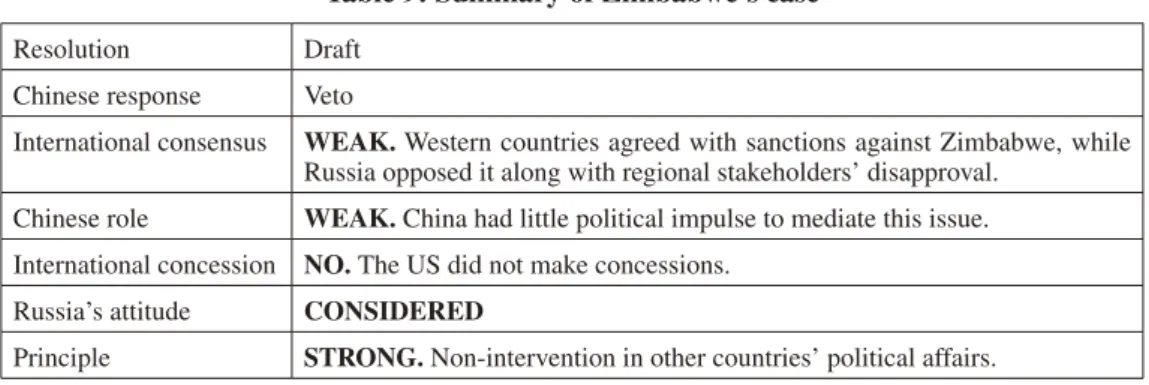
Table 9: Summary of Zimbabwe’s case
Resolution Draft Chinese response Veto
International consensus WEAK. Western countries agreed with sanctions against Zimbabwe, while
Russia opposed it along with regional stakeholders’ disapproval. Chinese role WEAK. China had little political impulse to mediate this issue.
International concession NO. The US did not make concessions. Russia’s attitude CONSIDERED
Principle STRONG. Non-intervention in other countries’ political affairs.
Conclusion
While China’s rhetoric remains tough in the political realm, its actual conduct with respect to the non-intervention principle has softened. China has accepted a greater scope of UN interventions, especially in the 21st century. With respect to UNSC sanctions, China seldom wields its veto power to impede such sanctions although it does not completely approve of imposing coercive measures on targeted states. China tries to make balanced decisions when the needs of the international community contradict with its foreign policy principles in dealing with issues relating to targeted states. From China’s perspective, international consensus provides legitimacy to intervention, which is essential for international sanctions. Hence, China is more likely to endorse sanctions when a broad consensus is reached. When there is a division in this respect, the principles of non-use of force, reasonable intention and promising
prospects affect its decision-making, especially in terms of calculations about the appropriateness of intervention. In such situations, China resists sanctions and expresses its concerns by means of abstentions or vetoes.
China’s attitude and behavior toward international sanctions can be categorized using three explanations, all of which exhibit Chinese preferences and concerns on specific issues. China’s non-intervention principle influences its preference for applying moderate measures towards solving international and regional crises in the UNSC. However, when means like dialogue or negotiation prove ineffective, China concedes to appeals by the international community. China’s decisions also depend on its capability of reconciliation and negotiation in specific cases. If China plays an important role in addressing the crisis of targeted states, it may water-down a draft resolution to minimize the negative consequences of the sanctions on targeted states as well as on itself. Because of its alienation from the majority of member states in the UNSC, when the international community fails to reach a consensus, China pursues a convergence of political stands with Russia to avoid isolation or blame. Three diverse cases, Libya, North Korea, and Zimbabwe, have been elaborated to test these presumptions.
China’s responsive behavior may be, to some degree, incredible, but it also demonstrates that it cannot fulfill its promise to be a responsible great power in diplomatic practice. China’s attitude and behavior in relation to UNSC sanctions provide an appropriate dimension to investigate Chinese foreign policy. However, it is only one tiny piece of the jigsaw. Other angles, such as Chinese participation in humanitarian intervention, will be scrutinized in order to capture a comprehensive understanding on China’s engagement in contemporary international society.
References
Abramowitz, M., & Lynch, C. (2006, July 7). After missiles, calls go out. Retrieved October 13, 2013, from Washington Post: http://www.washingtonpost.com/wp-dyn/content/ article/2006/07/06/AR2006070600208.html
AUPSC. (2011, February 23). Communique, 261mtg. AU Doc PSC/PR/COMM(CCLXI).
Banya, N. (2008, March 24). Some foreign investors gamble on Zimbabwe. (Reuters) Retrieved October 12, 2013, from http://amadlandawonye.wikispaces.com/ Some+foreign+investors+gamble+on+Zimbabwe,+Nelson+Banya,+Reuters
Bearak, B. (2008, February 14). Zimbabwe opponent criticizes Mbeki. Retrieved October 12, 2013, from New York Times: http://www.nytimes.com/2008/02/14/world/africa/14zimbabwe.