i
PUBLIC EXPENDITURE EFFECTIVENESS, ECONOMIC GROWTH, AND
POVERTY IN BANGLADESH
An Assessment of the Impact of Government Spending and Intervention on Poor Citizens
by
HOSSAIN Mohammad Imran
March 2013
Thesis Presented to the Higher Degree Committee
of Ritsumeikan Asia Pacific University
in Partial Fulfillment of the Requirement of the Degree of
Master‘s in International Cooperation Policy (ICP)
ii
Acknowledgement
This thesis would not have been possible to accomplish without the help and support of many kind people around me. Here I will mention only some of them.
Above all, I am grateful to my supervisor Prof. Junichi Hirata for his help, support and patience at all times, needless to mention about his unsurpassed knowledge of public finance and development policies in underdeveloped countries. His good advice, support and friendly attitude have been invaluable on both academic and personal level, for which, I would like to express my heartful gratitude.
This thesis would not have been possible without the help and valuable support throughout that I received from Ritsumeikan Asia Pacific University (APU) and Ritsumeikan Center for Asia Pacific Studies (RCAPS), for which, my mere expression of thanks likewise does not suffice. I would like to acknowledge the financial, academic and technical support of APU, particularly in the award of masters‘ student field research support that provided me the opportunity to collect important primary and secondary data necessary for the thesis. Other means of support including the library facilities and computer facilities of APU have been indispensable for me.
Last, but by no means least, I thank my friends, colleagues and teachers in Japan, Bangladesh and elsewhere for their support and encouragement throughout.
For any errors or inadequacies that may remain in this work, of course, the responsibility is entirely my own.
iii
Table of Contents
Abstract ... viii
Chapter One... 1
1.1 Background of the Study ... 1
1.2 Statement of the Problem ... 6
1.3 Research Questions ... 9
1.4 Objectives... 11
1.5 Hypothesis ... 12
1.6 Significance ... 13
1.7 Purposes and Organization of the Thesis... 15
Chapter Two ... 18
2.1 Introduction ... 18
2.2 Bangladesh Economy in the Recent Past (2000-2010) ... 18
2.3 The Bangladesh Economy Prior to the 1980s Era ... 20
2.4 Explaining Bangladesh‘s Economic Growth Since 1980 ... 23
2.4.1 Overall Growth Performance of the Economy ... 23
2.4.2 The Proximate Sources of Growth... 26
2.4.3 Other Impacting Factors ... 33
2.5 Conclusion ... 40
Chapter Three ... 42
3.1 Introduction ... 42
3.2 Public Expenditure ... 42
3.3 Poverty ... 49
3.3.1 Methodology of Poverty Estimation ... 49
3.3.2 Describing Poverty Trends ... 51
3.3.3 Inequality Issues ... 56
3.3.4 Welfare Impacts of Inflation and Changes in Poverty Data... 57
3.4 Conclusion ... 59
Chapter Four ... 61
iv
4.2. Public Expenditure Theories ... 61
Public Expenditure Definition and Classification ... 61
Two General Schools of Thoughts Regarding Public Expenditure ... 63
Public Expenditure Theory of Various State Forms... 64
The Theory of Public Choice ... 65
4.3 The Link among Public Expenditure, Economic growth and Poverty ... 66
4.4 Impacts of Public Expenditure ... 68
4.5 Review of Empirical Literature and Previous Research findings ... 71
4.6 Conclusion ... 76
Chapter Five ... 78
5.1 Introduction ... 78
5.2. Defining the Model ... 78
5.3 Data Sources and Estimation ... 79
5.4 Empirical Results ... 80
5.5 Findings and Discussions ... 84
5.6 Conclusion ... 88
Chapter Six ... 89
6.1 Introduction ... 89
6.2 Background Information and Theories for PETS and QSDS ... 89
6.2.1 Public Expenditure Tracking Surveys (PETS) in Education ... 92
6.2.2 Quantitative Service Delivery Surveys (QSDS) ... 94
6.3 Rationale for the PETS-QSDS and its Fitness to the Present Study ... 95
6.4 Major Methodological Considerations ... 97
Tracking Resource Flows ... 97
Institutional Assessment ... 98
Sampling Strategy ... 98
Survey Instruments ... 99
6.5 Survey Findings ... 99
Facts about Primary Education System in Bangladesh ... 99
General Descriptive Findings ... 101
v
Leakage of Resources ... 106
Inadequate Funding ... 108
Evaluating Primary Education Expenditure through Equity ... 110
6.6 Conclusion ... 110
Chapter Seven ... 112
7.1 Concluding Summary ... 112
7.2 Policy Recommendations and Direction for Future Expenditure Strategies ... 115
References ... 119
vi
List of Tables
Table 1.1: Bangladesh‘s Progress on Key Social Indicators ... 3
Table 2.1: Selected Recent Macroeconomic Indicators of the Bangladesh Economy (Amounts are in million U.S. dollar) ... 20
Table 2.2: Some of the Selected Macroeconomic Indicators of the Bangladesh Economy Prior to the 1980s (Amounts are in million U.S. dollar) ... 23
Table 2.3: Sectoral GDP Growth Rates for FY1980/81-FY2009/10 (Annual average and in constant 1995/96 producer prices) ... 28
Table 2.4: Growth of Principal Export Products (annual average and in million US dollars) ... 28
Table 2.5: Growth Figures for Various Economic Sectors between FY1980 and FY2010 (Based on 1995/96 constant prices) ... 28
Table 2.6: Average Growth of Industrial Production (Annual percentage change) ... 30
Table 2.7: Consumer Price Index and Inflation in Bangladesh (Base year 1995-96=100) ... 38
Table 2.8: Share of Employed Labor Force (Above 15 years) by Sector ... 39
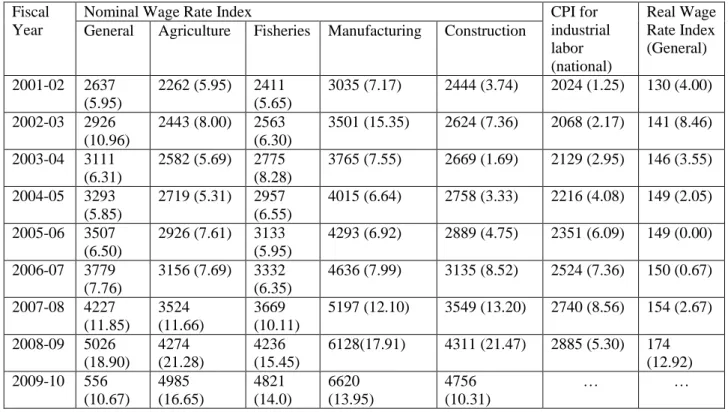
Table 2.9: Wage Rate Indices (Base year 1969-70=100) ... 40
Table 3.1: Bangladesh Government‘s Budget at a Glance (As percentage of GDP) ... 44
Table 3.2: Various Public Expenditure in Bangladesh (in Million TAKA) ... 44
Table 3.3: Sectoral Shares in Development Expenditure (Percentages) ... 45
Table 3.4: Government Expenditure on Health and Education Sectors ... 46
Table 3.5: Divisional Poverty Head Count Rate Measured by Cost of Basic Needs Method ... 53
Table 3.6: Estimated Poverty Gap and Squared Poverty Gap measured by CBN Method ... 55
Table 3.7: Percentage Distribution of Income and Gini Co-Efficient ... 56
Table 3.8: Change in Poverty Headcount Ratio from Base Expenditure Data ... 59
Table 4.1: Summary of Selected Literatures Reviewed ... 76
Table 5.1: Descriptive Statistics of Variables ... 81
Table 5.2: Augmented Dickey Fuller Unit Root Test (for Stationarity). ... 82
Table 5.3: Result Summary of OLS Estimates ... 84
Table 6.1: Basic Facts about Primary Education in Bangladesh... 101
Table 6.2: Type of School (Total 50 Primary Schools in 4 Districts) ... 102
Table 6.3: Average Size of School (2012 data and expressed as nearest round figures) ... 102
Table 6.4: Schooling Outcomes ... 102
Table 6.5: School‘s sources of funding (including funds related to teachers‘ salary) ... 102
Table 6.6: Share of fund receiving schools (except funds related to salary expenses, %) ... 103
Table 6.7: School Characteristics (% of the total sample) ... 103
Table 6.8: Record about Supervision and Accountability (% of total sample) ... 103
vii
List of Figures
Figure 2.1: Growth Rate of GDP at Constant Price: 1999/200-2009/10 (Annual average rate,%) .... 25
Figure 2.2: Growth of Bangladesh Economy During FY1980/81-FY2009/10 ... 25
Figure 2.3: Growth of Bangladesh Economy During FY1980/81-FY2009/10 ... 26
Figure 2.4: Contribution Trends of Various Key Sectors in GDP Growth (%) ... 27
Figure 2.5: Year-on-year Rates of Growth in Agriculture and its Sub-sectors (%) ... 29
Figure 2.6: Unsustainable Structural Transformation in the Bangladesh Economy ... 31
Figure 2.7: Export and Import Trend in Bangladesh During FY2001 to FY2010 ... 33
Figure 2.8: Gross Savings in Bangladesh (Domestic and National) ... 35
Figure 2.9: Gross Investment in Bangladesh as a Percent of GDP is Comparatively Lower ... 37
Figure 2.10: Inflation Trends in Bangladesh ... 38
Figure 3.1: Distribution of Expenditure on Health ... 47
Figure 3.2: Distribution of Expenditure on Education... 47
Figure 3.3: GDP Growth (%) and Sector-wise Disaggregated ADP Expenditure (%) ... 48
Figure 3.4: Poverty (HCR) and Sector-wise Disaggregated ADP Expenditure (%) ... 48
Figure 3.5: Poverty Head Count Rates Estimated by the CBN Method (1991-92 to 2010) ... 52
Figure 4.1: The Link Among Public Expenditure, Growth, Employment and Wages ... 67
Figure 6.1: The Relationship Among Various Actors in Education Service Delivery System ... 90
viii
Abstract
The main focus of this thesis is the link between public expenditure and its role in reducing poverty with an especial care on related expenditure management policies (initiatives) in Bangladesh. The objective of this thesis is to review and analyze the trends in government expenditure and its compositions in a Bangladesh perspective, and to develop an analytical framework for determining differential impacts of various public investments on economic growth and poverty alleviation. This study intended to examine and test two key hypotheses while trying to answer the basic research question: has public expenditure in Bangladesh
successfully contributed to economic growth and poverty alleviation of the country?
We did apply both qualitative judgments and quantitative estimations from a dynamic macro-econometric model and time series analysis by utilizing an Ordinary Least Square (OLS) Estimate. Since the link is complex in many aspects, this study made an attempt to utilize both analytical (qualitative) explanations and econometric analysis to untangle the nature of relationship. In the econometric analysis efforts were made to use a set of 31 years‘ time series data in order to see the impact of various components of government spending on poverty (through real GDP, wage, and employment growth) by estimating a linear equation. Another quantitative explanation has been performed based upon the findings of a joint Public Expenditure Tracking and Quantitative Service Delivery Survey (PETS-QSDS) conducted while considering the primary education sub-sector in Bangladesh as a test case.
Utilizing results of our econometric estimation we have checked the study‘s hypothesis one and found it to be partially true. We did not find any significant impact of government spending on economic growth and poverty reduction in the Bangladesh economy.
We verified our second hypothesis by our findings from the PETS-QSDS survey and found true. It was revealed that widespread corruption in resource management practices, leakages
ix of funds and/or political and bureaucratic capture coupled with a lack of adequate funds lowered significantly the welfare effects of public expenditure in Bangladesh. We found two layers of agency problem namely „between the citizens and politicians‟ and „between
politicians and service providers‟ appeared in the public expenditure management hierarchy.
This study was engaged to look for common trends and patterns and we also sought to gather evidences supporting our hypotheses through a variety of approaches and methods. Finally, this thesis deliberately visited various expenditure management initiatives in Bangladesh and justified their effectiveness through the prism of equity, accountability, transparency, and appropriateness. Based upon the findings of the study some policy recommendations were suggested to show the direction of future expenditure strategies in major sectors of the Bangladesh economy.
1 Chapter One
INTRODUCTION
1.1 Background of the Study
Following a nine month long liberation war Bangladesh gains independence from Pakistan in 1971. Formerly known as East Pakistan and before that as the East Bengal region of British India, Bangladesh was created as a result of ethnic division and the desire for self-expression by Bengalis (Vaughn, 2010). Whereas the division of British India into two countries (namely India and Pakistan) was a result of religious division between Hindus and Muslims and was based upon a political agreement by the so called Two Nations Theory1, twenty-five years later, the partition of Pakistan was the result of a desire for self-identity of the Bangladeshi people. This double partition was different from the previous one in a sense that the philosophy that drove the passion of the Bengalis was economic and political and was coupled with a strong secular identity (Pattanaik, 2005). Consequently, the creation of Bangladesh reconstructed the social and political history of the Indian Subcontinent. Rather than the religious component, the newly established Bangladesh State represents the national spirit of the Bengali identity, which offers a ray of hope for economic development and prosperity of the people.
At the first phase of development many impediments including desperate initial conditions, political instability, widespread corruption, and a record of systemic governance failure hindered the country‘s growth performance (Mahmud, Ahmed & Mahajan, 2008). Extensively State controlled economic policies until 1979 ended up with little or no investment, limited export gain, a stagnated financial sector and eventually a low level of per
1
In 1947 the Indian Subcontinent was partitioned into two separate nations: India and Pakistan. The Two Nations Theory advanced by Mohammad Ali Zinnah, the first President of Pakistan, acted as a founding principle of the Pakistan Movement. According to this theory the primary identity of people in the Subcontinent should be their religion, rather than commonalities in other factors such as language or ethnicity.
2 capita GDP. As a means of recovery, during the 1980s Bangladesh has adopted a series of reform policies particularly in areas of trade, finance and capital account in order to maintain a liberal economic regime (Bashar & Khan, 2007). Growth-patterns since then show that the country has moved from an uncertain economic future in 1971 (the year of independence) to become one of the best performers in the Least Developed Country category by 2010 (Rahman & Yusuf, 2010). Todaro and Smith (2010) acknowledged that even though starting out as desperately poor, with much of the institutional and physical capital obliterated by the liberation war, Bangladesh has been transforming itself from a symbol of famine to a symbol of hope.
Within forty years of independence Bangladesh has gained rapid economic growth and significant improvement in major social development indicators. Especially when viewed through the prism of weak initial conditions and surrounding pessimism and evaluating from the viewpoint of economic and social progresses, the country has achieved a remarkably positive record (World Bank, 2005). Recent data shows that Bangladesh‘s overall life expectancy at birth has risen to 68 years (more than both Pakistan‘s and neighboring India‘s), population growth rate has dropped to 1.5 percent (resulting from a reduction in the fertility rate from 7 children in 1972 to 2 in 2009), literacy has more than doubled (net primary school enrollment rate was only 49 percent in 1972 and has grown to 92 percent in 2009), child mortality has been cut by 70 percent, unemployment is down to 4 percent, poverty incidence as measured by the $1 a day has fallen to less than 40 percent, and at present about a quarter of the population lives in urban areas. Bangladesh is the only nation in South Asia to be on track in meeting Millennium Development Goal (MDG) on gender parity, having already achieved the goal in primary and secondary schooling. The ratio of female to male has been raised—there were an estimated 978 females for every 1000 males in 2008 which is more than those of in India, Sri Lanka, and Pakistan.
3 Giving credit for progresses the country achieved since independence, Nobel Laureate Dr. Amartya Sen addressed Bangladesh as a model of development. Sen (2011) evaluated that the people who once branded Bangladesh as a bottomless basket, they now consider it as a model of progress. Sen (2011) also claimed that doubts and doubters about the country‘s future were proven to be wrong. On the other hand, Khan (2011) concludes that the test case for development hypothesis dubbed undiplomatically by one U.S. statesman became no more valid for Bangladesh. Moreover, considering concerns of growth and future market potential, in 2005 Bangladesh was coined as a member of Goldman Sachs‘ Next 11 (N11) country category—a group of eleven most rapidly developing countries with superior economic opportunities and greater market potential.
Table 1.1: Bangladesh‘s Progress on Key Social Indicators
Social Indicators Then (Year) Now (Year)
Primary school enrollment rate (% net) Secondary school enrollment rate (% net) Rate of fertility
Immunization, DPT (% of children ages 12-23 months) Immunization, measles (% of children ages 12-23 months) Population with access to improved sanitation facilities (%) Total life expectancy at birth (years)
Malnutrition prevalence, weight for age (% of children under 5) Mortality rate of children under 5 years old (per 1000)
Infant mortality rate (per 1000 live births)
49(1972) 19(1990) 7(1972) 1(1980) 1(1982) 20(1990) 39(1972) 68(1983) 229(1972) 153(1972) 92(2009) 46(2009) 2(2009) 96(2009) 98(2009) 53(2008) 68(2009) 48(2004) 51(2009) 40(2009)
Source: World Bank (1981)
However, despite its progress on most human development indicators is indicative of the fact that within a short period of time the nation has performed relatively better than many of its neighbors, Bangladesh is afflicted with many of the social problems found in most developing countries. It is commonly acknowledged that the country lags behind many other developing nations and more importantly Bangladesh still suffers from difficulties of rampant poverty.
4 To achieve poverty reduction and certain threshold in development, per se, virtually all successive governments in the country implemented some ad hoc policies that were aimed to stimulate per capita income growth of people. Notwithstanding, economic growth is affected by the government‘s monetary and fiscal policy instruments including taxation, expenditure, and through correcting market failure, and providing a wide array of public goods. This is due to the fact that for a developing country perspective like Bangladesh, very low level of social services and meager infrastructural facilities are blamed to reduce greatly the contribution of private sector in development endeavors. The State, therefore, needs to generate the appropriate ground to stimulate private investment and better use of its scarce entrepreneurial ability by spending more in productive sectors like education, health, and infrastructure. In this respect government spending patterns in Bangladesh over the last decades have changed dramatically and a rapid growth in the nation‘s public expenditure account has been seen (Ketema, 2006).
Governments in Bangladesh try to focus on, inter-alia, the rate of annual growth in the country‘s real GDP as one of the main objectives while designing various economic and social policies. Macroeconomic instruments are engineered with an aim of overcoming persistent poverty and securing possible improvement in life standards of people by increasing per capita income. To ensure well-functioning markets government also spends resources to enforce contract, maintain national security, protect citizens against criminals, and provide valuable public goods like provisions of education and health services. In this connection, ensuring a sound public expenditure management system is considered to be an important obligation of the Bangladesh government. Moreover, the principal objectives of such expenditure management should be focused to confirm, among others, expenditure in productive sectors, exercise austerity in public spending, and restrain unproductive or unnecessary outlays.
5 It was mentioned in the Bangladesh Economic Review 2010 published by the Bangladesh Ministry of Finance that the key aspects of the nation‘s total public outlays in each year are to build physical infrastructure for channeling investment and developing human resources. On this ground, it is necessarily true that Bangladesh Government‘s pro-poor policies towards public spending in the areas of productive sectors, particularly in infrastructure development, health and education acted as a major force behind the progress made in the public expenditure account of the country. However, the success of the country‘s expenditure management policies and relevant systems are questioned in many ways, hence, we recommend that there is a need to revise, recheck, and update the policies regarding public expenditure management.
Having such background, the main focus of this thesis is surrounded by specific issues like public expenditure, growth, and poverty in Bangladesh because it is commonly acknowledged that public expenditure can play a significant role in economic lift-up and poverty reduction in the context of developing countries. Therefore, now-a-days, a vision of ensuring sustainable development and reducing mass poverty at a meaningful magnitude is enshrined in national expenditure strategy of many developing nations including Bangladesh today (Tanzi, 1994; CPD, 2008).
Nevertheless, our special attention for this study is paid to the link among public expenditure, economic growth, employment, and wages because theoretically the latter three factors are the fundamental sources that relate poverty and public expenditure in developing societies of many low income countries including Bangladesh. To give an explanation, an increase in expenditure puts a ripple effect in the economy by raising aggregate demand and productivity, which eventually leads to a higher level of employment and wages and thus reduces poverty by accumulating wealth with a favor to the poor people (Hassan, 2007).
6 The present study also sheds light on the performances, efficiency and effectiveness of current policies regarding public expenditure in Bangladesh. The role of governments in Bangladesh is found within the so called neo-liberal poverty reduction paradigm in which the current regime has made a commitment to bring country‘s poverty rate to 25 percent by 2013 and 15 percent by 2021. Having such national goals, governments in successive regimes have been implementing many poverty reduction programs and spending plenty of resources with the support of donors and other private bodies. Accordingly, viewing from the prism of poverty alleviation performances achieved by Bangladesh during the last two or three decades, it seems that policies are not completely ineffective in reducing poverty. But this thesis assembles evidences and information to show that some, if not all, public expenditure management tools are not achieving their targeted goals. Based on an experimental survey to measure the levels of accountability, transparency, equity, and effectiveness of the present policies we try to claim that policies are not qualified to fully address the evolution, character and dynamics of poverty in Bangladesh.
1.2 Statement of the Problem
The fundamental and foremost problem of this study, theoretically and empirically, is poverty and the role of public expenditure and government intervention in reducing it although poverty is a secondary concept in conventional economics and a residual in public finance (Musgrave, 1956). Bangladesh has been facing a rampant and long standing hardship of poverty since Independence. As reported by the Household Income and Expenditure Survey of 2010 (HIES-2010) conducted by the Bangladesh Bureau of Statistics (BBS) 31.5 percent of the total population in the country lives below the official poverty line. Moreover, spikes in food prices and high inflation plunge additional population under the officially estimated rate of poverty. If the problem cannot be addressed properly and the current trend continues, it was estimated that by 2021 more than 59.8 million Bangladeshis will fall below the poverty
7 line. From the above facts it can be claimed that the poverty reduction strategies (PRS) and the neo-liberal paradigm that successive regimes in Bangladesh have been pursuing are not sufficiently contributing to tackle the problem because evidence suggests that in the country still millions of people suffer from the curse of poverty (Rashed &Titumir, 2011). We put data table in a subsequent chapter which presents the rates and severity of poverty in Bangladesh from various dimensions.
We suggest that following a revision of Bangladesh government‘s expenditure related principles and an assessment of the role of the public sector in poverty alleviation, it then becomes possible to show appropriate paths in addressing the problem of deep and widespread poverty in the country. Hence, the first generic problem lies under the character and dynamics of poverty and its relation with government spending in Bangladesh. In this connection, no systematic study has been undertaken to see the appropriateness of current policy framework and the need for a comprehensive pro-poor public expenditure management system in the country.
Secondly, poverty estimation techniques such as those in Bangladesh are not free from criticism and question. Estimates are plagued with many problems because in measuring poverty they over emphasize on person‘s income without considering the impact of inflation or other socioeconomic facts. And the estimate that Bangladesh uses to measure poverty level is unrealistically low. In the country poverty is measured by USD 1.25 per day income or a minimum spending of about Tk. 50 which is equivalent to USD 0.71 for a need of 2122 kilocalories intake per day per person. This thesis maintains that poverty measuring tools do not capture the real magnitude and dimensions of poverty because in a country specific situation of Bangladesh it is very difficult or even impossible to maintain basic needs with this amount of income where every year prices are tend to rise continuously (Rashed &Titumir, 2011). Besides, inflation and food price inflation indices, which are presented in a
8 later chapter, have tremendous impacts on daily life of the poor people in the country.
The third element of the problem, already hinted earlier, is the weaknesses of the current expenditure related policy approaches in Bangladesh. Whether past and current policies are effective in reducing poverty is a corollary to the issue at hand. The approaches of structural adjustment policies of 1980s and the Poverty Reduction Strategy Papers (PRSPs) of the late 1990s enveloped by the poverty reduction paradigm of LDCs attract the main focus in this regard. It is claimed that these are contradictory in nature and practice. The wisdom behind this argument is that, at one hand, current policy paradigm in Bangladesh seeks to promote diminished role of government to confirm a status of minimum State intervention. Through liberalization, deregulation and privatization the State reduces its function ability assuming that market will overwhelmingly replace it to deliver the expected outcomes. On the other hand, the newly adopted poverty reduction conditionality promotes a bigger role for the State because in a developing country like Bangladesh market can hardly be a main actor when the problem is poverty reduction (Mushahara, 2004). From this point of view, public spending and government intervention, especially for the productive economic sectors, in Bangladesh can play important roles in reducing poverty, provided that resources are utilized properly in a favor to the well-being of poor people.
The fourth issue is related to the reasons of poverty and the major factors that led to a failure in reducing it by government‘s expenditure policies in Bangladesh. It is widely assumed that addressing the problem of poverty requires a thorough understanding of its generic causes. Among many other factors, we intentionally hypothesize that the major reasons for persistent poverty in Bangladesh include inadequate or inefficient State intervention and absence of efficient policies in government spending and resource management system. This phenomenon was reported by Bangladesh Ministry of Planning (GOB, 2011).
9 ―……..In instrumental sense, the major reasons for persistence of poverty are: absence of adequate State intervention for the expansion of production, deficiency of equalizing income augmenting employment system, shortfalls in public expenditure for capabilities enhancements, inadequacies in regulatory regimes, and lack of complementary policy structure and non-existence of enforceability of constitutional rights…..‖ (GOB, 2011).
Another important but often overlooked, though not neglected, fact is that poverty is a part of social relationship. It was asserted by Nobel laureate Dr. Muhammad Yunus that the poor are remaining to be poor not due to their fate but due to the structural reasons that force them to be poor. The system is like that accumulation of resources is biased in a favor of some groups who are rich and powerful in the society. Corruption and inadequacies in regulatory regimes are blamed to be some important underlying causes. This study suggests that Bangladesh, thus, needs to update intervention policies and affirmative actions must be taken in a favor to the poor if the country really wants to reduce the sufferings of poverty (Mushahara, 2004; GOB, 2011).
1.3 Research Questions
Annual budget account shows that substantial increase in public expenditure with the support of donors and development partners had taken place in Bangladesh since 1990s when the democratic regime had established in the country. After a long period of military rulings, a wide range of pro-poor economic and social policies in an effort to accelerate targeted growth and to reduce poverty were adopted. Since then investment in defense, education, health, energy, rural development and infrastructure became a critical part of various development and non-development expenditures in the country. The nation‘s expenditure management policies were aimed to translate resources into improvements in all thrust sectors. Having such records in past decades, there are various questions that come out of the above facts.
10 Does increase in government spending and changes in its composition help or hinder economic growth in Bangladesh? Is an increase in spending on education, health, and physical infrastructures effective in improving human development outcomes and complementing private sector investment; thereby boosting long-term growth given the weakness in public budget administrations? Is there any on-the-process leakage and capture in the disbursed funds on the way they reach to the frontline service providers and are they efficient in fulfilling their pre-designed goals? And what will be the probable prospects of government‘s policy on public expenditure in Bangladesh considering the challenging global and domestic economic conditions?
This study will thoroughly examine the Bangladesh Government‘s declared public investments under its development budget expenditure, the Annual Development Program (ADP), World Bank Public Expenditure Reviews (PER), and other published documents regarding State financed spending of the country. Then it seeks to answer the next core question: has public expenditure in Bangladesh successfully contributed to economic growth
and poverty alleviation of the country? Under this broader one, efforts will be made to
answer other relevant questions, such as:
How does government expenditure and intervention make an impact on economic growth and poverty in Bangladesh? Or, in other words, does an increase in spending on key sectors of the Bangladesh economy significantly contribute to raise income of the (poor) people?
How efficient are the public expenditure management policies adopted by the Bangladesh government? What is the level of accountability and transparency being maintained in the process of expenditure disbursement and utilization?
Does the system effectively reduce leakages and captures of funds in delivering provision of key public services?
11 Why has public expenditure in key sectors (targeted towards alleviation of mass poverty
in Bangladesh) been of little or no impact on the poor group of population?
If the policies are not successfully addressing the problem at hand, then, what are the appropriate alternatives that must replace them?
1.4 Objectives
The first and foremost objective of this study is to review and analyze the trends in government expenditure and its compositions in a Bangladesh perspective, and to develop an analytical framework in order to empirically determine differential impacts of various public investments on economic growth and poverty alleviation. We apply both qualitative judgments and quantitative estimations from a dynamic macro-econometric model and time series analysis by utilizing an Ordinary Least Square (OLS) Estimate. Since the link is complex in many aspects, this study makes an effort to utilize both analytical (qualitative) explanations and econometric analysis to untangle the relationship. In the econometric analysis efforts will be made using a set of 31 years‘ time series data to see the impact of various components of government spending on poverty through real GDP, wage, and employment growth by estimating a linear equation.
Another important objective of this study is to perform a quantitative explanation which is based upon the findings of a joint Public Expenditure Tracking and Quantitative Service Delivery Survey (PETS-QSDS) conducted while considering the primary education sub-sector in Bangladesh as a test case.
This thesis makes efforts to look for common trends and patterns and we also seek to gather evidences supporting our hypotheses through a variety of approaches and methods. Therefore, before going to the actual study, as a brief review, macroeconomic performances and some key factors of the Bangladesh Economy have been studied.
12 Finally, this thesis attempts to justify the effectiveness and efficiency of public expenditure in Bangladesh through the prism of performance, equity, accountability, transparency, and appropriateness.
As it has been mentioned before in a previous part, for this study, a survey has been conducted for a sample of about 50 primary schools in three districts of Bangladesh. The objective of the survey is to track expenditure flows in Bangladesh education sector using a combination of Public Expenditure Tracking Survey (PETS) and Quantitative Service Delivery Survey (QSDS). Specific objectives include measuring the leakage in school funding, absenteeism of school staffs, completion rates of enrolled students, capture in resources etc. In connection to the study‘s hypothesis that public expenditure in the key sectors is not efficient enough to improve quality of life of the poor, the objective of the proposed survey also includes a thorough investigation of the reasons behind the situation. A comparison of official budgetary allocations and actual spending in primary schools is done using various survey instruments. For this thesis we utilize our survey findings in an attempt
to logically explain our arguments related to policy conclusion rather than generalizing them
for the whole population. Thus, suggesting policies on the basis of the findings of the
statistical tests and the conducted survey is another important goal of this study.
1.5 Hypothesis
National budget data for the last three decades indicates that along with a rise in its quantity the pattern of public expenditure in Bangladesh has undergone some changes. Development expenditure as proportion of GDP has fallen for some key sectors—most importantly manufacturing, energy, water resources and agriculture. It is also notable that Bangladesh government is rapidly reducing spending in directly productive sectors while allocating more resources for the purpose of providing basic public goods such as education and health,
13 infrastructure building and rural development (Wahiuddin et al, 2004). From this point of view, government spending in Bangladesh seems to be pro-poor in nature. However, two important issues regarding recent policy reforms for public expenditure should not be ignored.
First, the quality and effectiveness of public spending in some social sectors are more
important than higher allocations if the aim is to translate resources in better social development outcomes. The underlying argument is that the actual effectiveness of public expenditures and their a priori rationale are two separate aspects. Second, although Bangladesh‘s performances in reducing poverty and achieving economic and social development outcomes in the last two three decades are not unsatisfactory, a review of the policies and programs related to public expenditure in key sectors—education and health, infrastructure and transport, power and energy, and agriculture and rural development—highlights a number of inefficiencies and structural issues which, if not addressed, will impede further progress on the outcomes. Being specific to the above mentioned issues, the present study intends to examine and test the following two key hypotheses:
Hypothesis 1: theoretically public expenditure in Bangladesh can be pro-poor but in effect it does not have positive and significant impact on economic growth and poverty reduction.
Hypothesis 2: The major impediments in Bangladesh‘s public expenditure management are—widespread corruption, lack of accountability and transparency in the system, leakage and capture of funds.
1.6 Significance
There are at least four reasons for carrying out the proposed study perspective to Bangladesh.
Firstly, it utilizes a mixed method and is focused on a set of time series data from 1980, a
14 advanced by the international financial organizations (IFOs)2, up to 2010, a year featured by an overturn to development after a long legacy of underdevelopment.
Secondly, if the country can continue its current growth pace, it was estimated that by 2021
Bangladesh will be able to graduate from the LDC status and elevate development conditions to such a level that can be viewed as what is resembled to ‗the process of industrialization‘. In this connection, public expenditure may emerge as an important factor to bring valuable economic growth in the coming future.
Thirdly, in Bangladesh the role of government is considerable from both scope and
significance in an effort aiming for utilizing public funds properly in order to reduce poverty level by keeping the growth ladder moving. Governments in successive years have taken poverty reduction activities as a priority in their manifestos and are spending billions of dollars in various relevant programs. Development partners including private bodies, NGOs, and donor countries are also incorporated to those pro-poor activities of the Bangladesh government. However, millions of people live under poverty yet which indicates that government efforts and spending are not appropriate and/or inefficient in attaining the targeted goals. This thesis will contribute to understand the genesis and causes of poverty and try to relate them with policy failure.
Fourthly, very little study to test the relationship among economic growth, poverty reduction
and government expenditure has so far been conducted in Bangladesh using both qualitative and quantitative methods. In fulfilling such research gaps, this thesis utilizes a mixed method and is focused on a set of time series data. Moreover, our study will conduct a PETS-QSDS survey in Bangladesh education sector for the first time in the nation‘s history.
15
At last, in developing countries including Bangladesh, now-a-days the long term effects of
government spending is of keen interest to policy makers for the purpose of designing strategies and helping achieve the Millennium Development Goals (MDGs). Thus, it is significantly important to look at trends, levels and composition of public expenditures, and to assess the causes of changes over time. This is even more important to determine the relative and differential contribution of various government expenditures to both productivity growth and poverty reduction of the country because they are interrelated with each other (Fan & Saurkar, 2003). In this connection, reliable information is crucial in designing effective policy for the field of public finance and State intervention. Therefore, this study will make an effort to provide such information for more efficient targeting of limited and often declining financial resources of the Bangladesh government.
1.7 Purpose and Organization of the Thesis
This study focuses mainly issues related to public expenditure, economic growth and poverty in Bangladesh within the period of 1980-2010. The nature, extent, trends and their interrelationships within these macroeconomic factors are examined using data covering the above mentioned time period. The situation of the Bangladesh economy is reviewed mainly since and after the year 1980 while not delving deeper into the past economic condition in 1970s or before because proper data for the period from 1971 (the year of independence) till 1979 in Bangladesh is very limited. In this connection, scarcity and unavailability of historical data have imposed some limitations for the present study. Another important limitation is that we cannot generalize the findings of our survey for the whole Bangladesh because proper sampling is necessary in that case and has not been done. The PETS-QSDS survey in primary schools conducted under this study was focused for a rather smaller list of school facilities located in some three out of a total 64 districts in the country within a shorter period of time. Potential future studies and researches on the similar field in Bangladesh
16 ought to fill these gaps, among others.
The thesis is planned and designed as follow. A brief overview of the Bangladesh Economy is presented in Chapter Two where the structures and proximate sources of growth are highlighted. The contributions and performances by various economic sectors are summarized separately. Economic reforms and other important factors affecting the country‘s growth achievement (such as growth in savings, investment, consumer price indices and inflation etc.) are also noted briefly.
Chapter Three covers public expenditure and poverty issues in Bangladesh. In the beginning of the chapter historical trends of public expenditures in various sectors and their roles in the Bangladesh economy is discussed. Next current poverty estimating method in the country has been reviewed. Then poverty trends in aggregate level and severity of poverty with the help of spatial variation in poverty and poverty gaps are examined. Later various welfare impacts of inflation on poverty are discussed where relevant changes in poverty data are shown. With the help of a micro level framework of demand and supply, the chapter also devotes some efforts to indicate the causes of poverty by promoting a link among economic growth, employment, wage, and poverty reduction.
Next is the Chapter Four which represents a glimpse of literature review in the contexts of both theoretical explanation and the results of previous findings. A list of public expenditure theories are discussed in some subsequent sections. Later the link among public expenditure, economic growth and poverty is explained with the help of a schematic diagram. In this chapter we also discuss the link and impacts of public expenditure from the viewpoints of firms and households. Finally in the empirical literature part we review and present some important research findings in similar fields of study from developing countries all over the world including Bangladesh.
17 Chapter Five of this thesis focuses on the methodologies and related issues which are going to be utilized for the study. Methods regarding our hypotheses have been separately described. The essence of an OLS Estimate which is used in our time series data analysis is pointed out here. Then in the next parts we define the econometric model and note the sources of data that are used to estimate the model before we summarize the fundamentals of a Public Expenditure Tracking Survey (PETS) and Quantitative Service Delivery Survey (QSDS) in the education sub-sector of a developing country. Finally, basic facts about the primary education system in Bangladesh are highlighted in a subsequent part.
An analysis based on findings of econometrics tests and the conducted surveys is called for in Chapter Six where we explain the contribution of government expenditures and growth on poverty reduction in Bangladesh. In the first part of the chapter we examine the impacts of public expenditure on poverty through GDP growth and various impacts of public expenditures in some important sectors of the Bangladesh economy. Then the survey results are described in an attempt to see the performance of Bangladesh‘s government spending in the nation‘s major economic sectors3 in terms of accountability, transparency, and equity.
Finally in Chapter Seven a conclusion of the thesis along with the study‘s major recommendations has been turned in. An overall summary of the entire thesis is presented first. Then some issues of policy recommendation to show proper directions for future public expenditure related strategies are suggested.
3 This study has collected primary data for only the primary education sub-sector in Bangladesh. It should be
very wise to perform surveys for all the relevant sectors which are utilized for this study. However, conducting such a broad study requires plenty of time and monetary resources.
18 Chapter Two
OVERVIEW OF THE BANGLADESH ECONOMY
2.1 Introduction
This chapter provides a very brief description about the fundamental features of the Bangladesh economy. Focus of this chapter includes historical growth of the country in some basic economic sectors starting mainly from the beginning of 1980s. Latest data from some key government led institutions are presented in outlining the recent performances of the economy. The indicators include GDP growth rates and its composition (structure and sources), external sectors (import and export), savings and investment rates, inflation and consumer price indices, and rate of employment and wages etc. The chapter claims that despite the economy‘s performance in the said sectors is not unsatisfactory, it needs to get improvement in all key sectors by reducing structural problems, taking conservative but effective reform measures and diversifying it to achieve a broader export base. A conclusion for the chapter will be turned in based upon the findings of the chapter‘s entire discussion.
2.2 Bangladesh Economy in the Recent Past (2000-2010)
Considering most recent performances achieved by the Bangladesh economy, it can be said that the economy has gained both macroeconomic stability and robust economic growth since the early 1990s and the country continued to demonstrate satisfactory performance despite the global economic recessions and amidst episodes of natural calamities and external shocks (Bhattacharaya, 2003; MOF, 2010). To report about the most recent growth achievement in Bangladesh, with brisk output activities meeting strong domestic demand, the economy was provisionally estimated to have grown at a rate of 5.83 percent during FY2009-10, slightly higher than that of 5.74 percent which was achieved in FY2008-09. As compared to other emerging and developing economies in Asia, Bangladesh economy is showing an impressive
19 growth rate and high potential for further growth. Evaluating from the sectoral contribution, the achievement of the economy during the previous two decades was featured by a sustained growth in agriculture sector coupled with moderate growth in industry and service areas (CPD, 2006; MOF, 2010).
Other features of the economy also maintained good records of performance. Revenue earnings grew at a satisfactory rate, remittances inflow started to maintain steady growth rate, foreign exchange reserves turned to be safe (in FY2009-10 there was a more than US$ 10 billion in reserve), and the current account deficit was disappeared to become surplus of US$ 3.73 billion. Moreover, some short, medium and long-term policy interventions by the government to stimulate agricultural and industrial investment became enormously successful as disbursement of loans in these two sectors increased enormously in FY2009-10. Furthermore, private sector credit flow has been increasing along with more import expenditures in capital equipment and industrial inputs. All these above mentioned developments formed a stronger base for the economy of Bangladesh and all of these above features are indicative to the fact that the economy has been standing on stronger footing by recent years and has been moving towards a positive direction (MOF, 2011).
However, these developments in the economy nevertheless interpreted in part as symptoms of economic stagnation. During the early 2000s the Bangladesh economy experienced a gradual build-up of inflationary pressures, a rapid draw-down of foreign exchange reserves, a dramatic deficit in government‘s resource base, and was indicative for a deteriorated budgetary balance (Mahmud, 2007). In addition to this, the balance of payments reached to an entrenched dangerous position since the start of the new decade (2000s) and the economy was supposed to vulnerable to the most severe exigency again after the economic crisis in 1980s. In this connection, foreign remittance which is regarded as very crucial for the
20 economy started to fall because of the fact that political turmoil in Arab nations deteriorated the labor market for millions of Bangladeshi workers abroad. Finally, the emanated twin deficits started to be exposed as threats to the enormous gains in the previous decades, as such, the achievements in the economic spheres (the macroeconomic stability and high growth) were in peril. Worldwide pressure from severe competition and other external shocks ranging from global economic recession to discriminatory treatment from the U.S. and European markets further aggravated the situation (Bhattacharaya, 2003).
Table 2.1: Selected Recent Macroeconomic Indicators of the Bangladesh Economy (Amounts are in million U.S. dollar)
Fiscal Year Foreign Exchange Reserve (Annual change, %) Inflow of Remittanc es (Annual Change, %) Balance of Payment (Annual Change, %) Total Value of Exports (Annual Change, %) Total Value of Imports (Annual Change, %) Total Invest ment as % of GDP GDP growth at constant prices (%) Inflatio n, (general , %) FY2001-0 2 1583 (21.1) 2501 (32.9) 408 (245.2) 5986 (-7.44) 8540 (-8.5) 23.1 4.42 2.79 FY2002-0 3 2470 (56) 3062 (22.4) 815 (99.8) 6548 (9.39) 9658 (13.1) 23.4 5.26 4.38 FY2003-0 4 2705 (9.5) 3372 (10.1) 171 (-79.0) 7603 (16.10) 10903 (12.9) 24.0 6.27 5.83 FY2004-0 5 2930 (8.3) 3848 (14.1) 67 (-60.8) 8655 (13.83) 13147 (20.6) 24.5 5.96 6.48 FY2005-0 6 3484 (18.9) 4802 (24.8) 365 (444.8) 10526 (21.63) 14746 (12.2) 24.7 6.63 7.17 FY2006-0 7 5077 (45.7) 5978 (24.5) 1493 (309.0) 12178 (15.69) 17157 (16.4) 24.5 6.43 7.22 FY2007-0 8 6149 (21.1) 7915 (32.4) 331 (-77.8) 14111 (15.87) 21629 (26.1) 24.2 6.19 9.93 FY2008-0 9 7471 (21.5) 9689 (22.4) 2058 (521.8) 15565 (10.31) 22507 (4.1) 24.4 5.74 6.66 FY2009-1 0 10750 (43.9) 10987 (13.4) 2865 (39.21) 16205 (4.11) 23738 (5.5) 24.4 6.07 7.31
Source: Bangladesh Bank, Bangladesh Ministry of Finance, Bangladesh Bureau of Statistics
2.3 The Bangladesh Economy Prior to the 1980s Era
Immediately after the country achieved independence, Bangladesh was viewed as lagging insurmountably behind every other nation in South Asia. In 1971 during the liberation war,
21 twenty percent of the economy was destroyed and later severe dislocations in it put the country on the trajectory of low economic growth (Rahman & Yusuf, 2010). Extremely weak initial conditions in social, political and economic spheres and multi-dimensional threats of vulnerabilities offered plenty to worry about the future of the nation. According to a World Bank document in 1981, (The title of the document is Bangladesh: Current Economic
Situation and Review of the Second Plan), the economy of Bangladesh was characterized by a
set of fundamental conditions and constraints which have persisted for years and in some cases for decades or more. A combination of underdeveloped physical and social infrastructure was coupled with limited natural resources and poor institutional capabilities. In the macro level extreme poverty (70% of the population) as a result of high rates of unemployment, underemployment and landlessness was reflected in widespread malnutrition. Severe poverty also inhibited savings and capital formation in the economy. Furthermore, most of the rural population (above 90 percent) lived below subsistence, infant malnutrition led to a very high child mortality rate (about 240 deaths for every 1000 children), extremely poor people sheltered in deplorable living conditions in urban slums grown enormously, and gender discrimination was prevalent—in 1970 the ratio of female to male was 0.958, which then was the lowest in Asia. In the industrial sector a severe dearth of skilled manpower and very low productivity of the labor force (especially in manufacturing sector) limited the country‘s managerial and entrepreneurial capabilities. Dissemination of knowledge and technology did not happen for widespread illiteracy in the mass level. Above all, particularly unrestrained growth in population retarded economic growth and has absorbed much of the benefit of whatever growth was achieved (World Bank, 1981).
In the early years following the War of Liberation (in 1971), economic management in Bangladesh was primarily aimed at reviving a war-ravaged economy in an overall framework of extensive State control and with an avowed ideology of socialism (Ahmed, 2005; Mahmud
22 2008a). During those days the government started to follow a socialist path of recovery by nationalizing most of the large manufacturing units. But recovery from the economic predicaments was far away from reality. As it was hinted earlier, at the first phase of development in the 1970s, many impediments including desperate initial conditions, political instability, widespread corruption and a record of systemic governance failure hindered the country‘s growth performance (Mahmud, Ahmed & Mahajan, 2008). Extensively State controlled economic policies until 1980 resulted in little savings and investment, low level in export earnings, an underdeveloped financial sector, high inflation rates and very low levels in growth of both national GDP and per capita income (see Table).
Therefore, at one hand, during the late 70s and the early 80s the newly elected regime started to reform the economy by embarking a denationalization program. They reduced agricultural subsidy and adjusted monetary policy in order to reduce inflation. They also included de-regulatory measures in their prescription to enhance the role of private enterprises (Islam, 1977). On the other hand, major economic reform initiatives in Bangladesh in the 1980s and early 1990s came out as implementation of a package of Structural Adjustment Policies (SAP) sponsored by the Breton Woods institution and under the support of the World Bank and the International Monetary Fund (IMF). Some examples include World Bank‘s Structural and Sectoral Adjustment Loans (SAL and SECLs) in early 1980s. Reform programs include trade liberalization, agricultural reforms, privatization, financial sector reforms, and fiscal reforms (Bashar & Khan, 2007) and were implemented accordingly during three phases— the first phase (1972-1975), the second phase (1977-1986) and the third phase (1986-Onward). These means of recovery enveloped in a series of reform policies particularly in areas of trade, finance, and capital account helped maintain a liberal economic regime later.
23 Table 2.2: Some of the Selected Macroeconomic Indicators of the Bangladesh Economy Prior to the
1980s (Amounts are in million U.S. dollar) Fiscal Year Foreign Exchange Reserve (Annual change, %) Inflow of Remittanc es (Annual Change, %) Current Account Balance (Annual Change, %) Total Value of Exports (Annual Change, %) Total Value of Imports (Annual Change, %) Total Invest ment as % of GDP GDP growth at constant prices of 1972/73 (%) Inflatio n, (general , %) FY1972-7 3 173 (…) 33 (…) -326 (…) 347 (…) 727 (…) … … … FY1973-7 4 115 (-33.52) 19 (-42.42) -554 (-69.93) 373 (7.49) 925 (27.23) … 12.09 40.6 FY1974-7 5 266 (131.3) 34 (78.94) -997 (-79.96) 359 (-3.75) 1402 (51.56) … 3.38 71.1 FY1975-7 6 213 (-19.92) 62 (82.35) -839 (15.84) 389 (8.36) 1266 (-9.70) … 12.24 -23.9 FY1976-7 7 294 (38.02) 81 (30.64) -345 (58.87) 455 (16.97) 865 (-31.67) … 1.33 -3.2 FY1977-7 8 269 (-8.50) 113 (39.50) -757 (-119.42) 496 (9.01) 1349 (55.95) …. 7.58 14.9 FY1978-7 9 393 (46.09) 140 (23.89) -807 (-6.60) 614 (23.79) 1556 (15.34) … 4.35 6.5 FY1979-8 0 251 (-56.57) 163 (16.43) -1477 (-83.02) 719 (17.10) 2352 (51.15) … 3.39 17.3 FY1980-8 1 … 219 (34.36) -1702 (-15.23) 757 (5.29) 2639 (12.20) … 7.52 8.1
Source: Adapted and calculated from World Bank (1981), ―…‖ indicates data unavailability
2.4 Explaining Bangladesh‘s Economic Growth Since 1980
2.4.1 Overall Growth Performance of the Economy
Despite many economic and political impediments—some manmade and some natural—the economy of Bangladesh has gone through a moderately accelerated growth environment in the last two decades. It was grown at an average rate of only 3.73 percent per annum during the 1980s. In the 1990s average annual growth rate has grown to reach a level of 4.81 percent. The average growth rates were 4.4 percent during FY91-95 and 5.2 percent between FY96 and FY20004. Later GDP growth has increased to report a rate of around 5.80 percent during the 2000s. According to the Bangladesh Bureau of Statistics (BBS) and Finance Department
4
24 of the Bangladesh Ministry of Finance, the economy posted an average annual growth rate of 5.3 percent during FY2001-04. Then economic growth has registered a solid average annual growth of 6.3 percent between FY2004 and FY2008. This is a significant acceleration in the economy if seen with the prism of desperate initial conditions and signs of huge pessimisms (Wahiuddin et al, 2008; CPD, 2003).
Accordingly, per capita income in Bangladesh grew comparatively rapidly. Estimated decadal data shows that growth rate of per capita GDP was only 1.57 percent during 1980s. In 1990s this has gained a record growth and jumped to 3.01 percent. The GDP per capita growth (annual %) in Bangladesh was last reported at 4.88 percent in 2010 and according to a World Bank report released in 2011 the economy maintained an average rate of around 5 percent during the whole 2000s. The country started with a per capita GDP figure of less than $70 in the 1970s. Later by 2004 per capita GDP had grown to US$392 and it reached to an estimated US$497 in 2008, then it jumped to above $700 in 2011. If considered separately, the per capita income growth from 2004 to 2008 indicates a rise of 19 percent over this four-year time interval (CPD, 2006; MOF, 2009).
The above phenomena simply attract our attention to ask about the reasons behind such an impressive growth performance. Both a slowdown in population growth and a sustained increase of GDP growth have contributed greatly to the per capita income growth of the country (GOB, 2011). In Bangladesh an early demographic transition at a low level of development has occurred. Population growth dropped to 2 percent by the early 1990s and now the rate is less than 1.6 percent. In the same time the country‘s GDP growth also accelerated in tandem. Both productive and reproductive performances of the economy boosted a remarkable improvement during the previous decades. However, to bring it in light
25 the aim of being a middle-income country by 2021, current government‘s “Vision 2021” demands to deliver 8 percent GDP growth by FY2013 (USAID, 2010).
Figure 2.1: Growth Rate of GDP at Constant Price: 1999/200-2009/10 (Annual average rate,%)
Source: Bangladesh Ministry of Finance (MOF, 2010)
Figure 2.2: Growth of Bangladesh Economy During FY1980/81-FY2009/10 (Decadal average growth rates)
Source: Data collected from BBS (2010) and MOF (2010)
5.9 5.3 4.4 5.3 6.3 6 6.6 6.4 6.2 5.7 5.9 0 1 2 3 4 5 6 7 3.73 4.81 5.81 2.16 1.79 1.46 1.57 3.01 4.07 1980/81-1989/90 1990/91-1999/2000 2000/2001-2009/2010
26 Figure 2.3: Growth of Bangladesh Economy During FY1980/81-FY2009/10
(Five-yearly average growth rates)
Source: Data collected from BBS (2010) and MOF (2010)
2.4.2 The Proximate Sources of Growth
In order to identify the underlying factors of growth in the economy we explore it at two levels. The proximate level, which searches at the relative performance of various economic sectors, sees which sector actually contributed the most. The second one, at somewhat deeper level, tries to identify forces that stimulated the leading economic sectors in Bangladesh.
GDP growth in Bangladesh is contributed by corresponding growths of some basic sectors like agriculture, industry, and services. The most recent growth figures for these three key sectors are 4.67 percent, 6.01 percent and 6.38 percent respectively. Within the real economy whereas the Service sector used to dominate during the earlier period (FY85-95), however, sectors such as Industry and Agriculture emerged as the major contributors to GDP in the later part of 1990s. But since FY2001 the Service sector has been contributing more than half of the total GDP and once again it has turned back to be considered as the major source of GDP growth in Bangladesh. 3.72 3.74 4.4 5.21 6.16 2.13 2.19 1.98 1.6 1.46 1.59 1.59 2.41 3.61 5.12 1980/81-1984/85 1985/86-1989/90 1990/91-1999/2000 2000/2001-2004/2005 2005/06-2009/2010
27 Figure 2.4: Contribution Trends of Various Key Sectors in GDP Growth (%)
Source: MOF (2010), BBS (2010), Bangladesh Bank Statistics Department (various issues)
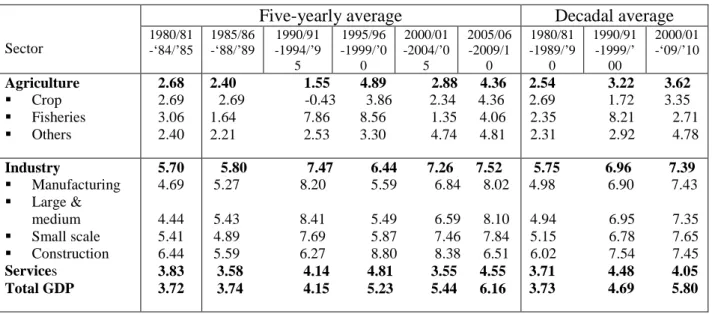
It can be noted from the sectoral contribution data that all three broad economic sectors contributed to the growth momentum. Decadal average data shows that agricultural GDP growth has been raised from 2.5 percent during the 1980s to 3.2 percent in the 1990s and later 3.62 percent in 2000s. Industrial sector GDP growth was seen to accelerate from 5.8 percent in 1980s to 7.0 percent in 1990s and later to 7.4 percent in the 2000s. And the service sector performed its proper role by increasing its contribution to the overall GDP growth from 3.71 percent in 1980s to 4.48 percent in 1990s, although later in the 2000s, the said sector‘s contribution declined to be only 4.05 percent (Osmani, 2004).
A careful attention in the disaggregated sectoral growth composition shows that fisheries and manufacturing have been emerged as the two fastest growing sub-sectors in Bangladesh. The earlier has experienced sharp growth acceleration from 2.4 percent in the 1980s to 8.2 percent in the 1990s and then declined again; whereas the latter has grown continuously to report a rate of 4.98 percent, 6.90 percent, and 7.43 percent during the consecutive three decades of 1980s, 1990s, and 2000s respectively. But since the 1990s, frozen shrimp as well as the textile industry have happened to be the fastest growing contributors in the economy. In the next sub-sections a glimpse of growth contributions by various sectors will be presented.
y = -0.945x + 19.405 y = 1.174x + 27.895 y = 2.492x + 41.91 0 10 20 30 40 50 60
FY1991-95 FY1996-00 FY2001-04 FY2005-10
Agriculture Industry Services Linear (Agriculture) Linear (Industry) Linear (Services)
28 Table 2.3: Sectoral GDP Growth Rates for FY1980/81-FY2009/10 (Annual average and in constant
1995/96 producer prices)
Sector
Five-yearly average Decadal average
1980/81 -‗84/‘85 1985/86 -‗88/‘89 1990/91 -1994/‘9 5 1995/96 -1999/‘0 0 2000/01 -2004/‘0 5 2005/06 -2009/1 0 1980/81 -1989/‘9 0 1990/91 -1999/‘ 00 2000/01 -‗09/‘10 Agriculture Crop Fisheries Others 2.68 2.69 3.06 2.40 2.40 1.55 4.89 2.88 4.36 2.69 -0.43 3.86 2.34 4.36 1.64 7.86 8.56 1.35 4.06 2.21 2.53 3.30 4.74 4.81 2.54 3.22 3.62 2.69 1.72 3.35 2.35 8.21 2.71 2.31 2.92 4.78 Industry Manufacturing Large & medium Small scale Construction Services Total GDP 5.70 4.69 4.44 5.41 6.44 3.83 3.72 5.80 7.47 6.44 7.26 7.52 5.27 8.20 5.59 6.84 8.02 5.43 8.41 5.49 6.59 8.10 4.89 7.69 5.87 7.46 7.84 5.59 6.27 8.80 8.38 6.51 3.58 4.14 4.81 3.55 4.55 3.74 4.15 5.23 5.44 6.16 5.75 6.96 7.39 4.98 6.90 7.43 4.94 6.95 7.35 5.15 6.78 7.65 6.02 7.54 7.45 3.71 4.48 4.05 3.73 4.69 5.80
Source: Estimated from BBS (2000) and BBS (2001a), MOF (2010)
Table 2.4: Growth of Principal Export Products (annual average and in million US dollars) Export item FY1989/90-FY19991/92 FY1998/99-FY2000/01 FY2007/08-FY2009/10 Textile products (RMG) &
knitwear Frozen foods All other exports Total exports 891 137 717 1745 4411 327 750 5488 12422 446 3017 15885
Source: World Bank (1999a) and GOB (2002)
Table 2.5: Growth Figures for Various Economic Sectors between FY1980 and FY2010 (Based on 1995/96 constant prices)
Sector Growth in GDP over
1979/80-1981/82 to 1988/89-1990/91 (billion taka) Growth in GDP over 1998/99-2000/2001 to 2007/2008-2009/2010 (billion taka) GDP growth increment from 1980s to 2000s (billion taka) Contribution of the sector in incremental GDP growth (%) Agriculture Crop production Fisheries Others 65.36 40.51 11.36 13.49 142.09 88.97 41.68 53.13 76.73 48.46 30.32 39.64 6.97 4.40 2.75 3.60 Industry Manufacturing Large & medium Small scale Construction Services Total GDP 102.36 56.22 39.66 16.58 29.26 174.05 341.77 N/A 297.24 209.00 88.24 148.86 172.96 1443.12 N/A 241.02 169.34 71.66 119.6 - 1101.35 N/A 21.88 15.37 6.51 10.86 - 100 Source: GOB (2010)