Analytical derivation of diffusion coefficient
of
two-dimensional
point
vortex
system with
Klimontovich
formalism
Yuichi
YATSUYANAGI
Faculty
of
Education,
Shizuoka
University
Tadatsugu
HATORI
Faculty of
Science, Kanagawa University
1
Introduction
A diffusion coefficient of a two-dimensional (2D) point vortex system is analytically
derived with Klimontovich formalism.
The main motif of this international seminar is to provide
an
opportunity forcollab-oration between mathematician and physicist. In such case, jargons in
a
group preventthe other group from active discussion. So, I will try to explain meanings of the words
which may be potentially jargons.
The $2D$ inviscid Euler equation has
a
formal solution ofsingular point vortices.How-ever, the Euler equation is the macroscopic fluid equation and should have macroscopic
smooth solutions. We regard the Euler equation that has the singular point vortex
solu-tion
as a
kineticequation. Thekinetic equationis formally identicalwith themacroscopicEulerequation. It happens that the macroscopic Euler equation and thekinetic equation
have the
same
form.Similar
case
can
be found in plasmaphysics. The Klomontovich-Dupree equation isa
kineticequationthat has a discretized exactsolutionbythe Diracdeltafunctionin
a
phasespace. Bycoarse-graining (averaging) the equation, the Fokker-Plancktypecollisionterm
is obtained. A kinetic equation with the Fokker-Planck type collision term is called the
Fokker-Planck equation, which is the versionofthe Boltzmann equation applicable to the
case
of long-range interparticle forces. The above procedure is called the Klimontovichformalism. This time,
we
apply the Klimontovich formalism to the point-vortex system,The organization
of
this paper isas
follows: InSec.
2, the point vortex system isintroduced. In
Sec.
3, outlineof the Klimontovich formalismis given. InSec.
4our
resultwill be given. In Sec. 5 we give
our
conclusion.2
Point
vortex
system
The$2D$ Eulerequationis
a
partialdifferential
equationwhich describes incompressibleflow in $2D$ plane.
$\frac{\partial u(r,t)}{\partial t}+u(r, t)\cdot\nabla u(r, t)=0$. (1)
Thevorticity equation is obtained by taking the rotation differential:
$\frac{\partial\omega_{z}(r,t)}{\partial t}+u(r, t)\cdot\nabla\omega_{z}(r, t)=0$, (2)
and it has a point vortex solution:
$\omega_{z}(r, t)=\sum_{i}\Omega_{i}\delta(r-r_{i}(t))$, (3)
where$\omega_{z}(r, t),$ $u(r, t)$
are
thenonzero
component of the vorticity and the flow field in $2D$plane pointedby$r=(x, y)$
.
Thecirculation
(strength) of the i-th point vortex at position$r_{i}$ is denotedby$\Omega_{i}$ whose valueiseither $\Omega_{0}or-\Omega_{0}$ where $\Omega_{0}$ is
a
positiveconstant. Thissolution (3) is discretized by the Dirac delta function. In general, macroscopic fluid
equation should have
a
smooth solution. Thus,we
regard the point vortex solution isa
solution for
a
kinetic equation that is formally identical with the $2D$ Euler equation. Wecall this equation the microscopic Euler equation. To distinguish the microscopic Euler
equation from the macroscopic one,
we
indicate the microscopic variable with a hat.$\frac{\partial\hat{\omega}_{z}(r,t)}{\partial t}+\hat{u}(r, t)\cdot\nabla\hat{\omega}_{z}(r, t)=0$ (4)
Themicroscopic and macroscopic variables
are
related by (ensemble)average
operator $\{\cdot\rangle$$\omega_{z}(r, t)=\{\hat{\omega}_{z}(r, t)\}$. (5)
The microscopic vorticity $\hat{\omega}_{z}(r, t)$, velocity$\hat{u}(r, t)$ and stream function$\hat{\psi}(r, t)$ satisfy the
following relations,
$\hat{u}(r, t)$ $=$ $\nabla\cross(\hat{\psi}(r, t)\hat{z})=-\hat{z}\cross\nabla\hat{\psi}(r, t)$ , (6)
$\hat{\omega}_{z}(r, t)$ $=$ $\nabla\cross\hat{u}(r, t)=-\nabla^{2}\hat{\psi}(r, t)$ (7)
where $\hat{z}$ is
a
unit vector in$z$ direction. Positions of the point vortices
are
governedby the microscopic Euler equation and by coarse-graining the distribution ofthe point
vortices, macroscopic vorticity distribution $\omega_{z}(r, t)$ is obtained. Here,
a
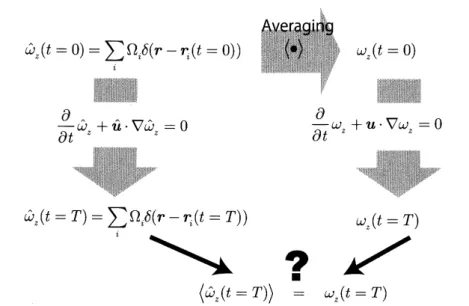
question arises.Themicroscopicsolutiongoverned bythemicroscopic Eulerequationandthe macroscopic
solution governed by the macroscopic Euler equation is the
same
as
is shown in Fig. 1?$l$
$\{\hat{\omega}_{z}(t=T)\}$ $=$ $\omega_{z}(t=T)$
Figure 1: The microscopic solution governed by the microscopic Euler equation and the
macroscopic solution governed by the macroscopic Euler equation is the same?
3
Klimontovich formalism
Klimontovich-Dupree equation
$\frac{\partial\hat{f}(r,v,t)}{\partial t}+v\cdot\nabla\hat{f}(r, v, t)+\frac{q}{m}(\hat{E}+v\cross\hat{B})\cdot\frac{\partial}{\partial v}\hat{f}(r, v, t)=0$ (8)
is
an
equation for 6-dimensional phase space with $(r, v)$ and hasan
exact solution fora
particle density function $\hat{f}(r, v, t)[1]$.
$f(r, v, t)= \sum_{i}\delta(r-r_{i}(t))\delta(v-v_{i}(t))$ (9)
The hat on the particle density function $f$
means
this function microscopic. Themi-croscopic electric and magnetic fields $\hat{E}$ and $\hat{B}$ obey the microscopic Maxwell equation
that is identical withthe macroscopic (usual) Maxwell equation
as
the Maxwell equationdoes not have nonlinear term. It is assumed that the microscopic quantity consists of a
macroscopic part and a fluctuation.
$f(r, v, t)$ $=$ $\{f(r, v, t)\}+\delta f(r, v, t)=f(r, v, t)+\delta f(r, v, t)$ (10)
$\hat{E}(r, v, t)$ $=$ $E(r, v, t)\}+\delta\hat{E}(r, v, t)$ (11)
$\hat{B}(r, v, t)$ $=$ $B(r, v, t)+\delta\hat{B}(r, v, t)$ (12)
Note that a macroscopic quantity is obtained by averaging
a
microscopic quantity withFigure 2: Klimontovich equation is related to the microscopic Euler equation that has the point vortex solution. By averaging Klimontovich equation, macroscopic
Fokker-Planck equation is obtained. Ignoring the Fokker-Planck collision term,
Vlasov
equationisobtained.
We
regard that the macroscopic Euler equationis related to themacroscopicVlasov equation. There is
no
related equation for the Fokker-Planck equation.(13)
Klimontovich-Dupree equation and averaging the equation, the following macroscopic
equation is
obtained.
$\frac{\partial f}{\partial t}+v\cdot\nabla f+\frac{q}{m}(E+v\cross B)\cdot\frac{\partial f}{\partial v}=\frac{q}{m}\{(\delta\hat{E}+v\cross\delta\hat{B}\cdot\frac{\partial}{\partial\delta v}\delta\hat{f})\}$
Further calculation yields the Fokker-Planck collision term from the right hand side of
Eq. (13) and
a
kinetic equation with Fokker-Planck collision term is calledFokker-Planck
equation:
$\frac{\partial f}{\partial t}+v\cdot\nabla f+\frac{q}{m}(E+v\cross B)\cdot\frac{\partial f}{\partial v}=\frac{\partial}{\partial v}\cdot(\overline{D}\cdot\frac{\partial f}{\partial v})$. (14)
If the collision term is dropped completely, it iscalled Vlasov equation:
$\frac{\partial f}{\partial t}+v\cdot\nabla f+\frac{q}{m}(E+v\cross B)\cdot\frac{\partial f}{\partial v}=0$ (15)
We summarize the relation between the Klimontovich equation and the point vortex
equation in Fig. 2. Klimontovich equation is related to the microscopic Euler equation
that has the point vortex solution. By averaging Klimontovich equation, macroscopic
Fokker-Planck equation is obtained. Ignoring the Fokker-Planck collision term, Vlasov
equation is obtained. We regard that the macroscopic Euler equation is related to the
macroscopicVlasovequation. There is
no
relatedequationfor the Fokker-Planckequation.This time,
we
focus ourselvesto obtainthe corresponding macroscopic equation that may4
Kinetic
theory
for
$2D$point
vortex
system
To obtain the Fokker-Planck type collision term for the $2D$ point vortex system, the
same
procedureas
the Klimontovich formalism is applied. Microscopic vorticity isas-sumed to consist of the macroscopic vorticity and the fluctuation.
$\hat{\omega}_{z}(r, t)$ $=$ $\{\hat{\omega}_{z}(r, t)\}+\delta\hat{\omega}_{z}(r, t)=\omega_{z}(r, t)+\delta\hat{\omega}_{z}(r, t)$ (16)
$\hat{u}(r, t)$ $=$ $u(r, t)+\delta\hat{u}(r, t)$ (17)
Same
as
before, substituting the microscopic variables into the microscopic Euler equation and averaging it, the following macroscopic equation is obtained.$\frac{\partial\omega_{z}(r,t)}{\partial t}+u(r, t)\cdot\nabla\omega_{z}(r, t)=-\nabla\cdot\langle\delta\hat{u}(r, t)\delta\omega_{z}(r, t)\rangle$ (18)
To evaluate the diffusion term
on
the right hand side,we
needan
evolution equationfor $\delta\omega_{z}(r, t)$
.
For this purpose, linearlized equation is introduced, which is obtained bysubstituting the microscopic variables (16) and (17) into the microscopic Euler equation
(4) and dropping the zero-th ordermacroscopic terms. The obtained linearlized equation
is given by
$\frac{\partial}{\partial t}\delta\hat{\omega}_{z}(r, t)+u(r, t)\cdot\nabla\delta\hat{\omega}_{z}(r, t)=-\delta\hat{u}(r, t)\cdot\nabla\omega_{z}(r, t)$ . (19)
This linearlized equation can be integrated as$u(r, t)$ in the second term on the left hand
side and $\omega_{z}(r, t)$
are
assumed to be constant in the microscopic scale:$\delta\hat{\omega}_{z}(r, t)=-\int_{-\infty}^{t}d\tau\delta\hat{u}(r-(t-\tau)u, \tau)\cdot\nabla\omega_{z}(r, t)$ (20)
Finally, the corresponding macroscopic equation is obtained:
$\frac{\partial}{\partial t}\omega_{z}(r, t)+u(r, t)\cdot\nabla\omega_{z}(r, t)=\nabla\cdot(\etarightarrow\cdot\nabla\omega_{z}(r, t))$ (21)
$\etarightarrow=\int_{-\infty}^{t}\langle\delta\hat{u}(r, t)\delta\hat{u}(r-(t-\tau)u, \tau)\}d\tau^{\sim}$ (22)
The right hand side is the diffusion term due to the discreteness of the vorticity. It may
be
an
extension of the well-known Green-Kubo formula. This result includes the positionand time correlations, while
Green-Kubo formula
includes the time correlation only.5
Conclusion
We have derived the diffusion term implicitly included in $2D$ Euler equation. On the
In
general,collision
term inFokker-Planck
equation consistsof
two parts:the diffusion
term and the friction term.
$\nabla\cdot(\etarightarrow\cdot\nabla\omega_{z}+A\omega_{z})$ (23)
In
our
result, friction term is not included. The frictiontermmay be derived by rewritingEq. (20)
as
$\delta\hat{\omega}_{z}(r, t)$ $=$ $- \int_{t_{0}}^{t}d\tau\delta\hat{u}(r-(t-\tau)u, \tau)\cdot\nabla\omega_{z}(r, t)$
$+\delta\omega_{z}(r-(t-t_{0})u, t_{0})$. (24)
Further calculation reveals that the second term is proportional to $\omega_{z}$. As this effect is,
however, evaluated negligible
as
compared with the diffusion term,we
ignore the term.References
[1] Y. L. Klimontovich: The