GEOMETRIC IDENTITIES GREG MCSHANE
1. INTRODUCTION
This text is
a
complement to the talk I gave at Hakone in May2012.
$I$ would like tothank the organizers for invitation toparticipatein
a
workshop in suchanidyllic setting. $I$should also like to thank Martin Bridgeman, Dany Caligari and Hidetoshi Masai for many useful discussions. Finally,
we
thank Sadayoshi Kojima for all his help and hospitality whilst visiting Tokyto Institute of Technology.1.1. History. Roughlyspeaking
a
geometricidentity fora
Fuchsian group,or more
gen-erally a Kleinian group, expressessome
fundamental quantityas
a series whose termsdepend on the values of the lengths of the closed geodesics inthe quotient space.
Let us begin by giving a very brief chronology of the development of these identities.
In the early $90s$ Ara Basmajian produced an identity which, in the simplest case, gives
the length of a totally geodesic boundary component of a hyperbolic surface
as
asum
over
lengthsoforthogeodesics. Atabout thesame
time the author gavean
identitywhich calculated thearea
ofa
cuspregionas a sum
overthe lengthoftheboundaries ofembeddedpairs ofpants. These identities found applications and have been extended by Bowditch,
Sakuma et al and Tan, Wong, Zhang to a variety of different settings. Around 2008 Bridgeman discovered
an
identitywhich gives thearea
ofa surfaceas
asum over
lengthsoforthogeodesics. With Kahn he went on to extend this to obtain the volume of higher
dimensional manifolds with totally geodesic boundary
as
a
series. Calegarigavea
related but different construction and with Masai the author shows that both constructions give thesame
identity whatever the dimension. Then, in 2010, Luo and Tan discovered anidentity which gives the
area
of a surfaceas
a sum over the length of the boundaries ofembedded pairs ofpants.
1.2. The underlying idea. All of the identities have the following in
common:
theyare
proved using hyperbolic geometry to decompose
some
set$X$ associatedto the surfaceinto countably many pieces and then calculating the volume (orarea or
length dependingon
the dimension) of the pieces. To obtain Basmajian’s and McShane’s identities the set $X$
is the totally geodesic boundary, whilst for Bridgeman-Kahn,Calegari and Luo-Tan$X$ is
the unit tangent bundle.
In this manuscript we will discuss in detail the constructions of Bridgeman-Kahn and
Calegari.
1.3. Bridgeman-Kahn and Calegari. Bridgeman-Kahn-Calegari formulae give the
vol-ume of$M^{n}$, a compact hyperbolic $n$-manifold with totallygeodesic boundary, in termsof
theorthospectrum of the manifold. Bridgeman-Kahn’s formula is:
$vo1_{n-1}(\mathbb{S}^{n-1})\cross vo1_{n}(M^{n})=\sum_{\alpha*}vol(\mathcal{B}_{\ell(\alpha*)})$
where the sum is over all orthogeodesics $\alpha*$ and $\mathcal{B}_{\ell(\alpha*)}$ is a certain subset of the unit
tangent bundle ofthe convex hull of a pair of disjoint totally geodesic n-l dimensional
hyperplanes in $\mathbb{H}^{n}$
.
Calegari’s formula has the same form but the set$\mathcal{B}_{\ell(\alpha*)}$ is replaced
by a quite different set $C_{\ell(\alpha*)}$. Both methods are thus based on decomposing the unit
tangent bundle into countably many pieces, each of which is naturally associated to a
unique orthogeodesic.
In two dimensions the volume of each piece turns out to be the Rogers’ dilogarithm
of a simple function of the ortholength [3], [6]. This
case
is of particular interest sincethe deformation theory ofconvex surfaces yields functional relations for the dilogarithm.
However,
as
onesees
from the formula below, in three dimensions the volume of eachpiece can be written in terms of the ortholength and its exponential. The deformation theory of hyperbolic 3 manifolds which have totally geodesic boundary is trivial and
no
functional relations are to be expected.
In dimensionsgreaterthan3 it is possibletogiveanexplicitclosed formula for the term
inthe sum althoughit seemsthat (see [9]) ineven dimensions one shoulduse
Bridgeman-Kahn’s construction whilst in odd dimensions Calegari’s construction is
more
suitable. 1.4. Explicit formulae. The Basmajian identity for a compact hyperbolic 3-manifold$M$ with totally geodesic boundary $\partial M$,
one
has$- \chi(\partial M)=\sum_{\alpha^{*}}\frac{4}{e^{\ell(\alpha^{*})}-1}$
where the sum is over all orthogeodesics $\alpha^{*}$
.
Compare this with Bridgeman-Kahn $2 vo1_{3}(M)=\sum_{\alpha^{l}}\frac{\ell(\alpha^{*})+1}{e^{2\ell(\alpha^{*})}-1}.$Thus both the volume of the 3-manifold and the
area
of the boundaryare
determined bythe orthospectrum. Moreover, these quantities arewritten as seriesover theorthospectra
and the terms
are
expressed using just usual functions.For completeness we give McShane’s identity for the punctured torus
$\sum_{\alpha}\frac{2}{1+e^{\ell(\alpha)}}=1$
where the
sum
isover
all closed simple geodesics.1.5. Statement of results. In this manuscript we give a new $pro$ofof:
Theorem 1.1. $\mathcal{B}_{l}$ and$c_{\iota}$ have the same volume when $n=2.$
This result
was
proven by Calegari in [7] by computing the volume for $C_{l}$ as afunctionof $l$ and comparing with the analogous expression
obtained by Bridgeman for $\mathcal{B}_{l}$
.
Herewe give a different proof which is entirely geometric being based on the non existence of
geodesic bigons in non positive curvature. As such our proofshould bevalid in pinched
strictly negative curvature
once
the definition of$\mathcal{B}_{l}$ and $C_{l}$ have been suitably modified(the reader is left to check the details). In [9], we prove that the two volumes
are
thesame
whatever the dimension using another quite different technique.Ourproofrequires
an
analysis of the geometry ofaclassof surfaces calledcrowns.
Recall that acrown (see [8]) isacompleteconvexhyperbolicsurface offinite areahomeomorphicto anannulus. In passingwe determinethe orthospectmm of a crown (Theorem 5.1 and
2. ORTHOGEODESICS
Informally, the orthospectrumof thesurface $S$ is theset oflengths ofcommon
perpen-diculars between (not necessarily distinct) boundary components.
2.1. Orthospectrum. We define the orthospectrum intwo different settings: for a gen-eralized ideal polygon in $\mathbb{H}$ and for a general surfacewith geodesic boundary.
2.1.1. Orthospectrum
of
a genemlized ideal polygon. Recall that an ideal polygon is the convex hull ofafinite set ofpoints $X=\{x_{1}, x_{2}\ldots x_{n}\}\subset\partial \mathbb{H}$More generally let, $X\subset\partial \mathbb{H}$be a closed, nowhere dense subset and note that the complement $X^{c}$ is an open subset
consisting of countably many intervals. The convex hull $C(X)$ of $X$ is a closed
convex
subsetbounded by countably many geodesics$\alpha_{k}$,
one
for each interval in$X^{c}$.
We refer to$C(X)$
as
a generalized ideal polygon, the $\alpha_{k}$ are the sides of $C(X)$ and we say that twosides $\alpha_{j},$$\alpha_{k}$ are adjacent if they are asymptotic.
The orthospectrum
of
$C(X)$ is the collection of distances $d_{H}(\alpha_{j}, \alpha_{k})$ where $\alpha_{j},$$\alpha_{k}$are
distinct, non adjacent sides. Note that $d_{H}(\alpha_{j}, \alpha_{k})$ is realised by the length ofthe unique
common
perpendicular between $\alpha_{j},$$\alpha_{k}$ whichwe
refer toas
the orthogeodesic associatedto thispair
of
sides.The numbers $d_{H}(\alpha_{j}, \alpha_{k})$
can
be determined explicitlyas
functions ofthe $x_{i}$as
follows.Suppose, without loss of generality, that $\alpha_{n}$ has endpoints $x_{n},$$x_{1}$ and that if $k\neq n$ then
$\alpha_{k}$ has endpoints $x_{k},$$x_{k+1}$
.
Then (see Beardon [2] fordetails)$\tanh^{2}(\frac{1}{2}d_{\mathbb{H}}(\alpha_{j}, \alpha_{k}))=\frac{(x_{j}-x_{k})(x_{j+1}-x_{k+1})}{(x_{j+1}-x_{k})(x_{j}-x_{k+1})}.$
In [3] Bridgeman calculates the orthospectrum of a regular ideal $n$-gon. If $n\geq 5$ is
an
odd integer the orthospectrum consists of the numbers $l_{m},$ $m=2\ldots(n-1)/2$ counted$n$
times, where $l_{m}$ is defined by
$\cosh(\frac{l_{m}}{2})=\frac{\sin(\frac{m\pi}{n})}{\sin(\frac{\pi}{n})}.$
The
case
$n=3$ corresponds to an ideal triangle which has exactly 3 pairwise adjacentsides
so
that the orthospectrum is empty.2.1.2. Orthospectrum
of
aconvex
surface.
We now consider a not necessarily compacthyperbohcsurface $S$ of finite volumewith non-empty geodesic boundary$\partial S$
.
Our surface$S$ is obtained
as
the quotient ofa convex
subset $C(X)\subset \mathbb{H}$ bya
group of orientationpreserving isometries $\Gamma$. For example, the limit set $\Lambda$ of $\Gamma$ is a non empty $\Gamma$-invariant
closed, nowhere dense subset of$\partial \mathbb{H}$and in this case $S$ can be identified with the quotient
of the
convex
hull $C(\Gamma)$ of the limit set by $\Gamma$. In fact any non empty $\Gamma$-invariant closedsubset of$\partial \mathbb{H}$contains $\Lambda$ theunion of$\Lambda$ andthe $\Gamma$-orbit ofsome finitesubset ofpoints not
in $\Lambda.$
The set of orthogeodesics of the surface isjust the set of $\Gamma$-orbits of orthogeodesics of
$C(X)$ and the orthospectrum is the corresponding collection of lengths. As
an
exampleconsider the orbifold$S$obtained
as
aquotientof the regular$n$-gon,$n\geq 5$odd, bythegroupof rotations contained in its group ofsymmetries. From Bridgeman’s work cited in the
previous paragraph
one sees
that theorthospectrumof$S$is the set $l_{m},$ $m=2\ldots(n-1)/2$2.1.3. Enumemting the orthospectrum. The orthospectrum of a finite volume surface $S$
can
becomputed algorithmically. For example, ifthe surface hasa
singletotallygeodesicboundary component and $H<\Gamma$ is a subgroup generated by a simple loop around the
boundary, $\beta$ say, then it suffices to enumerate the cosets of $H$ in $\Gamma$. This can be done
efficientlyusingafinite stateautomaton (see [10]) for details. If$g_{k}H,$ $g_{k}\in\Gamma$ beacomplete
repetion free list of cosets then orthospectrum is computed using the
cross
ratios of theendpoints of the axes of$\beta$ and $g_{k}\beta g_{k}^{-1}.$
2.1.4. $Iso$ orthospectml
surfaces.
The spectrum of lengths of closed geodesics ofahyper-bolic surfaces behaves quite subtly under taking finite covers see for example [12]. The
problem of finding pairs of non isometric isospectral surfaces was solved (see Buser [5]
for background), in partcular Sunada [13] gave a construction based on pairs of almost
conjugate subgroups.
The behavior of the orthospectrum is much simpler:
Lemma 2.1. Let$Xarrow Y$ be a $n$
-fold
cover then the orthospectrumof
$X$ is just thatof
$Y$but with all the multiplicties multiplied by$n.$
Proof: Since$X$ covers$Y$ theyhave thesameuniversalcover $U\subset \mathbb{H}$and there
are
groupsof orientation preserving isometries $\Gamma_{X}$ and $\Gamma_{Y}$ such that
$X=U/\Gamma_{X}, Y=U/\Gamma_{Y}.$
Since $X$ is an $n$-fold cover of$Y$ we have
$\Gamma_{Y}=\sqcup_{k=1}^{n}\Gamma_{X}g_{k}$
for any choice of coset representatives $g_{k}$
.
It is easy to check that if $\alpha*$ is a commonperpendicularto sides of$U$ then its $\Gamma_{Y}$-orbit decomposes into exactly$n$ ofthe $\Gamma_{X}$-orbits
and the lemma follows.
$\square$
Corollary 1. There
are
surfaces $X,$ $X’$, 2-foldcovers
of a pair ofpants $Y$ which are notisometric but have the same orthospectrum.
Proof: Let $Y$ be a pair of pants with boundary geodesics of lengths 1, 1,2 There is a
2-fold
cover
$X$ of$Y$ with boundary lengths 2,2,2, 2 and another $X’$ with lengths 1,1,2,4. These surfacescannot be isometric since boundarycurves aresent to boundarycurves
byan isometry. However, by the lemma they have the same orthospectrum.
$\square$
3. THE UNIT TANGENT BUNDLE
We denote$p$ : $T\mathbb{H}^{n}arrow \mathbb{H}^{n}$ the canonical mapthat associates to atangent vectorapoint
in the base. Let$A$be anisometry (diffeomorphism) of$\mathbb{H}^{n}$ then it inducesadiffeomorphism
of the tangent bundle which we continue to denote by $A.$
If$v\in T\mathbb{H}^{n}$ is $a$ (non zero) tangent vector then $\gamma_{v}:\mathbb{R}arrow \mathbb{H}^{n}$
is the unique geodesic parameterised by arclength such that $\dot{\gamma}_{v}(0)$ is a positive multiple
of$\mathbb{H}^{n}$
.
Observe that the map$v \mapsto\gamma_{v}(-\infty)$
$T\mathbb{H}^{n} arrow\partial \mathbb{H}^{n}$
is continuous and, in particular, the preimage of any measurable subset of $\partial \mathbb{H}^{n}$ is a
measurable subset of the tangent bundle.
Whenever we speak ofa geodesic $\alpha$ in $\mathbb{H}^{n}\cup\partial \mathbb{H}^{n}$ we mean the union of a geodesic $\alpha$
and its ideal endpoints $\alpha^{\pm}.$
As discussed in [4], the unit tangent bundle $T_{1}\mathbb{H}^{n}$ has a standardvolume form $\Omega$, which
is just the product ofthe standard volume forms
on
$\mathbb{H}^{n}$ and $S^{n-1}$.
To obtainan
explicitformula for $d\Omega$, we shall try to parametrize unit tangent vectors by triples $(x, y, t)\in \mathbb{R}^{n-1}\cross \mathbb{R}^{n-1}\cross \mathbb{R}.$
Consider the upper half space model of $\mathbb{H}^{n}$ so that the ideal boundary is identified with $\mathbb{R}^{n-1}\cup\{\infty\}.$ $A$ point $v\in T_{1}\mathbb{H}^{n}$ determines a unique directed geodesic $\gamma_{v}$ and
so an
ordered pairofpoints $(\gamma_{v}(-\infty), \gamma_{v}(\infty))$ in the ideal boundary $\mathbb{R}^{n-1}\cup\{\infty\}$ and, provided
neither of these points is $\infty$, we may set $(x, y)=(\gamma_{v}(-\infty), \gamma_{v}(\infty))$
.
The last coordinate$t\in \mathbb{R}$ is the signed hyperbolic length between the highest point of
$\gamma_{v}$ and $p(v)$
.
Ourparametrization is defined on a open dense subset of $T_{1}\mathbb{H}^{n}$ and it is easy to check that
the complement has
measure
zero, so we may ignore its contribution when we computevolumes in $T_{1}\mathbb{H}^{n}$ With this parametrization,
we
have$d \Omega=\frac{2dV(x)dV(y)dt}{|x-y|^{2n-2}},$
where $dV(x)=dx_{1}dx_{2}\cdots dx_{n-1}$ for $x=(x_{1}, x_{2}, \cdots, x_{n})\in \mathbb{R}^{n-1}.$
4. DECOMPOSITIONS OF THE TANGENT BUNDLE AND PROBABILITIES
Probably the easiest
convex
finite volume hyperbolic surfaces to studyare
the ideal polygons. In particular, the orthospectrum ofan
ideal polygon is finite and easy tocompute. Surprisingly the study of the orthospectrum in this very simple
case
providesuseful information: in [3] Bridgeman discusses the associated orthospectra and derives many ofthe classical identities satisfiedby Roger’s dilogarithm.
4.1. Idealpolygons. Let $P\subset \mathbb{H}$ be
an
ideal polygon and$T^{1}P$be the set ofunit tangentvectors $v$ such that $p(v)\in P$
.
Let $A(P)$ denote thearea
of $P$ and note that the totalvolume of$T^{1}P$ is$2\pi A(P)$
.
If$v\in T^{1}P$ then the geodesic $\gamma_{v}$
.
either intersects a pair of sides of$P$$\bullet$ or has at least one endpoint at an ideal vertex of$P.$
The set of vectors such that $\gamma_{v}(\infty)=x\in\partial \mathbb{H}$ is a closed,
co
dimension 1 subvariety ofthe unit tangent bundle and
so
hasmeasure
$0$.
Since $P$ has only finitely manyvertices, itfollows that the set of vectors $v$such that $\gamma_{v}$ does not intersect
a
pairof sides hasmeasure
zero.
Thuswehave adecompositionofasubset of fullmeasure
of$T^{1}P$ intopieces$\mathcal{B}(\alpha, \beta)$labelled by pairs of sides $\alpha\neq\beta$ ofthe polygon $P.$
Recall that the sides of
an
ideal polygonare
disjoint complete geodesics and thata
pairofsidesof
an
ideal polyhedronare
adjacent if the underlying geodesicsare
asympoticso
that they sharea common
endpoint in the ideal boundary. Configurations ofpairs of complete geodesics are essentially determined up to isometry by a cross ratio of the fourendpoints (see Beardon [2]). It follows that the probability that arandom geodesic meets
agiven pair of sides ofan ideal polygon canbe expressed as a function of the associated
cross ratio.
Theorem 2 (Bridgeman [3]). Let $\alpha,$$\beta$ be a pair of sides of an ideal polyhedron $P$ then
the probability that $\gamma_{v}$ meets $\alpha$ and $\beta$ is
$\bullet$ $\frac{1}{\pi A(P)}\mathcal{L}(\frac{(\alpha^{-}-\alpha^{+})}{(\beta^{+}-\alpha^{+})}\frac{(\beta^{+}-\alpha^{-})}{(\alpha^{-}-\alpha^{-})})$ if $\alpha,$$\beta$ are non adjacent
$\bullet$ $\frac{1}{\pi A(P)}\frac{\pi^{2}}{6}n$ if$\alpha,$$\beta$ are adjacent.
Further,
$\pi A(P)=\sum_{\alpha^{s}}\mathcal{L}(\frac{1}{\cosh^{2}(\ell(\alpha*)/2)})+n\frac{\pi^{2}}{6}$
where the sum is
over
allcommon
perpendiculars $\alpha*.$Note that in fact
$\frac{(\alpha^{-}-\alpha^{+})(\beta^{+}-\alpha^{-})}{(\beta^{+}-\alpha^{+})(\alpha^{-}-\alpha^{-})}=\frac{1}{\cosh^{2}(\ell(\alpha*)/2)}$
where $\alpha*$ is the common perpendicular between $\alpha$ and $\beta$ so the probability depends on
an ortholength.
4.2. Decompositions ofthe unit tangent bundle. From the construction in the
pre-vious paragraph weobtain a decomposition ofasubset of full
measure
of$T^{1}P$ intopieceslabelled by pairs of sides of the polygon $P$
.
To calculate the probabilities in Bridgeman’stheorem
one
has to determine the volume of certain subsets of the unit tangent bundle of $\mathbb{H}$ defined by pairs of disjoint geodesics.In fact, it is sufficient to do this for an ideal
quadrilateral. Let $l>0$ and $\beta,$$\alpha$ be a pair of disjoint geodesics in $\mathbb{H}\cup\partial \mathbb{H}$ such that
the length of the common perpendicular is $l$. The convex hull of $\beta$ and $\alpha$ is an ideal
quadrilateral $\mathcal{Q}$ (see Figure 1).
4.2.1.
Bridgeman$s$ set. With the above notation we define:$\mathcal{B}_{l}$ $:=\mathcal{B}(\alpha, \beta)$ to be the set ofunit vectors $v$ tangent to geodesic segments joining $\alpha$ to $\beta.$
More formally, it is the set of$v\in p^{-1}(\mathcal{Q})$ satisfying (1) the ray $\gamma_{v}(\mathbb{R}_{+})$ meets $\beta,$
(2) the ray $\gamma_{v}(\mathbb{R}_{-})$ meets $\alpha.$
This set is the intersection of two open sets of the unit tangent bundle so is measurable.
4.2.2. CalegaWis’s set. Subsequently, Calegari introduced a different decomposition:
$C_{l}$ $:=C(\alpha, \beta)$ is the set of unit vectors
$v$ such that
(1) the ray $\gamma_{v}(\mathbb{R}_{+})$ meets $\beta,$
Figure 1: The quadrilateral $\mathcal{Q}$ and its chimney.
The chimney is the dark subset of the ideal quadrilateral in Figure 1 it is the
convex
hull of $\alpha$ and the nearest point retraction of $\alpha$ to $\beta$. Following Calegari, we say that the
top
of
the chimney is $\alpha$ and the baseof
the chimney is the nearest point retraction of $\alpha$to $\beta$
.
The chimney is aconvex
quadrilateral with the top and the base forming a pairofsides.
5. CROWNS AND SPIKES
Crowns form aclass ofsurfaces for whichone
can
givea closed form for theorthospec-trum. The reason for this is that the fundamental group of a
crown
is isomorphic to $\mathbb{Z}$andso lifts to the universal cover
are
indexed by integers.A
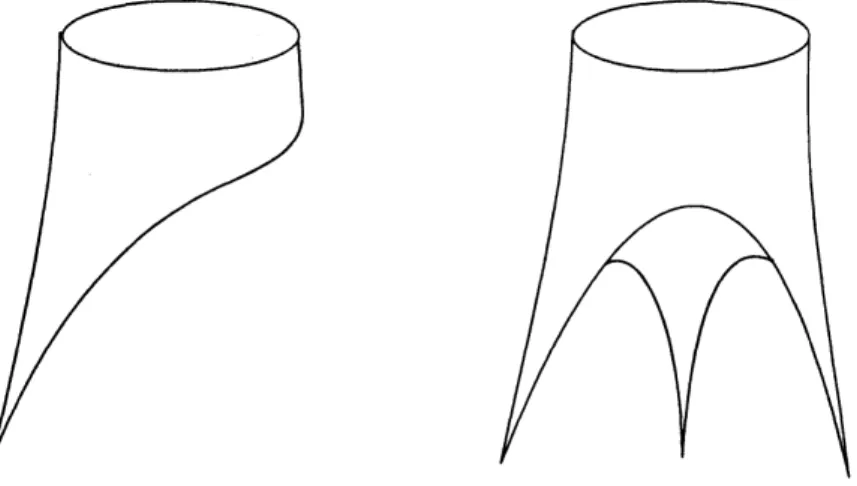
crown
(Figure 2)is acomplete convexhyperbolic surface of finite areahomeomorphicto an annulus. The boundary of the crownconsists of asingle closed geodesic, which
we
denote $\beta$, and finitely many disjoint complete geodesics
$\alpha_{i},$$i=1,$$\ldots n$
.
Onesees
easilyfrom the definition that a crown is non compact and further that the ends consist of
spikes. $A$ spike is a portion ofthe surface isometric to aregion between two asymptotic
geodesics in the hyperbolic plane. There
are
$n$ spikes, that is, exactly thesame
numberofspikes
as
complete geodesics $\alpha_{i}.$$\mathbb{R}om$ the Gauss-Bonnet formula the of
an
$n$ spikedcrown
is $\pi n$.
andso
the volume ofthe unit tanget bundle is $2\pi^{2}n.$
5.1. The single spiked
crown.
Let $\lambda>1$ and $S$ be the crown with a single spike anda boundary geodesic $\beta$ oflength $\log(\lambda)$.
We begin by finding a subset of $\mathbb{H}$ isometric to the universal cover of $S$
.
Let $\tilde{S}\subset \mathbb{H}$denote the convex hull of $\{0, \infty\}\sqcup\{\lambda^{k}, k\in \mathbb{Z}\}\subset\partial \mathbb{H}$
.
Observe that $\tilde{S}$is a generalized
ideal polygon, invariantunder the hyperbolic isometry$T$ : $z\mapsto\lambda^{k}z$. Further, the chimney
contained in the ideal quadrilateral 1,$\lambda,$$0,$$\infty$ is a fundamental domain for the group
generated by$T$
.
It follows that the universalcover
of $S$ can be identified with $\tilde{S}.$Figure
3:
The universalcover
ofa crown
in light greywith a chimney in darker grey. Theorem 5.1. The orthospectrumof
the single spikedcrown is the set$l_{k},$ $k\geq 2$ where $l_{k}$satisfies
$\cosh(\frac{l_{k}}{2})=\frac{\sinh(\frac{k\ell_{\beta}}{2})}{\sinh(\frac{\ell_{\beta}}{2})}$
and$l_{\infty}$ satisfying
$\cosh(\frac{l_{\infty}}{2})=\frac{1}{\sinh(\frac{\ell_{\beta}}{2})}.$
Proof: Let $\lambda>1$ and $S$ be the crown with a single spike and a boundary geodesic $\beta$
of length $\log(\lambda)$
.
The orthospectrum is easy to compute sincewe
have determined theuniversal cover of$S$. From the preceding discussion
9
has adistinguished side $0,$$\infty$ andsides $\lambda^{k},$$\lambda^{k+1}$ for $k\in \mathbb{Z}$
.
The distiguished side is $\Gamma$-invariant and $\Gamma$ acts transitively onthe othersides. The set oforthogeodesics of$\tilde{S}$
consists of
$\bullet$ the perpendiculars to $0,$
$\infty$ and $\lambda^{k},$$\lambda^{k+1}$
$\bullet$ the perpendiculars to $\lambda^{k},$$\lambda^{k+1}$ and $\lambda^{m},$$\lambda^{m+1}$
Usingthe transitivity of the action onesees that the orthospectrum of$S$ consists of $\bullet$ the length $l_{\infty}$ of the perpendicular $0,$$\infty$ to 1,$\lambda$
$\cosh^{2}(\frac{l_{\infty}}{2})=\frac{(\infty-1)(\lambda-0)}{(\lambda-1)(\infty-0)}=\frac{\lambda}{(\lambda-1)^{2}}=\frac{1}{\sinh^{2}(\frac{\ell_{\beta}}{2})}.$
$\bullet$ the lengths $l_{k}$ ofperpendiculars 1,$\lambda$ to $\lambda^{k},$$\lambda^{k+1}$
$\cosh^{2}(\frac{l_{k}}{2})=\frac{(\lambda^{k}-1)(\lambda-\lambda^{k+1})}{(\lambda-1)(\lambda^{k}-\lambda^{k+1})}=\frac{(\lambda^{k}-1)^{2}\lambda}{(\lambda-1)^{2}\lambda^{k}}=\frac{\sinh^{2}(\frac{k\ell_{\beta}}{2})}{\sinh^{2}(\frac{\ell_{\beta}}{2})}.$
5.2.
Lewin’s identity andcrowns.
$A$ very specialcrown
is the punctured idealmono-gon which
can
be obtained by identifying two sides ofan ideal triangle. We compute it’sspectrum andrelate it to an identity first proved by Lewin. We note that Bridgeman [3]
gave adifferent proof usinghis computationof the orthospectrum of aregularideal $n$-gon
and alimiting argument. Sincethe punctured monogon is alimit ofcrowns asthe length of the boundary geodesic goes to $0$, that it is possible to deduce this from Lemma 5.1
using
an
analogous argument to Bridgeman’s, however,we
givea
direct proof using the universalcover.
Lemma 5.2. The orthospectrum
of
the puncturedmonogon is the set$l_{k},$$k\geq 2$ where $l_{k}$satisfies
$\cosh(\frac{l_{k}}{2})=k^{2}$
Proof: Let $\tilde{S}\subset \mathbb{H}$ denote the convex hull
of the integers $\mathbb{Z}\subset\partial \mathbb{H}$
.
The polygon $\tilde{S}$ isinvariant under $T:z\mapsto z+1$ since $\mathbb{Z}$ is invariant by this translation. Observe that the
ideal triangle with vertices $0,1$ and $\infty$ is a fundamental domain for the group generated by$T$ and it follows that the universal cover of$S$
can
be identified with $\tilde{S}.$One now computes the orthospectrum
as
follows. Each side of $\tilde{S}$is a geodesic joining pairsof consecutiveintegers. Thegeodesic $[0, l]$joiningOand 1 isalift of thethe boundary
geodesic $\alpha$ and
so
every orthogeodesic lifts toa
perpendicular between this geodesic andanother side of $\tilde{S}$
, that is,
a
geodesic $[k, k+1]$ joining the integers $k,$$k+1$.
It followsimmediately that the orthospectrum is the set of distances $d_{\mathbb{H}}([O, 1], [k, k+1])$ where
$\cosh^{2}(d_{H}([0,1], [k, k+1]))=\frac{(k-0)(1-(k+1))}{(1-0)(k-(k+1))}=k^{2}.$
$\square$
It is easy to check that the set oftangent vectors such that $\gamma_{v}$ does not meet
a
pair ofsides is
measure
zero and so one obtains: Corollary 3. (Lewin’s identity)$\sum_{k}\mathcal{L}(\frac{1}{k^{2}})=\frac{\pi^{2}}{6}.$
5.3. Proof ofmain theorem. In this section,
we
show the following theorem: The Bridgeman set $\mathcal{B}_{l}$ and the Calegari set $C_{l}$ have thesame
area.
Proof: Let $S$ be asingle spiked crownwith closed boundary geodesic $\beta$and let $\alpha$ denote
the other boundary component. Consider $\gamma$a maximal geodesicon $S$
.
Bothendpoints of $\gamma$cannot be on$\beta$ since thisimphes the existence ofageodesic bigon, bounded byalift of $\gamma$ and a lift of $\beta$, in the universalcover.
but this is forbidden innon
positive curvature.Thus
$\bullet$ either both endpoints of
$\gamma$
are on
$\alpha$$\bullet$ orthere is one endpoint
on
$\alpha$and the other on $\beta.$$\bullet$
or
$\gamma$ isa
geodesic meeting $\beta$ and asymptotic to $\alpha.$This
means
that the unit tangent bundleofthe interiorof$S$ decomposesas
$X_{1}\sqcup X_{2}\sqcup X_{3}$where$X_{k}$ is the set of vectors $v$ such that$\gamma_{v}$ is respectively
one
ofthree types of geodesicSince Calegari’s chimney $\beta$ is a fundamental domain for action of the covering group
on $\mathbb{H}$ the set $p^{-1}(\beta)$ is a fundamental domain for action on $T^{1}\mathbb{H}$. It follows that any
$v\in X_{1}$ has exactly
one
lift $\tilde{v}\in p^{-1}(\beta)$ and by the preceding discussion $\tilde{v}\in C_{l}$.
The map $p$ preserves themeasure
and so$vo1_{3}(X_{1})=vo1_{3}(C_{l})$. Likewise every $v\in X_{1}$ has exactly
one
lift $\tilde{v}\in \mathcal{B}_{l}$ and$vo1_{3}(X_{1})=vo1_{3}(\mathcal{B}_{l})$,
and the result follows
$\square$
6. CLOSING REMARKS AND QUESTION
In this text we have given a brief survey of some of geometric identities and the
orthospectrum of hyperbolic manifolds with a particular emphasis
on
recent results ofBridgeman-Kahn and Calegari. There
are
many questions still open. In particular:$\bullet$ Arethese the only possible identities?
$\bullet$ By developping the ideas of Paragraph 2.1.4 it is not difficult to give examples
of pairs of surfaces with the same orthospectrum but different spectra of lengths
of closed geodesics. It is natural to ask: does the spectrum of lengths of closed geodesics determine the orthospectrum?
$\bullet$ Is a partial
converse
to Lemma 2.1 true: if two surfaces with thesame
orthospec-trum
are
they necessarilycommensurable?REFERENCES
[1] A. Basmajian, The orthogonalspectrum ofa hyperbolic manifold. Amer. J. Math. 115 (1993), no.
5, 1139-1159.
[2] A.F. Beardon, The geometry ofdiscrete groups, Springer-Verlag, cop. 1983
[3] M. Bridgeman, Orthospectm ofGeodesicLaminations andDilogarithm Identities on Moduli Space.
Geom. Topol. 15 (2011), no. 2, 707-733.
[4] M. Bridgeman and J. Kahn, Hyperbohc volume of$n$-manifolds with geodesic boundary and
orthos-pectra, Geometric and Functional Analysis, 20, Issue52010.
[5] P. Buser, Geometry and spectra ofcompactRiemann surfaces, Birkheuser, 1992
[6] D. Calegari, Chimneys, leopardspots, andtheidentitiesofBasmajianandBridgeman,Algebr.Geom.
Topol. 10 (2010), no. 3, 1857-1863.
[7] D. Calegari, Bridgeman’s Orthospectrum Identity, Topol. Proc. 38 (2011), 173-179.
[8] A. Casson and S Bleiler, Automorphisms of surfaces aflerNielsen and Thurston, Cambridge
Uni-versity Press, 1988
[9] H. Masai and G.McShane, Equidecomposability, volumeformulae and orthospectra, Preprint.
[10] G.McShane, J.R. Parker, and I. Redfem Drawing limit sets ofKleinian groups using finite state
automata, Experiment. Math. 3 (1994), 153-170.
[11] J.Ratcliffe, Foundations ofHyperbolicManifolds, Graduate Texts in Mathematics 149, 2006.
[12] P. Samak, Class numbers of indefinite binary quadratic forms., J. Number Theory 15 (1982),
229-247.
[13] T. Sunada, Riemannian coverings and isospectral manifolds, Ann. of Math. 121 (1985), 169-186.
INSTITUT FOURIER, UNIVERSITYOF GRENOBLE