On
the influence of delay
to
the strength of oscillation
criteria
for
neutral second
order
half-linear differential
equations
Robert
Ma\v{r}\’ik
Department
of
Mathematics, Mendel
University
in
Brno
Abstract
In the paperwestudythe second order neutral delay half-linear differential equation
$[r(t)\Phi(z’(t))]’+q(t)\Phi(x(\sigma(t)))=0,$
where$\Phi(t)=|t|^{p-2}t,$$p\geq 2$and$z.(t)=x(t)+b(t)x(\tau(t))$. We summarizethreedifferent methods availableto derive oscillationcriteriafor thisequationand comparethemonthe particular
ex-ampleof Eulertype equation and proportional delay. We show thatfor thisparticular equation the comparisonmethodproducesbetterresults ifthe delay is significant, whereasRiccati
equa-tionmethod produces sharper results if the delay argument is close to the classical argument.
We alsopoint outsome recentdevelopment in this area.
Keywords: half-linear differential equation, oscillation criteria, Riccati technique, delay
equa-tion, neutral equaequa-tion, Euler type equation
MSC: $34K11,$ $34K40$
1
Introduction
Consider the second order half-linearneutral differentialequation
$[r(t)\Phi(z’(t))]’+c(t)\Phi(x(\sigma(t)))=0, z(t)=x(t)+b(t)x(\tau(t))$, (1)
where $\Phi(t)=|t|^{p-2}t$ is the power type nonlinearityand$p\geq 2$,whichensures thatthefunction$\Phi$
is aconvex functionon $(0, \infty)$.
Underthe solutionof (1) we understand anydifferentiable function$x(t)$ which doesnot
identi-cally equal zero $eventually_{\rangle}$ such that$r(t)\Phi(z’(t))$ is differentiableand (1) holds for large $t.$
The solution ofequation (1) is said to be oscillatory ifit has infinitely many zeros tending to
infinity. Equation (1) issaidto beoscillatory ifallitssolutions areoscillatory. Inthe opposite$case_{\}}$
i.e., if there exists aneventually positive solution of (1), equation (1) is said to be nonoscillatory.
There
are
many oscillation criteria forequation (1) obtained byanapplicationofessentiallyone(i) using comparison with
a
half-linear second order equation basedon
apriori bound for thequotient $x(t)/z(t)$ (see e.g. [2,8,18
(ii) using the comparison method (comparison with linear first order delay differential equation,
see
e.g. [4-7, 9, 11, 13, 15]) and(iii) using the Riccati type substitution (seee.g. [10,14,17
The underlyingprincipleof all methods is toreplacetheequation (1) by
a
simpler object. Thespecialfocus is usually devoted to the second term, since the most disturbing thing in equation (1)
isthe presenceof both $z(t)$ and$x(t)$ in oneequationand it is easier to eliminate$x$ than$z.$
It is typical that all new criteria published in the literature
are
compared against the criteriaobtained by the
same
method. The aim of this paper is to collect available methods whichcan beused to derive oscillation criteria for equation (1) and compare them together. On
a
test of Eulertype equation wewill show that one ofthe methods produces sharper results for small delays and
another
one
for large delays. We will also modify the currently used approach in (i) and derive aresult whichis based on the comparison with second order delay differential equation rather than
second order ordinary differentialequation.
We will use the following assumptions on the coefficients and parameters. The coefficients $r$
and $b$
are
subject of usual conditions $r\in C^{1}([t_{0}, \infty), \mathbb{R}^{+})$, $b\in C^{1}([t_{0}, \infty), \mathbb{R}_{0}^{+})$ and the coefficient$c$ ispositive $c\in C([t_{0}, \infty), \mathbb{R}^{+})$
.
Further wesuppose that the deviating argumentsare unbounded,increasing and sufficiently smooth functions whichsatisfythe commutative law: $\tau\in C^{2}([t_{0}, \infty), \mathbb{R})$, $\tau’(t)>0,$ $\lim_{tarrow\infty}\tau(t)=\infty,$ $\sigma\in C^{1}([t_{0}, \infty), \mathbb{R})$, $\sigma’(t)>0,$ $\lim_{tarrow\infty}\sigma(t)=\infty$ and $\sigma(\tau(t))=\tau(\sigma(t))$
(for the weaker assumption $\sigma(\tau(t))\geq\tau(\sigma(t))$ see [10]). Depending on the method which will be
used to handle the problem, we will use some additional conditions,such
as
$b(t)\leq b_{0}$ or $b(t)<1.$For simplicity we will also suppose that both $\sigma$ and $\tau$ are delays and that the retardation in the
differential term is smaller than the retardation in the second term, i.e. we will suppose $\sigma(t)\leq$
$\tau(t)\leq t.$
In the paper the number $q=\overline{p}\overline{1}\underline{\not\simeq}$ is the conjugate numberto the number $p$. Given a positive
parameter $\varphi$ further define the function $Q$
as
minimum of$c(t)$ and$\varphi c(\tau(t))$$Q(t; \varphi)=\min\{c.(t), \varphi c(\tau(t))\}$ (2)
Finally, we willuse the assumption
$\int^{\infty}r^{1-q}(t)dt=\infty$ (3)
which (together with nonnegativity of $c(t)$)
ensures
that all eventually positive solutions satisfy$z’(t)>0$ eventually,
see
Lemma 1 below. Thus there is only one family of solutions which hasto be eliminated in order to
ensure
oscillation. Note that the oppositecase
to (3) is also handledfrequently in the literature and since in that case wehaveto eliminate two typesofsolutions(with
$z’(t)>0$ and $z’(t)<0$ eventually), the resulting oscillation criteria consist of two (similar but
relativelyindependent) conditions–each condition eliminates one of the families.
2
Monotonocity lemma
Thefollowinglemma
ensures
that theeventually positivesolutionssatisfy $z’(t)>0$ for large$t$. Theproofutilizes the condition (3) and can be found in many papers dealing with oscillation criteria
Lemma 1.
If
$x(t)$ is an eventually nonoscillatorysolutionof
(1), then the correspondingfunction
$z(t)=x(t)+b(t)x(\tau(t))$
satisfies
$z(t)>0, z’(t)>0, (r(t)\Phi(z’(t)))’<0$
eventually.
3
Method of apriori bound
The first idea how to remove the simultaneous presence of both $x(t)$ and $z(t)$ in (1) is to replace
$x(\sigma(t))$ by alower bound interm of$z(\sigma(t))$
.
If $x(t)$ is eventually nonegative, then $x(\tau(t))$ is also eventually nonegative and since $z(t)$ is
increasing and clearly $z(t)\geq x(t)$, wehave
$z(t)=x(t)+b(t)x(\tau(t))\leq x(t)+b(t)z(\tau(t))\leq x(t)+b(t)z(t)$
.
Thus if$b(t)<1$,the resulting inequalitycanbe utilizedtoobtainthe apriori boundfor thequotient
$x(t)/z(t)$
$0<1-b(t) \leq\frac{x(t)}{z(t)}$
.
(4)Thisapproachis summarized in the following lemma. The special case$\eta(t)=a(t)$ hasbeenused in
most papers dealingwith themethod ofapriori bound. The idea toreplace $\sigma$by asmallerfunction
$\eta$(andthusincreasethe delay$t-\sigma(t)$)isnewbut verysimpleand allows toimproveresultsobtained
by an applicationofathe so-called Myshkis-typecriterion from Theorem 1 below.
Lemma 2. Let $\eta(t)$ be continuous
function
such that$\eta(t)\leq\sigma(t)$ and $\lim_{tarrow\infty}\eta(t)=\infty$.
Supposethat
$b(t)<1$ (5)
holds eventually and suppose that the inequality
$[r(t)\Phi(z’(t))]’+c(t)(1-b(\sigma(t)))^{p-1}\Phi(z(\eta(t)))\leq 0$ (6)
doesnot have an eventually positive solution. Then (1) is oscillatory.
Proof.
It is sufficient to show that if$x(t)$ is an eventually positive solution of (1), then thecorre-spondingfunction $z(t)$ satisfies (6) eventually. If$\eta\equiv\sigma$, then (6) follows immediately from (1) and
inequality (4). Thefact that $\sigma(t)$ can be replaced by $\eta(t)\leq\sigma(t)$ follows from the monotonicityof
the function $z(t)$, see Lemma 1. $\square$
Inequality (6) is the second order delay differential inequalitywhich does not contain delay in
the differential term and is not neutral anymore. If$p=2$, then this inequality is handled by the
following theorem ofKoplatadze.
Theorem 1 ([12, Theorem 2]). Let
Then the inequality
$x”(t)$sgn$x(\eta(t))+c(t)|x(\eta(t))|\leq 0$
is oscillatory.
Note thatthe constant $\frac{1}{e}$ isoptimal and cannot be improved in general, but in
some
particularcases a refinement of Koplatadze’s results is possible,
see
[16]. As a consequence of Theorem 1, equation$x”(t)+ \frac{\beta}{t^{2}}x(\lambda t)=0$
is oscillatory if
$\beta>\frac{l}{e\lambda\ln\frac{1}{\lambda}}$ (7)
holds. You may
see
that the right hand side of thisinequality becomes unbounded if$\lambda$ approaches1. This undesired effectcan be eliminated by suitable choice of the function $\eta$ from Lemma 2,
see
(24) below.
Theorem 1 cannot be applied in the general
case
$p\geq 2$. Inthiscase
it is possibletouse
anotherapriory bound
$k \frac{\sigma(t)}{t}\leq\frac{z(\sigma(t))}{z(t)}$ for arbitrary $k\in(0,1)$ and large $t$ (8)
or
$\frac{\sigma(t)}{t}\leq\frac{z(\sigma(t))}{z(t)}$ for large$t$ (9)
which holds if
$\int^{\infty}c(s)(1-b(\sigma(s)))^{\rho-1}(\sigma(s))^{p-1}ds=\infty$, (10)
see [8, Theorem 13] for details.
Thus(6) does not haveaneventuallypositivesolutionifthecorresponding equationisoscillatory
which is true if either
$[r(t) \Phi(z’(t))]’+kc(t)(1-b(\sigma(t)))^{p-1}(\frac{\sigma(t)}{t})^{p-1}\Phi(z(t))=0$ (11)
is oscillatory for
some
$k\in(O, 1)$, or if (10) holds and$[r(t) \Phi(z’(t))]’+c(t)(1-b(\sigma(t)))^{p-1}(\frac{\sigma(t)}{t})^{p-1}\Phi(z(t))=0$ (12)
is oscillatory.
Various oscillation criteria for half-linear ordinary differential equations (12) and (11) are in
details discussedin the book [3] which
covers
main directions in oscillation theory of thehalf-linear4
Comparison
method
Themain idea of the comparisonmethod is to compare equation (1) with certainfirst order delay
differential inequality. Consider the original equation (1) and the same equation shifted from $t$
to $\tau(t)$
.
This gives in the second term expressions involving$x(\sigma(t))$and $x(\sigma(\tau(t)))$ which can be
combined into $z(\sigma(t))$. This allows to eliminate $x(t)$ in equation (1) and introduce $z(t)$ instead.
More precisely, weconsider theequation (1) and the equation
$\frac{1}{\tau’(t)}[r(\tau(t))\Phi(z’(\tau(t)))]’+c(\tau(t))\Phi(x(\sigma(\tau(t))))=0$ (13)
which arisesfrom (1) byshifting from $t$ to $\tau(t)$
.
Thenwetakeasuitablelinear combination of bothequations and use aseries of estimates which allow tocompare the resultingequation with certain
first order linear differential inequality. Note that the mainsteps to accomplish the desired result
are
inequality$c(t)x^{p-1}( \sigma(t))+c(\tau(t))b_{0}^{p-1}x^{p-1}(\sigma(\tau(t)))\geq\min\{c(t)$,$c(\tau(t))\}(x^{p-1}(\sigma(t))+b_{0}^{p-1}x^{p-1}(\sigma(\tau(t))))$
(14)
followed by the assumptionon commutativitybetween $\tau$ and $\sigma$ and by inequality
$x^{p-1}(\sigma(t))+b_{0}^{p-1}x^{p-1}(\tau(\sigma(t)))\geq 2^{p-2}(x(\sigma(t))+b_{0}x(\tau(\sigma(t)))^{p-1}\geq 2^{p-2}z^{p-1}(\sigma(t))$, (15)
where $b_{0}$ is aconstant upper bound of the function $b(t)$.
A closer examination of the published results shows, that theseinequalities
are
in some senseweakpointsofthe comparison method andpossessomeimprovement. See[10] for detailed discussion
and also for
more
generalversion of theseinequalities andsee also [8] forapplication of these ideasto the equation(1) and thecomparison method. One of the main results of [8] states thefollowing.
Theorem 2 $($ [8, Corollary (9), statement (ii)]$)$
.
Suppose that there exists a number$b_{0}$ such that$b(t)\leq b0$
.
Equation (1) is oscillatoryif
there exists a number$\varphi>0$ and afunction
$\eta(t)$ satisfying$\eta(t)\leq\sigma(t)$ and$\lim_{tarrow\infty}\eta(t)=\infty$ such that$\eta(t)<\tau(t)\leq t$ and
for
every$T$ there exists $t_{1}$ such that$\lim inftarrow\infty\int_{\tau^{-1}(\eta(t))}^{t}Q_{\eta}^{*}(s;\varphi, t_{1})ds>\frac{1}{e}(1+(\frac{\varphi}{\tau_{0}})^{q-1}b_{0})^{p-1}$ (16)
where
$Q_{\eta}^{*}(t; \varphi, t_{1}):=Q(t;\varphi)[\int_{t_{1}}^{\eta(t)}r^{1-q}(s)ds]^{p-1}$
Observe the presence of the function $\eta(t)$ in Theorem 2. An absolute majority of the recent
papers does not consider function like $\eta$ in the comparison method and deal just with the special
case $\eta(t)=\sigma(t)$. However, the influence of$\eta(t)$ to the value of the limes inferior on the left hand
side of the inequality (16) is ambivalent: bigger$\eta$ givesbigger$Q^{*}$ and thus has apositive influence
on the condition (16), but bigger $\eta$ also makes the interval of integration in (16) shorter and this
has anegative influence on the condition (16). As a consequence, some of the oscillation criteria
obtained by comparison method which produce poor results if $\sigma(t)$ is close to $t$ or $\tau(t)$ can be
improved byasuitable choiceof$\eta(t)<\sigma(t)$, seethe examples withsome discussion in [10, Example
2 andFigure 1], [9, Example 10 andFigure 2]. Asfar as the authorknows, theonlypapers dealing
5
Riccati equation method
The Riccati equation method is basedon the Riccati type substitution
$\omega(t)=\rho(t)\frac{r(t)(z’(t))^{p-1}}{z^{p-1}(\sigma(t))}$
.
(17)which implies
$\omega’(t)=\rho’(t)\frac{r(t)(z’(t))^{p-1}}{z^{p-1}(\sigma(t))}+\rho(t)\frac{(r(t)(z’(t))^{p-1})’}{z^{p-1}(\sigma(t))}-(p-1)\rho(t)\frac{r(t)(z’(t)(\sigma(t))\sigma’(t)}{))}.$
From$\sigma(t)\leq t$ and from the monotonicity of$r(t)\Phi(z’(t))$ wehave
$z’( \sigma(t))\geq(\frac{r(t)}{r(\sigma(t))})^{q-1}z’(t)$
andcombining these computations with (1)
we
get$\omega’(t)-\frac{\rho’(t)}{\rho(t)}\omega(t)+\frac{(p-1)\sigma’(t)}{\rho^{q-1}(t)r^{q-1}(\sigma(t))}\omega^{q}(t)\leq-\rho(t)\frac{c(t)x^{p-1}(\sigma(t))}{z^{p-1}(\sigma(t))}$. (18)
Notethat to perform these steps it is necessary tosuppose differentiability of$\sigma(t)$ and$\sigma(t)\leq t.$
Togetherwiththiscomputation
we
derivea
variantofthelastinequality whichcontains$x^{p-1}(\tau(\sigma(t)))$instead of$x^{p-1}(\sigma(t))$
.
Thenwewill be able tousethesameinequalitiesas
in thecomparisonmethodto combine $x(\sigma(t))$ and $x(\tau(\sigma(t)))$ into $z(\sigma(t))$. To accomplish this taskwe define
$v(t)= \rho(t)\frac{r(\tau(t))(z’(\tau(t)))^{p-1}}{z^{p-1}(\sigma(t))}$, (19)
use
the obvious fact $v(t)>0$and differentiate$v’(t)= \rho’(t)\frac{r(\tau(t))(z’(\tau(t)))^{p-1}}{z^{p-1}(\sigma(t))}+\rho(t)\frac{(r(\tau(t))(z’(\tau(t)))^{p-1})’}{z^{p-1}(\sigma(t))}-(p-1)\rho(t)\frac{r(\tau(t))(z’(\tau(t)))^{p-1}z’(\sigma(t))\sigma’(t)}{z^{p}(\sigma(t))}.$
Usingthe monotonicity of$r(t)\Phi(z’(t))$ and$\sigma(t)\leq\tau(t)$ wehave
$z’( \sigma(t))\geq(\frac{r(\tau(t))}{r(\sigma(t))})^{q-1}z’(\tau(t))$
and hence from the above computations and from (13)
we
get$v’(t)- \frac{\rho’(t)}{\rho(t)}v(t)+\frac{(p-1)\sigma’(t)}{\rho^{q-1}(t)r^{q-1}(\sigma(t))}v^{q}(t)\leq-\rho(t)\frac{\tau’(t)c(\tau(t))x^{p-1}(\sigma(\tau(t)))}{z^{p-1}(\sigma(t))}$. (20)
Notethat these stepsrequire $\sigma(t)\leq\tau(t)$ and differentiabilityofboth $\tau(t)$ and $\sigma(t)$
.
Let $l>1$ and $l^{*}=l/(l-1)>1$ be mutually conjugate numbers. Using linear combination of (18), (20)with coeffcients$l^{p-2},$ $(l^{*})^{p-2}$and usingessentiallythe
same
estimatesasinthecomparisonmethodwe can obtain inequality
$l^{p-2} \omega’(t)+(l^{*})^{p-2}\frac{[b(\sigma(t))]^{p-1}\varphi}{\tau(t)}v’(t)-l^{p-2}[\frac{\rho’(t)}{\rho(t)}\omega(t)-\frac{(p-1)\sigma’(t)}{\rho^{q-1}(t)r^{q-1}(\sigma(t))}\omega^{q}(t)]$
which canbestudied using just slight modificationsofclassical methods. You can see [10, Theorem
1] for details.
From the technical point of view, the problem is much simpler if
we
havea
constant upperbound for the expressions $b(t)$ and $\frac{1}{\tau(t)}$, see [10, Corollary 1]. The following theorem is avariant
of [10, Corollary 1] which is moresuitablefor comparison with other methods.
Theorem 3. Suppose that (3), $\sigma(t)\leq t$ and $\sigma(t)\leq\tau(t)$ are
satisfied
and there exist constants$b_{0}\geq 0$ and $\tau_{0}>0$ such that $b(t)\leq b_{0}<\infty$ and$\tau’(t)\geq\tau_{0}$
.
If
there exist a positive number$\varphi$ and a
positive
function
$\rho(t)$ such that$\lim tarrow\infty\sup\int_{t_{0}}^{t}\rho(s)Q(s)-\frac{1}{p^{p}}\frac{\rho(s)r(\sigma(s))}{(\sigma(s))^{p-1}}(1+\frac{b_{0}\varphi^{q-1}}{\tau_{0}^{q-1}})^{p-1}(\frac{\rho’(s)}{\rho(s)})_{+}^{p}ds=\infty$, (21)
then (1) is oscillatory.
Proof.
Follows from [10, Corollary 1], Really, taking constant function $\varphi(t)$ in the condition (20)of [10, Corollary 1] we get
$\lim tarrow\infty\sup\int_{t_{0}}^{t}\rho(s)Q(s)-\frac{1}{p^{p}}\frac{\rho(s)r(\sigma(s))}{(\sigma(s))^{p-1}}[l^{p-2}+(l^{*})^{p-2}\frac{b_{0}^{p-1}\varphi}{\tau_{0}}](\frac{\rho’(s)}{\rho(s)})_{+}^{p}ds=\infty$, (22)
$($where$l, l^{*} are$mutually conjugate numbers)
as a sufficient conditionfor oscillation of (1). Taking
$l=1+ \frac{b_{0}\varphi^{q-1}}{\tau_{0}^{q-1}}$ and $l^{*}= \frac{l}{l-1}=1+\frac{\tau_{0}^{q-1}}{b_{0}\varphi^{q-1}}$ (which gives a minimum for the function inside brackets
withrespect to$l$ variable,
see
[8, Lemma 1]) we seethat (22) takes the form (21). $\square$
6
Comparison
across
available methods for
Euler type equation
Let us test the strength of the above introduced methods on an example of Eulertype equation.
This equation is suitable for testing oscillation criteria, since it is conditionally oscillatory. As a
well known particularcase,
$x”+ \frac{\gamma}{t^{2}}x=0$
is oscillatory if and only if$\gamma>\frac{1}{4}.$
Now let usconsider the half-linear extension of Eulerequation withproportional delay and with
neutral term also with proportional delay, i.e, we consider equation inthe form
$( \Phi(z’(t)))’+\frac{\beta}{t^{p}}\Phi(x(\lambda_{2}t))=0$ (23)
where
$z(t)=x(t)+b_{0}x(\lambda_{1}t)$,
and $\lambda_{2}<\lambda_{1}<1$
.
Hence $\sigma(t)=\lambda_{2}t,$ $\sigma’(t)=\lambda_{2},$ $\tau(t)=\lambda_{1}t,$ $\tau’(t)=\lambda_{1},$ $\tau_{0}=\lambda_{1},$ $c(t)=p_{p}t,$$c(\tau(t))=\not\leq_{\lambda_{1}\overline{t^{p}}}$. We choose the parameter
$\varphi$ such that $c(\tau)=\varphi c(\tau(t))$ and thus we loose nothing
Method 1: Apriori bound. Usingmethodof apriori bound
we
compare the equation withsecondorderordinary differential equation. As aresult ofthis comparison, equation (23) is oscillatory if
$[ \Phi(z’(t))]’+k\frac{\beta}{t^{p}}(1-b_{0})^{p-1}\lambda_{2}^{p-1}\Phi(z(t))=0$
is oscillatoryfor
some
$k\in(0,1)$, which is trueif$\beta>(\frac{p-1}{p})^{p}\frac{1}{\lambda_{2}^{p-1}(1-b_{0})^{p-1}}.$
Methodlb: Apriori bound in the linear case. If$p=2$ and the equation is linear,
we
can alsoutilize Lemma2 and Theorem 1. Thus
$z”(t)+ \frac{\beta}{t^{2}}x(\lambda_{2}t)=0$
is oscillatoryif
$z”(t)+ \frac{\beta}{t^{2}}(1-b_{0})z(\lambda t)=0$ for some $\lambda\leq\lambda_{2}$
is oscillatorywhich is guaranteed (see (7)) by thecondition
$\beta>\min_{\lambda\in(0,\lambda_{2}]}\frac{1}{(1-b_{0})e\lambda\ln\frac{1}{\lambda}}$
.
(24)Method 2: Riccati method. Equation (23) has been examined in [10, Example 1] and it turns
out that (1) is oscillatory if
$\beta>(\frac{p-1}{p})^{p}\frac{(1+b_{0}\lambda_{1})^{p-1}}{\lambda_{2}^{p-1}}$
.
(25)This result has been obtained using Riccati equation method from Theorem 3 with the choice
$\rho(t)=t^{p-1}$
.
Note that thisexample shows, that animprovementof the classical approachbased on(14) and (15) has to berevisited, ifwewish to obtain the sharposcillation constant in the limiting
case when the delays shrink to zero and equation (1) becomes second order ordinary differential
equation. Note also that the fact that (25) sharpin
some
sense
can
be verified by the fact$\cdot$that if
we formally put $\lambda_{1}=\lambda_{2}=1$ and $b_{0}=0$ in (25), the condition (25) gives
$\beta>(\frac{p-1}{p})^{p}$
which is known to be sharp and nonimprovable oscillation condition for (23) if$\lambda_{1}\cdot=\lambda_{2}=1$ and
$b_{0}=0.$
Method 3: Comparison method (comparison with
first
orderequation). Letus
investigateequa-tion (23) from the pointof view of thecomparisonmethod, i.e. wewill useTheorem 2. The choice
$\eta(t)=\lambda t,$ $\lambda\leq\lambda_{2}$ and direct computationshows
$Q^{*}(t; \varphi, t_{1})=\frac{\beta}{t^{p}}[\lambda t-t_{1}]^{p-1}$
and
$\int_{\tau^{-1}\eta(t)}^{r_{t}}Q^{*}(t;\varphi, t_{1})dt=\int_{\frac{\lambda}{\lambda_{1}}t}^{t}\frac{\beta}{t}[\lambda-\frac{t_{1}}{t}]^{p-1}dt>\beta\lambda^{p-1}$In
Thusthecomparison method gives the result that equation (1) is oscillatory if
$\beta>\frac{1}{e}(1+b_{0}\lambda_{1})^{p-1}\min_{\lambda\in(0,\lambda_{2}]}\frac{1}{\lambda^{p-1}}\frac{1}{\ln_{\lambda}^{\lambda}\lrcorner}.$
Existence
of
nonoscallatory solution. Motivated by the classical ordinary differential equationwe may test the conditions under which equation (23) has a nonoscillatory solution $x(t)=t^{\alpha}$ for
some $\alpha$. Direct substitution into (23) reveals, that (23) has a
nonoscillatory solution if a satisfies
$\alpha^{p-1}(\alpha-1)(p-1)+\beta\Phi(\frac{\lambda_{2}^{\alpha}}{1+b_{0}\lambda_{1}^{\alpha}})=0.$
Given$p,$ $\lambda_{1},$ $\lambda_{2}$ and $b_{0}$ we may look for maximal value of$\beta$ forwhich this equation is satisfied for
some $\alpha\in \mathbb{R}$
.
Thus (23) is not oscillatory if$\beta\leq\max_{\alpha\in(0,1)}\alpha^{p-1}(1-\alpha)(p-1)\Phi(\frac{1+b_{0}\lambda_{1}^{\alpha}}{\lambda_{2}^{\alpha}})$
.
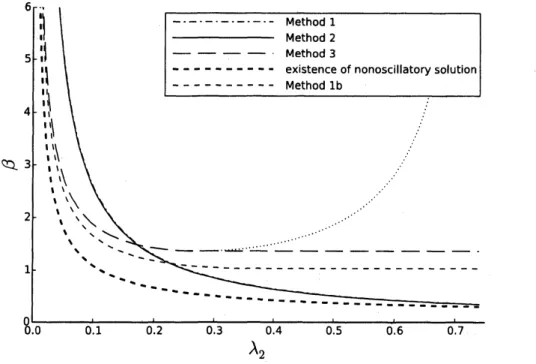
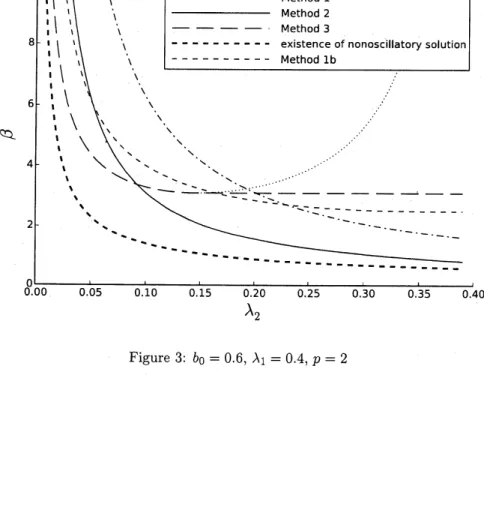
On the following graphs
we
illustrate these boundsas
functions of$\lambda_{2}$.
In order to allow bothvariants of method of apriori bound, we will consider the linear case $p=2$. Thus Methods 1
and lb reffer tothe method ofapriorybound with comparisonto second order ordinary and delay
differentialequation, respectively. Further Methods 2 and 3 reffer tothe method of Riccatiequation
and comparison method. The dotted curvewhich branches offthe curve for Method 3 denotes the
result ofcomparison method without considering the case $\eta\neq\sigma$ in Theorem 2, i.e. without the
$\min$operator in (24), which is often considered in the literature.
Observe, that if$b_{0}$ issmall, then estimate based on Method 1 is reasonably good,
but becomes
worse as $b_{0}$ increases. Note also that we obtain better results from Riccati method if
$\lambda_{2}$ is large.
On thecontrary, if$\lambda_{2}$ issmall,
better bound fortheoscillation constant $\beta$ canbe obtained fromthe
comparison method. Note also that the curves for Methods lb and 3 end up with constant parts,
theother curves aredecreasing.
The following threepicturesdemonstrate the fact thatnomethod beats the otheronesand that
the mutual relationship of the obtainedcurves is rich. However thesepictures (aswell asexploring
more similar portaits) give thegeneral impression that
$\circ$ apriorymethod (Methods
1 and lb) wastes of$b_{0}$ is not small enough,
$\bullet$ forlarge delay(large
difference$t-\sigma(t)$,i.e. $\sigma(t)\ll t$) it ismoreconvenient tousethemethods
based on Myshkis-type oscillation criteria for delay differential equations, i.e. Method lb (if
$b_{0}$ is small) and Method 3
$\bullet$ for small delay (small
difference $t-a(t)$) it is more convenient to use the methods based on
oscillation criteriaforordinarydifferentialequations,i.e. Method 1 (if$b_{0}$issmall) andMethod
Figure 1: $b_{0}=0.1,$ $\lambda_{1}=0.75,$ $p=2$, Method 1 almost coincides with Method 2,
o.oo
0.$05$ 0.$10$ 0.15 0.20 $\lambda_{2}$0.25 0.30 0.35
References
[1] R. P. Agarwal, M. Bohner, T. Li, Ch Zhang, Oscillationofsecond-order Emden-Fowler neutral
delaydifferential equations, Ann. Mat. PuraAppl. (2014) 193, 1861-1875.
[2$|$ J. G. Dong, Oscillation behavior ofsecondorder nonlinearneutral differential equationswith
deviating arguments, Comp. Math. Appl. 59 (2010), 3710-3717.
[3] O. Do\v{s}l\’y, P.
\v{R}eh\’ak,
Half-Linear Differential Equations. North-Holland Mathematics Studies202, Elsevier, 2005.
[4] B. Bacul\’ikov\’a, J. D\v{z}urina, Oscillation theorems for second-orderneutraldifferential equations,
Comp. Math. Appl. 61 (2011), 94-99.
[5] B. Bacul\’ikov\’a, J. D\v{z}urina, Oscillation theorems for second-order nonlinear neutral differential
equations, Comp. Math. Appl. 62 (2011), 4472-4478.
[6] B. Bacul\’ikov\’a, T. Li, J. D\v{z}urina, Oscillation theorems for second order neutral differential
equations, E. J. Qualitative Theory of Diff. Equ., No. 74 (2011), 1-13.
$[7|$ B. Bacul\’ikov\’a, T. Li, J. D\v{z}urina, Oscillation theorems for second-order superlinear neutral
differentialequations, Math. Slovaca63 No. 1 (2013), 123-134.
[8] S. Fi\v{s}narov\’a, R. Ma\v{r}\’ik, Oscillation ofhalf-lineardifferentialequationswith delay, Abstr.Appl.
Anal. (2013), Article ID 583147, 1-6.
$[9|$ S. Fi\v{s}narov\’a, R. Ma\v{r}\’ik, On eventually positive solutions ofquasilinear second order neutral
differentialequations, Abstr. Appl. Anal. 2014 (2014), Article ID 818732, 1-11.
[10] S. Fi\v{s}narov\’a, R. Ma\v{r}\’ik, Oscillation criteria for neutral second-order half-linear differential
equations with applications to Euler type equations, Bound. Value Probl. 2014:83 (2014),
1-14.
[11] Z. Han, T. Li, S. Sun, W. Chen, Oscillation criteria for second-order nonlinear neutral delay
differentialequations, Adv. Difference Equ. (2010), Article ID 763278, 1-23.
[12] R.G.Koplatadze, Criteriaforthe oscillation ofsolutions ofdifferentialinequalities and
second-orderequationswith retarded argument, (Russian) Tbiliss. Gos. Univ. Inst. Prikl. Mat. Trudy
17 (1986), 104-121.
[13] T. Li, Comparison theorems for second-order neutral differential equations of mixed $type_{\}}$
Electron. J. Diff. Equ., Vol. 2010(2010), No. 167, 1-7.
[14] T. Li, Z. Han, Ch. Zhang, H. Li, Oscillation criteria for second-ordersuperlinear neutral
dif-ferentialequations, Abstr. Appl. Anal. (2011), Article ID 367541, 1-17.
[15] T.Li, Y. V. Rogovchenko, Ch. Zhang, Oscillationofsecondorder neutral differentialequations,
Funkcial. Ekvac. 56 (2013), 111-120.
[16] Z. Oplu\v{s}til, J.
\v{S}remr,
Onoscillations ofsolutions tosecond-order lineardelaydifferential[17] S. Sun,T. Li, Z. Han,H. Li,Oscillation theorems for secondorder quasilinear neutralfunctional
differential equations, Abstr. Appl. Anal. (2012), Article ID 819342, 1-17.
[18] M. Hasanbulli, Y. Rogovchenko, Oscillation criteria for second order nonlinear neutral
differ-ential equations, Appl. Math. Comp. 215 (2010),4392-4399.
Department of Mathematics
Mendel University in Brno
Zem\v{e}d\v{e}lsk\’a 1
61300
BrnoCZECH REPUBLIC