On
the variance-stabilizing
multivariate
nonparametric
regression
estimation
Kiheiji
NISHIDA
and Yuichiro
J.
KANAZAWA
11
Introduction
The objective of this paper is to show the idea of the nonpara,metric
regres-sion estimator that produces constant estimator variance over all values of
the regressor va,riable. To a,ccomplish the purpose, we introduce the varia,ble
bandwidth matrix based on a,symptotic considera,tions chosen so as to
cor-rect heteroscedasticity, employingthe sa,me principle of the Aitken estima,tor
in linea,$r$ regression. We call the bandwidth matrix for this objective the
variance-sta,bilizing (henceforth VS) bandwidth matrix.
As past studies for theVS bandwidth, we know that Fanand Gijbel (1992)
introduced the idea of the VS bandwidth for the univariate local linear
esti-mator. However, they did not investigatethe VS bandwidth in detail because
thepaper was aimed at studying the variable bandwidth that minimizes mean
squared error (MSE). In contrast to this, Nishida and Kanazawa (2009, 2010)
lKiheiji NISHIDA is a student at the Graduate School of Systems and Information
Engineering, University of Tsukuba. Yuichiro J. KANAZAWA is Professor ofStatistics at
theGraduate Schoolof Systems and Information Engineering, University of Tsukuba,
1-1-1 Ten-noh-dai, Tsukuba, Ibaraki 305-8573, Japan. Correspondence concerning this article
should be addressed to Kiheiji NISHIDA. His e-mail address is [email protected].
This research is supported in part by the Grant-in-Aid for Scientific Research (C)(2)
$]2680310,$ $(C)(2)$ 16510103 and (B) 20310081 from the Japan Society for the Promotion
introduced the VS bandwidth for the univariate Nadaraya-Watson
(hence-forth NW) estimator and compared it to the Mean Integrated Squared Error
(MISE) minimizingfixed bandwidth in terms of global and local performance.
These two studies focus on univariate nonparametric regression estimators.
In the light of these two studies, we introduce the VS bandwidth matrix
for themultivariate NWestimator. In section 2, we show the brief summaries
of the multivariate NW estimator to know the principle of how the
VS
band-width matrix is introduced. In section 3, we introduce the VS bandwidth
matrix for the multivariate NW estimator. In each subsection of section 2,
we show the performance of the univa,riate a,nd the biva,riate VS regression
estimators. We also show the estimating procedure of the VS bandwidth
matrix in the univariate case. In section 4, we give concluding remark.
2
Summaries
of the
multivariate NW
estima-tor
2.1
Basic
setup
Let us consider a $p+1$ row vector $(X_{i0}, \ldots, X_{i(p-1)}, Y_{i})$ of random variables.
We assume $x_{i}$. $=(x_{i0}, \ldots, x_{i(p-1)}),$ $i=1,$ $\ldots,$$n$, are the realizations of random
explanatory vector $X_{i}$. $=(X_{i0}, \ldots, X_{i(p-1)})$, i.i.d. with respect to $i$ and whose
joint density function is denoted a,s $fx_{i}.(x_{i}.)$
on
support $I^{p}\in R^{p}$.
The $n$sample realizations of $(X_{i0}, \ldots, X_{i(p-I)})$ can be written in matrix form as
$(\begin{array}{lll}x_{\prime l0} \cdots x_{1(p-1)}| \ddots |x_{n0} \cdots x_{n(p-1)}\end{array})$
and we define the ith column of the matrix in (2.1) as $x_{i}$
.
We assume thatwith the kth variable$X_{k},$ $j\neq k$
.
We assume that the response $Y_{i},$ $i=1,$ $\ldots,$$n$,is influenced by the corresponding explana,tory vector $X_{7}\cdot$. in the form of
$m(X_{i}.)$ and the disturbance $U_{i}$ as
$Y_{i}=m(X_{i}.)+U_{i}$, (2.1)
where $m(\cdot)$ is $m$ : $R^{p}arrow R$ function of the $X_{i}.$
.
The $U_{i}|X_{i}.’ s,$ $i=1,$$\ldots,$$n$,
are ra,ndom variables independent with respect to $i$, and assumed to be
in-dependent of $X_{j}.,$ $i\neq j$
.
We additionally a,ssume the first two conditionalmoments of $U_{i}|X_{i}$. are
$E_{U_{i}|X_{i}}$. $[U_{i}|X_{i}$. $=x_{i}.]=0$, (2.2)
$E_{U_{i}|X_{*}}$. $[U_{i}^{2}|X_{i}=x_{i}.]=\sigma^{2}(x_{i}.)$
.
Then, from the assumptions (2.1) and (2.2), we obtain
$m(x_{i}.)=E_{Y_{i}|X_{i}}$. $[Y_{i}|X_{i}$. $= x_{i}.]=\int y_{i}f_{Y_{i}|X_{i}}.(y_{i}|x_{i}.)dy_{i}$
$= \frac{\int y_{i}f_{X_{i},Y_{i}}.(x_{i}.,y_{i})dy_{i}}{f_{X_{i}}(x_{i}.)}$,
where $f_{X;.,Y_{i}}(x_{i}., y_{i})$ is the multivariate density function of $(X_{i}., Y_{i}).$
Replac-ing unknown density function $f_{X_{i}.,y}(x_{i}., y_{i})$ and $f_{X_{i}}.(x_{i}.)$ with their
estima-tor $\overline{f_{X_{i}.,Y_{i}}}(x_{i}., y_{i})and.\overline{f_{X_{i}}.}(R,\cdot.)$ , we obtain thenonpa,rametric estimator $\hat{m}(x_{i}.)$
written as
$\hat{m}(x_{i}.)=\frac{\int y_{?:}\overline{f_{X_{*},Y}\dot{..}}(x_{i}.,y_{7}:)dy_{i,}}{\overline{f_{X_{*}}.}(x_{i}.)}$
.
(2.3)In estimating the denominator of (2.3), we employ the multivariate kernel
density estimator with $pdimensi_{ona}J$ kernel function $K_{X}(x)$ at any point
$x=(x_{0}, \ldots, x_{(p-1)})$ on $I^{p}\in R^{p}$ and with multivariate symmetric bandwidth
matrix,
$H_{X}=(\begin{array}{lll}h_{00} \cdots h_{0(p-1)}| \ddots |h_{0(p-1)} h_{(p-l)(p-1)}\end{array}),$ $h_{00}>0,$
written as
$\overline{f_{H_{X}}}(x)=\frac{1}{n|H_{X}|}\sum_{i=1}^{n}K_{X}(H_{\overline{x}}^{1}(x-x\cdot.))$
.
(2.5)Similarly, in estimating the numerator of (2.3), let $K_{X,Y}(x, y)$ be $(p+1)-$
dimensional kernel function at the point
$(x, y)=(xx, y)$
, and $H_{X,Y}$be the $(p+1)\cross(p+1)$ dimensional symmetric smoothing parameter matrix,
$H_{X,Y}=(h_{0(p-1)}...h_{(p-1)(p-1)}h_{(p-1)y_{/}}h_{0y}.\cdot h_{(p-1)y}h_{yy}h_{00}...\cdot\cdot.h_{0(p-1)}h_{0y^{\backslash }}$ $=(\begin{array}{ll}H_{X} h_{y}^{T}h_{y} h_{yy}\end{array})$ ,
where $h_{y}=(h_{0y}, \ldots, h_{(p-1)y})$
.
With this notation, $(p+1)$ dimensional kerneldensity estimator that appears in the numerator of (2.3) is written as
$\overline{f_{H_{X,Y}}}(x, y)=\frac{1}{n|H_{X,Y}|}\sum_{i=1}^{n}K_{X,Y}(H_{\overline{X}^{1}Y}(x-x_{i}.,y-Y_{i}))$
.
(2.6)Ifwe additionally assume that the kernel $K_{X,Y}(x, y)$ is multiplicativein terms
of X and $Y$, the smoothing parameter matrix is written as
$H_{X,Y}=(\begin{array}{ll}H_{X} 00 h_{yy}\end{array})$ , $|H_{X,Y}|=|H_{X}|h_{yy}$
and the numerator of (2.3) is rewritten by the symmetry of the kernel as
$\int\frac{y}{n|H_{X,Y}|}\sum_{i=1}^{n}Is_{X,Y}^{r}(H_{\overline{X}^{1}Y}(x-x_{i}., y-Y_{i}))dy$
$= \frac{1}{n|H_{X}|h_{yy}}\sum_{i=1}^{n}\int yK_{X}(H_{\overline{X}}^{1}(x-x_{i}.))Is_{Y}’(\frac{y-Y_{i}}{h_{yy}})dy$
$= \frac{1}{n|H_{X}|}\sum_{i=1}^{n}I\iota_{X}^{\nearrow}(H_{\overline{x}}^{1}(x-x_{i}.))Y_{i}$
.
(2.7)Substituting the numerator and the $denominator$ in (2.3) respectively for
(2.5) and (2.7), the multivariate NW estimator at the point $x$ is rewritten as
$\overline{m_{H_{X}}}(x)=\frac{\sum_{i=1}^{n}K_{X}(H_{\overline{x}}^{1}(x-x_{i}.).)Y_{i}}{\sum_{i=1}^{n}K_{X}(H_{\overline{x}}^{1}(x-x_{i}))}$
.
(For univaria,te ca荅se, Nada,raya 1964, 1965, 1970; Watson 1964; Wa,tson and
Lea,dbetter 1964. For multivariate ca,se, e.g. H\"ardle 2004). We write the
kernel function $It_{X}’(x)$ a,s $K(x)$ for brevity.
2.2
A
restriction
on multivariate
bandwidth
matrix
We see the role of the off-diagonal elements of the bandwidth matrix in (2.4)
in kernel density estimation. Observe the multiva,riate gaussian kernel,
$K( H_{\overline{x}}^{1}x)=\frac{1}{2\pi|H_{X}|}\exp[-\frac{1}{2}x(H_{\overline{x}}^{1})^{2}x^{T}]$ ,
and we find that $H_{X}^{2}$ corresponds to the variance covariance matrix $\Sigma$ of
the normal distribution. This means that the off-diagonal elements of the
bandwidth matrix $H_{X}$ in (2.4) reflect the correlation between the variables
in kernel function because the off-diagonal elements of $H_{x}^{2}$ are zero if $h_{(k)(j)}$,
$k\neq j$, are all set to be zero. This property is true of the symmetric kernel
functions defined by the quadratic form $x(H_{\overline{X}}^{1})^{2}x^{T}$ other than Ga,ussian.
Considering this property with the $0ff-diagona_{1}1$ elements of bandwidth
ma,trix in (2.4), we notice that it is better to employ a full bandwidth $ma_{t}trix$
for kernel density estimation ifit is considered that
X.;
is correlated with $X_{j}$.
In this point, Wand and Jones (1993) demonstrated in the bivariate density
estimation situation that MISE ofthe kernel densityestimator is deteriorated
$\overline{\overline{\rho 0.00.30.60.91.0}}$
the ratio (2.8) 1.00 0.93 0.74 0.37 0.00
Table 1: The ratio (2.8) for different values of correlation coefficient $\rho$ from
Wand and Jones (1993).
paper, they derived the theoretical
AMISE
of the bivariate kernel densityestimatorfor the bivariate normal distribution with its correlation coefficient
$p$
.
They also calculated the ratio,$[ \frac{\inf_{H\in H_{full}}AMISE(H)}{\inf_{H\in H_{diag}}AMISE(H)}]^{\frac{3}{2}}=[\frac{2(1-\rho^{2})}{\rho^{2}+2}]^{\frac{1}{2}}$ , (2.8)
for different values of $\rho$, where $H_{diag}$ and $H_{full}$ are respectively the classes
of the bivariate diagonal and the bivariatefull bandwidth matrix. This ratio
can be interpreted as the costs from not using full bandwidth matrix for the
correlated data in kernel density estimation. The result in table 1 indicates
that there surely exist the costs.
However, when we employ a full bandwidth matrix in (2.4), the number
of parameters to be estimated is $p(p+1)/2$
.
If we take the curse ofdimen-sionality into consideration, this is too many. To reduce the number of
pa-rameters to be estimated, the sphering approa,ch, as in e.g. Fukunaga (1972)
or Wand and Jones (1993), is available ifit is probable that $X_{i}$. is distributed
as normal distribution with variance covariance matrix $\Sigma$
.
That is, $1inea_{t}rly$transforming the data so that the sample variance covariance matrix is
diag-onal, we compute the density by the diagonal bandwidth matrix and finally
retransform the estimated pdfback to the original scale. In the following, we
assume that the data is approximately distributed as normal and the
spher-ing approach is available. Then we can sea,rch for the form of VS bandwidth
2.3
On the
conventional bandwidth
matrices
Under the assumption of the dia,gona,1 bandwidth ma,trix, the bias and the
variance of the multivariate NW estimator are derived at every point $x$ (e.g.
H\"ardle2004) under the standardset ofassumptions on appendix A. The bias so obtained is
$E_{Y,X}[\overline{m_{H_{X}}}(x)]-m(x)$
$= \frac{\mu_{2}(I_{1_{X}^{\nearrow}})}{2f_{X}(x)}[2(\nabla m(x))^{T}H_{X}H_{X}^{T}\nabla f_{X}(x)+f_{X}(x)tr [H_{X}^{T}\nabla^{2}m(x)H_{X}]]+o(1)$,
where
$\nabla f_{X}(x)=(\begin{array}{l}\frac{\partial fx,(x)}{\partial_{T}o}|\frac{\partial fx(x)}{\partial x_{p-l}}\end{array}),$$\nabla^{2}f_{X}(x)=(\begin{array}{lll}\frac{\partial^{2}fx(x)}{\partial x\partial x} \cdots \frac{\partial^{2}fx(x)}{\partial xo\partial x_{p-1}}| \ddots |\frac{\partial^{2}fx(x)}{\partial r_{\prime\rho-]}\partial xo} \cdots \frac{\partial^{2}fx(x)}{\partial\tau_{p-]}\partial x_{\rho-1}}\end{array})$ ,
and
$\mu_{2}(It_{X}^{\nearrow})=\int\cdots\int tt^{T}K(t)dt$ and $t=(t_{0}, \ldots, t_{p-1})$
.
Simila,rly, the $variance$ so obta,ined is
$V_{Y,X}[ \overline{m_{H_{X}}}(x)]=\frac{1}{n|H_{X}|}\cdot\frac{\sigma^{2}(x)}{f_{X}(x)}[\int\cdots\int K^{2}(t)dt]+o(1)$
.
(2.9)When $h_{m}=h_{11}=\cdots=h_{(p-1)(p-1)}$, we can obtain the asymptotic MISE
(AMISE) and derive the $diagona1$ fixed bandwidth matrix that balances the
leading terms of the integrated variance and the integrated bia,$s$ squared
written as
$H_{f^{ixed}}=[\frac{[\int\cdots\int K^{2}(t)dt][\int\cdots\int\sigma^{2}(x)dx]}{\mu_{2}^{2}(K)T_{fixed}}]^{\frac{1}{p+4}}p^{\frac{1}{p+4}}\cdot n^{-\frac{1}{p+4}}\cdot I_{p},(2.10)$
where
and
$\alpha_{i}(x)=2(\frac{\partial m(x)}{\partial_{X_{i}}})(\frac{\partial f_{X}(x)}{\partial_{X_{i}}})+f_{X}(x)(\frac{\partial^{2}m(x)}{\partial_{X_{i}^{2}}}),$$i=0,$ $\cdots p-1$
.
Hence the AMISE minimized by (2.10) is
$(p^{\overline{p}}+4- \lrcorner i+\frac{p^{\frac{4}{p+4}}}{4})[\frac{[\int\cdots\int K^{2}(t)dt]^{\frac{4}{p+4}}[\int\cdots\int\sigma^{2}(x)dx]^{\frac{4}{\rho+4}}}{[\mu_{2}^{2}(K)]^{-1}\overline{p}+\overline{4}[T_{fixed}]^{-R}\overline{p}+\overline{4}}]$
.
$n^{-\frac{4}{P+4}}$
.
In the same ma,nner to the fixed one in (2.10), the variable bandwidth
matrix that minimizes mean squared error MSE defined at each $x$ can be
obtained a,s
$H_{var}(x)=[\frac{[\int\cdots\int A^{\nearrow 2}(t)dt]\sigma^{2}(x)f_{X}(x)}{\mu_{2}^{2}(K)[\sum_{i=0}^{p-1}\alpha_{i}(x)]^{2}}]^{\frac{1}{\rho+4}}p^{\frac{1}{\rho+4}}$
.
$n^{-\frac{1}{p+4}}$.
$I_{p}$and the AMISE so obtained by using (2.12) is
$(p^{\frac{-p}{\rho+4}}+ \frac{p^{\frac{4}{P+4}}}{4})[\frac{[\int\cdots\int K^{2}(t)dt]^{\frac{4}{\rho+4}}T_{var}}{[\mu_{2}^{2}(K)]^{-L}\overline{\rho}+\overline{4}}]\cdot n^{-\frac{4}{P+4}}$ ,
where
$T_{var}= \int\cdots\int[\sigma^{2}(x)]^{\frac{4}{p+4}}[\frac{1}{f_{X}(x)}[\sum_{i=0}^{p-1}\alpha_{i}(x)]^{2}]^{\overline{\rho}+\overline{4}}dxR$
.
When $h_{m}=h_{11}=\cdots=h_{(p-1)(p-1)}$ does not necessarily hold, it is difficult
to generalize both the fixed and the varia,ble bandwidth ma,trices.
2.4
The
problem with
the
variance
of the
multivariate
NW
estimator
Weadderessthe problem with thevariance ofthe NW estimator. The leading
Both $fx(x)$ and $\sigma^{2}(x)$ are very unlikely to be uniform across different $x$ in
general. As a result, variances of the NW estima,tor at different points $x_{1}$
and $x_{2}$ differ in general unless properly controlled by the bandwidth ma,trix
$H_{X}$
.
As examples of the heterosceda,sticity of the NW estimator‘s variance,see Nishida and Kanazawa (2009, 2010).
3
Introduction
of the
multivariate
VS
band-width
matrix
We consider the form of the bandwidth matrix that counters
heteroscedastic-ity. Employing the same principle oftheAitken estimator in linear regression,
we propose the VS bandwidth matrix at the point $x$,
$H_{VS}(x)=h_{0}(0[\frac{\sigma^{2}(x)0}{fx(x)}]^{\eta 1(x)}0.\cdot.\cdot.\cdot.\cdot.$ $[ \frac{\sigma^{2}(x)}{fx(x)}]^{\eta_{p}-l(x)}0]$ , (3.1)
where $h_{0}>0$ is a global constant and $\eta_{i}(x)’ s,$ $i=0,$ $\ldots,p-1$, are the local
constants that are defined at each point $x$ and satisfying
$\sum_{i=0}^{p-1}\eta_{i}(x)=1$, $-$$oo$ $<\eta_{i}(x)<\infty$
.
(3.2)Among the class of bandwidth matrix in the form of (3.1) and (3.2), we
optimize global parameter $h_{O}$ so as to minimize AMISE given $\eta_{i}(x)$
.
Thebandwidth matrix so obtained given $\eta_{i}(x)$ is
where
$\cross diag([\frac{\sigma^{2}(x)}{f_{X}(x)}]^{r\chi)(x)},$
$\ldots,$
$[ \frac{\sigma^{2}(x)}{f_{X}(x)}]^{\eta_{\rho}-[(x)})$ , (3.3)
$T_{VS}( \eta_{0}(x), \ldots, \eta_{p-1}(x))=\int\cdots\int\frac{1}{f_{X}(x)}[\sum_{i=0}^{p-1}\alpha_{i}(x)[\frac{\sigma^{2}(x)}{f_{X}(x)}]^{2\eta i(x)}]^{2}dx.(3.4)$
The asymptotic homoscedastic variance so obtained given $\eta_{i}(x)$ is
$[ \frac{[\int\cdots\int K^{2}(t)dt]^{\frac{4}{p+4}}}{[\mu_{2}^{2}(K)]^{-1}\overline{\rho}+\overline{4}[T_{VS}(\eta_{0}(x),\ldots,\eta_{p-1}(x))]^{-4}\overline{p}+\overline{4}}]\cdot p^{\overline{p}}-z_{\overline{4}}+\cdot n^{-\frac{4}{p+4}}$
and the AMISE given $\eta_{i}(x)$ is
$(p^{\frac{-p}{\rho+4}}+ \frac{p^{\frac{4}{\rho+4}}}{4})[\frac{[\int\cdots\int K^{2}(t)dt]^{\frac{4}{p+4}}}{[\mu_{2}^{2}(K)]^{-r_{\overline{4}}z}\overline{p}+[T_{VS}(\eta_{0}(x),\ldots,\eta_{p-1}(x))]^{-}\overline{p}+\overline{4}}]$
.
$n^{-\frac{4}{\rho+4}}.(3.5)$Subsequently, to minimize (3.5), the term $T_{VS}(\eta_{0}(x), \ldots, \eta_{p-1}(x))$ in (3.5)
must also be minimized in terms of $\eta_{i}(x)i=0,1,$ $\ldots,$$p-1$
.
For such $\eta_{i}(x)$,we solve the following
minimization
problem in terms of$\eta_{i}(x)$ at every $x$,$\min_{\eta(x)}[\sum_{i=0}^{p-1}\alpha_{i}(x)[\frac{\sigma^{2}(x)}{f_{X}(x)}]^{2\eta;(x)}]$ , $s$
.
$t$.
$\sum_{i=0}^{p-1}\eta_{i}(x)=1$.
(3.6)We have so far derived the optimal parameters $\eta_{i}^{*}(x)$ up to $p=2$
.
In thefollowing, we show the property ofVS bandwidth matrix compared with the
heteroscedastic bandwidth matrix in the cases of$p=1$ and $p=2$
.
We alsoshow the estimating procedure in the case of$p=1$
.
3.1
Univariate
VS
bandwidth:
$p=1$We write the point $x_{0}$ as $x$ for brevity in the case of $p=1$
.
Setting $p=1$,we obtain $\eta_{0}^{*}(x)=1$ a,t every $x$
.
Then, we obtain univariate VS bandwidth,$=[ \frac{[\int K^{2}(t)dt]}{[\int t^{2}K(t)dt]^{2}[\int\frac{\sigma^{8}(x)\alpha^{2}(x)}{f_{X(x)}^{5}}dx]}]^{\frac{1}{5}}n^{-\frac{1}{5}}$
.
$\frac{\sigma^{2}(x)}{f_{X}(x)}$, (3.7)where $\alpha(x)=2f_{X}^{(1)}(x)m^{(1)}(x)+f_{X}(x)m^{(2)}(x)$
.
For this, $\hat{m}_{h_{VS}}(x)$ isho-moscedastic up to order $n^{-\frac{4}{5}}$
,
$AV_{X,Y}[ \overline{m_{h_{Vs}}}(x)]=[\frac{[\int K^{2}(t)dt]^{\frac{4}{5}}}{[\int t^{2}K(t,)dt]^{-\frac{2}{5}}[\int\frac{\sigma^{8}(x)\alpha^{2}(x)}{f_{X(jr,)}^{5}}dx]^{-\frac{1}{5}}}]n^{-\frac{4}{5}}$
.
(3.8)Let the MISE minimizing fixed ba,ndwidth and the MSE minimizing
vari-able bandwidth for the NW estimator respectively be $h_{fixed}$ and $h_{var}(x)$
.
Fan and Gijbel (1992) compa,red the VS bandwidth for the univariate loca,1
linear estimator with the MSE minimizing va,riable bandwidth in terms of
AMISE. Nishida and Kanazawa (2010) compared the VS bandwidth for the
univariate NW estima,tor with the fixed bandwidth in terms of AMISE and
local variance. In the following, we compare three bandwidths $h_{fixed},$ $h_{var}(x)$
and $h_{VS}(x)$ for the univariate NW estimator in terms of AMISE and local
variance.
3.1.1 Comparison of the three bandwidths in terms of local
vari-ance.
We compare three bandwidths in terms of variance. The asymptotic varia,nce
when $h_{fixed}$ is employed is
$AV_{X,Y}[ \overline{m_{h_{j*xed}}.}(x)]=\frac{\sigma^{2}(x)}{f_{X}(x)}[\frac{[\int K^{2}(t)dt]^{\frac{4}{5}}[.\int_{I^{1}}\sigma^{2}(x)dx]^{-\frac{l}{5}}}{[\int t^{2}K(t)dt,]^{-\frac{2}{5}}[\int_{I^{1}}\frac{\alpha^{2}(x)}{f_{X}(x)}dx]^{-\frac{1}{5}}}]n^{-\frac{4}{5}}$
.
(3.9)Similarly, the a,symptotic variance when $h_{var}(x)$ is employed is
Nishida and Kanazawa (2010) showed in proposition 1 that the univariate
VS bandwidth produces the asymptotic variance smaller on some part ofthe
support than the univariate fixed bandwidth,
$\min_{x\in I^{1}}AV_{X,Y}[\overline{m_{h_{f:xed}}}(x)]\leq AV_{X,Y}[\overline{m_{h_{VS}}}(x)]\leq\max_{x\in I^{1}}AV_{X,Y}[\overline{m_{h_{f*xed}}}(x)]$
.
Similarly, in comparison with the variable bandwidth, weobtain thesame
magnitude relation,
$\min_{x\in I^{1}}AV_{X,Y}[\overline{m_{h_{var}}}(x)]\leq AV_{X,Y}[\overline{m_{h_{VS}}}(x)]\leq\max_{x\in I^{1}}AV_{X,Y}[\overline{m_{h_{var}}}(x)]$
.
$(3.11)$The proofof (3.11) is in appendix B.
These two relations indicate that the worst case does not happen where
the homoscedastic variance produced by (3.7) is larger over all regressor
variables than the heteroscedastic variances produced by $h_{fixed}$ or $h_{var}(x)$
.
3.1.2 Comparison of the three bandwidths
in
terms of AMISE.Nishida and Kanazawa (2010) showed in proposition 3 that the univariate
VS bandwidth may in some cases achievesmaller AMISE than its fixed
coun-terpart. This argument is characterized by the ratio oftwo density functions,
$\beta(x)=\int_{I^{1}}\sigma^{2}(x)dx/\int_{T^{1}}f_{X}(x)dx$ because of the equation,
$AMISE^{5}(m(x),\overline{m_{h_{J^{1xed}}}}(x))$
–AMISE5
$(m(x),\overline{m_{h_{VS}}}(x))$$=C_{O}( \frac{5}{4})^{5}\cdot n^{-4}\int_{1}[1-\beta^{4}(x)]\cdot\frac{\alpha^{2}(x)}{f_{X}(x)}dx$. (3.12)
The term (3.12) takes positive value when the term $\alpha^{2}(x)/f_{X}(x)$ is large in
thearea where $\beta(x)<1$, whilethe $\alpha^{2}(x)/f_{X}(x)$ is small in the area$\beta(x)>1$
.
Tonotethis, weintroduced the casewhere theVS bandwidth outperforms
the fixed bandwidth in terms of AMISE in the illustrative example 1 in
Nisihida and Kanazawa (2010). In the example, we set $f_{X}(x)=2(2-x)/3$
$(8/3)(2-x)^{-7}$ is a monotone increasing function. At the same time, we
calculated the ratio of two AMISE $s$,
$r(f_{X}(x), \sigma^{2}(x), m(x))=\frac{AMISE(m(x),\overline{m_{h_{VS}}}(x))}{AMISE(m(x),\overline{m_{h_{f*xed}}.}(x))}$, (3.13)
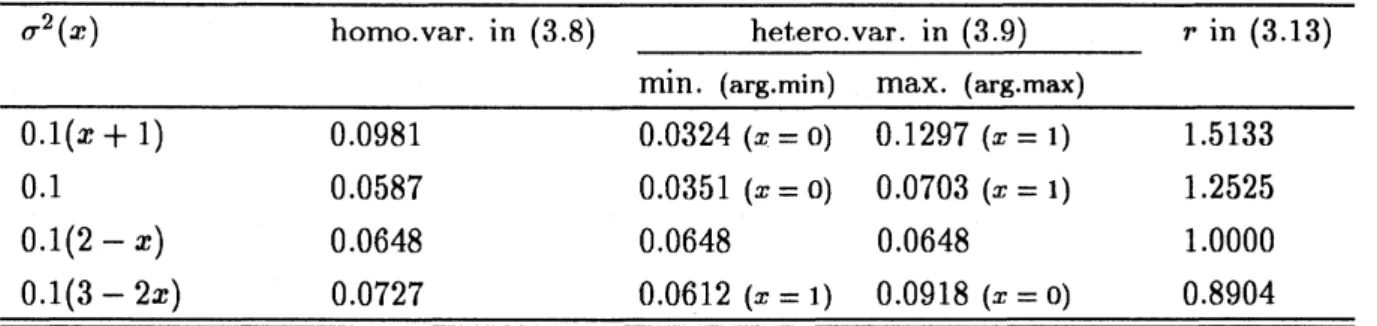
by the four types of conditional variance functions, $\sigma^{2}(x)=0.1(x+1),$ $0.1$,
0.1$(2-x)$ and 0.1$(3-2x)$. We show in Table 2 the asymptotic homoscedastic
variance in (3.8), the maximal and minimal values of the asymptotic
het-eroscedastic varia,nce in (3.9), and the ratio of the two AMISE $s$
.
We observethe ratio $r$ moves from 1.5133 to 0.8904. The practical implication obtained
here is that VS bandwidth outperforms the fixed bandwidth in terms of
AMISE if the conditional va,riance $\sigma^{2}(x)$ diminishes as $x$ increases under the
a,ssumption that the regression function $m(x)$ is a monotone increa,sing.
$\overline{\overline{0..\cdot 1(x+1)0..09811513301(3-2x)007270.8904\sigma^{2}(x)homo.var.in(3.8)r..in(3.13)0.1(2-x)0.064810000010.05871.2525\frac{hetero.var..\cdot.\cdot in(3.9)}{0.0612(x=1)00918(x=0)\min.(arg.\min)\max.(arg.\max_{=0.0351(x=0)00703(x1)})0.0324(x=0)01297(x=1)0.064800648}}}$
Table 2: The result of numerical calculation for illustrative example 1 in
Nishida and Kanazawa (2010).
Similarly, in the illustrative example 2 in Nisihida and Kanazawa (2010),
we investigated how fat-tailedness of the distribution of $X$’s affects the ratio
$r$ of the AMISE $s$ in (3.13). This is because we expect low density $f_{X}(x)$
at and near the boundaries of $I=[0,1]$ makes the proposed VS bandwidth
very wide, rendering the bias not to be ignora,ble. The main result from
the illustrative exa,mple 2 is that the $VS$ bandwidth is more serviceable than
On the other hand, in comparison with the MSE minimizing variable
bandwidth, it is proved by the H\"older $s$ inequality that the
MSE
minimizingvariable bandwidth always achieve smaller AMISE than the VS bandwidth,
$AM$$ISE(m(x),\overline{m_{h_{var}}}(x))\leq AMISE(m(x),\overline{m_{h_{VS}}}(x))$
.
3.1.3 Estimation of the
univariate
VS bandwidthWe show one estima,ting procedure of the univa,riate VS ba,ndwidth. In view
of (3.7), we estimate the univariate VS ba,ndwidth by the plug-in approach,
$\overline{h_{VS}}(x)=\hat{h}_{0}\cdot\frac{\sigma^{\hat{2}}(x)}{\hat{f_{X}}(x)}$, (3.14)
where $f_{X}(x)$ and $\sigma^{2}(x)$ are nonparametrically estimated and the constant
term $h_{0}$ is estimated by cross-validation method a,s in Marron and H\"ardle
(1986). As a candidate for $\hat{f_{X}}(x)$, we employ kernel density estimator, where
$\hat{h_{f}}$ is chosen to minimize the least-squares cross-validation as in Rudemo
(1982) and Bowman (1984). The $\hat{h_{f}}$ so obtained is known asymptotically
equivalent to the
MISE
optimized bandwidth of $h_{f}$ as in Hall (1983). As acandidate for $\sigma^{\hat{2}}(x)$, we employ the residual based estimator,
$\frac{\sum_{i=1}^{n}K(arrow)(Y_{i}-\overline{m_{h_{v}}}(X_{i}))^{2}}{\sum_{i=1}^{n}K(x_{h_{v}}^{-}arrow x)}$, (3.15)
as $|n,$ for instance, Fan and $Yao$ (1998).
However when $estima,ting\sigma^{2}(x)$, we generally need to estimate $m(x)$
be-forehand, which needs an estimator of $\sigma^{2}(x)be,forehand$ beca,use we are in
the variance-sta,bilizing setting. Hence an iterative method that enables us
$\sim(o)$
to estimate $\sigma^{2}(x)$ and $m(x)$ simultaneously, like $(\sigma^{2}$ $(x)arrow\hat{m}^{(0)}(x)arrow$
$\sim(1)$
$\sigma^{2}$ $(x)arrow\hat{m}^{(1)}(x)arrow\ldots),$ is required. The following is an idea of the
itera-tive estimating procedure.
$\bullet$ Obtain $\overline{Y}$
as an initial value and compute squared residuals $r^{2,(0)}(X_{i})=(Y_{i}-Y)^{2}-$,
$i=1,$ $\ldots,$$n$.
$\bullet$ Obtain bandwidth
$h_{v}^{(O)}$
that minimizes the cross-validation statistic,
$CV(h_{v}^{(0)})= \frac{1}{n}\sum_{i=1}^{n}(r^{2,(0)}(X_{i})_{-i,h_{v}^{(O)}}-\sigma^{\overline{2}}(X_{i}))^{2}$,
with respect to $h_{v}^{(O)}$, where
$\sigma^{\overline{2}}-i,h_{v}^{(o)}(X_{i})=\frac{\sum_{j=1;j\neq i}^{n}K(\frac{X_{j}-X_{1}}{h_{v}^{(0)}})r^{2,(O)}(X_{i})}{\sum_{j=1;j\neq i}^{n}K(\frac{X_{i}-X_{1}}{h_{v}^{(o)}})}$.
$arrow(O)$
The estimated bandwidth is $h_{v}$
.
Obtain nonparametric estimator ofconditional variance as$\overline{\sigma_{\frac{2}{h_{v}}(0)}}(x)=\frac{\sum_{i=1}^{n}K(\frac{x-X_{i}}{\overline{h_{1J}}^{(0)}})r^{2,(0)}(X_{i})}{\sum_{i=1}^{n}K(\frac{x-X_{i}}{\overline{h_{1\prime}}^{(o)}})}$ .
Stage 2: Estimation of $h_{0}^{(t)}$.
$\sim(0)$
$\bullet$ Obtain bandwidth $h_{0}$ that minimizes the cross-validation statistic,
$CV( \hat{h_{0}}(0))=\frac{1}{n}\sum_{i=1}^{n}(Y_{i}-\hat{m}_{-i,h_{V9}^{-(o)(X_{i}))^{2}}}$,
$-(O)$
with respect to $h_{0}$ , where
$\hat{h_{VS^{()}}}(X_{i})=\frac{\overline{\sigma_{\frac{2}{h_{v}}(0)}}(X_{i})}{\hat{f_{h_{f}}}(X_{i})}\cdot\hat{h_{0}}io(0),=1,$
$\ldots,$$n$.
$\bullet$ Obtain NW type estimator $\overline{m_{h_{VS}^{-(0)}}}(X_{i})=\frac{\Sigma_{j--1}^{\mathfrak{n}}K(\frac{x.-x_{j}}{h\overline{\backslash r}q^{(0)}(X_{i})})Y_{j}}{\Sigma_{j=1}^{n}K(\frac{x_{1}-x_{j}}{h_{VS}^{-(0)}(X_{i})})},$ $i=1,$
$\ldots,$$n$.
$\bullet$ Compute squared residuals
$r^{2,(1)}(X_{i})=(Y_{i}-\overline{m_{h_{VS}^{-(o)}}}(X_{i}))^{2},$ $i=1,$ $\ldots,$$n$.
Stage 3
$\bullet$ Substitute
$r^{2,(O)}(X_{i})\wedge(t)$ in Stage 1 for $r^{2,(1)}(X_{i})$ in Stage 2 and repeat Stage 1 and
Output
We obtain $\hat{h_{v}}$
and $\hat{h_{0}}$
alternately.
Simulation
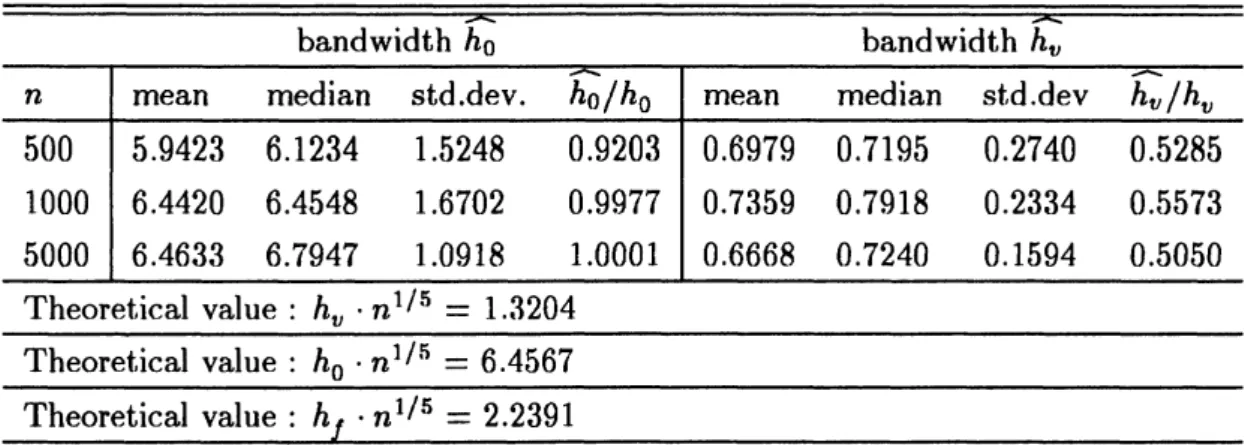
We performed the simulation of the estimating procedure above. We
es-timated two bandwidths $\hat{h}_{v}$ and $\hat{h}_{0}$ by $N=50$ sets
of samplesize $n$ randomly
generated by the following functions $m(x)=0.5x^{2},$ $\sigma^{2}(x)=0.1(0.5|x|+0.1)$
and $fx(x)=N(0,4)\{x:-1<x<1\}$ on the domain [-1, 1]. In the
simula-tion, a data set is generated on $[-3.0,3.0]$ to eliminate boundary effect. The
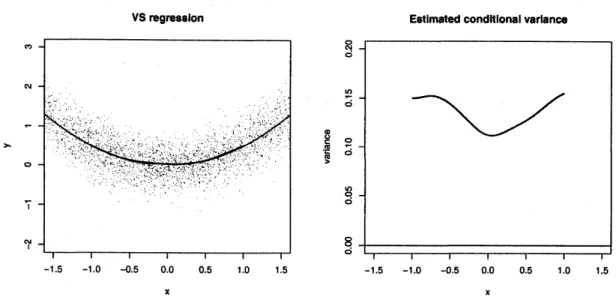
result and the plots of the estimated regression function are respectively on
Table 3 and Figure 1. The result on the table says that $\hat{h}_{0}$ is well estimated
while the estimation of $\hat{h_{v}}$ is poor. We
need further investigation on this
point.
$\overline{bandwidthh_{0}bandwidthh_{v}}$
Theoretical value: $h_{v}\cdot n^{1/5}=1.3204$
Theoretical value: $h_{0}\cdot n^{1/\backslash }=6.4567$
Theoretical value : $h_{f}\cdot n^{1/S}=2.2391$
Table 3: The result of the simulation. In the estimation, we employed
VS regression Estimated conditionalvarianco
$-1.5$ $-1.0$ $-0.5$ 0.0 0.5 1.0 15 $-1.5$ $-1.0$ $-0.5$ 0.0 0.5 1.0 1.5
xx
Figure 1: The left panel plots the va,ria,nce-stabilizing regression obta,ined by
theestimating procedure. The right panel is the $nonparametric$ regression of
the conditional variance function obtained in the process of the estimating procedure.
3.2
Bivariate
VS
bandwidth
matrix:
$p=2$When $p=2$, we can derive the optimal parameters $\eta_{0}^{*}(x)$ and $\eta_{1}^{*}(x)=$
$1-\eta_{0}^{*}(x)$ that minimize (3.6) at every $x$
.
The optimal $\eta_{0}^{*}(x)$ so obtained is$\eta_{0}^{*}(x)=\{$
$\frac{\log[|\frac{o}{\alpha}\perp\Pi 3\mathfrak{c}|[\frac{\sigma^{2}(\mathfrak{c})}{f_{X}(\epsilon)}]^{2}]}{4\log[\frac{\sigma^{2}(\mathfrak{c})}{f_{X}(,\sigma)}]}$
, if $\alpha_{i}(x)\neq 0$, $i=1,2$,
(3.16)
any value satisfying $\eta_{0}^{*}(x)+\eta_{1}^{*}(x)=1$, if $\alpha_{i}(x)=0$, $i=1,2$
.
We give an interpreta,tion to the set of parameters $\eta_{i}(x),$ $i=1,2$
.
Com-pare the two terms (2.11) $and(3.4)$ that appear in the integrated squared
bia,$s$ terms. Since the term $[\sigma^{2}(x)/f_{X}(x)]^{2\eta i(x)}$ tha,t appears in (3.4) can be
considered as the penalty for the varia,nce stabilization, the para,meter $\eta_{i}(x)$
stabi-lization between the axes. For example, if $\eta_{0}(x)=1/2$ and $\eta l(x)=1/2$, the
penalty for variance stabilization is equally distributed to each axis at the
point $x$
.
Similarly, if $\eta_{0}(x)=0$ and $\eta_{1}(x)=1$, all the penalty for variancestabilization is incurred to the axis $x_{1}$ and no penalty is incurred to the $x_{0}$
axis at the point $x$ and vice versa.
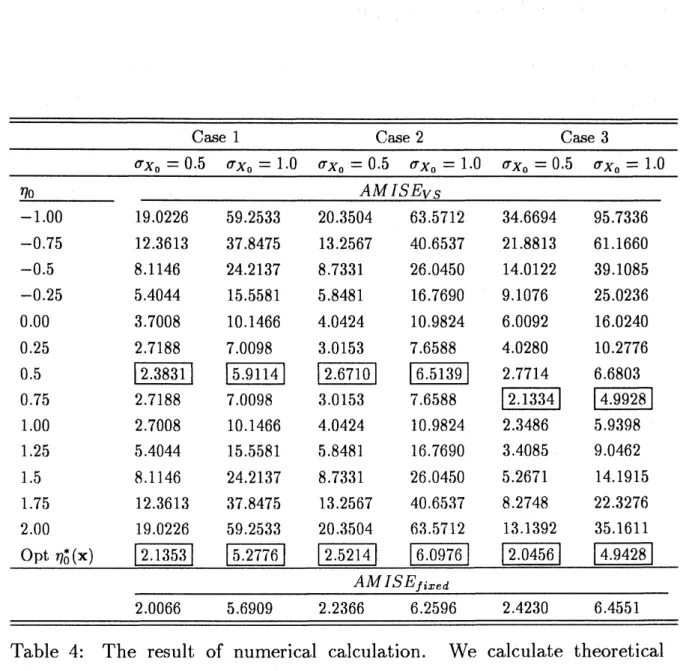
In the following, we arrangethenumerica,1 cases given $m(x_{0}, x_{1}),$ $\sigma^{2}(x_{0}, x_{1})$
and $f_{X_{0},X_{1}}(x_{0}, x_{1})$, and calculate theoretica,1 AMISE $s$ by the different
band-width matrices. The one is calculated by the fixed bandwidth matrix in
(2.10) denoted by $AMISE_{fixed}$
.
The another is ca,lculated by the VSband-width matrix in (3.3) denoted by $AMISE_{VS}$
.
As for the local parameters$\eta_{i}(x)$ of the VS bandwidth matrix, we employ two types, the optimal one in
(3.16) and the universal one determined arbitrarily. The results a,reon Table
4.
Casel: $m(x_{0},x_{1})=-3x_{0}^{2}-3x_{1}^{2},$$\sigma^{2}(x_{0},x_{1})=0.25,$ $f_{Xo,X_{1}}(x_{0},x_{1})\sim N(0,0,\sigma_{X_{0}},\sigma x_{1},P)$
trucated on $I^{2}=[-0.5,0.5]\cross[-0.5,0.5]$ and $\sigma_{X_{0}}=\sigma_{X_{1}},$ $\rho=0.0$
.
Case2: $m(x_{0}, x_{1})=-3x_{0}^{2}+2x_{0}x_{1}-3x_{1}^{2},$ $\sigma^{2}(x_{0}, x_{1})=0.25,$ $f_{X_{0},X_{1}}(x_{0}, x_{1})\sim$
$N(O, 0, \sigma_{X_{0}}, \sigma_{X_{1}}, \rho)$ trucated on $I^{2}=[-0.5,0.5]\cross[-0.5,0.5]$ and $\sigma_{X_{0}}=\sigma x_{1}$,
$\rho=0.0$
.
Case3: $m(x_{0}, x_{1})=\sin(2\pi x_{0})+x_{1},$ $\sigma^{2}(x_{0}, x_{1})=0.25,$ $f_{Xo,X_{1}}(x_{0}, x_{1})\sim$
$N(0,0, \sigma_{X_{0}}, \sigma_{X_{1}}, \rho)$ trucated on $I^{2}=[-0.5,0.5]\cross[-0.5,0.5]$ and $\sigma_{Xo}=\sigma_{X_{1}}$ ,
$\rho=0.0$
.
One main result obtained from the table is tha,$tAMISE_{VS}$ with optimal
loca,1 para,meter, $\eta_{i}^{*}(x)$, is a,lways smaller than that with universal one
deter-mined arbitrarily. This result is a matter of course beca,use we optimized the
local parameter so as to minimize AMISE. Another obtained result is that
$AMISE_{VS}$ can sometimes outperform $AMISE_{fixed}$
.
$Se_{\lrcorner}e$ the ca,ses 1,2 when$\sigma_{X_{0}}=1$ and the case 3 when $\sigma_{X_{0}}=0.5,1$
.
In the case 3, we observe that$AMISE_{VS}$ with universal local parameter can outperform $AMISE_{fixed}$
.
We$\overline{\overline{CaselCase2Case3}}$
$\sigma_{X_{0}}=0.5$ $\sigma_{X_{0}}=1.0$ $\sigma_{X_{0}}=0.5$ $\sigma_{X_{0}}=1.0$ $\sigma_{X_{0}}=0.5$ $\sigma_{X_{0}}=1.0$
$\frac{\eta_{0}}{-1.00}$ $\frac{AMISE_{VS}}{59.253320.350463.571234.669495.7336}$ 19.0226 $-0.75$ 12.3613 37.8475 13.2567 40.6537 21.8813 61.1660 $-0.5$ 8.1146 24.2137 8.7331 26.0450 14.0122 39.1085 $-0.25$ 5.4044 15.5581 5.8481 16.7690 9.1076 25.0236 0.00 3.7008 10.1466 4.0424 10.9824 6.0092 16.0240 0.25 2.7188 7.0098 3.0153 7.6588 4.0280 10.2776 0.5 2.3831 $\frac{59114}{}$ 2.6710 6.5139 2.7714 6.6803 0.75 2.7188 7.0098 3.0153 7.6588 2.1334 4.9928 1.00 2.7008 10.1466 4.0424 IO.9824 2.3486 5.9398 1.25 5.4044 15.5581 5.8481 16.7690 3.4085 9.0462 1.5 8.1146 24.2137 8.7331 26.0450 5.2671 14.1915 1.75 12.3613 37.8475 13.2567 40.6537 8.2748 22.3276 2.00 19.0226 59.2533 20.3504 63.5712 13.1392 35.1611 $\frac{O_{P}t\eta_{0}^{*}(x)2.1_{*}3535.2776\frac{25214}{}-6.09762.04564.9428}{\frac{AMISE_{f.ixed}}{2.00665.69092.2366625962.42306.4551}}$
Table 4: The result of numerical ca,lculation. We calculate theoretical
4
Concluding remark
In this paper, we limited the VS bandwidth matrix to the diagonal one by
the sphering approach and derived the theoretical form ofthe VS bandwidth
defined by two types of parameters $h_{0}$, global one, and $\eta_{i}(x)$, local one.
In the univariate case, we compared three bandwidths $h_{fixed},$ $h_{var}(x)$ and
$h_{VS}(x)$ in terms of local variance and AMISE. The implication obtained
here is that, in terms of local variance, $h_{VS}(x)$ can outperform both $h_{fixed}$
and $h_{var}(x)$ on some part of the domain. In terms of AMISE, $h_{VS}(x)$ can
sometimes outperform $h_{jixed}$, but never outperform $h_{var}(x)$
.
However, we observe a case where $h_{VS}(x)$ can be superior to the variable
bandwidth $h_{var}(x)$ in another point of view. At the point $x^{*}$ that satisfies
$\alpha^{2}(x^{*})=0$, the bandwidth $h_{var}(x^{*})$ takes infinitely large value. If $h_{var}(x^{*})$
approaches infinity, $\overline{m_{h_{ar}},,}(x^{*})$ a,pproaches to $\overline{Y}$
.
Then,if $m(x^{*})$ does not
happen to agree with $\overline{Y},\overline{m_{h_{var}}}(x^{*})$ has unconformity at the point $x^{*}$
.
As for$h_{vs}(x)$ in (3.7), such unconformity does not happen as long as $f_{X}(x)\neq 0$
.
If we consider this case, $VS$ bandwidth can be serviceable. Examples of
this kind of problem with variable bandwidth are illustrated in Nishida and
Kanawaza (2009) and can also be observed in the case of$p\geq 2$
.
In the bivariate case, we derived the optimal local parameters $\eta_{i}^{*}(x)$ and
give an interpretation. As a future study, we need to give further
investiga-tions to the bivariate case and develop a estimating procedure that can be
compared to the existing MSE based estimator as in Doksum (2000). We
also need to investigate the behavior of VS regression of$p\geq 3$
.
Appendix A
Suppose that the kernel function sa,tisfy:
K2 $\int\cdots\int tt^{T}K(t)dt<\infty$
.
K3 $\int\cdots\int K^{2}(t)dt<\infty$
.
K4 $\int\cdots\int|K(t)|dt<\infty$
.
$K5\lim_{tarrow\pm\infty}tK(t)arrow 0$
.
We place the following standa,rd set of assumptions:
Al $H_{X}arrow 0$ as $n$ goes to infinity.
A2 $nH_{X}arrow\infty$ as $n$ goes to infinity.
A3 The density of X is $0<f_{X}(x)<\infty$ on a compa,ct support $I^{p}$
.
A4 The $f_{X}(x)$ is bounded continuously differentiable on $I^{p}$.
A5 The conditional va,ria,nce $\sigma^{2}(x)$ is continuous with respect to $x$ and $0<$
$\sigma^{2}(x)<\infty$ on $I^{p}$
.
A6 The regression function $m(x)$ is twice bounded continuously
differen-tiable and is bounded and not identically constant on $I^{p}$
.
Appendix
$B$We obtain the following relation between the two variances (3.9) and (3.10),
$AV_{X,Y}^{5}[\overline{m_{h_{var}}}(x)]-AV_{X,Y}^{5}[\overline{m_{h_{vs}}}(x)]$
$= \frac{[\int K^{2}(t)dt]^{4}}{[\int t^{2}K(t)dt]^{-2}}\frac{\int_{I^{1}}\frac{\sigma^{8}(x)\alpha^{2}(x)}{f_{X(x)}^{5}}d_{X}}{f_{X}(x)}[\frac{\frac{\sigma^{8}(x)\alpha^{2}(x)}{f_{X(x)}^{5}}}{\int_{I^{1}}\frac{\sigma^{8}(x)\alpha^{2}(x)}{f_{X}^{5}(x)}d_{X}}-f_{X}(x)]$ (B.1)
This is enough to show (3.11) because (B.1) is a subtraction of the twodensity
functions defined on the common domain $I^{1}$
.
References
Bowman, A, W. (1984). An alternative method ofcross-validation for the smoothing of
density estimates. Biometroka, 71, pp353-360.
Doksum, K., Peterson, D., Samarov, A. (2000). On variable bandwidth selection in local
Fan, J., Gijbels, I. (1992). Variable bandwidth and local linear regression smoothers.
Annals ofstatistics, 20 (4), pp2008-2036.
Fan, J., Yao, Q. (1998). Efficient estimationofconditional variance functions in stochastic regression. Biomet$nka,$ $85(3)$, pp645-660.
Fukunaga, K. (1972). Introduction tostatistical pattern recognition. Academic press, New
York.
Hall, P. (1983). Large sample optimality ofleast square cross-validation in density
estima-tion. A nnals ofstatistics, 11, pp1156-1174.
H\"ardle, W., M\"uller, M., Sperlich, S., Werwatz, A. (2004). Nonparametric and
Semipara-metric Models. Springer, Berlin and Heidelberg.
Marron, J.S., H\"ardle, W. (1986). Random approximations to some measures ofaccuracy
in nonparametric curve estimation. Journal ofmultivariate Analysis, 20, pp91-113.
Nadaraya, E.A. (1964). On estimating regression. Theoryofprobabilityandits applications,
9, pp141-142.
Nadaraya, E.A. (1965). On nonparametric estimation of density functions and regression
curves. Theory ofprobability and its applications, 10, pp186-190.
Nadaraya, E.A. (1970). (Translated by B.Secklerfrom Russian) $R\epsilon$marks on
nonparamet-ric estimates for density functions and regression curves.Theory ofprobability and its
applications, 15, pp134-137.
Nishida, K., and Kanazawa, J.Y. (2009). A note on the variance-stabilizing
nonparamet-ric regression. RIMS $K\hat{o}ky\hat{\iota}$’roku, 1621, pp65-87. Research Institute for Mathematical
Sciences, Kyoto University, .lapan.
Nishida, K., and Kanazawa, J.Y. (2010). On variable variance-stabilizing bandwidth for
the Nadaraya-Watson regression estimator. Department ofSocial $\iota 9ystems$ and
Manage-ment Discussion Paper Series, 1257, The Graduate School of Systemsand Information
Engineering, University ofTsukuba, Japan.
Rudemo, M. (1982). Empirical choice of histgrams and kernel densityestimators.
Scandi-navian Journol ofStatistics, 9, pp65-78.
Wand, M.P., Jones, M.C. (1993). Comparison ofsmoothing parametrizations in bivariate
kernel density estimation. Journal of the American Statistical Association, 88(422),
pp520-528.
Watson, G.S. (1964). Smooth regression analysis. Sankhya, Series $A,$ $26$, pp359-372.
Watson, G.S., Leadbetter, M.R. (1963). On theestimationof probability density, I. Annals