浪花節(浪曲)のレパートリーの分析 ― 伝統と
未来
著者
時田 アリソン
雑誌名
日本伝統音楽研究
号
15
ページ
19-40
発行年
2018-06-30
URL
http://id.nii.ac.jp/1290/00000303/
The narrative worlds of contemporary
(
)
Alison T
OKITA
This paper presents a classification of the narrative genres within the contemporar y naniwa-bushi repertoire, based on data collected showing the extraordinarily large number of pieces actually performed at the Mokubatei theatre in Tokyo between 2011 and 2014, and the Isshinji Monzen Rōkyoku Yose in Osaka between 2013 and 2016. It will demonstrate that the earliest genres of k dan-derived pieces are still important, but that there is ongoing diversification of repertoire with the emergence of new younger performers. Based on the evidence of this data, the paper will argue against the commonly held view that naniwa-bushi is a dying art, and that on the contrary it is very much alive and still evolving.
Keywords: naniwa-bushi (r kyoku), k dan, classification of repertoire, Mokubatei, Isshinji Monzen Rōkyoku Yose, traditional referentiality
I Introduction
Modern Japan’s urban oral narrative, the story-singing genre of naniwa-bushi, is a curious mix of premodern and modern elements. It rose to prominence in the early twentieth century with narratives about the revenge of the forty-seven r nin (Ch shingura) that occurred in the early eighteenth century, stories collectively called the Gishi-den, and an accretion of associated stories (gaiden). A related prominent genre was stories about gangsters (ky kaku mono). They have in common heroes who are outlaws who live and act according to a code of honour that requires revenge killings (adauchi). The heroes of these narratives often take action against an exploitative boss figure and protect the weak.
Naniwa-bushi’s formative influences include the street performing arts of saimon and chobokure, k dan
story-telling, shamisen, and j ruri (said to be giday -bushi in Kansai and shinnai-bushi in Kantō). K dan story-telling was most important in providing extensive narrative content, followed by literar y adaptations and scripts written by professional writers. Tenchūken Kumoemon (1873-1916) transformed naniwa-bushi from a yose (vaudeville) style of performance to a stage format reminiscent of political speech-making with a moral and patriotic message.
Arguably, the k dan-derived revenge narratives are at the core of the genre and have generated the central
naniwa-bushi aesthetic of the growling voice and earthy manner (unaru うなる). This is counter-balanced by the
emphasis on evoking emotional responses from the listeners. These narratives are however only a couple of a number of genres within naniwa-bushi. Others feature stories on the theme “poor boy makes good” (shusse mono), human interest and romance (ninj mono), literary adaptations (bungei r kyoku), comic stories (kokkei mono) and so on.
This paper presents a classification of the narrative genres within the contemporary naniwa-bushi repertoire, based on data collected showing the extraordinarily large number of pieces(1) actually performed at the Mokubatei in
Tokyo between 2011 and 2014, and the Isshinji Monzen Rōkyoku Yose in Osaka between 2013 and 2016. It will demonstrate that the earliest genres of Gishi-den and ky kaku mono are still important, but that there is ongoing diversification of repertoire with the emergence of new younger performers. Based on the evidence of this data, the paper will argue against the commonly held view that naniwa-bushi is a dying art, and that on the contrary it is very much alive and still evolving.
In this paper I propose a classification of the current repertoire premised on the difference between “series” and standalone pieces and secondarily in terms of source and content(2). Special attention is given to the position of pieces derived from k dan, a formative influence of the genre. In addition, the relation of repertoire to performers will be discussed.
East & West
The labels kant -bushi and kansai-bushi have been applied to the naniwa-bushi of Tokyo and Osaka, respectively, since the late Meiji period. There are indeed two identifiable styles, but not strictly limited to region. Kansai-bushi is performed in both Kansai and in Tokyo, while kant -bushi is found almost exclusively in Tokyo (See Kitagawa 2011)(3).
II The Nature of the Data and Methodology
The data to be analyzed was collected in Tokyo and Osaka over a five-year period between 2011 and 2016. The data yielded over 1500 pieces performed, and after removing duplicates (pieces performed more than once) showed a current repertoire of almost 500 pieces. This is a sizable sample compared with other corpuses(4).
The research aims
The data was collected in order to ascertain the nature of contemporary naniwa-bushi as narrative. Music is the medium of the narrative, but it is important to grasp the essence of naniwa-bushi not only as music, as story-singing, but also as stor y-telling. The research aims to give a por trait of naniwa-bushi as narrative, to identify its characteristics as a story-telling art (wagei). By defining and categorizing the current repertoire and identifying its most “significant” pieces, a profile of naniwa-bushi in this time frame will emerge. We will attempt to define the identity of naniwa-bushi, what is “naniwa-bushi-teki 浪花節的”.
Furthermore, the study will demonstrate the vigour of the art, and test whether it is a declining art, as is often stated(5)
. A further aim is to assess the relative weight and importance of k dan-derived pieces in the current repertoire.
Analysis of the data will lead to four broad results. First, it will enable a classification of the current repertoire, revealing the relative weight of different categories of piece. Secondly, the most frequently performed pieces will be extrapolated to demonstrate the breadth of the repertoire as a whole, the repertoires of individual performers, and of “families” of performers. Differences attributable to gender, generation and region (Tokyo and Osaka) will be indicated. Thirdly, an analysis of the kōdan-derived pieces will be carried out. Finally, their significance in the current repertoire will be assessed in terms of “traditional referentiality”, that is, their links to the origins of the genre and the formation of its tradition(6).
The focus of data collection was on collecting the titles of all pieces performed in the regular monthly seasons (j seki 定席) of the professional naniwa-bushi associations in two locales, Tokyo and Osaka(7)
. No programs are announced in advance, only the singers’ names, reflecting the persisting improvisatory, spontaneous nature of the art. There is little need for rehearsal with the shamisen player, simply an uchiawase, a meeting to discuss arrangements. People come to hear the genre, or perhaps the singer, not particular repertoire.
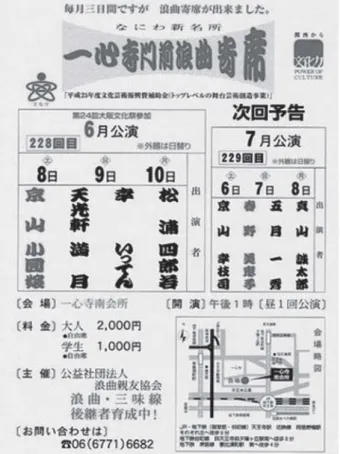
In Osaka, the monthly season of the Rōkyoku Shinyūkyōkai (Rōkyoku Shinyū Association) at the South Meeting Room (Minami kaijo) adjacent to the Isshinji temple in Tennōji ward, is a three-day one, held on the second Saturday, Sunday and Monday of the month, that is, 36 days per year. Between 1:00 and 3:00 in the afternoon, four pieces are presented each day by four performers, who all perform for the three days. Each performer therefore presents three different pieces on the three consecutive days. In all, 12 pieces are performed each month, giving a total of 144 per year. Only the New Year season varies this pattern. Of course, there are other performances in addition to these regular monthly seasons, for which systematic data is not available. The total number of pieces in our database for Osaka is 400 (of a total possible number of 444 in the collection period).
It is necessary to attend at least once each month, in order to obtain information about the three-day program, as it is not given on the chirashi (leaflet), nor posted on the website. When I first went, it was only shown on a handwritten poster at the entrance and I photographed it each month. After some months of photographing the poster, they started providing and distributing reduced photocopies of the wall poster; later still, the program was made available for audience members in a printed, word-processed form, but the wall poster was still there.
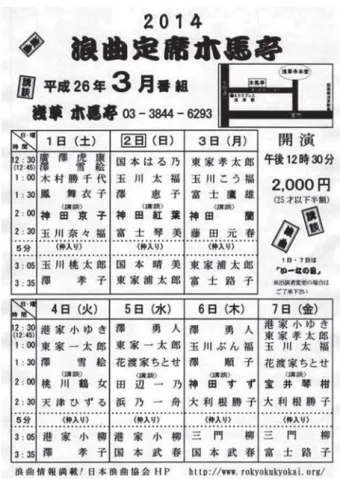
In Tokyo, the monthly season of the Nihon Rōkyoku Kyōkai takes place at the small variety theatre (yose), the
Mokubatei, in Asakusa, over the first seven days of every month, generating far more performances than Isshinji. Six or seven naniwa-bushi items and one k dan are presented each day over 84 days a year (in 2012, 486 pieces were performed.) The show lasts from 12:00 (since June 2014 12:15) to about 4:00 in the afternoon. About half of the performers present twice in a season, the rest only once. The total number of pieces in our database for Tokyo is 1139 (of a possible number between 1134 and 1323 in the collection period).
The Tokyo data was collected primarily from that made available on Twitter from November 2011 until it was discontinued in November 2014. It was not necessary to be physically there to get the information during this period, which unfortunately is no longer available. Performances were attended frequently in 2012, and sporadically from 2013. A number of interviews with several performers were carried out.
The data collected about performances in both locales consisted of venue, date, singer (r kyokushi), name of piece, shamisen player (kyokushi), and any other instrument (only available for Osaka; usually guitar) or sound system operator for karaoke type style of performance. The data was entered into an excel file(8)
.
Sorting of data
• The initial data set listed Tokyo (1148) and Osaka (406) separately. • When combined, there was a total of 1554 identifiably named pieces
• After duplicates (pieces performed more than once) were removed, a total repertoire of nearly 500 pieces resulted
Results derived
• Pieces were classified into categories (Table 1)
• Frequency of each piece was calculated (Tables 2, 3, 4, and 5)
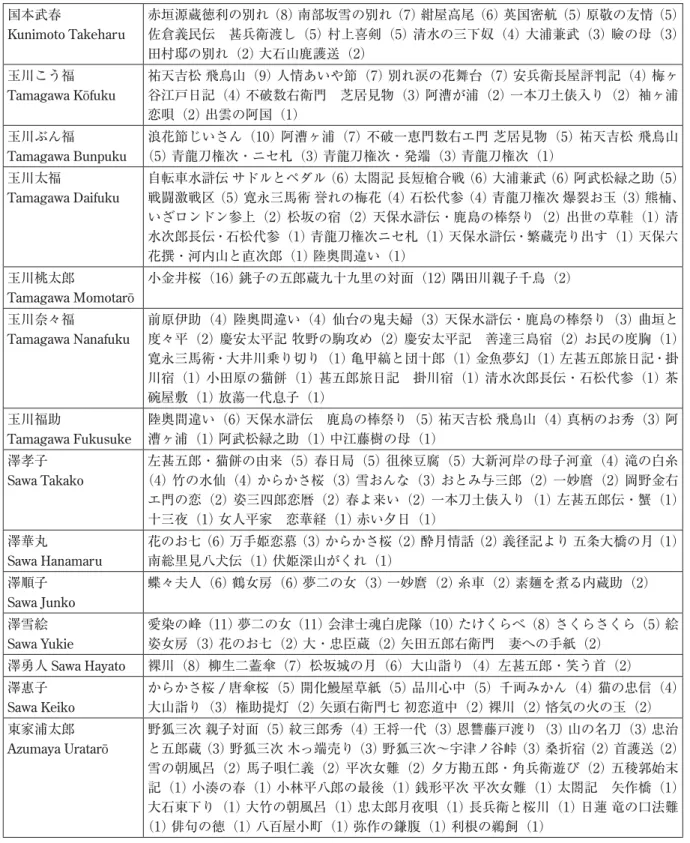
• Sorting by singer showed the repertoire of individual performers (see Tables 6 and 7), their “signature pieces” (18-ban), and suggested who were the most prominent performers.
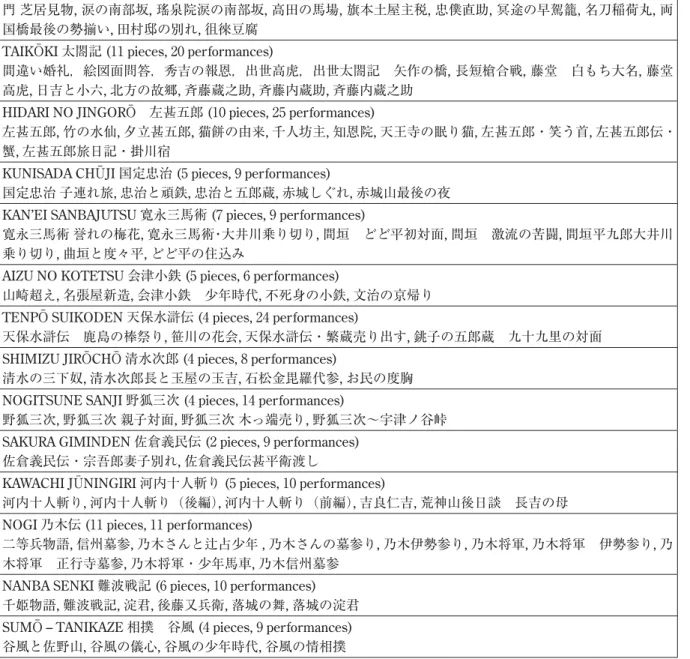
• K dan-derived series were identified (see Tables 8 and 9)
Limitations of the data
The identity of a “piece” is unstable, reflecting the oral character of naniwa-bushi. The same basic narrative or story can be treated differently by different performers, and be known by a different name. For example, Mabuta no
haha, performed frequently (20 times) by 5 different performers at Mokubatei, was performed 5 times at Isshinji by 3
performers (Mayama Ichirō and his “family” ) under the title Banba no Ch tar . There is a large number of “series”, or serial narratives. Often the name of the series is listed without identifying which episode in the series; for example,
Taik ki, Y ten Kichimatsu. Ashikawa, himself a naniwa-bushi “author”, in the preface to his little encyclopedia of
pieces writes: “There are many pieces telling the same story with different scripts. Many are variant texts developed by individual performers, whose reputation derives not from the text itself but the way it is individualized in performance”. Ashikawa further notes that changes are commonly made to texts including censorship of vulgarities. The original attribution of author or arranger becomes increasingly uncertain (2013:211). This problem has been dealt with as far as possible in handling the data.
The “spelling” used in the input of data is often inconsistent, especially in the Tokyo data: for example, Aa (Ah, alas) was input in the following different ways: ああ、あ々、アア、嗚呼 ; sakura is input as both 桜 and さくら , which
the computer treats as separate items. Data is missing for some days, or is incomplete. There is an imbalance between Tokyo and Osaka in the number of pieces available, performance days per season, length of the program (and hence number of items), and the period and length of time data were collected. Finally, data collection is limited to performances in the regular monthly season (j seki) at these two venues. Many performers are active in other venues on an ad hoc basis. It is possible that not all anomalies regarding piece names have been detected, so the absolute number of pieces is not reliable.
III Classification of the repertoire
Among many possible classifications are the criteria of form, content, theme, and music, but in the case of
naniwa-bushi, music is not a useful criteria in distinguishing categories of piece(9). Initially, classification was attempted according to source of narrative, but this was too problematic, as it could be direct or indirect coming via another genre, such as from heike or gikeiki via k dan. Whatever system was attempted, considerable overlap was generated.
The primary classification finally adopted is between multi-episode serial narratives (series) and single episode pieces. In actuality, the former are all derived from k dan, while the latter are extremely varied in source. K dan-origin pieces are typically multi-episode, serial narratives, whereas any deriving from rakugo are single episode. Pieces that originate in k dan narratives range over several categories just as in k dan itself. The genres of k dan include descriptions of battles (gundan), history, legend, scandals of daimyo houses (oie s d ), and ninj -banashi. Many k dan are derived from the worlds of heike, gikeiki, sekky , Edo period literature, j ruri and kabuki theatre. Another k dan category is biography of famous (including legendary) people (meijin-den), and of sumo wrestlers, merchants, artisans etc. There are apocryphal stories about heroes as children, and stories about modern heroes (such as Nogi Maresuke) (Kyokudō 1994: 267-341). Many of these genres were transferred to naniwa-bushi.
The single pieces include human interest or sentimental stories (ninj -banashi, sewamono), biography, anti-war, adaptations from modern literature, theatre or opera, stories about kabuki actors (Otoko no hanamachi, Kikk jima to
Danj r ). Most entail pathos, sentimentality or humour. Some express values associated with modernity, such as
success stories.
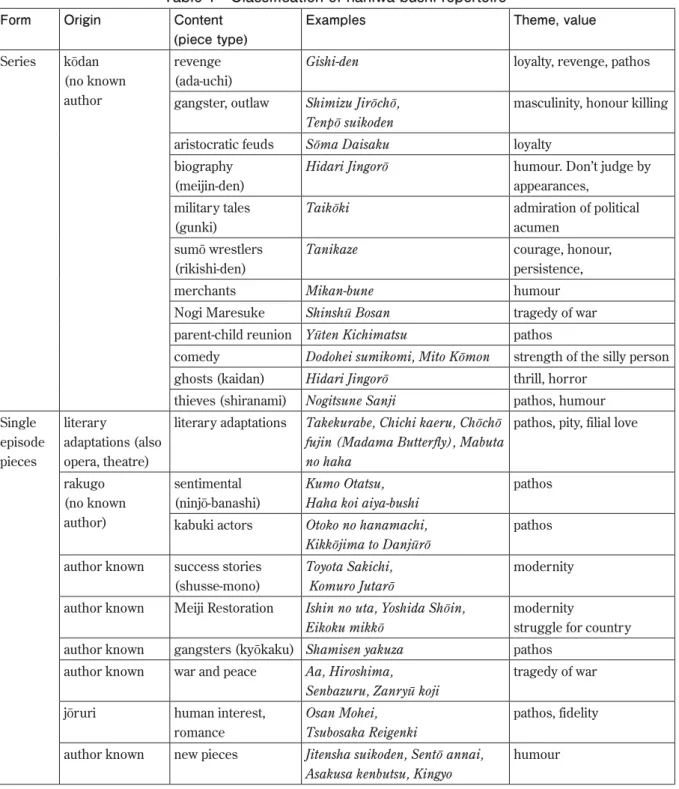
Table 1 is based on the primary criterion of form, the secondarily on the criterion of origin (including authorship where relevant); some prominent examples for each category are given, and finally any theme or value that is likely to be expressed in these pieces.
Many possible categories are not included in the table. For example, pieces with titles prefaced with “Ah!” are a lament, a cr y of despair. Many have titles including “... no wakaki hi” or “... no sh nen jidai”, focusing on the childhood of famous people(10). If all such possibilities are pursued, it would generate myriad categories, and hence be of limited use.
New pieces can be heard in Tokyo, but not in Osaka. In fact, the only cases were all created by kant -bushi performers.
Table 1 Classification of naniwa-bushi repertoire
Form Origin Content (piece type)
Examples Theme, value
Series kōdan (no known author
revenge (ada-uchi)
Gishi-den loyalty, revenge, pathos
gangster, outlaw Shimizu Jir ch , Tenp suikoden
masculinity, honour killing
aristocratic feuds S ma Daisaku loyalty biography
(meijin-den)
Hidari Jingor humour. Don’t judge by
appearances, military tales
(gunki)
Taik ki admiration of political
acumen sumō wrestlers
(rikishi-den)
Tanikaze courage, honour,
persistence, merchants Mikan-bune humour Nogi Maresuke Shinsh Bosan tragedy of war parent-child reunion Y ten Kichimatsu pathos
comedy Dodohei sumikomi, Mito K mon strength of the silly person ghosts (kaidan) Hidari Jingor thrill, horror
thieves (shiranami) Nogitsune Sanji pathos, humour Single episode pieces literary adaptations (also opera, theatre)
literary adaptations Takekurabe, Chichi kaeru, Ch ch fujin (Madama Butterfly), Mabuta no haha
pathos, pity, filial love
rakugo (no known author) sentimental (ninjō-banashi) Kumo Otatsu, Haha koi aiya-bushi
pathos
kabuki actors Otoko no hanamachi, Kikk jima to Danj r
pathos
author known success stories (shusse-mono)
Toyota Sakichi, Komuro Jutar
modernity
author known Meiji Restoration Ishin no uta, Yoshida Sh in, Eikoku mikk
modernity
struggle for country author known gangsters (kyōkaku) Shamisen yakuza pathos
author known war and peace Aa, Hiroshima, Senbazuru, Zanry koji
tragedy of war
jōruri human interest, romance
Osan Mohei, Tsubosaka Reigenki
pathos, fidelity
author known new pieces Jitensha suikoden, Sent annai, Asakusa kenbutsu, Kingyo
IV The most frequently performed pieces
Table 2 Most frequently performed pieces (Isshinji and Mokubatei combined)
K kōdan. G gishi-den. B bungei / literary. k kyōkaku/outlaw. N ninjō/sentimental. R rakugo. M meijin/biography. Kb kabuki. Ss shinsaku/new piece. S sumō.
Title Classification No. of times perf d
No. of Performers
Remarks
不破数右エ門芝居見物 K, G 26 8
瞼の母 / 番場の忠太郎 B 25 8 Same piece, different title
男の花道 K, R 18 3 Also in rakugo
赤垣源蔵徳利の別れ K, G 18 4
祐天吉松 飛鳥山 K, k 18 3 Tamagawa Fukutarō family
田宮坊太郎 K 17 7 小金井桜 小次郎 K, k 16 1 Tamagawa Momotarō 太刀山と清香 R 16 2 15/16 by Minatoya Koryū 両国橋最後の勢 い K, G 16 2 小田原情け相撲(谷風) K 13 2 人情江戸っ子祭り 13 1 Azumaya Kōtarō 夢二の女 13 2 村上喜剣 K, G 12 2 銚子の五郎蔵 九十九里の対面 12 1 Tamagawa Momotarō 陸奥間違い K, R 12 5 愛染の峰 11 1 Sawa Yukie 水戸黄門漫遊記 K 11 2 裸川 10 2
阿漕が浦 K 10 3 Tamagawa Fukutarō family
会津士魂白虎隊 10 1 Sawa Yukie 天保水滸伝 鹿島の棒祭り K 10 3 田宮坊太郎少年時代 K 10 2 徳川家康 人質から成長まで 10 2 父帰る B 10 3 浪花節じいさん 10 1 Tamagawa Bunpuku 五郎正宗少年時代 K 9 1 三味線ヤクザ 9 2 神田松 9 5 大浦兼武 9 2 梅山家の縁談 9 1 Ōtone Katsuko 良弁杉 K 9 2 からかさ桜 8 3 たけくらべ B 8 1 Sawa Yukie 安兵衛道場破り K, G 8 1 Azumaya Ichitarō 一休の婿入り 8 1 Azumaya Ichitarō 一本刀土俵入り K 8 2 花のお七 8 2 松坂城の月 8 2 南部坂雪の別れ K, G 8 2 名人竿中 N, M 8 1 Fujita Motoharu
弥作の鎌腹 8 2
人情あいや節 / 母恋あいや節 N 8 2
闇に散る小判 7 1 Azumaya Kōtarō
唄入り観音経 N 7 1 Mikado Yanagi
花売り娘 7 1 Ōtone Katsuko
梶川大力の粗忽 K, G 7 4 Haruno Yuriko family
大山詣り 7 2 発明王 豊田佐吉 M 7 1 Tenchūken Ryōgetsu 別れ涙の花舞台 Kb 7 1 Tamagawa Kōfuku 命の振り袖 7 2 柳生二蓋笠 7 1 Sawa Hayato 誉れの水馬 7 1 Fujita Motoharu 源太時雨 7 3 深川裸祭り 6 1 Minatoya Koryū は組小町 6 2 阿武松緑之助 K, S 6 3 恩讐藤戸渡り 6 2 絵姿女房 6 2 権太栗毛 6 2 高田の馬場 K, G 6 2 紺屋高尾 R, N 6 1 Kunimoto Takeharu 自転車水滸伝 サドルとペダル Ss 6 1 Tamagawa Daifuku 若き日の小村寿太郎 M 6 2
斉藤内蔵之助 K 6 3 Haruno Yuriko family
雪の夜話 6 1 Ōtone Katsuko 双葉山物語 6 1 Fuji Kotomi 大石妻子の別れ K, G 6 2 蝶々夫人 B 6 1 Sawa Junko 鶴女房 B 6 1 Sawa Junko 婦系図 B 6 2
両国夫婦花火 K 6 3 Haruno Yuriko family
武蔵坊弁慶 6 3 お染久松 Kb 5 1 Minatoya Koryū さくら さくら 5 1 Sawa Yukie 安兵衛婿入り K, G 5 英国密航 R 5 1 Kunimoto Takeharu 王将一代 5 2 開化鰻屋草子 5 1 Sawa Keiko 原敬の友情 M 5 1 Kunimoto Takeharu 恨みの十四日 5 1 Minatoya Koryū 佐倉義民伝甚平衛渡し K 5 1 妻妙と数右衛門 5 1 Ōtone Katsuko 三日の娑婆 5 1 Ōtone Katsuko 春日局 5 1 Sawa Takako 上尾の林蔵 5 1 Ōtori Maiko 深夜の警笛 5 1 Ōtone Katsuko
屋おせん Kb 5 3 竹の水仙 K 5 2 仲乗り新三 5 2 二十年目の恩返し 5 1 Kadoya Chitose 乃木将軍 正行寺墓参 M 5 萩の 5 1 Mikado Yanagi 品川心中 N 5 1 Sawa Keiko 野狐三次 親子対面 K 5 野狐三次 木っ端売り K 5 徂徠豆腐 K 5 1 Sawa Takako
Summary of Table 2.
Total of 443 pieces were performed 5 times or less. 214 pieces were performed only once in the survey period.
No. of pieces No. of times performed
1 26 1 25 1 19 3 18 1 17 5 16 3 13 3 12 2 11 7 10 7 9 11 8 11 7 18 6 24 5 43 4 59 3 103 2 214 1 Total: 443
Table 3 The ten most frequently performed pieces in Osaka
父帰る 梶川大力の粗忽 田宮坊太郎 番場の忠太郎 / 瞼の母 高田の馬場 斉藤蔵之助 徳川家康 武蔵坊弁慶 両国夫婦花火 屋おせん
The only piece in the top ten in common is Mabuta no haha / Banba no Ch tar
We want to know which pieces define the genre today, what the most significant pieces of the current repertoire are. If they are performed more than ten times, they can be thought to be significant, but if only by one person, does that detract from their significance to the repertoire as a whole? Are older pieces more likely to be performed across all generations, and in both Tokyo and Osaka? If they are only performed by one “family” of performers, this suggests the importance of direct oral transmission from a teacher or mentor (... yuzuri no gedai), the strength of tradition within lineages of performers. Even in the era of secondar y orality of learning from recordings, even for one’s teacher’s performance (such as in the case of Tamagawa Fukutarō (1945-2007) whose death left his followers (disciples, deshi) bereft), this permission remains important.
Viewed numerically, across both venues combined, the top five pieces are Fuwa Kazuemon shibai kenbutsu (26,
k dan / gishi-den), Mabuta no haha (25, based on a shinkokugeki play by Hasegawa Shin), Otoko no hanamachi (18, rakugo and k dan), Akagaki Genz Tokuri no wakare (18, k dan / gishi-den) and Y ten Kichimatsu Ausakayama (18, k dan) are “significant” pieces(11)
.
It is important to consider also how many people perform each piece. If we exclude pieces performed many times but by only one person, we may get a different picture of the representative pieces of current naniwa-bushi. For example, Tamagawa Momotarō (1924-2015) was the only performer of one piece, performed 16 times. (See Table 7) With his passing, it seems likely that this piece will fall out of the repertoire.
Performing one single piece became very common for pieces that were performed five times or fewer (see Table 7). Does this mean these people had a limited repertoire, or had not yet let their deshi take it over? Perhaps they used to have a wider repertoire but in old age stuck to solid favourites?
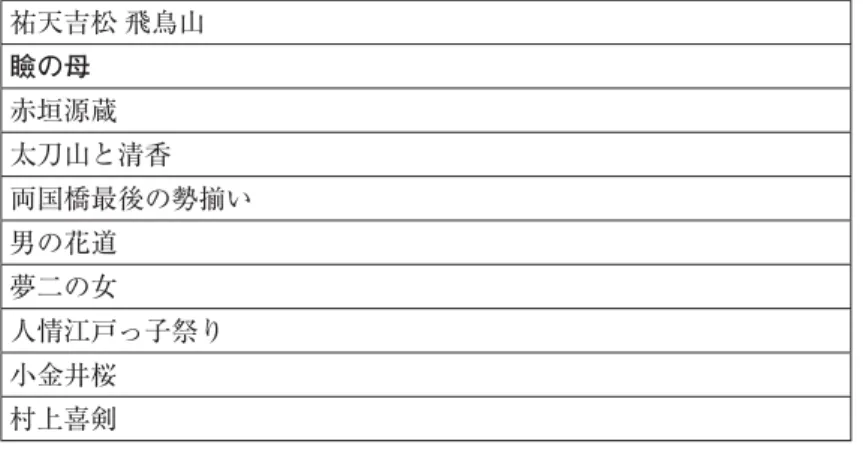
Table 4 The ten most frequently performed pieces in Tokyo
祐天吉松 飛鳥山 瞼の母 赤垣源蔵 太刀山と清香 両国橋最後の勢 い 男の花道 夢二の女 人情江戸っ子祭り 小金井桜 村上喜剣
Table 5 Pieces and series common to both venues (disregarding frequency)
21 pieces in common
お夏清十郎, 壺坂霊験記, は組小町, 阿武松, 伊達家の鬼夫婦・仙台の鬼夫婦, 亀甲縞と団十郎, 亀甲組, 権太栗毛, 源 太時雨・源太恋しぐれ, 黒田武士, 三味線やくざ, 首護送, 小田原相撲・情け相撲, 松坂城の月, 神田松, 人情あいや 節・母恋あいや節, 赤垣源蔵, 相馬大作, 男の花道 , 田宮坊太郎, 瞼の母・番場の忠太郎
7 series in common, but not necessarily the same pieces, often series name only given, not episode 義士伝, 寛永三馬術, 左甚五郎, 国定忠治, 太閤記:矢作の橋, 乃木伝, 天保水滸伝
If we want to know which pieces are the trademark or hallmark pieces of the genre, we need to consider the preferences of listeners, and the themes and values expressed. A new piece, however frequently performed, remains the territory of the one who created it, and so is probably is not significant in the same way as gishi-den and Mabuta
no haha. So let us now turn to performers and repertoire.
Performers and repertoire
Table 6 Key performers and their signature pieces
(number indicates times performed in the data collection period) 国本武春 Kunimoto Takeharu 赤垣源蔵徳利の別れ(8) 南部坂雪の別れ(7) 紺屋高尾(6) 英国密航(5) 原敬の友情(5) 佐倉義民伝 甚兵衛渡し(5) 村上喜剣(5) 清水の三下奴(4) 大浦兼武(3) 瞼の母(3) 田村邸の別れ(2) 大石山鹿護送(2) 玉川こう福 Tamagawa Kōfuku 祐天吉松 飛鳥山(9) 人情あいや節(7) 別れ涙の花舞台(7) 安兵衛長屋評判記(4) 梅ヶ 谷江戸日記(4) 不破数右衛門 芝居見物(3) 阿漕が浦(2) 一本刀土俵入り(2)袖ヶ浦 恋唄(2) 出雲の阿国(1) 玉川ぶん福 Tamagawa Bunpuku 浪花節じいさん(10) 阿漕ヶ浦(7) 不破一恵門数右エ門 芝居見物(5) 祐天吉松 飛鳥山 (5) 青龍刀権次・ニセ札(3) 青龍刀権次・発端(3) 青龍刀権次(1) 玉川太福 Tamagawa Daifuku 自転車水滸伝 サドルとペダル(6) 太閤記 長短槍合戦(6) 大浦兼武(6) 阿武松緑之助(5) 戦闘激戦区(5) 寛永三馬術 誉れの梅花(4) 石松代参(4) 青龍刀権次 爆裂お玉(3) 熊楠、 いざロンドン参上(2) 松坂の宿(2) 天保水滸伝・鹿島の棒祭り(2) 出世の草鞋(1) 清 水次郎長伝・石松代参(1) 青龍刀権次ニセ札(1) 天保水滸伝・繁蔵売り出す(1) 天保六 花 ・河内山と直次郎(1) 陸奥間違い(1) 玉川桃太郎 Tamagawa Momotarō 小金井桜(16) 銚子の五郎蔵九十九里の対面(12) 隅田川親子千鳥(2) 玉川奈々福 Tamagawa Nanafuku 前原伊助(4) 陸奥間違い(4) 仙台の鬼夫婦(3) 天保水滸伝・鹿島の棒祭り(3) 曲垣と 度々平(2) 慶安太平記 牧野の駒攻め(2) 慶安太平記 善達三島宿(2) お民の度胸(1) 寛永三馬術・大井川乗り切り(1) 亀甲縞と団十郎(1) 金魚夢幻(1) 左甚五郎旅日記・掛 川宿(1) 小田原の猫 (1) 甚五郎旅日記 掛川宿(1) 清水次郎長伝・石松代参(1) 茶 碗屋敷(1) 放蕩一代息子(1) 玉川福助 Tamagawa Fukusuke 陸奥間違い(6) 天保水滸伝 鹿島の棒祭り(5) 祐天吉松 飛鳥山(4) 真柄のお秀(3) 阿 漕ヶ浦(1) 阿武松緑之助(1) 中江藤樹の母(1) 澤孝子 Sawa Takako 左甚五郎・猫 の由来(5) 春日局(5) 徂徠豆腐(5) 大新河岸の母子河童(4) 滝の白糸 (4) 竹の水仙(4) からかさ桜(3) 雪おんな(3) おとみ与三郎(2) 一妙麿(2) 岡野金右 エ門の恋(2) 姿三四郎恋暦(2) 春よ来い(2) 一本刀土俵入り(1) 左甚五郎伝・蟹(1) 十三夜(1) 女人平家 恋華経(1) 赤い夕日(1) 澤華丸 Sawa Hanamaru 花のお七(6) 万手姫恋慕(3) からかさ桜(2) 酔月情話(2) 義径記より 五条大橋の月(1) 南総里見八犬伝(1) 伏姫深山がくれ(1) 澤順子 Sawa Junko 蝶々夫人(6) 鶴女房(6) 夢二の女(3) 一妙麿(2) 糸車(2) 素麺を煮る内蔵助(2) 澤雪絵 Sawa Yukie 愛染の峰(11) 夢二の女(11) 会津士魂白虎隊(10) たけくらべ(8) さくらさくら(5) 絵 姿女房(3) 花のお七(2) 大・忠臣蔵(2) 矢田五郎右衛門 妻への手紙(2) 澤勇人 Sawa Hayato 裸川(8)柳生二蓋傘(7)松坂城の月(6)大山詣り(4)左甚五郎・笑う首(2) 澤惠子 Sawa Keiko からかさ桜 / 唐傘桜(5) 開化鰻屋草紙(5) 品川心中(5)千両みかん(4) 猫の忠信(4) 大山詣り(3)権助提灯(2) 矢頭右衛門七 初恋道中(2) 裸川(2) 悋気の火の玉(2) 東家浦太郎 Azumaya Uratarō 野狐三次 親子対面(5) 紋三郎秀(4) 王将一代(3) 恩讐藤戸渡り(3) 山の名刀(3) 忠治 と五郎蔵(3) 野狐三次 木っ端売り(3) 野狐三次∼宇津ノ谷峠(3) 桑折宿(2) 首護送(2) 雪の朝風呂(2) 馬子唄仁義(2) 平次女難(2) 夕方勘五郎・角兵衛遊び(2) 五稜郭始末 記(1) 小湊の春(1) 小林平八郎の最後(1) 銭形平次 平次女難(1) 太閤記 矢作橋(1) 大石東下り(1) 大竹の朝風呂(1) 忠太郎月夜唄(1) 長兵衛と桜川(1) 日蓮 竜の口法難 (1) 俳句の徳(1) 八百屋小町(1) 弥作の鎌腹(1) 利根の鵜飼(1)
Table 7 Performers who performed one piece 5 times or more
Times
(5 times or more)
How many pieces in repertoire 東家浦太郎 Azumaya Uratarō 5 28 澤孝子 Sawa Takako 5, 5, 5 18 玉川大福 Tamagawa Daifuku 6, 6, 6, 5, 5 17 三門柳 Mikado Yanagi 7, 7, 7, 6, 5, 5 13 東家一太郎 Azumaya Ichitarō 10, 8, 8, 7,5 13 国本武春 Kunimoto Takeharu 8, 7, 6, 5, 5, 5, 5 13 大利根勝子 Ōtone Katsuko 9, 8, 7, 6, 5 10 澤恵子 Sawa Keiko 5, 5 10 玉川こう福 Tamagawa Kōfuku 9, 7, 7 10 港屋小柳 Minatoya Koryū 16, 11, 6, 5, 5, 5 10 東家一太郎 Azumaya Ichitarō 小田原情け相撲(10) 安兵衛道場破り(8) 一休の婿入り(8) 弥作の鎌腹(7) 国定忠治・ 忠治と頑鉄(5) たにしの田三郎(4) 恩讐藤戸渡り(3) 野狐三次 木っ端売り(3) 神田松 (2) 孟子の末裔 武林唯七(2) 浅草案内(1) 長家の置土産(1) 田三郎物語(1) 東家孝太郎 Azumaya Kōtarō 人情江戸っ子祭り(13) 闇に散る小判(7) 江戸相撲蒙古襲来(4) あたま山(1) 京山幸枝若 Kyōyama Kōshiwaka 河内十人斬り(後編)(2) 河内十人斬り(前編)(2) 間垣 どど平初対面・どど平住込み (2) 吉良仁吉(2) 左甚五郎 千人坊主(2) 左甚五郎 天王寺の眠り猫(2) 米屋剣法(2) 安珍清姫(1) 河内十人斬り(1) 間垣 激流の苦闘(1) 孝子万兵衛(1) 笹川の花会(1) 山崎超え(1) 大石と垣見(1) 竹の水仙(1)天宝水滸伝(1) 不死身の小鉄(1) 名張屋新 造(1) 京山倖若 Kyōyama Yukiwaka 稲川東下り(1) 左甚五郎(1) 奥州奴(1) 谷風の情相撲(1) 難波戦記(1) 玉砕 硫黄島 (1) 後藤又兵衛(1) 佐野山(1)谷風の少年時代(1) 京山幸太 Kyōyama Kōta 小田原相撲(3) 会津小鉄 少年時代(2) 左甚五郎 知恩院(2) 小鉄の少年時代(1) 比 良八荒(1) 弁慶五条の橋(1) 門出の一里塚(1) 夕立甚五郎(1) 京山幸枝司 Kyōyama Koshiji 源太恋時雨(2) 谷風の儀心(2) 破れ太鼓(2) 阿武松(阿武松緑之助)(1) 出世高虎(1) 藤堂 白もち大名(1) 藤堂髙虎(1) 武蔵屋新造(1) 名月隅田川(1) 幸いってん Kō Itten 武蔵坊弁慶(2) 間垣平九郎大井川乗り切り(2) 文治の京帰り(1) 甚五郎(1) 左甚五郎 千人坊主(1) 御所桜乗り込み(1)玉川お芳(1) 吉良仁吉(1) どど平の住込み(1) 真山一郎 Mayama Ichirō 日本の母(4) 俵星玄蕃(2) 番場の忠太郎(2) 大石妻子の別れ(22) 冥途の早籠(1) 北方 の故郷(1) 南部坂雪の別れ(1)刃傷松の廊下(1) 光方の故郷(1) 元禄晴れ街道(1) あ あ広島(1) 真山誠太郎 Mayama Seitarō 片割れ月(4) 長兵衛 男の花道(3) 落城の舞(3) ああ広島(2) 刃傷松の廊下(2) 番場 の忠太郎(2) 武蔵坊弁慶(2) 冥途の早駕籠(2) 赤城山(1) 乃木さんの墓参り(1) 波平 慈恋物語り(1) 真山隼人 Mayama Hayato 俵星玄蕃(3) 維新の歌(3) 鳴呼吉田松陰(3) ああ大塩平八郎(2) 山本五十六(2) 日本 の妻(1) 反乱(1) 武蔵坊弁慶(1) 落城の舞(1) 嵐の中の日本(1) 春野ココ Haruno Koko かぐや姫(2) 間違い婚礼(2) チュウチュウ物語(2) 一休さん(2) 谷風と佐野山(2) カ チカチ山(1) 舌切り雀(1) 春野一 Harono Hajime 梶川大力の粗忽(2) 新釈 南部坂(2) 千両幟(2) 出世太閤記(1) 斉藤内蔵助(1) 田宮 坊太郎(1) 春野恵子 Haruno Keiko 神田松(2) おさん茂平(1) 梶川大力の粗忽(1) 高田の馬場(1) 斉藤蔵之助(1) 天狗の 女房(1) 番町皿屋敷(1) 淀君(1)落城の淀君(1) 春野美恵子 Haruno Mieko 高田の馬場(4) 藤十郎の恋(3) 夫婦善哉(3) お紺殺し(2) 梶川大力の粗忽(2) 両国夫 婦花火(2) お夏清十郎(1) 暗闇の丑松(1) 田宮坊太郎(1) 婦系図よりお蔦と主税(1) 春野冨美代 Haruno Fumiyo 斉藤内蔵助(2) 屋おせん(2) 梅川忠兵衛(1) 両国夫婦花火(1)
With such a broad repertoire, obviously performers specialize in a certain number of items(12).
Population of performers (according to the respective websites)
Singers 浪曲師 Shamisen players 曲師
2018 木馬亭 Mokubatei 36 15
一心寺 Isshinji 23 5
2013 木馬亭 Mokubatei 40 16
一心寺 Issninji 22 5
Three per formers belong to both organizations: Tenchūken Ungetsu, Tenchūken Ryōgetsu, and Naniwatei Tomoka.
Families of performers and ownership of repertoire
While there are some pieces that seem to be the “territory” of particular singers, there also pieces that are shared among a “family” of performers.
In Tokyo, according to our audience survey conducted in November 2013 (Tokita 2014), by far the most popular performer was Kunimoto Takeharu (1960-2015) who regularly presented items that no-one else performed: Konya
Takao, Eikoku Mikk , Hara Kei no y j . He had no disciples, so this repertoire may disappear. (Actually, Tamagawa
Nanafuku has recently started performing Eikoku Mikk .) Tamagawa Fukutarō (1945-2007)’s repertoire is shared among his followers. Some pieces seem to be the territory of one of those followers, while others are shared widely among them but rarely if ever performed by other “families” of performers. Veteran performer Sawa Takako (b.1939) is raising a number of followers and is sharing her wide repertoire among them. Similarly with Azumaya Uratarō (b. 1942) and his followers.
In Osaka, the performer voted outright as most popular was Kyōyama Kōshiwaka (b. 1954), who is sharing his repertoire with his young student, Kōta. Similarly with Mayama Ichiro (b. 1959) and his young follower Mayama Hayato. Haruno Yuriko (1927-2016) also raised a number of followers, most of whom rely on the repertoire they learnt from her. Exceptionally, Haruno Keiko is highly innovative with new repertoire as well as the inherited pieces. A performer can only start performing a piece if it is permitted by her teacher, or by a senior mentor, or if she creates or commissions a new piece herself. The nature of transmission of tradition within naniwa-bushi is thus regulated and affects the scope of the repertoire of the singers. Interviews reveal that performers try to avoid duplicating the same repertoire learned from their teacher with fellow students but rather aim to build an individualized repertoire, just as they pride themselves on their own fushi and musical style. People talk about ...yuzuri, a piece permitted or transmitted to them by a teacher or mentor.
澤雪絵 Sawa Yukie 11, 10, 8, 5 9 玉川ぶん福 Tamagawa Bunpuku 10, 7, 5, 5 7 澤順子 Sawa Junko 6, 6 6 藤田元春 Fujita Motoharu 8, 8, 7, 7 6 澤隼人 Sawa Hayato 8, 7, 6 5 天中軒涼月 Tenchūken Ryōgetsu 11, 9, 7, 5 5 東家孝太郎 Azumaya Kōtarō 13, 7 4 玉川桃太郎 Tamagawa Momotarō 16, 12 3
V K dan-derived repertoire
In this section, we ponder the current significance of pieces derived from k dan by looking at their weight statistically: are they predominant numerically?
Like the k dan originals, these k dan-derived pieces do not have an author, although many accredit a “script-writer” (kyakuhonka) to a piece, who may have adapted an existing narrative for a particular singer. K dan is a pure story-telling art (wagei), with no sung melody or instrumental accompaniment. It specializes in multi-episode sagas, characterized by formality; it is serious, never frivolous. Its origins lie in the recitation of battles (gundan) and war chronicles (gunki) such as the Taiheiki.
By appropriating the narratives of k dan, naniwa-bushi acquired characteristics of wagei (Ōnishi 1977). Unusually among Japan’s musical narratives, it both sings and tells (in spoken delivery) third-person narrative; spoken delivery is not limited to dramatic dialogue (serifu) as in j ruri. Ōnishi laments that naniwa-bushi’s adoption of k dan content was “unfortunate”. Done to acquire respectability and credibility and to overcome its social stigma as a street performance of beggars (daid gei), it led to performers being allied with the establishment and the near-official ideology of the bushido ethic after the Russo-Japanese War (1904-1905), and being vulnerable to appropriation by the authorities in a number of contexts thereafter.
In an overview of narrative arts, Gunji Masakatsu explicates the distinctions between kataru = narrative with
fushi (heike and j ruri); hanasu = informal everyday language and applies to rakugo; and yomu, the term conventionally
applied to k dan, because they explicated and interpreted serious dogma and histor y, especially war narratives.
Naniwa-bushi acquired characteristics of all three types of verbal utterance (Gunji 1977).
The adaptation of k dan narratives enabled naniwa-bushi to develop into a substantial art: as wagei interlaced with melody and shamisen, it had overtaken k dan and rakugo in popularity by the early twentieth century. Of course,
k dan narratives were too long for naniwa-bushi, primarily because the melodic parts (fushi) take more time to deliver
than speech. Furthermore, in benefiting from the nascent recording industry, naniwa-bushi had to compromise to adjust to the limited recording time of SP records. With the coming of radio, the performance time of a piece became fixed to a 30-minute format that is still standard today in both Tokyo and Osaka. Given the time taken for musical delivery, this was too short for the k dan narratives, and so often stories became truncated and difficult to follow. It also led to the typical closing formula of “time’s up, come again tomorrow” (Mazu wa, kore made まず、これまで ). Such narrative truncation was attractive to promoters, as it served to keep audiences in suspense, hopefully to return for the next instalment. These days, it is a source of humour, as audiences know there will be no sequel the next day; they see ironic humour in what could be called a “cop-out” (sekinin nogare 責任逃れ ). (See Kitagawa 2016 for a case study of the development of the k dan narrative into naniwa-bushi.)
Our data indicates that, spread uniformly across the repertoire from the most frequently performed pieces to those performed only once, k dan pieces are still a significant part of the current repertoire. Many are niche repertoire, restricted to or “owned” by one singer, or a “family” of singers. A few are common to many performers. Notably, the gishi-den pieces are in this category, so arguably can be said to represent the genre as a whole.
Originally when an episode in a k dan saga of several chapters (stories) was adapted to naniwa-bushi, each episode was abbreviated, and not all chapters were adopted. Now in many cases, only one episode remains from what was a series of related stories.
The most commonly performed series
Gishi-den (33 pieces, 143 performances): The saga of the vendetta carried out by 47 samurai made masterless (r nin)
after their lord, the Daimyo of the Akō domain, attacked the chamberlain Kira in Edo palace in 1702. This is best known from the j ruri and kabuki plays it spawned, Kanadehon Ch shingura, or Treasury of Loyal Retainers. The historical events that took place between 1702 and 1704 were a major political scandal that was taken up in storytelling, theatre and literature. It generated a web of stories about the individual people involved (meimei-den) during the 14-month period between the ritual suicide of the Daimyo and the revenge attack of the r nin, and even led to apocryphal stories about non-historical figures (gaiden). These stories, “narratives of the loyal samurai” (gishi-den), infused with the ethos of bushi-d , were largely responsible for propelling Tenchūken Kumoemon and naniwa-bushi to fame in the late Meiji period (see Hyōdō and Smith 2006).
Taik ki (11 pieces, 20 performances): The military saga (gunki) Taik ki is an account of the life and deeds of
Toyotomi Hideyoshi (1537-1598), written in the seventeenth century. In the saga, Hideyoshi’s childhood is not given in detail, whereas a large amount of oral and dramatic lore developed around Hideyoshi, much of which is not historical and deals with his childhood and youth. Such stories were told in k dan, and from k dan entered
naniwa-bushi.
Hidari Jingor (10 pieces, 25 performances): Hidari Jingorō is a legendary sculptor, supposed to have lived in the
seventeenth century and served the daimyo, Ōkubo Hikozaemon (1560-1639). He also travelled incognito to various parts and reputedly left dozens of masterpieces. These stories are found in rakugo as well as k dan. They abound with humour and preach a view that the great and famous do not necessarily dress or act respectably.
Kan’ei Sanbajutsu (7 pieces, 7 performances): These pieces concern the famous Kan’ei period (1624-1644) horseman,
Magaki Heikurō, and an apparent simpleton, Dodohei, who attaches himself to Magaki and with him takes part in impossible equestrian feats. These episodes are redolent with humour and the need to recognize talent in the apparently stupid.
Shimizu Jir ch (4 pieces, 8 performances): This cycle is about an outlaw (ky kaku or premodern yakuza) boss,
Shimizu Jirōchō (1820-1893), and one of his apparently simpleton underlings, Mori no Ishimatsu. These pieces were the trademark of famous naniwa-bushi singer Hirosawa Torazō (1899-1964).
Two other prominent series of stories about outlaw bosses (ky kaku) are Tenp suikoden and Y ten Kichimatsu.
Tenp suikoden (4 pieces, 24 performances): A trademark of the Tamagawa family of performers, this series depicts
the gang warfare between bosses Sasagawa Shigezō (1810-1847) and Iioka Sukegorō (1792-1859). The swashbuckling hero is the r nin swordsman Hirade Miki (1810? – 1844).
Y ten Kichimatsu (1 piece, 18 performances): Kichimatsu is a pickpocket involved with gangsters in Edo, who
marries the daughter of a rich merchant, and they have a child. When his old contacts get him in trouble he must go into hiding. The most famous episode, and the one that is still widely performed is his chance encounter with his seven-year old son from whom he tries to hide his identity. All examples in our data are performed by members of the Tamagawa family, but there are interesting differences in plot between the Tamagawa and versions found on the recording of Kyōyama Kōshiwaka (previous generation).
Tamiya B tar (1 piece, 17 performances): Among the top six frequently performed pieces, the only episode in the
current repertoire from this long k dan narrative relates how Bōtarō as a boy avenges his father’s murder.
repertoire and would rush to a second-hand book store to pick up a volume of k dan and cook up a naniwa-bushi piece overnight. Anzai states further that singers may have wanted to present several episodes from a series, and certainly audiences enjoyed such series, but some episodes were more popular and were performed more frequently in response to audience demand. This led to attrition of repertoire. Of the 65 “representative and outstanding” pieces whose texts Anzai transcribes, 41 are represented in our data set, many of which however are performed only infrequently (Anzai 1975: 156-217).
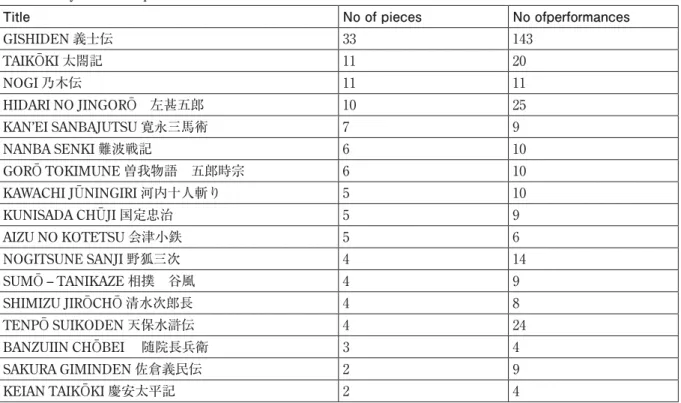
From our data, 233 k dan-derived pieces were clearly identified, which forms about 43% of the whole set of almost 500 pieces. This is a considerable proportion of the current repertoire. Table 8 contains the k dan-derived series that were represented by at least two pieces. The number of pieces for each series and the number of times performed is indicated in Table 9.
Table 8
n-derived series and pieces
GISHIDEN 義士伝 (33 pieces, 143 performances)
安兵衛の り妻, 安兵衛長屋評判記, 安兵衛道場破り, 雨の山科, 梶川大力の粗忽, 元禄花吹雪, 元禄秋晴れ街道, 元 禄曽我物語, 新釈 南部坂, 刃傷松の廊下, 赤垣源蔵 徳利の別れ, 赤穂の人妻, 赤穂開城, 村上喜剣, 大石と垣見, 大 石妻子別れ, 大石山鹿護送, 大石東下り, 中山安兵衛婿入り, 天野屋利兵衛, 南部坂雪の別れ, 俵星玄蕃, 不破数右衛 門 芝居見物, 涙の南部坂, 瑤泉院涙の南部坂, 高田の馬場, 旗本土屋主税, 忠僕直助, 冥途の早駕籠, 名刀稲荷丸, 両 国橋最後の勢 い, 田村邸の別れ, 徂徠豆腐
TAIKŌKI 太閤記 (11 pieces, 20 performances)
間違い婚礼,絵図面問答,秀吉の報恩,出世高虎,出世太閤記 矢作の橋, 長短槍合戦, 藤堂 白もち大名, 藤堂 高虎, 日吉と小六, 北方の故郷, 斉藤蔵之助, 斉藤内蔵助, 斉藤内蔵之助
HIDARI NO JINGORŌ 左甚五郎 (10 pieces, 25 performances)
左甚五郎, 竹の水仙, 夕立甚五郎, 猫 の由来, 千人坊主, 知恩院, 天王寺の眠り猫, 左甚五郎・笑う首, 左甚五郎伝・ 蟹, 左甚五郎旅日記・掛川宿
KUNISADA CHŪJI 国定忠治 (5 pieces, 9 performances)
国定忠治 子連れ旅, 忠治と頑鉄, 忠治と五郎蔵, 赤城しぐれ, 赤城山最後の夜 KAN’EI SANBAJUTSU 寛永三馬術 (7 pieces, 9 performances)
寛永三馬術 誉れの梅花, 寛永三馬術・大井川乗り切り, 間垣 どど平初対面, 間垣 激流の苦闘, 間垣平九郎大井川 乗り切り, 曲垣と度々平, どど平の住込み
AIZU NO KOTETSU 会津小鉄 (5 pieces, 6 performances)
山崎超え, 名張屋新造, 会津小鉄 少年時代, 不死身の小鉄, 文治の京帰り TENPŌ SUIKODEN 天保水滸伝 (4 pieces, 24 performances)
天保水滸伝 鹿島の棒祭り, 笹川の花会, 天保水滸伝・繁蔵売り出す, 銚子の五郎蔵 九十九里の対面 SHIMIZU JIRŌCHŌ 清水次郎 (4 pieces, 8 performances)
清水の三下奴, 清水次郎長と玉屋の玉吉, 石松金毘羅代参, お民の度胸 NOGITSUNE SANJI 野狐三次 (4 pieces, 14 performances)
野狐三次, 野狐三次 親子対面, 野狐三次 木っ端売り, 野狐三次∼宇津ノ谷峠 SAKURA GIMINDEN 佐倉義民伝 (2 pieces, 9 performances)
佐倉義民伝・宗吾郎妻子別れ, 佐倉義民伝甚平衛渡し
KAWACHI JŪNINGIRI 河内十人斬り (5 pieces, 10 performances)
河内十人斬り, 河内十人斬り(後編), 河内十人斬り(前編), 吉良仁吉, 荒神山後日談 長吉の母 NOGI 乃木伝 (11 pieces, 11 performances)
二等兵物語, 信州墓参, 乃木さんと 占少年 , 乃木さんの墓参り, 乃木伊勢参り, 乃木将軍, 乃木将軍 伊勢参り, 乃 木将軍 正行寺墓参, 乃木将軍・少年馬車, 乃木信州墓参
NANBA SENKI 難波戦記 (6 pieces, 10 performances) 千姫物語, 難波戦記, 淀君, 後藤又兵衛, 落城の舞, 落城の淀君 SUMŌ – TANIKAZE 相撲 谷風 (4 pieces, 9 performances) 谷風と佐野山, 谷風の儀心, 谷風の少年時代, 谷風の情相撲
Table 9
-derived series with pieces performed more than once
a. Ranked by number of pieces
Title No of pieces No ofperformances
GISHIDEN 義士伝 33 143 TAIKŌKI 太閤記 11 20 NOGI 乃木伝 11 11 HIDARI NO JINGORŌ 左甚五郎 10 25 KAN’EI SANBAJUTSU 寛永三馬術 7 9 NANBA SENKI 難波戦記 6 10 GORŌ TOKIMUNE 曽我物語 五郎時宗 6 10 KAWACHI JŪNINGIRI 河内十人斬り 5 10 KUNISADA CHŪJI 国定忠治 5 9 AIZU NO KOTETSU 会津小鉄 5 6 NOGITSUNE SANJI 野狐三次 4 14 SUMŌ – TANIKAZE 相撲 谷風 4 9 SHIMIZU JIRŌCHŌ 清水次郎長 4 8 TENPŌ SUIKODEN 天保水滸伝 4 24 BANZUIIN CHŌBEI 随院長兵衛 3 4 SAKURA GIMINDEN 佐倉義民伝 2 9 KEIAN TAIKŌKI 慶安太平記 2 4
b. Ranked by number of performances
Title No of pieces No of performances
GISHIDEN 義士伝 33 143 HIDARI NO JINGORŌ 左甚五郎 10 25 TENPŌ SUIKODEN 天保水滸伝 4 24 TAIKŌKI 太閤記 11 20 NOGITSUNE SANJI 野狐三次 4 14 NOGI 乃木伝 11 11 NANBA SENKI 難波戦記 6 10 GORŌ TOKIMUNE 曽我物語 五郎時宗 6 10 KAWACHI JŪNINGIRI 河内十人斬り 5 10 KAN’EI SANBAJUTSU 寛永三馬術 7 9 KUNISADA CHŪJI 国定忠治 5 9 SUMŌ – TANIKAZE 相撲 谷風 4 9 SAKURA GIMINDEN 佐倉義民伝 2 9 SHIMIZU JIRŌCHŌ 清水次郎長 4 8 AIZU NO KOTETSU 会津小鉄 5 6 BANZUIIN CHŌBEI 幡随院長兵衛 3 4 KEIAN TAIKŌKI 慶安太平記 2 4
GORŌ TOKIMUNE 曽我物語 五郎時宗 (6 pieces, 10 performances)
五郎とその妻, 五郎とその母, 五郎時宗・祖父の祈り, 五郎時致 祖父の鎮魂, 五郎時致 母の祈り, 五郎正宗少年時代 BANZUIIN CHŌBEI 随院長兵衛 (3 pieces, 4 performances)
長兵衛と桜川, 長兵衛男の花道, 幡随院長兵衛
KEIAN TAIKŌKI 慶安太平記 (2 pieces, 4 performances) 慶安太平記 善達三島宿, 慶安太平記 牧野の駒攻め
The data in Table 8 indicates that by far the most prominent set of serial narratives belongs to the gishi-den series, with 33 pieces, and 143 performances. In number of pieces, this is followed by Taik ki (11 pieces), Nogi-den (11 pieces), Hidari Jingor (10 pieces). (Nogi-den pieces all had different titles, but it is possible that the actual narrative content is duplicated between some items.)
Similar results are shown for the relative number of performances, although Hidari Jingor is ahead of Taik ki, and Nogi-den pieces had only 11 performances in all. Since the total number of pieces tallied for this group is 121, the remaining 113 pieces are examples of what was once a series, but have in effect become single-episode pieces. Many were only performed once. Prominent single examples with frequent performance include Otoko no hanamachi (per formed 18 times) about the relationship between kabuki actor Nakamura Utaemon (possibly the third, generation 1778-1838, or fourth generation1798-1852) and the celebrated eye doctor Habu Genseki (1762-1848) who operated on the actor’s eyes. This was also a rakugo piece and does not seem to have been part of a series. Tamiya
B tar (sh nen jidai) was part of a long k dan series but only this episode was found, performed 17 times. Another
frequently performed piece is Ausakayama (Oyako no taimen), the only episode from the series Y ten Kichimatsu; all 18 performances are by members of the Tamagawa “family”.
VI Concluding discussion
We have demonstrated that naniwa-bushi boasts a very wide currently performed repertoire, to which new pieces are being added. The most significant pieces are not necessarily the most numerically frequent. Pieces that are widely shared across the genre, in both Tokyo and Osaka, are important, but pieces inherited in families from a previous generation are valued.
What is the extent of the repertoire of individual performers, and how is a repertoire created? Individuality is prized, not only individual musical style, but also repertoire. In the Osaka data, there was little repetition by each performer, whereas in Tokyo with a larger population of performers and more opportunities to perform there was more repetition.
A sense of ownership over pieces may account for the loss of repertoire. People hesitate to encroach on the territory of others. There is often a close relation between the repertoire of teacher and student. It appears that some people have “exclusive rights” to a piece. Most individual singers have their signature pieces. Only one performer does certain pieces, such as Sawa Junko’s Ch ch fujin. Tenkōken Mangetsu’s Chichi kaeru was performed just once by his follower, Tenkōken Shingetsu. Some singers have broad repertoires, while others focus on a small number, which may be their exclusive possession. This seems to be the case of Ōtone Katsuko in Tokyo.
The prominence of “series” in the current repertoire shows “traditional referentiality” (see footnote 6), a connection with naniwa-bushi’s Meiji period origins, and the ongoing importance of traditional stories that can be called “classics”. However, the number of items in each series is obviously fewer than previously; severe attrition has occurred. In many cases only one or two pieces remain from what was a series.
What does this data tell us about the past, current and future repertoire of naniwa-bushi, its attrition and replacement or renewal? How many of Suzuki Yonewaka’s pieces are still performed? No case of Sado J wa was found in our data set (see Manabe 2017), whereas Hirosawa Torazō’s Shimizu Jir ch pieces continue to enjoy a certain popularity. Mikado Hiroshi’s follower, Mikado Yanagi, exclusively perpetuates his signature piece, Uta-iri Kannon-ky .
Will she pass it on to anyone?
There is definitely an East-west divide in the repertoire. There is a common core repertoire but the most frequently performed pieces differ widely. This correlates with the 2013 survey data, which found that audience preferences in the two regions for pieces and for performers are in stark contrast, and performers have their individual repertoires (Tokita 2014). This divide is due to the fact that there are two professional associations, that have almost no mingling. This generates two separate worlds of naniwa-bushi performance in the present day.
Given the appearance of new young performers, the creation of new repertoire, and efforts by many to revive or maintain repertoire, especially “classical” k dan repertoire, the future of the art seems not so bleak. Often through assiduous efforts to hold introductory group classes, new young performers are being attracted to the art, but clearly not for the money or the fame. They are attracted in part by the nature of story-singing, the direct communication with audiences, the still highly fluid nature of the pieces, and the fact that its stories are approachable and easy to relate to. New pieces are welcomed. Perhaps the core shared traditional value of Japanese sentiment (Nihon no
kokoro) gives a sense of security in a changing world, and a nostalgia for a disappearing downtown (shitamachi)
culture that is attractive, even exotic, to today’s performers and audiences.
We ascertained in the 2013 audience survey the changing profile of audiences: they are younger, follow more varied occupations, and have a higher level of education, about 50% of audiences being university graduates (Tokita 2014). Most of the younger performers too are university graduates; those who trained in naniwa-bushi from childhood are now a minority and are among the older age group.
Younger performers are working energetically to relate to and collaborate with wagei and other yose arts, and with modern popular culture, and of course contemporary media, to keep naniwa-bushi open and accessible.
Notes
1 The term for “piece” generally is kyoku 曲 . In naniwa-bushi, a piece is called gedai 外題 , seki 一席 , or sometimes the neutral “item” enmoku 演目 .
2 Strictly speaking, the data is no longer “current”. Every time I have attended since collecting the data, whether in Tokyo or Osaka, I hear at least one piece I have never encountered before. A few performers have since died or retired, and in some cases taken their repertoire with them, and on the other hand new young performers have debuted, and new pieces are being created.
3 According to an interview with Tamagawa Nanafuku 2017.10.20 her kant -bushi is eclectic and draws on kansai-bushi melodies now and then.
The data presented in this paper shows some significant differences in repertoire at least between naniwa-bushi in contemporary Tokyo and Osaka.
4 It is possible to gain a loose picture of the repertoire in past decades through the NHK T zai R kyoku Taikai program data on the National Theatre of Japan website, the pieces performed in the weekly NHK-FM radio program, Rokyoku J hachi Ban, and in various publications (Ashikawa 2013, Anzai 1975, Shiba 1994, Manabe 2017), Nichibunken’s catalogue of the Morikawa collection of records, and a database created by Onizuka.
5 Many have claimed that naniwa-bushi is a dying art, and the term suitairon is often encountered. In English, see Hyōdō and Smith (2006: 459).
6 Foley developed the concept of “traditional referentiality” to explain the connection between oral and oral-connected narratives, forming a continuous tradition (Foley 1999).
7 See websites of Nihon Rōkyoku Kyōkai and Rōkyoku Shinyūkai after the list of references.
8 The analysis deals only with singers not shamisen players, who can accompany anyone regardless of piece, genre or whether kansai- or kant -bushi style.
9 Content-related fushi (melody types) are urei and seme. There is little musical differentiation between the genres, unlike j ruri. Musical difference is more associated with the sequential use of different fushi. The difference between kant -bushi and kansai-bushi is significant. Then, individual differences are highly significant, and are prized.
10 Seven such pieces were found in our data set. Wakaki hi no Kumoemon, Wakaki hi no Komura Jutar , Wakaki hi no Aizu Kotetsu, Gor (Tokimune) no sh nen jidai, Tamiya B tar no sh nen jidai, Tanikawa no sh nen jidai, Tokugawa Ieyasu hitojichi seich made.
11 Frequency of kant -bushi compared with kansai-bushi has only been relevant in Tokyo, but since 2013, Naniwatei Tomoka performs in Osaka. Kant -bushi professional “family” names are Tamagawa, Azumaya, Kimura and Naniwatei.
12 Performers list their repertoire on the respective websites for the Nihon Rōkyoku Kyōkai (Tokyo) and Rōkyoku Shinyū Kyōkai (Osaka). This is often more numerous than what appeared in our data set.
References
Anzai, Takeo (1975). R kyoku Jiten. Tokyo: Nihon Jōhō Centre Ashikawa, Junpei (2013). R kyoku no shinzui. Osaka: JDC shuppan.
Foley, John Miles (1999). Homer's Traditional Art. University Park, PA: Pennsylvania State University Press Gunji, Masakatsu (1977). “Wagei to wa” in Wagei: sono keifu to tenkai. Tokyo: San’ichi shobo, 5-12
Hyōdō Hiromi (2000). Koe no kokumin kokka naniwa-bushi (Naniwa-bushi, the voice of the nation) NHK Books
Hyōdō Hiromi and Henry D. Smith II (2006). “Singing Tales of the Gishi: Naniwabushi and the Forty-seven Rōnin in Late Meiji Japan.” Monumenta Nipponica, 61/4 (Winter 2006), pp. 459-508. Includes a translation by Henry D. Smith of “Parting in the Snow at Nanbuzaka” (Nanbuzaka yuki no wakare) of Tōchūken Kumoemon, 509-519. Available at:
http://www.columbia.edu/~hds2/pdf/2006A_Singing_Tales_of_Gishi_MN.pdf)
Kitagawa Junko.(2011). “Kantō-bushi no rōkyoku ni okeru shamisen”. saka Ky iku Daigaku Kiy (daiichi bumon), 60 (1), 1-18. Kitagawa Junko (2016). “Rōkyoku no katari no seisei genre o meguru yobi kenkyū: Nogitsune Sanji o sozai ni (Part 2)”. saka
Ky iku Daigaku Kiy (daiichi bumon), 64 (2), 33-52.
Kyokudō Konanryō (1994). Meiji-ki Osaka no Engei sokki-bon Kiso kenky . Osaka: Taru shuppan
Manabe, Masayoshi (2017). Naniwa-bushi: ry d suru katari-gei: Enja to ch sh no kindai. Tokyo: Serica shobō Ōnishi, Nobuyuki (1977). “Naniwa-bushi” in Wagei: sono keifu to tenkai. Tokyo: San’ichi shobō, 127-166 Ōnishi, Nobuyuki (1998). Naniwa-bushi hanj ki. Tokyo: Shogakkan
Shiba, Kiyoshi (ed.) (1994). Azumaya Urataro: kant -bushi hitosuji. Tokyo: Rōkyoku henshūbu
Tokita, Alison (ed.) (2014). The Report of Social Research Class of 2013, Department of Sociology Doshisha University. Kyoto: Doshisha University
Websites
National Theater of Japan Bunka Digital Library ( 文化デジタルライブラリー ) Engei, Taishū Geinō
http://www2.ntj.jac.go.jp/dglib/plays/submenu.do;jsessionid=0171D952797FD66F6F37A021AC6B2DD2?division=plays&class =engei_taishu
International Research Center for Japanese Studies (Nichibunken) Morikawa Collection http://library.nichibun.ac.jp/en/
Onizuka rōkyoku database
http://octacore.egoism.jp/roukyoku_cmonos/ Nihon Rōkyoku Kyōkai
http:// rōkyoku.or.jp/ Rōkyoku Shinyu Kyōkai
https://www. rōkyokushinyu.org/
Acknowledgements
Terada Mayumi, for creating the database, collecting and entering the data.
JSPS Grant-in-aid for Scientific Research (KAKEN) (C) 2012-2014, Naniwa-bushi: Orality and Literacy. Grant no. 24520145. Doshisha University Department of Sociology, for enabling the field work study in 2013.
Kyoto City University of Arts, Research Centre for Traditional Japanese Music, for enabling the Team Research Project in 2013 Tamagawa Nanafuku, for checking data and for discussion of several issues.