Corresponding author: Akira Yamasaki, MD, PhD [email protected]
Received 2017 January 30 Accepted 2017 March 22
Abbreviations: BAP, biological antioxidant potential; BDHQ, brief self-administered diet history questionnaire; COPD, chronic obstructive pulmonary disease; dROM, diacron reactive oxygen metabolite; EBC, exhaled breath condensate; EIB, exercise induced bronchoconstriction; FeNO, fractional exhaled nitric oxide; FEV1, forced expiratory volume in 1 second; FVC, forced vital capacity; VC, vital capacity
Relationship between Oxidative Stress, Physical Activity, and Vitamin Intake in
Patients with Asthma
Akira Yamasaki, Yuji Kawasaki, Kenichi Takeda, Tomoya Harada, Yasuyuki Hasegawa, Takehito Fukushima, Ryota Okazaki, Haruhiko Makino, Yoshihiro Funaki, Yuriko Sueda, Akihiro Yamamoto, Jun Kurai, Masanari Watanabe and Eiji Shimizu
Division of Medical Oncology and Molecular Respirology, Department of Multidisciplinary Internal Medicine, School of Medicine, Tottori University Faculty of Medicine, Yonago 683-8504, Japan
ABSTRACT
Background Oxidative stress plays an important role in the pathogenesis of bronchial asthma. Antioxidant nu-trition and supplementation have been used to reduce ox-idative stress. However, a clinical trial with antioxidant supplementation showed no beneficial effects in patients with asthma. On the other hand, physical activity is re-lated to the prognosis of chronic obstructive pulmonary disease (COPD) and is also related to oxidant status. We investigated the relationships between oxidative stress, serum levels of vitamins, dietary vitamin intake, daily activities, and pulmonary functions in patients with asth-ma.
Methods Eighteen patients with bronchial asthma
were enrolled in this study. Reactive oxidative stress was assessed by measuring organic hydroperoxides (diacron reactive oxygen metabolites: dROM) in sera and by mea-suring H2O2 levels in exhaled breath condensates. The
biological antioxidant capacity in serum was evaluated by measuring antioxidant potential capacity against fer-ric ion. We also assessed pulmonary functions, fraction of exhaled nitric oxide, serum levels of vitamins, dietary vitamin intake, and physical activities.
Results There were no relationships between the index of oxidative stress (dROM and H2O2 in exhaled breathe
condensates) and pulmonary functions, serum levels of vitamins, daily vitamin intakes, and activity levels in patients with asthma.
Conclusion The status of transient oxidative stress may not be related to daily activities, vitamin levels, and pulmonary functions in patients with asthma in a real-life setting. However, our results were obtained in
the short-term period from a small number of subjects, so a large longitudinal study is required to ascertain the relationships between oxidative stress, physical activity and vitamin intake in patients with asthma.
Key words asthma; exhaled breath condensate; oxida-tive stress; vitamin
Oxidative stress is one of the risk factors for develop-ing and for exacerbatdevelop-ing atherosclerosis, cardiovascu-lar disease, and respiratory diseases, such as chronic obstructive disease (COPD) and bronchial asthma.1–4
In the pathogenesis of asthma, eosinophilic airway in-flammation induces asthmatic symptoms and oxidative stress. Since eosinophils contain nicotinamide adenine dinucleotide phosphate oxidase, eosinophilic peroxidase, and nitric oxide synthesis, reactive oxygen species can be generated in the asthmatic airway.5, 6 A recent study
in a mouse model showed that house dust mites increase oxidative stress.7 Furthermore, environmental stimuli,
such as diesel exhaust particles, cigarette smoke, ozone, and viral infections, can result in increased reactive oxy-gen species.8–11 Oxidative stress generated in the airway
of patients with asthma causes epithelial cell injury. Fur-thermore, reactive oxygen induces transforming growth factor-β1 secretion from epithelial cells,12 which may
induce airway remodeling in asthma. Therefore, antioxi-dants may be effective in the treatment of asthma.13
The therapeutic strategies for protecting against ox-idative stress are intake of antioxidants, such as dietary and vitamin supplementation (nutritional antioxidants), and chemical compounds or minerals, including N-ace-tyl cysteine,14, 15 selenium, magnesium, and zinc.16
How-ever, there are no clinical trial data suggesting that an-tioxidants prevent asthma development. Furthermore, a few small clinical trials showed either improved asthma symptoms or pulmonary function.16–18
It has been reported that the level of physical activi-ty is the one of the predictors of mortaliactivi-ty in COPD pa-tients.19, 20 Waschki et al reported that the level of
physi-cal activity is the strongest predictor compared to other established predictors, such as the ADO (age, dyspnea,
airflow obstruction) index, the BODE (BMI, airway obstruction, dyspnea, and exercise capacity) index, steps per day, forced expiratory volume in 1 second (FEV1)%
predicted, and six-minute walk distance.19 Although
physical activity has not been reported to improve asth-matic symptoms, exercise improved asthasth-matic symp-toms in adults and children.21–23 Furthermore, exercise
reduced the antioxidant status in asthmatic children.24
However, it has been reported that exercise induces oxi-dative stress in humans.25, 26 A few clinical trials on
exer-cise-induced bronchoconstriction (EIB) found that some natural antioxidants, such as ascorbic acid, α-tocopherol, and lycopene, improved both asthma symptoms and pulmonary function.27–29 In summary, these studies on
the relationship between physical activity, asthma, and oxidative stress are inconclusive.
In this study, we studied the correlations among ox-idative stress, serum antioxidant levels, dietary intake of antioxidants, pulmonary function, and daily activities in patients with asthma in a real-life setting.
SUBJECTS AND METHODS
Eighteen patients with bronchial asthma were enrolled in this study. Written informed consent was obtained from all of the patients. The diagnosis of asthma was made by respiratory physicians according to the American So-ciety Criteria.30 No patient experienced deterioration of
asthma symptoms from four weeks prior to enrollment of this study.
Assessment of oxidative stress and antioxidant potential in peripheral blood
Peripheral blood samples were collected from all pa-tients on the first day of the enrollment of this study and stored at –20 °C until further analysis. Oxidative stress was assessed by a radical analyzer system (FREE Carpe Diem; Wismerll, Tokyo, Japan) according to the manu-facturer’s instructions. In this study, we assessed oxida-tive stress by measuring the diacron reacoxida-tive oxygen me-tabolite (dROM) which reflects organic hydroperoxides formed by oxidative stress. The results are expressed as U.Carr. One unit of U.Carr equals 0.8 mg/L of hydrogen peroxide in the serum.31 We also assessed the biological
antioxidant potential (BAP). The BAP test reflects the antioxidant capacity in the serum by measuring the po-tential capacity against ferric ions.
Assessment of oxidative stress in exhaled breath condensates
All subjects breathed into an EcoScreen (Jaeger, Wurz-burg, Germany) for 10 to 15 minutes to collect exhaled breath condensate (EBC) on the first day of the
enroll-ment of this study. The EBCs were stored at –20 °C until analyzed. The H2O2 level in the EBCs was measured by a
radical analyzer system (FREE Carpe Diem; Wismerll).
Measurement of respiratory functions
On the first day of the enrollment in this study, all pa-tients were asked to perform a pulmonary function test with a Chestac 33 spirometer (Chest, Tokyo, Japan). Forced vital capacity (FVC) and FEV1 were recorded
from a minimum of three pulmonary function tests. Percent (%) of vital capacity (VC) is the VC expressed as a percentage of the predicted values 32 and %FEV1 is
the FEV1 expressed as a percentage of the predicted
val-ues.33
Measurement of fractional exhaled nitric oxide (FeNO)
The FeNO levels were measured using the Aerocrine NIOX MINO, a portable, hand-held NO analyzer (Aero-crine AB, Solna, Sweden). In each measurement, partici-pants were tested in a seated position without a nose clip with a constant flow rate of 50 mL/s. The measurement was performed once with each subject on the first day of enrollment in this study.
Measurement of serum vitamin levels
Serum vitamin levels were measured in each patient on the first day of enrollment in this study. Fractions of vitamin E (α-tocopherol, β-tocopherol, γ-tocopherol, and δ-tocopherol), and the levels of retinol, and vitamin C were measured by high performance liquid chroma-tography and 1,25 (OH)2 vitamin D was measured by
radioimmunoassay. All vitamin levels in the serum were measured at SRL Inc. (Hachioji, Tokyo, Japan).
Estimation of vitamin intake by a brief self-admin-istered diet history questionnaire (BDHQ)
The intake of retinol, β-carotene, vitamin C, vitamin D, α-tocopherol, β-tocopherol, γ-tocopherol, δ-tocoph-erol, and cryptoxanthin was assessed based on results of a brief self-administered diet history questionnaire (BDHQ) version 1-1. The BDHQ used in this study was written in Japanese and supplied from EBNJAPAN (Tokyo, Japan). The questions in the BDHQ included 58 on both food and beverage intake, and the frequency of food and beverage intake for the previous month was also included.
Assessing activity by actigraphy
The actigraph accelerometer is worn like a light-weight wrist watch (Actiwatch 2; Philips Respironics, Murrys-ville, PA). Actiwatch records a digitally-integrated
mea-sure of gross motor activity, which can be used to quan-titate rest and activity counts. The patients wore an acti-graph for seven consecutive days, and the activity counts (AC) were collected. We defined 60 seconds as 1 epoch. Total activity counts were calculated by the following formula: total activity counts = 0.04E–2 + 0.020E–1 + E
+ 0.2E+1 + 0.04E+2. E = activity counts during a scored
epoch. En = activity counts during previous or successive epochs. We assessed total activity counts and total activity per minute according to the Actiwatch 5 software.
Statistical analysis
All the data were expressed as mean ± SD. The cor-relations in the selected data sets were analyzed by Spearman’s correlation coefficients. GraphPad Prism 5 (GraphPad Software, San Diego, CA) was used for all statistical analyses.
This study was approved by the Ethics Committee of Tottori University (#1974) and was conducted accord-ing to the principles of the Declaration of Helsinki.
RESULTS
Characteristics of the patients
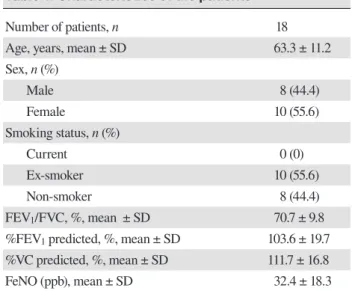
In total, 18 patients were enrolled in this study. The aver-age aver-age of the patients was 63.3 years, and included eight
Table 1. Characteristics of the patients
Number of patients, n 18
Age, years, mean ± SD 63.3 ± 11.2
Sex, n (%) Male 8 (44.4) Female 10 (55.6) Smoking status, n (%) Current 0 (0) Ex-smoker 10 (55.6) Non-smoker 8 (44.4) FEV1/FVC, %, mean ± SD 70.7 ± 9.8
%FEV1 predicted, %, mean ± SD 103.6 ± 19.7 %VC predicted, %, mean ± SD 111.7 ± 16.8
FeNO (ppb), mean ± SD 32.4 ± 18.3
FeNO, fractional exhaled nitric oxide; FEV1, forced expiratory volume in 1 second; FVC, forced vital capacity; VC vital capacity.
Table 2. Actigraphy data
Activity counts (24 h total), × 104, mean ± SD 260 ± 124 Activity counts per minutes, mean ± SD 283.3 ± 81.1
Table 3. Oxidative and antioxidative markers in pa-tients with asthma
Oxidative and antioxidative markers Patients(n = 18) Normalrange dROM (U.Carr), mean ± SD 333.9 ± 49.7 < 300 BAP (μmol/L), mean ± SD 2363.2 ± 290.7 > 2200 H2O2 in EBC (μmol/L), mean ± SD 0.6 ± 0.3 0.23 ± 0.03* *Adapted from reference 43.
BAP, biological antioxidant potential; dROM, diacron reactive oxygen metabolite; EBC, exhaled breath condensate.
Table 4. Serum vitamin levels in patients with asthma Serum vitamin levels Patients(n = 18) Normalrange
Retinol (IU/dL) 156.1 ± 44.4 97–316 Vitamin C (μg/mL) 9.8 ± 3.6 5.5–16.8 1, 25 (OH)2 Vitamin D (pg/mL) 59.1 ± 15.6 20.0–60.0 Vitamin E fraction α-tocopherol (mg/dL) 1.3 ± 0.3 0.49–1.09 β-tocopherol (mg/dL) 0.02 ± 0.006 < 0.02 γ-tocopherol (mg/dL) 0.09 ± 0.05 0.05–0.17 δ-tocopherol (mg/dL) Below detection limit < 0.01
males and 10 females of which 10 were ex-smokers and eight were non-smokers. The mean percentage of FEV1/
FVC was 70.7%, and the mean %FEV1 was 103.6%. The
mean FeNO level was 32.4 ppb. (Table 1).
Actigraphy
The average of total activity counts in 24 hours was 260 × 104 counts. The activity counts per minutes were 283.3
counts (Table 2).
Oxidative and antioxidative markers in patients with asthma
The average dROM level, an oxidant marker, was 333.9 U.Carr. The average BAP level, another antioxidant marker, was 2363.2 mmol/L. The average H2O2 in the
exhaled breath condensates was 0.6 mmol/L (Table 3).
Serum vitamin levels in patients with asthma
Several vitamins with antioxidant capacity were mea-sured. The average level of retinol was 156.1 IU/L, vitamin C was 9.8 μg/mL, 1,25 (OH)2 was 59.1 pg/mL.
Among the fraction of vitamin E, the average level of α-tocopherol was 1.3 mg/dL, β-tocopherol was 0.02 mg/ dL, and γ-tocopherol was 0.09 mg/dL. The level of δ-to-copherol was below the detection limit (Table 4).
Table 7. Relationships between dROM and pulmonary function, vitamin levels and activity counts
Spearman r P-value Pulmonary
function FEV1/FVC%FEV1 predicted 0.08983 0.7320.3283 0.1834 %VC predicted 0.253 0.3112
Serum level Retinol 0.2024 0.4206
Vitamin C 0.04134 0.8706 1,25 (OH)2 –0.1033 0.6835 Vitamin E –0.1177 0.6418 α-tocopherol 0.01809 0.9432 β-tocopherol 0.006814 0.9786 γ-tocopherol 0.06625 0.7939 Daily dietary
intake Retinolβ-carotene –0.19720.2024 0.42060.4328
Vitamin C –0.1074 0.6715 Vitamin D –0.3191 0.1969 α-tocopherol –0.3418 0.1651 β-tocopherol –0.2425 0.3323 γ-tocopherol –0.3717 0.1288 δ-tocopherol –0.3573 0.1456 Cryptoxanthin 0.06505 0.7976 Actigraphy
date Total activity countsActivity counts/min 0.07537 0.76630.3748 0.1254 dROM, diacron reactive oxygen metabolite; FEV1, forced expi-ratory volume in 1 second; FVC, forced vital capacity; VC vital capacity.
Daily vitamin intake estimated by BDHQ
The daily vitamin intake was estimated from the BDHQ. The average daily intake of retinol was 349.6 μg, β-caro-tene was 5336.8 μg, vitamin C was 144.8 mg, vitamin D was 15.5 μg, α-tocopherol was 7.8 mg, β-tocopherol was 0.4 mg, γ-tocopherol was 12.1 mg, δ-tocopherol was 3.3 mg, and cryptoxanthin was 381.9 μg (Table 5).
Relationships between dROM, BAP, and H2O2 in
EBC
The correlations of dROM, BAP, and H2O2 in EBC were
analyzed. There were no significant correlations be-tween either dROM and BAP, dROM and H2O2 in EBC,
or BAP and H2O2 (Table 6).
Relationships between dROM and pulmonary function, vitamin levels, and actigraphy data
We examined the relationships between dROM and oth-er parametoth-ers tested in this study. We could not find any significant correlation between dROM and either pul-monary function, serum levels of vitamins, daily dietary intake of vitamins, or activity counts (Table 7).
Table 5. Daily vitamin and provitamin intake estimat-ed by BDHQ Retinol (μg) 349.6 ± 290.0 β-carotene (μg) 5336.8 ± 3416.4 Vitamin C (mg) 144.8 ± 81.1 Vitamin D (μg) 15.5 ± 11.8 Vitamin E fraction α-tocopherol (mg) 7.8 ± 3.0 β-tocopherol (mg) 0.4 ± 0.1 γ-tocopherol (mg) 12.1 ± 3.9 δ-tocopherol (mg) 3.3 ± 1.3 Cryptoxanthin (μg) 381.9 ± 289.8
BDHQ, brief self-administered diet history questionnaire.
Table 6. Relationships between dROM, BAP and H2O2 in EBC
Spearman r P-value
BAP and dROM –0.2666 0.2848
H2O2 and dROM –0.3245 0.1888
H2O2 and BAP –0.4564 0.0569
BAP, biological antioxidant potential; dROM, diacron reactive oxygen metabolite; EBC, exhaled breath condensate.
Relationships between BAP and pulmonary func-tion, vitamin levels, and actigraphy data
We next examined the relationships between BAP and additional parameters. In these comparisons, we could not find any significant correlation between BAP and ei-ther pulmonary function, serum levels of vitamins, daily dietary intake of vitamins, or activity counts (Table 8).
Relationships between H2O2 in EBC and
pulmo-nary function, vitamin levels, and actigraphy data
We also examined the relationships between H2O2 in
EBC and other parameters tested in this study. In these comparisons, we could not find any significant correla-tion between H2O2 in EBC and either pulmonary
func-tion, serum levels of vitamins, daily dietary intake of vitamins, or activity counts (Table 9).
Relationships between activity counts and pulmo-nary function
Table 8. Relationships between BAP and pulmonary function, vitamin levels and activity counts
Spearman r P-value Pulmonary
function FEV1/FVC%FEV1 predicted –0.2941–0.0774 0.23610.7602 %VC predicted 0.02993 0.9062
Serum level Retinol –0.08678 0.7321
Vitamin C 0.2769 0.266 1,25 (OH)2 0.08772 0.7293 Vitamin E –0.1476 0.559 α-tocopherol –0.1198 0.6358 β-tocopherol 0.05572 0.8262 γ-tocopherol 0.02816 0.9117 Daily dietary
intake Retinolβ-carotene –0.10730.06502 0.79770.6717
Vitamin C –0.1084 0.6687 Vitamin D –0.2157 0.39 α-tocopherol –0.195 0.438 β-tocopherol 0.05572 0.8262 γ-tocopherol –0.02222 0.9303 δ-tocopherol –0.1078 0.6703 Cryptoxanthin 0.1199 0.6355 Actigraphy
date Total activity countsActivity counts/min 0.12690.01342 0.95790.6157 BAP, biological antioxidant potential; FEV1, forced expiratory volume in 1 second; FVC, forced vital capacity; VC vital capacity.
Table 10. Relationships between activity counts and pulmonary function
Total activity counts Spearman
r P-value Pulmonary
function FEV1/FVC%FEV1 predicted –0.08978 0.72310.3829 0.1168 %VC predicted 0.1620 0.5270
Activity counts/min Spearman
r P–value Pulmonary
function FEV1/FVC%FEV1 predicted 0.60170.4118 0.0083 0.0895 %VC predicted 0.2963 0.2798 FEV1, forced expiratory volume in 1 second; FVC, forced vital capacity; VC, vital capacity.
Table 9. Relationships between H2O2 in EBC and pul-monary function, vitamin levels and activity counts
Spearman r P-value Pulmonary
function FEV1/FVC%FEV1 predicted 0.08983 0.7320.3283 0.1834 %VC predicted 0.253 0.3112
Serum level Retinol 0.2024 0.4206
Vitamin C 0.04134 0.8706 1,25 (OH)2 –0.1033 0.6835 Vitamin E –0.1177 0.6418 α-tocopherol 0.01809 0.9432 β-tocopherol 0.006814 0.9786 γ-tocopherol 0.06625 0.7939 Daily dietary
intake Retinolβ-carotene –0.19720.2024 0.42060.4328
Vitamin C –0.1074 0.6715 Vitamin D –0.3191 0.1969 α-tocopherol –0.3418 0.1651 β-tocopherol –0.2425 0.3323 γ-tocopherol –0.3717 0.1288 δ-tocopherol –0.3573 0.1456 Cryptoxanthin 0.06505 0.7976 Actigraphy
date Total activity countsActivity counts/min 0.07537 0.76630.3748 0.1254 EBC, exhaled breath condensate; FEV1, forced expiratory volume in 1 second; FVC, forced vital capacity; VC vital capacity.
counts and pulmonary function. Total activity counts were not correlated with pulmonary function. Activity counts per minute were significantly correlated with FEV1/FVC. However, activity counts per minute were
not correlated with percent FEV1 nor percent VC (Table
10).
DISCUSSION
In this study, we assessed the correlations among oxi-dative stress, antioxidant capacity, dietary intake of an-tioxidants, pulmonary functions, and daily activities in patients with asthma in a real-life setting. We found no significant relationships between the index of oxidative stress (dROM and H2O2 in exhaled breathe condensates)
and pulmonary functions, levels of vitamin in serum, daily vitamin intakes, and activity counts in asthmatic patients. Our data suggest that oxidative stress is not affected by daily activity, intake of antioxidants, and pulmonary function in patients with asthma in a real-life setting.
We measured the dROM and BAP in sera and HO
in exhaled breath condensates. These parameters can be measured from a small volume of either blood samples (dROM and BAP) or exhaled breath condensates (HO)
and can be evaluated for oxidative status. The level of dROM has been measured in various diseases.34–37 The
international observational oxidative stress classified dROM levels into six stress levels as follows: Normal: < 300 U.Carr, Borderline: 301-320 U.Carr, Low oxidative stress: 321-340 U.Carr, Middle oxidative stress: 341-400 U.Carr, High oxidative stress: 401-500 U.Carr, and Very high oxidative stress: > 501 U.Carr.38 In our study, the
average level of dROM was 333.9 U.Carr, which is clas-sified as low oxidative stress. Suzuki et al. reported that the dROM level was constant in the stable condition and increased during acute exacerbation of asthma.39 They
reported that the dROM level was 268.2 U.Carr in eleven stable asthmatic patients, while Nakamoto et al. reported the dROM level was 345 U.Carr in 110 stable asthmatic patients.40 Therefore, our result is almost consistent with
the previous results. BAP level in patients with asthma is not yet well defined, the average BAP level in glauco-ma patients is 1955.8 ± 276.7 μmol/L and about 2100 to 2200 μmol/L in normal subjects.26, 41, 42 In our study, the
average level of BAP was 2363 μmol/L, which is slight compared to previous results.26, 41, 42 It has been
report-ed that a BAP level above 2200 μmol/L is considerreport-ed to have a normal biological antioxidant potential42 and
an increased BAP level possibly counteracts increased levels of exercise-induced reactive oxygen species.26
Therefore, elevated levels of BAP might be related to elevated levels of dROM. Further study is necessary to ascertain the relationships between levels of dROM and BAP in the same patients with repeated measurements. The H2O2 levels in EBC from patients with asthma have
been reported in previous studies, and the levels of H2O2
ranged from 0.238 to 0.91.43–45 These levels are
consis-tent with our study.
Although the levels of dROM, BAP, and H2O2 are
consistent with previous studies, we could not find any relationships among pulmonary function tests and these parameters. Suzuki et al. reported that the dROM level is increased during acute exacerbation of asthma and is correlated with serum inflammatory mediators.39
Mura-ta et al. reported that no relationships were observed in H2O2 levels and pulmonary functions46 while
Al-Oba-dity reported an inverse correlation between H2O2 and
FEV1 percent predicted.43 Therefore, these oxidative
stress markers may show a strong correlation with in-flammatory markers, and not with pulmonary functions in patients with asthma.
A variety of antioxidant supplements and nutrients has been studied for the treatment of asthma.16, 47 A few
studies have shown the beneficial effect of antioxidants on pulmonary functions and on asthmatic symptoms.17, 18 In
our study, we studied the relationships between
oxida-tive stress markers and either vitamins in serum or the daily intake of vitamins over a very short period, and no relationships were found. Therefore, no clear and ob-vious relationships may exist in antioxidant vitamins or nutrition in a real-life setting. It should be noted that the number of subjects was small, and the duration of our study was very short.
We also studied the serum levels and intake of vi-tamin D. Vivi-tamin D has no antioxidant capacity, but an effect of vitamin D on severe exacerbation of asthma has been observed.48 Brumpton et al. reported that low
vita-min D is associated with lung function decline in adult patients with asthma.49 We could not find any correlation
between pulmonary functions and either the serum lev-els or intake of vitamin D (data not shown). The protec-tive effects with exacerbation were not observed because of the short period of this study.
In this study, α-tocopherol was slightly above the normal range and γ-tocopherol was within normal range. Kodama et al. reported the concentration of α-tocopher-ol in patients with asthma was not significantly different from control subjects.50 The reason for the inconsistency
with our study is not known. On the other hand, Cook-Mills J et al. reported that the risk of asthma is increased in low levels of α-tocopherol with high levels of γ-to-copherol.51 Again, further study is necessary to clarify
the relationships between α-tocopherol and γ-tocopherol in patients with established asthma.
It has been reported that transient exercise increas-es both oxidative strincreas-ess and antioxidant capacity.25, 26
Furthermore, exercise training increases antioxidant ca-pacity.52 In this study, we could not find any significant
relationship between daily activity and oxidative stress level. Since our study evaluated average daily activity over a short period without exercise, and we did not compare the individual differences with activity level, further study is needed to show how either daily activity or exercise might influence oxidative stress on the same day in a single subject with asthma.
In this study, FEV1/FVC was positively correlated
with activity counts per minute. Although FEV1/FVC
was not correlated with total activity, activity counts per minutes were positively correlated with total activity (data not shown). Probably, patients who show better FEV1/
FVC are likely to have more physical activity. Physical activity is reduced in patients with severe asthma.53
Furthermore, Brumpton et al. reported that the decline in FEV1 was less in physically active patients with
asth-ma.54 In their study, physical activity was measured by
self-reporting. Therefore, it might be useful to study the relationship between physical activity and pulmonary function by using actigraphy.
In conclusion, we have found no relationships among oxidative stress, antioxidant capacity, vitamin levels, and physical activity in patients with asthma. In a real life setting with a short-term evaluation, oxidative stress may not be affected by daily activity and by antioxidant nu-trition intake. A large and longitudinal prospective study is necessary to confirm our results.
Acknowledgments: This work was supported by JPPS KAKENHI 24500976.
The authors declare no conflict of interest. REFERENCES
1 Siti HN, Kamisah Y, Kamsiah J. The role of oxidative stress, antioxidants and vascular inflammation in cardiovascular disease (a review). Vascul Pharmacol. 2015;71:40-56. PMID: 25869516.
2 Kim H, Yun J, Kwon SM. Therapeutic Strategies for Oxida-tive Stress-Related Cardiovascular Diseases: Removal of Ex-cess Reactive Oxygen Species in Adult Stem Cells. Oxid Med Cell Longev. 2016;2016:2483163. PMID: 27668035.
3 McNicholas WT. Chronic Obstructive Pulmonary Disease and Obstructive Sleep Apnea. Am J Respir Crit Care Med. 2009;180:692-700. PMID: 19628778.
4 Sugiura H, Ichinose M. Oxidative and nitrative stress in bron-chial asthma. Antioxid Redox Signal. 2008;10:785-97. PMID: 18177234.
5 Kinnula VL. Production and degradation of oxygen metabo-lites during inflammatory states in the human lung. Curr Drug Targets Inflamma Allergy. 2005;4:465-70. PMID: 16101523. 6 Hoshino T, Okamoto M, Takei S, Sakazaki Y, Iwanaga T,
Aizawa H. Redox-regulated mechanisms in asthma. Antioxid Redox Signal. 2008;10:769-83. PMID: 18179361.
7 Chan TK, Loh XY, Peh HY, Tan WN, Tan WS, Li N, et al. House dust mite-induced asthma causes oxidative damage and DNA double-strand breaks in the lungs. J Allergy Clin Immu-nol. 2016;138:84-96.e1. PMID: 27157131.
8 Li YJ, Takizawa H, Kawada T. Role of oxidative stresses induced by diesel exhaust particles in airway inflammation, allergy and asthma: their potential as a target of chemopre-vention. Inflamm Allergy Drug Targets. 2010;9:300-5. PMID: 20887268.
9 Santus P, Corsico A, Solidoro P, Braido F, Di Marco F, Scichilone N. Oxidative stress and respiratory system: phar-macological and clinical reappraisal of N-acetylcysteine. COPD. 2014;11:705-17. PMID: 24787454.
10 Message SD, Johnston SL. The immunology of virus infection in asthma. Eur Respir J. 2001;18:1013-25. PMID: 11829084. 11 Holguin F. Oxidative stress in airway diseases. Ann Am
Tho-rac Soc. 2013;10 Suppl:S150-7. PMID: 24313766.
12 Kinnula VL, Fattman CL, Tan RJ, Oury TD. Oxidative stress in pulmonary fibrosis: a possible role for redox modulatory therapy. Am J Respir Crit Care Med. 2005;172:417-22. PMID: 15894605.
13 Kirkham P, Rahman I. Oxidative stress in asthma and COPD: antioxidants as a therapeutic strategy. Pharmacol Ther. 2006;111:476-94. PMID: 16458359.
14 Blesa S, Cortijo J, Mata M, Serrano A, Closa D, Santangelo F, et al. Oral N-acetylcysteine attenuates the rat
pulmo-nary inflammatory response to antigen. The Eur Respir J. 2003;21:394-400. PMID: 12661991.
15 Carlsten C, MacNutt MJ, Zhang Z, Sava F, Pui MM. An-ti-oxidant N-acetylcysteine diminishes diesel exhaust-induced increased airway responsiveness in person with airway hy-per-reactivity. Toxicol Sci. 2014;139:479-87. PMID: 24814479. 16 Moreno-Macias H, Romieu I. Effects of antioxidant supple-ments and nutrients on patients with asthma and allergies. J Allergy Clin Immunol. 2014;133:1237-44; quiz 1245. PMID: 24766873.
17 Wood LG, Garg ML, Smart JM, Scott HA, Barker D, Gibson PG. Manipulating antioxidant intake in asthma: a random-ized controlled trial. Am J Clin Nutr. 2012;96:534-43. PMID: 22854412.
18 Rosenlund H, Magnusson J, Kull I, Hakansson N, Wolk A, Pershagen G, et al. Antioxidant intake and allergic disease in children. Clin Exp Allergy. 2012;42:1491-1500. PMID: 22994346.
19 Waschki B, Kirsten A, Holz O, Muller KC, Meyer T, Watz H, et al. Physical activity is the strongest predictor of all-cause mortality in patients with COPD: a prospective cohort study. Chest. 2011;140:331-42. PMID: 21273294.
20 Esteban C, Garcia-Gutierrez S, Legarreta MJ, Anton-Ladislao A, Gonzalez N, Lafuente I, et al. One-year Mortality in COPD After an Exacerbation: The Effect of Physical Activity Chang-es During the Event. COPD. 2016:1-8. PMID: 27285279. 21 Mendes FA, Goncalves RC, Nunes MP, Saraiva-Romanholo
BM, Cukier A, Stelmach R, et al. Effects of aerobic training on psychosocial morbidity and symptoms in patients with asthma: a randomized clinical trial. Chest. 2010;138:331-7. PMID: 20363839.
22 Dogra S, Kuk JL, Baker J, Jamnik V. Exercise is associat-ed with improvassociat-ed asthma control in adults. Eur Respir J. 2011;37:318-23. PMID: 20530042.
23 Vahlkvist S, Inman MD, Pedersen S. Effect of asthma treatment on fitness, daily activity and body composition in children with asthma. Allergy. 2010;65:1464-71. PMID: 20557298.
24 Onur E, Kabaroglu C, Gunay O, Var A, Yilmaz O, Dundar P, et al. The beneficial effects of physical exercise on antioxidant status in asthmatic children. Allergol Immunopathol (Madr). 2011;39:90-5. PMID: 21242022.
25 Powers SK, Nelson WB, Hudson MB. Exercise-induced oxi-dative stress in humans: cause and consequences. Free Radic Biol Med. 2011;51:942-50. PMID: 21167935.
26 Parker L, McGuckin TA, Leicht AS. Influence of exercise intensity on systemic oxidative stress and antioxidant ca-pacity. Clin Physiol Funct Imaging. 2014;34:377-83. PMID: 24283399.
27 Neuman I, Nahum H, Ben-Amotz A. Reduction of exer-cise-induced asthma oxidative stress by lycopene, a natural antioxidant. Allergy. 2000;55:1184-9. PMID: 11117277. 28 Hemila H. The effect of vitamin C on bronchoconstriction and
respiratory symptoms caused by exercise: a review and sta-tistical analysis. Allergy Asthma Clin Immunol. 2014;10:58. PMID: 25788952.
29 Kurti SP, Murphy JD, Ferguson CS, Brown KR, Smith JR, Harms CA. Improved lung function following dietary antiox-idant supplementation in exercise-induced asthmatics. Respir Physiol Neurobiol. 2016;220:95-101. PMID: 26453914. 30 Standards for the diagnosis and care of patients with chronic
obstructive pulmonary disease (COPD) and asthma. This offi-cial statement of the American Thoracic Society was adopted
by the ATS Board of Directors, November 1986. Am Rev Resp Dis. 1987;136:225-44. PMID: 3605835.
31 Cornelli U, Terranova R, Luca S, Cornelli M, Alberti A. Bio-availability and antioxidant activity of some food supplements in men and women using the D-Roms test as a marker of oxi-dative stress. J Nutr. 2001;131:3208-11. PMID: 11739867. 32 Baldwin ED, Cournand A, Richards DW, Jr. Pulmonary
in-sufficiency; physiological classification, clinical methods of analysis, standard values in normal subjects. Medicine (Balt-more). 1948;27:243-78. PMID: 18885031.
33 Berglund E, Birath G, Bjure J, Grimby G, Kjellmer I, Sandqvist L, et al. Spirometric studies in normal subjects. I. Forced expirograms in subjects between 7 and 70 years of age. Acta Med Scand. 1963;173:185-92. PMID: 13970718.
34 Hatanaka H, Hanyu H, Fukasawa R, Hirao K, Shimizu S, Kanetaka H, et al. Differences in peripheral oxidative stress markers in Alzheimer’s disease, vascular dementia and mixed dementia patients. Geriatr Gerontol Int. 2015;15 Suppl 1:53-8. PMID: 26671158.
35 Imatoh T, Kamimura S, Tanihara S. Moderate oxidative stress and high antioxidative activity are associated with steato-sis in Japanese males. Clin Transl Sci. 2013;6:45-9. PMID: 23399089.
36 Tanito M, Kaidzu S, Takai Y, Ohira A. Status of systemic ox-idative stresses in patients with primary open-angle glaucoma and pseudoexfoliation syndrome. PLoS One. 2012;7:e49680. PMID: 23189153.
37 Yamamoto E, Hirata Y, Tokitsu T, Kusaka H, Tabata N, Tsujita K, et al. The clinical significance of plasma neopterin in heart failure with preserved left ventricular ejection frac-tion. ESC Heart Fail. 2016;3:53-9. PMID: 27774267.
38 Trotti R, Carratelli M, Barbieri M. Performance and clinical application of a new, fast method for the detection of hydrop-eroxides in serum. Panminerva Med. 2002;44:37-40. PMID: 11887090.
39 Suzuki S, Matsukura S, Takeuchi H, Kawaguchi M, Ieki K, Odaka M, et al. Increase in reactive oxygen metabolite level in acute exacerbations of asthma. Int Arch Allergy Immunol. 2008;146 Suppl 1:67-72. PMID: 18504410.
40 Nakamoto K, Watanabe M, Sada M, Inui T, Nakamura M, Honda K, et al. Serum Reactive Oxygen Metabolite Lev-els Predict Severe Exacerbations of Asthma. PLoS One. 2016;11:e0164948. PMID: 27776186.
41 Tanito M, Kaidzu S, Takai Y, Ohira A. Association between systemic oxidative stress and visual field damage in open-an-gle glaucoma. Sci Rep. 2016;6:25792. PMID: 27165400. 42 Martarelli D, Verdenelli MC, Scuri S, Cocchioni M, Silvi S,
Cecchini C, et al. Effect of a probiotic intake on oxidant and antioxidant parameters in plasma of athletes during intense
exercise training. Curr Microbiol. 2011;62:1689-96. PMID: 21400082.
43 Al-Obaidy AH, Al-Samarai AG. Exhaled breath condensate pH and hydrogen peroxide as non-invasive markers for asth-ma. Saudi Med J. 2007;28:1860-3. PMID: 18060217.
44 Doniec Z, Nowak D, Tomalak W, Kurzawa R. [Exhaled hy-drogen peroxide (H2O2) in allergic and non-allergic stable mild asthmatic children]. Przegl Lek. 2005;62:1343-5. PMID: 16786744.
45 Jobsis Q, Raatgeep HC, Hermans PW, de Jongste JC. Hydro-gen peroxide in exhaled air is increased in stable asthmatic children. Eur Respir J. 1997;10:519-21. PMID: 9072978. 46 Murata K, Fujimoto K, Kitaguchi Y, Horiuchi T, Kubo K,
Honda T. Hydrogen peroxide content and pH of expired breath condensate from patients with asthma and COPD. COPD. 2014;11:81-7. PMID: 24111595.
47 Han YY, Forno E, Holguin F, Celedon JC. Diet and asthma: an update. Curr Opin Allergy Clin Immunol. 2015;15:369-74. PMID: 26110689.
48 Martineau AR, Cates CJ, Urashima M, Jensen M, Griffiths AP, Nurmatov U, et al. Vitamin D for the management of asthma. Cochrane Database Syst Rev. 2016;9:CD011511. PMID: 27595415.
49 Brumpton BM, Langhammer A, Henriksen AH, Camargo CA, Jr., Chen Y, Romundstad PR, et al. Vitamin D and Lung Function Decline in Adults With Asthma: The HUNT Study. Am J Epidemiol. 2016;183:739-46. PMID: 26994061.
50 Kodama Y, Kishimoto Y, Muramatsu Y, Tatebe J, Yamamoto Y, Hirota N, et al. Antioxidant nutrients in plasma of Japanese patients with chronic obstructive pulmonary disease (COPD), asthma-COPD overlap syndrome, and bronchial asthma. Clin Respir J. 2015. PMID: 26667049.
51 Cook-Mills J, Gebretsadik T, Abdala-Valencia H, Green J, Larkin EK, Dupont WD, et al. Interaction of vitamin E isoforms on asthma and allergic airway disease. Thorax. 2016;71:954-6. PMID: 27257004.
52 de Sousa CV, Sales MM, Rosa TS, Lewis JE, de Andrade RV, Simoes HG. The Antioxidant Effect of Exercise: A System-atic Review and Meta-Analysis. Sports Med. 2017;47:277-93. PMID: 27260682.
53 Bahmer T, Waschki B, Schatz F, Herzmann C, Zabel P, Kirsten AM, et al. Physical activity, airway resistance and small airway dysfunction in severe asthma. The Eur Respir J. 2017;49. PMID: 28052957.
54 Brumpton BM, Langhammer A, Henriksen AH, Camargo CA, Jr., Chen Y, Romundstad PR, et al. Physical activity and lung function decline in adults with asthma: The HUNT Study. Respirology. 2017;22:278-83. PMID: 27696634.