0) 凝縮系物質の形態
2 物質の構造
「単結晶(秩序)」から
「非晶質(乱れ)」まで
monocrystal single crystal polycrystal amorphous morphology 1) 結晶の構造 ー周期性と並進対称性ー h"ps://ja.wikipedia.org/wiki/%E6%BA %96%E7%B5%90%E6%99%B6#/media/File:Ho@[email protected] Daniel Shechtman Ho@Mg@ZnIalloy準結晶
「単結晶」でも「非晶質」でもない固体内秩序
h"p://[email protected]/arLcle/arLcle_20120223.php quasicrystal h"ps://news.engineering.iastate.edu/I 2011/10/05/iowa@state@ames@laboratory@ technion@scienLst@wins@nobel@prize@in@ chemistry/強靭、高抵抗…
1) 結晶の構造 ー周期性と並進対称性ー
単結晶Si (1.1eV), アモルファスSi ( 1.5 eV)
物質の電気的、光学的性質は原子・分子の空間配置に関係
単結晶Si は半導体,液化Siは金属
実用物質群のほとんどは複合材料(合金などの多元系)
不均一(非一様系、乱れた系)が本質的
温度・圧力・組成に依存した相
多くが多結晶(金属など)
単体物質の結晶構造の物性を理解しておくことは重要
1) 結晶の構造(平面格子(2D), 空間格子(3D))
T
= n
1a
+ n
2b
1) 結晶の構造 ー周期性と並進対称性ー
a
b
θ
並進ベクトル
基本格子ベクトル
基本格子(基本並進,基底)ベクトル
単純(基本単位)胞
n
i= 0, ±1, ± 2,...
(
)
単純胞
x1a+ x2b; 0 ≤ xi ≤1{
}
格子点1個
斜方 (oblique)
TranslaLon(al)Ivector primiLveIcell primiLveIvector basisIvector単純(基本単位)胞の選び方
基本格子ベクトルの選び方
a
b
正方格子 (square)
長方格子 (rectangular)
面心格子 (centered rectangular)
六方格子 (hexagonal)
90
90
60
a
b
90
a
b
◎ 2次元格子の回転対称性 (対称操作と群論は後述)
n
回の回転で自分自身に戻ってくる対称操作:
課題3 (※) を示せ.
C
nn
= 1, 2, 3, 4, 6
(※)θ
=
2
π
n
1) 結晶の構造 ー周期性と並進対称性ー
◎ 結晶格子の分類 Bravais格子と晶系
IcrystalIfamily① 2次元Bravais格子 (4晶系,5Bravais格子)
I Monoclinic ObliqueI IOrthorhombic RectangularI CenteredII rectangular I Hexagonal HexagonalI I ITetragonal SquareI a≠ b,
θ
≠ 90 a≠ b,θ
= 90 a= b,θ
= 120 (60) a= b,θ
= 90 5Bravais格子 IcrystalIla\ceBravais格子=並進操作で結晶を埋め尽くせる.
1) 結晶の構造 ー周期性と並進対称性ー
② 3次元格子
(7晶系,14のBravais格子)
t
n= n
1a
+ n
2b
+ n
3c
並進ベクトル
(
n
i= 0, ±1, ± 2,...
)
晶系
Bravais 格子
基本ベクトルの長さと角度
三斜 triclinic
単純
a b c,α β γ
単斜 monoclinic
単純, 底心
a b c,α=β=90 γ
直方* orthorhombic 単純, 底心, 面心,体心 a b c,α=β=γ= 90
正方 tetragonal
単純, 体心
a=b c,α=β=γ= 90
三方** trigonal
単純
a=b=c,α=β=γ<120 , 90
立方
cubic
単純,面心, 体心 a=b=c,α=β=γ= 90
六方
hexagonal
単純
a=b c,α=β= 90 ,γ=120
*斜方ともよばれる **菱面体ともいう
1) 結晶の構造 ー周期性と並進対称性ー
結晶構造 = (単位胞)+(平面 or 空間格子)
単位胞 平面格子1) 結晶の構造 ー周期性と並進対称性ー
http:// w w w .iu e. tu w ie n. ac. at /phd /ka rlo w at z/ no de 8. ht ml
◎ 体積充填率
packing fraction
π
6
≈ 0.52
単純立方格子
体心立方格子
面心立方格子
六方細密充填
simple cubic (sc)
body-centered cubic (bcc)
face-centered cubic (cc)
Hexagonal close-packed (hcp)
3
8
π ≈ 0.68
2
6
π ≈ 0.74
2
6
π ≈ 0.74
課題4 以下を示せ.
Cu, Ag, Au, Ni, Pd, Pt, Al, Pb, Ar, Xe, Ne
Na, Li, K, Rb, Cs, Nb, W, Ta, Mo, Cr, Fe
h"p://www.askwillonline.com/2013/10/the@structure@[email protected]
◎基本格子ベクトルの取り方
x
a
2= ay
z
a
1= ax
a
3= az
y
a
1
a
1=
a
2
x
+ y − z
(
)
a
2=
a
2
(
− x + y + z
)
a
2
a
3
a
3=
a
2
x
− y + z
(
)
a
1=
a
2
x
+ y
(
)
a
1
a
2
a
3
a
2=
a
2
y
+ z
(
)
a
3=
a
2
z
+ x
(
)
面心立方格子 (fcc)
六方細密充填 (hcp)
◎ 積層のちがいと積層欠陥
ABCABCABC…
ABABAB…
A B C
stacking fault1) 結晶の構造 ー周期性と並進対称性ー
◎ 結晶軸と結晶面
R
hkl= ha
1+ ka
2+ la
3格子点の位置ベクトル
(
h, k, l
∈Z
)
a
1,
a
2,
a
3結晶軸
基本並進ベクトルの方向にとるのが普通
hkl
[ ]
ベクトルの方向
R
hklに等価な方向
100
[ ]
⎡⎣ ⎤⎦ 010
100
⎡⎣
⎤⎦ 010
[ ]
[ ]
001
⎡⎣
00 1
⎤⎦
逆方向は上付きバーで示す
Miller指数
crystal axis crystal plane (facet)
Miller index (indices)
R
m 100
R
0m 20
R
00m 3を通る平面
もしくはこれに平行な結晶中の平面を
1) 結晶の構造 ー周期性と並進対称性ー
を満たす素数の組(Miller指数)を用いて のように表す.
h : k : l
=
1
m
1:
1
m
2:
1
m
3hkl
( )
h"ps://commons.wikimedia.org/wiki/File%3AMiller_Indices_Felix_Kling.svg1) 結晶の構造 ー周期性と並進対称性ー
hkl
[ ]
は 面に垂直. の組を で表す.
( )
hkl
( )
hkl
{ }
hkl
1) 結晶の構造 ー周期性と並進対称性ー
◎典型的な結晶構造 (1)
ダイアモンド構造
せん亜鉛鉱構造
diamond structure zinc-blende structure
R=1 4 a1+ a2+ a3
(
)
R =1 4 a1+ a2+ a3(
)
C, Si, Ge GaN, GaAs, ZnSe, CdTe
https://lampx.tugraz.at/~hadley/ss2/problems/Ti/Q1.php
CsCl構造
NaCl 構造
cesium chloride structure sodium chloride structure
scc
fcc
◎ Wigner-Seitzセル (1原子(電子)セル)
格子点間の垂直2等分線 で囲まれた面積(体積) h"p://britneyspears.ac/physics/crystals/wcrystals.htm bcc格子のWSセル2) 結晶構造の判定法
粒子線(プローブ)の散乱を利用して構造を調べる.
t
n= n
1a
+ n
2b
+ n
3c
n
( )
r
おおむね電子,原子核との相互作用にもとづく.
電子密度(場)
n
(
r
+
t
)
= n r
( )
並進対称性
(周期性)
Fourier展開
n
( )
r
=
n
G G∑
e
i G⋅re
i G⋅t= 1
G
: 逆格子ベクトル
n
(
r
+
t
)
= n r
( )
より
e.g., 光子,電子,中性子…
2) 結晶構造の判定法
G
= h
A
+ k
B
+ l
C
逆格子ベクトル
◎ 基本逆格子ベクトル
A
= 2
π
b
× c
a
⋅
b
× c
,
B
= 2
π
c
× a
a
⋅
b
× c
,
C
= 2
π
a
×
b
a
⋅
b
× c
A
⋅ a = 2
π
,
A
⋅
b
= 0,
A
⋅ c = 0
B
⋅ a = 0,
B
⋅
b
= 2
π
,
B
⋅ c = 0
C
⋅ a = 0
C
⋅
b
= 0
C
⋅ c = 2
π
h, k, l
∈Z
(
)
2) 結晶構造の判定法
○ 逆格子点の幾何学的意味
O
R
a
c
b
面ABC にOからおろした垂線の足
d
OR
=
2
π
d
A
B
C
N
ON
= d
となる 上の点 R!
ON
⋅OR = 2
π
ON
V
= ′
a
⋅
b
′
× ′
c
= d ′
(
a
b sin
′
θ
)
逆格子ベクトルの定義再考
C
=
2
π
d
=
2
π
′a× ′b
d
(
a
′
b sin
′
θ
)
=
2
π
′a× ′b
V
C
の大きさ
C
の向きまで考慮して
C
=
2
π
′a× ′b
V
= 2
π
′a× ′b
c
⋅ ′
a
×
b
′
2) 結晶構造の判定法
′a
′
b
c
◎ 結晶によるX線回折
平面波の変化
exp i
⎡⎣
(
k
−
k
′
)
⋅ r
⎤⎦
k
k
′
k
′
k
k
⋅ r = kr cos
ϕ
= krsin
θ
′
k
⋅ r = ′
k r cos
ϕ
′
= − ′
k r sin
θ
′
k
=
k
′
= k =
2
λ
π
2
π
r sin
θ
λ
−
2
π
r sin
λ
θ
′
=
k
⋅ r −
k
′
⋅ r =
(
k
−
k
′
)
⋅ r
O
r
参考:
λ ≈ 0.1 nm
@ V
= 10kV
位相差
h"ps://physics.stackexchange.com/quesLons/ 20385/peaks@on@top@of@bremsstrahlung◎ X線の発生 (電子線衝撃による内殻輻射遷移)
BremsstrahlungI X CharacterisLcIradiaLonI X h"ps://miac.unibas.ch/PMI/01@ BasicsOfXray.htmlCu K
α線 1.54 Å!
Mo K
α線 0.71 Å
k
−
k
′
(
)
⋅
R
= 2
π
n
強め合いの条件
◎ 回折条件(Bragg条件)
R
は格子ベクトルで
R
= n
a
a
+ n
bb
+ n
cc
n
∈N
(
)
k
d
′
k
θ
θ
k
−
k
′
(
)
= n
G
hkl(hkl)
(hkl)
k
G
hkl逆格子ベクトルによれば
k
−
k
′
=
4
π
λ
sin
θ
k
−
k
′
= n
2
π
d
⎧
⎨
⎪
⎩
⎪
∴ 2d sin
θ
= n
λ
Bragg 条件
Laue 条件
◎ Ewald 球の考え方
3) 球上の逆格子点が散乱方向
k
′
k
G
hkl
k
1) 入射ベクトルを描く
2) 半径 の球を描く
k
[0)結晶方位を決定]
P
C
O
◎ X線スペクトルの影響
k
′
k
G
hkl特性X線 Ewald球ひとつ 連続X線 Ewald球が沢山
P
C
O
反射点が少ない 反射点が沢山
◎ X線回折の種類
1) 単結晶X線回折(背面Laue法など)
h"p://mulLwire.com/index.shtml h"p://minerva.union.edu/jonesc/Photos %20ScienLfic.html SiIcrystalI(111)IbackwardIreflecLonPhoto51
超有名な単結晶回折の例
IAderIRaymondIGoslingI(RosalindIFranklin) h"ps://jp.pinterest.com/explore/dna@model/ h"ps://en.wikipedia.org/wiki/Photo_51ら線(単一ヘリックス)構造の回折パターン
h"ps://www.aps.org/meeLngs/march/vpr/2010/imagegallery/franklin.cfm2) 粉末X線回折(θ-2θ法)
h"ps://www.intechopen.com/books/ superconductors@new@developments/a@ fluorine@free@oxalate@route@for@the@ chemical@soluLon@deposiLon@of@
yba2cu3o7@films h"ps://www.researchgate.net/figure/257951207_fig2_Color@online@a@HR@XRD@2th@th@scan@
of@a@240nm@thick@NiCo2O4@film@grown@at@350C@on AI240 nmIthickINiCo2O4IfilmIgrownIatI350 °CI onIMgAl2O4I(001)Isubstrate.I (004)I (404)I (404)I ϕIscans
3)Debye-Scherrer法 (粉末X線回折法)
h"p://pd.chem.ucl.ac.uk/pdnn/inst2/linearea.htm h"p://www.chemgapedia.de/vsengine/vlu/vsc/de/ch/11/aac/vorlesung/ kap_5/vlu/kristallstrukturanalyse.vlu/Page/vsc/de/ch/11/aac/vorlesung/ kap_5/kap5_7/kap57_2.vscml.html◎ 散乱条件
A t
( )
= dr n(r) exp(−iΔ
∫
k
⋅ r)
× e
−i
ωt
全散乱波の振幅
Δ
k
≡
k
′
−
k
散乱波の強度
ここに
I
( )
Δ
k
∝ A
2∝ dr n(r) exp(−iΔk ⋅ r)
∫
2n
( )
r
=
n
G G∑
e
i G⋅rを入れれば,
I
( )
Δ
k
∝ A
2n
Gd
r e
i G−Δk(
)
⋅r∫
G∑
2位相整合条件
d
r e
i G−Δk(
)
⋅r∫
=
V (
G
= Δ
k )
0 (
G
≠ Δ
k )
⎧
⎨
⎪
⎩⎪
原子内の電子密度 の空間積分
n(
r )
n
hkl
=
1
V
c
d
r n(
r ) exp(
−i
G
⋅ r)
∫
=
1
V
c
e
−i
G
⋅r
ii
∑
d
′r n(′r)e
−i
G
⋅′
r
∫
結晶構造因子
◎ 構造因子 (structure factor)
原子散乱因子
原子散乱因子
結晶構造因子
f
i
= d′
∫
r n(
′r) exp(−i G⋅′r)
S
hkl
=
f
i
e
−i
G
hkl⋅r
ii
∑
= 4
π
d
′r n(′r) ′r
2sin 2k
(
r sin
′
θ
)
2k
r sin
′
θ
∫
k
′
k
G
hkl2
θ
◎ 結晶構造因子の(回折スポット)消滅則
体心立方の場合
S
=
f
i
i
∑
e
−2πi hn
(
1+kn
2+ln
3)
=
f
i
i
∑
e
−
πi h+k+l
(
)
=
0
(h
+ k + l : odd)
2 f (h
+ k + l : even)
{
r
1= 0, 0, 0
(
)
,
r
2=
1
2
,
1
2
,
1
2
⎛
⎝⎜
⎞
⎠⎟
例えば 面反射は消滅. (中間面が反射を打ち消すため)
(100)
体心立方からのずれがあると,消滅則が成り立たなくなる.
CsCl構造は消滅則に従わない. CsIでは消滅 ( ).
Cs
+, I
−after integration over d(cos !) between !1 and 1. Thus the form factor is given by
(50) If the same total electron density were concentrated at r " 0, only Gr " 0 would contribute to the integrand. In this limit (sin Gr)/Gr " 1, and
(51) the number of atomic electrons. Therefore f is the ratio of the radiation ampli-tude scattered by the actual electron distribution in an atom to that scattered by one electron localized at a point. In the forward direction G " 0, and f reduces again to the value Z.
The overall electron distribution in a solid as seen in x-ray diffraction is fairly close to that of the appropriate free atoms. This statement does not mean that the outermost or valence electrons are not redistributed somewhat in forming the solid; it means only that the x-ray reflection intensities are represented well by the free atom values of the form factors and are not very sensitive to small redistributions of the electrons.
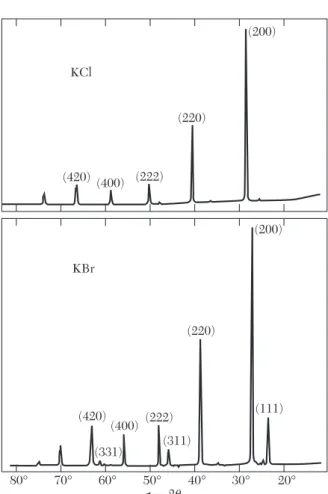
fj"4" ! dr nj(r)r2"Z , fj"4" ! dr nj(r)r2"sin GrGr . 42 (220) (220) (222) (222) (331) (400) (420) (311) (111) (400) (420) KCl KBr (200) (200) 2u 80° 70° 60° 50° 40° 30° 20°
Figure 17 Comparison of x-ray reflections from KCl
and KBr powders. In KCl the numbers of electrons of K#and Cl!ions are equal. The scattering
ampli-tudes f(K#) and f(Cl!) are almost exactly equal, so
that the crystal looks to x-rays as if it were a monatomic simple cubic lattice of lattice constant
a/2. Only even integers occur in the reflection indices
when these are based on a cubic lattice of lattice con-stant a. In KBr the form factor of Br!is quite
differ-ent to that of K#, and all reflections of the fcc
lattice are present. (Courtesy of R. van Nordstrand.) ch02.qxd 7/21/04 4:50 PM Page 42
C.IKi"el,IIntroducLonItoISolidIStateIPhysicsI(Wiley) SKCl= f (1+ e−πih+ e−πik+ e−πil)
= 0 (h, k, l : odd) 4 f (otherwise) ⎧ ⎨ ⎪ ⎩⎪ SKBr= fi i
∑
e−2πi hn( 1+kn2+ln3)= 0 (h, k, l : odd, even mixed) 4 f (otherwise) ⎧
⎨ ⎪ ⎩⎪