Building a New Graduation Thesis Registration and Retrieval System on the' Web
Sadahiko Nagae, Takashi Matoba Abstract
Under the existing graduation thesis retrieval system, a user searches on a library terminal for a thesis he or she wants to view. If the system finds it from a huge number of volumes in the library, it can be retrieved. However, if the system does not find the thesis in the library, the user must fill out a form indicating the title of the desired thesis, submit it to the library personnel, and pay the shipping charge in order to receive it. The entire process usually takes about a week. The system is not only time-consuming but also involves expenses.
The authors could hardly conceal the frustration and inconvenience caused by this University service that is quite out of sync with today's IT era. Therefore, the authors have tried to build a graduation thesis registration and retrieval system using Internet.
1. Introduction
The way information is exchanged changes in time. In old days, letters were used to exchange information. Some decades ago, telephones and fax machines became available. However, they incur both communication and personnel expenses. Communications by facsimiles also require unnecessary additional work, such as handling and sorting many sheets of paper output, as well as the need to rein put information to computers. As a solution to these problems, Electronic Data Interchange (EDI) was introduced to allow computers to exchange data via communications lines. Under EDI, data is exchanged in industry-prescribed for mat via dedicated lines or Value Added Networks (VAN). Standardized data makes it easy to incorporate data into databases. However, EDI has some demerits as well. The high cost of dedicated lines and VAN makes the introduction of EDI difficult. For this reason, the building of a system that uses TCP /IP, a standard protocol on the Internet, is under way at present. There is a so-called next-generation EDI language named Extensible Markup Language (XML). This is a general-purpose markup language on the Web. The system to be built at this time uses this XML.
2. Features of XML
XML has been developed by an XML working group organized in 1996 under the support of W 3 C. Since the language represents information by uniquely defining its elements and attributes, it is used to exchange and recycle informat ion in a growing number of fields. To begin with, XML is derived from a language called Standard Generalized Markup Language (SGML). SGML is a popular
Department of Electronic Systems and Information Engineering, Kinki University, Wakayama 649-6493, Japan
markup language used in the field of publishing a variety of information. The language had been widely in use even before it was standardized in 1986 by the ISO. As its features, documents are represented in text format without inserting any application-specific layout information, allowing users to define the tags they use. However, the difficulty in defining documents and its poor processing performance make it difficult to use SGML on the Web.
Hyper Text Markup Language (HTML) is another language that is derived from SGML. This language is easy to use and its installation is not so difficult.
Due to these characteristics coupled with its usability on the Web, the use of HTML has spread on the Internet at an explosive rate. However, despite its glory and handling ease, HTML does not offer enough functions to represent real data having a large number of structures. HTML provides the way in which Web pages maybe written but does not describe how to display data.
In brief, XML is a language that has the advantages of both SGML and HTML. In other words, the language can be used on the Web and users can define the tags they use. It is a language that makes use of all the sophisticated markup functions' of SGML with its only complex parts erased. Definition of tags is most important in understanding XML. Definition of tags provides information with meanings. For example, the words "~TffijI&iJ I O)=¥f5t)l't~" enclosed by element name "~lfB)(~" in Figure 1 are given a meaning by a word "~lfB)(~"
defined by the user. This allows both humans and computers to understand that
"~TffijI&iJ I O)=¥f3<jTt~" is the title of a essay Similarly, they also understand that
" 11\J!I
~*M" is the author of the essay. XML is simple structure. As a result,XML makes a good use of a various thing and uses in the word wide web .
.-hl.-.J • "1 0" ~ -"9ift ,",s"7)
"~AlJI VElI'SaF . ~UJUrF _
<ckx:urEnt>
~ ~~ ,5.J.)f.Jf'cf."'="~~7tft, ~'>~s~fa>
<:ft'
,5J,)f.Jf'cf.-"a~=t).~'>/J~~ ,5J,)f.J~J-"~~-r.t ~tA~.;·j'>-:?}VT)£T~
~1999<1~
<R)F)pdf/t.Est.pdf</FDF)
<B>~~~~J)O}*f.J~\
a:f=--
=*tI.JbOJ~s
Ir~~C1)J:5f :tcf.~-o,YJJ'o
~~ (I ckx:urEnt>
Figure 1: Example XML document
3. Overview of the Thesis Registration System
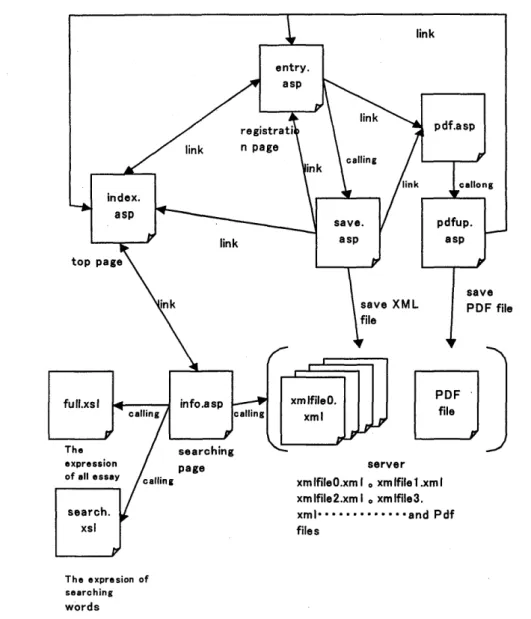
The overVIew of the registration and retrieval system is as shown in Figure 2.
full.xsl
The
search.
xsl
The expresion of searching
words
page
link
asp
save
PDF file
r-::l LJ
server
xm Ifile O.xm I 0 xm Ifile l.xm I xmlfile2.xm I 0 xmlfile3.
xml··· ·and Pdf files
Figure 2: Schematic representation of the registration and retrieval system At this time, arguments are explained as follows:
ASP : Acti veServer Page
XSL: Extensibel Style sheet Langage XML : Extensible Markup Language
Under the system the Internet Information server is used as the server and Microsoft Internet Explorer 5.0, which supports XML, as the browser. The
upload of PDF uses an addition component that called base21 (by Mr. Tatuo Baba). Note that all ASP, XSL, and XML files can only be created using Notepad.
The registration page (entry. asp) creates an XML document using a Document Object Model (DaM). This manipulates each node of XML documents generically.
After created, the document is saved by "save.asp." Entry.asp implements client processing while save.asp implements server-side processing. This processing can be achieved using asp. pdf.asp select pdf file for upload and it is saved by
" pdfup.asp"
Info.asp is the page to search for arid retrieve information. It reads multiple XML documents from the server into the memory to create one XML document.
For searching and sorting, XML documents read into the memory are processed and displayed on the client side.
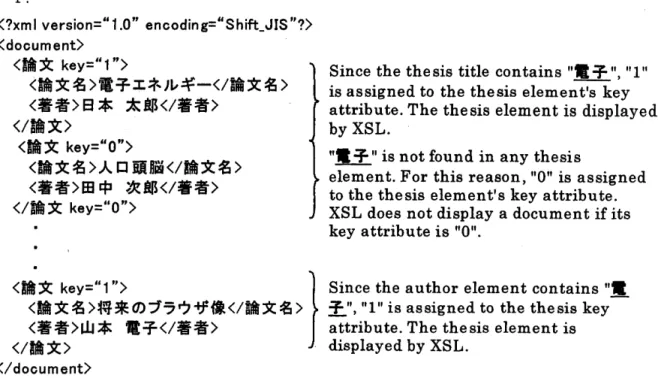
The search procedure begins with the acquisitiori of the XML document's element information. Next, using the Instr function of VBScript the system compares the acquired information against the information the system wants to know. If the information matches the key attribute created in advance in the XML document, the system assigns" 1 " to the key. If the information does not match, the system assigns " 0" to the key. Next, XSL is used to display the XML document. XSL displays only the XML documents whose key attribute is
1.
<?xml version=··1.0" encoding=··Shift_JIS"?>
<document>
<It
x
key=··1"><It
X
~ >.=r.r.*}v~-</Mx ~>
<~~> 8
* :tSB<I.=I>
</MX)
<ItJt key=··O")
<It
x
~> A
CJIIDi</ltx
~>
<.~>E8
tP
~SB<I.=I></Mx
key=··O"><MX key=u1"> }
<litix~ >~~*
(1):1"5'7
-ff"</M){~>
<fI~>L1J*
tI=r<lfI=I>
</ItX> .
</document>
Since the the sis title contains ".
=r ",
"1"is assigned to the thesis element's key attribute. The thesis element is displayed by XSL.
". =r"
is not found in any thesiselement. For this reason, "0" is assigned to the thesis element's key attribute.
XSL does not display a document if its key attribute is "0".
Since the author element contains ".
T ",
"1" is assigned to the thesis key attribute. The thesis element is displayed by XSL.Figure 3: Searching for contents containing "~r"
XSL is also used for sorting. This is a style sheet designed to provide specific functions for XML and to provide the browser with detailed information on how to display XML documents. XSL is equipped with an excellent sorting function to sort information that has been found. For example, a program as simple as
[Order by=" + author" ] can instruct the system to display author elements in ascending order.
At this time, XSL is explained briefly. One wonderful feature of XML and XSL is the separation of data from the representation procedure. Data in this sense indicates XML and the display procedure indicates XSL. This separation allows the data to be reused. Only necessary data is extracted and displayed by XSL.
For example, both search.xsl and full.xsl in this paper use the same XML document but their display procedures are different.
When creating a Web application, the primary concern of the creator is to create a lighter page. Being a type of style sheet, XSL can reduce the download time and the load of the server. In addition, XSL can be edited and manipulated with DOM since it is an XML document. Adding modifications to XSL allows the representation procedure to be modified at one time. This feature was utilized for sorting. Since processing is implemented on the client side, lighter sorting is implemented.
~ i;;v;affl !
"'···--·'····'~'Q::..}~iir··· ... , ..•.•..•. ,,_ .• ,,"
nSe:~ i. _if! ., ~~it ~ .ro-il.·
~~;~rJ.iJ;;.i!.l~·fu~~"!jJ:~~
~!~·~}~#.k{~t;t>,1L #~~~
,·zwJ:'\?I))!!Ify .. 1t#! 'J\IB~")'
~~~-"'~~;~~f
~¥.'.tjYf.:,:·;P)~$.!;: .. 1:11
~u
~,dJZ;1i%11 J!'4! ~~
WT~~I~, Et:i.b ).;+;.f-"1<-:;'''~$1~
. ;7')-:"I:tJV¥'"'*tt?tnj~, ;;J7.I't"1A.)j,~-1"
:)YJ\:£.G-!> ... ~:n~> 1~.A"'> ~.J:..1 •. I}"I!-(;:T·t>~
~~JNTi> • . ' ~G575.,ifl.(~~·t
'.T_~I~WJt\TJ.,t, I;;'du. ')tJ.ll)·»~I:Jf,~l:n1.
?>lJ'.lft;: .. .: f'ly.i'A).TfIl~ H;t~*>t'(J)J::':I'J '}::f.;jl.::(.;J!J'...,Tl.><.b'.
1I:T~~,~nd9.>
Figure 4 : Searching page
Figure 5 : Outlook of the real system
4. Problems and Considerations
This system uses DOM. Although it is essential for freely manipulating XML, DOM has a weakness as well. Its processing procedure reads an entire file and saves the tree structure in the memory. For this reason, when a huge XML document larger than the capacity of the memory needs to be handled, DOM may not be able to process completely. Although no investigation has been made yet on the limit of the thesis registration and retrieval system created at this time, it seems impossible to register a few tens of thousands theses existing worldwide. If all these theses are stored, it will be impossible for DOM to handle everyone of them. However, it is our opinion that narrowing down the theses by genre and then distributing them by Web applications can solve this problem.
Prior to the creation of this system, the authors have created a Web application using Access for the existing database. Compared with the Web application created using XML at this time, the previous application involved many cumbersome registrations, such as the registration of Open Database Connectivity (ODBC). In addition,. Access had to be purchased before we could use it. Compared with these demerits, XML does not require cumbersome settings or incur additional expenses since it can be freely used in the environment so long as IE 5.0 is installed. XML is advantageous in that anybody can create it, it is easy to use, and it does not cost anything.
Conclusion
In this paper, the authors have proposed a graduation thesis registration and retrieval system as an application and checked its usefulness. These results ascertain that the system is of practical use.
References
( 1) Natanya Pitts-Moultis Cheryl Kirk: XML Black book (the first volume) (the last volume), Ascii Ltd, 1999 (in Japanese)
( 2) Yoshihiro Yamada: Building a web application, Syuuwa Ltd, 1999 Cin Japanese)
( 3) Y oshihiro Yamada: Active Serve Page2.0 ,Syuuwa Ltd, 1998 (in Japanese) ( 4) Frank Boumphrey, Olivia Direnzo, Jon Duckett, Joe Graf, Paul Houle, Dave
Hollander, Trevor Jenkins, Peter Jones, Adrian Kingsley-Hughes, Kathy Kingsley-Hughes, Craig McQueen, Stephen Mohr: XML APPLICATIONS, Syuuei Ltd,· 2000 (in Japanese)
( 5) Michael Floyd: Building Web Sites with XML, Pearson Education Japan, 2000 (inJapanese)
(6) Nikkei BP. : "a struggle diary of web programming", Monthly Nikkei Soft Ware, 1999, pp 138-145 (in Japanese)
( 7) Ank Ltd: VB Script pocket reference, Gijyutu Hyouron Ltd, 1999 (in Japanese) ( 8) Mana Takahashi: starting Data Base, Nihon Jitugyou Ltd, 2000 (in Japanese) ( 9) Yasutaka Isono, Shiniti Kuramori : HTML Tag Reference, Natume Ltd, 1997
(in Japanese)
(10) Gijyutu Hyouron Ltd: "XML and E revolution", XML Press vol. 2 , 2000, pp.
32-51 .
(11) http://www.microsoft.com/japan/ developer/xml/ default. asp
m:tEO)$~~~::>tO)fi%:~~ ti" ~.tB""Cfi%: L" *$~~~~::>tiJ~tJ: tjnti'ftB*$~~l& tJ ~it G
~ t \ '3 v AT k ""C ~ Go L. n ~~ ti" -=FrE' ~ B~rE' ~ i5~iJ~iJ)iJ) G 0 *iiJf~""C ti L. n~~*j" G
t:~" InterNet ~;fljffl L t:$~~~::>tO)~~fi%: V AT k ~.~ L t:o
*f~~" Extensible Markup Language (XML) ~ t\ '3 §m~~1±§ L" L.n~fflt\t: Web
77°1) Jr-Va /'O)~~~~~t:o XML ti" Jtfff~~E35t""CfE~Lt:lm~il7
7"<
>~~~7>' 7"</
>""C Itt!~" i-0) Jtff¥~ ~~~"-* ~ ~ t: it Go i-0) *6~" ArE"~ ~ :J /' 1::0 .:L ->' -
,~ ~ Jtfff~~Iif[M~j"G L. ~iJ~""C~ Go i-O)-'-~tJ:~~t-9>;t" *f'~ WebJ:""CO)m~iJ~Mf;f~n" :f:*-'7 tJ: L. ~ ~~;fIJffl ~ n L"t\ Go*iiJf~-cti" $~~~::>tO)~~B~'~" ~~::>tJtff¥li~ XML 7 71 }v~~f*ffj"Go fi%:B~ti"
XML 7 71 }V~lPfljtfj L" j.:C I) J:""C*l~0) XML 7 71 }v~--::JO) XML 7 71 }v,~ i
~ ~ Go i-O)--::J'~ i ~ ~t: XML 7 71 }v~ 7 517 /' ~ ~ 1 p'""Cti{'F L" fi%:-? 'J - ~
~I!UJ:
c'
~fT --:> t:o 7° 0 7" 5 k § m'~ ti" ±,~ ActiveServerPage (ASP) ~ XML"Extensible Stylesheet Language (XSL)" Document Object Model (DaM)" VBSctript
~
±
~~ ffl t \ L"" mM 0) §I¥J
~jl L t:o L. 0) 1J#i:~ ~*ffE~~ 0) A -'7 iJ~ Web J: ""C" E3 ~I¥J
,~$~~~::>t 0) ~~ ~ ~fT L L" fT
<
L. ~ ~~ ~ tJ" t \"9 n ti*mf~ tJ: $~~::>tfi%: V A T k iJ~~~~ n G L. ~ ,~tJ: Go L. n G ti" ttt*O)tlo
<"
~~J¥t\
7'::".:L 7 }v~~R~ L t: tJ" ~{jffitJ: Jrffl ~iJ) t:r G L. ~ tJ:
<"
~~,~ 77 {? A iJ~t:lJ~~tJ: 7 I) - • r'J .J:. 7 'J 7 ~ r'J .J:. 70)*"
'y ~ ry - 7 fJ~iJ~~mj" Go