〔 Article 〕
A Proposal for an Online Tool to Encourage the Professional Development of EIL Teachers in Japan
Glen Andrew Stewart Darrin Mortson
Keywords
PD, professional development, pre-service training, in-service training, teacher training, JET programme, online tool, platform, pedagogical skills, teacher efficacy, teacher motivation, EIL, EFL, EPOSTL, J-POSTL
Abstract
This article presents the results of a small-scale action research project. The study focused on the design and development of an online tool for EIL teachers in Japan to help them to continue their professional development.
The two teacher-researchers (native-English speakers) conducting the study employed the online tool to support their peer-coaching process over a two-week period at their tertiary institution near Tokyo. Results indicate that the proposed peer-coaching framework and the online tool were useful in supporting the two teacher- researchers’ process, with both the autonomous knowledge-building and the peer-networking functionality of the online tool being identified as essential to that process. A six-step action plan was drawn up to organize the teacher-researchers’ efforts to finalize the online tool and introduce it to their fellow teachers at their institution and also more broadly.
Introduction
Research indicates that English teachers typically feel a need to continue their own professional development (PD) “regardless of their level of expertise and experience” (Johnston, Pawan, & Mahan-Taylor, 2013, p. 54).
Dunkley (1998) notes that such efforts to do so by professionals (not just English teachers) can be “periodic or even continuous” (p. 156). Yurtsever (2013) concurs, stating that “there is general agreement that learning to teach is a lifelong process ... there should be continuity” (p. 667). Maouche (2010) recommends that technology be incorporated into the PD training process in order to provide applicable structure and content, and further recommends that teachers create electronic teaching portfolios given the benefits (e.g. they foster critical self- reflection). With this in mind, what could facilitate EIL (English as an International Language) teachers in Japan needing to continue their PD is an online tool which could be used autonomously and/or as a support tool for on-site PD training and/or peer coaching, and whose design and functionality are based on the relevant literature. Such an online tool - with the level of comprehensiveness that the literature would deem necessary - does not yet seem to exist.
Literature Review
Why Teachers May Wish to Engage in Ongoing PD
Among the many reasons why EIL teachers in Japan may wish to engage in ongoing PD, there are three that
-2-
A Proposal for an Online Tool to Encourage the Professional Development of EIL Teachers in Japan
would seem to stand out: (1) teachers may need to, and could increase, their repertoire of pedagogical skills; (2) they could increase their teacher efficacy; and (3) they could increase their motivation.
Pedagogical Skills: Based on his review of the literature, Schalkoff (2014) points out that Japanese teachers of English in public schools in Japan often need both linguistic and pedagogical training and development.
In a study on the professional development of Japanese lower and upper secondary school EFL teachers in Japan, Kojima (2012) found that the participants in the 2011 Teacher Certification Renewal System (TCRS) program that he was conducting indicated needing to improve their approach to language teaching, the variety of skills that they employed, their classroom management, and the materials that they created (pp. 3-4). The results of a study by Igawa (2008) involving mostly secondary-school-level teachers (one was a tertiary-level teacher) in Japan and Korea (thirty-eight were non-native and six were native-English speakers) revealed that the teachers in that study perceived themselves to need teaching skills and methods, language improvement, communication skills, and motivation (p. 436). The above appear to largely correspond to the “good language teacher characteristics” offered by Brown (2007, p. 491, as cited in Winskowski, 2012, p. 16) which he grouped into four categories: technical knowledge, pedagogical skills, interpersonal skills, and personal qualities (see Kojima, 2012, also). Oga-Baldwin (2010, p. 212) makes the point that there are differences between teaching English at the tertiary level as opposed to the secondary school level, with tertiary-level teachers needing to focus on maximizing attendance (which may or may not be compulsory) and also on ensuring that they provide maximal lesson quality so that both learners and their parents are satisfied (since it is their parents that are more than likely financing their education). Taken together, the above would seem to confirm that self-assessment can help teachers to recognize aspects of their teaching that they may need to improve, including their pedagogical skills, and that the aspects to be drawn on in any specific teaching context may depend on that context.
Teacher Efficacy: Tschannen-Moran and Woolfolk Hoy (2001) reiterate that a teacher’s sense of efficacy has been linked to many positive teacher attitudes and behaviors (see their literature review, pp. 783-784).
According to Jie-Ying (2011) based on her review of the literature, teachers with high teacher efficacy: “have high expectations for their students ... set more demanding goals for their students ... are more skillful at classroom management” (p. 4), among other things. A recent study by Karimi (2011) would seem to confirm that PD opportunities for EFL teachers can positively influence teacher efficacy beliefs. He successfully employed in-service training, observation/assessment, development/improvement process, study groups, and mentoring to achieve this. Based on her review of the literature, Panfilio-padden (2014) concludes that “a teacher’s confidence in the ability to carry out a well-structured lesson requires time, reflection after lesson delivery, and practice developing teaching skills” (p. 16) and that “efficacious teachers seek to continuously improve in the instruction they provide to students” (p. 101). Jie-ying (2011) suggests that one way to enhance the teacher efficacy of tertiary-level English teachers is through mastery experiences. These involve the teacher achieving “mastery over a certain task through personal teaching experience” (p. 5). Taken together, the above would seem to confirm that there is considerable benefit to teachers maximizing their teacher efficacy and that it can be improved through PD (but that this may take time, in-service training, in-class experimentation, and/
or between-class reflection).
Teacher Motivation: Dornyei (2001, as cited in Lee, 2008, p. 140) provides four strategies that teachers can use to increase their motivation: (1) improve the motivation of their learners since this will in turn improve the teacher’s own motivation; (2) increase their commitment to their jobs and their learners; (3) build and maintain positive and trustworthy relationships with learners; and (4) engage in ongoing professional development.
Bier (2014) notes research by Kubanyiova (2009, as cited in, Bier, 2014) which would seem to confirm the importance of teachers envisioning their future teaching selves as a means through which to motivate themselves to continue their own PD (p. 514). There are also factors that can lead to teacher demotivation. According to Dornyei and Ushioda (2011), there are five general demotivating factors: “the particularly stressful nature of most teaching jobs”, “the inhibition of teacher autonomy” (because of set curricula, standardized tests, etc.),
“insufficient self-efficacy ... due to inappropriate training”, “content repetitiveness and limited potential for intellectual development”, and “inadequate career structures” (p. 168). Specific to tertiary-level teaching in Japan, Sugino (2010) found that learners’ attitudes and culture-specific factors (e.g. the fact that some Japanese tertiary-level learners sleep in class) can additionally be sources of demotivation. Taken together, the above would seem to confirm the centrality of ongoing PD to teacher motivation levels, that engaging in PD can further improve such levels, and that a lack of ongoing PD can, in fact, contribute to demotivation.
What a PD Training Program Should Incorporate
Previous research related to PD training programs for English-language teachers would seem to indicate that such programs should incorporate a number of key elements. In a review of the literature focused on the differences and similarities of the PD of public school teachers in Japan and in other contexts, Schalkoff (2014) argues that such programs should help teachers to improve their expertise and performance, that institutional development should form an integral part of such programs, and that needs assessment should precede and inform such programs. Igawa (2008) reminds us that the “professional development needs of EFL teachers are a function of their contexts” (p. 450). Panfilio-padden (2014) draws on the relevant teacher-efficacy literature to note the importance of collaboration among fellow teachers and a “collaborative school community” (p. 24) generally to help to build collective efficacy, which can then help to build student efficacy (p. 4). In a study focused on the professional identity and teaching practices of native-Japanese tertiary-level teachers in Japan, Nagatomo (2011) found that the most popular methods through which participants reported learning to teach English were “trial and error” and “from other teachers” (e.g. through asking questions, observing, etc.) (pp.
174-175). This would seem to call for PD training programs to incorporate in-class experimentation, after-class self-reflection, and collaboration. Beyond the above, the relevant literature would also seem to indicate that such programs could incorporate: “SMART” goals (see Miller, 2012) (i.e. goals which are specific, measurable, achievable, realistic/relevant, and timely/time-limited), teachers audio/video recording their own lessons for later retrospective self-analysis (Dodu, 2013), peer observation and feedback, and micro-teaching (Kamimura
& Takizawa, 2012), critical reflection on the metaphors a teacher uses to describe him/herself (Nagamine, 2012), and appropriation of pedagogical tools based on, and in collaboration with leaders at, the context in which they will be used (Kurihana, 2013).
Peer Coaching
In addition to the elements listed above, it would seem that peer coaching could be incorporated into PD
-4-
A Proposal for an Online Tool to Encourage the Professional Development of EIL Teachers in Japan
training programs given its advantages. Meng, Tajaroensuk, and Seepho (2013) found that their program, which incorporated peer coaching, seemed to facilitate professional knowledge and competence building. Using the Multi-layered Peer Coaching (MPC) model, they had teachers engage in peer coaching within the context of four-person teams (that is, 2 x 2 peers). According to Yurtsever (2013), peer coaching is a constructivist model and encourages knowledge construction through the teacher deciding what to focus on, what resources to use, and how long to work on a particular focus, and involves critical reflection and collaboration (see p. 668 for a review). It should be noted that teacher perception of, and their potential receptiveness to, this model may vary depending on the cultural context (Zepeda, Parylo, & IIgan, 2013). Further, Bang (2009) highlights the potential need for peer coaching to be organized and managed at the institutional level.
What a PD Training Program Should Avoid Doing
Previous research would also seem to indicate that PD training programs can suffer shortcomings. Ono and Ferreira (2010) note that many traditional PD programs may be “brief, fragmented, incoherent encounters” (p.
60) - and may not result in constructive change. Cho (2014) reminds us of the disconnect teachers may feel between the goals of a program and what they think they actually need for their L2 classroom (which should include addressing difficulties the teachers are having in the classroom). Panfilio-padden (2014) highlights the fact that a lack of time to pursue PD goals can mitigate improvement, and Knight (2007, as cited in, Panfilio-padden, 2014) emphasizes the importance of ongoing support for teachers so that they may continue to incorporate newly learned practices into their teaching beyond the end of the PD training program. In this vein, teachers in a study by Meng and Tajaroensuk (2013) indicated that, after having learned a new idea/practice from a seminar, they often returned to their former way of teaching because “there was no atmosphere for them to carry out what they had learned” (p. 1361).
EPOSTL and J-POSTL
It should be noted that a PD tool exists for language teachers in Europe, the European Portfolio for Student Teachers of Languages (EPOSTL). It is a paper-based tool and comprises a personal statement, a 195-item
“can-do” self-assessment, a dossier for providing evidence of one’s PD, a glossary, an index of terms, and a users’ guide (see Newby et al., 2007). CAKIR and balcikanli (2012) report on their attempt to incorporate this tool into their training program, and in so doing, recommend that it be converted to an online tool. They argue that it “should be seen as a reflection tool that enables teachers and teacher trainees to evaluate themselves in terms of certain competencies” (p. 5). In their study, they note that pre-service teachers considered the tool to be: (1) useful for improving their awareness of teaching skills and strategies and the strengths and weakness of their teaching; and (2) something that contributed to improvements in their classroom practice. Teacher trainers considered the tool to be useful for encouraging teacher self-reflection and self-assessment, sharing opinions, getting feedback, and learning more about language teaching. They also note that the tool did not replace their existing training program, but supplemented it. In Japan, a contextualized version of the EPOSTL, the J-POSTL, is being developed for use with pre- and in-service Japanese teachers of English. Hisamura (2014) reports on efforts to contextualize the document so that it is appropriate for the Japanese teaching context. He notes that the coordinators of those efforts are concerned with making the portfolio “user friendly”, “more accessible”, and “less time-intensive for users” (p. 13).
PD Training Supported by an Online Tool
What follows is a summary and a synthesis of the literature reviewed above in regards to PD training. First of all, PD training should aim to help teachers to take on more “good language teacher characteristics” and develop their pedagogical skills. It should also aim to help teachers to maximize their teacher efficacy and motivation given the benefits to their own in-class behavior, learner motivation, and learner outcomes. Further, it should aim to help teachers to build their expertise and improve their performance and also to make contributions towards improving practice at their institutions. In addition, it should be individualized and contextualized, and should also include a collaborative element (and this could take the form of team-based peer coaching).
Moreover, it should ensure a strong connection between the overall goals of the training program and teachers’
real-life teaching needs. Finally, it should provide teachers with the time and institutional support that they need to maximally benefit from the training.
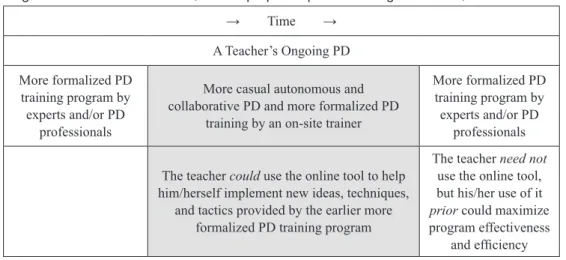
For the purposes of the current study and the online tool, “PD training” above may refer to all training types - more casual autonomous self-training and collaborative peer coaching, and also more formalized training programs initiated and managed by an institution and conducted by either its on-site trainer(s) or experts/PD professionals brought in to conduct on-site training seminars and certification renewal programs (these might also be conducted off-site). A central question relevant to the current study is: What role could an online tool play within the scope of such training? It is proposed that such a tool aim to provide structure, content, and functionality to support as much of what appeared in the summary and synthesis above as possible. The tool as it is primarily aims to support the more casual PD training types listed above. It also aims to support more formalized ongoing PD training conducted by on-site trainers (e.g. at an English-language school).
Given the aims of the online tool, it is proposed that it help teachers to:
1. take on more “good language teacher characteristics”;
2. add to their repertoire of pedagogical skills;
3. create and maintain a description of their vision for their future teaching self;
4. maximize their sense of teacher efficacy by providing content and functionality that encourages them to do things such as engage in critical self-reflection and achieve mastery over a range of tasks;
5. maximize their motivation by providing content and functionality that helps them to apply the four strategies outlined by Dornyei (2001, as cited in Lee, 2008) earlier, including improving the motivation of learners and building and maintaining positive and trustworthy relationships with learners;
6. ameliorate their demotivation by providing content and functionality which helps them to tackle sources of demotivation, such as negative learner attitudes;
7. have successful and rewarding autonomous PD self-training experiences;
8. gain access to quality evidence-based content to help them to increase their knowledge, and improve their skills and performance by providing functionality which encourages them to set goals and achieve them, and also have mastery experiences;
9. ensure that there is a strong connection between their PD goals and their real-life teaching needs;
10. problem solve and share ideas, techniques, tactics, and materials with other teachers working in similar teaching contexts around Japan, and have their on-site peer-coaching efforts supported by them being able
-6-
A Proposal for an Online Tool to Encourage the Professional Development of EIL Teachers in Japan
to connect with their peers using the online tool for the purposes of information, file, and link exchange, and feedback giving;
11. connect with their on-site trainer using the online tool and receive individualized feedback and support; and 12. make contributions towards improving practice at their institutions by providing functionality to help them
to collaborate with their peers.
Method Phase I
Design and Development of the Online Tool
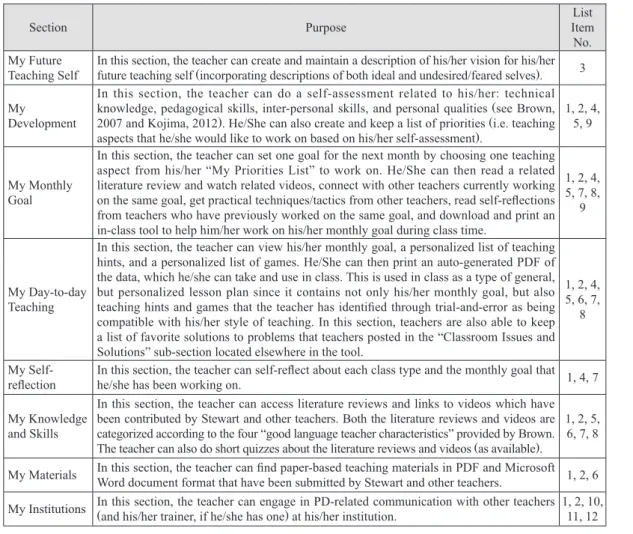
Following a similar method to that which he followed for Stewart (2015), Stewart drew on the summary and synthesis on the previous page to design the online tool. The tool was further updated in process (i.e. as the study progressed) based on feedback from Mortson. The completion of that process resulted in the tool incorporating the following sections with the following purposes:
Table 1: Sections included in the design of the online tool
Section Purpose List
Item No.
My Future
Teaching Self In this section, the teacher can create and maintain a description of his/her vision for his/her future teaching self (incorporating descriptions of both ideal and undesired/feared selves). 3 My Development
In this section, the teacher can do a self-assessment related to his/her: technical knowledge, pedagogical skills, inter-personal skills, and personal qualities (see Brown, 2007 and Kojima, 2012). He/She can also create and keep a list of priorities (i.e. teaching aspects that he/she would like to work on based on his/her self-assessment).
1, 2, 4, 5, 9
My Monthly Goal
In this section, the teacher can set one goal for the next month by choosing one teaching aspect from his/her “My Priorities List” to work on. He/She can then read a related literature review and watch related videos, connect with other teachers currently working on the same goal, get practical techniques/tactics from other teachers, read self-reflections from teachers who have previously worked on the same goal, and download and print an in-class tool to help him/her work on his/her monthly goal during class time.
1, 2, 4, 5, 7, 8,
9
My Day-to-day Teaching
In this section, the teacher can view his/her monthly goal, a personalized list of teaching hints, and a personalized list of games. He/She can then print an auto-generated PDF of the data, which he/she can take and use in class. This is used in class as a type of general, but personalized lesson plan since it contains not only his/her monthly goal, but also teaching hints and games that the teacher has identified through trial-and-error as being compatible with his/her style of teaching. In this section, teachers are also able to keep a list of favorite solutions to problems that teachers posted in the “Classroom Issues and Solutions” sub-section located elsewhere in the tool.
1, 2, 4, 5, 6, 7,
8
My Self-
reflection In this section, the teacher can self-reflect about each class type and the monthly goal that
he/she has been working on. 1, 4, 7
My Knowledge and Skills
In this section, the teacher can access literature reviews and links to videos which have been contributed by Stewart and other teachers. Both the literature reviews and videos are categorized according to the four “good language teacher characteristics” provided by Brown.
The teacher can also do short quizzes about the literature reviews and videos (as available).
1, 2, 5, 6, 7, 8
My Materials In this section, the teacher can find paper-based teaching materials in PDF and Microsoft Word document format that have been submitted by Stewart and other teachers. 1, 2, 6 My Institutions In this section, the teacher can engage in PD-related communication with other teachers (and his/her trainer, if he/she has one) at his/her institution. 1, 2, 10,
11, 12
Screenshots of some of the above sections are provided later in this article. It may make sense to look ahead at those screenshots now before reading on.
Does the design of the online tool address the theoretical and practical issues outlined earlier?
It would seem to begin to do so. Care was taken to design the tool so that teachers would be able to use the tool to do each of the twelve things in the previous list. For example, item one in that list relates to the tool helping teachers to take on more “good language teacher characteristics”. Most sections of the tool should contribute to this, including the “My Development” section (using which teachers do a self-assessment related to those characteristics) and the “My Monthly Goal” section (using which teachers set working on one characteristic as their goal for the month and access related resources). See the “List Item No.” column in Table 1 to see which sections of the tool have been designed to help teachers to achieve each item in the list.
It should be noted that, in a study by Yukawa (2014), a number of novice/recently graduated Japanese- native secondary-school-level teachers in Japan indicated that an “online archive of teaching materials” and an
“online conversation site to consult with others on their problems” (p. 112) could be useful in supporting their ongoing PD. The “My Day-to-day Teaching” and “My Materials” sections could be useful to such teachers given their functionality. Yukawa notes that teachers also indicated a desire to maintain contact with their universities, their professors, and their former fellow classmates. This may indicate that a new section, perhaps named “My Education”, should be added to the online tool to provide such an affordance.
Phase II
This phase of the study was focused on assessing the effect that using a working example of the online tool would have on the two teacher-researchers’ pedagogical skills, teacher efficacy, and motivation (with the main focus being on the second teacher-researcher, Mortson).
Theoretical Framework and Overall Research Design
The theoretical framework employed in Phase II of the study is grounded in the existing literature on teacher professional development (see e.g. Brown, 2007; Johnston, Pawan, & Mahan-Taylor, 2013; Kojima, 2012), teacher efficacy (see e.g. Jie-Ying, 2011; Tschannen-Moran & Woolfolk Hoy, 2001), teacher motivation (see e.g. Bier, 2014; Lee, 2008; Dornyei & Ushioda, 2011), and peer coaching (see e.g. Bang, 2009; Meng &
Tajaroensuk, 2013; Meng, Tajaroensuk, & Seepho, 2013; Yurtsever, 2013).
According to Creswell (2012), “action research provides an opportunity for educators to reflect on their own practices” and such research “offers a means for staff development, for teachers’ development as professionals” (p. 577). The study originated out of Stewart’s desire to create an online tool that teachers could use to continue their PD. After telling Mortson about it and his hopes for it, both teacher-researchers decided to assess the usefulness of a working example of the tool for continuing their own individual PD efforts within the context of peer coaching at their tertiary institution. It was based on this that the teacher-researchers determined that an action-research design would be the most natural fit. The practical, context-based issue to be solved in this case was how to encourage our own ongoing PD and that of other teachers to benefit our learners and our
-8-
A Proposal for an Online Tool to Encourage the Professional Development of EIL Teachers in Japan
institution. It would also provide: (1) the context within which to test out new ideas in a collaborative trial-and- error manner; and (2) opportunities to engage in self- and collaborative reflection. Both of these seem to be central to action research. Mills (2011, as cited in, Creswell, 2012) cautions that action research “is a model for teachers to use to study themselves, not a process of conducting research on teachers” (p. 580). On this point, though both teacher-researchers participated in the study, Mortson took on the role of “online tool end-user”
and viewed his use of the tool from within this prism. This was done to ensure that the teacher-researchers’
analysis of the usefulness and effectiveness of the online tool and its place within the proposed peer-coaching framework would be as balanced and as reality-based as possible and that Mortson would be able to speak to the classroom-based needs of teachers. This should be kept in mind when reading the Results and Discussion section that soon follows.
Participants and Context
Being action research, the two teacher-researchers of the current study were also the two participants in Phase II of the study. Both were employed as part-time teachers at a university just outside Tokyo. The first participant was male, 40 years old, and Australian. The second was male, 44 years of age, and Canadian. The first had been working at the tertiary level in Japan for more than a year (and prior to that, at the secondary-school level).
The second had been working at the tertiary level in Japan for more than seven years. At their institution, the two teachers were responsible for a variety of class types, including CALL classes, reading, writing, and speaking classes, and oral-communication classes. The private university which provided the context for the current study was situated approximately forty-five minutes from Tokyo. The study was conducted in the Faculty of International Studies. The faculty employed a number of native- and non-native English teachers part time to conduct a large number of its English-related courses. These teachers ranged in age from 35 to 70. In order for native-English speakers to be able to teach in the faculty, they needed to have completed or be currently working towards the completion of a master’s degree with a specialty in applied linguistics, TESOL, international relations/inter-cultural studies, or a related field. As for PD training, no formalized policy related to teachers continuing their PD was at that point in effect (which is typical at this level of the education system where teachers are expected to be professional, self-reliant, responsive to the demands of the job, and responsible for maintaining and further building their qualifications and pedagogical skills). However, the university did have students complete course evaluation questionnaires at the end of each term, with the results of these being provided to teachers in a report format within the first few weeks of the next teaching term. This report was comprehensive and could be used by teachers to identify aspects of their teaching that they could aim to improve.
Procedure
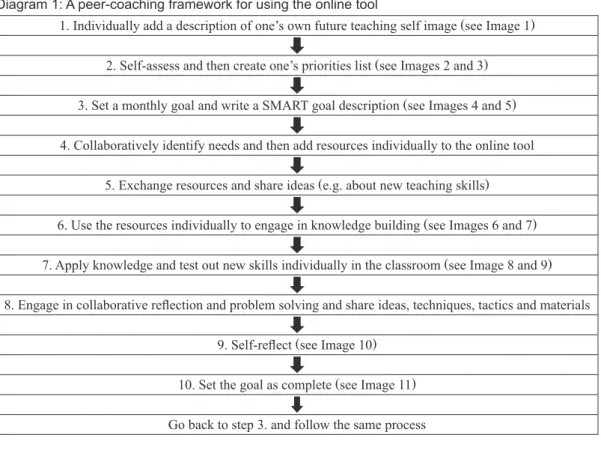
Schalkoff (2014) advocates viewing PD through a human-resources development (HRD) lens and employing an HRD process of analyzing, designing, developing, implementing, and evaluating to aid teachers in their efforts to improve both expertise and performance. Stewart followed the above process when developing a framework for how the online tool would be used within the context of peer coaching. This process resulted in the development of the following framework:
Diagram 1: A peer-coaching framework for using the online tool
1. Individually add a description of one’s own future teaching self image (see Image 1) 2. Self-assess and then create one’s priorities list
⬇
(see Images 2 and 3) 3. Set a monthly goal and write a SMART goal description⬇
(see Images 4 and 5) 4. Collaboratively identify needs and then add resources individually to the online tool⬇
5. Exchange resources and share ideas (e.g. about new teaching skills)
⬇
6. Use the resources individually to engage in knowledge building
⬇
(see Images 6 and 7) 7. Apply knowledge and test out new skills individually in the classroom⬇
(see Image 8 and 9) 8. Engage in collaborative reflection and problem solving and share ideas, techniques, tactics and materials⬇
9. Self-reflect
⬇
(see Image 10) 10. Set the goal as complete (see Image 11)⬇
Go back to step 3. and follow the same process
⬇
The following are screenshots that indicate how the online tool would be used according to the above framework:
Image 1
-10-
A Proposal for an Online Tool to Encourage the Professional Development of EIL Teachers in Japan
Image 2
Image 3
Image 4
Image 5
-12-
A Proposal for an Online Tool to Encourage the Professional Development of EIL Teachers in Japan
Image 6
Image 7
Image 8
Image 9
-14-
A Proposal for an Online Tool to Encourage the Professional Development of EIL Teachers in Japan
Image 10
Image 11
How the Framework was Used in the Current Study
In their study, Meng, Tajaroensuk, and Seepho (2013) brought in an “external expert” (p. 24) to update the teachers on the current developments in the field of TEFL. In the current study, however, the two teacher- researchers jointly took on this responsibility themselves, with each preparing resources (literature reviews, links to videos, etc.) to provide to the other teacher. Further, and in line with Yurtsever (2013), it was the individual teacher-researcher who decided which resources provided to him that he would use. In addition, it should be noted here that though classroom observation may typically be incorporated into peer-coaching models (see e.g. Bang, 2009), it was not incorporated into the current study given time constraints. However, classroom observation could be incorporated within the framework outlined earlier (perhaps as part of step 7).
After Stewart had developed the framework and Mortson had reviewed it and agreed on its applicability, the two teacher-researchers then employed it to govern their use of the online tool. They followed each step of the framework. Across the four weeks of the study, the first week was used to finalize the details of the study.
Over the following two weeks, the teacher-researchers used the online tool and the in-class tool to help them to work on their monthly goal both in and outside of class (for simplicity’s sake, both teacher-researchers decided to choose the same teaching aspect to be their monthly goal: “2.1 I always maintain good rapport with the learners to maximize cooperation.”). The teacher-researchers then met once weekly (twice weekly at most) to help each other to reflect on their practice, share ideas, techniques, tactics and materials, and solve problems.
It should be reiterated that earlier versions of some pages of the online tool were used during this time, with Stewart updating some pages in process based on Mortson’s feedback (for example, the priorities list was added as an intervening step between doing one’s self-assessment and setting a monthly goal; that being the case, neither teacher-researcher created such a list for the purposes of the current study, but both agreed that including it as part of the framework, and including updated screenshots of what the section looks like, was important). It should also be noted here that it was not possible for the teacher-researchers to work on their monthly goal for a full month given time constraints. In the final week, the two teacher-researchers collected, analyzed, and interpreted the data, and finally, drew up the action plan.
The In-class Tool
In order to apply the new knowledge and ideas that they had gained using the online tool to their classroom practice, the teacher-researchers would need a paper-based tool with which to plan before class, monitor and make decisions during class, and self-reflect after class. Bier (2014) did a review of the literature related to teacher cognition, affect and motivation and also that related to the influence of context. She confirmed the importance of teachers self-reflecting both during class - “reflection in action” - and also after class - “reflection on action” (p. 515).
As mentioned earlier, Jie-ying (2011) suggests that one way to enhance the teacher efficacy of tertiary- level English teachers is through mastery experiences. These involve the teacher achieving “mastery over a certain task through personal teaching experience” (p. 5). Mastery (i.e. the teacher’s efforts are judged as successful by him/herself as a result of learner outcomes and learner feedback) leads to increased teacher efficacy, and failure leads the teacher to try harder in order to eventually master the task. According to the
-16-
A Proposal for an Online Tool to Encourage the Professional Development of EIL Teachers in Japan
literature that Jie-ying cites, mastery also helps the teacher to gain practical knowledge, specifically knowledge of instruction and knowledge of context (p. 5). The teacher can then draw on this practical knowledge when preparing for and teaching future classes. One goal of using this in-class tool was, therefore, to help the teacher to plan to have, and have, a number of mastery experiences relevant to his chosen monthly goal in class in order to increase both his practical knowledge and his teacher efficacy. It is hoped that such experiences would also increase his repertoire of pedagogical skills and his motivation while also decreasing any demotivation.
Richards (1998) has identified six domains of second-language-teacher education. One that is of particular importance in this step of the current study is pedagogical reasoning and decision making. According to Richards, this involves “interactive decisions”, which are those that are made during the course of a class based on the dynamics of the class up until that point in the class. Such decisions involve four components. They are, in his words, (p. 11): (1) “monitoring one’s teaching and evaluating what is happening”; (2) “recognizing that a number of different courses of action are possible”; (3) “selecting a particular course of action”; and (4)
“evaluating the consequences of the choice”. An additional goal of using this in-class tool was, therefore, to help the teacher to improve his interactive decisions as they related to his chosen monthly goal.
Li and Wilhelm (2008) cite literature which reminds us that in order for teachers to change their behavior, they need to change their beliefs first (p. 100). Further, for beliefs to change, the teacher needs to see evidence of a change in learner outcomes. A further goal of using this in-class tool was, therefore, to help the teacher to self-reflect on any changes in learner outcomes that were produced by the specific behaviors he engaged in related to his chosen monthly goal and also what new beliefs he might take on as a result.
Based on the above, the in-class tool consisted of two A4-sized sheets of paper. On the tool, the teacher- researcher was able to write the class type, the date, the day of the class, the time of the class, the monthly goal, the specific details of what he would apply and how, the interactive decisions he made, and the perceived outcome for learners and the self-perceived change in belief(s) that may result in the future. The teacher- researchers then used this tool in each class during which they wanted to work on their monthly goal. The teacher-researchers were able to access this document in the “My Monthly Goal” section of the online tool (see Images 8 and 9).
Data Collection and Analysis
The study employed three types of data collection: (1) the audio recordings of discussions had by the two teacher-researchers when they met at least once weekly over the course of the study; (2) the in-class tool (several completed copies from each teacher-researcher); and (3) the data the teacher-researchers added to the database of the online tool through using the online tool. It should be noted that though the audio recordings were not transcribed given the length of each recording, comprehensive notes of the main points in each recording were made. Further, our discussions incorporated reflection on the completed copies of the in-class tool (data type (2) above). Both teacher-researchers kept a copy of all data types.
Results and Discussion
Analysis of the comprehensive notes taken from the audio recordings led to a number of themes being developed. What follows are: (1) Mortson’s reflections on the notes taken from the audio recordings and also his experiences over the course of the study generally; and (2) Stewart’s reflections on these, the data added to the database of the online tool by Mortson, and the possible implications for the relevant literature.
The Benefits Derived from Engaging in PD within the Context of Peer Coaching
Mortson: During the process, the time set aside for active self-reflection was entirely beneficial. The engagement in the practice of self-reflection alone increased my confidence to deliver optimum lessons. It seems like a very simple point that there is great value in reflection, yet teachers do not generally take the time to do this. Time is limited for many teachers, but the practice of self-reflection is not excessively time-consuming. It is extremely valuable, in my opinion, for teachers to both motivate themselves and their peers to self-reflect. As mentioned previously, a particularly constructive part of this study for me was the opportunity to regularly discuss this practice of reflection with Stewart. Both autonomous self-reflection and mutual reflection and discussion are essential facets of the process. A third facet - working on this article together - was also extremely motivating, although it is understood that this would not be the usual experience of the online-tool user. Given that teachers learn a considerable amount about the actual practice of teaching through a process of trial-and-error in the classroom and through consultation with other teachers, actual face-to-face meetings with our peers is crucial for PD. It is through these meetings that we may come to increase our motivation and improve both pedagogical and communicative skills. While autonomy in teaching is certainly necessary, peer discussion and coaching are themselves non-interfering with autonomy, and at the same time they help to mitigate potentially demotivating actualities of the profession. Peer collaboration at this level, then, is highly desirable and it is clear that this could be facilitated through the use of an online tool.
Stewart: Morton’s comments above confirm what Panfilio-padden (2014) notes about teachers needing time and after-class reflection. Mortson seems to have been reminded of the value of self-reflection and seems eager to continue to draw on it as a PD tool. In the “My Self-reflection” section of the online tool, Mortson added the following: “I need to remember to keep being patient and positive with these students. At one point a student, who I had half-identified as a being a potential “problem,” approached me at lunch outside of class and wanted to speak with me. I realized that what I had evaluated as being a “bad attitude” was a genuine lack of current ability to speak English. But, more importantly, the encounter signaled this student’s willingness to improve and to get along. I need to remember to not prejudge the attitudes or the motivations of all of my students.
Doing simple things, like remembering names and smiling and actively trying to include, is very effective.”
Having just dealt with the learner, Mortson is sure to have self-reflected in the moment, potentially started a process of belief change, and committed himself to approaching such learners differently in the future through modified in-class behavior. By spending time later to write/type out a self-reflection, he was able to keep a more permanent record of the experience which can be drawn on in the future. In their study, Meng and Tajaroensuk (2013) found that the teachers in their study (EFL teachers at a tertiary institution in China) thought that it was important for teachers to engage in in-service PD on a regular and ongoing basis. They also indicated a preference for collaboration and teamwork in such training. The findings of the current study would seem to
-18-
A Proposal for an Online Tool to Encourage the Professional Development of EIL Teachers in Japan
confirm this. Mortson’s comments above indicate a desire to collaborate face-to-face with other teachers at his institution to help him to improve his practice. He clearly has a keen sense of the value of such collaboration.
However, time constraints may limit his ability to engage in this. Mortson has identified two aspects of PD that are essential - self-reflection and collaboration with peers. Aside from facilitating teachers in their efforts to engage in these two aspects of PD, the online tool has the additional goal of providing teachers with easier access to the literature (with ongoing engagement with the literature being a third aspect). It is hoped that this aspect could help to inform and facilitate the two other aspects. Panfilio-padden (2014) reminds us about the importance of building collective efficacy given its potential positive effect on learner efficacy. Mortson’s comments would seem to indicate that, if all teachers at the teacher-researchers’ institution were to engage in the same process and respond in a similar way, the proposed peer-coaching framework and the online tool could be effective in helping to build collective efficacy at the institution.
The Online Tool
Why the Online Tool is Needed
Mortson: Teachers currently receive feedback on their teaching through information gleaned from end-of- semester student surveys, and while this is helpful, it is also limited in nature. The university may be sufficiently pleased with our ability to satisfy the needs of students as customers of the institution, but this does not really provide a baseline from which to judge effective teaching. This may not be the institution’s responsibility to provide, and in fact, such a top-down evaluation system may not be desired, but a means by which teachers could self-evaluate would be extremely helpful. The online tool could provide this baseline to judge our own abilities.
Stewart: As noted earlier, institutions at this level of the education system typically expect teachers to be self- reliant and responsible for further building their own qualifications and pedagogical skills. The same could be said for building and maintaining their own motivation levels. As Dornyei and Ushioda (2011) note, however, there are real sources of demotivation in any teaching context. Though “inhibition of teacher autonomy” is one,
“insufficient self-efficacy ... due to inappropriate training”, “limited potential for intellectual development”, and “inadequate career structures” (p. 168) are others. Mortson’s comments above would seem to indicate that the online tool could be used to provide teachers with a system for self-assessing and continuing to build their pedagogical skills, and this may indirectly help teachers to ameliorate their demotivation related to the sources cited above. Further, Mortson’s comments above would seem to speak to what Hisamura (2014) notes about the J-POSTL needing to be more accessible. That is, like Mortson, native-English-speaking teachers in Japan may recognize the benefit of such self-assessment tools, but currently, their ability to access such tools may be limited, for any number of reasons.
Priorities and Goals
Mortson: During our discussions, I questioned the need, although possibly advised by the literature, for working on only one goal per month. It is a given that different classes challenge teachers in different ways. If teachers were enabled, through application of the online tool, to undertake a sort of pre-assessment period in which teachers could generate and then set a plurality of priorities, this need not confuse or hamper the overall aim of
professional development. Many of the 54 aspects have overlapping facets that might facilitate a multi-priority approach, and pursuing different priorities also increases the possibility of forging links with other teachers working on similar priorities.
Stewart: According to Shen’s (2011) review of the literature, teacher autonomy refers to the teacher’s ability to improve his/her teaching through applying effort and also to the teacher being self-directed and free from control. This seems to have been reflected in Mortson’s comment that he would prefer to work on multiple priorities at once rather than just one. This means that teachers may need to be given considerable autonomy regarding how they use the online tool. Several factors may limit this, however, including the need for the online tool to reflect the relevant literature and also practical considerations, such as budgetary constraints.
Now that the “My Priorities List” section has been added, the process for working on one specific priority/goal is likely to be: choose a priority to be a goal, read the related literature review, watch related videos, read the techniques/tactics, read the self-reflections provided by other teachers, use the in-class tool in class, apply any new knowledge in class, self-reflect, collaborate with other teachers, do more reading and/or video watching, apply any additional knowledge in class, self-reflect, and set the goal as fine for now (but potentially still a priority). Given the amount of time and focus that it will take to complete this process, many teachers may choose to set just one priority as a goal and work on that goal only for a certain length of time and across all class types. Currently, teachers need not work on a goal for a full month. They can set the goal as complete and set a new one after any length of time has passed. Given this, “My Monthly Goal” may be updated to be
“My Current Goal”. The design of this section could be further updated by allowing teachers to set a different goal for each different class type. I have found, however, that I experience the same issues no matter the class type - e.g. my still-developing ability to consistently give clear, concise instructions; this is something that the
“My Self-reflection” section of the online tool has highlighted to me. As part of setting his monthly goal for the purposes of the current study, Mortson was asked to add a description of what he was going to do to help him to improve the related teaching aspect (i.e. rapport-building). His description included being more patient with learners when they take a long time to answer questions, making an effort to remember learner names, and a resolve to always be cheerful, encouraging, and generous with his time and knowledge. It is unclear as yet if it would be possible for him to work on multiple goals with such descriptions all at once, however. If it is, then ideally the online tool should provide an affordance for that. In this way, autonomy could be maximized and teachers could be provided with the ability to use the online tool in as individualized a way as possible.
However, there are budgetary and technological constraints. Given the above, further research is needed to: (1) finalize the design of the online tool so that it supports the PD process that a majority of teachers may wish to engage in (taking into account the aforementioned constraints); and (2) ascertain what the most pedagogically responsible approach to using the online tool is likely to be based on the relevant literature. The goal then would be to seek to balance the two.
For Peer Coaching and Peer Networking
Mortson: One benefit of the online tool is that it can enable and inspire both individual teachers and peer- coaching groups to work autonomously alongside the tool. This is in no way a drawback or limitation of the online tool. If the process of self-reflection that it initiates encourages teachers to continue with this not only via
-20-
A Proposal for an Online Tool to Encourage the Professional Development of EIL Teachers in Japan
the online tool, but also via paper-based or other media, then this is also a positive outcome. The social aspect of the online tool appears, for me, to be essential. As mentioned, a particularly constructive part of this study was our weekly discussions and collective reflections on our progress. The online tool, in this way, has two primary uses. The first fosters autonomous self-development and self-reflection, and the second - and for me the more important - use is as a peer-networking platform. The online tool could be effectively utilized for collective problem solving, for the sharing of literature and other resources, and for the building of peer motivation.
Stewart: The above would seem to indicate that the “My Self-reflection” section of the online tool could be of central importance to the usefulness of the tool itself and to teachers. Whether or not teachers type out a self-reflection in the online tool and save it there - or simply write out such self-reflections in a dedicated PD notebook - will depend on the individual teacher. One benefit of using the online tool for such a purpose is that teachers could choose to have their self-reflections display to other teachers in the “My Monthly Goal” section of the online tool. Perhaps by reading the thoughts and feelings of other teachers in similar situations, teachers may find inspiration, comfort, and/or new ideas, techniques, and tactics. As noted earlier, Yurtsever (2013) points out the centrality of the teacher deciding what to focus on, what resources to use, and how long to work on a particular focus, and him/her engaging in critical reflection and collaboration as part of peer coaching.
Mortson’s comments above would seem to indicate that this may extend to the online tool. That is, he may decide to work the peer-networking functionality of the online tool into his peer-coaching process. However, it seems clear that he considers the online tool a support, with face-to-face collaboration being considered the defining feature of peer coaching for him (which I concur with). In this way, one existing feature of the online tool that may be considered peer-networking functionality is the “Practical Techniques/Tactics” sub-section in the “My Monthly Goal” section (see Image 12). This affords the teacher the ability to add techniques/tactics for helping a peer (and also other teachers using the online tool) to work on his/her monthly goal, which the teacher can then also draw on during a peer-coaching process. Drawing on data from the 2013 OECD Teaching and Learning International Survey (TALIS), Schleicher (2015) reports that “the more frequent the participation in collaborative practices, the greater the teachers’ sense of self-efficacy” (p. 54). The data that this is based on is from lower-secondary-school level teachers (of any subject type) across all TALIS countries, including Japan.
This would seem to confirm Mortson’s point regarding how constructive collaboration is to one’s process and one’s PD. Meng and Tajaroensuk (2013) remind us of the importance of teachers having a constructive atmosphere for testing out new ideas/techniques/tactics learned in a PD training program after the program concludes. From Mortson’s comments above, it would seem that the proposed peer-coaching framework and the online tool could be effective in helping teachers to co-create such an atmosphere (with the advantage being that the “training program” in this case essentially never concludes since use of the online tool within the context of the proposed peer-coaching framework can be ongoing). Contrary to Bang (2009), it may not be necessary for peer coaching to be organized and managed at the institutional level. At least at the two teacher- researchers’ institution, it should be possible for the teachers themselves to do so.
Image 12
The Need for the Online Tool to be Accessible and Welcoming
Mortson: As the online tool is at least partially designed to be social, to enhance and facilitate peer-coaching, its success, like all social media, is dependent on a fairly high level of participation. If very few teachers are actually using it, it loses a substantial part of its intended function. A concern, then, would be that the tool be both accessible and welcoming for teachers who may have limited exposure to the relevant literature, and to simultaneously attract and be helpful to teachers who would be more inclined to use the tool to widen their existing knowledge of the current literature. Ultimately, it is hoped that the former group, who perhaps would be drawn to the online tool because of its social media applications, would be then more apt to take additional interest in the available literature. I also raised the point that the self-assessment process, incorporating 54 teaching aspects gleaned from the literature, itself presupposes a background in the literature. For example, the teaching aspect “2.2 I use silence effectively to refocus attention on myself as a teacher.” implies prior knowledge of this teaching technique. This presupposed background in the literature may be of only partial concern, as the sense of each of the 54 aspects including the above can be intuitively grasped or obtained from other users of the tool, but it reflects the need for the tool to be as inclusive and as jargon-free, as possible.
At any rate, it would be possible to engage with the tool at a deeper level where users would be able to both begin and increase their familiarity with the current literature and its terminology. Different teachers will, of course, assess themselves differently, according not only to perceived teaching strengths and weaknesses in an objective sense, but also according the singular personality of the teacher. I tended to mark myself low because I felt that very few of the 54 aspects can ever be completed. Another teacher, however, might mark him/herself quite high for very different reasons. This is in no sense a drawback as each teacher is the ultimate judge of his/
her own progress.
-22-
A Proposal for an Online Tool to Encourage the Professional Development of EIL Teachers in Japan
Stewart: Mortson’s comments above would seem to confirm that the online tool should have a dual aim of providing more literature-based structure, content, and functionality - and also more practically oriented peer- networking functionality (and it is acknowledged that there is overlap between the two). Regarding the self- assessment, his comments seem to highlight the necessity of the newly added six-star rating system. It is hoped that, through using it to identify more literature- and theory-based objective priorities - and through adding their own more practical classroom-based priorities, teachers will be able to develop in a more comprehensive/holistic fashion than would be otherwise possible. During our discussions, it also became apparent that cultivating an atmosphere in which teachers may want to continue their PD may be necessary before some teachers may come to see the usefulness of the online tool. In such an atmosphere, observation of one teacher using the online tool and experiencing PD gains may be enough to encourage other teachers to want to know more about it.
Who May Be Inclined to Use the Online Tool
Mortson: Both part-time and full-time teachers might benefit from practical advice on classroom management and other aspects of their teaching which could be provided by their peers. The process of improvement by trial-and-error, through which teachers learn a considerable amount, could be aided by use of the online tool.
Full-time academics might find the tool to be helpful if there was a layer that allowed them to use the tool for research-related purposes.
Stewart: As Kojima (2012) and Igawa (2008) found in their studies, secondary-school-level teachers may display awareness of teaching aspects that they need to improve. As with Mortson, they could come to see the value of the online tool if they thought it could help them to improve those teaching aspects. Oga-Baldwin’s (2010) point regarding the differences between tertiary-level and secondary-school-level teaching, however, should be duly noted. Part-time tertiary-level native-English-speaking teachers seeking full-time employment at the tertiary level in Japan, for example, may be particularly motivated to use the online tool for its instrumental purposes. Native-Japanese full-time secondary-school-level teachers, on the other hand, may be far less motivated to do so given issues such as time constraints and school culture. Further, Japanese-native full- time tertiary-level academics may also not be particularly motivated to use the online tool unless, as Mortson suggests, it could provide additional research-related content and functionality.
The Online Tool Should be Used in Combination with Paper-based In-class Tools
Mortson: A teacher acting on his/her own could beneficially utilize a paper-based tool for the purposes of engaging in PD, and such a tool is in fact required for in-class assessment in real time. While a paper-based tool alone could be effective, generally it would not allow the user to access information for self-improvement or to gain the feedback and support of other teachers using the online tool. A combination of online and related paper-based tools would be most effective. The in-class tool that we used for the purposes of the current study included a section for interactive decisions. As for these, I question if they are actually made in the way described earlier in this article. Very often, I feel, teachers do not have the opportunity to calmly weigh their options of what they might do in a given situation. There is little time for this. Interactive decisions are made spontaneously and are adapted in real time according to the responses they prompt. The interactive decisions I made during this process were of this sort. Both experience and self-reflection are drawn upon to make better
decisions, and in this regard, the self-reflective nature of the in-class tool aided in making quick and effective decisions.
Stewart: Bier (2014) notes that “reflection in action” is important. Mortson’s comments above confirm the usefulness of the in-class tool to engage in such reflection in class, and later, the online tool for accessing literature and also support, in the form of practical techniques/tactics, from other teachers. Given how useful Mortson perceived this in-class tool to be to his in-class decision-making process (despite his misgivings about the precise process followed when making interactive decisions), this may confirm the usefulness of providing such an in-class tool for teachers in the online tool. Teachers can then download, update, print, and use the tool in class to help them to work on their monthly goal. As Nagatomo (2011) found in her study - and Mortson himself reiterates elsewhere in this article - teachers use trial-and-error as a primary means through which to develop teaching ability. It is clear that a paper-based in-class tool may be something that can further facilitate this very practical process.
The Need for Teacher Feedback/Input
Mortson: A concern that arose early on was with the two-option nominal scale for self-assessment. Initially, it was proposed that online tool users be given the choice to select “I still need to work on this.” or “I am fine with this.” for each of the 54 teaching aspects. During the course of working on the goal of rapport-building, I began to consider that this was too limiting. The option “I am fine with this.” would seem to indicate a type of closure. I realized that a goal like this does not have any obvious completion. This reflection led to the inclusion of a drag-and-drop priorities list within the tool. In this way, users would be given the option to create a list of priorities and continue to work on multiple priorities across time. If desired, teachers would also be able to set one priority as a goal, work on it, set it as complete, and then move onto another priority in their list, and repeat the process.
Stewart: This was one of the sections whose design was updated in process. Here Mortson confirmed my concern that a two-option nominal scale would not be suitable since most instruments (including the EPOSTL and the J-POSTL) represent the development of an individual’s competence in a teaching aspect along a continuum. The two-option scale was initially included to keep coding costs low. Mortson’s sense that rapport- building was not something that a teacher would ever completely finish working on also led to the drag-and- drop priorities list being created. This process of testing out the functionality, receiving feedback, and then updating highlighted the need for obtaining the feedback and input of a small number of other teachers who are likely to become regular users of the online tool prior to introducing it more broadly.
Limitations of the Online Tool / Future Developments
Mortson: As the goal of the study was to explore the application of the online tool, it was strictly structured from the start. This, of course, would not be the experience of subsequent users. As more content is added to the online tool, as more priorities are specified, as more teachers begin to use and interact with the tool and each other, the online tool has the capacity to become increasingly individualized. The initial self-assessment was a form of needs assessment and was included to help the teacher to individualize the process. However,
-24-
A Proposal for an Online Tool to Encourage the Professional Development of EIL Teachers in Japan
a teacher will come to the process with pre-existing things that he or she would like to work on. This is an important part of individualization as the online tool will allow the user to add individualized priorities. This will mean, however, that there will be no content initially for each newly added priority. The user would need to prepare literature reviews, videos, etc. him/herself if he/she was to use the online tool as structured. This returns to the question of the connection between theory and practice. If, as the needs for each classroom are varied, the teacher/user feels the need to include new priorities or teaching aspects to the online tool, he or she would have to add new content. This may present a serious drawback if the user decided that there was little use to take this step. Here, the social networking and peer coaching aspects of the tool might prove compensating.
Newly added content would be shared and thus potentially benefit the entire community of users. At this stage, however, it is very difficult to determine if this would occur. One possible suggestion for the online tool includes a keyword search function, enabling users to locate others working on similar goals and to easily check the relevant literature, and a section for users to post games. Ultimately, the social and quasi-open aspect of the online tool would allow users to develop the online tool themselves by generating content and by offering their own suggestions for improvement.
Stewart: Schalkoff (2014) notes the importance of needs assessment. The self-assessment in the “My Self- assessment” section is a form of this and has been included to help the teacher to identify his/her individual needs based on the literature. However, a teacher may also come to the process with priorities that are not currently included in the existing self-assessment, and may also identify priorities later. As Mortson notes, the teacher will be able to add such priorities to an individualized priorities list and seek to work on these. Cho (2014) points out that teachers may feel a disconnect between their needs for their classrooms and the goals of the PD program that they are undertaking. It is hoped that the ability for teachers to add their own list of priorities and then eventually source ideas, techniques, tactics, and materials related to specific priorities from it - as well as engage in peer coaching with a fellow teacher at their institution - may help to ameliorate this.
This may also speak to what Igawa (2008) notes regarding teachers’ needs being a function of their workplace and what Schalkoff (2014) points out regarding the need for institutional development to be a partial driver of individual teacher development. That is, it should be possible for a teacher to use the list to add priorities that will help to additionally develop that teacher based on the needs of the institution as a whole. The point of the online tool is to provide structure, content, and functionality to help the teacher to work on such priorities.
The limitation is that, while content (e.g. literature reviews, videos, etc.) for items in the self-assessment can be added in advance of most teachers starting to access the online tool for the first time, content for priorities added by individual teachers later cannot be. As Mortson notes, some content, such as practical techniques/
tactics (e.g. “Try smiling a lot!” for rapport-building), can be added quickly and easily. Other content, such as literature reviews and videos, are more time intensive. An important goal of the online tool is to provide teachers with a totality of content that is drawn both from the literature (to the extent that research findings can be directly applied to the classroom) and the practical classroom experience of teachers using the tool.
Mortson pointed out earlier that the self-assessment in the current study may presuppose a background in the (English-language-pedagogy-related) literature. This comment may indicate that teachers may not be as well acquainted with the literature as may be beneficial to themselves and their learners. Therefore, it will be essential for the online tool to offer both types of content and for it to feature functionality that makes adding
all content - that sourced from the literature and that sourced from practical classroom experience - as quick and easy as possible. Ideally, different teachers may be motivated to add different types of content. Further, since the main page of the online tool lists the number of literature review contributions the teacher has made to the online tool, this may motivate some teachers to take on more responsibility for such contributions (especially if information such as this could eventually make up part of a teacher’s electronic teaching portfolio that could be created in part using the online tool). Such teachers could be further rewarded by their institutions, particularly if their contributions are relevant to the needs of other teachers in the same teaching context. The above could certainly help specific institutions to develop, which Schalkoff (2014) reminds us is central to the HRD process. In regards to the online tool, using such a method, it may be possible to motivate teachers who have the time to make comparatively large contributions to it for the benefit of those who do not, or who may be less knowledgeable and/or experienced or less inclined. Another section of the online tool that could be used to motivate and reward teachers is the “My Institutions” section. This is another section whose design was updated in process. It now allows groups of peers to set institutional development goals and keep and view a list of completed goals (see Image 13). It also assigns points to any actions teachers take in the online tool that contribute to the development of their peers and their institution (see Image 14). Though the “Leader Board”
sub-section aims to reward individual teacher contributions, further research will be needed to ascertain if a focus more on cooperation rather than competition may prove more encouraging and effective.
Image 13
-26-
A Proposal for an Online Tool to Encourage the Professional Development of EIL Teachers in Japan
Image 14
The Proposed Peer-coaching Framework
In this section, the two teacher-researchers reflect on/evaluate the peer-coaching framework proposed earlier.
The Need for a Pre-assessment
Mortson: Ideally, it would have been helpful to have had time for a pre-assessment, by employing an additional paper-based in-class tool, prior to using the online tool in order to determine the highest priorities for my classes. Due to the confines of the study, this was not possible.
Stewart: Though the online tool provides a self-assessment in the “My Self-assessment” section, the 54 items are pre-set and cannot be changed. Mortson’s comments above reiterate his comments earlier related to some teachers possibly wanting to complete their own needs assessment in class prior to using the more strictly literature- and theory-based self-assessment in the online tool. Such teachers may want to do this since it would enable them to further individualize their PD process. Given this, an additional paper-based in-class tool - which could be named “In-class Tool for Assessing Your Practical Needs” - will be developed in consultation with Mortson at a later time and made available in the online tool.
The Need for Face-to-Face Meetings and The Need for Time
Mortson: In order to optimize the use of the online tool, teachers should have sufficient time to meet with their peers. A teacher using the online tool on his/her own might not find the process to be as valuable as teachers who incorporated peer coaching into the process, although presently this is unknown. The eventual addition of content by users should also be ultimately time-saving. The weekly meetings with Stewart were very valuable.
While we had the added incentive to meet in order to discuss the progression of this research, the meetings themselves were reflective of the type of peer coaching that may be inspired and facilitated by the use of the online tool.
Stewart: Mortson’s comments above confirm what Meng and Tajaroensuk (2013) found in their study - that teachers may indicate a preference for collaboration and teamwork in PD training. One sub-section of the “My Institutions” section provides functionality for teachers to list established meeting times (see Image 15). Other teachers can then choose one based on their own availability and join the meeting. This could support efforts by peers to collaborate. Another sub-section provides functionality for teachers to share much-needed information about their institution (e.g. what the institution’s language policy is) that they may not have the opportunity to share face-to-face given time constraints and mismatching schedules (see Image 16). A further sub-section provides functionality for teachers to use to connect with their peer coach at their institution (see Image 17).
As Panfilio-padden (2014) notes, teachers need time to pursue their PD goals if they are to improve. This, obviously, is not something that the online tool can provide teachers with more of. However, it could provide them with a means through which to use time that they have set aside for continuing their PD more effectively and efficiently.
Image 15