SUMMARY Recently, a control technique of light distribution pattern has become important to improve the functionality and the light utilization efficiency of electronic displays, illumination devices and so on. As a light control technique, polymer-dispersed liquid crystals (PDLCs) have been commonly used so far. However, a precise control of the light diffusion dis- tribution of conventional PDLC has been difficult due to the random poly- mer network structure, which results in the low light utilization efficiency.
On the other hand, reverse-mode PDLCs with homogeneously aligned molecules can anisotropically diffuse light. The reverse-mode PDLC, how- ever, has polarization dependency in the haze value due to homogeneously aligned molecules, which also results in the low light utilization efficiency.
Therefore, it is necessary to establish the optimization method of light dif- fusion distribution without the molecules alignment treatment, and we have proposed a novel PDLC with structure-controlled polymer network which was fabricated by the irradiation with uni-directionally diffused UV light.
In this paper, we investigated the effect of the process temperature during UV irradiation on the internal structure and light diffusion distribution of the proposed PDLC. As a result, in case that the mixture during UV ir- radiation was in isotropic phase, we clarified that the structure-controlled PDLCs with alternating striped LCs/polymer pattern could be obtained be- cause the mixture was sufficiently irradiated with uni-directionally diffused UV light. For the high haze, this structure-controlled PDLC should be fabricated as low temperature as possible with maintaining the mixture in isotropic phase so that the mixture was not a nano-scaled molecular mix- ing state. Also, this PDLC had no polarization dependency in the haze value and could electrically switch the light distribution pattern between anisotropic light diffusion and light transmission. From the above results, we concluded that the proposed PDLC could precisely control the light diffusion distribution, and realize the high light utilization efficiency.
key words: light control, polymer-dispersed liquid crystal, polymer net- work structure, UV curing
1. Introduction
Recently, a control technique of light distribution pattern has become important to improve the functionality and the light utilization efficiency of electronic displays, illumination de- vices and so on. In the case of the electronic displays, a wide-distributed light pattern is necessary for the viewing by a plurality of people, whereas a narrow-distributed light pattern is necessary for personal use. The suitable light con- trol for various situations not only enables the protection of user’s privacy by the control of viewing angle range but also improves the light utilization efficiency.
As a control technique of light distribution pattern, Manuscript received February 28, 2018.
Manuscript revised May 24, 2018.
†The authors are with the Department of Electronics, Graduate School of Engineering, Tohoku University, Sendai-shi, 980–8579 Japan.
a) E-mail: [email protected] DOI: 10.1587/transele.E101.C.857
Fig. 1 Schematic illustrations for operation of conventional PDLC in (a) voltage off-state and (b) voltage on-state.
polymer-dispersed liquid crystals (PDLCs) have been com- monly used so far[1]–[4]. This PDLC diffuses the incident light isotropically due to the mismatch of refractive indices between liquid crystal (LC) droplets and polymer network (Fig. 1 (a)). In contrast, it becomes transparent state when an electric field is applied to the PDLC because the ordi- nary refractive index of the aligned LC molecules along the electric field corresponds with that of the polymer network (Fig. 1 (b)). Based on this principle, PDLCs can electrically switch the light distribution pattern between isotropic light diffusion under voltage off-state and light transmission un- der voltage on-state. However, a precise control of light dif- fusion distribution has been difficult due to the random poly- mer network structure in conventional PDLC[5]–[7], which results in the low light utilization efficiency because it dif- fuses light to the unnecessary areas. Therefore, the opti- mization of light diffusion distribution of PDLCs is one of the important challenges to overcome this problem and im- prove the light utilization efficiency.
The reverse-mode PDLCs have been reported so far as a method for the control of light diffusion distribu- tion[8], [9]. The reverse-mode PDLCs are composed of homogeneously aligned reactive mesogens (RMs) and LC molecules. When the electric field is applied to the reverse- mode PDLC, the mismatch of extraordinary refractive in- dices between RM and LC molecule occurred because the LC molecules are aligned along the electric field. Due to this mismatch of extraordinary refractive indices, the reverse-mode PDLC can anisotropically diffuse light to- ward the direction perpendicular to optical axes of RM and LC molecules. However, ordinary light straightly transmits since the ordinary refractive index of LC molecule corre- Copyright c2018 The Institute of Electronics, Information and Communication Engineers
858
IEICE TRANS. ELECTRON., VOL.E101–C, NO.11 NOVEMBER 2018
Fig. 2 Schematic illustration of light-diffusing film with alternating polymer layers structure.
sponds with that of RM, which results in the low light uti- lization efficiency.
Therefore, it is necessary to establish the optimization method of light diffusion distribution without the molecules alignment treatment; however, such method has not been established yet. Hence, we have proposed a novel optimiza- tion method of the light diffusion distribution of PDLCs by the distribution control of polymer network structure.
2. Distribution Control of Polymer Network Structure We have previously reported light-diffusing films com- posed of alternating polymer layers with different refrac- tive indices at a pitch of several microns (Fig. 2)[10]–[12].
This film is fabricated by the polymerization-induced phase separation (PIPS) method and has an optical property of anisotropic light diffusion[13]–[16] due to the diffraction phenomenon in microstructure having the anisotropic dis- tribution of refractive indices[17]. In the PIPS method, a mixture of two kinds of monomers with high and low refrac- tive indices is irradiated with the uni-directionally diffused ultraviolet (UV) light. When the mixture is irradiated with the UV light, the monomer with higher reactivity aggregates at the upper side of the mixture and photopolymerization of the monomer with higher reactivity is promoted under the aggregates. Consequently, the alternating polymer layers structure is formed by separating from the other monomer with lower reactivity[18],[19].
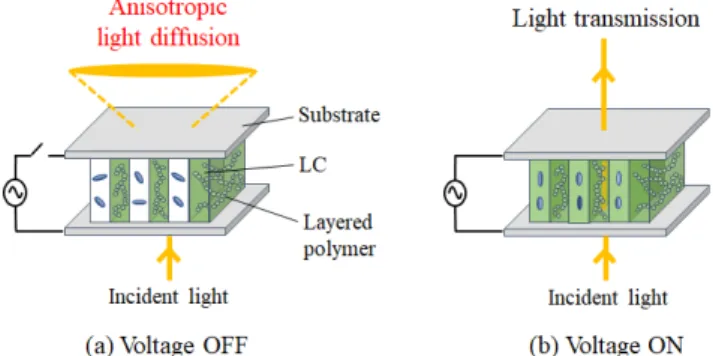
On the basis of this control technique of polymer struc- ture distribution, we have proposed a structure-controlled PDLC with anisotropic distribution of the polymer net- work structure which was fabricated by the irradiation with uni-directionally diffused UV light (Fig. 3). Due to this anisotropic internal structure, we considered that the pro- posed PDLC can electrically switch the light distribution pattern between the anisotropic light diffusion under voltage off-state and the light transmission under voltage on-state.
(Fig. 4). In general, it has been reported that the phase sepa- ration of polymer network and LCs in conventional PDLCs is considerably affected by the temperature of mixture dur- ing UV irradiation process[20]–[22]. Therefore, in this pa- per, we investigated the effect of the process temperature during uni-directionally diffused UV irradiation on the inter- nal structure and light diffusion distribution of the proposed
Fig. 3 Schematic illustration of the fabrication method of proposed PDLC.
Fig. 4 Schematic illustration for the operation of proposed PDLC in (a) voltage off-state and (b) voltage on-state.
PDLC.
3. Experimental
The fabrication procedure of the proposed PDLC is as fol- lows. We prepared a mixture composed of nematic LCs with a positive dielectric anisotropy (E-7 supplied from Merck Co., Ltd.,no=1.522,ne=1.746,Δε=13.8,TNI =59.8◦C) and UV curable monomers (NOA65 supplied from Norland Products Co., Ltd., n = 1.524) at a weight ratio of 3 : 2.
Next, the mixture was injected to an empty cell which was composed of two polycarbonate substrates by the capillarity phenomenon. The cell gap was 10μm. The molecules align- ment treatment was not carried out on the polycarbonate substrates. Finally, the mixture cell was irradiated with the uni-directionally diffused UV light (non-polarized) adjusted by combination of a collimated UV light source (JATEC Co., Ltd.) and a surface modulated light-diffusing plate (Lu- minit Co., Ltd.) whose diffusion angle is 60 along the Y-axis direction and 1◦ along the X- axis direction (Fig. 3). The center wavelength of UV light was 365 nm, and the tem- perature of mixture during UV irradiation process was con- trolled from 30◦C to 90◦C by a hot plate. The integrated amount of UV light was 1.8 J/cm2 in order to sufficiently polymerize the monomers in mixture.
The internal structure of PDLCs was observed by the polarizing microscope (BX-50, Olympus Co., Ltd.) under crossed-Nicols.
The light diffusion distribution of PDLC was measured by the angle-luminance analyzer (Conoscope, Autronic-
Fig. 5 Evaluation method of (a) light diffusion distribution and (b) FWHM of the diffused light.
MELCHERS GmbH) equipped with a collimated white light source (Fig. 5 (a)). In order to evaluate the anisotropy of light diffusion distribution, we estimated a full width at half maximum (FWHM) from angle-luminance character- istic of the diffused light excluding the transmitted straight light (Fig. 5 (b)), and defined a ratio of FWHM along the X and Y-axis as an ellipticity (Eq. (1)). The light diffusion distribution of PDLC shows isotropic when the ellipticity is equal to 1. If the ellipticity is other value except for 1, the diffused light can be distinguished as anisotropic light diffu- sion.
Ellipticity= FWHM along X-axis
FWHM along Y-axis (1)
The amount of the diffused light (haze value) of PDLC was measured by the haze meter (HM-150, Murakami Color Research Laboratory Co., Ltd.). The haze value indicates a ratio of the total light transmittance and the diffused light transmittance and calculated by using following equation (Eq. (2)).
Haze (%)= Diffused light transmittance
Total light transmittance ×100 (2) 4. Results and Discussion
Figure 6 shows the relation between ellipticity of light diffu- sion distribution and temperature of mixture during UV ir- radiation process. When the process temperature was lower than 40◦C, the light diffusion distribution of PDLCs showed isotropic with the ellipticity of about 1. In contrast, when the process temperature was higher than 42.5◦C, the light diffusion distribution of PDLCs showed anisotropic with the ellipticity of more than 1.5. To discuss the relation between
Fig. 6 Process temperature dependency in the ellipticity
Fig. 7 Microscope images of PDLC surface and angle-luminance dis- tributions of the diffused light at process temperature of (a) 30◦C and (b) 60◦C.
light diffusion distribution and internal structure, we ob- served the PDLC surfaces by using the crossed-Nicols polar- izing microscope. The surface images on PDLC are shown in Fig. 7. Here, the presented two kinds of data were ex- amples for isotropic light diffusion at 30◦C and anisotropic light diffusion at 60◦C. In the case of the process tem- perature of 30◦C, the surface image on PDLC showed the blend structure composed of random polymer network and many LC droplets by polymerization-induced phase separa- tion (Fig. 7 (a)). On the other hand, in the case of the process temperature of 60◦C, the surface image on PDLC showed the alternating striped LCs/polymer pattern along the diffu- sion direction of UV light (Fig. 7 (b)). The alternating dark and bright region of striped pattern under crossed-Nicols po- larizer means the presence of many polymers with isotropic refractive index and LCs with birefringence, respectively.
Therefore, the formation of layered LCs/polymer structure was indicated by the observation of microscope images.
Then, we investigated that the light scattering behav- ior of mixture during UV irradiation in order to clarify the
860
IEICE TRANS. ELECTRON., VOL.E101–C, NO.11 NOVEMBER 2018
Fig. 8 Appearances of mixture cell during UV irradiation at the process temperature of (a) 30◦C and (b) 60◦C.
Fig. 9 Process temperature dependency in the haze value.
reason why their structural difference occurred. We placed the mixture cells on a paper with the logo of “Tohoku Uni- versity”. When the process temperature was lower than 40◦C, the cell was so scattered that the logo could not be seen because the LCs in mixture exhibited nematic phase (Fig. 8 (a)). Therefore, we considered that the structure- controlled PDLC could not be obtained since UV light was scattered and the uni-directionality of UV light was disturbed. In contrast, when the process temperature was higher than 42.5◦C, the cell was so transparent that the logo could be seen clearly. This result is attributed to isotropic phase of LC in the mixture (Fig. 8 (b)). Generally, it is re- ported that the nematic-isotropic phase transition tempera- ture of LCs/polymer (TNI ) is lower than that of pure LCs (TNI) due to the reduction of the order parameter[23],[24].
Hence, we considered that the structure-controlled PDLC could be obtained because the mixture was irradiated with the uni-directionally diffused UV light. From the above re- sults, we clarified that the UV irradiation to the mixture in isotropic phase, here is higher than 42.5◦C, enables to con- trol the polymer structure distribution and to optimize the light diffusion distribution.
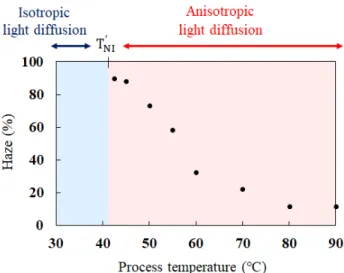
Figure 9 shows the relation between the haze value of structure-controlled PDLC and the process temperature dur- ing UV irradiation. The evaluated haze value of structure- controlled PDLC decreased with increasing the process tem-
Fig. 10 Microscope images of PDLC surface at process temperature of (a) 45◦C, (b) 60◦C and (c) 80◦C.
perature. To clarify this reason, we observed the PDLC sur- faces by using crossed-Nicols polarizing microscope. Three microscopic images at 45◦C, 60◦C and 80◦C are shown in Fig. 10. The microscope image of PDLC at 45◦C thor- oughly showed the alternating striped LCs/polymer pattern (Fig. 10 (a)). On the other hand, the microscope images of PDLC at higher temperature than 45◦C showed the local for- mation of alternating striped pattern, and the dark region could be quite observed under crossed-Nicols (Figs. 10 (b) and (c)). The dark region on microscope images indicate the transmitted straight light without diffusing, and the wide- distributed dark region resulted in the low haze value.
In general, the compatibility of mixture improves with increasing the ambient temperature. We considered that the polymerization-induced phase separation is hard to oc- cur at high process temperature because LC molecules and monomers become a nano-scaled molecular mixing state by the high compatibility. Consequently, the anisotropic dis- tribution of polymer network structure could not be suffi- ciently formed, which resulted in the low haze value at high process temperature. From the above results, we clarified that the structure-controlled PDLCs should be fabricated as low temperature as possible with maintaining the mixture in isotropic phase for the high haze value.
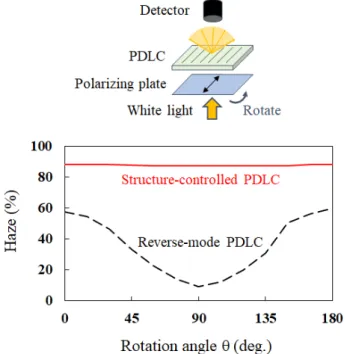
Figure 11 shows the polarization dependency in the haze value. The solid line in Fig. 11 indicates the data of structure-controlled PDLC which was fabricated at 45◦C.
Here, we defined a rotation angle θ as the angle con- sisted of transmission axis of polarizer and direction along striped pattern of polymer structure. Compared to structure- controlled PDLC, the polarization dependency in the haze value of reverse-mode PDLC (applied voltage is 80 V) is also shown in Fig. 11 as dashed line. In reverse-mode PDLC, we defined the rotation angleθas the angle consisted of transmission axis of polarizer and alignment direction of molecules. As a result, the structure-controlled PDLC had no polarization dependency in the haze value, whereas the reverse-mode PDLC considerably has polarization depen- dency in the haze value from 10% to 60%. Therefore, we confirmed that the structure-controlled PDLC enables more efficient light diffusion than the reverse-mode PDLC.
Finally, we demonstrated the electrical switching of light distribution pattern using the proposed PDLC and a monochromatic laser light with a wavelength of 650 nm.
Figure 12 shows the photographs of light distribution pat-
Fig. 11 Polarization dependency in the haze value of structure- controlled PDLC (solid line) and reverse-mode PDLC (dash line).
Fig. 12 Electrical switching of light distribution pattern of structure- controlled PDLC
tern of the structure-controlled PDLC under voltage on- and off-states. A red laser light is perpendicularly incident to this PDLC. As a result, the FWHM along X-axis showed 13.4◦under voltage off-state and 2.2◦under voltage on-state.
Therefore, we confirmed that the structure-controlled PDLC can electrically switch the light distribution pattern between the anisotropic light diffusion under voltage off-state and the light transmission under voltage on-state.
5. Conclusions
For a precise control of the light diffusion distribution
be obtained by the UV irradiation to mixture in isotropic phase. For the high haze, this structure-controlled PDLC should be fabricated as low temperature as possible with maintaining the mixture in isotropic phase. Also, this PDLC had no polarization dependency in the haze value and could electrically switch the light distribution pattern between anisotropic light diffusion and light transmission. From the above results, we confirmed that the proposed PDLC could precisely control the light diffusion distribution, and realize the high light utilization efficiency.
Acknowledgments
This work was funded by JSPS Grant-in-Aid for Scientific Research JP16K06289.
References
[1] P.S. Drzaic, “Polymer dispersed nematic liquid crystal for large area displays and light valves,” J. Appl. Phys., vol.60, no.6, pp.2142–2148, Sept. 1986.
[2] J.W. Doane, N.A. Vaz, B.-G. Wu, and S. ˇZumer, “Field controlled light scattering from nematic microdroplets,” Appl. Phys. Lett., vol.48, no.4, pp.269–271, Jan. 1986.
[3] Y. Hisatake, Y. Kawata, and A. Murayama, “Viewing angle control- lable LCD using variable optical compensator and variable diffuser,”
SID 05 DIGEST, vol.36, no.1, pp.1218–1221, 2005.
[4] H. Fujikake, Y. Tanaka, S. Kimura, H. Asakawa, T. Tamura, H.
Kita, K. Takeuchi, H. Ogawa, A. Nagashima, Y. Utsumi, and K.
Takizawa, “Heat-resistant liquid crystal light modulator containing polymer network for high-power luminaires,” Jpn. J. Appl. Phys., vol.39, no.10, pp.5870–5874, Oct. 2000.
[5] I. Dierking, “Polymer network-stabilized liquid crystals,” Adv.
Mater., vol.12, no.3, pp.167–181, 2000.
[6] I. Dierking, L.L. Kosbar, A. Afzail-Ardakani, A.C. Lowe, and G.A.
Held, “Network morphology of polymer stabilized liquid crystals,”
Appl. Phys. Lett., vol.71, no.17, pp.2454–2456, Oct. 1997.
[7] Y.K. Fung, D.-K. Yang, S. Ying, L.-C. Chien, S. Zumer, and J.W.
Doane, “Polymer networks formed in liquid crystals,” Liquid Crys- tals, vol.19, no.6, pp.797–801, 1995.
[8] R.A.M. Hikmet, “Electrically induced light scattering from anisotropic gels,” J. Appl. Phys., vol.68, no.9, pp.4406–4412, Nov.
1990.
[9] R. Yamaguchi, Y. Waki, and S. Sato, “Reverse mode and wide view- ing angle properties in polymer dispersed liquid crystal cells pre- pared using a UV curable liquid crystal,” Jpn. J. Appl. Phys., vol.36, no.5A, pp.2771–2774, May 1997.
[10] S. Seo, M. Nishizawa, Y. Shibata, T. Ishinabe, and H. Fujikake,
“Light diffusion angle dependence on difference in polymer refrac- tive indices of alternating polymer layer structures,” IEICE Trans.
Electron., vol.E99-C, no.11, pp.1283–1286, Nov. 2016.
[11] M. Nishizawa, K. Kusama, K. Sekiya, B. Katagiri, T. Kawakami, and T. Uchida, “Investigation of novel diffuser films for 2D light- distribution control,” IDW ’11, pp.1385–1388, 2011.
[12] M. Nishizawa, K. Sekiya, T. Kawakami, and T. Uchida, “Synthe- sis and optical property analysis of novel anisotropic light diffusing
862
IEICE TRANS. ELECTRON., VOL.E101–C, NO.11 NOVEMBER 2018
film,” Bull. Chem. Soc. Jpn., vol.85, no.7, pp.839–841, 2012.
[13] K. Maeda, S. Ishizuka, T. Tsujino, H. Yamamoto, and A. Takigawa,
“Optical performance of angle dependent light control glass,” Opt.
Materials Technol. for Energy Efficiency and Solar Energy Conver- sion, vol.1536, pp.138–148, 1991.
[14] T. Okita, K. Kawamura, T. Ohno, M. Ueda, S. Kitayama, and S. Hozumi, “A polymer film that controls light transission –LUMISTY–,” Sumitomo Kagaku, pp.37–48, 1991.
[15] M. Honda, S. Hozumi, and S. Kitayama, “A novel polymer film that controls light transmission,” 3rd Pacific Polym. Conf., pp.159–169, 1993.
[16] T. Uematsu, S. Maenosono, A. Watanabe, and Y. Yamaguchi, “An- gular dependence in the transmittance from self-organized striped pattern of refractive indices in photopolymer,” J. Polym. Sci. Part B:
Polym. Phys., vol.40, no.2, pp.216–225, 2002.
[17] S. Seo, M. Nishizawa, Y. Horii, Y. Shibata, T. Ishinabe, and H.
Fujikake, “Proposal of novel optical model for light-diffusing film having alternating polymer layers with different refractive indices,”
IEICE Trans. Electron., vol.E100-C, no.11, pp.1047–1051, 2017.
[18] T. Uematsu, A. Watanabe, and Y. Yamaguchi, “Self-organization of striped pattern of refractive indices in photopolymer film,” J. Polym.
Sci. Part B: Polym. Phys., vol.42, no.18, pp.3351–3358, 2004.
[19] B. Katagiri, K. Kusama, T. Orui, and S. Shoshi, “Ellipsoidal light diffusing film with narrow louver micro structure of refractive in- dex,” SID ’14 DIGEST, vol.45, no.1, pp.1424–1427, 2014.
[20] P. Kumar and K.K. Raina, “Morphological and electro-optical re- sponses of dichroic polymer dispersed liquid crystal films,” Current Appl. Phys., vol.7, no.6, pp.636–642, Jan. 2007.
[21] R.R. Deshmukh and M.K. Malik, “Effect of temperature on the op- tical and electro-optical properties of poly (methyl methacrylate)/E7 polymer-dispersed liquid crystal composites,” J. Appl. Phys. Sci., vol.109, no.1, pp.627–637, Dec. 2007.
[22] S. Ohta, S. Inasawa, and Y. Yamaguchi, “Size control of phase-sep- arated liquid crystal droplets in a polymer matrix based on the phase diagram,” J. Polym. Sci. Part B: Polym. Phys., vol.50, no.12, pp.863–869, March 2012.
[23] C. Shen and T. Kyu, “Spinodals in a polymer dispersed liquid crys- tal,” J. Chem. Phys., vol.102, no.1, pp.556–562, Jan. 1995.
[24] D. Nwabunma, K.J. Kim, Y. Lin, L.C. Chien, and T. Kyu, “Phase Diagram and Photopolymerization Behavior of Mixtures of UV-Cur- able Multifunctional Monomer and Low Molar Mass Nematic Liq- uid Crystal,” Macromolecules, vol.31, no.20, pp.6806–6812, Aug.
1998.
Yuya Horii received the B.E. degree from Tohoku University, Sendai, Japan, in 2017.
Now, he is a graduate student in the Department of Electronic Engineering, Graduate School of Engineering, Tohoku University. He is engaged in the light distribution control. He received the Outstanding Poster Paper Award from IDW in 2017.
Yosei Shibata received his PhD degree in engineering from Tokyo Institute of Tech- nology (Japan) in March 2013. He has re- search interests on organic semiconductor de- vices such as organic transistors and organic photovoltaics. Then he joined the National In- stitute of Advanced Industrial Science and Tech- nologies (AIST, Japan) as a postdoctoral posi- tion. In October 2015, he joined the Department of Electronics of Tohoku University as an Assis- tant Professor.
Takahiro Ishinabe received his B.S., M.S., and Ph. D. degrees in Electronic Engineering from Tohoku University, Sendai, Japan, in 1995, 1997 and 2000, respectively. From 2000 to 2002, he was a Research Fellow of the Japan Society for the Promotion of Science and from 2003 to 2012, he was an Assistant Professor, and since 2013, he has been an Associate Pro- fessor in the Department of Electronics, Gradu- ate school of Engineering, Tohoku University.
He has also been a Visiting Professor in the CREOL, The College of Optics and Photonics, University of Central Florida from 2010 to 2011. He has been performing a research on ad- vanced liquid crystal displays such as wide viewing angle LCD, reflective full-color LCD, field sequential color LCD and flexible LCD.
Hideo Fujikake received M.E and Ph.D.
degrees from Tohoku University, Japan, in 1985 and 2003, respectively. In 1985, he joined Japan Broadcasting Corporation (NHK). In 1988–
2012, he was with NHK Science and Tech- nology Research Laboratories. Since 2012, he has been a professor at Department of Elec- tronic Engineering, Tohoku University. He re- ceived Best Paper Award from Institute of Elec- tronics, Information and Communication En- gineers (IEICE) in 2001, Best Paper Award from Japanese Liquid Crystal Society (JLCS) in 2001 and 2015, Niwa- Takayanagi Best Paper Awards from Institute of Image Information and Television Engineers of Japan (ITE) in 2003 and 2009, and Electronics So- ciety Award from IEICE in 2013. His current interest is concerned with flexible liquid crystal displays. He also served as a General Vice Chair in International Display Workshops in 2015–2016, a Japan Chapter Chair in IEEE Consumer Electronics Society in 2012–2014, and a Vice President of Japanese Liquid Crystal Society in 2015–2016. He is an IEICE fellow since 2015, and ITE fellow since 2016.