Bull. Natl. Mus. Nat. Sci., Ser. C, 41, pp. 17–23, December 22, 2015
Halysitid Tabulate Corals from the Silurian Fukami Formation, Kumamoto Prefecture, Japan
Shuji Niko
Department of Environmental Studies, Faculty of Integrated Arts and Sciences, Hiroshima University, 1–7–1 Kagamiyama, Higashihiroshima, Hiroshima 739–8521, Japan
Abstract Five Wenlock to Ludlow (late Early to early Late Silurian) species of halysitid tabulate corals are recorded from limestones of the Fukami Formation in Kumamoto Prefecture, southern Japan. They are Halysites catenularius (Linnaeus, 1767), H. bellulus Hamada, 1958, H. miyaza- kiensis Niko and Adachi, 2014, Falsicatenipora shikokuensis Noda and Hamada in Hamada, 1958, and Schedohalysites kitakamiensis (Sugiyama, 1940). Halysites bellulus and H. miyazakiensis rep- resent the first occurrences in the formation. The specific diagnosis of S. kitakamiensis is emended based on a newly discovered specimen as the possession of the dendritic corallum.
Key words : Wenlock to Ludlow (late Early to early Late Silurian), Halysites, Falsicatenipora, Schedohalysites, Halysitida
Introduction
The first reference to Silurian rocks from Kumamoto Prefecture, southern Japan was made by Kanmera and Matsumoto (1948), who discov- ered Halysites-bearing limestone and associated tuffaceous shale in the Fukami area. Subse- quently, Matsumoto and Kanmera (1949) pro- vided the geological map of this area, and Matsumoto and Kanmera (1964) designated these rocks as the Fukami Formation. Paleonto- logical investigations of the formation were began to start by T. Hamada. His results were published in 1956 and 1958 (halysitid tabulate corals) and 1962 (brachiopods).
The present paper documents the occurrences of five species of halysitid tabulate corals in the Fukami Formation, and reexamines previously known species. This is a part of my long-term study to reveal species composition of the Fukami fauna. Used abbreviations herein indicat- ing repositories of examined specimens are NMNS (National Science Museum of Nature and Sciences, Tokyo) and UMUT (University Museum, the University of Tokyo).
Geologic Setting and Locality
The Fukami Formation crops out as the dis- connected lenticular bodies along the northern margin of the serpentinite zone in the Kurose- gawa Belt. These bodies are small (up to ca.
30‒40 m width and 150 m length) and surrounded by high-angled faults. Constituents of these bod- ies are limestone, tuffaceous shale, and acidic pyroclastic rocks (Matsumoto and Kanmera, 1964). Murata (1992) correlated the former two strata with the Wenlock to Ludlow (upper Lower to lower Upper Silurian) G2 to G3 Members of the Gionyama Formation, Miyazaki Prefecture in southern Japan, and suggested similarity between remaining pyroclastic rocks and the Upper Silu- rian to Lower Devonian G4 Member of the same formation. Limestones of the formation are more or less recrystallized. Bioclastic wackestone is predominant in their lithology with subordinate amounts of calclithite and coral biolithite.
Although moderately diverse megafossils occur in limestones and tuffaceous shales; they are tra- versed by calcite veins and poorly preserved.
The geographic positions of these fossil locali-
ties are shown in Fig. 1. Except for material of
locality 1 that was recovered from float blocks in riverbeds of the Fukami-gawa River, all speci- mens were collected from taluses near the out- crops.
Systematic Paleontology
Subclass Tabulata Milne-Edwards and
Haime, 1850
Order Halysitida Sokolov, 1947
Family Halysitidae Milne-Edwards and Haime, 1849 Subfamily Halysitinae Milne-Edwards and Haime,
1849
Genus Halysites Fischer von Waldheim, 1828 Type species: Tubipora catenularia Linnaeus, 1767.
Halysites catenularius (Linnaeus, 1767)
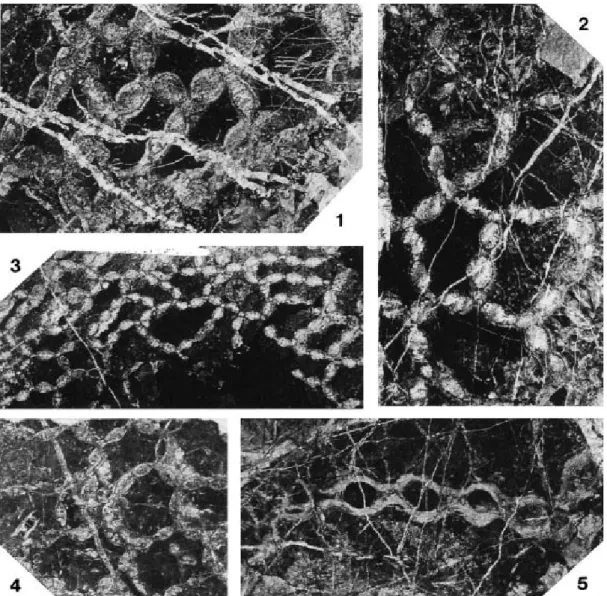
(Figs. 2-1, 2)
Halysites catenularius (Linnaeus); Niko and Adachi, 2013, p. 17, 20, figs. 1-1‒5, 2-1‒6 [with earlier synon- ymy]; Adachi and Niko, 2015, p. 75, 77, figs. 1-A‒E.
Material examined: NMNS PA18306, 18316‒
18320, 18327.
Occurrence: Common in gray limestones at localities 1 (NMNS PA18306) and 2 (NMNS PA18316‒18320, 18327).
Discussion: Revisions of Halysites catenular- ius are given by Laub (1979), Young and Noble (1987), and Mõtus and Klaamann (1999). This species somewhat resembles an associated spe- cies, H. bellulus, however its well inflated coral- lites with larger diameters than those of H. bellu- lus are diagnostic, if fragmented such as the present case. The stratigraphic rang of H. catenu- larius in Japan is upper Wenlock to lower Lud- low (Niko and Adachi, 2013).
A single corallum (UMUT PC7271) from the Fukami Formation was referred to Halysites cra- tus Etheridge, 1904 by Hamada (1958). Because there are no significant differences between the emended specific diagnosis of H. catenularius and characters of the Fukami specimens includ- ing Hamadaʼs one, it is better to exclude from the faunal list of the formation.
Fig. 1. Index maps showing fossil localities in the Fukami area, Kumamoto Prefecture, on the topographic map of “Sakamoto” scale 1:25,000 published by the Geographical Survey Institute.
Silurian Tabulate Corals from Kumamoto 19
Halysites bellulus Hamada, 1958
(Figs. 2-3, 4)
Halysites bellulus Hamada; Niko and Adachi, 2013, p. 20, 22, figs. 3-1‒6 [with earlier synonymy]; Adachi and Niko, 2015, p. 77, figs. 2-A‒C.
Material examined: NMNS PA18323‒18326, 18330.
Occurrence: Rare in gray to reddish gray lime- stones at Localities 2 (NMNS PA18323‒18326)
and 3 (NMNS PA18330).
Discussion: The holotype (UMUT PC7276) of Halysites bellulus from the G3 Member of the Gionyama Formation was accurately re- described and illustrated by Niko and Adachi (2013). Morphologies of the examined speci- mens herein are consistent with those of the holotype. This is the first record of this species except for the type locality in the Kuraoka area, Miyazaki Prefecture.
Fig. 2. 1, 2, Halysites catenularius (Linnaeus, 1767), thin transverse sections of corallites. 1, NMNS PA18318,
×5. 2, NMNS PA18327, ×5. 3, 4, Halysites bellulus Hamada, 1958, thin transverse sections of corallites.
3, NMNS PA18324, ×5. 4, NMNS PA18325, ×5. 5, Halysites miyazakiensis Niko and Adachi, 2014, thin transverse sections of corallites, NMNS PA18333, ×5.
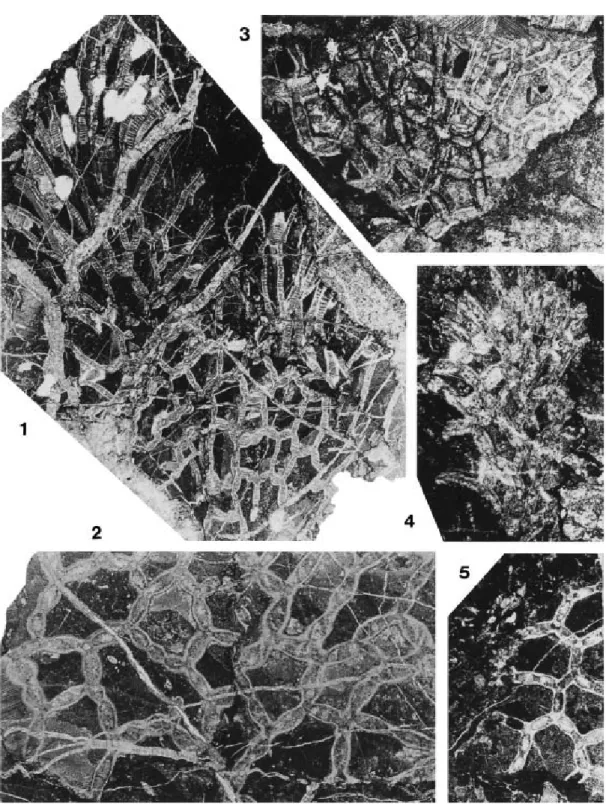
Fig. 3. 1, 2, 5, Schedohalysites kitakamiensis (Sugiyama, 1940), thin sections. 1, 2, NMNS PA18328; 1, oblique sections of branches, note branching, ×2; 2, transverse sections of corallites, ×5. 5, NMNS PA18331, trans- verse sections of corallites, ×5. 3, 4, Falsicatenipora shikokuensis Noda and Hamada in Hamada, 1958, thin sections. 3, NMNS PA18322, transverse section of branch, ×5. 4, NMNS PA18334, longitudinal section of branch, ×5.
Silurian Tabulate Corals from Kumamoto 21
Halysites miyazakiensis Niko and Adachi, 2014
(Fig. 2-5)
Halysites miyazakiensis Niko and Adachi, 2014, p. 11‒13, figs. 1-1‒5.
Material examined: NMNS PA18333.
Occurrence: Very rare in gray limestone at locality 3.
Discussion: Halysites miyazakiensis was pre- viously represented by a single corallum from the G3 Member of the Gionyama Formation (Niko and Adachi, 2014). The present fragmen- tary specimen indicates large diameters of coral- lites with strongly inflated profiles and very thick corallite walls, whose characters warrant its spe- cific placement and clearly distinguish this spe- cies from all others in the Fukami fauna.
Genus Falsicatenipora Hamada, 1958 Type species: Halysites japonica Sugiyama, 1940.
Falsicatenipora shikokuensis Noda and Hamada in Hamada, 1958
(Figs. 3-3, 4)
Falsicatenipora shikokuensis Noda and Hamada; Niko and Adachi, 2013, p. 30, 33, figs. 9-1‒6 [with earlier synonymy]; Kawamura et al., in Kawamura et al., 2013, figs. 4.9B, 4.10A; Adachi and Niko, 2015, p. 81, figs. 6-A‒D.
Material examined: NMNS PA18321, 18322, 18334.
Occurrence: Rare in gray limestones at locali- ties 2 (NMNS PA18321, 18322) and 3 (NMNS PA18334).
Discussion: Although fragmentary, preserved characters, such as corallite shape and arrange- ments of the examined Fukami specimens match with those of Falsicatenipora shikokuensis. This species is the most common halysitid coral in the Kurosegawa and South Kitakami Belts, and a relaiable index-fossil of late Wenlock age.
Matsumoto and Kanmera (1964) documented Cf. Falsicatenipora shikokuensis without any
description and illustration. This discovery from the Fukami Formation conforms to their docu- mentation.
Genus Schedohalysites Hamada, 1957 Type species: Halysites orthopteroides Ether- idge, 1904.
Discussion: Growth forms of the colonies in Schedohalysites kitakamiensis (see below) and Falsicatenipora shikokuensis (see Niko and Ada- chi, 2013) are quite different in comparing with the massive ones in usual species of Halysites.
There is a possibility that genera of the subfamily Halysitinae can separate into two groups on the basis of this criterion.
Schedohalysites kitakamiensis (Sugiyama, 1940)
(Figs. 3-1, 2, 5)
Schedohalysites kitakamiensis (Sugiyama); Niko and Adachi, 2013, p. 30, 33, figs. 9-1‒6 [with earlier syn- onymy]; Adachi and Niko, 2015, p. 81, 86, figs.
7-A‒E.
Material examined: NMNS PA18304, 18305, 18307‒18315, 18328, 18329, 18331, 18332, 18335, 18336.
Emended diagnosis: Coralla dendritic consist- ing of thick branches. For other diagnostic char- acters see previous workers, including Sugiyama (1940), Hamada (1956, 1957, 1958), Nakai (1981), and Niko and Adachi (2013).
Description of coralla: Large more than 14 cm in diameter and dendritic with subcylindrical branches; branching bifurcate; diameters of branches are thick, usually 18‒60 mm.
Occurrence: Abundant in gray to reddish gray limestones at localities 1 (NMNS PA18304, 18305, 18307‒18309), 2 (NMNS PA18310‒
18315), 3 (NMNS PA18328, 18329, 18331, 18332), and 5 (NMNS PA18335, 18336).
Discussion: Detailed morphologies of coral-
lites, lacunae, coenenchymal tubule, and internal
structures of Schedohalysites kitakamiensis are
given in Niko and Adachi (2013). Because of no
additional information from the Fukami speci-
mens except for morphologies of corallum, they are not repeated herein. Corallum growth form of the species has been misidentified as “massive”,
“bun-shaped”, “trochoidal”, “irregular” or “cylin-
drical” in previous workers owing to its large and fragile natures. However, a newly discovered large fragment of a corallum (NMNS PA18328) provides the above-mentioned emendations.
Schedohalysites kitakamiensis widely occurs in the Ludlow limestones in the South Kitakami and Kurosegawa Belts in Japan. In addition, this species also detected from the Wenlock G2 Member of the Gionyama Formation (Niko and Adachi, 2013).
Acknowledgements
My sincere thanks to the late Dr. Takashi Hamada, who provided information of Silurian fossil localities in the Fukami area. I am grateful to Mr. Yoshihito Senzai for his help during field works and Mr. Tomio Adachi for his donation of important specimens. Thanks are also due to Dr.
Hisayoshi Igo for constructive reviews that improve this manuscript.
References
Adachi, T. and Niko, S. (2015) Silurian halysitid corals from the Gionyama Formation in Miyazaki Prefecture, southern Japan. Chigakukenkyu, 62: 75–90. (In Japa- nese.)
Etheridge, R. Jr. (1904) A monograph of the Silurian and Devonian corals of New South Wales; with illustrations from other parts of Australia. Part I. The genus Hal- ysites. Memoirs of the Geological Survey of New South Wales, Palaeontology, 13: 1–39, pls. 1–9.
Fischer von Waldheim, G. F. (1828) Notice sur les polypi- ers tubipores fossils. Programme pour la séance pub- lique de la Societé Imperiale des Naturalistes, Univer- sité Impériale, Moscow, pp. 9–23, pl. 1. (Not seen.) Hamada, T. (1956) Halysites kitakamiensis Sugiyama
from the Gotlandian formation in the Kuraoka district, Kyûshû, Japan. Japanese Journal of Geology and Geography, 27: 133–141, pl. 9.
Hamada, T. (1957) On the classification of the Halysiti- dae, I. Journal of the Faculty of Science, University of Tokyo. Section 2, 10: 393–405.
Hamada, T. (1958) Japanese Halysitidae. Journal of the
Faculty of Science, University of Tokyo. Section 2, 11:
91–114, pls. 6–10.
Hamada, T. (1962) Two brachiopods from Kyushu. The Silurian shelly fauna from Southwest Japan (II). Scien- tific Papers of the College of General Education, Uni- versity of Tokyo, 12: 241–258, pls. 1, 2.
Kanmera, K. and Matsumoto, T. (1948) Geological new observations in lower reaches of the Kuma-gawa River.
The Journal of the Geological Society of Japan, 54:
157. (In Japanese.)
Kawamura, T., Uchino, T., Kawamura, M., Yoshida, K., Nakagawa, M. and Nagata, H. (2013) Geology of the Hayachine San District. Quadrangle Series 1:50,000.
101 pp. Geological Survey of Japan, AIST, Tsukuba.
(In Japanese with English abstract.)
Laub, R. S. (1979) The corals of the Brassfield Formation (Mid-Llandovery; Lower Silurian) in the Cincinnati Arch region. Bulletins of American Paleontology, 75:
1–432, pls. 1–42.
Linnaeus, C. (1767) Systema naturae per regna tria natu- rae, secundum classes, ordines, genera, species, cum characteribus, differentiis synonymis, locis. Tomus 1, 12th ed. Volume 1, Part 2, pp. 533–1327. (Not seen.) Matsumoto, T. and Kanmera, K. (1949) Contributions to
the tectonic history in the Outer Zone of Southwest Japan. Memoirs of the Faculty of Science, Kyushu Uni- versity, Series D, 3: 77–90.
Matsumoto, T. and Kanmera, K. (1964) Explanatory Text of the Geological Map of Japan. Scale 1:50,000. 147 pp. Geological Survey of Japan, Kawasaki. (In Japa- nese with English abstract.)
Milne-Edwards H. and Haime, J. (1849) Mémoire sur les polypiers appartenant aux groupes naturels des Zoan- thaires perforés et des Zoanthaires tabulés. Académie des Sciences, Paris, Comptes Rendus, 29: 257–263.
Milne-Edwards, H. and Haime, J. (1850) A Monograph of the British Fossil Corals. First Part. Introduction; Cor- als From the Tertiary and Cretaceous Formations. 71 pp., 11 pls. Monographs of the Palaeontographical Society, London.
Mõtus, M.-A. and Klaamann, E. R. (1999) The halysitid coral genera Halysites and Cystihalysites from Gotland, Sweden. GFF, 121: 81–90.
Murata, M. (1992) 2.7 Chichibu Terrane. (1) Kurosegawa Tectonic Zone. 1. Paleozoic Formations. In: Karakida, Y. et al. (Eds.), Regional Geology of Japan. Part 9.
Kyushu. Kyoritsu Shuppan, Tokyo, pp. 48–51. (In Jap- anese.)
Nakai, H. (1981) Silurian corals from the Yokokurayama Formation in the Mt. Yokokura region, Kochi Prefec- ture, Southwest Japan. Part I. Halysitidae. Transactions and Proceedings of the Palaeontological Society of Japan, New Series, 123: 139–158, pls. 16–19.
Niko, S. and Adachi, T. (2013) Silurian halysitids (Coel- enterata: Tabulata) from the Gionyama Formation,
Silurian Tabulate Corals from Kumamoto 23 Miyazaki Prefecture, Japan. Bulletin of the National
Museum of Nature and Science, Series C, 39: 17–41.
Niko, S. and Adachi, T. (2014) Halysites miyazakiensis, a new species of Silurian halysitids (Coelenterata: Tabu- lata) from the Gionyama Formation, Miyazaki Prefec- ture, Japan. Bulletin of the National Museum of Nature and Science, Series C, 40: 11–13.
Sokolov, B. S. (1947) Novye syringoporidy Taymyra [New syringoporids from the Taymyr]. Byulleten Mos-
kovskoe Ovschchestva Ispytatelei Prirody, Otdel Geol- ogischeskii, 22: 19–28. (In Russian.)
Sugiyama, T. (1940) Stratigraphical and palaeontological studies of the Gotlandian deposits of the Kitakami Mountainland. Science Reports of the Tôhoku Imperial University, Series 2, 21: 81–146, pls. 13–33.
Young, G. A. and Noble, J. P. A. (1987) The Llandovery–
Wenlock Halysitidae from New Brunswick, Canada.
Journal of Paleontology, 61: 1125–1147.