Kimuraite-(Y), a Layered Hydrous Carbonate of Calcium and Rare Earths, from Mikhailovsky District, Far East Russia
Ritsuro Miyawaki
1* , Koichi Momma
1, Takashi Sano
1, Masako Shigeoka
1, Yukiyasu Tsutsumi
1, Sergei A. Kasatkin
2, Igor Chekryzhov
2and Kazumi Yokoyama
11Department of Geology and Paleontology, National Museum of Nature and Science, 4–1–1 Amakubo, Tsukuba, Ibaraki 305–0005, Japan
2Far East Geological Institute, Far Eastern Branch of the Russian Academy of Sciences 159, 100 let Vladivostok Pr, 690022, Russia
*E-mail: [email protected]
Abstract. Kimuraite-(Y) occurs in white veins of dark charcoal gray siliceous mudstone rich in Y (ca.1000–3000 ppm) in Abramovskoye, Mikhailovsky district, Primorye, Far East Russia. The mineral is associated with lanthanite-(Nd) and lokkaite-(Y). The white aggregate of minute crys- tals has a pearly to silky luster. An electron microprobe analysis (SEM-EDS) gave the following empirical formula: Ca1.00Y1.78Ce0.01Nd0.01Gd0.01Dy0.04Ho0.03Er0.06Tm0.01Yb0.04Lu0.01(CO3)4・6H2O.
The chondrite normalized lanthanoid pattern indicates the trend of Y-minerals, where it is rich in heavy rare earth elements. The orthorhombic unit cell parameters refined from powder XRD pat- tern are; a = 9.246(3), b = 23.974(8), c = 6.058(3) Å, and V = 1342.8(8) Å3. The 5 strongest lines in the powder XRD pattern [d(Å) (I/I0) hkl] are: 11.99 (96) 020; 5.99 (86) 040; 4.62 (100) 200; 3.76 (83) 051; and 2.08 (50) 431.
Key words: kimuraite-(Y), rare earth, Russia
Introduction
Kimuraite-(Y), ideally CaY
2(CO
3)
4・6H2O, was described in fissures in an alkali olivine basalt in Higashi-Matsuura district, Saga Prefec- ture, Japan, in association with lokkaite-(Y) and lanthanite-(Nd) (Nagashima et al., 1986). Later, the mineral was discovered in several other localities with different geological backgrounds.
It was recognized as a secondary mineral on gadolinite-(Y) from a pegmatite in Ytterby, Swe- den (Miyawaki, et al., 1993). Kimuraite-(Y) examined in the present mineralogical study was found in the Abramovskoye ore in the hydrother- mal rare earth element (REE) mineralization in Cambrian carbonaceous shales, located at the periphery of the Voznesenskii ore region (Khankayskii massif, Primorskiy Kray), near the Pavlovsk brown coal deposit (Seredin, 1998).
Kimuraite-(Y) occurs in white veins of dark charcoal gray siliceous mudstone, which was
described as argillaceous rock of carbonaceous shale by Seredin (1998), in association with lan- thanite-(Nd) and lokkaite-(Y) as reported in the previous study. The white aggregate of minute (less than few ten μm) flaky thin (less than 10
μm) crystals shows a pearly to silky luster(Fig. 1).
Fig. 1. A photomicrograph of the white aggregates of minute flaky thin crystals of kimuraite-(Y).
The field of view is 5.7 mm.
Chemistry
Chemical analyses of kimuraite-(Y) and the associated minerals were carried out with a JEOL JSM-6610/OXFORD X-Max SEM/EDS spec- trometer using a lower beam current (15 kV, 0.6 nA, a beam diameter of 2
μm, and an approxi-mate scan area of 4
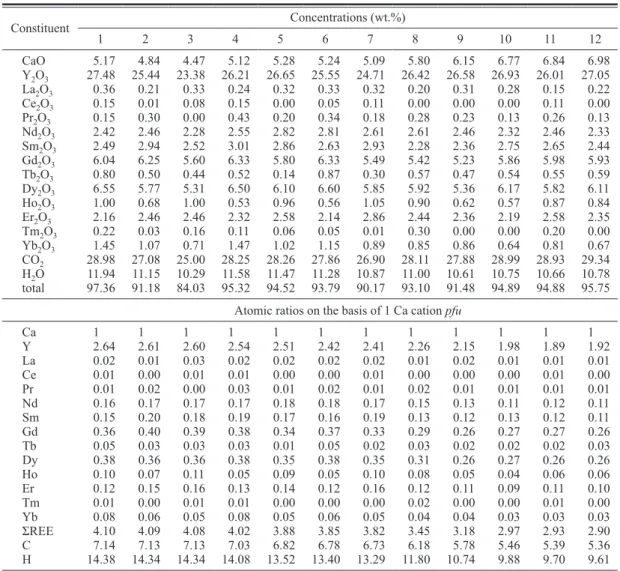
μm2) to avoid decomposing the hydrous carbonate minerals that can be dam- aged by the electron beam. The chemical compo- sition of kimuraite-(Y), lanthanite-(Nd), and some associated calcium yttrium carbonate min- erals are listed in Tables 1, 2, and 3, respectively.
The empirical formulae for kimuraite-(Y) on the
basis of 3 cations, 4 carbonate ions, and 6 water molecules pfu are:
Ca
1.00Y
1.78Ce
0.01Nd
0.01Gd
0.01Dy
0.04Ho
0.03Er
0.06Tm
0.01Yb
0.04Lu
0.01(CO
3)
4・6H2O (1) Ca
1.00Y
1.78Pr
0.01Nd
0.01Sm
0.01Gd
0.03Dy
0.04Ho
0.02Er
0.05Tm
0.01Yb
0.03Lu
0.01(CO
3)
4・6H2O (2) Ca
0.99Y
1.80La
0.02Nd
0.01Sm
0.01Gd
0.02Dy
0.04Ho
0.02Er
0.04Yb
0.03Lu
0.02(CO
3)
4・6H2O (3) Ca
1.00Y
1.80La
0.01Nd
0.01Sm
0.01Gd
0.02Dy
0.03Ho
0.02Er
0.04Tm
0.01Yb
0.03Lu
0.02(CO
3)
4・6H2O (4) Ca
0.98Y
1.82La
0.02Nd
0.01Gd
0.03Tb
0.01Dy
0.04Ho
0.01Er
0.04Yb
0.03Lu
0.01(CO
3)
4・6H2O (5) Ca
1.01Y
1.81La
0.01Nd
0.02Gd
0.02Dy
0.05Ho
0.01Er
0.04Yb
0.04(CO
3)
4・6H2O (6)
Table 1. Chemical composition of kimuraite-(Y).
Constituent Concentrations (wt.%)
1 2 3 4 5 6
CaO 9.41 9.33 8.99 8.45 8.17 7.63
Y2O3 33.69 33.79 33.20 30.90 30.31 27.43
La2O3 0.28 0.01 0.43 0.35 0.49 0.24
Ce2O3 0.00 0.00 0.01 0.01 0.10 0.00
Pr2O3 0.00 0.14 0.01 0.00 0.09 0.00
Nd2O3 0.28 0.35 0.24 0.24 0.28 0.40
Sm2O3 0.04 0.15 0.21 0.24 0.06 0.04
Gd2O3 0.35 0.76 0.59 0.45 0.70 0.59
Tb2O3 0.00 0.06 0.00 0.00 0.21 0.07
Dy2O3 1.15 1.13 1.12 0.73 1.10 1.30
Ho2O3 0.48 0.44 0.44 0.34 0.21 0.07
Er2O3 1.85 1.71 1.15 1.27 1.13 1.12
Tm2O3 0.36 0.27 0.00 0.15 0.00 0.00
Yb2O3 1.32 0.99 0.99 0.92 0.99 1.00
Lu2O3 0.27 0.25 0.50 0.46 0.20 0.00
CO2 29.44 29.38 28.55 26.59 26.11 23.78
H2O 18.08 18.04 17.53 16.33 16.03 14.60
total 97.00 96.79 93.95 87.43 86.19 78.27
Atomic ratios on the basis of 3 cations, 4 carbonate ions and 6 water molecules pfu
Ca 1.00 1.00 0.99 1.00 0.98 1.01
Y 1.78 1.78 1.80 1.80 1.82 1.81
La 0.01 0.00 0.02 0.01 0.02 0.01
Ce 0.00 0.00 0.00 0.00 0.00 0.00
Pr 0.00 0.01 0.00 0.00 0.00 0.00
Nd 0.01 0.01 0.01 0.01 0.01 0.02
Sm 0.00 0.01 0.01 0.01 0.00 0.00
Gd 0.01 0.03 0.02 0.02 0.03 0.02
Tb 0.00 0.00 0.00 0.00 0.01 0.00
Dy 0.04 0.04 0.04 0.03 0.04 0.05
Ho 0.03 0.02 0.02 0.02 0.01 0.00
Er 0.06 0.05 0.04 0.04 0.04 0.04
Tm 0.01 0.01 0.00 0.01 0.00 0.00
Yb 0.04 0.03 0.03 0.03 0.03 0.04
Lu 0.01 0.01 0.02 0.02 0.01 0.00
C 4 4 4 4 4 4
H 12 12 12 12 12 12
The hydrous carbonates of REE are often decom- posed into other phases via in vacuo dehydration.
Lanthanite-(Nd), Nd
2(CO
3)
3・8H2O, easily loses half of the crystallization water in vacuo to become Nd
2(CO
3)
3・4H2O, which corresponds to the Nd-analogue of calkinsite-(Ce). The chemical data of the present analysis suggested such a dehydration nature of lanthanite-(Nd) in vacuo.
The empirical formula of lanthanite-(Nd) was calculated excluding the Si as an impurity and assuming full hydration of the crystal structure normalized to 2 rare earth (RE) cations, 3 car-
bonate ions, and 4 water molecules pfu:
Y
0.11La
0.64Pr
0.17Nd
0.70Sm
0.24Gd
0.10Dy
0.04(CO
3)
3・4H2
O (1)
Y
0 . 11L a
0 . 5 9P r
0 . 1 6N d
0 . 7 1S m
0 . 2 5G d
0 . 1 0T b
0 . 0 1Dy
0.05Yb
0.01(CO
3)
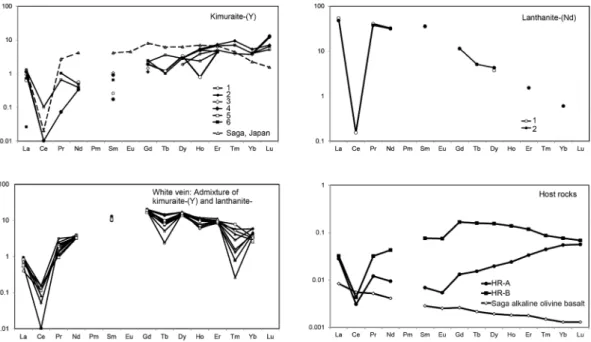
3・4H2O (2) The chondrite normalized lanthanoid patterns are given in Fig. 2.
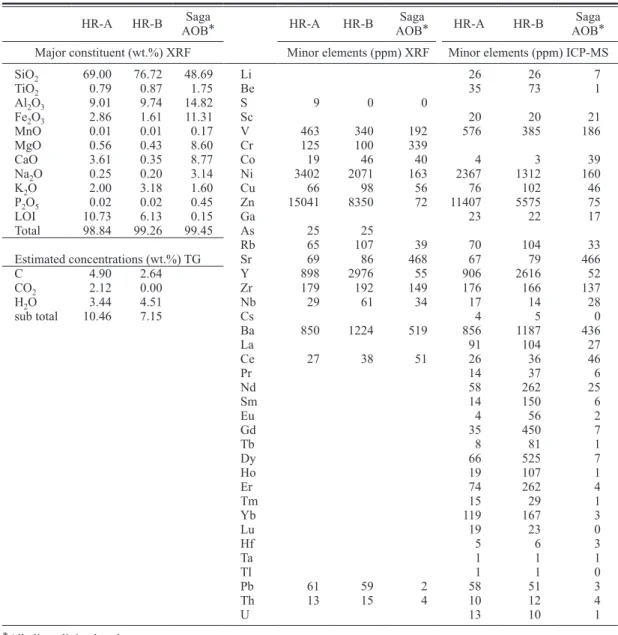
Two samples of the host rock were analyzed for their major and selected trace element com- positions by X-ray fluorescence (XRF) and for their trace element compositions by acid- digested solution Inductively Coupled Plasma–
Mass Spectrometry (ICP–MS). The rock samples were crushed into ~1 cm diameter grains, then, the grains were washed ultrasonically, twice in alcohol and twice in distilled water. The cleaned grains were dried for >12 hours in an oven at 110°C and then ground to powder in an agate mill. Before the major element analysis, ~0.4 g of the powder were weighed on a Metler Toledo dual balance system and heated at 1025°C for 4 hours in an electric muffle furnace to determine loss-on-ignition (LOI). After LOI determination, fused glass beads were prepared using a lithium tetra borate flux (10 : 1 dilution of sample). For the selected trace element analysis, ~4.0 g of powder were pressed into a pellet by a 12 ton force from a hydraulic press. The XRF analyses followed the method of Sano et al. (2011), except that a RIGAKU ZSX Primus II was used.
ICP–MS trace element concentrations were determined using a quadrupole Agilent 7700x following the procedures described by Chang et
al. (2003), except that analyses of Li, Be, V, Zn,and Ga were also performed. Sample preparation involved digestion using an acid mixture com- prised of HF–HClO
4–HNO
3, and the final disso- lution was performed in 2% HNO
3plus 0.1% HF spiked with
115In and
209Bi. These elements were added to standardize the signal for the ICP–MS measurements. The chemical compositions of the host rock samples are summarized in Table 4, together with the estimated values from the sub- sequent DTA-TG data.
The differential thermal-thermogravimetric (DTA-TG) curves were recorded on a RIGAKU
Table 2. Chemical composition of lanthanite-(Nd).
Constituent Concentrations (wt.%)
1 2
SiO2 0.80 0.00
Y2O3 2.39 2.33
La2O3 20.44 18.07
Ce2O3 0.15 0.00
Pr2O3 5.52 5.11
Nd2O3 23.17 22.48
Sm2O3 8.26 8.13
Gd2O3 3.54 3.56
Tb2O3 0.00 0.30
Dy2O3 1.45 1.67
Ho2O3 0.00 0.00
Er2O3 0.00 0.39
Tm2O3 0.00 0.00
Yb2O3 0.00 0.15
Lu2O3 0.00 0.00
CO2 25.97 24.81
H2O 14.18 13.54
total 105.87 100.54
Atomic ratios on the basis of 2 RE cations, 3 carbonate ions and 4 water molecules pfu
Si 0.07 0.00
Y 0.11 0.11
La 0.64 0.59
Ce 0.00 0.00
Pr 0.17 0.16
Nd 0.70 0.71
Sm 0.24 0.25
Gd 0.10 0.10
Tb 0.00 0.01
Dy 0.04 0.05
Ho 0.00 0.00
Er 0.00 0.01
Tm 0.00 0.00
Yb 0.00 0.00
Lu 0.00 0.00
C 3 3
H 8 8
Thermo plus 2 / TG-8120 thermal analyzer by heating 40 mg of each sample in a Pt cup from room temperature to 1150°C at a rate of 10 degrees per minute (Fig. 3). The DTA curves showed endothermic peaks at around 155, 490, and 575°C. These endothermic reactions can be attributed to the dehydration of clay minerals such as kaolin-smectite in the rock sample. An exothermic peak at around 675°C suggests com- bustion of carbonaceous materials, such as coal, peat, and bitumen including graphite, in the dark gray sample. One of the host rock samples, HR-A, gave an additional endothermic peak at around 770°C, which corresponds to the decar- bonation of calcite (Rodriguez-Navarro, et al.,
2009). The XRD reflections of calcite were con- firmed with the powder XRD pattern of the host rock sample HR-A, for which the XRF analysis indicated considerable amounts of Ca (3.61 wt.%
CaO; see Table 4). The amounts of H
2O, C, and CO
2estimated from the weight loss accompanied with the 2 endothermic and 1 exothermic reac- tions are; 4.90, 3.44, and 2.12 wt.%, and 2.64, 4.51, and 0 wt.% for HR-A and HR-B, the 2 host rock samples, respectively. The individual values of total weight loss are comparable to the values of loss-on-ignition (LOI).
Table 3. Chemical compositions of associated calcium yttrium carbonate minerals.
Constituent Concentrations (wt.%)
1 2 3 4 5 6 7 8 9 10 11 12
CaO 5.17 4.84 4.47 5.12 5.28 5.24 5.09 5.80 6.15 6.77 6.84 6.98
Y2O3 27.48 25.44 23.38 26.21 26.65 25.55 24.71 26.42 26.58 26.93 26.01 27.05 La2O3 0.36 0.21 0.33 0.24 0.32 0.33 0.32 0.20 0.31 0.28 0.15 0.22 Ce2O3 0.15 0.01 0.08 0.15 0.00 0.05 0.11 0.00 0.00 0.00 0.11 0.00 Pr2O3 0.15 0.30 0.00 0.43 0.20 0.34 0.18 0.28 0.23 0.13 0.26 0.13 Nd2O3 2.42 2.46 2.28 2.55 2.82 2.81 2.61 2.61 2.46 2.32 2.46 2.33 Sm2O3 2.49 2.94 2.52 3.01 2.86 2.63 2.93 2.28 2.36 2.75 2.65 2.44 Gd2O3 6.04 6.25 5.60 6.33 5.80 6.33 5.49 5.42 5.23 5.86 5.98 5.93 Tb2O3 0.80 0.50 0.44 0.52 0.14 0.87 0.30 0.57 0.47 0.54 0.55 0.59 Dy2O3 6.55 5.77 5.31 6.50 6.10 6.60 5.85 5.92 5.36 6.17 5.82 6.11 Ho2O3 1.00 0.68 1.00 0.53 0.96 0.56 1.05 0.90 0.62 0.57 0.87 0.84 Er2O3 2.16 2.46 2.46 2.32 2.58 2.14 2.86 2.44 2.36 2.19 2.58 2.35 Tm2O3 0.22 0.03 0.16 0.11 0.06 0.05 0.01 0.30 0.00 0.00 0.20 0.00 Yb2O3 1.45 1.07 0.71 1.47 1.02 1.15 0.89 0.85 0.86 0.64 0.81 0.67 CO2 28.98 27.08 25.00 28.25 28.26 27.86 26.90 28.11 27.88 28.99 28.93 29.34 H2O 11.94 11.15 10.29 11.58 11.47 11.28 10.87 11.00 10.61 10.75 10.66 10.78 total 97.36 91.18 84.03 95.32 94.52 93.79 90.17 93.10 91.48 94.89 94.88 95.75
Atomic ratios on the basis of 1 Ca cation pfu
Ca 1 1 1 1 1 1 1 1 1 1 1 1
Y 2.64 2.61 2.60 2.54 2.51 2.42 2.41 2.26 2.15 1.98 1.89 1.92
La 0.02 0.01 0.03 0.02 0.02 0.02 0.02 0.01 0.02 0.01 0.01 0.01
Ce 0.01 0.00 0.01 0.01 0.00 0.00 0.01 0.00 0.00 0.00 0.01 0.00
Pr 0.01 0.02 0.00 0.03 0.01 0.02 0.01 0.02 0.01 0.01 0.01 0.01
Nd 0.16 0.17 0.17 0.17 0.18 0.18 0.17 0.15 0.13 0.11 0.12 0.11
Sm 0.15 0.20 0.18 0.19 0.17 0.16 0.19 0.13 0.12 0.13 0.12 0.11
Gd 0.36 0.40 0.39 0.38 0.34 0.37 0.33 0.29 0.26 0.27 0.27 0.26
Tb 0.05 0.03 0.03 0.03 0.01 0.05 0.02 0.03 0.02 0.02 0.02 0.03
Dy 0.38 0.36 0.36 0.38 0.35 0.38 0.35 0.31 0.26 0.27 0.26 0.26
Ho 0.10 0.07 0.11 0.05 0.09 0.05 0.10 0.08 0.05 0.04 0.06 0.06
Er 0.12 0.15 0.16 0.13 0.14 0.12 0.16 0.12 0.11 0.09 0.11 0.10
Tm 0.01 0.00 0.01 0.01 0.00 0.00 0.00 0.02 0.00 0.00 0.01 0.00
Yb 0.08 0.06 0.05 0.08 0.05 0.06 0.05 0.04 0.04 0.03 0.03 0.03
ΣREE 4.10 4.09 4.08 4.02 3.88 3.85 3.82 3.45 3.18 2.97 2.93 2.90
C 7.14 7.13 7.13 7.03 6.82 6.78 6.73 6.18 5.78 5.46 5.39 5.36
H 14.38 14.34 14.34 14.08 13.52 13.40 13.29 11.80 10.74 9.88 9.70 9.61
X-ray crystallography
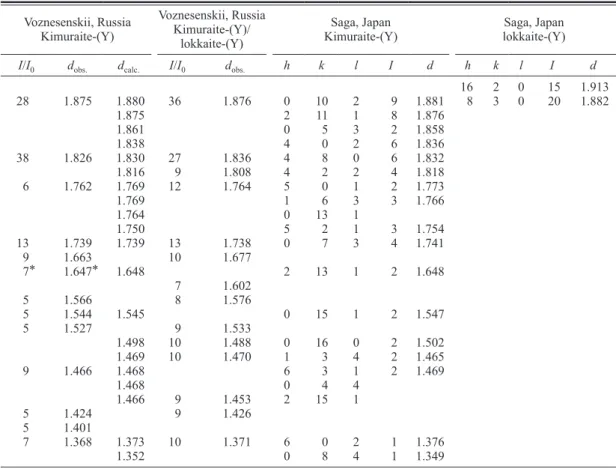
The powder X-ray diffraction (XRD) patterns of kimuraite-(Y) and associated minerals in the white veins were obtained using a Gandolfi cam- era, 114.6 mm in diameter, employing Ni-filtered Cu Kα radiation. The exposures were carried out without vacuum deairing to avoid decomposition owing to the nature of kimuraite-(Y), therefore the dehydration occurred in vacuo. The data were recorded on an imaging plate (IP), were pro- cessed with a Fuji BAS-2500 bio-image analyzer using a computer program written by Nakamuta (1999), and were calibrated with an internal Si- standard reference material (NBS #640b). The unit cell parameters of the orthorhombic system were refined using a computer program by Toraya (1993); a
= 9.246(3), b = 23.974(8), c = 6.058(3) Å, and V = 1342.8(8) Å3. The XRD data of kimuraite-(Y) from Abramovskoye are shown in Table 5, with the XRD data of a mixture of kimuraite-(Y) and lokkaite-(Y) shown for comparison.
The XRD data of the host rocks were obtained with a conventional X-ray diffractometer
(RIGAKU RINT2100; graphite monochroma- tized Cu Kα radiation, 20 kV 40 mA) in addition to the data from a Gandolfi camera. Quartz was determined to be the main constituent, and feld- spar and some phyllosilicates having basal planes of 14.5 and 7.2 Å, which were possibly kaolin- smectite clays, were determined to be minor con- stituents. The XRD pattern of HR-A showed reflections of calcite as another minor constituent in the sample.
Some mineralogical and petrological aspects on the Russian kimuraite-(Y)
Kimuraite-(Y) from Mikhailovsky district, Russia shows several differences from the min- eral from Saga, Japan, where is the type locality.
The Russian specimen is colorless with smaller amounts of Nd (ca. 0.01 apfu), in comparison to the pale pinkish purple color of the type speci- men with considerable amount of Nd (0.107
apfu). On the other hand, Y is more dominant(ca. 1.8 apfu) in the Russian kimuraite-(Y) than the type material (1.57 apfu). The dominance of Y-group REEs in the Russian kimuraite-(Y) is
Fig. 2. Chondrite normalized lanthanoids patterns of kimuraite-(Y), lanthanite-(Nd), the mixture of kimuraite-(Y) and lanthanite-(Nd) and the host rock samples.
Fig. 3. DTA-TG curves of the host rock samples of kimuraite-(Y).
Table 4. Chemical compositions of the host rock samples.
HR-A HR-B Saga
AOB* HR-A HR-B Saga
AOB* HR-A HR-B Saga
AOB*
Major constituent (wt.%) XRF Minor elements (ppm) XRF Minor elements (ppm) ICP-MS
SiO2 69.00 76.72 48.69 Li 26 26 7
TiO2 0.79 0.87 1.75 Be 35 73 1
Al2O3 9.01 9.74 14.82 S 9 0 0
Fe2O3 2.86 1.61 11.31 Sc 20 20 21
MnO 0.01 0.01 0.17 V 463 340 192 576 385 186
MgO 0.56 0.43 8.60 Cr 125 100 339
CaO 3.61 0.35 8.77 Co 19 46 40 4 3 39
Na2O 0.25 0.20 3.14 Ni 3402 2071 163 2367 1312 160
K2O 2.00 3.18 1.60 Cu 66 98 56 76 102 46
P2O5 0.02 0.02 0.45 Zn 15041 8350 72 11407 5575 75
LOI 10.73 6.13 0.15 Ga 23 22 17
Total 98.84 99.26 99.45 As 25 25
Rb 65 107 39 70 104 33
Estimated concentrations (wt.%) TG Sr 69 86 468 67 79 466
C 4.90 2.64 Y 898 2976 55 906 2616 52
CO2 2.12 0.00 Zr 179 192 149 176 166 137
H2O 3.44 4.51 Nb 29 61 34 17 14 28
sub total 10.46 7.15 Cs 4 5 0
Ba 850 1224 519 856 1187 436
La 91 104 27
Ce 27 38 51 26 36 46
Pr 14 37 6
Nd 58 262 25
Sm 14 150 6
Eu 4 56 2
Gd 35 450 7
Tb 8 81 1
Dy 66 525 7
Ho 19 107 1
Er 74 262 4
Tm 15 29 1
Yb 119 167 3
Lu 19 23 0
Hf 5 6 3
Ta 1 1 1
Tl 1 1 0
Pb 61 59 2 58 51 3
Th 13 15 4 10 12 4
U 13 10 1
*Alkaline olivine basalt
Table 5. XRD data of kimuraite-(Y).
Voznesenskii, Russia Kimuraite-(Y)
Voznesenskii, Russia Kimuraite-(Y)/
lokkaite-(Y)
Saga, Japan
Kimuraite-(Y) Saga, Japan
lokkaite-(Y)
I/I0 dobs. dcalc. I/I0 dobs. h k l I d h k l I d
5 37.3
13 19.9 2 0 0 25 19.81
96 11.93 11.99 13 12.0 0 2 0 100 12.06
20 9.90 4 0 0 50 9.90
6 8.92
11 8.61 8.63 1 1 0 2 8.66
4 8.08
37 6.54 6 0 0 70 6.56
86 5.91 5.99 0 4 0 40 6.02
5.87 78 5.87 0 1 1 20 5.93 2 1 0 50 5.85
5 5.09 5.07 12 5.17 1 0 1 1 5.11 4 1 0 7 5.19
33 4.84 4.83 10 4.84 0 3 1 10 4.87
100 4.62 4.62 100 4.62 2 0 0 10 4.64 0 0 2 55 4.62
21 4.48 6 1 0 10 4.49
24 4.31 4.31 7 4.31 2 2 0 3 4.33
12 3.99 4.00 0 6 0 20 4.01
17 3.87 3.87 20 3.91 1 4 1 5 3.87 10 0 0 50 3.94
83 3.76 3.76 97 3.82 0 5 1 30 3.76 8 1 0 100 3.84
38 3.64 3.66 37 3.62 2 4 0 1 3.68 2 1 2 25 3.63
3.63 2 1 1 6 3.64
17 3.44 4 1 2 7 3.45
45 3.34 3.34 15 3.34 2 3 1 7 3.35
21* 3.14* 3.14 9* 3.15* 1 6 1 6 3.16
13 3.21 6 1 2 10 3.23
3.03 0 0 2
13 3.02 3.02 18 3.00 2 6 0 4 3.03
3.00 0 8 0 8 3.01 10 0 2 10 3.01
47 2.92 2.94 70 2.94 0 2 2 10 2.93 8 1 2 40 2.95
2.92 2 5 1
38 2.68 2.68 31 2.69 3 2 1 5 2.69
10 2.58 2.58 13 2.59 1 8 1 5 2.59
28 2.54 2.53 46 2.54 2 0 2 8 2.55 0 2 2 30 2.55
30 2.50 2.51 2 8 0 6 2.52
2.51 2 7 1
2.48 19 2.45 2 2 2 4 2.48 16 0 0 25 2.46
15 2.41 2.44 22 2.41 0 9 1 3 2.44 10 2 0 15 2.41
2.41 0 6 2 4 2.42
2.40 6 2.37 0 10 0 6 2.41
6 2.33 2.33 2 4 2 1 2.35
9 2.31 2.31 10 2.30 4 0 0 1 2.32
13 2.27 2.27 4 2 0 1 2.27
6 2.22 2.20 7 2.24 1 7 2 1 2.23
20 2.15 2.16 19 2.16 4 4 0 4 2.16 16 0 2 15 2.17
2.16 2 9 1
2.15 24 2.14 4 1 1 4 2.15
2.15 3 1 2
23 2.13 2.13 20 2.11 2 10 0 8 2.13
2.13 0 8 2
50 2.09 2.08 18 2.09 4 3 1 7 2.09
25 2.05 2.05 49 2.05 0 11 1 12 2.05 18 1 0 40 2.06
14 2.02 2.02 13 2.02 3 8 1 2 2.02
2.01 0 1 3 1 2.01
2.00 4 6 0
24 1.968 1.969 35 1.972 4 5 1 4 1.972 18 0 2 10 1.979
1.958 0 3 3 4 1.948
15* 1.935* 1.935 6* 1.938* 2 8 2 4 1.934
suggested by the upward trend with abundances in heavy REEs, the typical trend for Y-dominant REE minerals, on the chondrite-normalized lan- thanoid patterns (Fig. 2). The trend is not so sig- nificant for the type kimuraite-(Y) with abundant middle REE, e.g., Gd and Tb. On the contrary, lanthanite-(Nd) from Mikhailovsky district, Rus- sia, shows a downward trend with abundances in light REEs, as well as lanthanite-(Nd) from other localities. All the patterns of the Russian speci- mens show a negative anomaly at the position of Ce (Fig. 2). This anomaly suggests some events under oxidizing conditions that led to the oxida- tion of Ce to separate the Ce
4+from the crystal- lizing system. The oxidizing conditions appear to have occurred at the source locality as well as in Higashi-Matsuura alkaline olivine basalt in Saga, Japan.
The difference in the REE composition has
little effect on the unit cell parameters of kimuraite-(Y):
a = 9.246(3), b = 23.974(8), c = 6.058(3) Å, and V = 1342.8(8) Å3[Mikhailovsky], a = 9.2545(8), b = 23.976(4),
c = 6.0433(7) Å, and V = 1340.9(3) Å3[Saga].
It is worth noting that some minute fragments (<100
μm) on the Gandolfi camera gave theXRD pattern of a mixture of kimuraite-(Y) and lokkaite-(Y). The XRD pattern indicates that the two REE carbonate minerals are closely associ- ated with each other. An epitaxial overgrowth in the systematical stacking sequence is suspected in the fragments.
The host rock examined in the present study should correspond to the argillizated brecciated shale with adsorbed REEs and/or the stockwork of REE – carbonates (Seredin, 1998). Seredin (1998) suggested that the Abramovskoye ore occurrence and the Higashi-Matsuura alkaline
Voznesenskii, Russia Kimuraite-(Y)
Voznesenskii, Russia Kimuraite-(Y)/
lokkaite-(Y)
Saga, Japan
Kimuraite-(Y) Saga, Japan
lokkaite-(Y)
I/I0 dobs. dcalc. I/I0 dobs. h k l I d h k l I d
16 2 0 15 1.913
28 1.875 1.880 36 1.876 0 10 2 9 1.881 8 3 0 20 1.882
1.875 2 11 1 8 1.876
1.861 0 5 3 2 1.858
1.838 4 0 2 6 1.836
38 1.826 1.830 27 1.836 4 8 0 6 1.832
1.816 9 1.808 4 2 2 4 1.818
6 1.762 1.769 12 1.764 5 0 1 2 1.773
1.769 1 6 3 3 1.766
1.764 0 13 1
1.750 5 2 1 3 1.754
13 1.739 1.739 13 1.738 0 7 3 4 1.741
9 1.663 10 1.677
7* 1.647* 1.648 2 13 1 2 1.648
7 1.602
5 1.566 8 1.576
5 1.544 1.545 0 15 1 2 1.547
5 1.527 9 1.533
1.498 10 1.488 0 16 0 2 1.502
1.469 10 1.470 1 3 4 2 1.465
9 1.466 1.468 6 3 1 2 1.469
1.468 0 4 4
1.466 9 1.453 2 15 1
5 1.424 9 1.426
5 1.401
7 1.368 1.373 10 1.371 6 0 2 1 1.376
1.352 0 8 4 1 1.349
* Estimaterd from data without the internal Si-standard, because of overlap by the reflections of Si.
Table 5. continued
olivine basalt are characterized by a common geological feature that is related to the basaltic volcanism. The present chemical and crystallo- graphic examinations on the host rock samples revealed that they are siliceous mudstone consist- ing of quartz as the main constituent mineral with minor kaolin-smectite clay minerals and K-feldspar with some carbonaceous materials and trace accessary minerals. The Mg- and Fe- poor host rock samples are not maffic, but are rather felsic. They showed no signature of basal- tic volcanism origin.
The extraordinarily high REE concentration of the host rocks (Seredin, 1998) was confirmed by the present chemical analyses of the mudstone.
The REE concentration is remarkably higher than those of the alkaline olivine basalt from Saga, Japan (Table 4). The alkaline olivine basalt indicated no Ce-anomaly, but a decreasing trend toward heavy REEs on the chondrite-normalized REE pattern (Fig. 2). The negative and positive Ce-anomalies in the rare earth carbonate miner- als and weathered basalt, respectively, in Saga Prefecture suggest that the carbonate minerals are precipitation products after the separation of Ce
4+, which was oxidized during the weathering of the alkaline olivine basalt, from the source of the rare earth carbonate minerals (Watanabe et
al., 2014). On the contrary, the host rock samples(HR-A and -B) showed chondrite-normalized REE patterns, which are comparable to those of the host rare earth carbonate minerals, having the Ce-anomaly and an increasing trend toward heavy REEs. The geological backgrounds of Mikhailovsky and Saga contrast with each other, whereas kimuraite-(Y) shows some commonali- ties in occurrence nature, e.g., the associated minerals and the negative Ce-anomaly, between the two localities across the Sea of Japan.
Acknowledgements
This joint investigation between the National Museum of Nature and Science, Tokyo, Japan and the Far East Geological Institute, Far Eastern Brach Russian Academy of Sciences, Vladivo-
stok, Russia, was supported by the research proj- ect entitled “Research on the Earthʼs surface pro- cesses and biota in and near the Sea of Japan” of the National Museum of Nature and Science. The authors are grateful to Professor A. I. Khanchuk, Director, Academician of the Far East Geological Institute, Far Eastern Brach Russian Academy of Sciences, Vladivostok, Russia for his hospitable supports. We express our appreciation to Dr. S.
Matsubara, curator emeritus of the National Museum of Nature and Science, for his com- ments and suggestions. Special thanks go to Dr.
S. Uehara of Kyushu University and Mr. S.
Iwano of the Mineral Friends of Fukuoka for their supports in the field research.
References
Chang, Q., T. Shibata, K. Shinotsuka, M. Yoshikawa & Y.
Tatsumi, 2003. Precise determination of trace elements in geological standard rocks using inductively coupled plasma mass spectrometry. Frontier Research on Earth Evolution (IFREE Report for 2001–2002), 1: 357–362.
Miyawaki, R., J. Kuriyama & I. Nakai, 1993. The redefi- nition of tengerite-(Y), Y2(CO3)3・2–3H2O, and its crys- tal structure. American Mineralogist, 78: 425–432.
Nagashima, K., R. Miyawaki, J. Takase, I. Nakai, K. Sak- urai, S. Matsubara, A. Kato & S. Iwano, 1986. Kimu- raite, CaY2(CO3)4・6H2O, a new mineral from fissures in an alkali olivine basalt from Saga Prefecture, Japan, and new data on lokkaite. American Mineralogist, 71:
1028–1033.
Nakamuta, Y, 1999. Precise analysis of a very small min- eral by an X–ray diffraction method. Journal of the Mineralogical Society of Japan, 28: 117–121 (in Japa- nese with English abstract).
Rodriguez-Navarro, C., E. Ruiz-Agudo, A. Luque, A. B.
Rodriguez-Navarro & M. Ortega-Huertas, 2009. Ther- mal decomposition of calcite: Mechanisms of forma- tion and textural evolution of CaO nanocrystals. Ameri- can Mineralogist, 94: 578–593.
Sano, T., T. Fukuoka & M. Ishimoto, 2011. Petrological constraints on magma evolution of the Fuji volcano: A case study for the 1707 Hoei eruption, in Studies on the Origin and Biodiversity in the Sagami Sea Fossa Magna Element and the Izu-Ogasawara (Bonin) Arc.
Memoirs of the National Museum of Nature and Sci- ence, Tokyo, 47: 471–496.
Seredin, V. V., 1998. Rare earth mineralization in Late Cenozoic explosion structures (Khanka massif, Primor- skii Krai, Russia). Geology of Ore Deposits, 40: 357–
371.
Toraya, H., 1993. The determination of unit–cell parame- ters from Bragg reflection data using a standard refer- ence material but without a calibration curve. Journal of Applied Crystallography, 26: 583–590.
Watanabe, Y., M. Hoshino & Y. Horiuchi, 2014. Genesis of the rare earth minerals in the Higashi Matsu-ura Basalt in the Saga Prefecture, Japan. Rare Earths, 64:
40–41 (in Japanese with English abstract).
極東ロシア産の木村石
宮 脇 律 郎・門 馬 綱 一・佐 野 貴 司・堤 之 恭・
Sergei A. Kasatkin・Igor Chekryzhov・横 山 一 己
極東ロシア,プリモルスキー州産の木村石は,微細結晶が真珠から絹糸光沢を呈する白 色集合体として,ロッカ石やネオジムランタン石を伴って,黒色ないしは暗褐色の泥岩中 の白色脈として産する.母岩の泥岩は,微細な石英粒を主体とし,長石類,層状ケイ酸塩 や石墨を含み,時に方解石を伴う.佐賀県産の原記載の木村石と類似の化学組成と結晶の 単位格子を示すが,原記載の木村石に比べ,重希土の卓越が著しく,典型的なイットリウ ム鉱物の希土類パターンを持つ.原記載と同様に,セリウムとユウロピウムに負の異常が 見られるが,母岩の泥岩は1000から3000 ppm程度の高いイットリウム濃度を示し,これ までに報告の無い特異的な成因が注目される.