
• 検索結果がありません。

台湾2011調査報告書

N/A
N/A
Protected

Academic year: 2021

シェア "台湾2011調査報告書"

Copied!
297
0
0

読み込み中.... (全文を見る)

全文

(1)

統計数理研究所調査研究リポート No.106

2012年6月

アジア・太平洋価値観国際比較調査

文化多様体の統計科学的解析

台湾2011調査報告書

吉野諒三・芝井清久 編集

大学共同利用機関法人 情報・システム研究機構

統 計 数 理 研 究 所

〒190-8562 東京都立川市緑町10-3

(2)

統計数理研究所調査研究リポート

ISM Survey Research Report

統計数理研究所調査研究リポートは、当研究所の研究調査のデータの発表を目的とし て、調査研究リポート編集委員会の審査を経て、適宜、発刊する。ただし、内容に関し てはすべて各著者・編者が責任を負う。著作権は統計数理研究所にあるものとする。調 査研究リポート編集委員会の文書による承諾なしには、調査研究リポートの全部または 一部の転載や複製は、いかなる形式、いかなる媒体においても禁ずる。ただし、各著者 が執筆した部分については、本人が論文等で活用する権利は認める。

(注) 本調査研究リポートは過去に以下のような名称で発刊されてきたが、平成 22 年 12 月に誌名は現在の「統 計数理研究所調査研究リポート(略称 調査研究リポート)」と変更された。

No.1~2 統数研研究リポート

No.3~41 数研研究リポート

No.42~101 統計数理研究所研究リポート

No.102~ 統計数理研究所調査研究リポート

The Institute of Statistical Mathematics issues the series of ISM Survey Research Report under the supervision of the committee of ISM Survey Research Report in order to publish data of surveys carried out by the institute. The author(s) and/or editor(s) of each issue, however, are responsible for the content. Copyright is reserved by the Institute of Statistical Mathematics. No part of any issue may be reproduced or transmitted in any form or by any means, electric or mechanical, including photocopy, recording, or any information storage and retrieval system, without permission in writing from the committee of the institute. The author or editor of each issue, however, may make use of his/her writing in another academic paper or article.

(Note) This series of survey reports has been published under different titles in the past, but it has been renewed as "統計数理研究所調査研究リポート (ISM Survey Research Report)"

in December of 2010.

No.1~2 統数研研究リポート (Research Report, General Series) No.3~41 数研研究リポート (Research Report, General Series)

No.42~101 統計数理研究所研究リポート(Research Report, General Series) No.102~ 統計数理研究所調査研究リポート(ISM Survey Research Report)

大学共同利用機関法人 情報・システム研究機構 The Institute of Statistical Mathematics 統計数理研究所 10-3 Midori-cho, Tachikawa

〒190-8562 東京都立川市緑町 10-3 Tokyo 190-8562, JAPAN

電話 050-5533-8500(代表)
Phone: +81-(0)50-5533-8500 (receptionist)

© The Institute of Statistical Mathematics (2012)

(3)

統計数理研究所調査研究リポート ISM Survey Research Report

統計数理研究所調査研究リポートは、当研究所の研究調査のデータの発表を目的とし て、調査研究リポート編集委員会の審査を経て、適宜、発刊する。ただし、内容に関し てはすべて各著者・編者が責任を負う。著作権は統計数理研究所にあるものとする。調 査研究リポート編集委員会の文書による承諾なしには、調査研究リポートの全部または 一部の転載や複製は、いかなる形式、いかなる媒体においても禁ずる。ただし、各著者 が執筆した部分については、本人が論文等で活用する権利は認める。

(注) 本調査研究リポートは過去に以下のような名称で発刊されてきたが、平成 22 年 12 月に誌名は現在の「統

計数理研究所調査研究リポート(略称 調査研究リポート)」と変更された。

No.1~2 統数研研究リポート

No.3~41 数研研究リポート

No.42~101 統計数理研究所研究リポート

No.102~ 統計数理研究所調査研究リポート

The Institute of Statistical Mathematics issues the series of ISM Survey Research Report under the supervision of the committee of ISM Survey Research Report in order to publish data of surveys carried out by the institute. The author(s) and/or editor(s) of each issue, however, are responsible for the content. Copyright is reserved by the Institute of Statistical Mathematics. No part of any issue may be reproduced or transmitted in any form or by any means, electric or mechanical, including photocopy, recording, or any information storage and retrieval system, without permission in writing from the committee of the institute. The author or editor of each issue, however, may make use of his/her writing in another academic paper or article.

(Note) This series of survey reports has been published under different titles in the past, but it has been renewed as "統計数理研究所調査研究リポート (ISM Survey Research Report)"

in December of 2010.

No.1~2 統数研研究リポート (Research Report, General Series) No.3~41 数研研究リポート (Research Report, General Series)

No.42~101 統計数理研究所研究リポート(Research Report, General Series) No.102~ 統計数理研究所調査研究リポート(ISM Survey Research Report)

大学共同利用機関法人 情報・システム研究機構 The Institute of Statistical Mathematics

統計数理研究所

10-3 Midori-cho, Tachikawa

〒190-8562 東京都立川市緑町 10-3 Tokyo 190-8562, JAPAN

電話 050-5533-8500(代表)
Phone: +81-(0)50-5533-8500 (receptionist)

(4)

統計数理研究所 調査研究リポート No.106

アジア・太平洋価値観国際比較調査

――文化多様体の統計科学的解析――

台湾 2011 調査報告書

吉野諒三・芝井清久 編集

平成 24 年 6 月

大学共同利用機関法人 情報・システム研究機構

統計数理研究所

〒190-8562 東京都立川市緑町 10-3

(5)

アジア・太平洋価値観国際比較調査 台湾 2011 調査報告書

――文化多様体の統計科学的解析――

研究組織

研究代表者 吉野諒三 (統計数理研究所 データ科学研究系 教授)

(統計数理研究所 調査科学研究センター センター長)

研究分担者 土屋隆裕 (統計数理研究所 データ科学研究系 准教授)

研究協力者 山岡和枝 (帝京大学 公衆衛生学研究科 教授)

佐々木正道(中央大学 文学部 教授)

鄭 躍軍 (同志社大学 文化情報学部 教授)

林 文 (東洋英和女学院大学 人間科学部 教授)

芝井清久 (統計数理研究所 特任研究員)

二階堂晃祐(統計数理研究所 特任研究員)

氏家豊 (統計数理研究所 特任研究員)

大﨑裕子 (統計数理研究所 技術補佐員)

※ 今後、本報告書を含め、過去の調査報告書に誤謬が見つかった場合は、報告書の Web ページ

( http://www.ism.ac.jp/~yoshino/ )にてお知らせする予定である。

(6)

The Asia-Pacific Values Survey

--- Cultural Manifold Analysis (CULMAN ) on peoples’ sense of trust --- Taiwan 2011 Survey

Chief

Ryozo Yoshino

(Professor, Department of Data Science, The Institute of Statistical Mathematics) (Director, Survey Science Center, The Institute of Statistical Mathematics)

Members

Takahiro Tsuchiya (Associate Professor, Department of Data Science, The Institute of Statistical Mathematics)

Kazue Yamaoka (Professor, Teikyo University ) Masamichi Sasaki (Professor, Chuo University) Yuejun Zheng (Professor, Doshisha University)

Fumi Hayashi (Ex-Professor, Toyo-Eiwa Women’s University)

Assistants

Kiyohisa Shibai (Project Researcher, The Institute of Statistical Mathematics) Kosuke Nikaido (Project Researcher, The Institute of Statistical Mathematics) Yutaka Ujiie (Project Researcher, The Institute of Statistical Mathematics) Hiroko Osaki (Technical Assistant, The Institute of Statistical Mathematics)

Note: In the case we find some errors in our reports or data, we will list them in our home page:

(7)
(8)

i

はしがき

本書は、日本学術振興会の科学研究費補助金の支援による「アジア・太平洋価値観国際 比較調査 --- 文化多様体の統計科学的解析 --- 」(基盤研究 S 課題番号 No.22223006 、研究代 表 吉野諒三) (2010 年度 -2014 年度 ) の台湾 2011 年調査の第 1 次報告を、統計数理研究 所・調査研究リポートとして発刊したものである。

本 調 査 研 究 は 先 行 す る 2002-2005 年 度 の 「 東 ア ジ ア 価 値 観 国 際 比 較 調 査 」、 お よ び

2006-2009 年度の「環太平洋価値観国際比較調査」の拡大を意図した調査研究の一環であ

り、 2010 年度は日本と米国、 2011 年度は中国(北京・上海・香港)および台湾において、

それぞれの国・地域に応じた統計的標本抽出法に則り、面接調査が遂行された。

この研究は、歴史的には統計数理研究所における 1953 年以来の「日本人の国民性」調 査及び 1971 年以来の「意識の国際比較」調査の延長上にある。 「日本人の国民性」調査は、

戦後民主主義の基盤としての官民の世論調査発展と緊密に結びつき、 「意識の国際比較」調 査は、連鎖的調査分析( Cultural Linkage Analysis, CLA )の確立へとつながった。そし てさらに、近年の研究は、計量的文明論としての「文化多様体解析( Cultural Manifold

Analysis, CULMAN )」という方法論の確立を目指す研究の一環として位置づけられてい

る。

本研究の背景と意義は、以下の通りである。

冷戦の終了以降、世界情勢のダイナミックな変動とともに、政治、経済、社会の伝統的 枠組が大きく変わり、社会生活の基盤であった人々の信頼のあり方も大きな影響を受けて いる。伝統的な産業社会から高度情報化社会への過渡期と見られる現在、従来の家庭、学 校、職場での人間関係のあり方にも崩壊が生じ、新たな時代の流れが確立するまでの混乱 が続いてきた。日本経済はバブル崩壊以降、 「失われた 10 年」と言われたが、その状況は 現在でも改善されたわけではない。さらに、昨年 3 月は東日本大震災とそれに伴うフクシ マ原子力発電所事故という未曽有の災難を被り、その復興の途上で混迷が続いている。

一方、政治経済の視点からは、欧州共同体や南北アメリカ圏のみならず、東アジア圏の 再編成が唱えられている。東南アジアを含む東アジア圏は、欧州とは異なり、多様な文化、

歴史を持つ国々や地域の集合であり、政治にせよ経済にせよ、それらの統合は必ずしも容 易ではないであろうが、現実には ASEAN 等の協力関係が推進されつつある。我々が 2002 年の東アジア価値観調査を計画した時には、 「東アジア」という言葉はまだ一般には、地理 的に曖昧なものでしかなかった。その後、 「東アジア共同体」構想についての議論が高まり、

特に戦後長期に継続した自民党政権から民主党の鳩山政権になり、その構想が掲げられた

が、沖縄米軍基地移転問題などを含め、日中米の国際関係の中で警戒感を巻き起こし、交

代した菅政権では、その言葉は消えてしまった。ただし、アジアと太平洋の各国の多様な

協力、多重の連携協力は着実に推進されており、現在の野田政権において「アジア・太平洋

共同体(APEC)」や「環太平洋戦略的経済連携協定(TPP)」等々の国際協力の枠組みの

検討が進展し、あたかも「文化の多様体」 ( 吉野 ,2005; Yoshino, Nikaido & Fujita, 2009)

が構築されているかのようである。

(9)

ii

こういった世界の流れを適格に把握し、将来を見通すための実証的基礎情報を収集すべ く、各国、各機関が様々な社会調査、国際比較調査を遂行している。例えば、世界価値観

調査( World Values Survey )は世界の数十カ国で共通質問項目を用いた国際比較調査デ

ータや時系列比較可能なデータを提供し、学術研究にも行政施策にも資するところが大き い。しかしながら、過去の東アジア地域における調査の実情を詳細に調べてみると、その 結果には疑いが隠せない。国際比較調査では、質問項目を各国の言語に適切に翻訳するこ とが重要な手続きであるが、各国内の事情の差異を見過ごしたための誤訳が見受けられ、

また、報告された回収率などから、計画された統計的無作為標本抽出の手続きが調査の現 場でどこまで遵守されているのか、疑義を持つ調査研究者も少なくない。

以上のような背景があり、我々は、アジア・太平洋地域の調査は、やはり当該地域の人々 によって慎重に推進されるべきであるという認識に至った。我々は、各国でどの程度統計 学的に適正な標本抽出調査が遂行でき、また国際比較可能性が保てるのかという課題を自 ら実証的に検討することを主眼にし、それを把握した上でアジア・太平洋諸国の人々の価 値観や意識を比較分析する課題に取り組んできた。現実には、各国で日常、厳密な統計調 査がどの程度なされているか、それ自体が各国の政治・経済・社会の状況を如実に表して いることが強く認識されている。

今回の調査票は、一般社会意識調査としてのスタイルをとり、人々の生活一般に関する 多様な項目を含んでいる。しかし、特に 21 世紀初頭の急変しつつある世界情勢、そして その中でも、急速に変化するアジア・太平洋の国々と、数々の問題を抱えながらも再秩序 化されつつある国家間の関係を考慮して、日本と他のアジア・太平洋諸国の人々の価値観、

対人的信頼感や法意識を含む人間関係に関する意識、自然観や生命観の統計的解明に適切 と思われる項目を検討した。結果として、多くの項目は、 2002-2005 年度の「東アジア価 値観国際比較調査」及び 2006-2009 年度の「環太平洋価値観国際比較調査」と重複してい るので、重複して調査されている国や地域については、この 10 年ほどの時系列調査とも なっている。

社会調査、特に国際比較調査では費用、時間、労力のみならず様々な技術的な限界が常 に付き纏うものであり、目前の多様な問題解決へ直ちに繋がるような調査項目の選定は容 易ではない。今後の各方面での調査データや情報を、相補的に考慮して研究を推進するの みである。

アジア・太平洋諸国の社会状態は複雑であり、特に中国、そしてインドの躍進は目覚ま しいものがある。一方でどの国も政治的にも決して一枚岩ではなく、地域や階層の間の大 きな経済格差を抱え、それが国際関係の進展にも影を投げ、将来を予測するのは容易では ない。それゆえに、各国の客観的実態統計とともに、各国民の意識や価値観の動向を的確 に調査する意義がある。我々の基本方針は、現地で通常用いられている調査方法を尊重し、

その実態を学ぶことである。国や地域によっては、しばしば、回収データの質の低さの点

で、これまで我々が遂行してきた国や地域と比較して、統計的方法論や実践的手続きなど

の諸問題に憂いを抱かざるを得ないが、調査研究者としてはそのようなデータの中から、

(10)

iii

いかに信頼できる情報を抽出できるか考えていかねばならない。

国際比較としての詳細なデータ解析も、実際の調査では避けられない各国・各地域の言 語の差異、調査方法の差異などを考慮し、単純に回答分布の皮相な数字の大小比較ではな く、今後収集されていく他の関連諸国・地域の調査データや資料、情報とともに、慎重に 時間をかけて安定したパターン構造を浮かび上がらせるような分析がなされて行くべきで ある。それゆえ、本報告書は、国内外の多くの方々に速やかに基本情報を提供すべく、一 次報告として刊行されている旨を御了解願いたい。

(文責 吉野諒三)

※注意 1 .今回の中国調査は、北京および上海での近年の居住地域の編成の急激な変化と、

各居民委員会(日本の自治会に相当)における住民の出入りの厳重な管理に応じて、前 2 回の調査で用いられたエリアサンプリング法を適用することが困難となり、地点抽出され た各居民委員会の入り口で当該の住民を性別・年齢層別に割り当て抽出するという方法に 変更した。これに応じて、台湾調査でも同様の方法に変えた。このため、データの時系列 比較においては、サンプリング方法の差異をも勘案すべきであろう。(注.現地調査会社 によると、台湾では、台北を除き、前回同様にランダムルート法などで面接調査は十分に 可能と分かったが、中国本土と方法を合わせることとした。)

※注意 2 . われ われの 過去 の国 際比較 調査 等、 関連情 報とし て、 次の統 計数 理研 究所の Web ページも参考にして頂きたい( http://www.ism.ac.jp/~yoshino/ )。今後、本報告書を 含め、過去の調査報告書に誤謬が見つかった場合は、同 Web ページにてお知らせする予 定である。

※注意 3 . 2006-2009 年度の「環太平洋価値観国際比較調査」に関して、同調査が環太平

洋地域のみならずインドを含めていたため、過去の報告書や論文等で「アジア・太平洋価 値観比較調査」の名称が用いられていた場合があったが、今後は、 3 つの関連する調査を 明確に区別するために以下のように正式名称を定めることとします。

・「東アジア価値観国際比較調査」( 2002-2005 年度)

・「環太平洋価値観国際比較調査」( 2006-2009 年度)

・「アジア・太平洋価値観国際比較調査」 (2010 年度 -2014 年度 ) 謝辞

本研究は日本学術振興会による科学研究費補助金・基盤研究 S (課題番号 No.22223006 、 研究代表 吉野諒三)の御支援により遂行されている。

今回のアジア・太平洋価値観国際比較調査は、これまでの一連の調査研究の延長上にあ

り、これらの研究は、文部科学省研究振興局学術研究助成課、機関課、情報課、日本学術

振興会、トヨタ財団、日本財団、笹川財団をはじめ、官民の多くの方々や団体の御支援を

(11)

iv 得て遂行されたものであり、深く感謝いたします。

また、本報告書の作成の作業は松本拓郎、龍田佳典、岩永有史、臼杵悠、岸野幸枝、松 元玲依、青野桃子、小宮沙都希、小野洋平(順不同)の諸君にお手伝いいただきました。

皆様に感謝いたします。

(12)

v 参考文献

Fujita, T., and Yoshino, R. (2009). Social values on international relationships in the Asia-Pacific region. Behaviormetrika , Vol.36, No.2, pp.148-165.

Hayashi, F. and Nikkaido K. (2009). Religious Faith and Religious Feelings in Japan:

Analyses of Cross-Cultural and Longitudinal Surverys. Behaviormetrika , Vol.36, No.2, pp.167-180.

林知己夫、鈴木達三、吉野諒三他 (1998). 国民性七か国比較.出光書店 林知己夫他 (1992). 第五 日本人の国民性.出光書店.

Inkeles, A. (1997). National character . Transaction Publishers: New Brunswick.

(吉野諒三( 2003 )訳「国民性論 ― 精神社会的展望 ―」出光書店)

Tsunoda, H., Yoshino, R., & Yokoyama. (2008). Components of Social Capital and Socio-Psychological Factors That Worsen the Perceived Health of Japanese Males and Females. The Tohoku Journal of Experimental Medicine , Vol.216, No.2 , pp.173-185.

吉野諒三 (2001). 心を測る ― 個と集団の意識の科学 ―.朝倉書店.

Yoshino, R. (2002). A time to trust. Behaviormetrika . Vol.29 No.2, pp.231-260.

吉野諒三 (2003). 「信の崩壊」― 世論調査方法 論の今日の課題.行動計 量学,展望「 21

世紀の行動計量学」第 29 巻第 1 号 , pp.45-54.

吉野諒三 (2003). 「信頼の時代」 . Eco-Forum, Vol.22, No.1, 特集号「ソーシャル・キャピ タル Part II 」 ,pp.42-51. 統計研究会 .

吉野諒三 (2005). 東アジア価値観国際比較調査―文化多様体解析( CULMAN )に基づく

計量的文明論構築へ向けて―.行動計量学 . 第 32 巻 2 号 , pp. 133-146.

吉野諒三 (2005). 富国信頼の時代へ―東アジア価値観国際比較調査における「信頼感」の

統計科学的解析―.行動計量学 . 第 32 巻 2 号 , pp. 147-160.

Yoshino, R. (2005). Trust and National Character--- Japanese sense of trust,

Cross-national and longitudinal surveys-. Comparative Sociology , Vol.4, No.3-4, pp.417-450.

吉野諒三 (2005). 東アジア価値観調査-文化多様体解析( CULMAN )に基づく計量文明

論の構築へ向けて — .行動計量学.第 32 巻第 2 号, pp.133-146.

吉野諒三 (2005). 富国信頼の時代へ —— 東アジア価値観国際比較調査における信頼感の

統計科学的解析 —— .行動計量学.第 32 巻第 2 号, pp.147-160.

Yoshino, R. (2006). A social value survey of China --- on the change and stability in the Chinese globalization ---. Behaviormetrika . Vol.33, No.2, pp. 111-130.

吉野諒三編 (2007). 東アジア国民性比較 データの科学.勉誠出版.

吉野諒三 (2008). 「科学的」世論調査の価値 - 歴史と理論と実践の三位一体 . 日本統計学会

誌、 37,2,pp.279-290. (2008).

吉野諒三 (2008). 海外の標本抽出面接調査の方法 . いんふぉるむ 第 53 回 . 新情報、 Vol.95.

pp.7-12.

吉野諒三 (2008). 「国民性」と環境問題 --- 文化の多様性を受け入れる政策立案のために

(13)

vi ---. 環境情報科学 37,1,pp.21-26. (特集号)

吉野諒三 (2008). UFO は存在するか ? --- お化け調査再考「合理と非合理の間」 ---. 市場調 査、 273 、 pp.4-13.

吉野諒三 (2008). 継続調査の課題と将来 . 社会と調査、創刊号、 pp.29-35.

吉野諒三 . (2008). 信頼の国際比較 . (所収「ソーシャル・キャピタルの潜在力」稲葉陽二

編) , 日本評論社 , pp. 31-53.

Yoshino, R. (2009). Reconstruction of trust on a cultural manifold: sense of trust in longitudinal and cross-national surveys of national character. Behaviormetrika , Vol.36, No.2, pp.114-147.

Yoshino, R. (2012). Reconstruction of trust on a cultural manifold: sense of trust in longitudinal and cross-national surveys of national character. In M. Sasaki, M. &

R. M. Marsh, R.M., (ed.), Trust-comparative perspectives -, pp.297-346.

Yoshino, R. & Hayashi, C. (2002). An overview of cultural link analysis of national character. Behaviormetrika . Vol.29 No.2, pp.125-141.

吉野諒三、鄭躍軍、朴承根 (2003). 東アジア諸国の人々の日本語観.行動計量学 , 第 30 巻第 1 号, pp.311-52.

Yoshino, R., Nikaido, K., & Fujita, T. (2009). Cultural manifold analysis (CULMAN) of national character: paradigm of cross-national survey. In Behaviormetrika , Vol.36, No.2, pp.89-114.

吉野諒三・林文・山岡和枝( 2010) . 国際比較データの解析 . 朝倉書店 .

鄭躍軍、吉野諒三、村上征勝 (2006). 東アジア諸国の人々の自然観・環境観の解析 — 環境 意識形成に影響を与える要因の抽出 — .行動計量学. Vol.32, No.2, pp.55-68.

[統計数理研究所 研究リポート]

(http://www.ism.ac.jp/editsec/kenripo/index.html に一覧がある )

No. 54. 社会的態度基底構造についての国際比較方法の標準化に関する研究 . ( 林知己夫編 ,

1981)

No. 59. 社会調査による国際比較方法の研究 . ( 林知己夫編 , 1984)

No. 70. 意識の国際比較方法論の研究:連鎖的比較方法の確立とその展開- 1988 年ハワ

イ・ホノルル市民調査- . ( 林知己夫・鈴木達三編 , 1991)

No. 71. 意 識 の 国際 比 較 方 法論 の 研 究 -新 し い 統計 的 社 会 調査 法 の 確立 と そ の 展開 - . ( 林知己夫・鈴木達三編 , 1991)

No. 72. 意識の 国際比 較方法 論の研 究 - 5ヵ 国調査共 通ファ イルコ ードブ ック- 1987 年ドイツ調査 1987 年フランス調査 1987 年イギリス調査 1988 年アメリカ調査 1988 年日本調査 . ( 林知己夫編 , 1992)

No. 73. 意識の国際比較方法論の研究 -5ヵ国調査性別・年齢別集計- 1987 年ドイツ調

査 1987 年フランス調査 1987 年イギリス調査 1988 年アメリカ調査 1988 年日本 調査 . ( 林知己夫編 , 1993)

No. 74. ブラジル日系人の意識調査 - 1991 ~ 1992 - . ( 山本勝造・河合武夫編 , 1993)

No. 75. 国民性の研究 第 9 回全国調査 - 1993 年全国調査- . ( 日本人の国民性調査委員

(14)

vii 会編 , 1994).

No. 76. 意識の国際比較における連鎖的調査分析方法の実用化に関する研究-総合報告書

- . ( 吉野諒三・鈴木達三編 , 1995)

No. 77. 意識の国際比較における連鎖的調査分析方法の実用化に関する研究-国民性の国

際比較の為のマニュアル- . ( 吉野諒三・鈴木達三編 , 1995)

No. 78. 意識の国際比較における連鎖的調査分析方法の実用化に関する研究-イタリア調

査の回答コードブック- . ( 吉野諒三・鈴木達三編 , 1995)

No. 79. 意識の国際比較における連鎖的調査分析方法の実用化に関する研究-イタリア調

査の自由回答データ- . ( 吉野諒三・鈴木達三編 , 1995)

No. 80. 意識の国際比較における連鎖的調査分析方法の実用化に関する研究-オランダ調

査の回答コードブック- . ( 吉野諒三・鈴木達三編 , 1995)

No. 81. 意識の国際比較における連鎖的調査分析方法の実用化に関する研究-オランダ調

査の自由回答データ- . ( 吉野諒三・鈴木達三編 , 1995)

No. 82. 意識の国際比較における連鎖的調査分析方法の実用化に関する研究-共通ファイ

ルコードブック- . ( 吉野諒三・鈴木達三編 , 1995)

No. 83. 国民性の研究 第 10 次全国調査- 1998 年全国調査- . ( 日本人の国民性調査委員会 編 , 1998)

No. 84. 国民性に関する意識調査データに基づく文化の伝播変容のダイナミズムの統計科

学的解析 . ( 吉野諒三編 , 2000)

No. 86. 文化の伝搬変容の統計科学的研究-ハワイ日系人・非日系人国際比較調査- . ( 吉

野諒三編, 2001)

No. 89. 日本・中国の国民性比較のための基礎研究 - 中国北京市における意識調査 - .

( 鄭躍軍編 , 2003)

No. 90. 日本・中国の国民性比較のための基礎研究 (2)- 中国上海市における意識調

査 - . ( 鄭躍軍編 , 2003)

No. 91. 東アジア価値観国際比較調査 - 「信頼感」の統計科学的解析 - 2002 年日本調

査報告書 . ( 吉野諒三編 , 2004)

No. 103. アジア・太平洋価値観国際比較調査 -文化多様体の統計科学的解析- 2010 年

日本調査報告書 . ( 吉野諒三・二階堂晃祐編 , 2011)

No. 104. アジア・太平洋価値観国際比較調査 -文化多様体の統計科学的解析- 2010 年

USA 調査報告書 . ( 吉野諒三・二階堂晃祐編 , 2011)

[その他の統計数理研究所刊行のレポート]

東アジア価値観国際比較調査 2002 年日本調査 . ( 吉野諒三編 , 2004)

東アジア価値観国際比較調査 2002 年中国調査 [ 北京 , 上海 , 香港 ]. ( 吉野諒三編 , 2004) 東アジア価値観国際比較調査 2003 年台湾調査 . ( 吉野諒三編 , 2005)

東アジア価値観国際比較調査 2003 年韓国調査 . ( 吉野諒三編 , 2005)

東アジア価値観国際比較調査 2004 年シンガポール調査 . ( 吉野諒三編 , 2005)

東アジア価値観国際比較調査 2004 年日本 A 調査 . ( 吉野諒三編 , 2005)

(15)

viii

東アジア価値観国際比較調査 2004 年日本 B 調査 . ( 吉野諒三編 , 2005)

東アジア価値観国際比較調査 --- 「信頼感」の統計科学的解析― . 総合報告書 . ( 吉野諒三編 , 2006)

環太平洋価値観国際比較調査 2005 年中国調査 [ 北京 , 上海 , 香港 ]. ( 吉野諒三編 , 2007) 環太平洋価値観国際比較調査 2006 年台湾調査 . ( 吉野諒三・袰岩晶編 , 2007)

環太平洋価値観国際比較調査 2006 年韓国調査 . ( 吉野諒三・松本渉編 , 2007) 環太平洋価値観国際比較調査 2006 年 USA 調査 . ( 吉野諒三編 , 2007)

環太平洋価値観国際比較調査 2007 年シンガポール調査 . ( 吉野諒三編 , 2008)

環太平洋価値観国際比較調査 2007 年オーストラリア調査 . ( 吉野諒三・松本渉編 , 2008) 環太平洋価値観国際比較調査 2008 年インド調査 . ( 吉野諒三編 , 2009)

環太平洋価値観国際比較調査 - 東アジアと周辺諸国の「信頼感」の統計科学的解析 --. 総合 報告書 . ( 吉野諒三編 , 2010)

※ 行動計量学 32 巻 2 号、 33 巻 1 号及び Behaviormetirka 、 Vol.29No.2 、 Vol.30No.1 、 Vol.36No.2 、 Vol.37No.1 の特集号も参照していただきたい。それらは, J-stage の無 料オンライン・ジャーナルとしてダウンロードが可能である。

行動計量学 http://www.jstage.jst.go.jp/browse/jbhmk/

Behaviormetirka http://www.jstage.jst.go.jp/browse/bhmk/

(16)

ix

The Asia Pacific Values Survey

--- Cultural Manifold Analysis (CULMAN ) on Peoples’ Sense of Trust --- TAIWAN 2011 Survey

Ryozo Yoshino

Cross-National Survey Team of National Character The Institute of Statistical Mathematics

10-3 Midori-cho, Tachikawa-shi, Tokyo, Japan 106-8562.

1. Introduction

This is a report on Taiwan 2011 Survey as part of “the Asia-Pacific Values Survey”

(2010-2014 fiscal years) by the cross-national survey team of the Institute of Statistical Mathematics (Chief: Ryozo Yoshino). We are developing this study in order to exemplify practical research of a new methodology for cross-national comparative survey, called CULMAN (Cultural Manifold Analysis) (See Yoshino, 2005; Yoshino, Nikaido & Fujita, 2009). It is part of the broader research project that is meant to build on and expand the two predecessor projects: the East Asia Values Survey (2002-2005), and the Pacific-Rim Values Survey (2006-2009). In 2010, we conducted fieldwork for the surveys in Japan and the United States, and in 2011 we did the same in three locations in China (Beijing, Shanghai and Hong Kong) and in Taiwan, using the statistical sampling method appropriate for each location and through face-to-face interviews.

This brief monograph gives some historical background of the study. On the other hand, we would like to refer readers to Yoshino (2001, 2005c, 2006, 2009), Yoshino &

Hayashi (2001), and Yoshino, Nikaido & Fujita (2009) for more detailed English explanation on the methodologies such as back-translation technique for questionnaire and statistical random sampling, a paradigm of cross-national comparability, etc. As for the information on our past surveys, see a series of ISM Research Reports published over decades, or our home page of the Institute of Statistical mathematics.

(http://www.ism.ac.jp/~yoshino/)

2. Some History on Our National Character Survey

The Institute of Statistical Mathematics (ISM) has been conducting a longitudinal nationwide social survey on the Japanese national character every five years since 1953, using the same questionnaire items (Mizuno et al., 1992). The survey is called

“Nihonjin no Kokuminsei Chosa” (Japanese National Character Survey). Although

definition of the term “national character” may be very problematic, here it simply

means the characteristic shown in people’s response patterns to a questionnaire

survey (Hayashi et al., 1998; cf. Inkeles, 1997). The question items cover various

aspects of people’s opinions about their culture and daily life. This survey was one of

(17)

x

the foundations of the public opinion survey system based on the statistical sampling theory developed immediately after World War II in Japan. The significance of this survey was clear at the time when Japan was expected to shift from the military regime to a democratic system in the latter half of 1940s (Yoshino, 1994). This survey stimulated many countries to carry out the same sort of time series surveys such as the World Value Survey, Eurobarometer, General Social Survey (GSS) of USA, ALLBUS of Germany, CREDOC of France, etc. (There was a time that the post-war Japanese democracy had been criticized because it was not democratic from a viewpoint of the Western world. Interestingly, however, Japan conducts public-opinion polls based on statistically ideal sampling using an almost complete residential or voters’ list whereas the other countries have to use other methods such as quota sampling or random-route sampling. The latter two sampling methods consider statistical randomness but do not yield the statistical estimate of sampling errors. As far as the system of public-opinion polls is concerned, therefore, Japan may be more democratic than the Western countries in the sense of inclusiveness and representativeness.) Since 1971, the survey of ISM has been extended to a cross-national comparative study for more advanced understanding of Japanese national character (Hayashi, 1973). The focus of our cross-national surveys is the investigation of the statistical comparison of peoples’ social values and their ways of thinking and feeling. More explicitly, our concern has been with cultural identities and people’s attitudes toward economy, freedom of speech, interpersonal relationships, leadership, politics, public acceptance of science and technology, religion, social security, etc. These aspects may clarify certain similarities or dissimilarities that are represented by psychological distances between countries or races in certain statistical pattern analyses of responses (Hayashi, 2001a, 2001b; Hayashi et al., 1998; Yoshino, 1994, 2001c).

Table 1 . List of Our Past Surveys on National Character.

--- 1953 - present Japanese National Character Survey (every five years)

1971 Americans of Japanese ancestry in Hawaii 1978 Honolulu residents, Americans in Mainland USA 1983 Honolulu residents

1988 Honolulu residents

1987-1993 Seven Country Survey 1987 Britain, Germany & France

1988 Americans in Mainland USA, Japanese in Japan 1992 Italy

1993 The Netherlands

1991-1999 Recent Overseas Japanese Surveys 1991 Brazilians of Japanese ancestry in Brazil

1998 Americans of Japanese ancestry on the U.S. West Coast.

1999 Honolulu residents in Hawaii

(18)

xi 2002-2005 East Asia Values Survey

(Japan, China [Beijing, Shanghai], Hong Kong, Taiwan, South Korea, & Singapore) 2004-2009 The Pacific-Rim Values Survey (1

st

round of The Asia-Pacific Values Survey) (Japan, China [Beijing, Shanghai], Hong Kong, Taiwan, South Korea, USA, Singapore, Australia & India)

2010-2014 (ongoing) The Asia-Pacific Values Survey (2

nd

round)

(Japan, China [Beijing, Shanghai], Hong Kong, Taiwan, South Korea, USA, Singapore, Australia & India)

2010 Japan & USA

2011 China (Beijing, Shanghai, & Hong Kong) and Taiwan

(All of these are face-to-face surveys based on nationwide sampling data, except for Hawaii, Brazil, Mainland China, i.e., Beijing and Shanghai [urban areas only]), Australia [Queensland, New South Wales, & Victoria]), and India [10 major cities].)

Note: Although the Japanese title of the survey project 2004-2009 literally means the Pacific-Rim Values Survey, the title “The Asia-Pacific Values Survey” was occasionally used for the project in the past English publication, because it covered not only Pacific-Rim Area but India. From now on, we designate the Pacific-Rim Values Survey (effectively 1

st

round of the Asia-Pacific Values Survey) for the 2004-2009 project and the Asia-Pacific Values Survey for the 2010-2014 project (effectively 2

nd

round the Asia-Pacific Values Survey).

--- The cross-national survey, however, involves particular methodological problems. It is not simple to compare response data collected under different conditions. Different countries may use the same questionnaire but in different languages and employ different statistical sampling methods as well. There is no a priori knowledge as to how these different conditions influence peoples’ responses even in the case where there is no substantive difference of opinions and social values between peoples (Yoshino, 2001c). Thus, an important problem of our study is to investigate those conditions under which meaningful cross-national comparability of social survey data is guaranteed. As our approach towards this problem over decades, we have been developing the methodology called CLA (cultural link analysis). The main components of CLA are 1) a spatial link for cross-national comparison, 2) a temporal link inherent in longitudinal analysis, and 3) an item-structure link inherent in the commonalties and differences in item response patterns within and across different cultures (cf.

Guttman, 1972). In CLA we utilize, for example, the back-translation technique and

statistical pattern analyses such as Hayashi’s Quantification Method (Hayashi, 1992)

or Yoshino’s (1992a, 1992b, 1994, 2001c) Super-culture Model. The utilization of those

pattern analyses consists of an important part of our methodology. Namely, although a

simple cross-national tabulation of people’s responses with respect to a single item

may not be reliable because people’s responses may occasionally be sensitive to slight

differences in the wording of certain questions, certain pattern analyses or scaling on a

set of items can be reliable. (See Yoshino & Hayashi [2002] for an overview on our

(19)

xii approach.)

On the other hand, in this cross-national study, we have found some response tendencies particular to certain countries. For example, the Japanese tend to avoid polar answer categories and to choose intermediate categories, whereas the French generally tend to give negative responses to any question. (Here I may be exaggerating these tendencies to make the points clearer.) I think that we should consider these response tendencies when we analyze not only people’s sense of trust but public opinion polls or social survey data in general.

See Hayashi (2001a, 2001b), Hayashi et al. (1998), Yoshino (1994, 2001c, 2002, 2005, 2006, 2009), Yoshino & Hayashi (2002), Yoshino, Nikaido & Fujita (2009), and Yoshino, Hayashi & Yamaoka (2010) for results of our cross-national surveys.

3. Japanese national character survey (1953-present)

Our longitudinal survey of Japanese national character shows some stable aspects of attitudes and social values of the Japanese (Hayashi & Kuroda, 1997; Yoshino, 1994).

Among others, the stability of interpersonal attitudes and religious attitudes may distinguish the Japanese from other countries. Namely, the Japanese show a higher score on the “Giri-Ninjyo scale” than the other countries. Moreover, while only one third of the Japanese have religious faith, but more than 60% of the Japanese support the opinion that religious attitudes are important (Yoshino & Hayashi, 2002; Yamaoka, 2000).

I will briefly explain certain fundamental dimensions of the Japanese social values as follows.

Fundamental dimensions of the Japanese social values

Hayashi (1993) has identified two important dimensions that underlie the Japanese national character in the survey. That is, 1) the dimension of interpersonal relationships (“Giri-Ninjyo” attitude, or a complicated sense of humanity and obligation that is particular to the Japanese interpersonal relationships) and 2) the dimension of a modern-traditional contrast in their way of thinking. On one hand, as mentioned before, the Japanese interpersonal attitude has been stable, at least over the last half century, and probably for much longer than our longitudinal survey. This corresponds to the first dimension. On the other hand, for over 100 years since the Meiji Restoration in 1868, Japan has been doing her best to overtake Western science and technology and to develop it into a Japanese adaptation. Probably this enduring effort has underlined the dimension of the tradition vs. modernity orientation in the Japanese way of thinking.

However, the Japanese way of thinking has been gradually changing, and there

appeared a generation gap between people of 20-24 years old and those older than 25

years in our survey of 1978 (note that the younger generation was born more than 10

years after the end of World War II. In 1956, an economic white paper declared, “Japan

(20)

xiii

is no longer in the post-war condition,” and this symbolized the start of the high-speed development of industry and economy. On the other hand, however, Japan had to face many social problems concerning pollution because of the high-speed industrialization around 1970. Since the signs of the younger generation’s changes appeared as early as 1978, their current way of thinking has become more complicated than ever.

Furthermore, the Japanese have been in the confusion of the transition period from the established social system to a system of a highly advanced information age. In this confusion, a Central Research Services, Inc. (2000) survey reports of the majority of Japanese people’s distrust toward traditional systems such as banking, bureaucracy, as well as of congressmen, police, etc., in spite of the stereotype of the Japanese as a highly trustful nation (Fukuyama, 1995).

4. The World as a Cultural Manifold

The 20th century was the time of expansion of Western civilization. Differences of cultures occasionally prevented us from our understanding each other. In this time of globalization, I would like to emphasize the fact that there are various ways of successful social development, therefore, we should not impose one’s own social value on any other country if we intend to develop a peaceful world.

The globalization necessarily changes some institutional systems and customs towards more universal ones under the influences of transnational exchange or trade. On the other hand, some other systems are becoming more and more sensitive to cultural differences, as a reaction to the globalization.

In order to facilitate the mutual understanding between the East and the West, we need to keep in mind the differences of social values between them. The study on the scale of trust (Yoshino, 2005, 2006, 2008) may caution us on the applicability of a certain “single” scale invented by the Western cultures to the Eastern cultures, or vice versa. For example, it is not always the case in Asia that “the distrust is a culture of poverty” as Banfield (1958) once mentioned. A Chinese proverb says that

“Fine manners need a full stomach” (or “The belly has no ears”), but another says

“Be contended with honest poverty.” Gallup (1977, p.461) reported that they could

not find a very poor but still happy people in their global survey. I think that they

missed the reality. For example, Brazilians were very optimistic even when Brazil

fell down to the worst debtor nation in the world (Inkeles, 1997) . Inglehart

reported a correlation of .57 between economic development and life satisfaction for

some 20 countries surveyed in 1980s (Inkeles, 1997, pp. 366-371). But the life

satisfaction of Japan in the 1980’s was lower than around 2000, although Japan

was close to the top of the world economy in those days and now she has been

suffering from depression over years. Thus, we need scales constructed from

various perspectives or social values in order to understand various cultures in the

age of globalization.

(21)

xiv

Although China had so many battles between small countries (within the area corresponding to the modern China) over thousands of years in their history, once they were synthesized as a large empire, their government employed peoples of various races as high-class bureaucrats. This made it possible for them to develop and maintain a large empire and their culture, often over centuries. This is analogous to the Roman Empire, but it is contrastive to the modern Western countries (and Japan during WWII) that colonized Asian and African countries in the 19th and 20th centuries. The history shows that trust between different races changes according to social conditions in the short run, although it is relatively stable over time.

After our previous China survey (China 2001 survey [Yoshino, 2006]), there occurred the problem of SARS spreading from Guang-Zhou in China. People inside and outside China criticized the local governments, suspecting that they attempted to hide the serious conditions. This seems to suggest a significant change of China, from secretive attitude to more open attitude for every matter. The secretive attitude was linked to the system of severe punishment on political responsibility.

The open attitude is a key to democracy that is necessary for successful capitalism.

The then mayor of Beijing got fired because of his mishandling of SARS. The government started encouraging people to inform of the presence of patients. This situation seems to show that China is changing rapidly, but in a Chinese way.

Here it may be important to quote Dogan (2000)’s statement“... Erosion of confidence is first of all a sign of political maturity. It is not so much that democracy has deteriorated, but rather the critical spirit of most citizens has improved...”

In spite of prevailing confusion in East Asia (actually in the entire world), I hope that East Asia will advance towards the peaceful development without serious conflicts. For the mutual understanding among Asian countries, one should keep in mind their ways of thinking such as “Mentsu (face)” and “Honne and Tatemae (real intension and principle)” of the Chinese, the Japanese, and the Korean. This is also the case with the Asian countries for their understanding of the West.

Once upon a time, Weber (1904-05) argued that Asian countries were not able to develop capitalism in his theory on religion and capitalism. Now we know so many counter-examples such as Japan, Korea, NIES, and China, against his argument.

Some people argued that the Japanese adaptation of Confucius philosophy adapted

to Japan functioned as a replacement of Protestant ethics and led Japan to a

successful development of capitalism (Morishima, 1984). But the past decades have

seen many examples to show that economic success is not linked to a particular

ethics, ideology or religion. Now we have more and more data to consider the

relationships between economic development, social systems and social values

because of the rapid change of social systems in many countries of the world than

(22)

xv before.

In 2010 spring, we started a new project “The Asia-Pacific Values Survey” and carried out a nationwide face-to-face survey in Jap and USA during November of 2010 to January of 2011. This project will cover at least all the countries and areas of the previous project “Pacific-Rim Values Survey”, and possibly other countries such as Philippines, Thailand, and Vietnam.

I hope that our survey data will be helpful for further constructive arguments, and the mutual understanding for the peaceful development and economic prosperity of the world.

Ryozo Yoshino

Note 1: The area sampling method which we employed in our last two surveys – the East Asia Value Survey and the Pacific-Rim Value Survey – turned out to be impracticable for this round of survey research in China, mainly due to the rapid restructuring of residential areas that have taken place in Beijing and Shanghai recently, and the practice of tightly restricting entry through check points by the Resident’s Committee of residential districts. Therefore we changed our sampling method in China to quota sampling by gender and age groups, in which would-be respondents were contacted in front of the check points of the sampled Resident’s Committees. Correspondingly, we also changed to the same sampling method in Taiwan. Those intending to refer to or analyze our data are advised to take into consideration this change in sampling method in conducing longitudinal comparison of data from different surveys. (According to the research agency in Taiwan, random route sampling is still practicable except in Taipei that we employed in the Pacific-Rim Values Survey (2006). However, we decided to change the sampling method in Taiwan in accordance with the survey in China.)

Note 2: In the case we find some errors in our reports or data, we will list them in our home page:

Acknowledgement

This study is financially supported by the Japan Society for the Promotion of Science

(JSPS): Grant-in-Aid for Scientific Research (S) No.22223006. We are very grateful

for their support over years.

(23)

xvi REFERENCES

Fujita, T., & Yoshino, R. (2009). Social values on international relationships in the Asia-Pacific region. Behaviormetrika, Vol.36, No.2, pp.148-165.

Hayashi, C. (ed.) (1973). Japanese Americans in Hawaii. ISM Research Report, No. 33.

Tokyo: The Institute of statistical mathematics.

Hayashi, C. (1992a). Quantitative Social Research-Belief Systems, the way of thinking and sentiments of five nations―. Behaviormetrika, Vol. 19, No.2, pp. 127- 170.

Hayashi, C. (1992b). Belief systems, Japanese way of thinking: Interchronological and

international perspectives. Social, Educational and Clinical Psychology, Proceedings of the 22

nd

International Congress of Applied Psychology, 3, pp. 3-34. Lawrence Erlbaum

Associates, Publishers.

Hayashi, C. (1998). The quantitative study of national character: Interchronological and international perspectives. In M. Sasaki (ed.), Values and attitude across nations and time (pp. 91-114). Boston: Brill.

Hayashi, C. (2000). The Future study on national character to quantitative study on civilization from comparative study of national character (in Japanese). The proceeding of ISM , Vol.48, No.1, pp. 33-66

Hayashi, C. & Kuroda, Y. (1997). Japanese culture in comparative perspective. London:

Praeger.

Hayashi, C. & Suzuki, T. (1997). Shakai-chosa to Suryo-ka [Social Survey And Quantification Methods]. Tokyo: Iwanami-shoten.

Hayashi, C., Yoshino, R., Suzuki, T., Murakami, M., Hayashi, F., Kamano, S., Miyake, I., &

Sasaki, M. (1998). Kokumin-sei nanaka-koku hikaku [Comparison of national character of seven countries]. Tokyo: Idemitu-syoten.

Hayashi. C., Yoshino, R., Yamamoto, K., Kawai, T., Wakisaka, K., Miyao, S., Mori, K., Mizuno, H., Suzuki, T., & Hayashi, F. (1991). Research on Japanese Brazilians in 1991. ISM Research Report, No.74.

Inkeles, A. (1997). National character. Transaction Publications.

Kuroda, M. (1990). Restrictions by mother tongue and the international mutual Understanding

survey on Arabic college students. Toyota foundation.

Matsumoto, W. (2006). Sense of trust on organizations in East Asia--- analysis for a cross-national comparative study---. The Japanese Journal of Behaviormetrika, 33, 1, pp.25-40.

Mizuno, K., Yoshino, R., Hayashi, C., Nishihira, S., Hayashi, F.(1992), Sakamoto, Y., Murakami, M., Nakamura, T. Nihonnjin no Kokuminnsei [Japanese national character], Vol. 5.

Tokyo: Idemitu-Shoten.

Sakamoto, Y., Tsuchiya, T., Nakamura, T., Maeda, T., & Fouse, D. (2000). A survey of national character: the 10th nationwide survey (1998). ISM report No.85. The Institute of StatisticalMathematics:Tokyo.

Yamaoka, K. (2000). Variation in attitudes and values among Japanese Americans and Japanese Brazilians across generations. Behaviormetrika , 27, 2, pp. 125-151.

Yoshino, R. (1992a). Superculture as a frame of reference for cross-national comparison of national character. Behaviormetrika, 19, 1, 23-41.

Yoshino, R. (1992b). The unbiased BIGHT model and its application to the distinction of responses to a free-answer question in a social survey. Behaviormetrika, 19, 2, pp. 83-96.

Yoshino, R. (1995a ). Application of cultural link analysis for comparative social survey.

ISM Research Report, No.76. Tokyo: The Institute of Statistical Mathematics.

Yoshino, R. (1995b). Application of cultural link analysis for comparative social survey

(24)

xvii

manual of cross-national social survey on national character. ISM Research Report, No.77. Tokyo: The Institute of Statistical Mathematics.

Yoshino, R. (1996). Degree of conformity for the cross-national comparative studies. In

Hayashi. C. & Scheuch, E. K., Quantitative Social Research. Oplanden: Reske+Budrich.

Yoshino, R. (1997). Introduction to an institute of public opinion survey-the Institute of Statistical Mathematics. The Journal of JAPOR, YORON, 79, pp. 82-90.

Yoshino, R. (1998). A social quantum theory―for analysis the study of public Opinion survey―. Behaviormetrika, 25, 2, pp. 111-132.

Yoshino, R. (2000). The Japanese American on the West coast survey. ISM Research Report No.84. The Institute of Statistical Mathematics: Tokyo.

Yoshino, R. (2001). Kokoro wo hakaru [Measurement of Mind]. Tokyo: Asakura-syoten.

Yoshino, R. (2002). A time to trust – a study on peoples’ sense of trust from a viewpoint of cross-national and longitudinal study on national character -. Behaviormetrika. Vol.29 No.2,pp.231-260.

Yoshino, R. (2005a). East Asia Values Survey –towards the development of a

behaviormetric study on the cultural manifold analysis (CULMAN) —. The Japanese Journal of Behaviormetrika, 32, 1, pp.133-146.

Yoshino, R.(2005b). For the development of trust and economic prosperity- A study of data science on East Asia Values Survey —. The Japanese Journal of Behaviormetrika, 32, 1, pp.147-160.

Yoshino, R. (2006). A social value survey of China --- on the change and stability in the Chinese globalization ---. Behaviormetrika, 33, 2, pp. 111-130.

Yoshino, R. (ed.) (2007). Higasi-ajia no kokuminsei –dehta no kagaku [East Asia Value Survey --- Science of Data---]. Bensei-syuppan: Tokyo.

Yoshino, R. (2009). Reconstruction of trust on a cultural manifold: sense of trust in longitudinal and cross-national surveys of national character. Behaviormetrika, Vol.36, No.2, pp.114-147.

Yoshino, R. (2012). Reconstruction of trust on a cultural manifold: sense of trust in longitudinal and cross-national surveys of national character. In M. Sasaki, M. & R. M. Marsh, R.M., (ed.), Trust-comparative perspectives-, pp.297-346. (Revised version of Yoshino [2009].) Yoshino, R., Chino, N. & Yamagishi, K. (2007). Ch.5 A Behaviormetirc study of civilization on

Data Science(in Jppanese). Baihuu-kan: Tokyo.

Yoshino, R., & Hayashi, C. (2002). An Overview of Cultural Link Analysis of National Character. Behaviormetrika, Vol. 29, No.2,pp.125-142.

Yoshino, R. & Khor, D. (1995). Complementary scaling for cross-national analyses of national character. Behaviormetrika, 22 (2), pp. 155-184.

Yoshino, R. Hayashi, C. Suzuki, T. (1995 ). Kokuminnsei no kokusai-hikaku-chousa no tame no situmon-bun no sakusei (Constrution of questionnaire for cross-national comparative social survey). Japanese Journal of Behaviormetrika, Vol. 22, No. 1, 62-79.

Yoshino, R., Nikaido, K., & Fujita, T. (2009). Cultural manifold analysis (CULMAN) of national character: paradigm of cross-national survey. Behaviormetrika, Vol.36, No.2, pp.89-114.

Yoshino, R., Zheng, Y., Phark, S. (2003). Japanese language census of the East Asia (in Japanese). The Japanese Journal of Behaviormetrika, 30, 1, pp.311-52.

Yoshino, R., Hayashi, F., & Yamaoka, K. (2010). Analysis of cross-national survey data.

(in Japanese). Asakura-syoten: Tokyo.

Zheng, Y., Yoshino, R., & Murakami, M. (2006). The sense of natural environments- a comparative study of Japan and China--. The Japanese Journal of Behaviormetrika, 32, 2, pp.55-68.

The following is a list of ISM Research Report Series on our surveys.

(For the list of titles of all the reports in Japanese, see

(25)

xviii http://www.ism.ac.jp/editsec/kenripo/index.html)

No. 54. A Statistical Method for Comparative Study of Fundamental Structure of Social Attitude.

(Hayashi, C. [ed.], 1981)

No. 59. Statistical Methods for Comparative Study of Social Attitude by Surveys. (Hayashi, C.

[ed.], 1984)

No. 70. Toward the Establishment and Development of Statistical Analysis for the Study of Comparative Culture: The Fourth Attitudinal Survey of Honolulu Residents, 1988. (Hayashi, C. and Suzuki, T. [eds.], 1991[1988])

No. 71. Cultural Link Analysis for Comparative Social Research: A New Approach for the Exploration of Structure in Ways of Thinking Applied to Cross-National Analysis of General Social Attitudes. (Hayashi, C. and Suzuki, T. [eds.], 1991)

No. 72. Cultural Link Analysis for Comparative Social Research: A Codebook for A Common File of 1987’s German Survey, 1987’s French Survey, 1987’s British Survey, 1988’s U.S. Survey, and 1988’s Japanese Survey. (Hayashi, C. [ed.], 1992)

No. 73. Cultural Link Analysis for Comparative Social Research: Cross-Tables by Sex and Age for 1987’s German Survey, 1987’s French Survey, 1987’s British Survey, 1987’s U.S. Survey, and 1988’s Japanese Survey. (Hayashi, C. [ed.], 1993)

No. 74. Research on National Character of Japanese Brazilian: 1991~1992. (Yamamoto, K. and Mori, K. [eds.], 1993[1991~92])

No. 75. A Study of the Japanese National Character: The Ninth Nationwide Survey. (Research Committee on the Study of the Japanese National Character [ed.], 1994).

No. 76. Application of Cultural Link Analysis for Comparative Social Survey: A General Report.

(Yoshino, R. and Suzuki, T. [eds.], 1995)

No. 77. Application of Cultural Link Analysis for Comparative Social Survey: A Manual for International Comparison of the National Character. (Yoshino, R. and Suzuki, T. [eds.], 1995) No. 78. Application of Cultural Link Analysis for Comparative Social Survey: A Codebook of

1992 Italian Survey. (Yoshino, R. and Suzuki, T. [eds.], 1995)

No. 79. Application of Cultural Link Analysis for Comparative Social Survey: A List of Responses for Open-Ended Questions of 1992’s Italian Survey. (Yoshino, R. and Suzuki, T. [eds.], 1995) No. 80. Application of Cultural Link Analysis for Comparative Social Survey: A Codebook of

1993’s Dutch Survey. (Yoshino, R, and Suzuki, T. [eds.], 1995)

No. 81. Application of Cultural Link Analysis for Comparative Social Survey: A List of Responses for Open-Ended Questions of 1993’s Dutch Survey. (Yoshino, R. and Suzuki, T. [eds.], 1995) No. 82. Application of Cultural Link Analysis for Comparative Social Survey: A Codebook for a

Common File of 1992’s Italian Survey, 1993’s Dutch Survey. (Yoshino, R. and Suzuki, T.

[eds.], 1995)

No. 83. A Study of the Japanese National Character: The Tenth Nationwide Survey. (Research Committee on the Study of the Japanese National Character [ed.], 1998)

No. 84. A Study of Statistical Science on Cultural Transmission: Japanese Americans on the West

Coast Survey (JAWCS). (Yoshino, R.[ed.], 2000)

(26)

xix

No. 86. Hawaii Resident Survey 1999-2000 by the Research Committee of Cross-National Comparative Survey. (Yoshino, R. [ed.], 2001)

No. 89. Researches on the National Character of Chinese and Japanese: A Sampling Survey in Beijing, China. (Zheng, Y. [ed.], 2003)

No. 90. Researches on the National Character of Chinese and Japanese: A Sampling Survey in Shanghai, China. (Zheng, Y. [ed.], 2003)

No. 91. East Asia Values Survey: Japan 2002 Survey by the Research Committee of Cross-National Comparative Survey. (Yoshino, R. [ed.], 2004)

No. 103. Asia-Pacific Values Survey: Japan2010 Survey by the Research Committee of Cross-National Comparative Survey. (Yoshino, R. & Nikaido, K. [ed.], 2011).

No. 104. Asia-Pacific Values Survey: USA2010 Survey by the Research Committee of Cross-National Comparative Survey. (Yoshino, R. & Nikaido, K. [ed.], 2011).

The following reports have also been published by ISM.

The East Asia Value Survey: China 2002-03 Survey [Beijing, Shanghai & Hong-Kong] by the Research Committee of Cross-National Comparative Survey. (Yoshino, R. [ed.], 2004)

The East Asia Value Survey: Japan 2004A Survey by the Research Committee of Cross-National Comparative Survey. (Yoshino, R. [ed.], 2005)

The East Asia Value Survey: Japan 2004B Survey by the Research Committee of Cross-National Comparative Survey. (Yoshino, R. [ed.], 2005)

The East Asia Value Survey (2002-2005): Data Analysis on Peoples’ Sense of Trust. (Yoshino, R.

[ed.], 2006)

The Asia & Pacific Value Survey: China 2005 Survey [Beijing, Shanghai & Hong-Kong] by The Research Committee of Cross-National Comparative Survey. (Yoshino, R. [ed.], 2007)

The Asia & Pacific Value Survey: Taiwan 2006 by the Research Committee of Cross-National Comparative Survey. (Yoshino, R. and Horoiwa, A. [eds.], 2007)

The Asia-Pacific Value Survey: South Korea 2006 Survey by the Research Committee of Cross-National Comparative Survey. (Yoshino, R. and Matsumoto, W. [eds.], 2007)

The Asia-Pacific Value Survey: USA 2006 Survey by the Research Committee of Cross-National Comparative Survey. (Yoshino, R. [ed.], 2007)

The Asia & Pacific Value Survey: Singapore 2007 Survey by the Research Committee of Cross-National Comparative Survey. (Yoshino, R. [ed.], 2008)

The Asia & Pacific Value Survey: Australia 2007 Survey by the Research Committee of Cross-National Comparative Survey. (Yoshino, R., and Matsumoto, W. [eds.], 2008)

The Asia & Pacific Value Survey: India 2008 Survey by the Research Committee of Cross-National Comparative Survey. (Yoshino, R. [ed.], 2009)

The Asia & Pacific Value Survey: General report. (Yoshino, R. [ed.], 2010)

A Study of Statistical Science on Health and Culture: Cross-National Comparative Survey on Life – 2006 America CATI Survey – (Yamaoka, K. and Yoshino, R. [eds.], 2008)

A Study of Statistical Science on Health and Culture: Cross-National Comparative Survey on Life

(27)

xx

– 2007 German CATI Survey – (Yamaoka, K. and Yoshino, R. [eds.], 2008)

A Study of Statistical Science on Health and Culture: Cross-National Comparative Survey on Life – 2009 JAPAN CATI Survey – (Yamaoka, K. and Yoshino, R. [eds.], 2010)

A Study of Statistical Science on Health and Culture: Cross-National Comparative Survey on Life – 2009 France CATI Survey – (Yamaoka, K. and Yoshino, R. [eds.], 2010)

A Study of Statistical Science on Health and Culture: Cross-National Comparative Survey on Life – 2010 UK CATI Survey – (Yamaoka, K. and Yoshino, R. [eds.], 2011)

Five volumes have been published as a series of “Japanese National Character Survey” by Shisei-dou (Vol.1, 2 & 3) and Idemitu-syoten (Vol.4 & 5).

Special issues on our longitudinal or cross-national surveys have been published in the following journals.

・The Japanese Journal of Statistical Mathematics, Vol.43, No.1. (1995) (on Japanese national character survey 1953-1993)

・The Japanese Journal of Statistical Mathematics, Vol.48, No.1. (2000) (on Japanese national character survey 1953-1998)

・The Japanese Journal of Statistical Mathematics, Vol.53, No.1. (2005) (on Japanese national character survey 1953-2003)

・Behaviormetrika Vol.29, No.2 (2002)& Vol.30, No.1(2003)

(on our past longitudinal and cross-national surveys of national character 1953-2001)

・The Japanese Journal of Behaviormetrika, No.32-1(2005) & 33-1 (2006).

(on the East Asia Values Survey 2002-2005).

・Behaviormetrika Vol.36, No.2 (2009)& Vol.37, No.1(2010)

(on our past longitudinal and cross-national surveys of national character 1953-2001) The papers of these special issues are available on a free online journal of the Journal of

Behaviormetrika the Japanese Journal of

Behaviormetrika

As for our past surveys, see our home pages of the Institute of Statistical Mathematics

a

Note: In the case we find some errors in our reports or data, we will list them in our

home page:

(28)
(29)

目次 ページ

1. 交付申請書等 ・・・ 1

2. アジア・太平洋価値観国際比較・台湾 2011 調査の標本抽出計画と回収状況等

・・・ 3

3. 単純集計表 ・・・ 16

4. 調査票と提示カード ・・・ 190

5. 項目の出典履歴 ・・・ 251

(30)

The Asia - Pacific Values Survey Taiwan 2011 SURVEY

Content Page

1. The Objective of This Survey ・・・ 1

2. On Sampling and Valid Questionnaire Returns ・・・ 3

3. Simple-Tabulation & Cross-Tabulation with respect to Gender and Age Categories

・・・ 16

4. Questionnaire & Show Cards ・・・ 190

5. History of items ・・・ 251

(31)

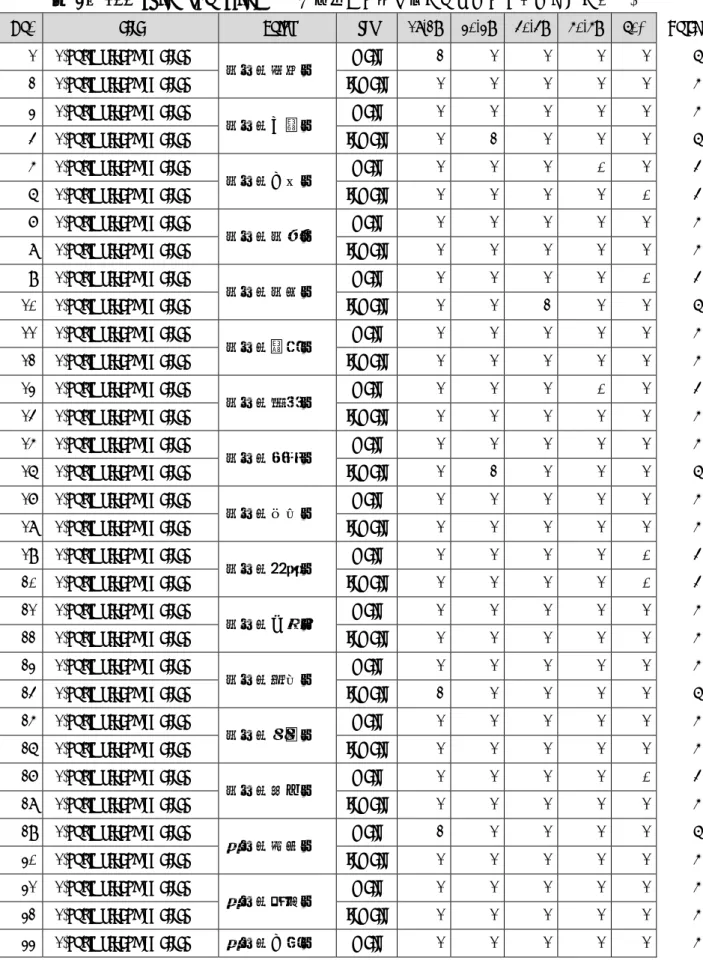
表 3 . 100 point sampling     各地点での割り当ては以下のようになっている。
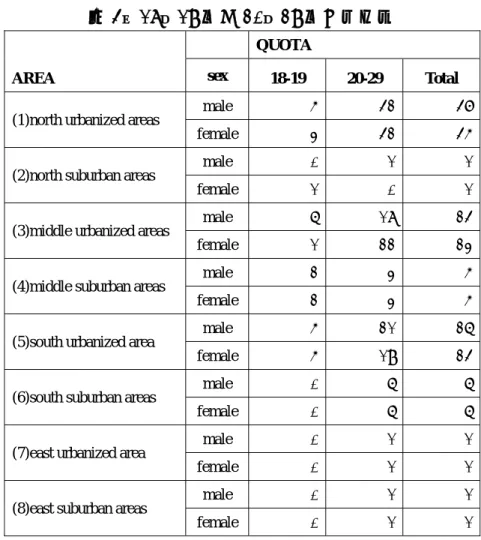
表 4 . 18 - 19 歳と 20 - 29 歳の抽出数

参照

関連したドキュメント

She reviews the status of a number of interrelated problems on diameters of graphs, including: (i) degree/diameter problem, (ii) order/degree problem, (iii) given n, D, D 0 ,

This section describes results concerning graphs relatively close to minimum K p -saturated graphs, such as the saturation number of K p with restrictions on the minimum or

combinatorial invariant, in particular, it does not depend on the field K , while the depth is homological invariant and in case of squarefree monomial ideal, a topological invariant

Classical definitions of locally complete intersection (l.c.i.) homomor- phisms of commutative rings are limited to maps that are essentially of finite type, or flat.. The

Yin, “Global existence and blow-up phenomena for an integrable two-component Camassa-Holm shallow water system,” Journal of Differential Equations, vol.. Yin, “Global weak

— In this paper, we give a brief survey on the fundamental group of the complement of a plane curve and its Alexander polynomial.. We also introduce the notion of

Stavroulakis, Oscillations of first-order delay differential equations in a critical state, Applicable Analysis, 61(1996), 359-377..

We study the classical invariant theory of the B´ ezoutiant R(A, B) of a pair of binary forms A, B.. We also describe a ‘generic reduc- tion formula’ which recovers B from R(A, B)