©Research Institute for Integrated Science, Kanagawa University
■Full-Length Paper■
An Alternatively Spliced Site in the Proline-Rich Region of Microtubule–Associated Protein 4 Plays an Important Role in
Microtubule Stabilization
Kiyotaka Tokuraku
1,4, Hatsune Moriyama
2, Kazuyuki Matsushima
3and Susumu Kotani
31 Department of Chemical Science and Engineering, Miyakonojo National College of Technology, Miyakonojo-City, Miyazaki 885–8567, Japan
2 Department of Bioscience and Bioinformatics, Faculty of Computer Science and Systems Engineering, Kyushu Institute of Technology, Fukuoka-City 820–8502, Japan
3 Department of Biological Sciences, Faculty of Science-City, Kanagawa University, Hiratsuka-City, Kanagawa 259–1293, Japan.
4 To whom correspondence should be addressed. E-mail: [email protected]
Abstract: We previously reported that the microtubule-stabilizing activity of a microtubule-associated protein (MAP) 4 variant, with a deletion in the Pro-rich region (MAP4-SP), was lower than that of a variant with a full length Pro-rich region (MAP4-LP).
However, it remained unclear whether the deletion of the specific site in the Pro-rich region is responsible for the reduction of the microtubule-stabilizing activity. To answer this question, we examined the microtubule-stabilizing activities of four different MAP4 variants, MAP4-SP, MAP4-LP, and two additional MAP4-LP variants lacking a part of the Repeat region, and considered the correlation between the activity and the structure.
When microtubules assembled in the presence of each of the MAP4 variants were treated with nocodazole for disassembly, the MAP4-SP-induced microtubules were significantly less stable than the other variant-induced microtubules. Another set of experiments, in which the microtubules were allowed to disassemble by dilution, yielded similar results: the MAP4-SP-induced microtubules were significantly less stable than the other variant-induced microtubules. The results clearly indicated that the microtubule-stabilizing activity of MAP4 depends on the specific, alternatively spliced site in the Pro-rich region.
Keywords: microtubule, microtubule-associated protein 4 (MAP4), Pro-rich region, microtubule stability and dynamics, alternatively splicing
Introduction
Microtubule-associated protein (MAP)* 4, which is known as a ubiquitous MAP, plays important roles in the dynamic functions of microtubules in vivo1,2). MAP4 consists of an amino-terminal projection domain and a carboxyl-terminal micro
tubule-binding domain, with the latter further divided into the proline rich (Pro-rich) region, the Repeat region, and the Tail region1). We have cloned several MAP4 variants generated by alternative splicing, and examined their functions3-6). We recently reported that the micro- tubule-stabilizing activity of a neural variant of MAP4, with a deletion in the Pro-rich region (MAP4-SP), was lower than that of the full length version (MAP4-LP), both in vitro and in vivo5). Nguyen et al. (1997) reported that the over- expression of intact MAP4 stabilized cytoplasmic microtubules and slowed down cell growth,
*Abbreviations: MAP, microtubule-associated protein;
Pro-rich, proline rich; SP, short Pro-rich; LP, long Pro-rich;
SDS-PAGE, sodium dodecyl sulfate-polyacrylamide gel electrophoresis; RB, reassembly buffer; LPA3T, MAP4 fragment containing the long Pro-rich region, the Repeat region with three AP sequences, and the Tail region; LPA4T, MAP4 fragment containing the long Pro-rich region, the Repeat region with four AP sequences, and the Tail region;
LPA5T, MAP4 fragment containing the long Pro-rich region, the Repeat region with five AP sequences, and the Tail region;
SPA5T, MAP4 fragment containing the short Pro-rich region, the Repeat region with five AP sequences, and the Tail region.
without inducing mitotic arrest or cell death7). The expression of MAP4-SP, which is less competent in stabilizing microtubules, may facilitate the elaborate regulation of microtubule dynamics in a living cell. Since the expression of the MAP4-SP variant is restricted to neural cells4), we suppose that the variant may contribute to the dynamic behaviors of neural cells in particular5). Although it is evident that MAP4-SP has lower microtubule-stabilizing activity, it still remains unclear whether the deletion of a specific site in the Pro-rich region is responsible for the reduction in the activity, since we have compared only limited numbers of MAP4 variants5). In addition, the microtubule-binding domain fragment of MAP4-LP used in the experiment bundled microtubules, while that of MAP4-SP did not4); therefore, the accurate assessment of the microtubule-stabilizing activity may have been hampered by the formation of microtubule bundles.
In this study, we examined the microtubule- stabilizing activity of four types of MAP4 variants, including MAP4-SP. Since the polypeptide length, the net charge, and the microtubule bundling activity differed among these variants3,4), we expected that a careful examination of these variants would reveal the factor responsible for the reduction in the microtubule-stabilizing activity. The results showed a strong dependency of the microtubule- stabilizing activity on the alternatively spliced site in the Pro-rich region.
Materials and Methods
Microtubule-binding domain fragments of the MAP4 variants were purified from Escherichia coli cells expressing the fragments, as described previously3,4). Porcine brain tubulin was prepared by the standard method8,9). Protein concentrations were determined by the method of Lowry et al.10), using bovine albumin as the standard. Sodium dodecyl sulfate-polyacrylami-de gel electrophoresis (SDS-PAGE) was carried out according to the method of Laemmli11), using 10% gels.
Microtubule stability assay
The microtubule-stabilizing activity of the MAP4 variants was analyzed as described previously5). Tubulin (15 µM) was polymerized in the presence
of the MAP4 variants (2 µM) in reassembly buffer (RB: 100 mM 2-morpholinoethanesulfonic acid, pH 6.8, 0.1 mM ethylene glycol-bis(ß-aminoethyl ether)-N,N,N’,N’-tetraacetic acid, and 0.5 mM MgCl2) containing 0.5 mM GTP, at 37˚C for 30 min. The samples were treated with nocodazole (50 µg/ml) or were diluted 10-fold by adding pre-warmed RB. After a 10 min incubation, the treated samples and the untreated control sample were centrifuged at 16000 x g for 30 min. The pellets were resuspended in the original volume of RB. The supernatant and the pellet solutions were supplemented with a set volume of SDS-PAGE loading buffer, and a 15 µl aliquot of each sample was analyzed by electrophoresis on a 10% gel. For quantitative analysis, representative gels were prepared from three independent ex- periments. The amounts of tubulin on the poly- acrylamide gels were quantified by image analysis (NIH image, NIH, USA).
Results
Preparation of the Proteins
In this study, we used four MAP4 fragments (Fig.
1A), each corresponding to the entire microtubule- binding domain of one of the MAP4 variants3,4). Three of the four fragments contain the intact Pro–rich region (LPA5T, LPA4T, and LPA3T), while the other has a deletion in the region (SPA5T).
The fragments were renamed to show the length of the Pro–rich region explicitly. LPA5T, LPA4T, LPA3T, and SPA5T correspond to the former PA5T, PA4T, PA3T3), and SP4), respectively. The MAP4 fragments and the tubulin were purified to homogeneity (Fig. 1B).
Stability of microtubules assembled in the presence of the MAP4 variants
To assess the microtubule-stabilizing activities of the MAP4 variants, we examined the resistance of microtubules against disassembly induced by the addition of nocodazole or dilution, as de- scribed previously5). Microtubules assembled in vitro in the presence of the MAP4 variants were treated with nocodazole or were diluted with pre–warmed RB, and then the samples were centri- fuged to recover the microtubules remaining in the pellet fractions. Fig. 2 shows the percentage of the
Fig. 2. Stability of microtubules assembled in the presence of the MAP4 variants. Tubulin (15 µM) was polymerized in the presence of each MAP4 variant (2 µM). The samples were supplemented with 50 µg/ml of nocodazole (A) or were diluted 10-fold by the addition of pre-warmed RB (B).
After a 10 min incubation, the treated samples were centrifuged. The amount of pelleted tubulin in each sample was quantified, as described in the Materials and Methods, and the results are presented as the percentages of the untreated sample (100%). Data are averaged from three independent experiments. Error bars denote S.D.s.
amount of sedimented tubulin in each sample relative to that of each untreated sample (100%).
The SPA5T-induced microtubules were clearly less resistant to nocodazole treatment than the LPA5T- induced microtubules (Fig. 2A). Although the LPA3T- and LPA4T-induced microtubules were also more susceptible than the LPA5T-induced microtubules, the effect was not as pronounced as that on the SPA5T-induced microtubules. The same is true of the dilution experiment (Fig. 2B). The SPA5T-induced microtubules were much less stable than any of the MAP4-LP variant (LPA3T, LPA4T, and LAP5T)-induced microtubules. The results clearly indicated that the SPA5T-induced microtubules are less stable, and in other words, more dynamic. The dilution was more effective than the nocodazole treatment in depolymerizing the SPA5T-induced microtubules: The percentage
of microtubules remaining was 35% in the diluted sample, while it was 54% in the nocodazole-treated sample. Meanwhile, the two treatments showed similar effects on the depolymerization of the other three fragment-induced microtubules.
Discussion
In this study, we revealed that the microtubule- stabilizing activity of MAP4 strongly depends on the specific site in the Pro-rich region. Although Fig. 1. Schematic structures of the microtubule-
binding domain fragments of MAP4 variants, and SDS-PAGE patterns of the proteins used in this study. (A) Schematic structures of intact MAP4, LPA5T, LPA4T, LPA3T, and SPA5T. The numbers in parentheses indicate the amino acid positions of intact MAP4. (B) SDS-PAGE of the purified proteins. Lane M is the molecular mass markers:
bovine serum albumin (69 kDa), porcine tubulin (50 kDa), and rabbit actin (42 kDa). Lane 1, porcine tubulin; lane 2, LPA3T; lane 3, LPA4T;
lane 4, LPA5T; lane 5, SPA5T.
a deletion within the Repeat region also affected the stability of the microtubules against nocodazole treatment and dilution, the effect was only marginal, as compared with the deletion within the Pro-rich region.
Protein-protein interactions are generally affected by the polypeptide length and the charge12). Although we previously reported the modulation of the microtubule-stabilizing activity of MAP4 by a deletion in the Pro-rich region4), it still remained unclear whether the primary factor in the re- duction of the microtubule-stabilizing activity was the deletion of the specific sequence in the Pro-rich region or simply the length and/or the charge of the polypeptide. To address this issue, we prepared four MAP4 variants with different polypeptide lengths and net charges in this study.
Table 1 summarizes the parameters of the MAP4 microtubule-binding domain fragments used in this study. The data in the table show that all three of the parameters (length, net charge, and bundling activity) of SPA5T, in addition to the deletion in the Pro-rich region, are different from those of LPA5T. Apparently, it is difficult to specify which factor is dominant in lowering the activity of SPA5T. In fact, the microtubule-stabi- lizing activities of LPA5T, LPA4T and LPA3T decreased in that order, which correlates well with the order of the three parameters, raising the possibility that the low microtubule-stabilizing activity of SPA5T is associated with a general length and/or charge effect, and is not specific to the alternative splicing in the Pro-rich region. However, the activity of SPA5T is much less than those of the others. Especially, the difference in the activity between SPA5T and LPA3T should be noticed.
The polypeptide length of SPA5T (448- amino acid residues) is similar to that of LPA3T (451-amino acid residues), and their net charges are the same (+41). In addition, both fragments lack microtubule bundling activity3,4). Despite these similarities, the microtubule-stabilizing activity of SPA5T was significantly lower than that of LPA3T, indicating that the difference in the microtubule-stabilizing activity does not depend on the polypeptide length, net charge, or microtubule bundling activity. In other words, MAP4 regulates its microtubule- stabilizing activity by alternatively splicing a
specific site in the Pro-rich region.
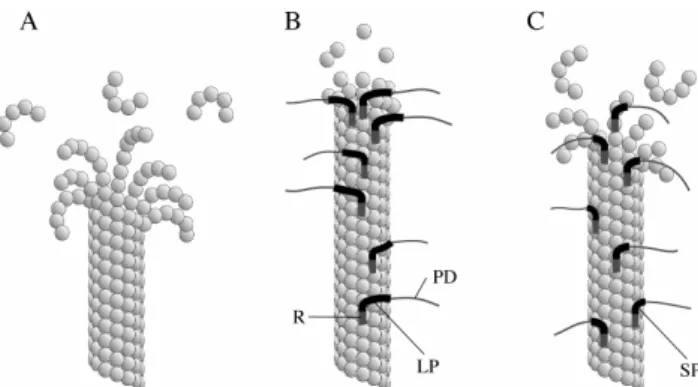
Why is the microtubule-stabilizing activity of MAP4 reduced by the absence of a part of the Pro-rich region? Intact MAP4 enhances the rescue frequency without decreasing the catastrophe frequency, and reduces the shortening lengths13,14). Mandelkow et al.15) found that the tips of shrinking microtubules have the protofilaments coiled inside out, and concluded that the protofilaments of shrink- ing microtubules peel outward, and consequently, the microtubules rapidly depolymerize (Fig. 3A).
According to our hypothesis16), the Pro-rich region of MAP4 facilitates the lateral association of protofilaments by bridging them. If so, then the shrinking of a microtubule will stop at the MAP4-bound region (Fig. 3B), and it subsequently will be rescued. The microtubule- stabilizing activity of the MAP4-SP fragment (SPA5T) was Table 1. Parameters of the microtubule-binding domain fragments of MAP4 variants.
Variant names LPA3T LPA4T LPA5T SPA5T Length [a. a.]a 451 489 520 448 Net chargeb +41 +46 +52 +41
Bundlingc – + ++ –
Nocodazole [%]d 69 ± 20 79 ± 25 89 ± 19 54 ± 15 Dilution [%]e 70 ± 25 79 ± 15 84 ± 19 35 ± 9
a,bLength and Net charge of MAP4 fragments, calculated from amino acid sequence data.
cBundling activities reported by Tokuraku et al.3) and Matsushima et al.4).
d,eMicrotubule–stabilizing activities from Figure 2.
Fig. 3. Schematic illustration of disassembling microtubules in the presence or absence of MAP4 variants. (A) The first step in microtubule disassembly is the coiling of the protofilament tips.
Consequently, the lateral bonds between them are disrupted; after that, they peel off, and subsequently break apart. (B) MAP4-LP enhances the lateral association of protofilaments by bridging them;
therefore, the disassembly does not proceed over the MAP4-bound region because the peeling is blocked by the bridging. (C) The short Pro-rich region cannot bridge the adjacent protofilaments efficiently enough to stop the disassembly. PD, R, LP, and SP indicate projection domain, Repeat region, long Pro-rich region, and short Pro-rich region, respectively.
significantly lower than those of the other MAP4-LP fragments (LPA3T, LPA4T, LPA5T), suggesting that the region essential for the protofilament bridging activity is missing in the MAP4-SP variant (Fig. 3C). The mechanism by which the missing sequence contributes to the bridging will be clarified by further experiments.
MAP4 variants are derived from a single gene by alternative RNA splicing1). The expression of these variants depends on the tissue types and the developmental stages4,17). As reported by Matsushima et al.4), the expression of the MAP4- SP variant, which lacks part of the Pro-rich region, was restricted to neural cells4). Since we demonstrated that the structure of the Pro-rich region dictates the microtubule-stabilizing activity of MAP4 in this study, it is quite possible that this variant contributes to the dynamic behaviors of neural cells, as speculated previously5).
References
1) Tokuraku K, Katsuki M and Kotani S (2002) Structural and functional analyses of microtubule- associated protein 4. Recent Res. Devel. Biochem.
3: 315-333.
2) Olson KR, McIntosh JR and Olmsted JB (1995) Analysis of MAP 4 function in living cells using green fluorescent protein (GFP) chimeras. J. Cell Biol. 130: 639-650.
3) Tokuraku K, Matsushima K, Matui T, Nakagawa H, Katsuki M, Majima R and Kotani S (2003) The number of repeat sequences in microtubule- associated protein 4 affects the microtubule surface properties. J. Biol. Chem. 278: 29609- 29618.
4) Matsushima K, Aosaki M, Tokuraku K, Hasan MR, Nakagawa H and Kotani S (2005) Identification of a neural cell specific variant of microtubule- associated protein 4. Cell Struct. Funct. 29: 111-124.
5) Hasan MR, Jin M, Matsushima K, Miyamoto S, Kotani S and Nakagawa H (2006) Differences in the regulation of microtubule stabilily by the pro-rich region variants of microtubule-associated protein 4.
FEBS Lett. 580: 3505-3510.
6) Hasan MR, Matsushima K, Yue JM, Nakagawa H, Miyamoto S and Kotani S (2006) Functional analyses
of a neural cell specific variant of microtubule- associated protein 4. Sci. J. Kanagawa Univ. 17:
3-11.
7) Nguyen HL, Chari S, Gruber D, Lue CM, Chapin SJ and Bulinski JC (1997) Overexpression of full- or partial-length MAP4 stabilizes microtubules and alters cell growth. J. Cell Sci. 110: 281-294.
8) Shelanski ML, Gaskin F and Cantor CR (1973) Microtubule assembly in the absence of added nucleotides. Proc. Natl. Acad. Sci. USA. 70: 765- 768.
9) Weingarten MD, Lockwood AH, Hwo SY and Kirschner MW (1975) A protein factor essential for microtubule assembly. Proc. Natl. Acad. Sci. USA.
72: 1858-1862.
10) Lowry OH, Rosebrough NJ, Farr AL and Randall RJ (1951) Protein measurement with the Folin phenol reagent. J. Biol. Chem. 193: 265-275.
11) Laemmli UK (1970) Cleavage of structural proteins during the assembly of the head of bacteriophage T4, Nature. 227: 680-685.
12) Alberts B, Johnson A, Lewis J, Raff M, Roberts K and Walter P (2002) Molecular biology of the Cell, 4th edn. Garland Science, New York.
13) Ookata K, Hisanaga S, Bulinski JC, Murofushi H, Aizawa H, Itoh TJ, Hotani H, Okumura E, Tachibana K and Kishimoto T (1995) Cyclin B interaction with microtubule-associated protein 4 (MAP4) targets p34cdc2 kinase to microtubules and is a potential regulator of M-phase microtubule dynamics. J. Cell Biol. 128: 849-862.
14) Permana S, Hisanaga S, Nagatomo Y, Iida J, Hotani H and Itoh TJ (2005) Truncation of the projection domain of MAP4 (microtubule- associated protein 4) leads to attenuation of microtubule dynamic instability. Cell Struct. Funct. 29: 147-157.
15) Mandelkow EM, Mandelkow E and Milligan RA (1991) Microtubule dynamics and microtubule caps:
a time-resolved cryo-electron microscopy study. J.
Cell Biol. 114: 977-991.
16) Tokuraku K, Katsuki M, Nakagawa H and Kotani S (1999) A new model for microtubule-associated protein (MAP)-induced microtubule assembly. The Pro-rich region of MAP4 promotes nucleation of microtubule assembly in vitro. Eur. J. Biochem.
259: 158-166.
17) Chapin SJ, Lue CM, Yu MT and Bulinski JC (1995) Differential expression of alternatively spliced forms of MAP4: a repertoire of structurally different microtubule-binding domains. Biochemistry 34: 2289-2301.