Introduction
There is a consensus among researchers that Inter-net addiction (IA) DOES exist (Chou, Condron, & Bel-land, 2005), although there is no standardized definition of IA, or the other researchers reported some critical considerations regarding IA (Shaffer, Hall, & Vander Bilt, 2000).Young cautiously concluded that there are increasing numbers of people with IA not only in the United States, but also in other developed countries (Young, 1996; Young, 1998). Since Young’s description of IA, many studies of IA have been conducted around the world (Beard & Wolf, 2001; Johansson & Gotestam, 2004; Nalwa & Anand, 2003; Shapira, Goldsmith, Keck, Khosla, & McElroy, 2000). In many studies, the target populations are adolescents, who comprise the majority of Internet users. In northeastern Asia, researchers have focused on IA from diverse perspectives (Tsai & Lin, 2003; Whang, Lee, & Chang, 2003). More recently, a relationship between IA and attention-deficit/hyper-activity disorder (AD/HD) was reported (Yoo et al., 2004), and many other researchers have also reported on issues relevant to IA. The other researchers report-ed relationships between IA and AD/HD, substance abuse, and other psychiatric symptoms (Yen et al., 2008; Yen, Ko, Yen, Wu, & Yang, 2007). With the explo-sive development in information technology at the
be-ginning of the 21st century, IA seems as if it is becom-ing more widespread and more serious.
In Japan, the percentage of Internet users in the population has been similar to those of other developed countries since the beginning of the Internet era. Sev-eral studies relevant to IA have been conducted in Ja-pan (Shimai & Deguchi, 2001; Wada, 2002), but as far as we know, none have defined IA as a mental disor-der. Since it has not yet seen as a mental disorder, IA studies have been fewer in Japan than in other coun-tries. Because Japan is one of the leading countries in the IT field, there are as many Internet users in Japan as in countries where many IA studies have been con-ducted. In this regard, Japan lags behind in the field of IA research, although the proportion of the Japanese population suffering from IA is suspected to be similar to those in other countries. Until now, we have not known how many Japanese individuals can be regarded as suffering from IA.
College students, who comprise the majority of Inter-net users, face multiple stressors, such as academic overload, constant pressure to succeed, competition with peers, and in some countries, financial burden and concerns about the future. As this severe stress may lead to psychopathology, the health of university/col-lege students has been the subject of increasing focus (Tosevski, Milovancevic, & Gajic, 2010).
University/col-lege students can be regarded as vulnerable to mental health problems and socially maladaptive behaviors
Received November 15, 2012;Accepted December 17, 2012 1 Professor, Department of Psychology, Senshu University
Internet addiction in Japanese college students:
Is Japanese version of Internet Addiction Test (JIAT)
useful as a screening tool?
Hirokazu Osada
1 AbstractBackground: Due to lack of evidence of Internet addiction (IA) in Japan, we investigated IA and examined
the utility of the Japanese version of the Internet Addiction Test (JIAT) for screening for IA in adolescents.
Method: 299 college students were divided into two groups (Internet Addiction group: IAG and
Non-Inter-net Addiction group: NIAG). A self report questionnaire was employed. Results: The IAG showed more problematic Internet use and poorer mental health than the NIAG. The JIAT showed good reliability and validity. To identify IA, we set the cut-off of the JIAT at > 53. Conclusions: 5.0% of Japanese college stu-dents were identified as internet addicted, and they exhibited poor mental health. The JIAT can be useful as a screening tool for IA.
(Kitzrow, 2003). Indeed, Scherer reported college stu-dents’ problematic Internet use (Scherer, 1997). Hence, focusing on university/college students is important for prevention of their specific problems.
Although Japanese use of technology is greater than most other nationalities, IA relevant researches have not been comprehensively conducted in Japan. In addi-tion, college students often experiences fully unmoni-tored use of Internet for the first time when entering college. It is imperative to investigate IA in Japanese adolescents. In the present study, we investigated IA, and examined the utility of the Japanese version of Young’s Internet Addiction Test for screening for IA in Japanese college students. As mentioned above, in many previous studies, the target populations were ad-olescents. Hence, as representatives of adolescents, we targeted college students, who also tend to be suscepti-ble to mental health prosuscepti-blems as well as engaging in socially maladaptive behaviors. In light of prior re-search, Internet-addicted college students may be at risk for comorbid mental health problems. Detecting IA in Japanese college students could be the first step in protecting them from other mental health problems. Precise screening would also allow us to estimate how many Japanese adolescents suffer from IA.
Method
Participants
Over a period of four weeks, we asked a total of 350 students to complete paper-based questionnaires. The participants were recruited in their regular classes. It took about 20 minutes for them to fill out the question-naires. The questionnaires were collected from the stu-dents after they finished answering all of the questions at the end of the classes. A total of 299 (184 males and 115 females) usable questionnaires were returned, yielding an effective response rate of 85.4%. The mean age of the participants was 19.4 years ± 2.67, with no statistical difference between males and females.
Measures
A self-report questionnaire was employed to mea-sure demographic information (e.g., age, gender), Inter-net use and addiction, and psychological characteristics
previously associated with excessive Internet use (Widyanto & McMurran, 2004).
Internet Use
The participants were asked the following two ques-tions about their Internet use: How long do you spend online per day? Which device do you usually use for ac-cessing the Internet, a personal computer (PC) or a mo-bile phone, including “Smartphones”? We also asked a multiple-answer question about the purposes of re-spondents’ Internet use. According to a survey of Japa-nese telecom use, among JapaJapa-nese adolescents, “Send-ing and receiv“Send-ing e-mails,” “Brows“Send-ing personal websites, blogging, and using social networking servic-es (SNS),” “Searching for information,” “Shopping and/or gaming,” and “Looking at, listening to or down-loading digital content” were the five most common purposes of Internet use (Ministry of Internal Affairs and Communications, 2009).We created the following multiple-answer question about Internet use based on the survey: Choose the purpose(s) of your Internet use: “Sending and receiving e-mails,” “Browsing personal websites, blogging, and using social networking services (SNS),” “Searching for information,” “Shopping and/or gaming,” and “Looking at, listening to or downloading digital content”.
Young’s Diagnostic Questionnaire (YDQ) of IA
clas-sified as being addicted to the Internet. The partici-pants were divided into two independent groups using the criteria. Fifteen students scored five or more on the YDQ. We labeled those 15 students the IA group (IAG) and the other 284 the Non-IA group (NIAG).
Japanese version of the Internet Addiction Test (JIAT) Since Odajima had already translated the original In-ternet Addiction Test (IAT) into Japanese in her book (Young, 1998), we had it translated into English by the above-mentioned Japanese-English bilingual profes-sional. We confirmed that each back-translated item was acceptably similar to Young’s original IAT. Hence, in the present study, we used the Japanese version of the IAT as translated by Odajima. We received ap-proval for using it for research purposes from Young. According to Chang and Law, the IAT shows not only strong internal reliability across studies, but also good construct validity (Chang & Law, 2008). The IAT is a 20-item questionnaire that measures mild, moderate, and severe levels of IA. Each question is answered us-ing the followus-ing scale: 1=Rarely, 2=Occasionally, 3= Frequently, 4=Often, 5=Always. We adapted the same scoring procedure to the JIAT, yielding a range of possible total scores from 20 to 100.
The 12-Item General Health Questionnaire (GHQ-12) The General Health Questionnaire (GHQ) was em-ployed to evaluate the negative mood states of depres-sion, anxiety, and stress, subjective feelings of social isolation or loneliness, denial, and behavioral disengage-ment. The scale asks whether the respondent has re-cently experienced a particular symptom or behavior. Each question is self-rated on a four-point scale (less than usual, no more than usual, rather more than usual, or much more than usual). In this study, the 12-item GHQ (GHQ-12) was used. The most common scoring methods are Likert scoring (0-1-2-3) and bi-modal scoring (0-0-1-1). The methods produce total scores of 36 or 12, respectively. Since the GHQ-12 is brief, simple, and easy to complete, its application in research settings as a screening tool for poor general health con-ditions has been well-documented. There is evidence that the GHQ-12 is a consistent and reliable instru-ment when used in general population samples (Peval-in, 2000). In Japan, GHQ-12 has been reported to be
usable with a cut-off score set at 4 or greater, when using a bi-modal scoring method (Honda, Shibata, & Nakane, 2001). In this study, we also applied a bi-mod-al scoring method for the purpose of determining whether the participants were mentally healthy.
Statistical analyses
ROC curve is in the nearest left upper corner. The lev-el of significance was set at p<.05 (two-tailed). SPSS 16.0 for Windows software was used to conduct the statistical analyses.
Ethical consideration
We asked all respondents to fill out a written con-sent form to participate in the study in compliance with the Declaration of Helsinki. Before we distributed the questionnaires, we received permission to conduct the survey from the instructor of each class.
Results
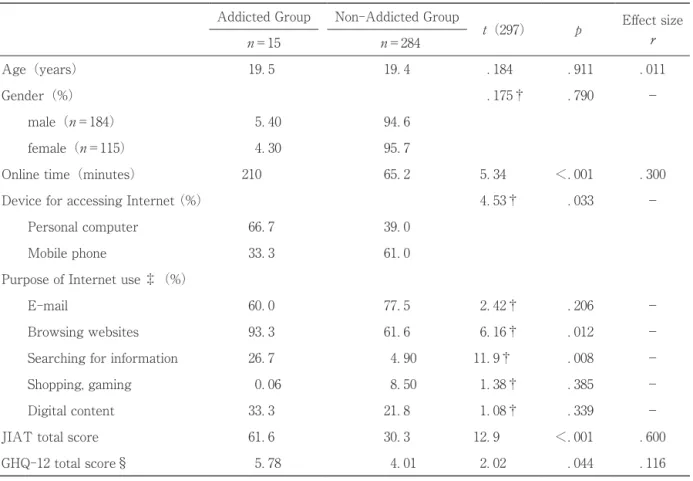
There were no significant differences in age or gen-der ratio between the IAG and NIAG (see Table 1). The percentage of females in the IAG was 33.3% (5 of 15), whereas in the NIAG it was 38.7% (110 of 284). There was no significant difference in gender
distribu-tion between the IAG and NIAG. In terms of purposes of Internet use, the IAG showed significantly longer on-line time than the NIAG. The IAG used PCs rather than mobile phones when accessing the Internet, while the NIAG preferred using mobile phones to PCs. The IAG also reported significantly more Internet use for the purposes of browsing personal websites, blogging, using SNS, and searching for information than their NIAG counterparts.
Cronbach’s α of the JIAT was 0.93, which showed very strong internal consistency. The IAG showed sig-nificantly higher scores on the JIAT and GHQ-12 than the NIAG. Both groups showed GHQ-12 scores above the cut-off. In addition, the IAG showed significantly higher scores on all of the questions of the JIAT than the NIAG (see Table 2).
We submitted all 20 items of the JIAT to factor anal-ysis. Using the latent root criterion for retaining factors Table 1 Comparison of age, gender, Internet use relevant data, JIAT, and GHQ-12 between the Internet Addicted
and Non- Internet-Addicted Groups
Addicted Group Non-Addicted Group
t(297) p Effect size r n=15 n=284 Age(years) 19.5 19.4 .184 .911 .011 Gender(%) .175† .790 - male(n=184) 5.40 94.6 female(n=115) 4.30 95.7 Online time(minutes) 210 65.2 5.34 <.001 .300
Device for accessing Internet(%) 4.53† .033 -
Personal computer 66.7 39.0
Mobile phone 33.3 61.0
Purpose of Internet use ‡(%)
E-mail 60.0 77.5 2.42† .206 -
Browsing websites 93.3 61.6 6.16† .012 -
Searching for information 26.7 4.90 11.9† .008 -
Shopping, gaming 0.06 8.50 1.38† .385 -
Digital content 33.3 21.8 1.08† .339 -
JIAT total score 61.6 30.3 12.9 <.001 .600
GHQ-12 total score§ 5.78 4.01 2.02 .044 .116
JIAT: Japanese version of Internet Addiction Test GHQ-12: The 12-Item General Health Questionnaire † χ2
‡ Multiple-answer
Table 2 Comparison of gender ratio and scores of the JIAT between Internet Addiction group (IAG) and Non-Internet Addiction group (NIAG)
JIAT IAG NIAG df=297t a
effect-size r n=15 n=284a
Q 1 . How often do you find that you stay on-line longer than you intended?
4.47 2.61 6.45 .35
Q 2 . How often do you neglect household chores to spend more time on-line?
3.40 1.67 6.78 .37
Q 3 . How often do you prefer the excitement of the Internet to inti-macy with your partner?
2.87 1.33 8.71 .45
Q 4 . How often do you form new relationships with fellow on-line users?
2.33 1.34 5.05 .28
Q 5 . How often do others in your life complain to you about the amount of time you spend on-line?
3.00 1.30 8.62 .45
Q 6 . How often do your grades or school work suffer because of the amount of time you spend on-line?
3.27 1.47 8.08 .43
Q 7 . How often do you check your e-mail before something else that you need to do?
3.53 2.16 4.13 .23
Q 8 . How often does your job performance or productivity suffer because of the Internet?
3.13 1.50 7.30 .39
Q 9 . How often do you become defensive or secretive when anyone asks you what you do on-line?
3.47 1.70 6.28 .34
Q10. How often do you block out disturbing thoughts about your life with soothing thoughts of the Internet?
3.20 1.27 11.6 .56
Q11. How often do you find yourself anticipating when you will go on-line again?
3.60 1.61 8.21 .43
Q12. How often do you fear that life without the Internet would be boring, empty, and joyless?
3.13 1.69 5.59 .31
Q13. How often do you snap, yell, or act annoyed if someone both-ers you while you are on-line?
2.60 1.43 5.71 .31
Q14. How often do you lose sleep due to late-night log-ins? 3.80 1.62 8.78 .45 Q15. How often do you feel preoccupied with the Internet when
off-line, or fantasize about being on-line?
2.27 1.12 10.5 .52
Q16. How often do you find yourself saying “just a few more min-utes” when on-line?
3.00 1.54 5.80 .32
Q17. How often do you try to cut down the amount of time you spend on-line and fail?
3.40 1.39 9.68 .49
Q18. How often do you try to hide how long you’ve been on-line? 2.60 1.25 7.33 .39 Q19. How often do you choose to spend more time on-line over
go-ing out with others?
2.33 1.17 9.10 .47
Q20. How often do you feel depressed, moody, or nervous when you are off-line, which goes away once you are back on-line?
2.20 1.11 11.2 .54
Total 61.6 30.3 12.2 .58
JIAT: The Japanese version of Internet Addiction Test
with Eigenvalues greater than 1.0 and the Scree plot, a three-factor structure was identified, with the ex-tracted factors explaining 58.2% of the total variance. We labeled these three factors as “Social interactive problems,” “Virtual reality,” “Obsession and difficulty of impulse-control” Table 3 shows a pattern matrix of the three factors, factor loadings of each item, and tor correlations. The Cronbach’s α values of each
fac-tor were 0.91, 0.75, and 0.78, respectively. These val-ues showed good internal consistency and reliability.
For each total score of the JIAT, sensitivity, specific-ity, PPV, NPV, LR positive, and LR negative were de-termined. In Table 4, the results of the calculations are partly given for the total scores of the JIAT between 50 and 65. Because all of IAG showed more than 50, while all of NIAG scored less than 65, we presented Table 3 Factor Analysis of the Japanese version of Internet Addiction Test
Items Factor loadings
1 2 3
Q 1 How often do you find that you stay on-line longer than you intended? .38 -.02 .40
Q 2 How often do you neglect household chores to spend more time on-line? .56 -.002 .32 Q 3 How often do you prefer the excitement of the Internet to intimacy with your
partner?
.45 .35 -.03 Q 4 How often do you form new relationships with fellow on-line users? .18 .36 .02 Q 5 How often do others in your life complain to you about the amount of time you
spend on-line?
.54 .35 -.17 Q 6 How often do your grades or school work suffer because of the amount of time
you spend on-line?
.63 -.01 .18 Q 7 How often do you check your e-mail before something else that you need to do? .03 -.15 .64
Q 8 How often does your job performance or productivity suffer because of the In-ternet?
.48 -.15 .47 Q 9 How often do you become defensive or secretive when anyone asks you what
you do on-line?
.94 -.11 -.08 Q10 How often do you block out disturbing thoughts about your life with soothing
thoughts of the Internet?
.59 .29 -.13 Q11 How often do you find yourself anticipating when you will go on-line again? .26 .31 .20 Q12 How often do you fear that life without the Internet would be boring, empty,
and joyless?
-.30 .27 .77
Q13 How often do you snap, yell, or act annoyed if someone bothers you while you are on-line?
-.04 .20 .52
Q14 How often do you lose sleep due to late-night log-ins? .29 .06 .49
Q15 How often do you feel preoccupied with the Internet when off-line, or fantasize about being on-line?
-.03 .69 .06
Q16 How often do you find yourself saying “just a few more minutes” when on-line? .40 .12 .21 Q17 How often do you try to cut down the amount of time you spend on-line and
fail?
.43 .05 .27 Q18 How often do you try to hide how long you’ve been on-line? .60 .12 -.11 Q19 How often do you choose to spend more time on-line over going out with
oth-ers?
.11 .76 -.06
Q20 How often do you feel depressed, moody, or nervous when you are off-line, which goes away once you are back on-line?
-.03 .78 .09
1 1.00 .65 .70
Factor Correlations 2 .65 1.00 .62
3 .70 .62 1.00
Factor 1: Social interactive Problems Factor 2: Virtual Reality
this limited range. By and large, Table 4 reveals that as the total score of the JIAT increases, sensitivity de-creases, PPV inde-creases, while specificity and NPV are fairly stable. Table 4 also shows the results for LRs. Findings of LR positive and LR negative values ranged respectively from 23.3 and 0.07, associated with the total score of the JIAT of 50, to 40.0 and 0.61, which are associated with respectively the total score of the JIAT of 65. For a positive test result, LR positive should be greater, ideally much greater, than 1, while for a negative test result, LR negative should be much less than 1 (Henderson, 1993). In addition, to determine the appropriate cut-off, it is very important to have high sensitivity and PPV, because a positive result will probably lead to diagnosis of IA. Considering these rea-sons, we set as cut-off the total score of the JIAT > 53, based on sensitivity of 0.87, PPV of 0.72, LR positive of 43.5, and LR negative of 0.13. In Figure 1, the ROC curve shows the optimum cut-off of the JIAT for detecting IA according to YDQ. Total scores of the JIAT (50, 53, 58, 65) are indicated on the curve in Fig-ure 1 and show that, as the cut-off point decreases, sensitivity increases and specificity decreases. As we set the optimum cut-off as > 53 (sensitivity=0.87;
specificity=0.98; PPV=0.72; NPV=0.99), the AUC for the JIAT was 0.987. Based on Swets (1988), this means that the JIAT has high diagnostic accuracy. The standard error was 0.005 and the 95% CI is 0.98-1.00. The 95% CI does not incorporate 0.5, show-ing that the CDS predicts IA better than chance. Even-tually, discriminative predicted value was 95.6% based on the cut-off as > 53.
Discussion
In the present study, we recruited participants at one institution, which was a “middle level” private uni-versity in Japan. Thus, our sample may represent “av-erage” Japanese adolescents. We used a convenience sampling method for recruiting our target population, which was matched with data on the demographics of Japanese Internet users. In Japan, according to the Ministry of Internal Affairs and Communications, the gender ratio (male vs. female) of adolescent Internet users is about 3:2 (male, 58%; female, 42%) (Ministry of Internal Affairs and Communications, 2009). In our sample, the ratio was 8:5 (male, 62%; female, 38%), which is approximately equal to the ratio reported by the national survey. Hence, our sample could be re-Table 4 Calculations of the Japanese vervion of Internet Addiction Test (JIAT) sensitivity, specificity,
posi-tive predicposi-tive value (PPV), negaposi-tive predicposi-tive value (NPV) and likelihood ratio (LR posiposi-tive and LR negative) of the Young’s Diagnostic Questionnaire, with ≥ 5 as the criterion
JIAT total score
(n=299) Sensitivity Specificity PPV NPV LR positive LR negative
garded as representative of Japanese youth.
According to Shaw and Black, several surveys have been conducted to estimate the prevalence of IA in dif-ferent countries (Shaw & Black, 2008). Most studies have focused on younger populations rather than the wider adult population, perhaps reflecting the view that IA is primarily a disorder of younger persons. IA prevalence estimates range from 0.9% to 38%, while reported relationships of IA with gender vary. Various studies have reported a majority of males or a majority of females, while others have found an equal gender distribution (Shaw & Black, 2008). Recently, Pallanti, Bemardi, and Leonardo reported an IA prevalence of 5.4% based on 275 Italian students, with IA affecting both genders equally (Pallanti, Bernardi, & Quercioli, 2006). In the present study, with a similar sample size as the Italian study, the prevalence rate was 5.0% (15 out of 299), and the prevalence in each gender was al-most equal (male vs. female; 5.4% vs. 4.3%). Some previous studies reporting a majority of males with IA were conducted prior to 2005. As far as we know, since 2006, no data showing a preponderance of males in the IA population have been reported. Because the variety of uses for the Internet has expanded, more females
have begun to use the Internet than ever. For example, women seem especially interested in SNS and online shopping (Ministry of Internal Affairs and Communica-tions, 2009). In sum, the Japanese IA prevalence rate found in this study is almost the same as those report-ed for Taiwan, Korea, Italy, and the Unitreport-ed States. Al-though it is difficult to generalize our results beyond their immediate context, this study is the first to inves-tigate IA in the Japanese context. We will need more data to confirm our results in the general population in the future.
As might be expected, the IAG spent significantly more time online than the NIAG. We found that re-gardless of IA status, checking e-mail seemed to be very common in Japanese college students, but individ-uals in the IAG showed evidence of distinctive behav-ior patterns, which were related to three factors of the JIAT found in this study. In the present study, the IAG used the Internet more than the NIAG for the purpos-es of “Browsing personal websitpurpos-es, blogging, or using SNS” and “Searching for information.” The former seems to relate to Factor 1 “Social interactive prob-lems” and Factor 2 “Virtual reality,” while the latter relates to Factor 3 “Obsession and difficulty of im-Figure 1 ROC curve of the Japanese version of Internet Addiction Test
pulse-control.” Social interactive problems may have been affected by the development of SNS. In Japan, the most popular SNS is mixi, which exceeded 20 million users in 2010, the majority of whom are college/univer-sity students (Mixi, 2010). Using SNS, we can even find and meet with friends and virtually socialize. Us-ers of SNS can easily become acquainted with othUs-ers (even strangers) via the Internet. They can frequently “meet” each other online to exchange information without meeting in the real world. This study con-firmed that many Japanese college students used SNS, possibly causing the IAG to develop Social interactive problems and to addict to Virtual reality. In terms of “Searching for information,” students are accustomed to using the Internet to gather relevant information not only for their own interests, but also for their studies and assignments. However, compared with the NIAG, the IAG tended to unnecessarily and obsessively spend excessive time on the Internet beyond that required for gathering information.
Generally, if Cronbach’s α is more than 0.70, inter-nal consistency can be regarded as good. Since Cron-bach’s α was as strong in this study as in previous studies, we confirmed the reliability of the JIAT. This also validated our use of the total score of the JIAT to classify individuals as IA. Members of the IAG had sig-nificantly higher scores on all items of the JIAT than did members of the NIAG. The JIAT had discrimina-tive validity, meaning that the scale adequately differ-entiated between the two groups.
As a screening tool, the JIAT can be regarded as us-able in the Japanese population. We set the cut-off score as > 53 out of 100, with very high sensitivity. Generally, sensitivity is primarily considered for setting cut-off scores when the prevalence rate of the disease is low. Not only in our sample, but also in previous studies, prevalence rates of IA were not high enough that predictive values had to be considered. However, a condition with a relatively low prevalence rate is bound to yield high false positive rates that exceed false negative rates. In such a circumstance, a limited positive predictive value yields high false positive rates, even in the presence of a specificity that is very close to 100% (Agresti, 1996). In the present study, the
spec-ificity was almost 100%, which may have pointed to-ward high false positive rates of the JIAT. However, due to a low prevalence of IA, we had to primarily con-sider sensitivity for the screening tool rather than less-ening a false positive rate. We were at least able to show usability of the JIAT as a screening tool for IA. We will still need evidence-based research for refining the JIAT using samples representative of the larger general population in Japan. Although we believe that SNS are convenient and very useful, indeed, some re-lated problems have been reported (Ybarra & Mitchell, 2008). To prevent them from the problems, we have to find out the IAG as soon as possible. The JIAT
We found that the IAG showed significantly poorer mental health status than the NIAG. We could not de-termine which problem came first, IA or poor mental health. IA might have triggered mental health prob-lems; on the other hand, poor mental health conditions, such as depressive mood, might have caused IA. Ac-cording to the existing literature, individuals with IA commonly exhibit comorbid mental health problems (Yen et al., 2008; Yen et al., 2007; Yoo et al., 2004),
anti-social behaviors, and forensic issues (Recupero, 2008). Empirically, we can at least suggest that mental health professionals use the JIAT for screening for IA in col-lege students who have already been diagnosed with other mental health problems. This may permit the IA to be treated before the problem becomes serious.
References
Agresti, A. (1996). An Introduction to Categorical Data Analysis. New York: Wiley.
American Psychiatric Association. (1994). Diagnostic and Statistical Manual of Mental Disorders, Fourth Edition; DSM-IV. Washington DC: American Psychiatric Associa-tion.
Beard, K. W., & Wolf, E. M. (2001). Modification in the pro-posed diagnostic criteria for Internet addiction. Cyberpsy-chology & Behavior, 4(3), 377-383.
Chang, M. K., & Law, S. P. M. (2008). Factor structure for Young’s Internet Addiction Test: A confirmatory study. Computers in Human Behavior, 24, 2597-2619.
Chou, C., Condron, L., & Belland, J. C. (2005). A Review of the Research on Internet Addiction. Educational Psychol-ogy Review, 17(4), 363-383.
Men-tal Disorders by using The 12-item General Health Ques-tionnaire [in Japanese]. Journal of Health and Wealfare Statistics, 48(10), 5-10.
Johansson, A., & Gotestam, K. G. (2004). Internet addiction: characteristics of a questionnaire and prevalence in Nor-wegian youth (12-18 years). Scandinavian Journal of Psychology, 45(3), 223-229.
Kitzrow, M. A. (2003). The mental health needs of today’s college students: challenges and recommendations. NAS-PA Journal, 41, 167-181.
Ministry of Internal Affairs and Communications. (2009). Survey of Internet Users. Retrieved Deccember 16, 2009, from http://www.soumu.go.jp/johotsusintokei/whitepa-per/ja/h12/html/C1221000.htm
Mixi. (2010). The first quarterly report in fiscal year 2010. Retrieved August 1, from http://eir.eol.co.jp/EIR/View. aspx?template=ir_material&sid=6512&code=2121 Nalwa, K., & Anand, A. P. (2003). Internet addiction in
stu-dents: a cause of concern. Cyberpsychology & Behavior, 6 (6), 653-656.
Pallanti, S., Bernardi, S., & Quercioli, L. (2006). The Shorter PROMIS Questionnaire and the Internet Addiction Scale in the assessment of multiple addictions in a high-school population: prevalence and related disability. CNS Spec-trum, 11(12), 966-974.
Pevalin, D. J. (2000). Multiple applications of the GHQ-12 in a general population sample: an investigation of long-term retest effects. Social Psychiatry and Psychiatric Epi-demiology, 35(11), 508-512.
Recupero, P. R. (2008). Forensic evaluation of problematic Internet use. Journal of the American Academy of Psychi-atry & Law, 36(4), 505-514.
Scherer, K. (1997). College life online: Healthy and un-healthy Internet use. Journal of College Student Develop-ment, 38(6), 655-665.
Shaffer, H. J., Hall, M. N., & Vander Bilt, J. (2000). “Comput-er addiction”: a critical consid“Comput-eration. Am“Comput-erican Journal of Orthopsychiatry, 70(2), 162-168.
Shapira, N. A., Goldsmith, T. D., Keck, P. E., Jr., Khosla, U. M., & McElroy, S. L. (2000). Psychiatric features of indi-viduals with problematic internet use. Journal of Affective Disorder, 57(1-3), 267-272.
Shaw, M., & Black, D. W. (2008). Internet addiction: defini-tion, assessment, epidemiology and clinical management. CNS Drugs, 22(5), 353-365.
Shimai, S., & Deguchi, H. (2001). Relationship of internet use with psychosocial health. [in Japanese]. Journal of Ja-pan Universities Association for Computer Education 19, 31-33.
Swets, J. A. (1988). Measuring the accuracy of diagnostics systems. Science, 240, 1285-1293.
Swets, J. A. (1996). Signal Detection Theory and ROC anal-ysis in Psychology and Diagnostics: Collected Papers. Lon-don: Psychology Press.
Tosevski, D. L., Milovancevic, M. P., & Gajic, S. D. (2010). Personality and psychopathology of university students. Current Opinion on Psychiatry, 23(1), 48-52.
Tsai, C. C., & Lin, S. S. (2003). Internet addiction of adoles-cents in Taiwan: an interview study. Cyberpsychology & Behavior, 6(6), 649-652.
Wada, M. (2002). An empirical study of the relation with in-ternet addiction and inin-ternet-anxiety on students. [in Japanese]. Bulletin of Integrated Research Center for Educational Practice, 26, 199-207.
Whang, L. S., Lee, S., & Chang, G. (2003). Internet over-us-ers’ psychological profiles: a behavior sampling analysis on internet addiction. Cyberpsychology & Behavior, 6(2), 143-150.
Widyanto, L., & McMurran, M. (2004). The psychometric properties of the internet addiction test. Cyberpsychology & Behavior, 7(4), 443-450.
Ybarra, M. L., & Mitchell, K. J. (2008). How risky are social networking sites? A comparison of places online where youth sexual solicitation and harassment occurs. Pediat-rics, 121(2), e350-357.
Yen, J. Y., Ko, C. H., Yen, C. F., Chen, S. H., Chung, W. L., & Chen, C. C. (2008). Psychiatric symptoms in adolescents with Internet addiction: Comparison with substance use. Psychiatry and Clinical Neuroscience, 62(1), 9-16. Yen, J. Y., Ko, C. H., Yen, C. F., Wu, H. Y., & Yang, M. J.
(2007). The comorbid psychiatric symptoms of internet addiction: attention deficit and hyperactivity disorder (ADHD), depression, social phobia, and hostility. Journal
of Adolescent Health, 41(1), 93-98.
Yoo, H. J., Cho, S. C., Ha, J., Yune, S. K., Kim, S. J., Hwang, J., et al. (2004). Attention deficit hyperactivity symptoms and internet addiction. Psychiatry Clin Neurosci, 58(5), 487-494.
Young, K. (1996). Internet addiction: the emergence of a new clinical disorder. CyberPsychol & Behavior, 1, 237-244.
Young, K. (2004). Internet addiction: a new clinical phenom-enon and its consequences. The American Behavioral Sci-entist, 48, 402-415.