125
Comparing the Difference of
Japanese College Students'
English Listening Ability between
the English and Japanese Answer
Sheet Versions
Ryoko Muranaka
Ⅰ. Introduetion
Test techniques are a means of eliciting behavior from students which can be a reliable and valid indicator of their ability and also
which can be reliably scored. Multiple-choice testing lS One Of them.
Students must identify or select the correct or most appropriate op-tions.Where a multiple-choice fわrmat is used to test listening
comprehen-sion, there seems to be a potential f♭r disparity in the manner in
which the answers are presented, i.e., English or the students'native language.
The specific question addressed in this research concems the
test-lng Of oral communication in English as a foreign language among
Japanese college students stated as a null hypothesis. That is ; There is no difference in the results when JapalWSe COllege students take Tnul-tiple-choice English listenmg tests in which answer options to ques-tioTW are Written in Japanese than those who take the same test zLlithⅠⅠ. Purpose
The main purpose of this study is to compare the difference of
stu-dents' English listening comprehension between the English and Japanese answer sheet versions.
ⅠⅠⅠ. Method
l・ Subjects
The subjects inthis study were 202 native Japanese University
dents maJOnng in Business Administration. Nearly all of these
stu-dents have been studying English in Japan fわr more than six years,
and most were from eighteen to twenty-one years of age.
2. Test Instruments and Procedures
The test instrument utilized in this research was adapted from the multiple choice design of TOEFL. and, more speci丘cally, adapted or
arranged from units 6, 8, 10, ll, 14 and 15 from "Listening for TOEFL" edited by Trokeloshivili, S. Davis and N. Sakikawa (1996).
The TOEFL listening test format facilitatesthis research paradigm
since only the multiple choice options are written on the answer
sheet.
The students responded to ten items with fわur multiple-choice
op-tions each written either in English or in Japanese. The English
lis-tening test items were presented by means of tape-recording of native speakers'dialogue.
3. Data Anal
Comparing the Difference of Japanese College Students' 127
ⅠⅤ. Results and Discussion
1. Testin Results
Distribution and Variability. The results of the testing are shown in
Tables 1 and 2 below.
Table 1 Distribution of Test Results Totals
Score 波&WVVW&6V蹌 Japanese 之誚ニJapaneseEnglish 3 1 1 4 4 3.8 5 5 4.8 6 迭15 迭14.4 7 R21 R20.2 8 33 ゅ31.7 9 "22 "縒21.2 10 釘3 釘2.9 Total 涛104 100
Table 2 Variability of Results AIeans
N 磐VS.D. 巴sig. 唯d.∫. 睦
Japanese 涛8.01 r9.22 督R3.ll 澱<.05
English B7.43 紊B
These data show a small but significant difference in the mean scores of the two groups. The modes of the two groups are identical.
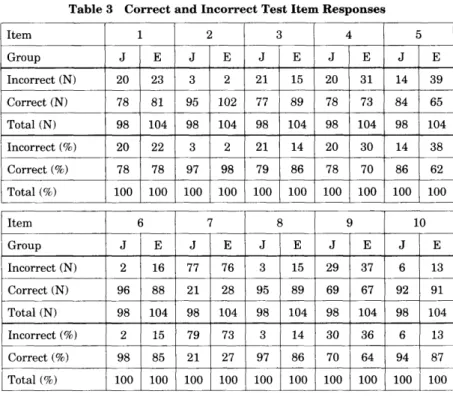
IteTn Analysis. The correct/incorrect responses to each item by
groups are shown in Table 3. Mean scores appear in Tables 4 and 5.
Table 3 Correct and Incorrect Test Item Responses Ⅰtem 釘 迭 Group rE rE rE rE rE Ⅰncorrect(N) 23 2 15 31 B39 Correct(N) 都81 涛R102 都r89 都73 塔B65 Total(N) 涛104 涛104 涛104 涛104 涛104 Ⅰncorrect(%) 22 2 14 30 B38 Correct(%) 都78 涛r98 都86 都70 塔b62 Total(%) 100 100 100 100 100 Ⅰtem 澱 途 唐 湯 Group rE rE 箸E rE rE Ⅰncorrect(N) 16 都r76 15 37 澱13 Correct(N) 涛b88 28 涛R89 田67 涛"91 Total(N) 涛104 涛104 涛104 涛104 涛104 Ⅰncorrect(%) 15 都73 14 36 澱13 Correct(%) 涛85 27 涛r86 都64 涛B87 Total(%) 100 100 100 100 100
Note : ∫ stands fわr Japanese version answers and E stands fわr English version
an-swers.
Comparingthe Difference of Japanese College Students' 129
Table 6 Test Item Chi-Square Comparison
Ⅰtem 2 4 迭6 途8 湯10
sig. 門2nS 門2nS ツp<.001 門2p<.01 門2nS
Note・ The data fb∫ individual items appear in Appendix C.
2. Discussion
Table 1 shows that in the Japanese version most of the students re-ceived a score of 7, 8 or 9. The score with the highest percentage of students was 8. This table also shows that in the English version
most of the students received a score of6, 7, 8 or 9 withthe majority
recelVlng a SCOre Or 8. 1n terms or the score modes, these two groups
are identical. In other words,there seems to be a similarity in the
Shape of the two frequency distributions.
There is a significant difference shown in Table 2 at the.05 level in the means of the two groups. That is, those who take the Japanese version where the multiple-choice options are glVen in Japanese and those who take the English version where the multiple-choice options
are glVen in English. As a whole, we can say with great confidence
thatthe students who aregiven the multiple-choice items in
Japa-nese do better on the testthan those who aregiven the options in
English. Our research question, stated in the null form, There is no
diHerence in the results when Japanese college students take
Tnultiple-choice English listenmg tests in which answeT・ Options to questions are written in Japanese than those who take the saTne test ZLJith answer op-tions to quesop-tions written in English, has not been supported.1n the Japanese version, item 7 is the most difficult and item 6 is the
easiest. However, item 7 is by far the most difrlCult, judging from
scores obseⅣed in the tables. In the English version, item 7 is the
most difficult and item 2 is the easiest.And agaln item 7 is far more
difficult than the others. Betweenthe Japanese version andthe
Eng-lish version, the most difficult item is common to both tests (EngEng-lish
version and Japanese version), while the easiest one is different. As a whole, the order of difficulty of each item in each version of the test
(English and Japanese) is different, and the students seemed to have
performed differently depending on what language was used on the
question sheet.
Table 6 indicates that there has been a significant difference in the chi-square distributions for items 5, 6 and 8 0f the two groups. Indi-vidual chi-square results appear in Appendix C. Another way of look-ing at these items is that the difference between the students who got items correct and the students who got items incorrect in the Japa-nese version is statistically bigger than that in the English version. In
other words, for items 5, 6 and 8, students do better in the Japanese
version than in the English version. The result of this present re-search has successfully rejected the null rere-search question, because students do better in these items in the Japanese version than in the English version. Although there are 7 Other items where there is no
statistical difference inthe distribution between the two groups, we
still can say with great con丘dence that students do better in the
Japa-nese version test than in the English version test. On the basis of these data analyses included in Tables 1 through 6, we could say that
Japa-Comparing the Difference of Japanese College Students' 131
nese college students take multiple-choice English listeTung tests in which answer options to questions aT・e Written in Japanese than those
who take the salne test With anszLJer OPtions to questions written in
English, has not been supported.
The present researcher acknowledges the failure to do a try-Out
and discrimination analysis. Those procedures could have led to the
removal or re-write of items with low levels of discrimination and
po-tential greater effectiveness of the research. Since no try-out was ducted, Some of the items which had low discriminating power
con-tributed very little to the item analysis.
The two language levels and their translations seemed to be equiva-lent in the professional oplnions of the present researcher and the
translation reviewer ; that is, each item in both languages used
equlValent levels of grammatical constmction, vocabulary, syntax etc・ Similarly, sentence stmctures in both versions seemed to be simple enough fわr students to understand. However, it might be possible to
say that the lack of students'background knowledge or word connota-tions in three items 5, 6 and 8 innuenced their weaker perfわrmance in
the English version. For example, if, in item 5, students are not
famil-iar with or not fond of golfing, it could be a little difficult to
under-stand the situation. In item 6, if students were not aware of the lan一
guage paraphraslng "from open to close" this might have confused the
students in the English version. In item 8, the word "direct''in
Eng-lish might not have been familiar to students. Thus, one possible
rather than trying to understand the meaning of difficult English
sen-tences or words when the choices weregiven in their native language.
Althoughit is difrlCult to identifyan outside reason forthe
differ-ence in the results, the afbrementioned explanations f♭r three items
possibly identify some language-oriented reasons for the resulting
VananCe.
V. Conclusions
The research question has not been supported as follows :
1) The mean score difference of the listening test scores between the two versions (English and Japanese) suggests that students
tak-lng the Japanese version do better than those taking the English
VerSIOn.
2) The Chi-square test results show that, for three items, students taking the Japanese version do slgni丘cantly better than those
taking the English version. Accordingly, even in the details, the basic premise of the research question has not been supported.
The present research shows that, in the English listening
compre-hension test, students perform measurably different when the options
aregiven in their mother tongue probably because they choose their
answers without having difFICulty in understanding the language
problem of option choices. This seems to permit students to fわcus
more on listening rather than reading the choices and understanding
the meanlng Of the English sentences.
Comparing the Difference of Japanese College Students' 133
be done in that target language. However, the present research does
not necessarily supportthat general testing methodology, especially
when it comes to a listening test.
APPENDICES
Appendix A (English Version)
1. (woman) The cooking class is canceled this week.
(man) Oh, no. Ⅰ'm going away on a business trip next week, and
this is my only free week.
(na汀atOr) What is the man's problem?
(A) He loves to cook.
(ち) He can't go to cooking classes very o枕en.
(C) He is not very good at cooking. (D) He can't come to the class next week.
2・ (woman) I findthat jogging in the morning is very refreshing.
(man) I prefer jogging during the evening.
(narrator)Why doesthe woman jog in the moming?
(A) Because it makes her feel better.
(B) Because she's scared to jog during the night. (C) Because she likes getting up early.
(D) Because it makes her tired.
3・ (man) I need some help in the ofrlCe this summer. Are you
inter-ested?
(woman) Do I need a college degree?
(narrator) What is the woman worried about? (A) If she can get the job.
summer job.
(C) If she was going away during the summer. (D) Ifthe man was going to change his mind.
4. (woman) rve been waiting forthe machinery for five months.
(man) Two or three months is normal, but that's ridiculous. (na汀atOr) What is the man saying about the delay?
(A) It's scary.
(ち) The woman should wait longer.
(C) The delay is too long.
(D) The machinery is broken by now.
5. (woman) I played 7 holes of golf this moming. Then it started to
rain, but I continued.
(man) I really don't care much for golf.
(narrator)What did the woman do?
(A) She went home.
(B) She carried on playing even though it started to rain. (C) She stopped playing.
(D) She played 7 holes.
6. (man) I propose you keep the shop open during the Christmas
holi-days.
(woman) I think that's a good idea.
(na汀atOr) What is the man saying?
(A) He thinks the shop should be closed.
(B) He wants to go home fわr Christmas.
(C) He doesn't want the shop to close at Christmas time. (D) He wants to make money.
Comparingthe Difference of Japanese College Students' 135 a pleasure working with you.
(woman) We do work very well together.
(narrator) ``Conclude" probably means :
(A) Begin.
(B) Hesitate. (C) Finish. (D) Celebrate.
8. (woman) Could you direct me to the nearest post office? (man) Ⅰ'm sorry, I don't know where it is.
(na汀atOr) What is the woman asking?
(A) How to get to a post Office. (B) How much a stamp costs.
(C) Show her what a post office looks like. (D) Direct her to the farthest post office. 9. (woman) Have you watered the plants yet?
(man) I thought you were going to do it.
(narrator) What is the man implying?
(A) That he hasn't watered the plants yet.
(B) That the woman should have watered the plants. (C) That the woman hasn't watered the plants. (D) That the plants don't like water.
10. (man) I have to hand in my schedule fわr my summer vacation next
week.
(woman) Ⅰ'm postponing mine until October because I'm too busy
now.
(narrator)When will the woman t,ake her vacation?
(B) Next year. (C) In October. (D) In the summer.
Appendix B
Appendix C
The Chi-Square Test Results of the Distribution of the Four Catego-ries in Each Item
incorrect(%) 215 14.4 ゅ8.025 p<.01 correct(%) 涛R澱纈89 85.6 ィ Total(%) 涛104 100 " J-Version 燃ユfW'6柳Total 巴ユfヌVRdf 睦 incorrect(%) #偵b37 35.6 田b3"縒0.822 nS Correct(%) 田s紕67 64.4 3bcr Total(%) 涛104 100 " item 10 ∫-Version 燃ユfW'6柳Total 巴ユfヌVRdr 睦 incorrect(%) 澱b13 12.5 偵B2.408 nS correct(%) 涛"纈91 87.5 c綯 Total(%) 涛104 100 " B IBLIOGRAPHY
Alderson, I.C., Clapham, C. and Wall, D. (1995). Language Test Construction
and Evaluation. Cambridge : Cambridge University Press.
Allison, D. (1999). Language Testing and Evaluation.・ An Introductory Course.
Singapore : Singapore University Press.
Comparing the Difference of Japanese College Students' 141
Baclman, L.F. and Palmer, A.S. (1996). LangzLage Testing in Practice. 0Ⅹford : 0Ⅹford University Press.
Brown, H.D. (1994). Teaching by Principles.・ An Interactive AppT・OaCh to Lan-guage Pedagogy. New Jersey : Prentice Hall Regents.
Brown, H.D. (2004). Language AssessTnent-Principles and Classroom PT・actices. New York : Pearson Education.
Brown, J.D. (1996). Testing in Language PT・OgT・aTnS. New Jersey : Prentice Hall
Regents.
Brown, J.D, (Ed.). (1998). New Ways of ClassrooTn AssessTnent.Alexandria, VA l.
TESOL.
Buck, G. (1988). Testing Listening Comprehension in Japanese University En-trance Examinations. JALT Journal 10, 1 & 2, 15-42.
Buck, G. (1994). The appropriacy of psychometric measurement models for test-lng Second language listening comprehension. Language Testing l1, 2, 145
-170.
Buck, G. (2001). Assessing ListeTu'ng. Cambridge, U.K. : Cambridge University
Press.
Davies, A. (1984). Validating three tests of English language proficiency.
Lan-guage Testing 1, 1, 50169.
Douglas, D. (2003). English Language Testing in U.S. Colleges and Universities. Washington, D.C. : NAFSA :Association of Int,ernational Educators. Davies, A., Brown, A., Elder, C., Hill, K., Lumley, T., McNamara, T. (Eds.).
(1999). Dictionary OfLanguage Testing. Cambridge : Cambridge University
Press.
Dunkel, P. (1991). Listening in the native and second/foreign language : Toward
anintegration of research and practice. TESOL QuarteT・ly 25, 3, 431-457.
Flowerdew, J. (Ed.). (1994). Academic Listening : Research Perspectives. Cam-bridge : CamCam-bridge University Press.
Henning, G. (1987). A Guide to Language Testing : DeuelopTnent, Evaluation, Re-search. Cambridge : Newbury House Publishers.
Hughes, A. (2003). Testing for Language TeacheT・S. Second Edition. Cambridge :
Cambridge University Press.
Linn, R.L. (1993). Educational Measurement (3 rd ed.). Phoenix, AZ : The Oryx
Press.
Osterlind, S.J. ( 1998). Constructing Test IteTnS : Multiple-Choice,
Richards, ∫.C. (1983). Listening comprehension : Approach, design, procedure.
TESOL QuaT・teT・ly 17, 2, 219-239
Rost, M. (1996). Listening in Language Learning. New York : Longman Inc.
Trokeloshvili, D., Davies, S. and Sakikawa, N. (Eds.). (1996). Listening fTor TOEFL. Tokyo : EichoISha.
Weir, C.J. (1990). Colnmunicatiue Language Testing. New York : Prentice Hall. Weir, C.J. (1993). Understanding and Developing Language Tests. London :
Pren-tice Hall.
Weir, C.J. (2005). Language Testing and Validation.・ An Evidence-Based