17
Music and Imagery of Water
As a Symbol of Mutability in Twelfth Night
Ayano Hamada
Many critics have given a wide range of comments on Twelfth Night, as its sub-title "What You Will" indicates, from E. K. Chamber 1 through C. L. Berber 2 to John Hollander. 3Surprisingly, there are, to my knowledge, few studies that examine the connection of the music with the imagery of water in the play. Although D. J. Palmer succeeds in examining the theme of mutability through "the Ovidian concept of metamorphosis" 4 and R. H. Wells explains the same theme by
1
2
3
4
. An excerpt from E. K. Chamber, "Twelfth Night," Shakespeare: A Survey (Oxford: Oxford University Press, 1925; rpt., 1926), pp. 172-80, in Shakespearean Criticism, Vol. 1, ed. Laurie L. Harris. (Detroit: Gale Research Company, 1984) , pp. 561-62. He regards the play as "the comedy of the sentimentalists, of the tendency of minds pent in the artificial atmosphere of cities to a spiritual self- deception".
. C. L. Barber, "Testing Courtesy and Humanity in `Twelfth Night'," in his Shakespeare's Festive Comedy: A Study of Dramatic Form and its Relation to Social Custom (Princeton: Princeton University Press, 1959, rpt., 1972), pp. 240-61.
He examines the play as a festive comedy.
. John Hollander, "`Twelfth Night' and the Morality of Indulgence," in William Shakespeare: Comedies and Romances, ed. Harold Bloom. (New York: Chelsea Hous(: Publishers, 1986) , pp. 133-46. He analyses Shakespeare's dramatization of a moral through comparing Shakespeare's with "Jonson's techniques in making mora.. comedy."
. An excerpt from D. J. Palmer, "Art and Nature in 'Twelfth Night,— Critical Quarterly, Vol. 9 (1967), 201-12 in Shakespearean Criticism, Vol. 1, pp. 648-650.
investigating the love and songs in the play , 5 neither of them pays attention to the wealth of images of water in the play . John Hollander, in turn, mentions the images of water and its importance without considering the association of water with music. 6
Twelfth Night begins and ends with music: in the opening scene Orsino requests some moody music, and in the final scene Feste , a fool, sings a song. 7 The play is apparently full of music: instrumental, dance and vocal music. We hear love songs for romantic love , merry ones for revelry and a ballad as an epilogue in the play. Another notable thing in Twelfth Night is the omnipresence of imagery relating to water, appearing in many forms such as seawater, tears , liquor and
so on.
Through his book The Shakespearian Tempest, G . Wilson Knight examines the music of Shakespeare's plays as a symbol of harmony , opposed to the tempest as one of disorder. 8 Indeed, some of the music used in his plays has the `sweet power' 9 to alter discord into harmony and to restore the harmonized human soul, as well as the healthy human body, to balanced humours; however, it should be noted that
5 . R. H. Wells. "9 `Ydle shallowe things': love and song in Twelfth Night," in his Elizabethan Mythologies: Studies in Poetry, Drama and Music (Cambridge:
Cambridge University Press, 1994) , pp. 208-224.
6. Hollander. op. cit.
7 . A. C. Bradley mentions the musical richness and the important role of the music of the play and focuses on the Feste's songs. An excerpt from A. C. Bradley ,
"Feste the Jester" in his A Miscellany (Macmillan and Co
., Ltd., 1929), pp. 207-17 in Shakespearean Criticism, Vol. 1.
8. See G. Wilson Knight, The Shakespearean Tempest (London: Methuen, 1932:
third edition, 1953) .
9 . The Merchant of Venice, 5.1 : 70-88. The Riverside Shakespeare, ed. G. B. Evans (Boston: Houghton Mifflin Company, 1974).
Music and Imagery of Water As a Symbol of Mutability in Twelfth Night 19 there is another idea of music as a symbol of the idea of mutability, as Robin H. Wells points out.'°
It is clear that the music of the play plays an important role in delineating the characters and dominating the atmosphere of the play, as some critics point out; however, little attention has been paid to the importance of the imagery of water in the play. It should be mentioned that not only the music but the imagery of water is also significant in respect of the theme of mutability of human emotion,11 which is linked with romantic love in the play. We see that Orsino suddenly changes from a melancholy man in love with Olivia into a suitor to Viola at the
last moment, while Olivia transforms from a cloistered lady into a woman in love with Cesario-Viola in disguise.
The music in Twelfth Night helps to identify the characters and determines the mood of the play, but is also more deeply connected to the theme of human mutability with the imagery of water. In other words, Shakespeare effectively uses the music and the imagery of water to emphasize the mutability of human emotion. I will argue that the music is used to suggest the theme of human mutability, and that Shakespeare connects music with human mutability by scattering the imagery of water throughout Twelfth Night.
10. Wells, op. cit., pp. 209-10. He explains the new idea of music that "Renaissance theorists saw an analogy with fortune's mutability."
11. Harold Jenkins states the theme of "the changeableness of human emotion," but does not mention the relation between it and the images of water in the play in his
"Shakespeare's Twelfth Night" in Shakespeare the Comedies: A Collection of Critical Essays, ed. Kenneth Muir. (Englewood Cliffs, N. J.: Prentice-Hall, Inc., 1965) , p. 78.
I shall first explore the imagery of water as a symbol of mutability in Twelfth Night. Besides the omnipresence of the music in the play , it should be mentioned that the imagery of water also permeates the play .
Water is represented in many different forms in the play: seawater , tears, liquor, urine, rain. Moreover, it is associated with the four humours of the human body because of its liquidity and changeable- ness. 12 The imagery of water is metaphorically and symbolically related to some of the characteristics and the theme of mutability of the play.
First, it works as a metaphor for the indulgence of most of the characters, who are `drowned' in several ways . 13 At the beginning of the play, Viola and Sebastian are literally almost drowned by shipwreck, which conjures up the image of seawater.
As the opening lines of Twelfth Night indicate, Orsino drowns in romantic but unrequited love for Olivia.
If music be the food of love, play on Give me excess of it, that, surfeiting,
The appetite may sicken, and so die. (1.1 : 1-3)14
12. Hollander, op, cit., p. 145.
13. Hollander, The Untuning of the Sky: Ideas of Music in English Poetry , 1500--1700 (Princeton: Princeton University Press, 1961), p. 153-4. Wells, op. cit., p. 208.
They both point out that many characters of the play tend to be indulged; however , neither of them mention an image of water as indulgence which is associated with
`drowning .'
14. All quotations of the play are based on The Arden Shakespeare Twelfth Night , eds. J. M. Lothian and T. W. Craik. (London: Methuen and Co. Ltd., 1975) .
Music and Imagery of Water As a Symbol of Mutability in Twelfth Night 21 His `appetite' for love needs the overrun of music so as to `sicken' and
`die.' The image of his love is linked to the natural desire of eating that is represented through the words `food,' `surfeiting' and `appetite.' He
drowns so much in love that his passion is beyond the control of his reason. According to a stage direction, [Music.] , some soft music, which sounds like `a dying fall' (1.1 : 4), is performed on the stage. The music is somewhat moody.
Shakespeare relates love to music also in Antony and Cleopatra.
Cleopatra orders performance of some music to help her deal with loneliness.
Give me some music; music, moody food
Of us that trade in love. (2.5 : 1-2) 15
Cleopatra requests `moody' music because of her missing Antony, whom she passionately loves, when he can't help going back to Rome due to
political and personal reasons. The word `moody' indicates her melancholic state of mind.
Both Orsino and Cleopatra feel some appetite for sentimental music because they `trade in love.' In both plays, love is associated with music. Thus, the lines and music at the opening of Twelfth Night portray the melancholic mood of the scene and the man in love.
Moreover, Orsino's melancholic character is also clearly described by Feste, a fool waiting on Olivia. After Feste sings an `old and plain'
15. All quotations of the other plays except for Twelfth Night are based on The Riverside Shakespeare.
song requested by Orsino and earns some money, he replies to Orsino:
"No
w the melancholy god protect thee" (2.4 : 73) . In those days , melancholy, one of the four humours of the human body, was considered to be sometimes caused as a result of romantic love; music was thought of as a cure for it. Orsino's melancholy derives from the love in which he is drowning, and the music which he requests has the effect of moderating his passion for Olivia and his melancholy as it is shown in his line: "Methought it [the old and antic song] did relieve my passion much" (2.4 : 4) .
Not only Orsino but also Olivia, whose suitor is Orsino, at the beginning of the play, drowns in grief about her brother's death (1 .1 : 28-31) . Valentine, a servant of Orsino, describes how Olivia is in deep grief.
But like a cloistress she will veiled walk, And water once a day her chamber round
With eye-offending brine. (1.1 : 28-30)
She drowns in tears, which is indicated by `water' and `eye-offending brine,' and she makes a vow to refuse any offer of marriage for seven years for mourning her brother's death, though the vow is to be broken soon. Shortly after, however, she meets a messenger sent by Orsino, and she immediately drowns in love with the messenger Cesario-Viola.
She says to herself after Orsino's servant leaves her house:
Methinks I feel this youth's perfections
Music and Imagery of Water As a Symbol of Mutability in Twelfth Night 23 With an invisible and subtle stealth
To creep in at mine eyes. (1.5 : 300-2)
Olivia is confused with her feelings for Cesario-Viola, and indicates it through her expressions of self-restraint and repeated self-questioning lines (1.5 : 297-99) . To the audience, however, she clearly begins to fall in love, and consequently drowns in her romantic but unsuccessful love, beyond control of her reason.
Sir Toby, Olivia's kinsman, is immersed in drunkenness; he drowns in liquor. Maria advises Sir Toby not to drink too much, when they first
appear on the stage: "That quaffing and drinking will undo you" (1.3 : 14) . He is more or less drunk all the time, as said by Olivia 'half drunk' (1.5 : 117) when he reports a messenger Cesario-Viola standing at the gate of her house. And Feste answers Olivia's question.
Oli. What's a drunken man like, fool?
Clown. Like a drowned man, a fool, and a madman:
one draught above heat makes him a fool, the
second mads him, and a third drowns him. (1.5 : 131-4)
It is interesting that 'a drunken man' is compared to `a drowned man' by association between liquor and water. Sir Toby is drowned in drink.
Like Sir Toby, Sir Andrew, who is another suitor to Olivia, is pickled in liquor. Maria mentions his drunkenness: "he's drunk nightly in your company" (1.3 : 36-37) . We know his liking for drinking from the scene of his revel with Sir Toby and Feste (2.3) .
Furthermore, Sir Andrew drowns in the pleasing words of Sir Toby . He tells Sir Toby to leave Olivia's villa because there seems to be no chance for him to get married to his niece; however , as soon as Sir Toby encourages him, he withdraws what he has just said and stays longer at her house (1.3 : 102-112) . In Act 3, Scene 2, Sir Andrew again makes his mind up to give up wooing and go home because he knows that Olivia is interested not in him but in the messenger of Orsino; but , Sir Toby and Febian easily coax him into challenging Cesario-Viola . He is `a dear manikin' (3.2 : 51) who is very easy to be flattered into doing something for fun, just as Roderigo is easy for Cassio to manipulate in Othello . He always acts with no doubts about what others tells him to do . In short, not following what he decides by himself, he drowns in doing what others tell him to do.
Malvolio wallows in 'self-love' (1.5 : 89) stated by his Mistress Olivia when he sarcastically responds to what Feste said . And in a later scene, after he throws scornful words to Sir Toby , Sir Andrew and Feste who are singing and drinking, Maria portrays him: "a time-pleasure , an affectioned ass ... the best persuaded of himself , so crammed (as he thinks) with excellencies" (2.3 : 147-50) . In addition to his self-love enough for "his grounds of faith that all that look on him love him"
(ibid. 151-52) , he is an ambitious steward drowning in his self-love . Thus, the image of 'drown,' which is associated with water , apparently works as a metaphor for carrying something to excess or indulging oneself in something beyond the control of reason. We see Orsino drowning in love, Olivia drowning first in grief and then in love , Sir Toby drowning in drinking, Sir Andrew drowning in be:ng `a dear
Music and Imagery of Water As a Symbol of Mutability in Twelfth Night 25 manikin' as well as in liquor, and Malvolio drowning in self-love.
Secondly, taking into consideration the nature of fluidity or liquidity of water in itself, water is symbolically linked to the mutability and brevity of romantic love, youth, beauty, and human emotion.
We see the transience of human emotion in the character of Orsino.
At the beginning of the play, he requests some melancholic music; he, however, turns it down soon.
0, it came o'er my ear like the sweet sound That breathes upon a bank of violets,
Stealing and giving odour. Enough, no more;
`Tis not so sweet now as it was before
. (1.1 : 5-8)
The music which has `sweet sound' attracts Orsino; he, however, suddenly orders it stopped after a few seconds. His `Enough, no more' is uttered in the line 7, in spite of his compliment (5-7) . It is within less than 10 lines that Orsino begins to listen to music required by himself
and then turns down its performance. The length of lines from the start to the end of the music apparently indicates a very quick change in his mind. Thus, in less than the ten lines at the opening scene, the music marks an explicit characteristic of Orsino, his changeableness as well as the melancholic mood of the play.
Later in the play, Feste points out Orsino's mutability through metaphors using some cloth and a jewel. When Feste is invited at the Duke's villa to respond to his request for music and performs an `old and plain' song (2.4 : 43) , he replies to the reward from Orsino:
the/ tailor make thy doublet of changeable taffeta, for
thy mind is a very opal. (2.4 : 73-75)
A specific cloth `taffeta' has the characteristic of "changing colour with the light." 16 The adjective `changeable' is suitable for the metaphor of Orsino's mutability in this sense. And 'opal' is a jewel famous for altering colour beautifully according to the light. These metaphors explicitly indicate the changeableness of Orsino's `mind.' So, Feste points out Orsino's passion for love like `changeable taffeta' and `a very opal' because of its mutability.
In the opening scene of the play, Orsino mentions the unreality and transience of romantic love.
O spirit of love, how quick and fresh art thou, That notwithstanding thy capacity
Receiveth as the sea.
So full of shapes is fancy That it alone is high fantastical.
(1.1 : 9-11)
(1.1 : 14-5)
It is notable that `spirit of love' is compared to the sea as an unstable thing. Love is linked to the sea, an image of water, in this sentence, and has something common with the sea in its changing moods. 17 Later,
Orsino again compares his appetite for love to the sea: "mine is all as hungry as the sea." (2.4 : 101) . He insists that his capacity for love
16. The Arden, note on the lines.
17. Palmer, op, cit., p. 649.
Music and Imagery of Water As a Symbol of Mutability in Twelfth Night 27 affection is superior to women's; at another level, even though he himself is not aware of it, the association of love with the sea indicates to the audience the mutability of love.
The word `fancy' refers to romantic love, which assumes many
`shapes .' This, at the same time, explains the changeableness and unstableness of `fancy.' And also the word `high fantastical' indicates how unreal `fancy'is. 18Thus, these lines show how unstable and unreal romantic love is. Also in another scene when he speaks with Cesario-Viola (2.4 : 33-35), Orsino talks about the transience of male affection.
Furthermore, he argues with Cesario-Viola about the changeable nature of female affection (2.4 : 94- 95) . And he also mentions the brevity of beauty, comparing it to `roses' (2.4 : 38-9).
It is Feste's song beginning with the line `What is love?' that shows how vulnerable romantic love and youth are.
What is love? Tis not hereafter,
Present mirth hath present laughter:
What's to come is still unsure.
In delay there lies no plenty,
Then come kiss me, sweet and twenty:
Youth's a stuff will not endure. (2.3 : 48-53)
The word `present' repeatedly emphasizes the brevity of love. And the
18. Jenkins, op, cit., p. 78.
last lyric refers to the transience of youth. The song as a whole seemingly suggests the idea of the carpe diem, enjoying the day; there lies behind it, moreover, the sense of the mutability of a man and his youth because `What's to come is still unsure.'
In addition to the metaphor of mutability of love, water also, as I have already mentioned, represents, in the medieval medical understanding, the four humours of the human body: Choler, Blood, Phlegm and Melancholy. Connected with the nature of fluidity of water, the image of water as the four humours is also related to the mutability of human temperament, because human temperament always changes, corresponding with the dominant humour.
It is Feste who embodies the mutability of man as well as of human temperament, as the line `I am for all waters' (4.2 : 65) shows. Water represents the four humours, as mentioned before. Feste is a fool, but at some time, he transforms himself into Sir Topas, or a merry reveler with Sir Toby and Sir Andrew, or even a musician who sings love songs for melancholic Orsino. Feste has the characteristic of being very changeable in his appearance. Hearing the line and seeing the mutable fool, the audience might have linked `humors' to water. Thus, the imagery of water is clearly associated to music as a symbol of mutability in the character of Feste.
It could be said that there is room for the idea of music as a symbol of mutability in connection with the imagery of water in Twelfth Night, as well as for a symbol of harmony represented by the multiple couples in the final scene.
Music and Imagery of Water As a Symbol of Mutability in Twelfth Night 29 I shall have a look at the traditional theory of music before I examine the two types of music in Twelfth Night.
Boethius (c. 480-524/25A. D.) in his De institutione musica divides music into three types: musica mundana (cosmic music), musica humana (human music) and musica instrumentlis (instrumental music) . 19 Renaissance music generally accepts this traditional theory, for the division follows the idea of correspondence between macrocosm and microcosm which is sometimes represented by the human body.
The first, musica mundana, to Boetius, denotes "the order and proportions of the heavens and the elements, both in their properties and in their movements — the `harmony of the universe."' 20 "It refers"
not only to "the rhythm of the seasons and the music of the spheres" but also to "the power of music to control material objects and elemental forces" as seen in myths like Orpheus, Amphion and Anion. 21 Shakespeare also mentions such a kind of musical power in The Merchant of Venice.
Boetius means, by the second, musica humana, "the blending of incorporeal soul and the physical body." 22 It is related to "the physical
and mental harmony" of man when he keeps "a proper balance of the
19. Henry Chadwick, Boethius: The Consolations of Music, Logic, Theology, and Philosophy (Oxford: Oxford University Press, 1981; Clarendon Press, 1990), pp.
81-84.
Catherine M. Dunn, "The Function of Music in Shakespeare's Romances,"
Shakespeare Quarterly, 20 (1969) , pp. 391-92.
20. Dunn, op. cit., p. 392.
21. Dunn, loc. cit.
22. Chadwick, op. cit., p. 82.
four humours— body fluids." 23 The theory of the four humours of a human body is traced back to a medieval medical concept , which the Elizabethans still accepted. The theory states that the four humours—
Choler, Blood, Phlegm and Melancholy — operate on and predominate over the corresponding temperaments of a person. When the four humours of a person are equally proportioned, he is "good-humoured"
or "good-tempered," and also he is "in tune." 24 On the other hand , when the humours of a person are not balanced, he is "ill-humoured" or
"bad -tempered ," and also "out of tune," 25 as in Much Ado About Nothing Beatrice says "I am out of all other tune" (3.4 : 40) . Thus ,
musica humana takes a "medical and psychological lore: the widespread belief in music's curative powers." 26
Waters also represent the humours, the body fluids , 27 for an image of fluidity of water is associated with the changeableness of human temperament. Here is the connection between music, the imagery of water and human mutability, which I have already partly discussed in relation to Twelfth Night.
Based upon the concept of musica humana, the third music performed by musical instruments, musica insturumentalis is regarded as one of the important academic subjects by Renaissance nobles and scholars in respect of ethical as well as political matters. 28 Performing music, the
23. John H. Long, "Introduction," in Music in English Renaissance Drama, ed. John H. Long. (Lexington: University of Kentucky, 1968) , p. vii.
24. Long, loc. cit.
25. Long, loc. cit.
26. Dunn, loc. cit.
27. Andrson, op. cit., p. 30.
28. Dunn, loc. cit.
Music and Imagery of Water As a Symbol of Mutability in Twelfth Night 31 people believe, delivers a healthy human body and soul based on the balance of four humours in man, or the harmonious world under the Sun.
There is "a bad kind of music which corrupts and weakens," as W. H.
Auden summarizes the traditional theory of music. 29 This kind of music has the power to break harmony, provoke a fight or revel between people, or tempt a person into wrongdoing, as the music performed by Chaucer's Pardoner in his the General Prologue of The Canterbury
Tales.30 The Pardoner intentionally sings "an offertorie" very well so that people who listen to his song can be persuaded to offer some money to Pardoner's church. Shakespeare also mentions such an ambivalent effect of music in Measure for Measure: "... music oft hath such a charm/ To make bad good, and good provoke to harm" (4.1 : 14-15).
Thus, it must be remembered that music has not only good power to bring or restore harmony but also bad power to raise disorder.
In Twelfth Night, there are two types of music in the play which are represented in the characters of Viola and Feste.
Viola's music, even though she herself does not play any musical instrument in the play, is regarded as music with `the sweet power' to restore the harmony of the world and the harmonious soul of the proportional humours. Her voice, which sounds like vocal music, cures
29. W. H. Auden, "Music in Shakespeare" in his The Dyer's Hand and other Essays (London: Faber and Faber, 1948; rpt., 1962) , p. 501.
30. The General Prologue of The Canterbury Tales, 707-14. Geoffrey Chaucer, The works of Geoffrey Chaucer, Second Edition, ed. F. N. Robinson (Oxford: Oxford University Press, 1966; rpt., 1974) . I owe this interpretation of the Pardoner's use of music to Dr. Okuda, Kanagawa University.
the `drowned' people, especially Orsino and Olivia . Through her soothing musical power, Orsino makes a renewal of his wooing to Viola from Olivia. Olivia is brought back into the living world from her cloistered life as soon as she falls in love with Cesario-Viola , and is finally united with her true lover Sebastian . Viola's music-like voice restores Olivia.
In addition, the captain implicitly refers to her musical power .
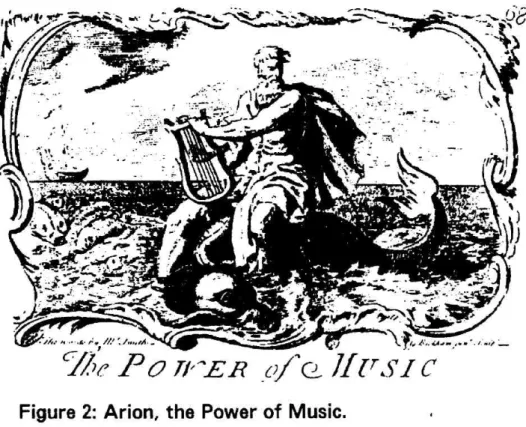
Where, like Arion on the dolphin's back ,
I saw him hold acquaintance with the waves . (1.2 : 15-6)
Arion, the mythic Orpheus-like poet-musician, is tossed over board by malicious mariners to die in the sea; however, his musical power to tame wild beasts and bring harmony helps him to charm a wild dolphin , which carries him on his back to the shore. 31 The captain does not directly mention Viola but her brother Sebastian; however , it is not difficult to see that Arion represents Viola, not only because she disguises herself as a male, who looks very like her supposedly drowned brother, but also because the twins have 'One face, one voice, one habit' (5.1 : 214).
As figure 1 and 2 show, Arion on the dolphin's back holds stringed instruments, which bring discord back to the harmony of the world and the soul of a man. Orpheus as a poet-musician in myth is not less popular than Anion among the Elizabethans. The reason why 31. James Hall, Dictionary of Subjects and Symbols in Art (New York: Harper and
Row, Publishers, 1974; Icon Editions, revised edition, 1979) , p. 31.
Music and Imagery of Water As a Symbol of Mutability in Twelfth Night 33
(,, ;-- ' ' V_
\ - ---'
+
74,
Figure 1: Anion on the back of the dolphin.
George Wither, A Collection of Emblems (1635) in John Hollander, The Untuning of the Sky: Ideas of Music in English Poetry 1500-1700 (Princeton: Princeton University Press, 1961).
7/Foii ?C- 1 irsi c
Figure 2: Arion, the Power of Music.
George Bickham, The Musical Entertainer (London, 1740) , in Ruth Katz, Divining the Power of Music: Aesthetic Theory and the Origins of Opera (New York: Pendragon, 1986).
Shakespeare chooses Arion, not Orpheus, might be found in the difference of the ends of their stories. Arion finally reaches the shore with the help of a charmed dolphin by his musical power , while, despite his musical power, Orpheus at last is dismembered by the bacchantes for his misogyny. 32 By choosing Arion, Shakespeare might have avoided the image of death associated with Orpheus.
Another difference between Arion and Oepheus lies in the locations of each story. The story of Arion is located at sea; on the other hand, Orpheus never goes to sea. Shakespeare might have positively selected Arion in order to deliver the image of water and the connection between music and water as well as the association of a shipwreck at the beginning of the play.
In addition, most evidently, the name `Viola' suggests a stringed musical instrument which is a viol. Therefore, in the play she takes the role of a musician to restore harmony like Arion.
The other type of music is Feste's, which has the power both to stir up revels and to break harmony. There is evidence to show Feste's music as negative. Coming across the fool, Viola mentions one of the musical instruments that Feste plays: 'tabor' (3.1 : 2) . As seen in figure 3, this instrument is associated with Bacchus/Dionysus, who is the mythical god of festival, revel and drinking. The music performed by Feste stirs up wild merrymaking with drunken Sir Toby and Sir Andrew. And also, though Feste performs a song as a request by Orsino, his music lures Orsino's melancholic mood into more disturbed condition and then
32. Hall, op. cit., p. 230-31.
Music and Imagery of Water As a Symbol of Mutability in Twelfth Night 35
rESO:"
is `
J
Cr'9 ,
1K•;M!r
Li~,:~~ _ le /C~0~y^
rIReitx..Z
~~~ Y~
544.4'.4:-.7.--V,..r.M .yr.ek7.,,,c.l'.x"—NaeL. -5?'1'ril-r Plk
Figure 3: Bacchus.
Geffrey Whitney, A Choice of Emblem (Leyden, 1586) Henry Green (New York: Benjamin Blom, 1967).
Wic
4'j er1/4. Ed.
makes his humours more unbalanced. Moreover, Feste's song "What is love?" (2.3 : 48-53) refers to the changeableness of love and youth.
Therefore, Feste's music stands as a symbol of the mutability of balanced status, that is, harmony and the harmonious soul of a man, although ironically the harmony is restored through the sweet music.
In other words, music as a symbol of mutability paradoxically explains that harmony always has the potential danger of falling into discord.
In this sense, harmony restored through music is also regarded as mutable and ephemeral.
At the very end of the play after all the characters . go off the stage, Feste remains alone on the stage. After the harmony, symbolized by the multiple couples, is brought back to the world, the mutability,
represented by Feste, is still standing before the audience . At this time, Feste delivers an epilogue in the form of a song, in which the only constancy in the world is 'the rain' (5.1 : 388-407) . The ballad sung by the fool has all five stanzas and the same phrase "For the rain it rainth every day" is repeated at the end of each stanza except for the last one . There is also another repeated phrase "With hey, ho, the wind and the rain" on the second line of all the stanzas.
Not only does 'the rain' fall but also 'the wind' blows on us; the only thing that continues 'every day' in the world is 'the rain.' Considering 'the wind'
refers to air, which is associated to music, 33 'the wind' reminds us of music as a symbol of mutability as well as of harmony , although it is also mutable, while 'the rain' is a form of water, a symbol
of mutability. It could be said that the line 'the rain it raineth every day' tells us that the mutability and brevity of the harmonized world and the human soul of balanced humours, as part of the nature of the world, goes on 'every day.'
In addition to the mutability and brevity of harmony in the world, Robin H. Wells claims that Twelfth Night "seems to reflect that sense of national decline that is such a characteristic feature of the period." 34 When Orsino talks about the brevity of women's beauty, Viola replies:
'to die
, even when they to perfection grow!' (2.4 : 41). It is clear that these words literally refer to the vulnerability of women's beauty. It
33. OED. `air': N . 18. Connected succession of musical sounds; expressive rhythmical sequence of musical tone; songlike music, melody, The meaning of 'air' is this sense is found
, for example, in Midsummer Night's Dream: "... your tongue's sweet air/ More tuneable than lark to shepherd's ear" (1.1 : 183-84) . 34. Wells. op. cit., p. 222.
Music and Imagery of Water As a Symbol of Mutability in Twelfth Night 37 might be said, however, that the Elizabethan audience could catch the feeling of "the transitoriness of civilization" "behind her words." 35 The slightly dark tone in the play reflects the people's feeling for the unstableness and mutability of the world as well as their sense of sadness for the end of the festival and a return to the harsh ordinary life, where `the wind and the rain' severely blows. Shakespeare thus emphasizes the theme of human mutability both by assigning the epilogue to Feste, a symbol of mutability, and by the positive connection between music and the imagery of water in the play.
Bibliography
Anderson, Ruth L. Elizabethan Psychology and Shakespeare's Play. New York: Haskell House, 1964.
Auden, W. H. "Music in Shakespeare" in The Dyer's Hand and Other Essays.
London: Faber and Faber, 1948; rpt., 1962, pp. 500-27.
Chadwick, Henry. Boethius: The Consolations of Music, Logic, Theology, and Philosophy. Oxford: Oxford University Press, 1981; Clarendon Press, 1990.
Chaucer, Geoffrey. The Works of Geoffrey Chaucer, Second Edtion. Ed. F.
N. Robinson. Oxford: Oxford University Press, 1966; rpt., 1974.
Dunn, Catherine M. "The Function of Music in Shakespeare's Romances."
Shakespeare Quarterly, 20 (1969), 391-405.
Katz, Ruth. Divining the Power of Music: Aesthetic Theory and the Origins of Opera. New York: Pendragon, 1986.
Hall, James. Dictionary of Subjects and Symbols in Art. New York: Harper and Row, Publishers, 1974; Icon Editions, revised ed. 1979.
Harris, Laurie L. Ed. "Twelfth Night" in Shakespearean Criticism, Vol. 1.
Detroit: Gale Research Company, 1984, pp. 543-650.
35. Wells. loc. cit.
Hollander, John. The Untuning of the Sky: Idea of Music in English Poetry 1500-1700. Princeton: Princeton University Press, 1961.
---
"`Twelfth Night' and the Morality of Indulgence" in Willi am Shakespeare: Comedies and Romances. Ed. Harold Bloom. New York: Chelsea House Publishers, 1986, pp. 133-46.
Jenkins, Harold. "Shakespeare's Twelfth Night" in Shakespeare the Comedies: A Collection of Critical Essays. Ed. Kenneth Muir. Englewood Cliffs, N.
J.: Prentice-Hall, Inc., 1965, pp. 72-87.
Knight, G. Wilson. The Shakespearian Tempest. London: Methuen & Co.
Ltd., 3rd ed., 1953.
Long, John H. Shakespeare's Use of Music: A Study of the Music and its Performance in the Original Production of Seven Comedies. Gainesvill: University of Florida Press, 1955.
---
"Introduction" in Music in English Renaissance Drama
. Ed. John H. Long. Lexington: University of Kentucky Press, 1968, pp. v -- xi.
Salingar, L. G. "The Design of Twelfth Night." Shakespeare Quarterly. 9 (1958), 117-139.
Seng, Peter J. The Vocal Songs in the Plays of Shakespeare: A Critical History. Cambridge, Massachusetts: Harvard University Press, 1967.
Shakespeare, William. The Arden Shakespeare Twelfth Night. Eds. J. M.
Lothian, and T. W. Craik. London: Methuen & Co. Ltd., 1975.
---
The Riverside Shakespeare. Ed. G. B. Evans. Boston: Houghton Mifflin Company, 1974.
Stevens, John. "Part One: Shakespeare and the Music of the Elizabethan Stage" in Shakespeare in Music. Ed. Phtllis Hartnoll. London: Macmillan & Co.
Ltd., 1964.
--- "Chapter 4 Idea and Theories
, Medieval and Humanist" in Music and Poetry in the Early Tudor Court. London: Methuen and Co. Ltd., 1961, pp. 58 -71.
Wells, Robin H. Elizabethan Mythologies: Studies in Poetry Drama and Music. Cambridge: Cambridge University Press, 1994.
MusicandImageryofWaterAsaSymbolofMutabilityinTwelfthNight39 Whitney,Geffrey.AChoiceofEmblem.Leyden:1586.Ed.HenryGreen.
NewYork:BenjaminBlom,1967.
Yearling,ElizabethM."Language,Theme,andCharacteriǹTwelfth Night,"'ShakespeareSurvey,35{1982),79‑86.
r十 二 夜 』 に お け る音 楽 と水 の イ メ ー ジ
変 容 の象 徴 と して
濱 田 あや の
シェ イ クス ピア の 『十 二 夜 』 は音 楽 で始 ま り音 楽 で終 わ る。 劇進 行 に あ わ せ て 恋 の歌 や ダ ンスの 曲 な ど、 い ろ い ろ な音 楽 が 演 奏 され る。 これ らの 音 楽 は、 登 場 人 物 の性 格 や 特 徴、 劇 の 雰 囲 気 を伝 え るだ けで な く、 当時 の 音 楽 理 論 や音 楽 に まっ わ る神 話 とあ わ せ て考 慮 す る と、 『十 二 夜 』 の 主 題 の1っ で あ る、 変 わ りや す さ との関 連 を持 って い る と考 え られ る。 また、
この劇 に は海 や涙 、 酒 な ど、 さ ま ざ ま な形 で水 の イ メー ジが た くさん使 わ れ て い る。 この よ うな水 の イ メー ジ も、 音 楽 と同様 に、 登 場 人 物 の特 徴 を 描 きだす だ けで な く、 移 ろ い や す さ と い うテ ー マ も提 示 して い る。 劇 中 で は若 さや美 、 この世 界 もは か な く移 ろ いや す い もの と見 な され て い るが、
最 も焦 点 が 当 て られ て い る もの は恋 す る心 、 す なわ ち 人 の心 の変 わ りや す さで あ る。 劇 中 に あふ れ て い る音 楽 と散 りば め られ た 水 の イ メ ー ジが どの よ うな役 割 を し、 ま た変 わ りや す さ と い うテ ー マ とど の よ うに関連 して い
るか を考 察 す る。
『十 二 夜 』 の中 で い ろい ろな 形 を と って あ らわれ る水 の イ メ ー ジは、 ま ず、 登 場 人物 た ち の特 徴 と して 、 それ ぞれ が 何 か に溺 れ て い る こ とを示 し
て い る。 さ らに、温 度 変 化 で 固 体 ・液 体 ・気 体 と変 わ る水 本 来 の特 徴 や 、 中世 医学 の伝統 に根 ざ した、 人 間 の4っ の体 液 と の連 想 と合 わ せ て、 変 わ りやす さ とい うテ ー マ を示 す た め に水 の イ メ ー ジが効 果 的 に用 い られ て い る。
16世 紀 イ ギ リス の音 楽 理 論 や、 ギ リシ ャ神 話 の オ ル フ ェ ウ ス とデ ィオ ニ ュ ソ スが そ れ ぞ れ奏 で る音 楽 の特 質 との関 連 に よれ ば 、 『十 二夜」 に はヴ ァ イ オ ラが 体 現 す る調 和 を導 く音 楽 と、 フ ェ ス テ にみ られ る調 和 を乱 す 音楽 が あ る。 道 化 で あ る フ ェ ス テが音 楽 師 に な った り悪 魔 払 い をす るサ ー ・ ト パ ス にな る こ と に着 目 し、音 楽 と水 の イ メ ー ジが変 わ りや す さ とい うテ ー マ で結 びっ い て い る こ とを 明 らか にす る。