Financial Market Development on Economic Growth
著者 Hino Tomoko
出版者 Institute of Comparative Economic Studies, Hosei University
journal or
publication title
Journal of International Economic Studies
volume 32
page range 25‑37
year 2018‑03
URL http://doi.org/10.15002/00014482
Impact of Foreign Direct Investment and Financial Market Development on Economic Growth
Tomoko Hino
Hosei University
Abstract
Foreign direct investment (FDI) has a major impact on the economic growth of both the investing and host countries. In the present study, the impact of FDI and financial market development on economic growth in host countries is examined by conducting ordinary least squares, fixed effects model, and instrumental variables regression analyses of panel data collected for 60 countries from 1980 to 2014. The results of the analyses show that FDI and financial market development have independent positive effects on economic growth in host countries, and also that financial market development does not increase the positive effect of FDI on economic growth.
JEL classification: F21, F30, F43, O16.
1. Introduction
Foreign direct investment (FDI) has several major effects on the economic growth of both the investing and host countries. In the host country, compared with cases where there is only domestic investment, FDI improves total factor productivity and income, making it possible to prevent capital that could be invested domestically from flowing out of the country. FDI also makes it possible to increase domestic capital stock without increasing external debt, and the inflow of capital promotes expansion of production and employment and the transfer of new technology to the host country.
However, FDI also intensifies economic competition due to increased entry of foreign-affiliated companies. In the investing country, FDI increases exports of intermediate goods via greater inter- process division of labor. In addition, domestic production becomes more specialized in capital- intensive manufacturing processes through the export of labor-intensive production processes, which increases the pool of skilled workers and improves domestic productivity. However, FDI also reduces the domestic production scale and raises the domestic unemployment rate.
Developing countries are characterized by a chronic lack of financial assets; therefore, to attract FDI, developing countries must first develop their financial markets, which has positive effects on their economic growth. Through financial market development, the number of domestic enterprises that lack financial assets is decreased, leading to a greater capacity for investment. The inflow of FDI then increases domestic savings and investment, and the efficiency of the domestic market is improved. Finally, as international risk-sharing progresses, capital costs are reduced, production specialization progresses, and productivity improves.
Although many of the positive effects of FDI and financial market development on economic growth in host countries are understood, the full effects are yet to be fully elucidated. It also remains
unknown whether financial market development enhances the positive effects of FDI on economic growth. Therefore, the present study examines these two points.
In this paper, Section 2 provides a summary of relevant studies previously conducted on the issue. Section 3 presents the two models and Section 4 describes the data used in the present estimations. Section 5 presents the results of the analyses. Section 6 compares the present results with those of a previous study. Section 7 concludes.
2. Previous studies
2.1. FDI and economic growth
Several previous studies demonstrate that FDI increases the income of the host country and has a positive effect on productivity. De Mello (1999) conducted an analysis using panel data from 33 countries that included both Organisation for Economic Co-operation and Development (OECD) member and non-member countries and found that FDI has a positive impact on economic growth in all countries, with the rate of economic growth increasing most in OECD member countries. This was attributed to FDI having a greater effect on improving productivity in countries with more advanced production technology. However, even in non-OECD countries, FDI was found to have a positive effect on economic growth because productivity is improved by the promotion of capital accumulation through FDI.
Xu (2000) examined the effect of technology transfer through FDI in host countries and found that only developed countries that have already accumulated human capital benefit from this type of technology transfer.
Soto (2000) and Reisen and Soto (2001) examined the impact of capital flows on economic growth by using panel data for developing countries and found strong positive correlations between FDI and capital flow, and between FDI and GDP growth rate. In developing countries, where financial markets are not fully developed, capital flows have advantages over debt flows. In other words, if the volatility of capital flows is large, the negative impact on the economy will increase.
However, the volatility of FDI is smaller than the volatility of capital flows. For that reason, FDI has a greater positive effect on economic growth.
In contrast to this previous study, Blomström, Kokko, and Zejan (2000) analyzed data for developing countries and found that FDI does not have a positive effect on economic growth because there is no accumulation of human capital in developing countries, and so any improvement in productivity due to technology transfer through FDI is negligible. This suggests that FDI does not always lead to economic growth.
2.2. Technical level of the host country
Borensztein, De Gregorio, and Lee (1998) analyzed the relationship between the effect of FDI on economic growth and the technical level of the host country and found that when new capital inflow from FDI enhances technological progress, productivity improves and economic growth advances.
However, they also found that the technical level of the workforce dictates the scale of economic growth. This suggests, that economic growth from FDI is positive only in countries that guarantee a minimum level of education.
2.3. Financial market development
Acemoglu and Zilibotti (1997) and Beck, Levine, and Loyaza (2000) report that if a country’s financial markets are not fully developed, multinational companies are more advantageous than local businesses, which means that local companies may not benefit from FDI.
According to Hermes and Lensink (2003), a fully developed financial system is necessary for FDI to increase economic growth in the host country. The introduction of new technology through FDI improves productivity and increases economic growth. However, economic growth requires sufficient financial assets. Furthermore, to properly select investment destinations, a well-developed financial system is indispensable.
Alfaro et al. (2004) used cross-country data to examine the relationship between financial system development and the effect of FDI on economic growth and found that the positive effect of FDI on economic growth is ambiguous. However, they found that if the financial markets develop, the positive effect of FDI on economic growth is boosted.
In an analysis of cross-section of equity foreign portfolio investment (EFPI) data, Durham (2004) found that FDI and EFPI have no direct positive effect on economic growth, but that EFPI promotes the effect of FDI on economic growth.
Lee and Chang (2009) used panel data for 37 countries to examine whether financial market development or FDI affects economic growth most and found that financial market development has a greater influence on economic growth than FDI.
Chee and Nair (2010) used panel data for 44 countries in Asia and Oceania and a fixed effect regression model and a random effect model to examine the relationship between the degree of financial market development and the effect of FDI on economic growth and found that financial market development increases the positive effect of FDI on economic growth.
Li and Liu (2005) used panel data from 84 countries to examine whether FDI has a positive influence on economic growth. In the analysis, a three-stage least squares method was used and income gap relative to the United States was taken as an index of the absorptive capacity of the country. The coefficient for the interaction between the variables “income gap with the United States” and “FDI” was a significant negative value. In other words, the greater the income gap with the United States, the less positive the impact of FDI on economic growth.
2.4. Evolution of estimation methods
The effect of FDI on economic growth varies from country to country. With the introduction of panel data, it has become possible to incorporate different effects for each country into estimation models so that more detailed analyses can be conducted. However, panel data is often heteroscedastic.
Arellano and Bond (1991) and Arellano and Bover (1995) used dynamic panel data models to remove bias from their results. Nair-Reichert and Weinhold (2001) analyzed panel data from 24 developing countries by using homogeneity and heteroscedasticity assumptions. For the homogeneity assumptions, they used dynamic panel models, and for the heteroscedasticity assumptions they used a mixed fixed and random model. In both cases, they found that FDI has a positive impact on economic growth, which means that the process by which FDI brings economic growth varies from country to country.
2.5. The endogeneity problem
When analyzing how FDI affects economic growth in host countries, the problem of endogeneity must be considered. Endogeneity arises in this context because a reverse causality exists, if host countries are chosen in anticipation of future economic growth. This means that FDI does not
promote economic growth in the host country, but rather that FDI is being directed to countries where economic growth is currently occurring or where economic growth is expected to occur. The following papers consider countermeasures to the problem of endogeneity: Alfaro et al. (2004) used instrumental variables regression, Li and Liu (2005) used a three-stage least squares method, and De Mello (1999) used fixed effect instrument variable estimation.
3. The model
Two models are used in the present study. The independent variable in Equation (1) is FDI and other variables. By using Equation (1), the effect of FDI on economic growth can be estimated. To the independent variable in Equation (1), Equation (2) adds variables that describe financial market development and the interaction between FDI and the financial markets. This makes it possible to determine not only the impact of financial market development on economic growth but also whether financial market development increases or decreases the positive effect of FDI on economic growth.
GROWTHi = β0+β1Log(Initial GDPi ) +β2 FDIi + β3 CONTROLSi + vi …(1)
GROWTHi = β′0+β′1 FDIi + β′2 (FDIi ×FINANCEi )+β′3FINANCEi +β′4CONTROLSi + vi …(2)
4. Data
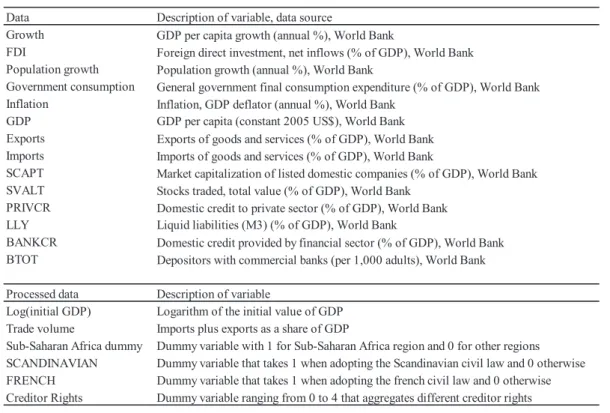
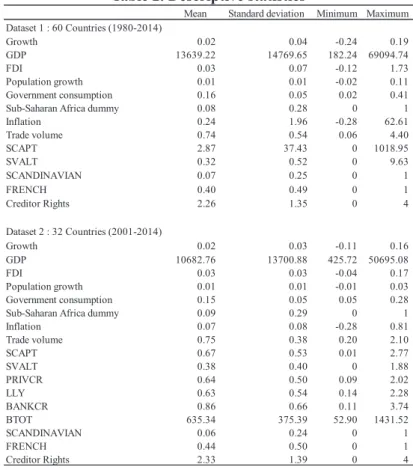
Two datasets are used in the present analyses. The first dataset comprises panel data for 60 countries for the period 1980 to 2014, and the second dataset comprises panel data for 32 countries for the period 2001 to 2014 (Table 7). All values are real values and the data was obtained from the World Bank. Table 1 summarizes the variables used in the analyses and their data sources, and Table 2 provides descriptive statistics for each variable.
Data are collected for the following six variables representing financial market development:
SCAPT, market capitalization of listed domestic companies; SVALT, the total value of stocks traded;
PRIVCR, domestic credit to private sector; LLY, liquid liabilities (M3); BANKCR, domestic credit provided by the financial sector; and BTOT, depositors with commercial banks. The data for BTOT is logarithmic. SCAPT and SVALT are included in both datasets, whereas the other variables are included only in the 32-country dataset.
Processed data used in the analyses include the data for Log(initial GDP) and trade volume.
Log(initial GDP) is the logarithm of the initial value of GDP and is used as a dummy variable. Trade volume is calculated as imports plus exports as a share of GDP.
The following four dummy variables are also used in the analysis: Sub-Saharan Africa dummy, SCANDINAVIAN, FRENCH, and Creditor Rights. The Sub-Saharan Africa dummy variable is a dummy variable that takes 1 for Sub-Saharan Africa region and 0 for all other regions.
SCANDINAVIAN and FRENCH are legal origin dummy variables. SCANDINAVIAN is a dummy variable that takes 1 when adopting Scandinavian civil law and 0 otherwise; the four countries corresponding to 1 are Sweden, Denmark, Norway, and Finland. FRENCH is a dummy variable that takes 1 when adopting French civil law and 0 otherwise; the 24 countries corresponding to 1 are Argentina, Belgium, Brazil, Chile, Colombia, Costa Rica, Ecuador, El Salvador, France, Guatemala, Guyana, Italy, Jamaica, Mexico, Netherlands, Panama, Paraguay, Peru, Portugal, South Africa, Spain, Trinidad and Tobago, Uruguay, and Venezuela.
Creditor Rights is used by adopting the classification of La Porta et al. (1997, 1998). This dummy variable is an index that classifies creditor rights into four classes. In the countries classified as 1, the minimum dividend for applying for the reorganization of a company or the consent of the creditors is regulated; the nine countries corresponding to 1 are Argentina, Australia, Brazil, Canada, Denmark, Germany, Guyana, Italy, and Spain. In countries classified as 2, once the reorganization petition is approved, the secured creditor can gain possession of their securities; the 10 countries corresponding to 2 are Belgium, Chile, Finland, Japan, Kenya, Pakistan, Papua New Guinea, Trinidad and Tobago, United Kingdom, and Venezuela. In countries classified as 3, in the distribution of procedures that result in the disposition of assets of a bankrupt firm, secured creditors will receive assets first; the eight countries corresponding to 3 are Austria, Ecuador, Greece, Malaysia, Panama, Thailand, Turkey, and United States. In countries classified as 4, the debtor does not retain management of a property until a resolution of reorganization is made; the 11 countries corresponding to 4 are Egypt, El Salvador, Iran, Ireland, Jamaica, Malawi, Mexico, Paraguay, Sri Lanka, Sweden, and Zimbabwe. The five countries corresponding to 0 are Colombia, Ghana, New Zealand, Singapore, and South Africa.
Table 1. Data
Data Description of variable, data source
Growth GDP per capita growth (annual %), World Bank
FDI Foreign direct investment, net inflows (% of GDP), World Bank Population growth Population growth (annual %), World Bank
Government consumption General government final consumption expenditure (% of GDP), World Bank Inflation Inflation, GDP deflator (annual %), World Bank
GDP GDP per capita (constant 2005 US$), World Bank Exports Exports of goods and services (% of GDP), World Bank Imports Imports of goods and services (% of GDP), World Bank
SCAPT Market capitalization of listed domestic companies (% of GDP), World Bank SVALT Stocks traded, total value (% of GDP), World Bank
PRIVCR Domestic credit to private sector (% of GDP), World Bank LLY Liquid liabilities (M3) (% of GDP), World Bank
BANKCR Domestic credit provided by financial sector (% of GDP), World Bank BTOT Depositors with commercial banks (per 1,000 adults), World Bank Processed data Description of variable
Log(initial GDP) Logarithm of the initial value of GDP Trade volume Imports plus exports as a share of GDP
Sub-Saharan Africa dummy Dummy variable with 1 for Sub-Saharan Africa region and 0 for other regions SCANDINAVIAN Dummy variable that takes 1 when adopting the Scandinavian civil law and 0 otherwise FRENCH Dummy variable that takes 1 when adopting the french civil law and 0 otherwise Creditor Rights Dummy variable ranging from 0 to 4 that aggregates different creditor rights
Table 2. Descriptive statistics
Mean Standard deviation Minimum Maximum Dataset 1 : 60 Countries (1980-2014)
Growth 0.02 0.04 -0.24 0.19
GDP 13639.22 14769.65 182.24 69094.74
FDI 0.03 0.07 -0.12 1.73
Population growth 0.01 0.01 -0.02 0.11
Government consumption 0.16 0.05 0.02 0.41
Sub-Saharan Africa dummy 0.08 0.28 0 1
Inflation 0.24 1.96 -0.28 62.61
Trade volume 0.74 0.54 0.06 4.40
SCAPT 2.87 37.43 0 1018.95
SVALT 0.32 0.52 0 9.63
SCANDINAVIAN 0.07 0.25 0 1
FRENCH 0.40 0.49 0 1
Creditor Rights 2.26 1.35 0 4
Dataset 2 : 32 Countries (2001-2014)
Growth 0.02 0.03 -0.11 0.16
GDP 10682.76 13700.88 425.72 50695.08
FDI 0.03 0.03 -0.04 0.17
Population growth 0.01 0.01 -0.01 0.03
Government consumption 0.15 0.05 0.05 0.28
Sub-Saharan Africa dummy 0.09 0.29 0 1
Inflation 0.07 0.08 -0.28 0.81
Trade volume 0.75 0.38 0.20 2.10
SCAPT 0.67 0.53 0.01 2.77
SVALT 0.38 0.40 0 1.88
PRIVCR 0.64 0.50 0.09 2.02
LLY 0.63 0.54 0.14 2.28
BANKCR 0.86 0.66 0.11 3.74
BTOT 635.34 375.39 52.90 1431.52
SCANDINAVIAN 0.06 0.24 0 1
FRENCH 0.44 0.50 0 1
Creditor Rights 2.33 1.39 0 4
5. Empirical results
Table 3 shows the results of the ordinary least squares regression analysis made by using Equation (1). This analysis measures the effect of FDI on economic growth in the host country. Both datasets are used to provide estimates for two different time periods. In both analyses (Table 3, columns (1) and (2)), the coefficient for FDI is positive and statistically significant, indicating that an increase in FDI is associated with an increase in economic growth in the host country.
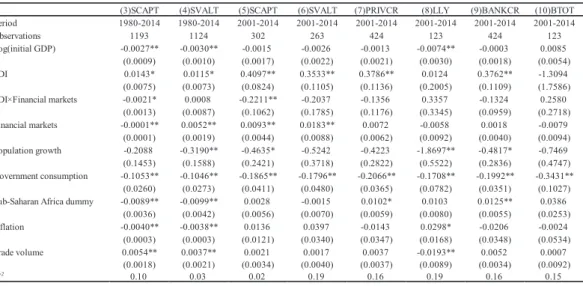
Table 4 shows the results of ordinary least squares regression analysis made by using Equation (2) in which variables expressing financial market development are added to Equation (1). This analysis measures the impact of FDI and financial market development on economic growth in the host country. In addition to the six variables regarding financial market development, a variable for the interaction between FDI and financial markets is added, which allows us to examine how financial market development supports economic growth through FDI. In the results of the analysis, the coefficients for FDI were significant and positive for most variables. Therefore, as in the previous ordinary least squares regression analysis (Table 3), FDI has a positive effect on economic growth in the host country. Among the coefficients for Financial markets, only the coefficients for SCAPT and SVALT are significant; however, the coefficients for many of the other interactions are positive.
Together, these results indicate that economic growth increases as the financial markets develop.
Next, an interaction term is added to examine the impact of financial market development on the effect of FDI on economic growth in the host country. In the results of the analysis, only the coefficients for SCAPT are significant, although they are also negative. This suggests that as the
financial market develops, the positive effect of FDI on economic growth decreases. In other words, the development of the financial market does not boost the effect of FDI on economic growth.
Considering this result in more detail, in column (3), the signs for the coefficients for FDI, Financial markets, and the interaction term are positive, negative, and negative, respectively; therefore, financial market development has a negative effect on economic growth. In the case of column (5), the signs for the coefficients for FDI, Financial markets, and the interaction term are positive, positive, and negative, respectively; therefore, FDI and financial market development both have a positive effect on economic growth. However, the negative sign for the coefficient for the interaction term suggests that as financial market development progresses, the positive impact on economic growth by FDI decreases.
Table 5 shows the results obtained from the fixed effect regression model analysis. Note that different data are used in the ordinary least squares regression analysis (Table 4) and this fixed effect regression model analysis. In this analysis, Log(GDP) is added, and Log(initial GDP) and Sub- Saharan Africa dummy variable are removed. The reason for using a fixed effect regression model is that this estimation contains a reverse causal problem where if the host country is chosen based on anticipated future economic growth, a reverse causality exists that results in the creation of endogenous bias. By using a fixed effect regression model it is possible to remove endogenous bias, and omitted variable bias generally does not occur in this type of analysis. In the present analysis (Table 5), the coefficient for FDI is significant and positive for most of the estimates, which is consistent with the previous two analyses (Tables 3 and 4). Also, of the coefficients for Financial markets development, only that for SCAPT is significant, and the signs in columns (11) and (13) are different. In addition, the coefficients for FDI, Financial markets, and the interaction term only have significant values in column (11). The signs of the coefficients for FDI, Financial markets, and the interaction term are positive, negative, and negative, respectively, which is the same as in column (3). Table 6 shows the results of the instrumental variables regression analysis. A major advantage for using instrumental variables regression is that it deals with the reverse causal problem. In an instrumental variables regression, selection of the appropriate instrumental variables is important.
The appropriate instrumental variables are correlated with the independent variable and are not affected by the dependent variable. In the present analysis, two variables are used; one is a dummy variable created from the origin of a country’s legal rules and the other is a dummy variable created by classifying creditor rights into four categories. By using the instrument variables regression, the statistical significances of the three coefficients of FDI, Financial market, and the interaction term are improved greatly. Looking at columns (20), (22), and (23), the signs for the coefficients for FDI, Financial markets, and the interaction term are positive, positive, and negative in all three columns.
In other words, FDI and financial market development both have a positive effect on economic growth, but financial market development does not boost the effect of FDI on economic growth.
Together, the results of the three analyses show that FDI and financial market development have a positive impact on economic growth in the host country. However, since the interaction between FDI and financial market variables is negative, financial market development does not increase the effect of FDI on economic growth. This is likely because as the financial markets develop, the economy is able to grow, making it possible to raise funds from the domestic market, which reduces the importance of FDI. For this reason, the influence of FDI on economic growth in the host country is reduced. Another likely factor is that part of the domestic investment is crowded out; in other words, as the financial market develops, overseas funds flow into the host country and investment expands, resulting in increased government expenditure and rising interest rates.
However, this shrinks private investment and negatively affects the effect of FDI.
Table 3. Effect of FDI on economic growth (ordinary least squares regression analysis)
(1) (2)
Period 1980-2014 2001-2014
Observations 2025 431
Log(initial GDP) -0.0016* -0.0004
(0.0009) (0.0015)
FDI 0.0328** 0.2652**
(0.0140) (0.0516)
Population growth -0.5551** -0.5908**
(0.1428) (0.2436) Government consumption -0.1285** -0.2050**
(0.0253) (0.0366) Sub-Saharan Africa dummy -0.0077* 0.0130**
(0.0044) (0.0051)
Inflation -0.0022** -0.0183
(0.0006) (0.0340)
Trade volume 0.0081** 0.0049
(0.0018) (0.0033)
0.08 0.16
R2
Notes: Dependent variable: average annual real per capita growth rate.
Data are presented as coefficients with standard deviations in parentheses.
Coefficients are statistically significant at the *10% or **5%
significance level.
Table 4. Effect of financial market development and FDI on economic growth (ordinary least squares regression analysis)
(3)SCAPT (4)SVALT (5)SCAPT (6)SVALT (7)PRIVCR (8)LLY (9)BANKCR (10)BTOT
Period 1980-2014 1980-2014 2001-2014 2001-2014 2001-2014 2001-2014 2001-2014 2001-2014
Observations 1193 1124 302 263 424 123 424 123
Log(initial GDP) -0.0027** -0.0030** -0.0015 -0.0026 -0.0013 -0.0074** -0.0003 0.0085
(0.0009) (0.0010) (0.0017) (0.0022) (0.0021) (0.0030) (0.0018) (0.0054)
FDI 0.0143* 0.0115* 0.4097** 0.3533** 0.3786** 0.0124 0.3762** -1.3094
(0.0075) (0.0073) (0.0824) (0.1105) (0.1136) (0.2005) (0.1109) (1.7586)
FDI Financial markets -0.0021* 0.0008 -0.2211** -0.2037 -0.1356 0.3357 -0.1324 0.2580
(0.0013) (0.0087) (0.1062) (0.1785) (0.1176) (0.3345) (0.0959) (0.2718)
Financial markets -0.0001** 0.0052** 0.0093** 0.0183** 0.0072 -0.0058 0.0018 -0.0079
(0.0001) (0.0019) (0.0044) (0.0088) (0.0062) (0.0092) (0.0040) (0.0094)
Population growth -0.2088 -0.3190** -0.4635* -0.5242 -0.4223 -1.8697** -0.4817* -0.7469
(0.1453) (0.1588) (0.2421) (0.3718) (0.2822) (0.5522) (0.2836) (0.4747) Government consumption -0.1053** -0.1046** -0.1865** -0.1796** -0.2066** -0.1708** -0.1992** -0.3431**
(0.0260) (0.0273) (0.0411) (0.0480) (0.0365) (0.0782) (0.0351) (0.1027) Sub-Saharan Africa dummy -0.0089** -0.0099** 0.0028 -0.0015 0.0102* 0.0103 0.0125** 0.0386
(0.0036) (0.0042) (0.0056) (0.0070) (0.0059) (0.0080) (0.0055) (0.0253)
Inflation -0.0040** -0.0038** 0.0136 0.0397 -0.0143 0.0298* -0.0206 -0.0024
(0.0003) (0.0003) (0.0121) (0.0340) (0.0347) (0.0168) (0.0348) (0.0534)
Trade volume 0.0054** 0.0037** 0.0021 0.0017 0.0037 -0.0193** 0.0052 0.0007
(0.0018) (0.0021) (0.0034) (0.0040) (0.0037) (0.0089) (0.0034) (0.0092)
0.10 0.03 0.02 0.19 0.16 0.19 0.16 0.15
R2
Notes: Dependent variable: average annual real per capita growth rate.
Data are presented as coefficients with standard deviations in parentheses.
Coefficients are statistically significant at the *10% or **5% significance level.
Table 5. Effect of financial market development and FDI on economic growth (fixed effect regression model)
(11)SCAPT (12)SVALT (13)SCAPT (14)SVALT (15)PRIVCR (16)LLY (17)BANKCR (18)BTOT
Period 1980-2014 1980-2014 2001-2014 2001-2014 2001-2014 2001-2014 2001-2014 2001-2014
Observations 1193 1124 302 263 424 123 424 123
Log(GDP) -0.0099 -0.0150 0.0185 0.0226 0.0463* 0.0625** 0.0418* 0.1002**
(0.0091) (0.0093) (0.0129) (0.0300) (0.0242) (0.0274) (0.0214) (0.0271)
FDI 0.0327** 0.0204** 0.4494** 0.4582** 0.5032** -0.1278 0.5355** -1.7715
(0.0133) (0.0093) (0.1339) (0.1727) (0.1137) (0.2399) (0.1136) (1.7604) FDI Financial markets -0.0030** 0.0024 -0.2082 -0.4287* -0.3708** -0.0149 -0.3402** 0.3997
(0.0011) (0.0128) (0.1518) (0.2244) (0.1150) (0.4999) (0.0963) (0.3175)
Financial markets -0.0001** 0.0043 0.0181** 0.0099 -0.0260 0.0227 -0.0217 -0.0448
(0.0001) (0.0037) (0.0069) (0.0076) (0.0203) (0.0216) (0.0143) (0.0265)
Population growth -0.4229 -0.5846** -1.3594 -2.3175** -2.3363** -1.9624 -2.2432** 3.3437
(0.2714) (0.2906) (1.0067) (1.1025) (0.8631) (1.6378) (0.9004) (2.8548) Government consumption -0.3875** -0.4451** -0.4162** -0.8261** -0.5563** -1.0030** -0.5194** -0.2338
(0.1315) (0.1459) (0.1892) (0.1953) (0.1917) (0.1868) (0.1960) (0.3010)
Inflation -0.0049** -0.0050** 0.0194 0.0143 -0.0384 0.0355** -0.0351 -0.0139
(0.0005) (0.0006) (0.0127) (0.0223) (0.0307) (0.0148) (0.0300) (0.0430)
Trade volume 0.0030 0.0071 0.0124 0.0349 0.0453** 0.0730** 0.0475** 0.0904**
(0.0103) (0.0144) (0.0107) (0.0219) (0.0161) (0.0216) (0.0170) (0.0373)
0.09 0.10 0.23 0.21 0.21 0.25 0.21 0.19
R2
Notes: Dependent variable: average annual real per capita growth rate.
Standard deviations are given in parentheses under the coefficients.
Individual coefficients are statistically significant at the *10% or **5% significance level.
Table 6. Effect of financial market development and FDI on economic growth (instrumental variables regression)
(19)SCAPT (20)SVALT (21)SCAPT (22)SVALT (23)PRIVCR (24)LLY (25)BANKCR (26)BTOT
Period 1980-2014 1980-2014 2001-2014 2001-2014 2001-2014 2001-2014 2001-2014 2001-2014
Observations 1004 979 302 263 424 96 424 123
Log(initial GDP) -0.0035** -0.0069** 0.0042 -0.0093** -0.0073** -0.0111** -0.0044* 0.0098 (0.0011) (0.0017) (0.0029) (0.0037) (0.0034) (0.0054) (0.0025) (0.0071)
FDI 0.0678* 0.1170** -0.2376** 0.7956** 0.8135** 0.1939 0.7520** -2.2300
(0.0407) (0.0529) (0.2594) (0.2278) (0.2436) (0.2441) (0.2034) (2.8900) FDI Financial markets -0.0446 -0.1528** 0.8665** -1.2810** -0.6235** 0.1846 -0.4615** 0.4040
(0.0441) (0.0590) (0.4361) (0.5019) (0.2634) (0.3758) (0.1760) (0.4457)
Financial markets 0.0013 0.0387** -0.0513 0.0769** 0.0450** 0.0103 0.0261** -0.0136
(0.0013) (0.0131) (0.0238) (0.0267) (0.0179) (0.0258) (0.0109) (0.0184)
Population growth -0.4083** -0.0938 -1.0393** 0.4144 0.2977 -0.7092 0.2494 -0.8800
(0.1710) (0.1764) (0.3241) (0.5580) (0.4202) (2.3439) (0.3899) (0.5648) Government consumption -0.0743** -0.0612* -0.1918** -0.1469** -0.2243** 0.0006 -0.2187** -0.3457**
(0.0326) (0.0358) (0.0477) (0.0600) (0.0396) (0.0914) (0.0376) (0.1037) Sub-Saharan Africa dummy -0.0112** -0.0191** 0.0386** -0.0222* -0.0075 -0.0040 -0.0013 0.0460
(0.0041) (0.0048) (0.0150) (0.0120) (0.0090) (0.0129) (0.0072) (0.0330)
Inflation -0.0035** -0.0032** -0.0194 0.0504 0.0182 0.1733 0.0057 -0.0037
(0.0003) (0.0004) (0.0247) (0.0338) (0.0338) (0.1127) (0.0338) (0.0533)
Trade volume 0.0075** -0.0005 0.0149** -0.0033 -0.0034 -0.0089 0.0041 -0.0018
(0.0026) (0.0032) (0.0061) (0.0052) (0.0054) (0.0135) (0.0038) (0.0096) Notes: Dependent variable: average annual real per capita growth rate.
Standard deviations are given in parentheses under the coefficients.
Individual coefficients are statistically significant at the *10% or **5% significance level.
Instrumental variables for each column are as follows: Column (19) is SCANDINAVIAN and Creditor Rights;
columns (20) is FRENCH and Creditor Rights; columns (21), (23), (25), and (26) are SCANDINAVIAN and FRENCH; column (22) is FRENCH; column (24) is SCANDINAVIAN, FRENCH, and Creditor Rights.
6. Comparison with previous studies
Alfaro et al. (2004) examined the impact of financial market development and FDI on economic growth in the host country and concluded that FDI has a positive effect on economic growth in the host country. However, the financial market development has a negative effect on the economic growth of the host country; the interaction between FDI and financial markets is positive. This means that financial market development alone does not contribute to economic growth in the host country, but that financial market development has the effect of increasing the positive effect of FDI.
In the present analyses, the signs of the coefficients for FDI, Financial markets, and the interaction term are positive, positive, and negative, respectively. Both FDI and financial market development have positive effects on economic growth, but financial market development does not increase the effect of FDI on economic growth. As the development of financial markets progresses, the positive impact FDI has on economic growth diminishes.
To determine why the results of the present study and those of Alfaro et al. differ, we must consider the characteristics of the data used. The World Bank classifies countries according to income level into four categories: high income, upper-middle income, lower-middle income, and low income. When classifying the data used in the present study to this classification, 50.0% of the countries are high income and 3.3% are low income. In contrast, in the data used in the study by Alfaro et al., 41.7% of the countries are high income and 12.5% are low income. Thus, compared with the present study, the data used by Alfaro et al. includes a higher proportion of low-income countries than the data used in the present study.
Berthelemy and Varoudakis (1996) examined the threshold effect on financial system development by using a standard economic growth model to which a variable describing financial market development was added. They found that further development of the financial system has a positive effect on economic growth in countries that already have a highly developed financial system. However, in countries with an underdeveloped financial system, further development of the financial system will have a negative effect on economic growth. Fung (2009) used a model that incorporated the interaction of financial system development and economic growth to examine data for low-income countries and found that low-income countries that are underdeveloped but have good financial systems are able to develop into middle-income countries in the future. However, low-income countries with unstable financial systems will became “poverty trap” states.
The data used by Alfaro et al. contains a relatively high percentage of low-income countries compared with the data used in the present study, that is, it includes a large proportion of countries where the financial system is incomplete. Therefore, it is possible that their results reflect more the situation in low-income countries. In other words, even if the financial markets develop due to improvement of the financial system, it may not necessarily have a positive effect on the economic growth of that country. However, low-income countries are characterized by a chronic financial asset shortage, and FDI plays a major role in resolving this situation. Therefore, financial market development likely has a negative impact on economic growth, and the interaction between FDI and the financial markets is positive.
In contrast, the data used in the present study contains a higher percentage of high-income countries than the data used by Alfaro et al., suggesting that the present results reflect the situation in high-income countries. The financial system in high-income countries is already highly developed, and further development of the financial system will have a positive influence on economic growth.
That is, high-income countries with well-developed financial markets can obtain any necessary financial assets from their financial markets without relying on FDI; therefore, FDI is less important
in high-income countries than in low-income countries. As a result, the signs of the coefficients obtained for FDI and the variables representing financial market development are positive, and the interaction between FDI and Financial markets is negative. That is, both an increase in FDI and financial market development have a positive effect on economic growth in the host country;
however, financial market development does not increase the positive effect of FDI on economic growth, and with financial market development, the positive effect of FDI on economic growth diminishes.
7. Conclusion
In developing countries where funds and human resources are limited, it is important to decide the content of policies and the order in which to enact them. Therefore, clarifying whether financial market development increases the effect of FDI on economic growth will be useful for informing policy decisions.
In the present study, we examined how FDI and financial market development influence economic growth in the host country by conducting ordinary least squares, fixed effects model, and instrumental variables regression analyses. Fixed effects model and instrumental variables regressions were used to address the reverse causal problem inherent in this type of estimation.
Among the estimation results, the results from the instrumental variables regression are the most significant. Among the six variables indicating development of financial markets, the total value of traded stocks and domestic credit to the private sector are significant values. The results show that financial market development and FDI both have a positive effect on economic growth in the host country; however, the results also show that financial market development does not increase the positive effect of FDI on economic growth in the host country.
There are two important differences between the results of the present study and the results of Alfaro et al. (2004). One concerns whether financial market development has a positive influence on economic growth in the host country and the other concerns whether financial market development increases the positive effect of FDI on economic growth. Alfaro et al. showed that financial market development alone does not contribute to economic growth in the host country, but that financial market development does increase the positive effect of FDI on economic growth in the host country.
In the present study, both FDI and the variables describing financial market development have a positive effect on economic growth, but financial market development does not increase the positive effect of FDI on economic growth. The reason for these different results is possibly the underlying characteristics of the data, that is, the data used in the study by Alfaro et al. contains a greater proportion of low-income countries than the data used in the present study.
Further studies are needed to clarify the conclusion of the present study. If the impact of financial market development on economic growth differs between high-income and low-income countries, it will be necessary to make estimations using separate datasets for high-income and low- income countries. Furthermore, if the supplementing effect of financial market development on the positive effect of FDI on economic growth in the host country varies based on the degree of financial market development, it may be necessary to divide the degree of financial market development into several stages and produce separate estimations for each stage. These are future research subjects for this series of studies.
Table 7. Countries included in the two datasets
Dataset 1 : 60 Countries (1980-2014)
Argentina, Australia, Austria, Bangladesh, Belgium, Brazil, Canada, Chile, Colombia, Costa Rica, Cyprus, Denmark, Ecuador, Egypt, El Salvador, Finland, France, Germany, Ghana, Greece, Guatemala, Guyana, India, Indonesia, Iran, Ireland, Israel, Italy, Jamaica, Japan, Jordan, Kenya, Korea, Malawi, Malaysia, Malta, Mexico, Netherlands, New Zealand, Norway, Pakistan, Panama, Papua New Guinea, Paraguay, Peru, Philippines, Portugal, Singapore, South Africa, Spain, Sri Lanka, Sweden, Thailand, Trinidad and Tobago, Turkey, United Kingdom, United States, Uruguay, Venezuela, Zimbabwe.
Dataset 2 : 32 Countries (2001-2014)
Australia, Bangladesh, Brazil, Canada, Chile, Colombia, Costa Rica, Denmark, Egypt, Ghana, Guatemala, Guyana, Indonesia, Israel, Jamaica, Japan, Kenya, Korea, Malaysia, Mexico, Pakistan, Panama, Papua New Guinea, Paraguay, Philippines, South Africa, Sweden, Thailand, Trinidad and Tobago, Turkey, Uruguay, Venezuela.
Acknowledgments
The author would like to thank Akiko Tamura, Aya Motozawa, and especially Kenji Miyazaki for their useful suggestions and encouragement while undertaking this research. The author also acknowledges the helpful comments of the participants in the “Empirical Study on Firms’ Foreign Direct Investment Strategy and Process which Improve Competitiveness” project.
REFERENCES
Acemoglu, Daron and Zilibotti, Fabrizio [1997] “Was Prometheus Unbound by Chance? Risk, Diversification and Growth,” Journal of Political Economy, 105, pp.709-751.
Alfaro, Laura; Chanda, Areendam; Kalemli-Ozcan, Sebnem and Sayek, Selin [2004] “FDI and economic growth: The role of local financial markets,” Journal of International Economics, 64[1], pp.89-112.
Arellano, Manuel and Bond, Stephen [1991] “Some Tests of Specification for Panel Data: Monte Carlo Evidence and Application to Employment Equations,” Review of Economic Studies, 58, pp.227-297.
Arellano, Manuel and Bover, Olympia [1995] “Another Look at the Instrumental-Variable Estimation of Error-Components Models,” Journal of Econometrics, 68, pp.29-51.
Beck, Thorsten; Levine, Ross and Loyaza, Norman [2000] “Financial Intermediation and Growth:
Causality and Causes,” Journal of Monetary Economics, 46[1], pp.31-77.
Berthelemy, Jean-Claude and Varoudakis, Aristomene [1996] “Economic Growth, Convergence Clubs, and the Role of Financial Development,” Oxford Economic Papers New Series, 48[2], pp.300-328.
Blomström, Magnus; Kokko, Ari and Zejan, Mario [2000] “Multinational Corporations and Productivity Convergence in Mexico,” Multinational corporations and productivity convergence in Mexico, Palgrave Macmillan UK.
Borensztein, Eduardo; De Gregorio, Jose and Lee, Jong-Wha [1998] “How Does Foreign Direct Investment Affect Economic Growth?,” Journal of International Economics, 45, pp.115-135.
Chee, Yen Li and Nair, Mahendhiran [2010] “The Impact of FDI and Financial Sector Development on Economic Growth: Empirical Evidence from Asia and Oceania,” International Journal of
Economics and Finance, 2[2], pp.107-119.
De Mello, Luiz R. Jr. [1999] “Foreign Direct Investment-Led Growth: Evidence from Time Series and Panel Data,” Oxford Economic Papers, 51[1], pp.133-151.
Durham, Benson J. [2004] “Absorptive capacity and the effects of foreign direct investment and equity foreign portfolio investment on economic growth,” European Economic Review, 48[2], pp.285-306.
Fung, Michael K. [2009] “Financial development and economic growth: Convergence or divergence?,” Journal of International Money and Finance, 28[1], pp.56-67.
Hermes, Niels and Lensink, Robert [2003] “Foreign direct investment, financial development and economic growth,” The Journal of Development Studies, 40[1], pp.142-163.
La Porta, Rafael; Lopez-de-Silanes, Florencio; Shleifer, Andrei and Vishny, Robert W. [1997] “Legal Determinants of External Finance,” Journal of Finance, 52[3], pp.1131-1150.
La Porta, Rafael; Lopez-de-Silanes, Florencio; Shleifer, Andrei and Vishny, Robert W. [1998] “Law and Finance,” The Journal of Political Economy, 106[6], pp.1113-1155.
Lee, Chien-Chiang and Chang, Chun-Ping [2009] “FDI, financial development, and economic growth: international evidence,” Journal of Applied Economics, 12[2], pp.249-271.
Li, Xiaoying and Liu, Xiaming [2005] “Foreign Direct Investment and Economic Growth: An Increasingly Endogenous Relationship,” World Development, 33[3], pp.393-407.
Nair-Reichert, Usha and Weinhold, Diana [2001] “Causality tests for cross-country panels: a new look at FDI and economic growth in developing countries,” Oxford Bulletin of Economics and Statistics, 63[2], pp.153-171.
Reisen, Helmut and Soto, Marcelo [2001] “Which Types of Capital Inflows Foster Developing- Country Growth?,” International Finance, 4[1], pp.1-14.
Soto, Marcelo [2000] “Capital Flows and Growth in Developing Countries: Recent Empirical Evidence,” OECD Development Centre Working Papers, 160.
Xu, Bin [2000] “Multinational Enterprises, Technology Diffusion, and Host Country Productivity Growth,” Journal of Development Economics, 62, pp.477-493.