The Illustrations for a Victorian Aesop and a Meiji Isoppu
著者 Scott Johnson
journal or
publication title
関西大学東西学術研究所紀要
volume 16
page range A51‑A99
year 1983‑01‑20
URL http://hdl.handle.net/10112/16046
The Illustrations for a Victorian Aesop and
a Meiji Isoppu.
Scott Johnson
Japan's long fascination with Aesop's Fables has been outlined in Prof. KOBORI Keiichiro's 1978 book Isoppu Guwa (Aesop's Fables). Japanese translations of the fables go back to the 16th C., and most published editions of the fables were illustrated. This essay deals with the illustra- tions to one of the most appealing Japanese editions, the WATABE Godo translation published in Meiji 5 and 6 (1872-3) as Tsuzoku Isoppu Monogatari, (A Popular Version of Aesop's Fables).
The Watabe (the name can also be read Watanabe) Isoppu contains illustrations by KAWANABE Kyosai, FUJISAWA Bainan and a third artist, who signed his illustrations Koson (IPH~), and may have been the little-known OSHIMA Koson. The problem of Koson's identity will be taken up later.
There is considerable esthetic impact from many of the woodblock illustrations to the Watabe Isoppu, but their most striking feature is their obvious Western influence, suggesting a specific model upon which the Japanese illustrators drew.
Prof. Kobori is correct in identifying this Western publication as the Thomas James transla- tion, published in several editions from 1848. The original illustrations for the 1848 James Aesop were the work of John Tenniel, best known for his later illustrations to Alice in Wonderland and other Lewis Carroll books.
Prof. Kobori relied upon an American edition of the James Aesop, and noted that whereas some of the Tenniel illustrations clearly were the models used by Kyosai, Bainan and Koson, others were completely different. Resolution of this seeming difficulty is not found in a different Western Ae- sop, but in another edition of the James Aesop, probably the 1858 London edition, which included revised illustrations by Tenniel, as well as new ones by Joseph Wolf, a German-born illustrator whose long career in London centered on scientific illustrations, especially of birds and animals.
The James Aesop was first published by John Murray in 1848 with illustrations by Tenniel only. Comparison of a copy of the 1848 edition with the Watabe Isoppu shows that only some of the Tenniel illustrations could have been the sources for the Japanese illustrations. The records of the John Murray publishing house in London show that the illustrations for the James Aesop were considerably revised for the 1858 edition.
Regrettably, John Murray does not retain a file copy of this 1858 edition and I have not been
Fig. 1-a. A typical two-page layout in its entirety. The Watabe Isoppu was printed in traditional Japanese woodblock style, which means that succeeding "pages" in the Western sense are printed from the same block, the paper then being folded and the loose ends bound up.
The title of the book is printed in the center of the woodblock; accordingly, when the sheet is folded, half the title shows on each side. The page number (30 here) is shown in the lower left margin, but this actually refers to the entire sheet; in other words, half of sheet 30 is not shown here. The right-hand portion of the design is the rear of page 29. By conven- tion pages are labelled A for the front and B for the back of the sheet. Fig. 1-a, then are pages 29B/30A from Vol. I. The white space above and below the design is typical of tradi- tional Japanese book illustrations, the proportionately larger area above following the conven- tions of scroll mounting.
able to locate a copy for study. My own copy of the James Aesop is a late one, published in 1898.
The 1898 illustrations however, appear to have been the models for the pictures in the 1872-3 Wa- tabe Isoppu.
Since this 1s chronologically impossible, it seems likely that the revized illustrations for the 1858 edition were not changed in subsequent editions of the James Aesop. It still remains a bit
The Illustrations for a Victorian Aesop and a Meiji Isoppu
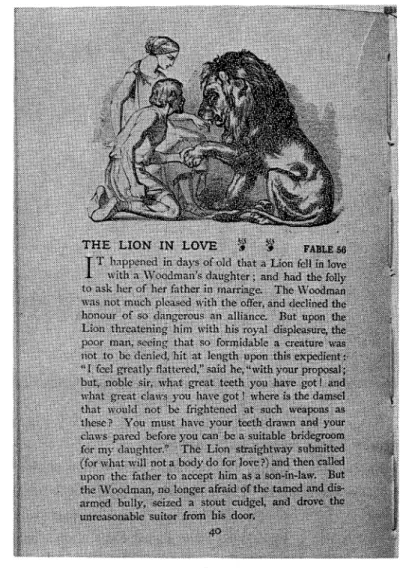
Fig. 1-b. Fable 56: "The Lion in Love." A typical page from the James Aesop, the illustration probably identical to that in the 1858 edi- tion, the proposed model for the Watabe Isoppu illustrations.
Although there is a good deal of variety in the format of the book, there are no two-page illustrations in the James Aesop.
unclear just which edition was used by Kyosai et al in preparing the Watabe Isoppu.
53
Before going any further, it seems best to compare photographs of illustrations to one of the fables, called by James "The Lion in Love." [Figs. 1-a and 1-b].
To begin with, the format of the two books is quite different. The James Aesop is small; 203 fables are presented in one octavo volume whose internal page size is 18.5 X 12 cm. The 106 de- signs are in various formats; the illustration here is only 6 X 9 cm. The engraving is unsigned, pre-
Fig. 2-a. Vol II, 19B/20A.
sumably an indication that it is by the principal illustrator, Tennie!.
The Watabe Isoppu is entirely printed by woodblocks, text as well as illustrations, in the tra- ditional, stitch-bound Japanese manner. The book contains a total of 237 fables in six volumes.
Book size is 22.5 X 15 cm.; all but one of the/35 illustrations cover two pages within a printed frame.
The "Lion in Love" illustration is 17 x 25 cm.; it is signed Shojo Kyosai, one of Kyosai's favor- ite signatures, suggesting a love of sake, and sealed Mugaku, "no education."
Tenniel's illustration is dominated by the lion, but gives prominence to the shrewd woodcutter who outwits the king of beasts. A background of closely spaced horizontal lines creates the effect of a neutral gray, accentuating the dark mane of the lion.
Kyosai's illustration gives prominence to the woodcutter's daughter, the catalyst of the story.
The lion is in the center of the illustration, giving him a strong place in the composition. The wood- cutter, however, is in a crouched position with only the upper half of his body visible. Although this may seem to weaken his importance too much, here the woodcut medium supplies strength of another sort. The block-carver, following the vigorous, brushed line of Kyosai's painted design, gives a sinuous sense of movement to the woodsman's shirt. The muscular forearms and the intent face of the woodsman extend this sense of animation and in turn draw the spectator's eye to the last
The Illustrations for a Victorian Aesop and a Meiji Isoppu 55
Fig. 2-b. Fable 102: "The Cat and the Mice."
remaining claw as it is about to be clipped off. This in turn prompts a look at the forelegs and the suggestion of mere stubs instead of claws.
Kyosai's illustration, then, partly because of the woodcut medium and partly because of the composition and line of Kyosai's brush, is dramatic, capturing an important moment in the story.
Tenniel, trying for a different effect, has created a more static composition, the balance and shading suggesting the effect of a tableau, or even a bas-relief.
The question here is not to point up one or the other artist as superior, but to indicate most emphatically that we are not dealing with a slavish imitation of Western art.
An even more striking example can be seen by comparing the unsigned (presumably Tenniel)
Fig. 3-a. Vol. I, iiB/iiiA, signed "BYNAN", lower left.
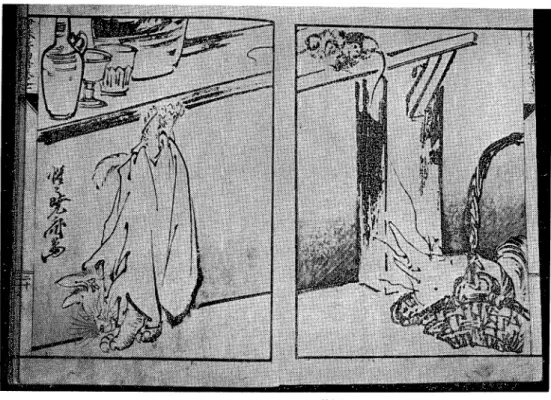
engraving for "The Cat and the Mice" with Kyosai's adaptation [Figs. 2-a and 2-b]. The mental image of a cat in a sack hanging down by his hind feet is the most striking feature of the fable.
Tenniel's illustration is very small, the vertical post balancing the hanging cat symmetrically. The mice are tiny, almost lost in the upper portion of the illustration. It is a straightforward illustra- tion of the fable, but certainly not one of Tenniel's more inspired offerings.
By contrast, K yosai presents a commanding horizontal composition. Again the vertical post balances the hanging cat, but this time across two pages. The fat cat with its extravagant ears and whiskers, and the black shading on the pillar give variety, and the diagonal shelf and floor line con- vey a feeling of asymmetry and a sense of movement. The glasses, jug and pot on the shelf are new elements; the glasses especially have a 'Western' look, without being specific as to time or country. The lower right hand is dominated by a typical Japanese basket containing what is pro- bably a kabu, a kind of turnip. The placement of the mice, not to mention the skill with which they are drawn, gives them ample focus; their long tails are echoed by the rootlets of the kabu.
The glasses and the basket are quite extraneous to the story of the fable, but add visual richness to Kyosai's design. By uniting Western and Japanese household goods in the same composition, a sense of universality is unobtrusively suggested.
The Illustrations for a Victorian Aesop and a Meiji Isoppu 57
Fig. 3-b. The Frontispiece, initialed JT, lower right.
But Kyosai was not the only illustrator of the Watabe lsoppu. Nine of the 35 illustrations were by FUJISAWA Bainan, who also wrote the preface to the Watabe Jsoppu. Bainan's considerable historical importance will be outlined later in the biographical notes on all the artists in both the James Aesop and the Watabe lsoppu. As an artist, he is known to have greatly admired the Nanga artist TSUBAKI Chinzan, and suffice it to say that this love for Chinzan is totally suppressed in his Jsoppu illustrations.
Bainan (~m) seems a perfectly typical Japanese art name, and it is with these ideograms that he signed the preface to the W atabe lsoppu. But eight of the nine illustrations by the artist are signed with a romanised homonym, "BYNAN", which appears to be an unusual but perfectly plau-
Fig. 4-a. Vol III, 12B/13A. Signed "BYNAN."
sible English family name. The ninth illustration is unsigned, but on stylistic grounds, it too can be surmised to be Bainan's.
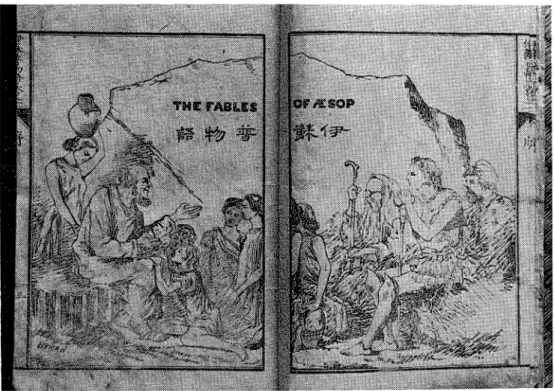
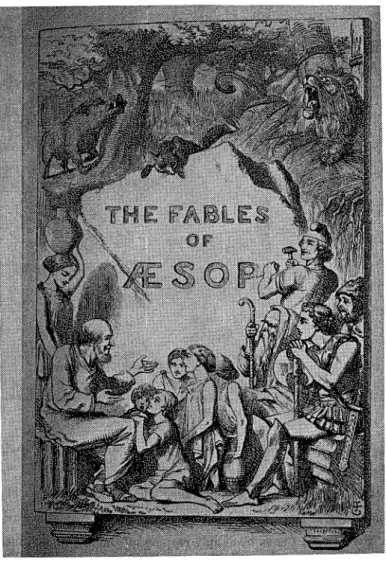
A comparison of the two frontispieces is revealing [Figs. 3-a and 3-b]. The Aesop illustration is initialed J.T., confirming it to be by John Tennie!. Bainan fitted this vertical design into the horizontal format of the Watabe Isoppu by simply lopping off the top of the illustration. There are no bold, brushlike effects in Bainan's illustration. In fact, all the lines are thin, almost unifom1.
Shading effects are achieved by cross-hatching and stippling. In short, techniques typical of en- graving are attempted in the woodblock medium, with results which are striking only if the Tenniel model has not been seen. But once the Tenniel illustration has been seen, the term "imitation"
seems not altogether inappropriate, and the label is equally applicable to other Bainan illustrations, with one exception.
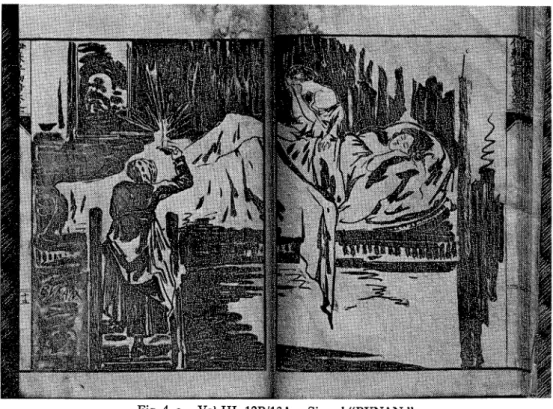
The exception is the illustration to what James called "The Old Woman and Her Maids." [Figs.
4-a and 4-b]. The unsigned (Tenniel?) illustration in the James Aesop creates the effect of late night by the extensive cross-hatching of the dark areas, contrasting with the candle-lit white sheet and skin of the two maids.
No attempt is made by Bainan to use cross-hatching here. The background over the maids'
The Illustrations for a Victorian Aesop and a Meiji Isoppu 59
Fig. 4-b. Fable 140: "The Old Woman and Her Maids."
heads and the black vertical shading to the right look curiously like charcoal or crayon, but the over- all effect is very much like the dramatic, wilful crudities of the Expressionists of some half a century later.
That effect is possible only on modern eyes looking back at this early Meiji book, but it cer- tainly seems safe to say that this illustration must have astonished early readers of the Watabe lsoppu, even if they accepted it as "Western." Bainan's approach is drastic, creating stylistic rupture within the Watabe lsoppu, and this must have been calculated to challenge its readers.
Only three of the 35 illustrations in the Watabe lsoppu are signed Koson (!!ll!~). Prof. Kobori identifies the artist as SAKAKI Koson, although his notes give no direct indication of the source
Fig. 5-a. Vol I, 3B/4A. Signed Koson.
for his identification. The Watabe Isoppu is somewhat unusual for books of the period in lacking a colophon page listing the illustrators, nor is there any hint given on the title pages. A check of the records of the First National Painting Exhibition in Meiji 15 (1882) reveals an OSHIMA Koson using the same ideograms, but it is unclear whether he is the Isoppu illustrator.
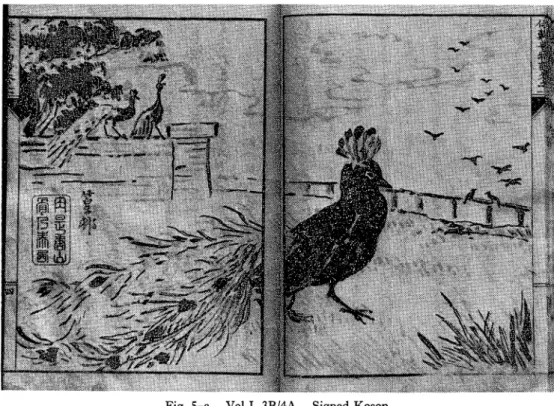
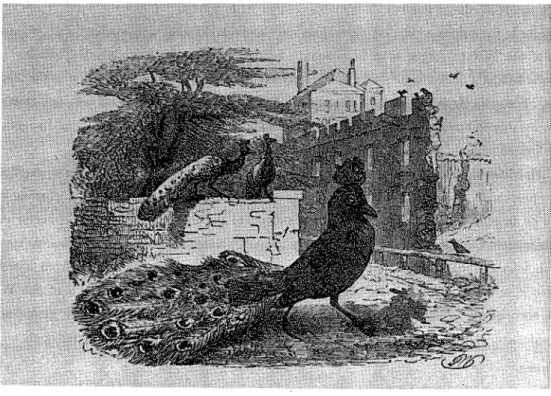
Regardless of who Koson was, he was a proficient artist, given the honor of the first three il- lustrations in the text. A comparison of Joseph Wolf's illustrations for "The Vain Jackdaw" with Koson's adaptation [Figs. 5-a and 5-b], shows his skill at simplifying the background and adding visual interest with a flock of birds on the right, presumably "Jackdaws." Here and in his other two illustrations, Koson displays an appealing ability to adapt his models to the woodblock medium, sharing Kyosai's brushed effects if not his brilliant imagination.
Although· Koson is given the text's first three illustrations, and Bainan all seven illustrations to volume three, the frontispiece and the Aesop portrait, the book is dominated by Kyosai. This is not simply a matter of numbers, although 23 of 35 illustrations does give Kyosai virtually two- thirds of the book. It is rather that the best of Kyosai's illustrations are extraordir:.arily evocative;
they linger in the mind.
Kyosai has long been admired for his skill as a painter, perhaps even more in the West than in
The Illustrations for a Victorian Aesop and a Meiji Isoppu 61
Fig. 5-b. Fable 6: "The Vain Jackdaw."
Japan. But he was also enormously prolific and gifted in creating designs for woodblock prints, and at least 50 books contain his woodblock illustrations. He was at the height of his powers when the Watabe Isoppu was published.
It should also be pointed out that five of Kyosai's illustrations have no counterpart in the Ten- niel-Wolf illustrations. These include the fables James called "The Bees, the Drones and the Wasp," "The Old Woman and Her Physician," and "The Birdcatcher and the Lark." The re- maining two illustrations have no counterpart among the fables covered in the James Aesop. James included 203 fables; Handford, in the more recent Penguin Fables of Aesop includes 206 fables, but indicates in his introduction that early manuscripts contained many more fables not generally accepted by modern critics. Neither James nor Handford include a story about travelers and a monkey king, one of the fables Kyosai illustrated. Nor do they include a fable of a father, his son and daughter, the final story illustrated by Kyosai. The Watabe Isoppu contains 238 fables, many of which must have been apocryphal.
Finally, it seems appropriate to mention that surviving examples of both the Watabe Isoppu and the James Aesop are rather scarce. The 1891 edition of the James Aesop advertised that 11,000 copies were in circulation, but the attrition rate for illustrated children's books is high; my own
copy of the 1898 edition has one illustration colored with crayons.
Records for printing runs on older Japanese books are almost non-existent, but at least two states of the Watabe Isoppu have been seen: a presumably early printing with judicious use of soft color blocks*; other copies seen retain only occasional gray blocks in addition to the black key blocks. Since the Japanese woodblock-printed book was entirely hand made, even two states does not necessarily indicate a large output. Practical experience with books of the period suggests se- verely limited editions, probably in the hundreds rather than the thousands.
*
C.H. Mitchell, cited below, informs me that he doubts the existence of the "second state" which I have proposed. Numerous examples of color variations, presence or absence of shading blocks and so on in other Edo and Meiji period books attest to the free hand of the publisher or printer in such matters. My comment rests on a stray copy of volume two only; plate 14--a in Appendix Two shows the illustration in question. The pink musculature is clearly printed from a separate woodblock, and lack of block wear confirms it as an early printing. Of seven sets of the WatabeIsoppu seen by me, none contains comparable coloring. The balance of evidence seems against a second state, but until further examples are studied, I prefer to leave the matter open.
Sources.
Special thanks must be paid to five people who have helped in the research for this essay.
C.H. Mitchell, an American who has lived in Tokyo for over 35 years, first showed me his set of the Watabe Isoppu and encouraged me to find my own set. Mr. Mitchell is recognized as one of the most experienced and scholaily Western collectors of Japanese illustrated books. He has generously shared his detailed notes and ideas on this and many other Japanese books over the last few years, for which I am deeply grateful and indebted. Jack Hillier has long been acknowl- edged as the foremost British authority on Japanese illustrated books. His extensive collection is now housed in the British Museum, and the cat&log of that collection, noted below, records the Watabe Isoppu as item 145. Independent of Prof. Kobmi, it was Mr. Hillier's wife, Mary, who recognized Tenniel as the likely model for the Isoppu illustrators and duly tracked down sev- eral editions of the James Aesop. Both Jack and Mary Hillier have shared their ideas through correspondence and in conversation, and their unflagging enthusiasm and warm support are great- ly appreciated. Prof. YAMAGUCHI Seiichi of Saitama University has shown me his father's extensive collection of books illustrated by Kyosai and his contemporaries; more importantly, he has guided me through numerous sources on Meiji art and history and corrected my too fre- quent mistakes with good humor and patience. Dr. KAWANABE Kusurni, Kyosai's great- granddaughter, has freely shared her family knowledge and research into that mercurial artist's life and work. Her Kyosai Society, and its periodical, Kyosai, have benefitted everyone interested in Kyosai and the art of his time. Whatever virtues this essay has are in large measure due to the help of these five friends.
The Illustrations for a Victorian Aesop and a Meiji lsoppu
References
Handford, S.A., trans. Fables of Aesop. Penguin Books: Middlesex, 1981.
Hillier, Jack and Lawrence Smith. Japanese Prints: 300 Years of Albums and Books. British Museum Publications: London, 1980.
Hillier, Jack and Mary. Unpublished notes and correspondence.
Isao, Toshihide. "Irasutoreetaa Toshite no Kyosai," (Kyosai as an Illustrator), KyiJsai, No. 3. Warabi:
Feb., 1980, pp. 16-17.
James, Thomas, trans. Aesop's Fables. John Murray: London, 1848 and subsequent editions.
KOBORI Keiichiro. Isoppu Guwa (Aesop's Fables). Chukoshinsho: Tokyo, 1978.
Mitchell, C.H. Unpublished bibliographical notes and correspondence.
Tohi Jimmeiroku (Town and Country Directory). Tokyo, 1881.
WATABE Godo, trans. Tsuzoku Isoppu Monogatari (A Popular Version of Aesop's Fables) 6 vols.
Tokyo, 1872-3.
YAMAGUCHI Seiichi. Unpublished notes and correspondence.
YAMAGUCHI Takemi. Meiji Zenki Gisakubon Shomoku (Catalog of Early Meiji Satirical Works).
Seishodo: Tokyo, 1980.
Appendix I: Bibliographical and Biographical Notes.
Tsuzoku Isoppu Monogatari (A Popular Version of Aesop's Fables).
63
Translated by WATABE Goda. Preface by FUJISAWA ~ainan. No publisher given, but presumably published by the translator, since a note specifies that the blocks were owned by him.
Published in Tokyo in six volumes, three in Meiji 5 (1872) and three in Meiji 6 (1873).
Soft paper covers, yellow, embossed network design. Title slip pasted on upper left comer of each volume, giving full title and volume number in black ink on white paper.
Vol. 1 title page printed on red paper, dated Meiji 5; vol. 3 title page printed on blue paper, dated Meiji 6.
The illustrators.
KAWANABE Kyasai (1831-1889) was one of the giants of later 19th C. Japanese art. Ec- lectic both by training and inclination, he was especially admired by Westerners for his ability to master and assimilate a bewildering range of styles. His illustrations for the Watabe Isoppu demon- strate this ability amply.
FUJISAWA Bainan (1835-1881) was a minor artist, but extremely important politically in the turbulent years from the end of the Shogunate into the early Meiji period. Born into the Katsuragawa Samurai family, famous for medical research, he was adopted into the Fujisawa fami- ly. As FUJI SA WA Jiken he rose to power, becoming second-in-command (fukusosai) of the Bakufu army at the end of the Shogunate. He was later active in the Genroin, the interim gov- ernment following the collapse of Tokugawa rule, and still later in the Meiji government itself.
His ideal in art was TSUBAKI Chinzan, although he was not a direct student of Chinzan.
In Meiji 12 (1879) he became a founding member of the Ryuchikai, the first society devoted to preserving and encouraging Japanese art, countering the excesses of the then current vogue for Western art. His name is listed in the 1881 Tohi Jimmeiroku (Town and Country Directory) as an
artist. His contributions to the Watabe lsoppu include the preface (signed and sealed Bainan) and his determinedly "Western" illustrations (signed "BYNAN").
Koson's identity remains a bit uncertain. The catalog for the First National Painting Exhibi- tion (Naikoku kaiga kyoshinkai) of 1882 lists two paintings by an OSHIMA Koson using the same ideograms. Prof. Kobori identifies him, without attribution, as SAKAKI Koson.
Aesop's Fables: A New Version, Chiefly from the Original Sources.
Translated and introduced by Thomas James. One volume. Published by John Murray in London in 1848, with subsequent editions.
Hard covers, light brown, with intertwined leaves printed in black. Aesop's Fables stamped in gold on the front cover and spine, with James' name added on the spine.
Tennie! did all the illustrations for the 1848 edition. In 1857 Joseph Wolf was commissioned to make additional illustrations, and these were included in the 1858 edition. Tennie! revised many of his own illustrations for the same edition.
Examination of a copy of the 1848 edition in the London Library, a private lending library noted for its Victoriana, confirmed that it was not the model for the Watabe lsoppu illustrations.
The John Murray publishing house, still on the same premises and under the same family as it was 150 years ago, regrettably does not retain a file copy of the 1858 edition, although payment of fees to Wolf and Tennie! for the 1858 edition is recorded. It is likely, however, that the 1858 edition marked the last revisions in the illustrations. Photographs in this essay are of my own copy of the 1898 edition.
The illustrators.
John Tennie! (1820-1914) was one of the most important Victorian illustrators. His de- signs for Lewis Carroll's Alice in Wonderland (1865) embody so thoroughly the feeling of this enor- mously popular book that it is hard to picture the characters or situations except in terms of Ten- niel's illustrations. The James Aesop shows the work of a much younger Tennie!, working in a more conservative vein.
Joseph Wolf (1820-1899) was born in Germany and had training in art and lithography, spe- cializing in birds and animals. From 1848 until his death he lived in London, working mainly on scientific illustrations for the British Museum and the Zoological Society. In the James Ae- sop his illustrations include both replacements for and reworkings of some of Tenniel's 1848 il- lustrations.
Appendix II: The Illustrations.
The Watabe lsoppu illustrations are shown in order of their appearance. The counterpart illustration from the James Aesop is identified by Fable; variations on this pattern are indicated.
ThelllustrationsfbraVictorianAesObandaMeijiIjOP" 65
蕊
蕊蕊篝
ハマロやず 融:魚:
…
母
−︑
一
︒
▲
︒
︒
■
■
■
﹃マー■巳DLpD︒
・叩■F■■
武師阻私や︾︾m叩軸叩
Vol.I,iiBiiiA. Bainan(BYNAN).
Fig.6−a
6
灘 蕃蕊 蕊
……
Fig.6‑b・ Frontispiece.
Fig.7. AportraitofAesop.Thereisnoexactcounterparttothisin theJamesJfesOP,butitisessentiallyareversedviewofAesop's profIlefifomtheFrontispiece. Althoughunsigned,itcanon stylisticgroundsbeassignedtoBainan(BYNAN).
ThelllustrationsfbraVictorianzdesOPandaMeijilbOPpzJ 67
Vol、1,3B/4A K5son Fig.8−a
謬蒋謹露鍔樽暮轡溌謬溌鍛謬壺鍛浄蝦溺謬承藷鞍迩葵緋溌争夢葱騨遺嫉農診誰礁
41406■4■4・■PP■●oG0甲■︒e寺■已寸等申寺七■●F■︒■●0●①■■毎■■伊凸伊rや●﹃ae●●申e■09●■●●P■●七七画■G守凸Fq■e①■■︒●6︒●①丑・炉■色子fG0G●g
■七6芋POB︒むけ■P●■△ら060■︒●申e・
やむq■ヨ毎むらe■P■●09e■■■e炉GhG05■①■・令画■cG044BUq
心■●■eTb■口■ナロ●Pいり争◇■oe0△4..・凸●白●■■台︐ロ日●ら?︒︒︒晶日e0DoG0◇◇寺︒︾P①G中甲●●凸︒e・■申be申③00■●■・凸55■06Bけ■●e●毎.●①凸G■叩■ee寺■③
p■写︒●や凸寸■1口日■Ffe4争日●︒七︒■︒◇︲▽5口4.砧■酢■︒■dge.︐r■牛■
凸■凸FPらpcG0●やde寺︒■●や■Lむゅ91■﹄毎凸bO①●05e凸■■・・hGf■︒■●■︒・やDOG●J●寺■■■■■ふり芋■■0
ce寺F■
伊g4e●J・■日日e凸6090■やむ■■﹄匹 ■舎舎0凸eq■e七申凸ep■e■■等寺・rLe七■■
■も争令守り6●■■Ge酢■■﹃しいむ凸■中e00■︒①︒■守りや■gdeFFpe十g■■q00●庁・
◇・争・︒︑6.0■寺︒■①d毎■凸・・ず◇0049◇︒■︒ロ日︒毎e●望毎︑■ロe■bセ ロ
■e■hee■■早守■GG6●●■■宇炉B■牛︒︒字■■bGf台600や96寺■●●PG■■64●・
叩争G1J4e﹃■●■LG■06■舎可■■ ■ 4口q■■■令凸■■6甲■■■︒■■■争︒f争宇●q●や■
・ず●むり▲毎甲●B■■PFr■③050●つ■4■■上り■早■064●■■や凸①■■むり︒■つ且①■・■争●︒古■■︾L0e0■らG■・伊台申心︒■︒●旬o4ee■■争r64p
寺■申e白●■■OG︒■甲むけ■●令①L凸e0460■申叩寸寸巳■中▼牛●64■①けむ●﹃p■?■04G巳&Ce■●■ G6■中■■P■b争令6■■■●■e■■わ■・■OeG4■e
■牛●七.︒■︒︒e古■■■■︑④ザg5G49﹃■いふ凸■■伊申50■︒e●■■●■も■字︒■ユ4B■4J④七十e
060寺■■毎毎■■①令凸︒■04■毎守■毎むむ申●e■叩令舎叩心毎■■■■▲■■︒■■q■①争・■b4FFgGG6G G守り■gr4■Gee●▼争凸七︒●eや古等■G■口十︒■●
司●凸且4■毎七qbp0△︒eザ?■oG4や︒やも04凸寺口々十■・ロ︐●やrも■b■◇︒?︒且■礼凸や凸ロ・耳4
・rrc■6凸甲守■e■呼凸e■いむe050■や■■毎・伊eF画・▲050055■p■・●ウPG寺66eや弓■●eP■●■十GG寺4■●■■●令︒早■③99︒﹃■■︒③③凸■r5
や舎可■毎句■牛p0F0Gcp①e■■●ワセLe06GBc6 ︒?4①中﹃■■十曲cg0申①e白■・■■■ウT■①■■●凸寺争■毎■字︒■中︒や■●・伊■b■ザら■Gc5e寸丘●・FPP■6451早白■■■●PP争伊●︒■4凸■●■
心G0中54︾■斗宇■6GF?▲●Gq4心■・eF■CG︒
●▲●■■■炉●■GfT4■凸■巳争可■■e■申b■50■B ︒●●■■毎■■G
一叩︒■Bq46字P●■1Ge5600&已守reや︾毎■FひらO04G06q●■・・■e■卜伊
曲龍・や龍品寸守乾︒閃■吟牌料︒︐︒︐ ︒︐ ︒︐ 台︒︒;巳:
ぃ凸 0 .F 可? .−.0LJ
ワヤ■■4口』③be。P■ヤ
■申旬③
r■4.もも寺fop︒●令寺b︒
。L ‑ ・ ・ ・弓 ・巳L F . ・ , 。r4●. 。 .、 。 ロ
、裳: L :キ:畠+:蕊騨鐙:舞鶴蕊蕊馨鐸 簿葬繊懸蕊認幾:;:蕊職$;;
:穂『:; !』j塗報::認邑塞寮報#,雛識榊ほ*
溌〆冤『;鱒『蝦鐸;群 :,報錨.諄綴【i、溌捧;:
篭f 』懲蕊 蕊鑪議溌鍛裁;; 11
。○ +■ ■』 ョ 4 G b や ■ ■q G G ョ+ ③■ T G P q ● L L
即 』 F Fr g凸4 り C ■eF ■ q r ■ ョ ③ ③ 弓 4 ャ D ■心 ■ d G G ■e
q ▲ ③ b + 『十 F 1 』 ■二 り ③e ■e■ ■F ■ ■ P b ■③ ■ ■Ⅱ 』 ョ ■ b L+訂
司口可TCrb G*③ウ炉■訂■寺 TTPP L』G P■ ●③●③ウ●■●③。中eロ オ4曲心bF■ 4③争0 ■q■中■ ■』4■GGb ■4。▲寺e,■
勺■戸..、 ロ ロマ −△・些一望・今・・T■▽寺 *凸.、『▲、・・△、些・ 』・・・・ロ●寺、0.Lqrl ・△← P4寺4, F、、。, r■■4. ,
■J、。 ・ .▽、 ・ロ 寺ヤウ■ 』』・二,e■や4△。、e dqや.P ■1−△ ・寺 e・F・セロ+4,』 『。 ロ 0Ⅱ、 4割4
、1 望 。●,、FF 1 1 ・'・・・4..・ ・ ..・令・ ・・・●凸 ロ 、』△ムL‑ 司・ ・̲令 P ワrraム ー ,・・,
鯨垂舞蕊蕊識蕊総謹
燕・胃..: ミ認.識窪津f耀耀熱難簿;鱈:篭Y
』f ・ 季:.,写 『b,17』 『謎緯煮:;62:::溌曾:;:::5二::↓・;5::2;;:溌芋:↓;;:芋
口dpq .争一・望。.。.●令,F、マ ロワロロロ 四●争.−q・・・.● ロ■、●‐・マ ・ロ』 ● ロ.。.。.。. . ・ロ ロ・・6.巳ロロ.・・・.4F。.。マ ●。 .。.。 ■望。.●●・司口企』●b・・望。。・・・・P4,。f・●F、 ロマ.F争 口●.●弓 .・・DF dマロTrP q
誌 二 ・:。;.F・.'.・ ・農』】!:。:‑: ;・:・;・;・:・;唾.:.:‑&‑‑.;・『・;,↑・↑,?,Z、:ワず;.:.:.:.:.:.;,:
・ず, , . 。 . F・ p・ ・ b令・竺司・・.。‐p・・・ロ ▼■ウ 。・・・.ppq,,◇●F1.= G●・ロ●。"4.争争。.マ. ・マリ.・ロ令, 。 q
■ず.,』 .F・ロ司竺。.マ ◇ロ ●‐。b,■・ ・aL.‑も。口F・●●‐● ワ ロ rab●■。。.・・・・マ。.F T、. ,ロロ。 4
.ザ, 、 ..●4.. 令司.●マT・ ・q■、・ム・匠争。。●・4●.‐・弓.●rFrpp D. 争‑..マ。.◇Fロ●。 ロ1.. .b、・・・.。
・ザロ.. . ‑,1.,...‑了斗 トPや今・',。 ... ‑F. ロロ .‑4.。.。.q一口、・・'。、 ,凸・ ̲今.・、陰陽‑.・̲、
;#; ・倉:.:茅.:? ;:.』】x2: :f爵;::§g::鋳;職』:::::;裁::認& :』::韓;::;:、1
。〃ロ .。 。、 Pb割e、0七・寺■寺0『申七■■』■・・・ロPロ・●・・・●ロー・■r凸Deロォ。且0ロヰレゥ4...・腸eJO■Fq404D.L字』e●.。
、ザb。竺司マ。.◇厚 寺●■・・QPpG・ム・●・可・●・・・.?。。.●●・●。p■aDr.Lざ.・・・.,令・T1o・●ロ. LL今・・・.。.。.‐.。.●
・・申』 ・ ・ ,D・弓‑,了.,‑‑『4.,..‑』4....・・弓.。.。.'P..。『・ロa・・・・今・・今ご・・・マo‑qD八・・ .。. . ざ. ..
』母..・ ・●.『.・・F,● 。 ・ロざ令.。.●・ロ・。。●.c・可ロ巳ワ・ロ■ロー・・争・ ‑・●マ●ゥ。q・・・.●今■.や.■.。.。.●マ々Fマ0. 6
■〃▽ '' 0 L r・ 0.心令ee4e・・・ 二弓e・0十。。■・qO△心r・ロ40.0● e ..,十FDd。 44晶些 望 △ロ eP・●▽。,q 』 .■△D些。
P ● GF G 甲 P ■ 1 甲 ■ ■ 』 b ee Ge= ③ 0 ① ■、 0争 ヨ ③ ③七舎寸P ■ ■■ 』 O G二
発 E ・・ : 5. .7.9'ヨマ』。:。:,: g・$ :.;。?,魂.:、?。:。:。:。:。:.g・:。:。;・『,:?:.&.:,↓";・』。:.:・富,:.↑
■訂 GT ■ ・ 心 ■ Le e b+ 0e●白 5 6 ■ 0 0●■や■もむ ■ ■ ■■ ③ ■■■。 F 『 ■ ■ ■①■●ワワ ■ ■ ● ③ ■4 ③e‐々 ■も ■■ OF4 Q ■ ■寺。 ① ■ ■ C P ■4 ③ ①■ ■ ■ e 心 L d G
鍵;識識:鐸識辮鍵蕊簿鍵蕊簿
灘識蕊蕊蕊蕊ゅer ■o pB B■●e■ ■十企 C G ■■ Q● ■ ■ ■十や凸 C G ● ③ 。 F■−■ 0 5 ■ △ g
識識蕊織鍵蕊鐵蕊辮 弊:籍蕊蕊議蕊識蕊鍵蕊鍵蕊鐸
芋4 ...マ ゃP・・ャ▽■■。q、6・こ■E望■。・・・■。。'.・・・b・qD■。・巳・・■。。。‑ざ・ロ9.。■■.■caT●■・・・LP一・●。●ppq司白・ロ。●・
錘1日:蕊鐵辮織韓蕊;鐵緯§燕識燕:
窃一 : 二、5口:。:↑:,fo8。:。?・fpj、:。:'9.:。:。:直:。: :・魂。:、:・託・ :。:。;.: : :.:.:.。.;.:.:
無燕縦諜溌鐙:鐸鑑識蕊溌辮蕊辮 賢癖蝿舞辮権議鐸熱鍾轆:蕊轌蕊
f●. P 弓。..ロ●■・・ 。。■■●・●・凸。F・.●・・・e・口・』U凸申b■・・。■・わぷ・ロロマ・ ・●可●。cグd・・・.・ 4...今ワーロ・・・.●・■■ 寺 守 り ■ ■e b q舎 口 ■ q C色■ee● ■ ■ 0口■ ■■伊甸 Q七■ B O七。 ■■ 4 ■ ■■ B子■
ず.『 . マヤ◇ロ.今q‑,‑.●・口供F、。.・.・・ロ● ・ウロロ・・*△・・ちゃ。■‑.. 。.■●D●・巳・画・ひ.●‑‑.。.■P,ヤマ●,。、ppcLbcL.
、マロャ巳,。 』ムム 凸.b・△.。.・・・可●マ。。。■■・ロ・・ゅ●。●.。●。。・・・.●。●。、■■ご●6.bo4.。.。●■。。●。c、、。。。L・PPa・●.▲、%寺 r1O‐宇。勺B ①十 ■守 C ■4 り 心 炉 q ■ ■一々b ■① ■牛● B ①−0 Q ■ ■ C △ ■
毒蕊蕊蕊蕊鑿
や③ ③●e * P4 U●‐e oや■ 1 ■ L ■ ■ ■ ■申 ■e−■■ ■▲牛e ■ 。む け 寺 0も ■ C O
2−rり '‑ ..・‐。. ‑....,.,口。. .。.‐・̲ ‑...‑. 。., ・ ■・ ・・... , . . , .̲ .
■■ ■ ■ L G争一・ G口凸 Cウ ョ ■ 。e■■ ■ いむ * Cや ■ O G ■ e ③ ■ ■ ■ ■心 4● ■ ■寺 。④ ■
■▲ 。 ョ 訂 ■ ① F* Q ■ ■ ■ ■e 呵凸 @ F ■ ③ Q ■ ■ △ ③−+ Ge。= ■ rd b e寺 P F q も T 可
:癖::;;:ヨニ:::白識
T1■44
;:;識;;:::牙:;::;.:鮫
霧鍵鑿
:]:鍔:::::号:↑:2審:;ら.』弓:::麩綾; 3 ]・ …
Fig.8‑b・ Fable6:
琴繊溌溌職霧醗熟;箕鰄灘璽蕊 耗冠職職織熟職漁灘職鐡蕊溌
認識鐙蕊 I畢苓:錘:識.鯵避難:識趨謹#鐵蕊謙薙糖簿轆識琴菖 魁
CGTheVainJackdaw.,,
露
Vol.I,8B/9A K3son Fig.9−a
零
。串
ぶ干報配り如晶︐恥・串や●●鋸ふめ︽
癖織蝉醗謹
!.■姑△①■、
…
Fig.9‑b. Fable20: @@TheCountrymanandtheSnake'',initialedJT.
ThelllustrationsfOraVictorian"esOPandaMeiji lbO"" 69
■e●申凸rふりFOD
Fig. 10‑a Vol、1,14B/15A Kason
撫議総 灘
ヨ
.・5.淫
識鷺 蕊騒緊
基52:・承 :蓉鑑
謹鍵鑿 …:I鐸 衝!
ロザ秒己クザFig.10‑b・ Fable30: G0TheCountryMouseand theTownMouse,''initialedIT.
灘灘
Vol.I,20B/21A KyOsai Fig. 11‑a
職 蕊議謡需
唖寺DC千秒
0JEF・
詳曽
蕊議鐵
一一識
挙 苛︽ 一 崎
︽︽ふい一目拙一
聯 娃
漁 驚議
蝿 譲蕊 霧
鍵
'二・局 7・;−7f・》蕊簿%
錘
蕊鑑識
I
鰯
一熟一溌
黙難澱d域誘識溌n畔錦繍蕊難慧錘O蕊轍織轆蕊︒D
●﹃唖訓甜︲率マ串必畢︒昨︼牢釦叫覗一幸.叩1皿J部︽一嫁迩鐡鐡d
認鐸薄薄悪r 蕊溌溌斡壊e
姪鍾晦遜h・溌畿脚打
灘灘熟黙Sd撚瀧蒋諜難eに凝鍛黙難.n・皿 擬繋蕊聰︑T・並
︾︾︾︾
︾︾血︾出
咋姿蝋ゞ︾#淫g
砺獅獅岡ThelllustrationsfbraVictorian4esOPandaMeijiIjOPP" 71
寓骨的
蕊
蕊 #燕;
貯貼■︒︒︒TPも︒の︒マロ︒弓$hqD・P・ロ画︒毎・DQao
I
Oo1p440︑申qq4FRB凡凡hひげ鍵轟壺
Ⅱ。■●。。。▽。■■●、●,●画●"■.●.●ロ・・・...b 可.。..、毛寺。。.p昏口旬日
■■■■5。①■や■●■牛凸GGF■③ウマqLC■q
■cc、早・DP・ ...口.q ロ。。■り◇・ロ●.・・・.、ャ●▲TLマーロ.■4・・・.
D・? ・・・・・・・・。.。.。F・・申、ロ申・ロロュ・今'.。‑や・今今.a割。D・・心.。q 二。5.諦呼沙;・;。:。:。:・昌・:。;.:』窟。:。:。窕暑琴
溌認識識錨篭鍵 蕊識鍵難蕊蕊
Vol.1,25B/26A
Fig. 12‑a KyOsai
を菜
鱗 識:隷則鳥講..
イ十F庁︐Je◇七︒.︒◇↑◇争守.?P04卜◇◇◇◇◇0004︒︒?寺fq凸蕊鰯
側 :唾
漉奄;
Eog口:。;
議篝蕊
鋸。
威謬
心r■■■4rbL11 LL■q』
Fig. 12‑b・ Fable50: cCTheTravelersand theBear,'' initialedJT.
蕊慰溌
遼
Vol. 1,29B/30A Fig. 13‑a
蕊溌
誼●詫泓凡
蕊 ##
藤髭溌蕊職發鐸
'、蝉.;;蕊撫:遮 : ;職.窓.:&隷冒 ↑:
I撫緯迩繊fA鑑舗謡
,. 。、・・、.。.、.。.。.。.。一、.,..,
蜂.』.↓↓ 蕊 蕊 z4群…報剰
│ :蕊‑:11蟻蕊識' ; 嫌鰄凝蕊緯識誘詞
撚
畦 吋賦詮吋賦詮
+●︑や
劃画一
■Tで
岬哩嘘峠いゐ軋泌
墨 I
;:胃:;韓;難:
■』ヤ■■40■F EP: :。: :‑:。:く・:.;・↓。:。X』§燕認識
i灘
託命
…怠蕊
…霊
ー‐ E珠E珠
b可
藍j溌媒
甲中旬Fロ函篝
■ 口』CQ』0■p■Tb■qFq ppqTr■qP ヤワ債; :鷺;:?5 ら:::::二 二::?:.:と島 ::: み 。?:2;2:騨蕊:a&が:;没.:6;&.kL ↓?【【$.jj : 』 91
… 瀞誤
可﹃
一
職
.=
:識
#譲霧霊
=
蕊
0■』■■■CL■CUh T■オ0■0■■ウ■T00F■Lbョ①05凸0牛L■4△LO■■■■■■■■rU■■■■■■■C
L■&■■■Ub■や■・■ⅡLCrP。■も1曲■T
■CPP■『■■ヤF■qヤロLG寺qTウ■qQpP■0F1■
LG4■』③▲ョb争■や▲心■凸。』e争ChFP5心q△もL*64■■C4L■ ■r■可ウCr■司守ウF■1■■司守ウ■■0
,.些竺..・・b争...口...■■争ロ ・、■0.ざ..争・ 。。.P●,.F、..b■...L ‐◇4 4LL
Ir,.』、,?鍔;:ウ;h巳。.拡群錘;;& 51;?癖::鑑群;燕:;?茶:;
弓竪
中●︾一︾
︑︑ 1
鵬寿
C<TheLioninLove.''
Fig.13‑b Fable56
ThelllustrationsfOraVictorianAesOPandaMeijiISOPPzJ 73
Fig.14‑a・ Vol.II,3B/4A.KyOsai・Apmkcolorblockwasusedto highlightHercules'muscularityinthisapparentlyearly
◆ ●
1rnpress10n.
Fig.1+b, Fable67: GUHerculesand theWaggoner,''initialedJT.
謹罷;
蕊鍵
宴
(。
鍵 蕊
義・託
#
諸蝿
しむ巳
蕊誌 ;;蕊識 …
藍謹謹
鼻・・印・高計..
..︑・・・■J王日・ロ﹄全国・・・・牢
.酢色一画二一一一吋一望一︻垂一三恥
・
﹄
.︒・ ・ ・
Ⅲ…
蕊蕊蕊
癖群解群辮 や
S
縦蕊裁韓t
蕊難蕊S蕊蕊蕊e蕊辮一蕊︽○ロ ー鍔錘識︾○己
認識難ua 一 ︾
如騨群群等蒋
識蕊蕊9K
蕊蕊蕊C瀞隷蕊O塁
蕊
韓 津 l
溌鍵謎口D ︾溌蕊vご
澱熊擬a癖蕊蕊r灘濟織質︶
識満蕊a津蕊仕蚤釘蕪e別科・壁紙鯵l
鞠漂蕊r獄一認e一堂黙p凸︑聡溌一p二O︾;三UO峨岬
︑ ・Le
顕h○t識心恥○″O
争 咋・ 脾回 沁︒︒
・が F 軸
︒ r
○
○
″
■ ロ
︑
嫌遜Bd
簿鮮鞠⑨︒n:.・・:!ja 騨蕊露︽丁几S
霧韓忍︾Id↑︾謎:○Lu 範が恥山
一︽
q
●澱擬a
一
・・襄撒︽5 織蕊1且
●蕊蕊g
鮮姫鐵諦だ●口■晶
蕊愁F鱗
蕊
灘鰯鍵鰯鍵鰯蕊謬
Fig.15‑b・ Fable78: CGTheNurseandtheWolf.''
TheIllustrationsfOraVictorian4esOPandaMeijiISOPP" 75
; : 1』 『
識
貼■‑.叩.。?・;報
︑も日
Fig.16‑a・ Vol.I1,12B/13A. KyOsai.
蕊蕊議灘灘
罰も呼剃別︐叩1吋
郡.︒︲︲一.
蒋燕︾
蕊 驚議
蕊霞蕊溌
…,詫今悪口冒
鷺 鱗
H隠峠好患浄 謹露や謬謹
忽懲織霞詞 孤科湫澱裁 熟紫爺溌蕪
撒排口繊ロー刎
灘雛蝋唖庇
謎郵熊振曲醐
懇蕊肋伽
驚稚蕊難穣蕊葦華n 蓋蒋蕊燕蕊薩eo1 鎚黙品川
一︾三︾一口︾︾
口繍口IJI口蝋口印幟
毒撚辮塞燕識g
仙一・一鍾認鞭制一耐
起霊郵蕊斗︽一
れⅧ一溌吋蕊州
謹誇
f蕊蕊鴛や部表片峰. 訳や索︲︾一浬︾圃碍碁
鷺銅撫熟對瀧辮蕊燕轍
隷譲鍵
…篝
■04︒●古申qP色甲q・凸ョ弓B■炉サG6
心●十bGe0■や︒︒
CG■■OG0J4hマ
64B■■4岨PLe①
︒︒①守りや﹃■■e・弓o4of口1◇ずf昏qff
Fig.17-a Vol.II,19B/20A thewallbase.
KyOsai Grayblockfbrshadingalong
畷馳槻
Fig.17-b FablelO2: 6CTheCatandtheMice.''
ThelllustrationsfbraVictorianAesOPandaMeijiISQPP" 77
蕊
Fig. 18‑a. Vol.II,24B/25A. KyOsai. Reddish‑graycolorblockusedfbr
auturnngrasses.
鷺 !
慰溌
Fig. 18‑b. Fablell2: q!TheDoglnvitedtoSupper.''
議
Fig.19‑a・ Vol・ III,5B/6A. Bainan(BYNAN).
騨織 蕊蛎坤 輪蕊 N 職
K魂…癖:fz報郵
滅ぶ『溌繊:
寒き霊
滋轍副禰濁翻暉醗舞獄淀鞭義戦癖
綴
課
蕊 篝
、、
■ご宮
qミマ
■b 且凸
…守り■
ロロ、ー、
鱒
雲配
ザイ、:趣Fig. 19‑b・ Fablel28: . @@TheTravellersandtheHatchet.''
[承、'へ郵諏・;・
鍵
、ーTheIllustrationsfOraVictorianzdesOPandaMeijiISQ"" 79
e●■甲■凸可eq寺64ト■③F.■e66e凸■七口■ヨe1JG①B守り︒①
+●0●■■心①七■伊③七③4﹃甲③二■甸叩4勺r4■OGGGPL▲③ GGbb勺L404①中︒?︑︒︒白00字G6eeT・争寸■4GGeb■■●444︒心■︒・凸・・q
①6be■■■・〃Jや寺GGGTG064■伊叩①・・■﹃■4●●G▲︒・
1①G096GT甲小寺e﹃毎凸1■ヨ白白q
︒●令$寺■■﹃寺TrG↑?古︒■q・●守り︒︒︾b七■■e今叫③
GeGaP■心卜毎令■4凸J■︒?も4︒①寺守
■いゃc4■
やo5Bc0Ge■e・・■・eq&③
・や︑L凸ら︒︒や︒やロし.﹃今や◇寺マ︒︒︒︒︒︒Fr.︒︒q60■●GGc■g寺・■凸や寺も▲⑱︒︾や■■■■aら可64●■■甲■r申eFo4e540■七L凸七PL4・JGee やoGB60G①PG﹃七■や寺1TGG や●■065■も早凸?七・■■■申4B■曲り↑●■︒●寺JeG■︒■0ヶLbb子
も■$・宮や今■6.....04口︒︒︒︒■︒︒今毎︒寺領■0︒q
r6e七■争毎酢I■寺■︒■■G巳毎e■
執︒銘︑叩品や叩P認◆群品毎詫口醜口詫守秘
︒■●︒c毎句申4●6︒早■︒BG已争■■ ■■昏■■■申年■や■︒●Pウg■寺■■
℃■︒・中■︒︒・ず︒︒︒ロ︒●・ロ︒■︒︒Doロ発︒︒︒︒︒●︒︐り︐︒罰いい沖獣押綻搾母鍵拷戟詠綻諦 rb牛
議雛鋼
串§
灘奄綴恥懸
・ 邸
・ 叫 聿 型 雫
・ 準
・
︾
・ 聿 誰
︾
・ 零
.
︾ 一
︾ 一 華
. 一
・ 一 一
︾ 奄 一
︽ 聿 乳 一
︽ 叫 錯
︾
︾ 一 F 鐸 轟
・
︾ 一 卵
︾ ロ
.
・
・ 鐘
︑ 詳 騨
旨嚥 ロ◇,ロマゥeF△ロ.弓* 、マロF
蕊
錘;?隷評:謹蕊
eb
繍繍灘
Fig.20‑a. Vo1.111,12B/13A・ Baman(BYNAN).
織溌露#壷:i韓縦噌韓蕊:i諺蕊韓蕊*I韓謡蕊:
守踞
蕊
灘
蕊
●
熱識認識辨識謹一鐵熱辮熱識鐵識癖@・
蓉識認識燕辮辮鍼騨溌識謹蕊織蝉辮︾辮蝉辮制︹︺
認謹騨諜騨罫奔郛郷群w剰騨群塞群唖︑呼寒縛騨無勢︾誰銭鵡叩岬●︒■凸
蕊溌蕊溌蕊舗蕊議識鐵蕊溌溌a
壼
Fablel40:
Fig.20-b
80
鐘
識
Fig.21‑a. Vol・III,18B/19A. Bainan(BYNAN).
J 臘
蕊
霧
鑑灘謬
津・号。。 ・・??脚
i鍛綻露
●乳帥
癖
$
f丑、予多
澤卓 ・?寺吟亨.>託・
P鐸: 逵彩56
譲 齢 R §
零 蕊、瀞
︾︸︾
マ印︾︾ 含叩命霧
︾ 一 一
.
夕︒■ロ転鐸
燕
燕"『.'b:、 品。fず
い『 .
. .、癖§
I●9
︑彰.子︒.見え△ず
︑
職※ 慧
Fig.21‑b. Fablel56: @CTheJackassinO田Cel"
initialedJT.
ThelllustrationsfOraVictorianAesOPandaMeijiISQP" 81
獄認識蕊
灘蕊鍵識毎口や昏口oQB凸︑q色︑●毎︒rやF6.︒︒︒?◇む︒●︒◇毎口■むぁ■q6e?■①?■0勺
︒︒︑姑︒︒D■︒︒︒$︒︒■・口︒︒・・︒︒︒守︒︒・今︒可
■■P●ややり甲be﹃・●昏■■③ ■09$5℃60■
■や■﹃巳毎
薄 發 諒 溌 懲 諮 狩
■■︒■■旬■■や︒■凸■句■●
群 群
︾ 識 燕 織 職 織 鞍
説︒叩企心や詫凸や認・詔△黙
︒■﹄●&守り申de舎口ヨ宇
群奪奪蕊卿騨
や丈の謎十群・巽︒韻群︒紅今
い、■■、。q申
●Q■叩
認識減獄繊識︾識詫
!
鯛
働鷺
■■C■巳▲二Lo E‑ ':05。み:o:・発:
蕊溌#
1鍵;斌茶齢
巳■毎●むら0申凸
︑甲L●bPg6g0550申54■
可■・毎■・七F■
Fig.22−a. Vol.III,24B/25A. Bainan(BYNAN).
ザ‑ ‑ ‑里‑ニー:古式毒穴苛。、、、や、pも受 千 今?・・中・…….‑?.,い"。 ….■些命
、ザ
;鱗
p 無
︑6可決
燕
I
凡
・3
. . .t
、 .
今.、,
孜、 、
患$ :!:
D甦▽記h・瓦
▽︒ぜゆお里
貼咄■p■③凸
訊吋瀧瀞熱蝋蝿繍鍵繍鍵繍蝋翻
鷺蕊麗 鰯§
茨
識 秘
爵灘P函 溌斑
蕊 1蒋量も]=
謹蕊
、 T ・ ・c ロ・ ・ F ・ 、1.,・ロ c申
. ざ ‑琴差..ヘー・.・』一堂勺・4..マド品0. ...。.,、.
脳職職蟻臓
静
鐙 蟻
較昆鐙
︑a◇◇ q悪§識
.b
品 い︾部﹄語へ
昨
︽◇
需嘩︾
"TheManandHisTwoWives,''initialedJT
Fablel67 Fig.22-b
P︒$﹂↑・凸 壱 叩命 令 鮭肌
←鯨 唯 呼
︑16拍︒︒︲04︒︒︒︒︒︒■U$︒
鵜
一宇雲?
Fig.23−a.Vol.III,30B/31A. Bainan(BYNAN).
︒
・
・
︑
︒
・
・
﹃ ご 口 令 口
:
・
・
・ 洲
︒ 糊
Ⅲ
︒
・ 淵
△ 淵 今 引 畑 利
︲
・ 学
Ⅱ
︼
︻
Ⅱ
︾ 幸
︒ b 令 詫 塊
︒ 締 慾
︒ 綿 1 封
︒ 認
︾ や や や
︑
︒ 朝
︑ 可 漆
︒
︐
︼
︑ H 口 咋
・ 恥
︒
↑
・ 裾 蛸
↑
︐ 評 親 詠 い い 叫 粋 糾 秒 伽 野 戦
議溌蕊蕊蕊議鴬蕊鍵議蕊蕊蕊蕊篭篭蕊蕊蕊溌職鍾
払
︒
◇ 藷
﹃
︐
﹃
◇ 許
︲
﹄ P
↑ い ら
︾ 心 輻 椎 騨
. 剰 恥 輔 撚 蒋 秒
︒
︲ マ
・ 霊 語 令
﹄
︒ b
︲
︒
﹄
︒
・
・ r f
﹄
◇ 黙
Ⅱ 滝
︲
.
︒
◇ マ q 弐
︲ 唾 P P 出
︐ 恥 溝
︒ L 帥
︒ 牌
︒
Ⅱ 凸 欲
︒
︲
蕊
邨蕊
雲蝉
蕊蕊
繊
封晶餌今
●・ひ㎡︒
□■凸ゲ◇や由呼
凸一
蕊群轆蕪解
鼓 叩
. 韓 叩 蕊
︾
︾ j
祷斡難噺裁f 響雷継婿虻・除軌l
島藏必耽惑廷撫h減が鐸銑p蕊鍵樽峠ぷe 畦馴溝難しS
溌謝布︾O岬溌蕊象熱勘¥J 亭酷雌叩︲芯Hく
封強謡W対 露 盤 鴨
︲ 津 寸 日 J
︾岬汰斗示一認識9︽u
汽いが上漂い粉海a一
︲
︲
.
︲
● 二 口
■
■ 一
鯛 戦 慰
¥ 雑 必 心 L
舞壁抄癖.m
↑ 旧 甲
﹄
︒ 龍
︐
︾ 沖 叩 相
︒
︾
◆ 一 口
■
■ 一
薪が動Xx
叢 蹴 に こ O
満︑だF
鎚溌罵凝ゞe
一通黙出瀝 了 諌 列 d
沖詳灘↑n
脚報芥︾雄a
篭︾峠細ra
Ⅳ一口蝋助郷砺蹄
剛嫡
蕊祷.︑燃撫削
睡峰遷鯉e
蕊諦u 蝋鯏励
浸飽笠b
︾ 堤 咋 一 一 卜
・ 叩 心 一 心 干 咋 斗 や 一 一
︾
Ⅱ
Ⅱ 一
溺捧︲鶏脚蛎3
疑寅ャ調2惑篭ごゞgo 一
・ 眼 鋤
. ぐ
﹄
︒
︒
︒
?
・ 聖
● 二 口
■ 一
識ご画F
ThelllustrationsfbraVictorianAesOjandaMeijiISO"" 83
:蕊簔簔
︐J牛b
朧ざ
蕊
迩←E言曾舎:含 : :、・5・帝蕊
溺蕊蕊 一§溌一
;・認。:
尚戦
鐘::識
蕊蕊
ロ.qロロ4.0,昔.
・・...・・、、■
¥吾.:
屯・茅
お蔓蚤:i韓
p顎
Fig.24‑a. Vol.III,36B/37A. Bainan(BYNAN).
一計三
JI
■■C■■■溌蕊蕊蕊簿蕊
■鈍 一 泣 一
︷ 麹
︾ 一 獅 錘 謝撚典 幾裳蕊
海戦
匪懸嘩識 嘩鐸
鴬稚蕊 ︾︾
︾︾
溌凝一
蹴一驚一﹄
選織﹃ I
蕊ハキ対や︒命⑭卸*酢︑雫︾◇叩叩︲︾・魂寺封︒誰︒餌司叩今払喀叩︑尋や︾ヘマ試巳誌
詫 口惣純︐
咋小知命︒
¥や■︾
・汁0︒
︾・や︒
呼誌︐0
¥詫命や
註令子﹄︒
︾・呼子
塊口詫
マ︒︑勺も4︒◆︒﹃・DC凸・■︒△︒マ・マ巳︒︒◆︒巳や︒・も︒︒今︒︒.︑04︒●︒︒◆寺︒︒◆︒︒◇で︒︲0や
︾岬︾︾研一︾口
︾︾
とく 』
、 :苫 縄・
1謎
;:.
『・争司・
華;
『 ::
津:
:言・
I F :Ca■
#蕊篝篝 騨蕊 識獅撚溌鋤燕鰄鐵撫 識鐡撤謹灘溌燕秘鐡綴 溌蕊鄭蕊蕊鯉轆
Ⅷ円高凸︒oD0Gワ凸品AAfJffoTⅡ00企
口阜■十gGe▽rワ口凸争令●◇も■■■凸e●L■CD◇■◇P■阜心L5■■叩■■毎6■︒■Tr5■■心・
qop0BQ寺令︒︑︒﹃毎令d偶︒■︐凸ロ︑含︒︑︒︒p・・卜L
.︒004?﹃044︐◇︒︲■D4ao0■40◇◇◇ぜ■△◇△
鶴蕊鍛蕊蕊蕊篭蕊蕊蕊蕊撫蕊な職i
i蕊鍵蕊蕊蕊露I ;溌職#泌鐵麺麹醗蕊I錘卿迩職請#
難譲り蕊蕊蕊遜舞難錘塞舞農惑蕊:蕊窪域;獄、#
徽熱蕊蕊蕊燕蕪:蕊蕊溌蕊麹識漿蕊葬.難鐙擬蟻錨韓誤蕊鯉鍛鎌譽擬:蕪源犠f
画1.6︐尋︒︒︒や1口▲ffpQ
3
rfrβ$
︲︑
Fable203: (GTheMiller,HisSon,andTheirAss.,’
ThisandthesucceedingfigurefromtheJamesAesOP showthatthereweresixillustrationstothisonefable
(SeealsoFig、25‑b).
Fig.24‑b
姉品●・勺︒QJooや︒q︑︒︒■昏口︒.︒
︲LL◇◇◇日引A◇伽繊︒ザⅧ灸︒伽引矧酬︒凸●密叫ぶ⑭品一堺詳撫識戦獄鍼鍛蝿織撫雛織稚識
鯉︽︾紬錐酢蹄即稚い識識恥群詳識︑群︾癖識誰レー
マ■■■■■●●●■凸●︒?卜P︒■Bp0qee①①︒e■T寺$ワ︒︒ご寺﹃ロ﹄︲・昏0勺●・毎色︒今︒口も◇●ワ︒凸︒LQo争口︒︑︑︒●︒︒●6回●︑旬のロ・・
・稗・詮●淀︒苓翻︑芋●1認寺詔認﹃粍令獣︒唖誇舛
甲■▼①●・叩ヨG■■争七r■eG00■004■︒︒●e●︒︒︒$︒︒■︒︒︑︑︒︒︒﹃︒T6︽や︒︒︸句︒︒︒■・腸?﹄.︐■a︒︒︒Poゥ︒︒︒︒︑6リワ︑△
●申①G■・■■■be①4︒■写り46屯■①耳■■・巽勺い
ふ︒瀧口叩︒誰︒や︒卵︒叩寺粍︒・↓︒︒.﹃嘩幹や︑︽句砺や銘しr
▽◇︒︒︒4◇︑︒舎巳6●◇◇◇◇q■いややq︑.ロョ.七日心仏bDeDワ妬︐︒.fD6D0D■︐ロ
巳.、ロロ。↓、。.q b、巳。.。A,4
篝
194.4勺1nJ4e1■1︐4■0
ロロロppb心BCL﹄もbワboIa℃L
季:。『。ご巳 E塊:
F0卜G令心GOL■
蕊蕊議篝篝簔簔蕊篝鍔
Fig.25‑a. Vol・I11,37B/38A. Bainan(BYNAN). NotethatFigs.
24‑aand25‑aoccuronsucceedingpages, theonlysuch exampleintheWatabeISOPP".
蕊撫瀧錘嘩麺懇職燃郷蕊蕊錘輝燕頭職韓
11III繍燕識茜雛蕊蕊蕊灘灘
I蕊職魏燕織 蜂X灘穂 1職§輝き螺嘩鱗賦
鱗嘘職靹識 、 蘭! 職 唖輔 ; : 、戦跡曾函u
f燕:懲獅 . . 二 ・ . : , 鍼 識 . ; : 蕊厩 。 . . や嘩睡蕊 . , 『
; : : … ・ : ノ r;:〃;錨 :↓ 冒 +,:‐ ↑、炎可− ・ 、 :
Fig.25−b・ Fable203,thesucceedingpagestoFig、24−b
ThelllustrationsfbraVictorianAesOPandaMeijiI""" 85
灘
‐寺0■■つg■ずCCF4CT■
■■■■■■CG■4■5GCb
■BOG■*①F■。■■ひOCL
■可■。『■■P■■1■LP■●』L▲△も■C■4LPU●。
蕊篝
篝
蕊緊灘
Fig.26−a・ Vol.IV,3B/4A・ KyOsai.
Jf■F獺懲議議諺』十'職塞塞垂塗篭f亙騨1弓J■職至lt撫鰄総口 ¥: う ・ ゞ i :§ ノ ュ 」 :T; :評§嘩黙蕊:減ゞ減: :鋸い,蓉製: : :峯褥::;↑ ;ii ,i:r:ャ・; ;二、 ; 霊滝; 号峻《 二
Fig.26‑b. Fablel8: <@TheFighting‑cocksandtheEagle.''
鐙
Kynsai Vol、1V,7B/8A
Fig.27‑a
自今
、七.●
蕊
鵜
鯛
Fable34: <@TheHouse‑dogandtheWolf''initialed JW(JosephWolf)lowerright;signedJ.W.Whymper,
theengraver.
Fig.27‑b
ThelllustrationsfbraVictorianAesOPandaMeijiISOPP" 87
溌議 PFらgC0GG■brGT■ぜ▼ウ①beU●争■@F■③①eG0Q■■C■L■P・ロ 』。。■ら。、。●●。.Fロゃq・・ワ.。.。。c・今.・・・・△今・争q,L■●甲■■旬①rlTG。・●③■●e
︾⁝
I鼓:
『口継
蕊
X
『陰I .・ロロ出口69巳
蕊
. b,4.. ., 』, 。 ・ ・,..,,
・ q、 ., .、. も。 凸
識溌鐇
蕊
霧
刷謂葺溌錐溌
︒︒︒qD守口■︒■むりロ画︑︒■︒︑6..︐口のq1.﹄gTG●■︒041.・・﹄
︒︒︒?︒マ︑CDやqe0hoq︒︒︒︒L今︒︒︑ゅ︒6甲︒
①削げece七?▲︒o寺︒︒③q ●︒■■﹄■■P●■︒■■6凸
職溌職職溌蹄
……
Fig.28. ThereisnoillustrationintheJamesAesOPtocorrespondto thisKyOsaidesign. Thestory,however, isFable69: @GThe OldWomanandthePhysician.,,
Fig.29-a. Vo]. IV,17B/18A.KyOsai.
難
一
斗
雁
捧 r
︾ 群 一
︽
︾
﹂
一﹄︽︾叩咋一︽一
に一一一峰倖一一一一︒
恥 一 一
・ 幸 羽
︼
. o f
◆ 令
︑
・
◆ 恥 騨
︾
﹃ 令
︑
◇
◇
◇︾
︒
︾ 和 一 諄
︾
↑ へ 一
◇
◇
◇
﹀ 岬
・
︒
︾
◇ 一 一
.
. ◇
︑
◇
︑ .
穴
︲ 隈
一
︑ ︾
一 一
︒ 軸
Ⅱ
一 ︒
︑
・ 今
L
−瀦一︾一斗
轟魯確一町斗口
ま.鮓
︾
︾
︾ 日 や
︽
.
Ⅱ 卦 一
◇
F ●
Fig.29-b. Fable84: