A unifying perspective for language contact phenomena
著者(英) Leo Loveday
journal or
publication title
Doshisha literature
number 37
page range 111‑167
year 1994‑03‑10
権利(英) English Literary Society of Doshisha University
URL http://doi.org/10.14988/pa.2017.0000014778
A UNIFYING PERSPECTIVE FOR LANGUAGE CONTACT PHENOMENA
LEO LOVEDAY
1.0. Language contact as a field of study
Language contact (henceforth LC) exists in most countries of the contemporary world1 and is observable throughQut recorded history2 The term LC, as employed here, covers an extremely broad range of phenomena all of which relate to the direct and indirect influences of languages on each other.
These influences of one or more languages on each other may be on any or all linguistic levels and also extend beyond these to discourse and interaction.
The terms "LC' and "language transfer' are employed here because they do not imply any normative judgements concerning the purity or legitimacy of the linguistic results of contact nor suggest any degree of integration into a language during or after contact. Furthermore, the term "LC' indicates no particular source or type of influence and ascribes no volition on the part of speakers which other terms such as mixing or borrowing might.
The subject of LC has long been considered as peripheral to the discipline of linguistics which has devoted its attention to the idealization of already standardized varieties within a prescriptivist and scriptist paradigm3. The contact varieties of second language learners and bilingual communities were ignored because of their imputed deviancy until only about two decades ago. The linguist's neglect of these phenomena is attributable to a negative folk ideology toward Le. However, these academic attitudes have recently
(111J
undergone reVlSlOn III accord with a more liberal Zeitgeist.
Many different processes and types of LC have been studied without their integration into a single, general theory e.g. areal features, borrowing, code-switching, pidginization and interlanguage, to name but a few. This neglect of LC is also the consequence of the domination of a monolingual orientation that viewed LC as essentailly "aberrant". This article sets out to present a unifying framework for understanding and analyzing these Le phenomena from a sociolinguistic position.
The subject of LC has been approached from many diverse and unrelated perspectives including historical linguistics, language typology, pidgin and creole studies, second language acquisition, dialectology, sociology, anthro- pology and psycholinguistics. However, the approach of researchers has been fragmented with no generally accepted set of terminology employed and with hardly any attempts to search for universals.
Of course, it is impossible to provide a full review of LC research here; in fact, various works have recently appeared which offer clear, comprehensive overviews and reflect a growing concern for the significance of this topic cf.Apple & Muysken (1987); Lehiste (1988), and making important innovative theoretical contributions, Nelde (1983); Clyne (1984); Nelde et.al.(1986) and Thomason & Kaufman (1988).
Ironically enough, it was during the emergence of the discipline of modern linguistics at the end of the last century that the subject of language contact received serious attention under the name of "Sprachmischung" (Hermann, 1866) and "Language mixture" (Whitney, 1881). However, it was not until the publication by U riel Weinreich of "Language in Contact" iri 1953 that LC was recognized as a disciplinary concern in this centruy. In fact the theorectical foundations and metalinguistic distinctions established by Weinreich continue to exert a strong influence in the field. The latter seminal work offers an exhaustive survey of LC literature up until its
publication together with a rigorous structural analysis and discussion of major sociological factors contributing to LC.
The most traditional paradigm in LC study has been to collect data, usually restricted to borrowed lexical items in order to portray a particular episode of cultural history. Most analyses consist of case studies of the structural consequences of LC on a particular language. It should be pointed out that hardly any researchers have empirically investigated the sociocultu- ral context of Le.
There now follows a brief survey of the major concepts and terminology fundamental to LC, with particular attention paid to the sociolinguistic and cultural dimensions. This is then synthesized into a unifying framework that aims at allowing for predictability of LC phenomena according to a characterization of the social setting in which the LC takes place.
1.1.Areal linguistics
In the fields of comparative and typological linguistics LC has been investigated under the concept of Sprachbund which was first proposed by Trubetzkoy (1928). Instead of genetically inheriting components from a common ancestor tongue, certain languages acquire "areal features' as a result of contact through physical proximity. Languages sharing such areal features have been postulated all over the world e.g: tone in Chinese, Thai and Vietnamese (Henderson, 1965); clicks in Bantu languages (Guthrie, 1967); morpho-syntactic similarities in Modern Greek, Albanian, Romanian and Bulgarian (Trudgill, 1974). However, according to Hartmann (1980:24) such studies are deficient due to "their reliance on no more than a handful of isolated phonological and lexical items ... without considering the whole of language in its natural context".
1.2. Interference
The analysis of areal features generally has to do with the transfer of elements from one language to another. Transfer is also involved in the proeess of interference4 but the point here is not the shared nature of feature due to geographic bordering but the alteration and transformation of a language adopting features from another. Interference can exist on a community-wide basis or be simply limited to the individual.
Weinreich defines interference as "those instances of deviation from the norms of either language which occur in the speech of bilinguals as a result of their similarity with more than one language"(1953:1). Thus, interference refers to the transfer of elements from either of the languages in contact which are marked as "deviant' in contrast to the "purer', source items.
Winreich offers a systematic classification of "phonic", grammatical and lexical interference pointing to their structural causes deriving from contrasts between the two languages. Interference is seen as stemming from cases where certain features are more differentiated in one language than the other or completely lacking in one of them. When two languages come into contact, Weinreich claims, there is a dominance relationship where a "lower' language borrows predominantly from an upper one. Although the possibil- ity of grammatical interference was long doubted, Weinreich provided evidence of its existence.
However, the term "interference" does not cover the subsequent integra- tion, adaption and community acceptance which may take place after initial transfer. Thus, the term "interference' characteristically applies to unstable, temporary
Le
phenomena which, although possibly fixed through habitual use, have not yet undergone societal institutionalization, even if widespread among a (minority) bilingual community.1.3. Interlanguage
From the 50's onwards, bilingualism has become a topic of intensive research and a vast literature now exists on the subject. Weinreich's study led to the assumption that interference could be associated with all fore~n
language learning and was drawn upon to explain second language (henceforth L2) learning problems and error cf. Robert Lado in his
"Linguistics Across Cultures" (1957) who established the field of contras- tive analysis with his assertion that areas of L2 learning difficulty could be predicted by systematically comparing linguistic features. The study of interference stimulated intensive interest in L2 error in general, eventually discrediting the interference hypothesis as the sole explanation of L2 error13.
Many terms have, in fact, vied with each other to describe L2 phenomena which do not conform to native norms. For example, Nemser (1971) calls second languages which have not reached the stage of absolute nativeness and are neither the variety of a social group nor the ideolectof an individual but which contain the conventions of both an approximative system while Corder (1971) introduces the term idiosyncratic dialect. On the other hand, both Richards (1972) and Selinker (1972) employ the term interlanguagewhich has gained the widest currency cf. Davies et.al. (1984). However, these insights have been restricted to pedagogically oriented applied linguistics and not extended to general "contact linguistics', as the field is now coming to be referred to.
1.4. Borrowing
It is important to understand that borrowing and interference are not synonymous since borrowing is generally understood as applying only to LC on the lexical level. Furthermore, borrowing may occur where no community
knowledge of an L2 exists, although a minimum of oral, aural or written contact with a medium of the L2 (not necessarily native) must be ultimately responsible for the initiation of the loan. The most authoritative account of the structural aspects. of borrowing so far is that of Haugen (1950,1952) for whom borro~ing is "the attempted reproduction in one language of patterns previously found in another"(ibid, 1950:212)5.
The main problem ~ith the misnomer "borrowing' (the "borrowed' items are never "returned') is that it can refer to both LC process and product.
Borrowing also seems to imply a temporally limited activity but some languages may be transferring items permanently e.g. Japanese millen- nia-long contact with Chinese. Additionally, the term also suggests a consciousness or volition on the part of those involved in the contact which need not be present in every case.
The term "borrowing' does not usually refer to syntactic and phonological transfer and is rarely employed for indirect influences such as the transfer of stylistic features or discourse patterns, nor to innovatory varieties resulting from contact. N everthless it is a widely adopted and convenient general term which is most often taken as referring to the transfer and integration of lexemes from one language into another, including the subsequent modifica- tion and/or hybridization of the latter.
1.5. Le in sociolinguistic perspective
The majority or LC research has been conducted with hardly any proper consideration of the sociocultural factors involved in Le. Weinreich, with exceptionally advanced perception devoted two chapters to the discussion of matters such as the size and openness of the speech-community involved in the contact, the number of bilinguals, the duration of LC, the situations in which the contacting groups interact, the degree of reciprocal proficiency in each group's language, the method of L2 acquisition, the status and social
acceptance of the linguistic groups 1ll relation to each other as well as attitudes towards Le. Weinreich's comment on the daunting task of analyzing the interrelations and dynamics of these variables is still valid 30 years later: "To ascertain how the various factors may best be grouped and studied is a formidable sociolinguistic research problem in itself". For Weinreich, the ultimate goal of studying Le was "to predict typical forms of interference from the the sociolinguistic description of a bilingual community and a structural description of its languages"(ibid., p.86).
However, the theoretical and methodological foundations which would permit such sociologically based predictions are still to be built cf. Hymes (1984:44).
Furthermore, Le researchers have wrongly restricted their focus to the results but not the social behaviour which accounts for the language change cf. Fishman (1968:fn.30) who has severely attacked the lack of consideration of social variation in Le: "the laundry lists of examples of phonetic, grammatical, lexical and semantic interference that have been published are sociolinguistically quite worthless and misleading." Sjolin (1980:271) bemoans the definitive status of Haugen's and Weinreich's contributions and notes that "a perusal of some of the more recent handbooks and works of reference will reveal that the monolithic "languages-in-contact" model as criticized by Fishman back in 1968 still prevails and that the notion of interference is still as undifferentiated and contradictory as 25 years ago".
Thus, although the majority of Le research is still conducted within a structuralist framework, a sociolinguistic perspective is increasingly recog- nized as the only meaningful approach to the phenomenon. Below are presented certain sociolinguistic insights mainly deriving from case-studies which appear generally valid for many Le situations. However, only a brief review is possible here.
1.5.1. BI-AND MULTILINGUAL COMMUNITIES AS LC SETTINGS
A complete review of the extensive sociolinguistic material on bi-and multilingual communities is far beyond the scope of this section and neither are the findings from this field all directly relevant to the present study. (The term "bilingual' should henceforth be understood as denoting both "biling- ual' or "multilingual').
Bilingualism should not be confused with LC since it is possible, although rare outside classroom L2 acquisition, that speakers may employ two languages without either influencing the other and, of course, LC may refer to cases where items from a donor language are employed without the user having any knowledge of that donor language e.g. the Japanese-derived loans in English such as typhoon and tycoon.
No precise definition of bilingualism is as yet available since there exists extreme heterogeneity in the level of proficiency, nature of acquisition and social background of bilinguals. Various classifications have been proposed;
the most common distinction, the validity of which has since been heavily attacked, is the separation between compound and coordinate bilingualism. The former type of bilingual has compounded or fused his two language systems with the result that constant recourse to either is possible while the latter possesses two completely independent and mutually exclusive language systems which do not allow for cross-referencing cf. Diller (1970), Macnamara (1970) and McCormack (1977). To~ay there is a less idealistic conception of a bilingual as someone who can function with a degree of efficiency in two language worlds but is not necessarily fluent cf. Segalowitz and Gatbonton (1977).
Over the last decade many predominantly descriptive studies concentrat- ing on individual case-studies and applying a sociolinguistic perspective to
the study of LC in bilingual communities have been published, beginning with Fishman's (1978) pioneering "Advances in the Study of Societal Multilingualism" cf. Meisel (1977), Mackey & Ornstein (1979), Werner (1980), Caudmont (1982), Coulmas (1984), Nelde (1980,1983,1986), Wolson and Manes (1985), Dow (1987), Mac Eoin et. al.(1987), Robins & Uhlenbeck (1991), Fase et.al.(1992) and Jahr (1992). Relevant points from this work will now be briefly presented.
1.5.1.1. Language shift
The term "language shift' refers to the instability of language in a bilingual community and the social factors involved in the retention or abandonment of a community's indigenous language. Language shift is a response to social change and is most often observed among minority language groups ceding to dominant speech communities, such as immigrants or displaced aboriginal communities. Other social causes uncovered include migration, the rapid expansion of mass education in a non-native language, moderniza- tion, religion and ingroup ideology but vary considerably depending on the situation. It seems that the shift can be and often is completed within three generations as each generation succesively orientates itself to the dominant linguistic group.
1.5.1.2. Diglossia plus bilingualism and bilingualism mznus diglossia Diglossia, according to Ferguson's (1959) original definition, referes to cases where structurally and historically related varieties of the same language are socially categorized into High and Low due to their hierarchical, functional allocation. The High (H) variety is associated with formal and public communication, tending to be a prestigious, codified, superposed variety used for a respected body of literature, learned through formal education and with a grammar, phonology and lexicon differentianted
from the low (L) variety. Fishman (1971) controversially extended the concept to any society using two or more varieties, even where these are separate and even unrelated languages with four binary possibilities of the relationship between diglossia and bilingualism6. Of interest here are particularly the setting of (i) diglossia plus bilingualism and (ii) bilingualism minus diglossia because of the LC phenomena they produce such as interference, borrowing, code-switching, code-mixing, convergence, pidgi- nization and decreolization. Thus, when bilingual diglossia begins to break down, presaging a transition to the "minus diglossia' setting, it is possible for new varieties which constitute a fusing of the separated Hand L to emerge7 e.g. in Tanzaina, Swahili is taking over functions previously reserved for English and speakers transfer many lexical items and longer phrasal units from English into Swahili (Fasold, 1984:56).
Bilingualism minus diglossia refers to "circumstances of rapid social change, of great social unrest, of widespread abandonment of prior norms before the consolidation of new ones. Children typically become bilingual at a very early age, when they are still largely confined to home and neighborhood, since their elders (both adults and school-aged) carry into the domains of intimacy a language learned outside its confines. Formal institutions tend to render individuals increasingly monolingual in a language other than that of hearth and home. Ultimately the language of school and government replaces the language of home and neighbourhood precisely because it provides status in the later domains as well" (ibid.p.83).
Thus, this setting corresponds closely to the early stage of language shift and tends to be found in immigrant communities but also previously stable bilingual settings cf. Verdoodt (1972).
1.5.1.3. Code-switching
Sociolinguistic research into bi - and multilingual communities has also
121 led to the study of code-switching which has been identified with:
(i) the employment of different varieties either within the same stretch of discourse (intersententially and/or intrasententially) known as "metaphoric- al' (Blom and Gumperz 1972) or "conversational' code-swithing8 cf.
Gumperz (1982).
(ii) the reservation of distinct varieties for separate situations or "domains' such as home, school or work which sometimes may be diglosslc.
Code-switching in general has been shown to serve multiple functions9 and in seeking to explain its causes, sociolinguists have turned to sociopsychological notions of speaker strategies and intentions as well as stylistic and rhetorical concepts. In some cases the motivating factor appears to be "trigger words" cf. Clyne (1967,1978). However, Sankoff (1971) warns against a "predictive approach" for, although variables such as participants, topic, context, channel, message form, mood, tone and intentions may each motivate switching, certain cases seems to defy explanation. On the other hand, Gumperz (1982:70) disputes the arbitrariness of code-switching, declaring th~t "if members can agree on interpretations of switching in context and on categorizing others on the basis of their switching, there must be some regularities and shared perceptions on which these judgements can be based" which are not to be found on a grammatical level but on a stylistic or metaphorical basis.
The distinction between code- switching and interference seems to lie in the speaker's ability to control the degree of transfer between the languages in contact so that interference is seen as resulting from competence and performance deficiencies in the L21O. Borrowing, on the other hand, is generally more. stable and systematizable but less idiosyncratic than code- switchingl l, but all these terms are more "squishy" than discrete12 The foreignness of the transferred element or its degree of assimilation appears as the decisive criterion for distringuishing between code-switching and
borrowing cf. Pfaff (1979) who claims that borrowing occurs in the speech of those with only monolingual competence, while code-switching implies some degree of competence in two languages.
1.5.1.4. Code-mixing
The difference between code-switching and code-mixing IS far from straightforward, for many linguists apply either or both terms to refer to similiar phenomena resulting in considerable blurring of these potentially useful conceptsl3. In one of the few detailed discussions on the matter, Kachru (1978: 1 07 -8) separates the two devices by stating that
"code-switching entails the ability to switch from code A to code B ... it refers to categorization of one's verbal repertoire in terms of functions and roles ... for various types of effects", while "code-mixing, on the other hand, entails transferring linguistic units from one code into another. Such a transfer (mixing) results in developing a new restricted or not so restricted code of linguistic variation. One may consider code-switching a process which can result in code-mixed varieties" (my emphasis).
Thus, code-mixing can be understood as those cases where code-switch- ing has led to the emergence of a stabilized, institutionalized variety in which the transferred elements have reached a stage of considerable linguistic integration and community recognition as a particular speech-- style-often bearing a specific name usually with a negative connotation;
such varieties are seen as symbolizing special aspects of speaker identity14.
One fundamental problem is whether considerable lexical borowing alone constitutes code-mixing. For Kachru (1978:115-6) code-mixing is different from borrowing in that the former involves "extended borrowing' which is not only the filling of lexical gaps but the transfer on a "higher level" than s.ingle lexical items. Kachru (1978) assigns four functions to code-mixing as a communicative strategy with particular reference to Hindi code-mixing
with English, Sanskrit and Persian elements: (i) register identification15 (ii) formal cues for style identification16 (iii) as a device for elucidation and interpretation where two linguistic sources are used to redefine each other (especially necessary where terminologies have not yet stablilized) and (iv) neutralization where attitudinally and contextually neutral lexical items can conceal social or regional identities and reduce formality.
1.5.1.5. Convergence
The subject of linguistic convergence has received extremely mlllor attention. In some ways the phenomenon resembles the contact process' involved in the spread of areal features but the intensity is much greater. The term refers to the reproduction of the system-related features of another language on all linguistic levels without necessarily involving lexical transfer. Borrowing is not the key characteristic of this phenomenon which ultimately aims at attaining structural parity between the two systems in contact17.
1.5.1.6. Nativization
Le varieties are rarely invested with status during their crystallization.
Accordingly, considerable controversy surrounds the acceptance of nonna- tive, ex-colonial English varieties18 employed in multilingual communities for internal purposes often diglossically cf. Smith (1981); Kachru (1982a,1985,1986); Platt, Weber & Lian (1984). Although the term nativization has been confusingly applied to every type of divergence from native norms in local varieties19, it is employed here only in the sense of creative and innovative (lexical) patterns based on L2 resources different from native usage.
1.5.1.7. Pidginization and decreolization20
Linguistic varieties known as pidgins and creoles owe their very existence to language contact since pidgins arise when the languages of two groups are not mutually intelligible and there is some limited need for communication resulting in a reduced, simplified hybrid variety; they can be observed on almost every continent21. Pidgins typically take the lexis of a dominant group and the structure and phonology of a subordinate one, functioning only as an auxiliary Pledium to facilitate contact between the two groups;
they are characterized by invariance with a heavy reliance on word order cf.
Hymes (1971b:43) and DeCamp (1971). Creoles, on the other hand, elaborate and expand the vocabulary and syntactic devices of a pidgin, making it sufficient for all the communication needs of its speakers who now may employ it as a native language.
Considerable social and temporal instability marks these contact situa- tions since they tend to be embedded in settings of social upheaval and involve the temporary or permanent displacement of communities. Pidgi- nization refers to the first stage in the making of a pidgin as an improvised compromise for contact and arises when the input model of the dominant group is not readily accessible to the learners due to social distance. Many different LC processes can contribute to pidginization e.g. phonological and syntactic interference, imperfect learning including simplification strategies, mutual error reinforcement and the absence of linguistic norma- tivity.
Decreolization refers to the case where a stable creole comes once more into contact with its original, main lexifier language and converges with it.
Finally, it should be noted that any pidgin and creole variety may experience subsequent LC, not only as depidginization and decreolization but also through interference and convergence cf. Herzfield (1980).
1.6. Seeking
Le
universalsSince Weinreich's (1953) contribution there have been few major developments in Le theory. However, Thomason and Kaufman (1988) offer an exciting contribution in their attempt to make predictions about the types and extent of interference under varying social and linguistic conditions. My framework set out below, nevertheless was conceived independently before reading their work an~ I share with them the conclusion that "it is the sociolinguistic history of the speakers, and not the structure of their language, that is the primary determinant of the linguistic outcome of language contact" (ibid.p.34).
Apart from being able to explain the reasons for Le, a general theory should also recognize aspects common to phenomena which have so far been separately studied and variously labelled. It would, for example, be theoretically valuable to identify the similarities in the linguistic phenomena termed "interference' and "convergence' since both may involve the phonological, syntactic and/or semantic restructuring of an L1 due to the influence of an L2. Likewise, the process of restructuring-this time of an L2 on the basis of an L1-in differently termed phenomena such as
"nativization", "interlanguage", "borrowing", "L2 varieties" and "pidginiza- tion" also deserves recognition.
The degree of assimilation appears to be a significant factor in the terminological distinctions where unassimilated items are generally treated under "interference" and "code-switching" while more normatively inte- grated types of transfer receive attention under "borrowing". Another distinguishing criterion is the Rarticipants' consciousness of engaging in Le whereby code-switching is apparently a more conscious process than
"interference" but less conscious than "borrowing" because it rarely involves phonological adaptions. Not only the shared theoretical aspects of Le
terminology but also their co-occurrence and interrelating dynamics require greater recognition and this is the purpose of the following section.
1.6.1. A SOCIOLINGUISTIC TYPOLOGY OF LC SETTINGS
-In the study of language contact, what has made any sort of comparison or generalization most difficult is the lack of a common system of reference. Before any general theory can be elaborated, the problem of comparability must be solved -(Mackey, 1983:71).
The reason that no general typology for
Le
processes in relation to their sociocultural setting exists is probably due to the problems of formulating empirical and historical universals forLe
phenomena which linguists have assumed to be more or less random and unsystematizable.Of course,
Le
situations are dynamic in that they can alter their characteristics at any moment in response to social change.Le
initiation, maintenance, reduction and termination depend on a host of apparently heterogeneous factors which, admittedly, are difficult to codify. However, it is encouraging to observe how recently linguists are increasingly concerning themselves with producing evolutionary, cross-societal generalizations about bi-and multilingual situations.I wish to now propose a practical and simple typology for all situations of
Le
which may serve as a convenient method for comparing and contrastingLe
phenomena in relation to their social settings, thereby allowing for a measure of predictability and providing a unifying framework.I shall take the minimum level of the local community or a community- type network as the unit of reference where appropriate22 The communities involved in
Le
are categorized according to their degree of bilingualism i.e."no, little or widespread" societal bilingualism, levels which obviously represent different points on a continuum but more precise specification is
127 obviously not possible as the bilingualism may vary considerably across community members. Furthermore, the degree of societal bilingualism may increase, decrease or revert over time in the same way as the amount of Le can. However, only a general profile of a community during a particular phase of development is taken as the stage of reference here; the duration of the Le is not indicated23. Likewise, the motivating causes for Le are not referred to in the typology as these are fortuitous and depend on a very particular sociohistorical configuration. Among the diverse factors responsi- ble for Le can be included the social proximity of a group speaking another language, military occupation, a superposed religious medium, the institu- tional teaching of an L2, political affiliation, immigration or economic activity to list but the most general; these may also occur in combination with each other. Of course, the extent of community acceptance of or resistance to Le, although not directly shown in the typology, is evident from the amount of Le phenomena observable in a certain setting as well as the degree of bilingualism associated with it.
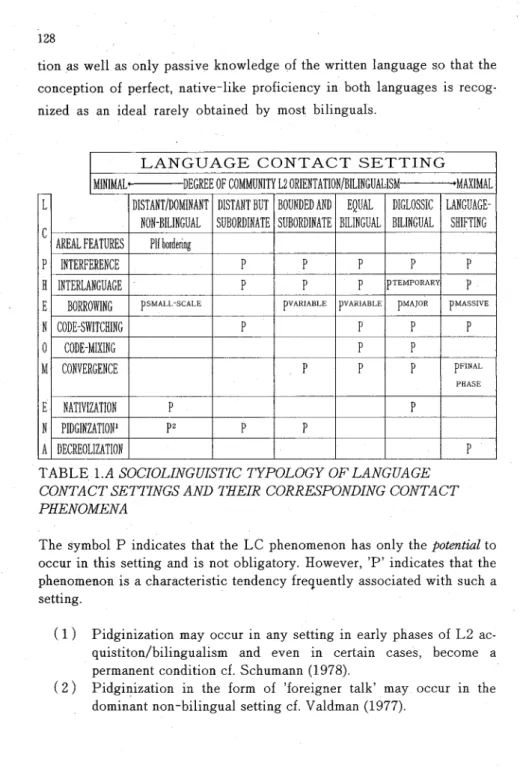
In Table I a sociolinguistic typology of six archetypal Le settings are proposed. The table presents my interpretation and synthesis of various data and arguments24 The Le settings presented here constitute general
"profiles' of the language behaviour of a particular speech communiy. The typology should be understood as a systematization of patterns to be expected in certain Le situations. The six settings represent an increasing level of bilingualism in the contact language (when moving from left to right). However, particularly in the equal, diglossic and language-shifting settings, the distribution of bilingual competence may be equally high among
certain community members. The term "bilingual" in the table is understood as including multilingualism. The concept of bilingualism today is broad and includes non-fluent interlanguage states varying in native approxima-
tion as well as only passive knowledge of the written language so that the conception of perfect, native-like proficiency in both languages is recog- nized as an ideal rarely obtained by most bilinguals.
I
LANGUAGE CONTACT SETTINGI
MINIMAL' DEGREE OF COMMUNITY L2 ORIENTATION/BILINGUALISM 'MAXIMALc -
L DISTANT/DOMINANT DISTANT BUT BOUNDED AND EQUAL DlGLOSSIC LANGUAGE- NON-BILINGUAL SUBORDINATE SUBORDINATE BILINGUAL BILINGUAL SHIFTING C
PI! bordering AREAL FEATURES
P INTERFERENCE P P P P P
H INTERLANGUAGE P P P PTEMPORARY P
E BORROWING P SMALL -SCALE pVARIABLE pVARIABLE PMA]OR PMASSIVE
N CODE-SWITCHING P P P P
0 CODE-MIXING P P
M CONVERGENCE P P P pFINAL
PHASE
E NATIVIZATION P P
N PIDGINZATION' p2 P P
A DECREOLIZATION P
TABLE l.A SOCIOLINGUISTIC TYPOLOGY OF LANGUAGE CONTACT SETTINGS AND THEIR CORRESPONDING CONTACT PHENOMENA
The :symbol P indicates that the
Le
phenomenon has only the potential to occur in this setting and is not obligatory. However, 'P' indicates that the phenomenon is a characteristic tendency frequently associated with such a setting.( 1) Pidginization may occur in any setting in early phases of L2 ac- quistiton/bilingualism and even in certain cases, become a permanent condition cf. Schumann (1978).
( 2 ) Pidginization in the form of 'foreigner talk' may occur in the dominant non-bilingual setting cf. Valdman (1977).
129 The various LC phenomena listed in Table 1 have all been discussed above. The contact phenomena for each community will vary in the way they combine and in their intensity at a particular moment so that, borrowing, for example, may involve the transfer of ten or one thousand words. N everthe- less, there is a correlation between the number of loans transferred ie. the intensity of contact, and the degree of community bilingualism so that the settings to the right-hand side constitute the most fertile ground for Le.
1.6.1.1. The distant or dominant non-bilingual setting
This refers to the case where, among the members of a particular community, which may be either monolingual or socially bi-or multiling- ual, the knowledge and use of one (or more) contact language(s) is not widely distributed. Although there may well be some individuals familiar with the contact language(s), they are not representative of the community as a whole e.g. the knowledge of Japanese among the British. The key characteristics of such a setting are that the community maintains no community-wide relations with speakers of the donor language and that it does not socially require the acquisition of the donor language. Contact in this setting is usually limited to lexical borrowing which may start, increase, decrease or terminate during certain periods; indirect contact may also be evident in loan translations or even stylistic influences.
LC in this setting may be initiated through various channels. First of all, it may start with individual cases of diffusion into the community but is not introduced directly through bilingual interaction. The initiating agents may come from within the recipient community or outsiders familiar with the donor language with sufficient influence may also instigate the LC in the recipient community. Other agents may be those who venture beyond the bounds of their community such as travellers, explorers and temporary emigrants who bring back LC.
A second channel of contact is not directly personal but involves the transmission of the donor language in oral form via radio, film record, casette or video and in written form via printed and handwritten material. Mediating agents, again usually within the recipient community, draw on these sources and initiate Le. In such cases, these agents need not to have been in direct contact with L2 community but need to have had access to the L2 via indirect channels and be in a sufficiently influential position to diffuse LC phenomena into the recipient community. Thus, these agents tend to be specialists of various kinds such as journalists, translators, religious, academic, scientific or technical researchers, innovating artists and crafts- men. The integration of such LC will depend on the general sociocultural significance of the items designated by the loans to the community at large.
A clear example of this setting is the case of contemporary English LC with languages such as Czech, Danish, Dutch, Finnish, German, Hungarian, Icelandic, Latvian, Lithuanian, Norwegian, Romanian, Serbo-Croatian and Turkish cf. Filipovic (1982). All these communities are located at considerable physical distance from the donor source (England and the USA) and the LC observed has been generally limited to small-scale lexical borrowing with varying degrees of nativization on phonological and semantic levels. Of course, it must be pointed out that the acquisition of English in an institutional context (cf. 1.6.1.2. below) is also a feature of many of these communities, although the L2 is not employed to fulfil any internal function.
Another type of distant non-bilingval setting is where the donor language of contact is employed by a subordinate group within the territory of a socio-economically and ethnolinguistically superior recipient community, the majority of whose speakers are ignorant of the donor variety. Typically, there exists considerable social distance between these contact groups so that the only form of LC in the dominant non-bilingual community, if any,
131 tends to be lexical borrowing on a limited scale, often for place names, terms for local fauna and flora and cultural items specific to the subordinate group.
This situation is well exemplified by the LC behaviour evident in the British Dominions in relation to the vocabulary of indigenous groups such as Australian Aborigines, New Zealand Maoris, Native Americans and Eski- mos cf. Eagleson (1982:431). A different case which also belongs to this setting is the English-French LC situation in CaMda where English speakers have been dominant since the 1840's and "it is difficult to identify many borrowings or significant influences from the French of Canada that have entered since the mid-19th century" (Bailey, 1982:166). Further back in history is the case of the extremely few Celtic loans in Old English, due to the social distance between the conquering Germanic tribes and the enslaved Romanized Celts. Thus, in a dominant non-bilingual setting, LC phenomena other than small-scale lexical borrowing are rare. The principal characteris- tic of the distant non-bilingual setting is the unfamiliarity of the donor language in the recipient community.
1.6.1.2. The distant but institutional setting
Similar to the previous setting, this kind of LC occurs when the acquisition of a non-native language is not employed for community activities, unless in the domain of religion, but is promoted through an institution such as a school. The reasons for this language learning may be political dominance e.g. Russian in East German schools, or it may be culturally for its own sake e.g. Latin in Britain, or religious e.g. Classical Arabic for African Moslems. The motivation for the L2 instruction varies according to the particular social history of the community.
It is essential to realize that institutional L2 learning does not lead to the creation of community bilingualism, for as
J
akobvits (1971:22) bluntly states: "second language learning as a classroom subject is one thing, andbeing a bilingual person another and they often have little to do with each other"; also cf. Moag's (1982a:38) statement that "the person whose contact with a.:.(foreign language) is limited to studying it as a school subject is in no sense bilingual but anyone using it in his professional or private life, even in very restricted activities, is".
Unlike in natural settings of L2 acquistion, where many informal sources are available for reinforcement and practice, the institutionally taught
"foreign" L2 tends to be regarded as an end or product in itself rather than as a vehicle to achieve communicative goals. Among the most significant variables of this setting are
-the range and depth of L2 acquisition in relation to the skills imparted -the linguistic varieties (models) selected for acquisition
-the methodology selected e.g. grammar-translation or rote memorization -the purpose of L2 learning e.g. to pass exams, have access to information
or maintain sacred texts
-the social and psychological characteristics of the learners and their teachers e.g. age, personality, previous learning habits, amount of training and experience, attitudes and motivation
-aspects of the learning situation such as class SIze, curriculum and material, contact hours, teacher-student relations
There are hardly any countries in the contemporary world which do not provide some of its citizens with the chance of institutionally acquiring an L2. LC as a direct consequence of this on a societal scale, however, is very rarely observable25. If community-wide LC does occur, as with English in West Germany, it is not due to L2 education alone but involves other motivating factors. In the case of English, of course, contributing causes such as the international use and status of English, world-power affiliation and economic, technological and scientific communication must be taken into account.
133 The LC phenomena typically associated with this setting are interference, interlanguage, pidginization cf. Schumann (1978), and code-switching in classroom -talk.
1.6.1.3. The bounded26 and/or subordinate community As can be seen from Table 1, the degree of bilingualism in this setting is higher than the previous two but nevertheless if fends to be of a "restricted"
nature in that it is neither fluent, accurate nor native-like. This "restricted"
bilingualism arises from the restricted social contact maintained by the recipient or donor community or both towards each other. In section 1.6.l.l.
above, a dominant recipient community's LC behaviour was characterized by limited borrowing but in a bounded or subordinate community due to the increased presence of bilingualism, there tends to occur various LC phenomena such as interference, interlanguage, pidginization and, more rarely, convergence.
Often, cultural displacement and/or economic disadvantage or differing ethnicity leads to the social distance between the two communities. The reason for the term bounded has to do with the "sealed-off' nature of the recipient community which may be either self-imposed or externally constructed by the dominant community. This ethnic boundary may vary between "soft" and "hard", depending on distinctions such as skin coloring, facial features, dress style, cultural tradition, values and language cf. Giles (1979). This setting lasts as long as the boundary remains stable; a sign of the collapse of the ethnolinguistic boundary is language shift.
Lewis (1978) discusses different types of relatively stable bounded communities such as (i) those existing in geographic isolation (ii) those which experience urban segregation (iii) ethnic minority enclaves and (iv) those with their "own tradition of restricted culture contact" (ibid.,p.25).
Contemporary examples of each of these evidencing LC are:
( i) the Irish of Gaeltacht; the Scots of the Highlands and Islands; the Fries of Holland; Romance-speakers of Switzerland
(ii) (first generation) Pakastanis in North England; (first generation) Turks in West Germany; Hispanics in the USA
(iii) Albanians, Croats and Greeks in Southern Italy; Basques in Southern France; Doukhobor Russians in Canada
(iv) conservative German-speaking Amish of Pennsylvania; Athapaskan and Pueblo Indians of the USA
A further category that needs to be added are more mobile linguistic minorities such as nomads, gypsies, seasonal migrants and involuntary immigrants such as slaves.
Typical for these communities IS the low level of bilingualism27 and, particularly, pidginization and fossilized interlanguages due to the lack of access to the L2 model and/or lack of assimilatory motivation cf. Schumann (1978), Richards (1974) and Meisel (1980). If the pidgin or interlanguage is only a temporary phase e.g. associated only with one generation, then the setting should be re-categorized as one of the following three: "equal-biling- ual', "language-shift' or "diglossic-bilingual'. However, when the acquisi- tion of the L2 does not lead to greater mobility or entry into the dominant community and when few contacts or ties with native-speakers from the dominant community are available, restricted LC is likely to be more long-lasting for most members of the subordinate community. Educational opportunities in the mainstream language mayor may not increase the level of bilingualism and inaugurate language shift.
Exactly what keeps a community bounded for a stable period is community-specific and has received hardly any attention from linguists28.
Finally, the resemblance of this setting to Fishman's (1971) category of
"diglossia without bilingualisIh" should not go unnoticed29
1. 6.1. 4. The equal, bilingual setting
This setting may entail one community employing two languages or two communities in the same territory employing two languages but the key feature is that neither of the languages is subordinate to the other and that either language may be employed for equal access in almost all social domains. This situation is infrequent, since communities tend to favour the employment of one lansuage and there are often historical power relations involved in the social evaluation of the two languages, even if their equality is legally guaranteed e.g. Flemish and French in Brussels; English and French in Quebec; German in Belgium as reported by Verdoodt (1972).
For Pietersen (1978:39) this situation occurs "when two languages in a territory function for the same people and both can be used officially and at the dialect level ... there is no high and low status ... Both languages are used in almost all domains", although not "haphazardly so that in practice there is probably a division of labor in which one language is used at home as the main language and not the other. But the point here is that both languages can be used in every domain".
In communities where two languages are in principle equal to each other, their separate identities are not necessarily kept apart. The norms of one may be renounced and interference, borrowing, code-switching, code-mixing and convergence are likely to appear30 An example of convergence is provided by Scollon and Scollon (1973) in their study of LC between French, English, Chipewyan and Cree in a subarctic, multilingual Alaskan commun- ity where the four languages have syntactically and semantially coalesced with none of them exclusively symbolizing a separate ethnic identity, as their speakers in this setting share the same ethnicity. Such convergence has serious theoretical consequences for the traditional linguist's conception of language as a clearly distinguishable, self-contained system. In this setting,
one mental system called a "language" may be fused on various levels with another originally separate system. Such radical contact reveals the environmental dependency and elasticity of phenomena which linguists have up to now treated as stable and autonomous.
1.6.1.5. The language-shifting community
The term language shift has been briefly introduced above cf. 1.5.1.1. The initiation, rate and process of language shift vary considerably from case to case but the ph~nomenon is observable in many contemporary communities cf. note 1. For example, Batori (1983) describes how Finnougric languages in the Soviet Union are shifting to Russian resulting in massive lexical borrowing and syntactic change in these languages. Gal (1979) mentions code-switching, borrowing and interference occurring in the shift from Hungarian to German in her study of the Oberwart community. Cf. also the shift in culturally displaced and disadvantaged indigenous minorities (Lewis, 1978) and immigrants (Haugen, 1978) for which borrowing, code-switching, interference, learner pidgins and interlanguage varieties have been documented.
The language shifting community has frequently been regarded as the LC setting par excellence and pioneering studies into LC drew much of their data from this setting e.g. Weinreich's seminal study of LC mentions numerous examples of interference in American immigrants and Haugen's analysis of borrowing is based on Norwegian immigrants' shift to American English.
From Table 1, it can be seen that convergence between the contact languages involved in language-shifting communities may also occur during the final stages of the shift. Evidence for this comes from Dressier's (1982) account of language shift among, for example, Bretons and Austrian Croatians where a restructuring of morphology, syntax, semantics and
137 pronouns on the basis of the majority language has been noted together with
"lexical fading" i.e. massive borrowing from the language shifted to.
Decreolization may also be regarded as a form of language shift-from the creole to the standard and thus involving bilingualism and LC31 . Of course, decreolization results from the diglossic relationship between the creole and the standard. Actually, language-shifting communities tend to generally appear in digiossic settings where the donor language belongs to a socially higher group32 The shift occurs because the subordinate community renounces its ethnolinguistic separateness in an effort to identify with or penetrate the dominant communi ty33.
1.6.1.6. The diglossic bilingual setting
As explained in section 1.5.1.2., Fishman (1971) extended Ferguson's (1959) concept of diglossia to include bi-/multilingual situations where unrelated varieties also serve High and Low functions in the same community. A diglossic bilingual community is, therefore, one where linguistic and role repertoires are compartmentalized but widely accessible to members of the community, although as Fasold (1984:42) states, only partial bilingualism in the H variety tends to characterize the majority. In diglossic bilingual settings the acquisition of the entire community repertoire is not acquired at home nor in neighbourhood playgroups but through formal institutions of education, religion, government or the work sphere34
When it comes to the correlation of this setting with the listed LC phenomena, considerable data is available from studies of non-native English varieties employed as H with local languages as L in many African and Asian states. Thus, Tay (1982) describes interlanguage, pidginization, prosodic, syntactic and phonological interference as well as borrowing from both directions in the English -Chinese/Malay continuum of Singapore.
Jibril (1982) also observes phonological and syntactic interference, borrow- ing of local cultural items, nativization and pidginization in the diglossic LC setting of English in Nigeria; Zwengler (1982) documents code-switching, nativization and interference in the English of Kenya. Mehrotra (1982) reports on interference, nativization, interlanguage and pidginization in Indian English varieties for which Kachru (1977) had also noted code- switching and code-mixing. Furthermore, Kachru (1978) states that massive borrowing from English has occurred into many South-East Asian lan- guages due to the internally High function of the former. Gonzalez (1982) mentions code-switching and code-mixing in the English of the Philippines while Gibbons (1983) analyses code-mixing between English and Cantonese in Hong Kong35.
Finally, the case of areal features marked as potential under this setting needs to be briefly explained. Although areal features may occur due to the physical proximity of different and distinct communities speaking different languages who share a long history of coexistence and some degree of social contact but do not employ each other's language on a societal basis (as indicated for the "distant non-bilingual setting"), areal features may also occur in a diglossic situation through the diffusion of a High variety across several neighbouring communities. Thus, the often cited Sprachbund in the Balkan area where Modern Greek, Albanian, Romanian and Bulgarian share a rich fund of common vocabulary, morph for morph equivalents and various syntactic devices is due to the unifying force of Byzantine civilization as represented by the Greek Church so that in many instances Greek can be recognised as the donor model for the shared LC cf. Trudgill (1974:161)36 Fishman attributes the contemporary proliferation of diglossic bilingual settings to modernization and growing social complexity. In a classic diglossic bilingual community each language has its own circumscribed functions which are well-established, socially accepted and maintained. As
seen from Table 1, the contact features potentially occurring here are the most far-ranging than any of the earlier settings; the two (or more) languages in contact both reveal greater "permeability" but the High language tends to be less susceptible to change due to its overriding status and enshrined norms. The motivation for
Le
in a diglossic bilingual setting appears to correspond closely to the classic Weinreichian factor of prestige or social advance372.0. Concluding comments
Social attitudes towards
Le
have long been characterized by disparage- ment, scorn and even hostility. This negative reaction often accompanies and derives from the equally negative, low social evaluation ofLe
makers,especially when they are immigrant or deprived indigenous minorities.
However, large-scale
Le
can find social favor at a certain moment in community evolution if it is mainly lexical, as can be seen today in the way Japanese society embraces lexical infusion from English. Sometimes attitudes are complex and include both positive and hostile elements cf.Whitely (1967:139) on the ambiguous reactions to Bantu loanwords in Tanzania. The negativeness may eventually take the form of politically organized language purification such as has occurred in Israel, the Philippines and France. On the other hand,
Le
may be officially promoted for ideological purposes e.g. Ataturk's expulsion of Arabisms and Persian- isms from Turkish and the encouragement of importing French and English loans, or the dehebraization of Soviet Yiddish and its planned submission to Slavic lexical stock cf. Erlich (1981:704). Acceptance or resistance towardsLe
is typically a response to the way language serves to symbolize social identities and affiliation.This article has been an attempt to provide a comprehensive, concise and unifying typological framework for identifying
Le
phenomena in relation tospecific settings. It has demonstrated the world-wide scale of LC today as well as its historical occurrence. In the search to explain the nature of LC not only is the necessity of the sociolinguistic approach conclusively validated but both sociolinguistics and general linguistics extended and enriched.
NOTES
Here is a selection of current research focussing centrally on LC taking place in the. world today; research which touches on LC only in connection with some other topic such as second language learning or bilingualism is not included.
Although indisputably LC phenomena, research on particular pidgins and creoles are not listed below; these contact varieties constitute a special subfield cf.
Hancock (1971) for a survey and list of pidgins and creoles in the world.
Collections of case studies relating to many different regions are not directly listed cf. Coulmas (1984), Wolfson & Manes (1985), Dow (1987) and Mac Eoin et.a!' (1987). Below the symbol +-+ indicates that the languages on either side of it are "in contact" with each other; when the symbol appears in succession between several languages, contact between all the listed languages is signified, although the degree & type of contact between each of the particular languages in question will vary from case to case. The symbol -+ indicates that a language shift is evident in the speech community in front of the arrow towards the language following the arrow.
LANGUAGE CONTACT IN THE CONTEMPORARY WORLD UNITED KINGDOM: Welsh' English (Lewis, 1978)
Gaelic ---> English shift (MacCauly, 1982) Minority Language -+ English (Stubbs, 1985) FRANCE: Flemish -+ French shift (Vanneste, 1982)
French +-+ English lexical contact (Forgue, 1980)
BELGIUM: German -+ French shift; grammatical, semantic lexical, stylistic aspects (Nelde, 1980)
WEST GERMANY: English +-+ German on lexical, grammatical, semantic, stylistic levels (Viereck, 1980; Pfitzner, 1978) SP AIN : French +-+ Basque +-+ Catalan Spanish on syntactic level due to
historical coexistence (Haensch, 1982)
IT AL Y : German -+ Italian on morphological, syntactic and phonological level (Denison, 1980)
MAL TA: Italian +--+ Slavic lexical contact (Kontzi, 1982)
SCANDINAVIA: Finno- Ugric +--+ Slavic +--+ German (Batori, 1983) Norwegian +--+ Lappish +--+ Finnish (Jahr, 1983) RUMANIA: German -+ Rumanian (Rein, 1980)
Rumanian +--+ Slavic (Rolshoven, 1980)
SOVIET UNION: Finnougric languages, particularly Finnish and Hungarian
-+ Russian resulting in massive lexical borrowing and syntactic change (Batori, 1983)
Various U ral-Altaic, Caucasian & Indo-European minor- ity languages -+ Russian (Kreindler, 1982; Lewis, 1983) UNITED STATES: Haugen (1978) provides an extensive list of research on contact between English +-+ and immigrant languages such as Czech, Danish, Armenian, Dutch, Finnish, Greek, Hungarian, Icelandic, Polish, Slovak, Sorbian, Swedish, Ukranian, Welsh & Yiddish; Ferguson & Heath (1981) deal with English +--+ Puerto Rican Spanish, Italian, Slavic & Phillipine languages; Bright (1973) treats Amerindian languages from the Arctic to the Rio Grande
+--+ English & Spanish; Hill (1978) on Uto-Aztecan total language shift to English.
CANADA: Quebec FreElch +--+ English lexically" morphologically, syntactic- allty & semantically; immigrant language +--+ English (Rudnyck- yj, 1973)
SOUTH AMERICA: Spanish +--+ Portuguese (Elizaincin, 1983; Hensey, 1982)
Spanish +--+ Guarani in Paraguay (Melia, 1980); Span- ish +--+ Amerindian languages in Bolivia, Chile, Argen- tina, Paraguay (di Pietro, 1968)
AFRICA: African languages French (Kwofie, 1980)
African languages +--+ English resulting in code-switching and
structural changes (Bokamba, 1982)
Nigerian languages +---+ English on phonological, syntactic and semantic level (Jibril, 1982)
Goodman (1971) states that LC occurs all over the African continent due to extensive multilingualism with over 1,000 indige- nous languages in addition to extraneous lingua franc as/ ex- colonial languages such as Arabic, Afrikaans,French, Portuguese and English.
MIDDLE EAST: Hebrew +---+ Arabic in Algeria & Morocco (Fishman, 1981) Arabic ...:-. East, West and Central African languages such as Hausa, Songhay, Fulani, Tigre & Havaru (Blanc, 1971):
Modern Arabic +-+ French & English (Abdulaziz, 1986) INDIA: Indo-Aryan languages in contact with each other resulting in borrowing, pidginization and creolization (Shapiro & Schiffmann, 1983: Mehrotra, 1985)
English +-> Indian languages on phonetic, lexical, syntactic &
stylistic levels (Kachru, 1978)
Hindi +-+ English borrowing (Singh, 1980)
MALA YSIA : English .+---+ local languages such as Malay & Hokkien on phonological, lexical and syntactic levels (Platt. 1980) SINGAPORE: English +---+ Chinese, Tamil & Malay (Crewe, 1977) HONG KONG: English +-+ Cantonese (Gibbons, 1983)
PHILIPPINES: Spanish +---+ Tagalog (Kelz, 1980): local languages +--+
Pilipino & English (Gonzalez, 1985)
EAST ASIA: Sebeok (1967) includes various articles mentioning Chinese
+---+ E.& S.E.Asian languages such as Tibetan, Lao, Korean, Thai, Cambodian & Vietnamese: Burmese +-> Pali (Okell, 1965): Korean +---+ Japanese (Tanaka and Lee, 1986) CHINA: English +---+ Chinese (Yongquan, 1986)
AUSTRALIA: Aboriginal languages +---+ English (Sandefur, 1983) English +--+ European languages (Clyne, 1982: Pauwels, 1986)
2 The vocabulary of the oldest recorded Indo-European language, Hittite, dating
from the third millennium B.C., reveals a strong influence from other non- Indo-European languages, particularly Hattic cf. Diringer (1968:55).
3 Kuhn (1970) explains how "scientists work from models acquired through education and through subsequent exposure to the literature often without quite knowing or needing to know what characteristics have given these models the status of community paradigms" (p.46). These paradigms refer to the constellation of beliefs values and techniques "which ... can replace explicit rules as a basis for the solution of the remaining puzzles of normal science" (p.l71). Paradigms may become ideological frames for formulating linguistic knowledge, assuming sometimes a doctrinal status. According to Harris (1980) modern linguistics derives much from the orthographic representation of language resulting in what he calls scriptism which is "the assumption that writing is a more ideal form of linguistic representation than speech" (p.6).
4 Interference is a term originally from behaviorist psychology and may be viewed as a form of "negative transfer' i.e. the application of acquired behavior to a situation which required a completely new behavior pattern cf. Carrol (1968).
5 In Haugen's (1952) classification of the integration of English elements into Norwegian by immigrants to the USA, a basic distinction is made between importation and substitution. The former applies to a loan similar enough to the model so that a native speaker would accept it as his own but represents an innovation in the language that adopts it, while the latter is only a partial reproduction of the model based on patterns in the borrower's language. Haugen included the following additional categories: (i) loanworaSwhich show morphemic importation without substitution (ii) loanblenaS which show morphemic substitu- tion and importation (iii) loanshifts which show morphemic substitution without importation (iv) hybrzd creations, mostly of the type in which loan morphemes have been substituted in the nucleus while the marginal components are native and (v) completely native creations made by L2 speakers. Haugen also discusses important aspects such as the grammatical integration of loan words (their assignment by the borrower to various classes and their inflectional treatment), the structural effects of borrowing (particularly on the phonological level where phonemic redistribution or phonemic importation may occur), the social variabil- ity of the sources for loan word transmission and the phonological consequences