Local Indigenous Livelihoods : The Case of the Bwabwata National Park in Namibia
著者(英) Attila Paksi, Aili Pyhala journal or
publication title
Senri Ethnological Studies
volume 99
page range 197‑214
year 2018‑07‑18
URL http://doi.org/10.15021/00009127
197
Edited by R. Fleming Puckett and Kazunobu Ikeya
Socio-economic Impacts of a National Park on Local Indigenous Livelihoods:
The Case of the Bwabwata National Park in Namibia
Attila Paksi
University of Helsinki
Aili Pyhälä
University of Helsinki ABSTRACT
Community Based Natural Resource Management (CBNRM) is a conservation model that, contrary to the conventional top-down protected area management approach, aims to merge biodiversity conservation with community livelihoods.
That said, the actual contribution of CBNRM to local livelihoods remains contested. Using a Sustainable Livelihoods Framework to analyse empirical data from the East Bwabwata National Park (BNP East) in Namibia, we assess the contribution of CBNRM to rural income development relative to other revenue sources. We identify four main livelihood strategies related to income: (1) formal employment, (2) seasonal employment, (3) occasional cash income, and (4) social safety nets. Our results indicate that the largest income contribution to residents of BNP East comes from non-CBNRM-based formal employment (45.06%) followed by social safety-net benefits (33.83%). CBNRM-related income accounts for less than a quarter (21.11%) of annual household incomes, whilst also displaying the highest vulnerability. We advocate for a greater diversification of income sources, including that from CBNRM. In order to ensure socio-ecological justice and sustainability of both livelihoods and the local natural resource base, we conclude by emphasizing the need to ground the CBNRM model in its core principle of community control over decision-making processes that impact the local environment.
INTRODUCTION
Protected areas (‘PAs’) are an important instrument for biodiversity conservation,
covering around 15% of the earth’s total land area (UNEP-WCMC and IUCN
2016). Meanwhile, Indigenous Peoples (‘IP’) are those who experience first-hand
this so-called biodiversity conservation, as 98% of high biodiversity areas overlap
with indigenous and traditional territories (Oviedo and Maffi 2000). Despite this
fundamental link, PAs have, to date, been predominantly imposed in a
non-participatory and top-down manner upon IPs (Colchester 1994), with
potentially tremendous negative impacts on local livelihoods (Naughton-Treves et al. 2005; Oldekop et al. 2016; Pyhälä et al. 2016). While PAs (like any natural ecosystems) could, in theory, provide several direct and indirect benefits to local communities – for instance, through the provision of food, building materials, and medicinal plants, as well as spiritual and cultural services (Coad et al. 2008) – West
et al. (2006) argue that the establishment of PAs are a product ofglobalization and a commodification of natural resources, such that local communities are rarely the ones benefitting most, if at all.
The predominant conservation model over the past century has mostly relied on state control and national parks (Berkes 2007). Alternative approaches highlight the potential of involving local communities in biodiversity conservation (Holmes 2013; Jonas et al. 2014). Community Based Natural Resource Management (‘CBNRM’) is one such alternative model, which promotes the active engagement of local people in conservation while taking into account their local knowledge and needs (Suich et al. 2012). CBNRM, in various forms, is not only a tool for conservation but also an established policy goal for rural development, especially in Africa (Blaikie 2006). However, perceptions of CBNRM may well differ among various stakeholders. While local communities might understand CBNRM as yet another form of development intervention and expect tangible (often monetary) benefits, the primary concern of conservation NGOs or national governments is often in meeting pre-established biodiversity conservation targets (Arntzen et al.
2007). Despite these discrepancies, donors have actively funded CBNRM activities for decades under the hope or illusion of simultaneously promoting both conservation and local economic development (see App et al. 2008), while voices of the affected communities remain largely unarticulated, both in decision-making and in the scientific literature (Blaikie 2006).
This study assesses the magnitude and importance of CBNRM-related income
relative to other employment options, questioning its overall contribution to rural
income development. The study focuses on one particular state-imposed PA,
namely the Bwabwata National Park (‘BNP’) in Namibia, and is part of a broader
research project also looking at traditional knowledge transmission, schooling, and
development interventions inside BNP. We present recent empirical data from BNP
and analyse it using a modified livelihood strategies framework based on the
sustainable livelihoods literature (see, e.g., Carney 1998; Scoones 1998; Ellis
2000). Below we present our theoretical and analytical framework followed by a
review of the evidence at hand of CBNRM impacts on local communities in the
region (southern Africa). We then present our case study, including historical
background, followed by the methods used, the results, and a discussion of the
main findings.
REVIEW AND THEORY 1) Analytical Framework
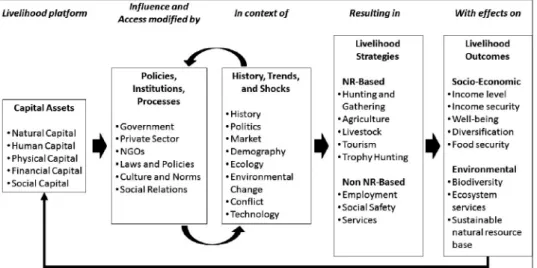
This study uses the Sustainable Livelihoods (‘SL’) framework (Scoones 1998) designed to understand livelihood strategies by taking into account the given political and socio-economic setting, while looking at the present and optimal combinations of livelihood resources for a sustainable outcome. The SL approach prioritises the needs of the poor and supports a holistic and systematic analysis of poverty and its causes to support better informed development planning (Ashley and Carney 1999).
We use a slightly modified version of the original framework (see Figure 1) to assess the livelihood outcomes of natural-resource-based income generation and then contextualise these relative to other sources of household income. This approach is useful and appropriate for several reasons. First, the approach takes into account a number of contextual factors deemed relevant and even critical to this study, including policies, institutions, and vulnerabilities. Second, it recognises the importance of capital assets and the variety of livelihood activities required for a means of living. Third, the approach provides a holistic analysis of livelihood strategies in light of livelihood outcomes. Specifically, we examine the reliance and benefit of natural-resource-based income generation activities on livelihood strategies among the residents of BNP East in Namibia.
2) Background of CBNRM
CBNRM is essentially a conservation programme aiming for the sustainable management of common-pool natural resources. However, its long-term goal is to promote rural development by supporting livelihood diversification through the
Figure 1 Modified sustainable livelihoods framework (adapted from Scoones 1998; Ellis 2000).
promotion of wildlife and tourism in addition to other land-use strategies (Long 2004). Studies over the years reported CBNRM-related additional monetary benefits to local communities through tourism and trophy hunting, employment, live game sales, crafts, and selling various natural resources like thatching grass or other veld products (Long 2004; App et al. 2008; Roe et al. 2009). The CBNRM approach, however, is criticised for doing less for indigenous rights to land and biodiversity and focusing more on the commodification of resources, while the benefits are shared unequally, hindering the overall goal of rural development (Dressler et al. 2010).
Namibia is well known in the CBNRM literature for being home to the so-called
conservancies – i.e., initiatives whereby groups of private landownersform institutions to manage their lands collectively – which became popular during the 1980s and have set the scene for communal conservancies in Namibia ever since (Jones 1999; Jones and Murphree 2001). Communal conservancies are self-governing entities, with two main sources of income: tourism and trophy hunting. The national government has applied a CBNRM model through cooperation with local communities since the 1990s. Residents of a communal area can form a conservancy and are granted some level of control and management over certain wildlife species. The ultimate ownership of wildlife, however, along with the ownership of communal land, remains with the State (Sullivan 2002). CBNRM provides a framework to set up joint ventures with the private sector to utilise natural resources, while strict regulations and quotas are in place, set and modified by the Ministry of Environment and Tourism (‘MET’), which continuously monitors the communal conservancies. The latter, in turn, are obliged to follow pre-set institutional processes, for instance by abiding to a game management plan, conducting annual general meetings, and preparing financial reports. Currently, 83 conservancies are registered across Namibia, with a total land cover of 163,017 km
2and directly overlapping the territorial livelihoods of an estimated 190,000 rural people
1).
METHODS 1) The Study Site
This study was conducted in the eastern part of Bwabwata National Park, in the Zambezi region of Namibia (see Figure 2) on two separate occasions, between July and November 2016 and between March and June 2017. The Bwabwata National Park is a key part of the Kavango-Zambezi Transfrontier Conservation Area (‘KAZA’), which spans into neighbouring Angola, Botswana, and Zambia.
The vegetation of the Park is Broad-Leafed Kalahari Woodland on sparsely
vegetated sand dunes with old, natural drainage lines (omurambas) in between. It
is a popular destination for drive-through tourists who come to see the relatively
large concentrations of elephants and buffaloes, various antelope species, and even
the occasional predators including lions, leopards, and hyenas. The abundant
wildlife also serves as a big attraction for trophy hunting, a recreation popular amongst international tourists.
2) The Khwe San in BNP East
The Khwe people are one of southern Africa’s indigenous San groups, historically hunter-gatherers, with extensive traditional knowledge of wildlife species, veld- food collection, and nature management. Today, the Khwe are around 8,000 individuals living across Angola, Botswana, Namibia, Zambia, and South Africa.
One of the largest groups, an estimated 4,000 individuals (Taylor 2012), live in the area formerly known as the ‘Caprivi Strip’ of Namibia, inside the Bwabwata National Park.
The history of this geographical area is critical for understanding the recent history of the Khwe. In the early 1900s during the German colonial period, the area of West Caprivi, being an arid wooded savanna, was regarded as unsuitable land for any economic activity by the colonial power. Similarly, the Khwe people were seen as an inadequate labour force (Boden 2009). The Khwe were thus largely left to live undisturbed in small bands, practising hunting and gathering.
After World War I, the territory became an integral part of the South African Union, and in 1964, the South African administration proposed to create a
‘homeland’ for the Khwe in the West Caprivi area. However, instead of a homeland, a nature conservation area called the ‘West Caprivi Game Park’ was established in 1968. The Khwe were allowed to remain in the area, but under the condition that hunting was restricted to the use of traditional weapons only. From the 1970s, the South African Defence Force (‘SADF’) occupied the area and changed the livelihood dynamics of the Khwe substantially by providing paid employment and exploiting the rich natural resources to an extent that was beyond
Figure 2 Map of Bwabwata National Park, Namibia (MET).
sustainable limits. Boden (2009: 63) describes the changing history of the Khwe up until Namibian independence:
The Khwe were allowed to stay in West Caprivi, protected from slave raids, accepted as mine workers, befriended by food distributions, empowered by receiving political leaders, courted as potentially useful people for the South Africans and hired in great numbers as soldiers by the SADF.
In 1989, at the time of Namibian independence, the SADF withdrew from the area, and the Khwe were left without employment or monetary income. In 2000, the Angolan War transformed the Caprivi again into a military zone, forcing many Khwe to flee to Botswana and return only after the end of the war. Meanwhile, further areas surrounding the Caprivi Park were set aside under a regime of strict nature conservation. In 2007, the Bwabwata National Park was officially established, incorporating the former Caprivi Game Park. Today, the Khwe remain in this area, formerly their ancestral lands, together with the abundant wildlife, but under the strict regulations of the National Park, including a total ban on hunting for their own use.
MET is the responsible authority for managing PAs in Namibia, and this Ministry refers to BNP as the “People’s Park”, hosting both a large wildlife population and a large human population (MET 2010). MET created two types of zones inside the Park with different levels of access and user rights. The core areas are designated for nature conservation: no human settlement or foraging activities are allowed therein. These areas are rich in natural resources and present a core habitat for wildlife. The larger multiple-use area is designated for human settlements and small-scale agriculture, veld-food collection, and community-based tourism. Trophy hunting activities can take place in both zones, but are strictly controlled by concessions and quotas and remain inaccessible to local communities. MET emphasises an integrated management approach, meaning that the residents of the Park are supposedly actively involved in park management. To meet that end, the Ministry works closely with the official residents’ organisation for the Park, namely the Kyaramacan Association (‘KA’).
Being inside a national park, the Khwe San are not eligible to apply for their
own communal conservancy. As an alternative, KA was established by the
residents of the Park as a Community Based Organization (‘CBO’) representing
all the residents
2)in BNP, with the main purpose being to manage the communal
income resulting from trophy hunting and tourism. MET officially recognised the
Association in 2006, and KA has since been operating on a similar basis as the
well known communal conservancies in Namibia. KA currently employs 40 Khwe
ecological monitors, including 25 Community Game Guards (‘CGGs’) and 15
Community Resource Monitors (‘CRMs’), who foot-patrol across the National
Park on a daily basis.
3) Data Collection
A mixed-methods approach was chosen to examine the livelihood outcomes of the National Park regulations for the local indigenous Khwe San communities. We conducted a socio-economic household-level survey across all of the households in six case study villages, collecting basic demographic data as well as the socio- economic profile of each household, including employment, income, participation in food production (farming and gardening), and natural-resource-based income generation (basket-making and devil’s claw harvesting). A total of 233 households were surveyed in the six villages: Chetto (n=86), Pipo (n=13), TonXei (n=11), Omega 3 (n=62), Poca (n=15), and Mashambo (n=46), with a total sample of 1,385 individuals.
In total, 43 in-depth individual interviews were conducted in the villages, selected using stratified random sampling based on the livelihood strategies indicated in the household survey. Moreover, nine stakeholder interviews were conducted with relevant governmental and non-governmental officers responsible for projects or policies in the BNP. All research was carried out in line with the Code of Ethics from the International Society of Ethnobiology (ISE 2006). In each village, free, prior informed consent was asked in writing from the local headman, who in turn informed and consulted with the residents about our presence and the nature of our study. In addition, every individual and household interviewed for the study was asked orally for their free, prior informed consent before proceeding with any interviews.
The interviews were conducted by the first author, supported where necessary with Khwedam translation by local research assistants. These local research assistants were selected from a pool of bilingual (English and Khwedam) residents who had excellent language skills and in-depth local knowledge. The research assistants received additional training in translation and the methods of data collection and, where necessary, simultaneously translated the survey questions and responses during the household visits. The study uses inductive content analysis followed by a thematic organisation of the data under the various components of the sustainable livelihoods framework, including livelihood outcomes, livelihood strategies, and livelihood resources, as well as policies, institutions, and processes.
We differentiate between CBNRM-based (Table 1) and non-CBNRM-based (Table 2) formal employment options and categorise them by sector and employer.
Our analysis includes the total number of employees (working inside or outside the Park) and their annual income, to calculate their contribution to the households’ total annual income in BNP East.
4) Limitations of the Research
There are a few limitations to the present study that we would like to point out.
First, there are in total eight settlements in Bwabwata NP East, of which we were
only able to cover six in this research, due to time constraints and remoteness of
settlements. Further research challenges arose due to the high mobility of the Khwe, resulting in six households not being part of the overall study sample. In addition, even though the research assistants had a high command of English, we acknowledge that we may have missed some finer details and nuances due to our own inability to speak the local language.
RESULTS
1) Formal Employment
Four main livelihood strategies were identified related to income-based livelihood outcomes in the study area: (1) formal employment, (2) seasonal employment, (3) occasional cash income, and (4) the social safety net.
Stable, formal employment with a monthly salary, whether natural-resource- based or not, was regarded by the majority of the interviewed Khwe adults as the primary goal for a sound livelihood. Inside the Park, however, employment options are limited: in the study area, only 16.9% (n=107) of the working-age population are currently employed. Of these, 83 people are employed in the Park, while 24 work outside of the Park.
Three CBNRM-related employers are present in the study area, providing formal employment for 51 people, who earn a total of 838,800 NAD annually.
The largest employer in the study area is the Kyaramacan Association, employing a total of 37 people in various roles. This is followed by a trophy hunting company (employing 12 people) and a CBNRM-related NGO (employing two people).
The government sector employs 45 local people, who earn a total of 2,440,800 NAD annually. Among the various government ministries active in the study area, the education sector (qualified and unqualified local teachers, cooks, cleaners, and security guards) is the second largest employer and by far the largest contributor of income from regular salaries: 19 employees earning a total of 940,800 NAD.
The health sector (qualified nurses, trained health officers, cleaners, and security guards) provides employment for 11 people, the police employ eight locals, and the MET employs four people, in addition to the three Khwe working at various government offices. The non-governmental sector provides four employed positions (all inside BNP) paying 120,000 NAD, while the private sector employs seven Khwe (all outside BNP), who earn a total of 384,000 NAD (see Table 2).
2) Seasonal Employment
In addition to the above-mentioned forms of formal employment, there are various
forms of CBNRM-related seasonal employment, of which we examined two: the
harvesting of devil’s claw (Harpagophylum procumbens), a wild plant known
globally for its natural curative properties for treating arthritis, and the fan palm
(Hyphaene petersiana), also a wild plant, the leaves of which are commonly used
for traditional craft-making.
In the case of devil’s claw, the harvesting is coordinated by KA, supported by a local NGO, and permitted by MET, providing a one-time annual income for a large number of households. The sustainable harvesting of this organically certified wild plant demands hard work, but also provides income for close to 400 harvesters annually within the Park. Harvesters are registered, trained, and monitored every year to ensure sustainable practices. The reported earnings range between 1,000 and 2,500 NAD per season, which spans from March until October and requires the harvester (with his/her family) to spend approximately one month in the bush harvesting. The statistics received from KA show a gradual increase in the average income per harvester in recent years: 1,506 NAD in 2014; 1,540 NAD in 2015; and 1,718 NAD in 2016. In total, 48.4% (n=113) of the surveyed households in BNP East reported receiving income from devil’s claw harvesting in 2016, providing a seasonal income contribution to 60% (n=834) of the studied population. Based on the average income per harvester, we calculate this annual income to amount to 194,146 NAD for BNP East.
As for the fan palm, the leaves are collected, dried, coloured, and woven into baskets. The Khwe women reported that they are able to produce two or three baskets a week when the palm leaves are available. One basket can be sold for between 50 NAD and 200 NAD depending on size and quality. In recent years, the local production of baskets has dropped considerably. While 76 individuals reported having the skills to make the traditional Khwe collecting baskets, only 37 individuals reported doing so in 2016. The main reason for this drop, as indicated by the interviewees, is that payments are still pending from the local craft shop, resulting in a reluctance to provide more baskets before being fully compensated for previous ones. Another reason given was that the elderly women amongst the harvesters struggle to travel the required long distances into the bush to collect the leaves. Only a few women indicated that they are selling baskets on the side of the road for tourists; however, they were unable to estimate the cash income earned from this, which appears to be marginal compared to other sources.
3) Occasional Cash Income
Another occasional source of income is an annual cash distribution by the Kyaramacan Association. KA not only provides direct employment but is also responsible for providing indirect benefits to the community members, by starting community projects or providing educational support for its members. However, members can decide whether or not to initiate community projects from the communal income and may opt instead for individual cash distributions. After the failure of many community projects in 2014 and 2015, members voted for cash distribution in 2016, receiving 250 NAD per person, amounting to a total of 346,250 NAD distributed as a one-off payment to all KA members (n=1,385) in the study area.
4) Social Safety Net
The fourth component of the income-based local livelihood strategy is the social
safety net provided by the Namibian Government. The old-age social pension scheme provides all Namibians over 60 years of age a monthly unconditional allowance of 1,200 NAD. There is also a Disability Grant (1,200 NAD per month per person) that supports disabled people (including the blind and individuals with HIV-AIDS) between the ages of 16 and 59. In addition, the Vulnerable Child Grant (250 NAD per month per child) is given to children whose parents have no source of income or earn less than 1,000 NAD per month. All in all, the Namibian Government’s social safety net provides 2,211,000 NAD in total for the residents of BNP East (see Table 3).
5) Annual Income Distribution
From the results above, we find that the largest income contribution to residents of BNP East comes from non-CBNRM-based formal employment (45.06%) followed by social safety net benefits (33.83%). Meanwhile, all CBNRM-related income accounts for less than a quarter (21.11%)
3)of the annual income of the households in the study area (see Figure 3 and Table 1).
Figure 3 Total Annual Income Distribution, BNP East.
Source: Made by the author.
Table 1 CBNRM Employment Statistics and Income (12.84%):
Employment CBNRM
Total
KA Hunting NGO
Inside BNP 37 12 2 51
Outside BNP 0 0 0 0
Total 37 12 2 51
Annual Income (NAD) 454,800 288,000 96,000
Total Income (NAD) 838,800
Source: Made by the author.
Table 2 Non-CBNRM Formal Employment Statistics and Income (45.06%):
Employment Government
NGO Private Total Education Health Police MET Admin
Inside BNP 17 9 0 2 0 4 0 32
Outside BNP 2 2 8 2 3 0 7 24
Total 19 11 8 4 3 4 7 56 Annual Income
(NAD) 940,800 468,000 576,000 312,000 144,000
120,000 384,000 2,944,800 Total Income
(NAD) 2,440,800
Source: Made by the author.
Table 3 Social Safety Net Statistics and Income (33.83%):
Social Safety Eligible Receiving Total (NAD)
Old age pension 99 75 1,080,000
Disability grant NA 20 288,000
Vulnerable child grant 437 281 843,000
Total 376 2,211,000
Source: Made by the author.
To put the above calculated total annual income from Figure 3 (6,534,996 NAD) into national as well as international contexts, we have compared the daily monetary income per capita in our study area to the Namibian and international poverty lines. Based on our data, the average daily monetary income is 12.92 NAD per person in our study area, which is just below the Namibian lower bound poverty line (‘LBPL’) of 12.97 NAD defined by the Namibian Statistics Agency (NSA 2016) as the threshold of severe poverty. The daily income per person in BNP East converts to 0.96 USD, which is significantly lower than the 1.90 USD daily poverty threshold suggested by the World Bank.
4)6) Other Livelihood Strategies
Apart from the above mentioned monetary-based livelihood strategies, other land-use approaches like animal husbandry, crop farming, and hunting and gathering for own consumption are also providing benefits for communities in and around the communal conservancies in Namibia (Long 2004). In the case of Bwabwata National Park, however, hunting for own consumption has been banned for many years now, while gathering has been restricted more recently. Likewise, cattle herding is not allowed in BNP; hence, the Khwe are raising only a small number of goats and chickens, with minimal or no benefits. Crop farming was reported as a very important food source by the Khwe; however, due to human- wildlife conflicts, delayed support in agricultural inputs, and unproductive farming methods, the yields are very low (Heim and Pyhälä 2017).
DISCUSSION
This chapter makes a contribution to the existing literature on the impacts of
top-down conservation strategies – such as PAs – on the livelihoods of indigenous
hunter-gatherers. The socio-economic data indicate that, while the PA has created some additional monetary benefits to the communities living in Bwabwata National Park, it provides a relatively small contribution compared to other income sources. Furthermore, based on the sustainable livelihoods framework, other factors like access and vulnerability also need to be taken into account for a more holistic analysis.
The four investigated livelihood strategies differ significantly in terms of vulnerability. Concerning the CBNRM-related income, access to natural resources in BNP poses the highest risk. As stated above, the ownership of land and all natural resources in BNP officially resides with the State. However, in a supposed community-based management regime, access and management of natural resources are expected – by definition – to be community-based. Despite this, in December 2016, the Namibian Government deployed the Namibian Defence Force inside BNP due to recent increases in illegal wildlife poaching
5), without involving the local communities in any of the related decision-making processes. At the same time, local villagers were advised not to stray further than three kilometres from their villages.
In June 2017, the restrictions became tighter: MET cancelled the permits for the 2017 devil’s claw harvesting season and ordered the Community Game Guards and Community Resource Monitors to stay in their villages until further notice. As a result, the local communities have lost an important source of natural-resource- based income that had contributed approximately 3% of annual income to a large number of households (see Figure 3). Apart from the lost monetary benefit, this restriction also has a profound effect on food security and gathering-based livelihood strategies. Since the beginning of 2017, multiple shootings have occurred inside the Park, involving locals who had left their villages to gather wild plants. Because of this, the Khwe are now afraid of going into the bush and are, thus, further denied access to natural resources both for income generation and for self-subsistence. Local interviewees perceived this sudden act by the Namibian Government as a demonstration that the tourism-based monetary benefits from wild animals are considered more important than the food security, health, and well-being of local communities.
Khwe representatives have expressed their concerns several times to various government offices, protesting their loss of access and user rights to natural resources, yet receiving no informative response. In September 2017, Khwe elders and leaders wrote another letter
6)to direct the attention of international organisations to their hardships inside the Park. This letter includes the following statement:
Our hardship problem is that CBNRM is not covering all of our needs.
It is a government programme, and it has its own policy.
This statement supports the argument of Arnetzen et al. (2007) concerning
stakeholders’ different expectations and suggests a ‘back to barriers’ (Hutton et al.
2005) approach, where the State is in full control. While the Khwe representatives are demanding their rights to free movement and access to natural resources, stakeholders at various ministerial offices who were interviewed in this study clearly prioritised government programmes designed to integrate the Khwe and other marginalised communities into the mainstream economy, emphasising monetary-based livelihoods instead of those based on gathering and dependence on external food-aid.
Another major vulnerability of CBNRM-related livelihoods is the heavy reliance on trophy hunting revenues. For instance, the Kyaramacan Association depends entirely on the income from trophy hunting (3.8 million NAD in 2016), with no other income sources. The economic and conservation significance of the trophy hunting industry has sparked a heated debate internationally (Lindsey et al.
2007; Di Minin et al. 2016). Despite this, trophy hunting continues to take place in at least 23 countries in Africa – regulated by the Convention on International Trade in Endangered Species of Wild Fauna and Flora (‘CITES’) – often in PAs that are not dissimilar to BNP in terms of biocultural value. Yet, the topic is extremely delicate and complex, not least because a change in international regulations or hunting quotas would immediately hamstring the operation of KA, one of the main income sources of the Khwe.
Meanwhile, the primary risk concerning non-CBNRM-based formal employment is posed by the different social and cultural norms that have developed over time between the Khwe and other ethnic groups. Several Khwe reported having been dismissed from their employment, naming cultural discrimination as the primary reason. However, employers noted poor work ethic, absenteeism, and consumption of alcohol as the main factors behind Khwe employees’ dismissals. Once again, these confrontations raise deeply engrained and complex issues, calling into question the source of these tensions, namely fundamental human rights abuses. National policies and development agendas do positively discriminate on behalf of the Khwe by providing them with access to free education and easing employment requirements, but ultimately, these have failed to translate into increases in long-term formal employment.
Namibia has a long history of providing non-contributory old age pension schemes and child grants that are otherwise uncommon on the African continent.
Levine
et al. (2011) showed that the various social grants are an effective policyintervention for poverty alleviation in Namibia. Similarly, our results also demonstrate the overall high contribution of the social safety net to Khwe household income. However, less than two-thirds of the eligible community members actually receive these social benefits (for old age and child grants, 356 out of 536 – see Table 3), due to missing ID documents, lack of transport to register in the nearest office, and difficulties understanding official procedures.
Stakeholders interviewed from ministerial offices in the area pointed to a lack
of buying power as the main reason behind low rural development in BNP East.
They argued that no private-sector investor would provide services and that the government would not do any infrastructural development until the locals are able to pay for the services. Ministry-level stakeholders argue that buying power could be increased by generating more revenues from the abundant natural resources via CBNRM policies. Meanwhile, the locals are struggling to provide enough food for their families and do not believe that increased natural-resource-based income would be sufficient to trigger economic development, especially with the present restrictions in place.
CONCLUSIONS
Our findings show that, under current circumstances, local communities see CBNRM as an imposed development model from which to expect tangible benefits, whereas the Namibian Government’s primary concern remains biodiversity conservation outcomes to be achieved through strict controls over natural resources. As our results demonstrate, all CBNRM-related income accounts for less than a quarter (21.11%) of overall household income in Eastern Bwabwata National Park. Based on the data presented in this chapter, current CBNRM- related income per household provides only an occasional and often last-resort safety net for the Khwe, rather than providing a secure, accessible, sustained source of income. That said, the question remains: Does CBNRM still hold the potential to provide a broader rural-development alternative for the Khwe in BNP East? Currently, the denied access to natural resources and the heavy reliance on externally controlled trophy hunting revenues make CBNRM-related income extremely vulnerable. Instead, other, more formal employment options constitute a much larger contribution to the economic security of Khwe households today and are locally regarded as having a higher potential for long-term development in the future.
To reduce the vulnerability of livelihood strategies, options for the diversification of income sources within and outside of CBNRM need to be considered. Support for increasing the employability of Park dwellers and ensuring that all eligible people receive their social safety net benefits will have the greatest impact on short-term income security in BNP. Furthermore, joint ventures and community-based tourism, shares from Park entrance fees, and sustainable community-managed wild game harvesting are some promising examples of alternatives that seem to have worked well in other communal conservancies. To what extent these initiatives actually allow for the equal and fair distribution of benefits, and to what extent such enterprises are truly locally owned and managed, are other questions that need to be addressed, not only in Namibia, but worldwide.
Meanwhile, the long-term security of local livelihoods in PAs like BNP
requires a devolution of rights and ownership back to those traditional and
indigenous communities whose natural resource user rights have been stripped
away. Our findings echo those of other studies (e.g., Twyman 2017), demonstrating
that, for CBNRM to live up to its label, the model needs to return to its core principle of community control over the decision-making processes that impact the local environment. Only then will social justice and socio-ecological sustainability be assured.
ACKNOWLEDGEMENTS
We would like to thank the Khwe San communities living in the Bwabwata National Park for allowing us to conduct interviews, make observations, and participate in their daily activities.
We also wish to say thanks to Friedrich Alpers from IRDNC, Anita Heim from University of Helsinki, and Sonner Geria, the chairperson of the Khwe Custodian Committee, for their continuous support in the field.
NOTES
1) For up-to-date information, visit the Namibian Association of CBNRM Support Organisations (NACSO) website at http://www.nacso.org.na/.
2) The majority of the Park’s residents are Khwe San; however, on the western side of Bwabwata National Park (Kavango region), an increasing number of Mbukushu people have settled and continue to move in.
3) This number is comprised of the following: 12.84% income from CBNRM employment (Table 1), 5.3% cash distribution, and 2.97% from the collection of devil’s claw (see Figure 4) Taking purchasing power parities into consideration, the daily income per person converts to 3).
2.21 USD. A more detailed analysis on household-level income and food security in relation to a locally defined food/poverty line is in progress.
5) Several Namibian newspapers covered this issue, e.g., The Namibian Sun, ‘From War to Wildlife’ (21 August 2017) https://www.namibiansun.com/news/from-war-to-wildlife/ and
‘No mercy for poachers’ (30 December 2016) https://www.namibiansun.com/news/no-mercy- for-poachers.
6) This letter was entitled ‘Khwe injustices in Bwabwata Park, Namibia’ and was dated September 2, 2017.
REFERENCES
App, B., A. Mosimane, T. Resch, and D. Robinson
2008 USAID support to the Community-Based Natural Resource Management Program in Namibia: LIFE Program Review. Washington DC: USAID
Arntzen, J., T. Setlhogile, and J. Barnes
2007 Rural Livelihoods, Poverty Reduction, and Food Security in Southern Africa: Is CBNRM the Answer? Washington DC: International Resources Group (IRG).
Ashley, C. and D. Carney
1999 Sustainable Livelihoods: Lessons from Early Experience 7(1). London: Department for International Development.
Berkes, F.
2007 Community-Based Conservation in a Globalized World. Proceedings of the National Academy of Sciences 104(39): 15188-15193.
Blaikie, P.
2006 Is Small Really Beautiful? Community-Based Natural Resource Management in Malawi and Botswana. World Development 34(11): 1942-1957.
Boden, G.
2009 The Khwe and West Caprivi before Namibian Independence: Matters of Land, Labour, Power and Alliance. Journal of Namibian Studies 5: 27-71.
Carney, D.
1998 Sustainable Rural Livelihoods: What Contribution Can We Make? London:
Department for International Development.
Coad, L., A. Campbell, L. Miles, and K. Humphries
2008 The Costs and Benefits of Protected Areas for Local Livelihoods: A Review of the Current Literature. Cambridge, UK: UNEP World Conservation Monitoring Centre Colchester, M.
1994 Salvaging Nature: Indigenous Peoples, Protected Areas and Biodiversity Conservation Vol. 55. Collingdale, PA: Diane Publishing.
Di Minin, E., N. Leader-Williams, and C. J. Bradshaw
2016 Banning Trophy Hunting Will Exacerbate Biodiversity Loss. Trends in Ecology and Evolution 31(2): 99-102.
Dressler, W., B. Büscher, M. Schoon, D. A. N. Brockington, T. Hayes, C. A. Kull, J. McCathy, and K. Shrestha
2010 From Hope to Crisis and Back again? A Critical History of the Global CBNRM Narrative. Environmental Conservation 37(1): 5-15.
Ellis, F.
2000 Rural Livelihoods and Diversity in Developing Countries. Oxford: Oxford University Press.
Heim, A. and A. Pyhälä
2017 “Farming Inside a National Park: What Is the Way Forward?” Paper presented at Tropentag 2017, Bonn, Germany. September 2017.
Holmes, G.
2013 Exploring the Relationship between Local Support and the Success of Protected Areas. Conservation and Society 11(1): 72.
Hutton, J., W. M. Adams, and J. C. Murombedzi
2005 Back to the Barriers? Changing Narratives in Biodiversity Conservation. Forum for Development Studies 32(2): 341-370.
ISE (International Society of Ethnobiology)
2006 International Society of Ethnobiology Code of Ethics (with 2008 Additions). http://
ethnobiology.net/code-of-ethics/. (Accessed 2nd September 2017) Jonas, H., D. Roe, and A. Dilke
2014 Human Rights Standards for Conservation, Part II: Which International Standards Apply to Conservation Initiatives? IIED Discussion Paper. London: IIED.
Jones, B.
1999 Rights, Revenue and Resources: The Problems and Potential of Conservancies as Community Wildlife Management Institutions in Namibia. (Evaluating Eden Series Discussion Paper No.2). London: International Institute for Environment and Development.
Jones, B. and M. W. Murphree
2001 The Evolution of Policy on Community Conservation in Namibia and Zimbabwe.
In D. Hulme and M. W. Murphree (eds.) African Wildlife and Livelihoods: The Promise and Performance of Community Conservation. Oxford: James Currey.
Levine, S., S. van der Berg, and D. Yu
2011 The Impact of Cash Transfers on Household Welfare in Namibia. Development Southern Africa 28(1): 39-59.
Lindsey, P. A., P. A. Roulet, and S. S. Romanach
2007 Economic and Conservation Significance of the Trophy Hunting Industry in Sub-Saharan Africa. Biological conservation 134(4): 455-469.
Long, S. A. (ed.)
2004 Livelihoods and CBNRM in Namibia: The Findings on the WILD Project. Final Technical Report of the Wildlife Integration for Livelihood Diversification Project (WILD). Directorates of Environmental Affairs and Parks and Wildlife Management, the Ministry of Environment and Tourism.
MET (Ministry of Environment and Tourism Namibia)
2010 Bwabwata National Park. Windhoek: Ministry of Environment and Tourism.
NSA (Namibian Statistics Agency)
2016 Namibia Household Income and Expenditure Survey (NHIES), 2015/2016. Key Poverty Indicators (Preliminary Findings).
Naughton-Treves, L., M. B. Holland, and K. Brandon
2005 The Role of Protected Areas in Conserving Biodiversity and Sustaining Local Livelihoods. Annual Review of Environment and Resources 30: 219-252.
Oldekop, J. A., G. Holmes, W. E. Harris, and K. L. Evans
2016 A Global Assessment of the Social and Conservation Outcomes of Protected Areas.
Conservation Biology 30(1): 133-141.
Oviedo, G. and L. Maffi
2000 Indigenous and Traditional Peoples of the World and Ecoregional Conservation:
An Integrated Approach to Conserving the world’s Biological and Cultural Diversity. Gland: WWF International and Terralingua.
Pyhälä, A., A. Osuna Orozco, and S. Counsell
2016 Protected Areas in the Congo Basin: Failing both People and Biodiversity?
London: Rainforest Foundation UK.
Roe, D., F. Nelson, and C. Sandbrook (eds.)
2009 Community Management of Natural Resources in Africa: Impacts, Experiences and Future Directions. London: International Institute for Environment and Development.
Scoones, I.
1998 Sustainable Rural Livelihoods: A Framework for Analysis. Working paper 72, Institute of Development Studies.
Suich, H., B. Child, and A. Spenceley
2012 Evolution and Innovation in Wildlife Conservation: Parks and Game Ranches to Transfrontier Conservation Areas. Sterling, VA: Earthscan.
Sullivan, S.
2002 How Sustainable Is the Communalizing Discourse of ‘New Conservancies’ of Namibia. In D. Chatty and M. Colchester (eds.) Conservation and Mobile Indigenous Peoples: Displacement, Forced Settlement and Sustainable Development. New York and Oxford: Berghan Books.
Taylor, J. J.
2012 Naming the Land: San Identity and Community Conservation in Namibia’s West Caprivi, vol.12. Basel: Basler Afrika Bibliographien.
Twyman, C.
2017 Community-Based Natural Resource Management. (The International Encyclopedia of Geography). New York: Wiley.
UNEP-WCMC and IUCN
2016 Protected Planet Report 2016. Cambridge UK and Gland, Switzerland: UNEP- WCMC and IUCN:.
West, P., J. Igoe, and D. Brockington
2006 Parks and Peoples: the Social Impact of Protected Areas. Annual Review of Anthropology 35: 251-277.