Food Cultures in the World Represented by a Museum Exhibition
著者(英) Kazunobu Ikeya
journal or
publication title
Senri Ethnological Studies
volume 100
page range 65‑79
year 2019‑03‑12
URL http://doi.org/10.15021/00009387
65
Edited by Kazunobu IKEYA
Food Cultures in the World Represented by a Museum Exhibition
博物馆展览方式所呈现的世界饮食文化
Kazunobu IKEYA
池谷和信 National Museum of Ethnology
(日本)国立民族学博物馆
ABSTRACT
Many museums in Japan and abroad have hosted exhibitions of food cultures.
Only at the National Museum of Ethnology in Osaka (commonly called
‘Minpaku’), however, can people can get a glimpse of world food cultures in Japan. This report describes a study elucidating the locality and commonality of world food cultures based on the example of the permanent exhibition of the National Museum of Ethnology. The author collected information related to food culture for the exhibition section, considering the museum’s permanent exhibition as the field, in November 2014. Three main food culture contents included food ingredients, cooking methods or utensils, and meals or dining tables. According to the author, two methods exist to read food cultures from the exhibited items:
summarizing them and their component elements, and identifying each regional food culture in the history of humanity. The author divided this history into four periods for consideration: 1) the beginning of food (some ten thousands of years ago), with the formation of the base of food cultures; 2) cooking methods and dining with other people, with invention of new food culture (about ten thousand years ago); 3) development of ‘food culture and food civilization’ in many places worldwide (about 500-2,000 years ago) based on exhibitions of the Korean Peninsula, China, and other regions; and 4) food industrialization (about 200 years ago to the present) based on Ajinomoto Company, Cup-noodle, and Kikkoman Company.
摘要
许多国内外的博物馆都举办过饮食文化的相关展览。在日本国内,人们只有在位于大 阪的国立民族学博物馆(俗称“民博”)才能了解到世界的饮食文化。因此,本报告以 国立民族学博物馆的常设展览为例来阐述我们对世界饮食文化的地域性与共同性所做
出的研究。笔者在 2014 年 11 月对博物馆的常设展览进行了考察,并收集了各展区内 与饮食文化有关的资料。其中,以饮食文化为主的展示内容包括三个部分 :即食物原 料、烹饪方法与器具以及餐桌形态。笔者认为,需要运用两种方法对这些展示物品进 行文化解读 :一种是对它们的各个组成元素进行总结,另一种是对人类历史中各地区 的饮食文化进行识别。其中,笔者将历史分为四个时期进行考察 :1 )饮食文化形成 之初的食物开始阶段(大约几万年以前);2 )伴随着新类型的饮食文化的诞生,人们 烹制食物并与他人共餐(大约一万年前);3 )世界各地饮食文化与饮食文明的发展阶 段(大约五百至两千年之前),例如朝鲜半岛,中国以及世界其他地区 ;4 )以味之素 等企业为代表的食品工业化阶段(大约距今两百年的时间)。
INTRODUCTION
Many museums in Japan and abroad have hosted exhibitions of food cultures. As one example, an exhibition held by the Ajinomoto Foundation for Dietary Culture in Tokyo introduced changes to Japan’s kitchens from the Meiji era to the present day. The Mizukan Museum in Aichi presented sushi of the Edo era (reproduced) as a factor leading to the development of the rice vinegar industry. However, it is only at the National Museum of Ethnology in Osaka (commonly called ‘Minpaku’) that people can get a glimpse of global food cultures in Japan. This report describes a study elucidating the locality and commonality of world food cultures based on the example of the permanent exhibition of the National Museum of Ethnology. The author collected information related to food culture for the exhibition section, considering the museum’s permanent exhibition as the field, in November 2014. Three main food culture contents included food ingredients, cooking methods or utensils, and meals or dining tables.
The layout of the museum’s permanent exhibition is presented in Figure 1.
Items related to Oceania, the Americas, Europe, Africa, West Asia, South Asia, Southeast Asia, East Asia (such as Korea and China), Northern and Central Asia, Ainu, and Japan are displayed along the visitor’s route from the entrance to the exit. The layout is designed by region, whereas sections on language and music set between them are designed only by themes. Visitors must walk 4.8 kilometres to view the whole exhibition. They can learn about food cultures of the world both specifically and generally by referring to audio-visual materials (at the Videotheque), books, and literature, available away from the exhibition floor.
FOOD CULTURES EXHIBITED BY REGION
Table 1 presents exhibitions related to food culture on the museum’s permanent exhibition floor according to three categories: food ingredients, cooking methods or utensils, and meals or dining tables. An outline of each regional exhibition follows.
First, the Oceania section introduces the cooking of pot-roast pork and potatoes.
Guava as a drink is exhibited in a corner. In the American exhibit space, visitors see variously shaped and coloured potatoes, corn, and kidney beans (Photo 1).
Figure 1 Map of permanent exhibition at the National Museum of Ethnology (NME)
Photo 1 Diversity in bioculture Beans (South America)
Watermelon seeds (Africa)
Maize (South America) Table 1 Displays about food culture in the NME permanent exhibition.
Area Ingredients Cooking methods Dishes/ Place to eat
Oceania guava bevarage baking
North America potato, cassava poison removal meals (photo)
Europe bread none bread
(Asian Migrants) instant noodle
Africa watermelon, okra watermelon pot (photo)
West Asia coffee coffee (inside of a tent)
South Asia none none none
Southeast Asia none none none
Korea rice, kimchi kimchi pickling jar plates
China ingredients for noodles (wheat from north China, rice from south China)
kitchen (inside of a house)
North and Central Asia product from milk cooking stove, bread baking kitchen
Ainu bowl, cutting board irori (Japanese traditional
style dining space)
Japan edible wild plants,
mushrooms, honey
bitter taste removal irori (Japanese traditional style dining space) Okinawa
(Source: Author’s fieldwork on November 2014)
Replicas of tomatoes, cassava (manioc), pineapples, and sweet potatoes are also displayed to illustrate that their domestication began in this region (Photo 2).
In the European exhibition section, breads of different shapes are introduced (Photo 3). Although French bread is familiar to Japanese people, the exhibition suggests that original bread shapes were developed in many places throughout Europe. Moreover, the high demand for instant noodles among Asian immigrants is noted. On the African exhibition floor, items originating in Africa are displayed, such as watermelons (Ikeya 2014), okra, and coffee beans (Photo 4). Cooking methods used by the San people to roast or boil watermelons are introduced along with panels of related photographs.
The West Asian section exhibits a complete tent used by Bedouin nomads.
Utensils to host guests are also furnished in the tent, suggesting that coffee should be consumed there. Next to the tent is a life-size figure of a camel: camel milk and meat are known to be used as food ingredients and are fundamentally important to understand Arabic culture.
No section exists to exhibit food cultures in the South Asia and Southeast Asia exhibition spaces. In the Korean Peninsula exhibition area, tableware for
Photo 2 New foods from the Americas changed global eating habits (South America)
daily meals and foodstuffs such as rice and kimchi are displayed. A jar for pickling kimchi is also displayed. The Chinese exhibition incorporates a section for various vocations, but not for food. However, the exhibition explains that materials for noodles differ within China: wheat is used in the north and rice in the south. A reproduction of a Zhuang house is also displayed. People can enter the house and see what their modern kitchen is like.
Photo 4 Watermelon seeds in Africa (Africa exhibition renewal, 2008) Photo 3 A variety of bread shapes (Europe)
In the exhibit for northern and central Asia, a model of an Uzbek furnace for baking bread is displayed. Additionally, in the Mongolian exhibition section visitors may observe utensils used to process dairy products. In the Ainu section, an open hearth is furnished in a house, and bowls and cutting boards are introduced. The Japanese section displays not only some widely diverse foodstuffs obtained from mountains that are still consumed, including mountain vegetables, fungi, and honey, but also cooking methods to remove harshness.
As described above, the regional exhibition sections on the floor do not introduce food cultures. Moreover, if they are introduced, they do not incorporate all three aspects of foodstuffs, cooking methods or utensils, and meals or dining tables.
READING FOOD CULTURE FROM THE EXHIBITED ITEMS
According to the author’s framework, two methods exist to read food cultures from the items exhibited in the museum. First, they may be summarized according to component elements of a food culture, specifically the following five aspects: 1) foodstuffs consisting of various wild plants and animals; 2) cooking methods with various skills; 3) eating styles, such as dining with other people; 4) food and houses or food and ceremonies; and 5) change of foods. The first is represented by the domesticated plants in the American exhibition section, with a corner for products to change global dietary life. The second is represented by the exhibition spaces introducing the cooking methods of central Asia and China, as well as illustration of a stony furnace for smothering and real items, including shell pots and cooking earthenware, in Oceania (Photo 5, Photo 6). The third is represented by photographs of people taking a meal in the Andes and eating at tables used on the Korean Peninsula (Photo 7). The fourth is shown by the introduction of circulation sources in a Chinese stilted house (Photo 8). The fifth is represented in the corners exhibiting an African kiosk and European instant noodles (Photo 9).
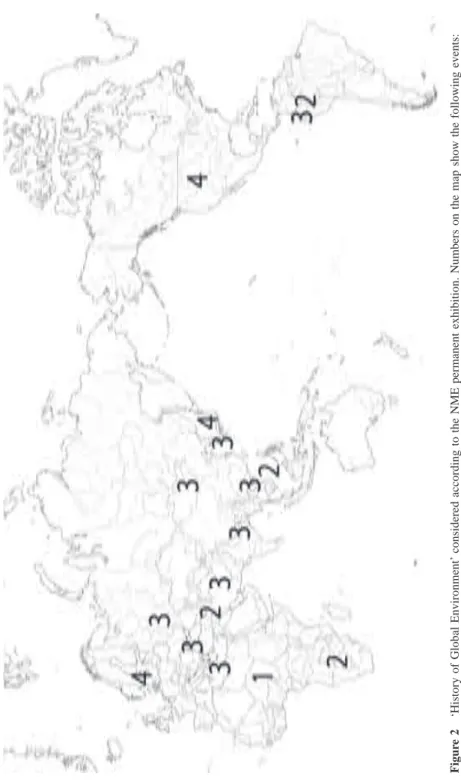
The second method of reading food cultures is to observe each region’s food culture from the perspective of human history. The author classified the cultural history of food into four distinct periods (see Figure 2):
1. The beginning and formation of human food culture (some hundred thousand years ago). Cooking and dining with other people.
2. Invention of new foods (about ten thousand years ago). South America’s creation of crop plants, which transformed the world’s dietary life.
3. Development of ‘food cultures and food civilization’ in many places around the world (about 500-2,000 years ago). Shown in regional exhibition spaces including the Korean Peninsula and China.
4. Industrialization of food (about 200 years ago to the present). Shown by exhibits on Ajinomoto, Nisshin cup-noodle, Kikkoman soy sauce, local dishes in Obama, the Wakasa area, Fukui Prefecture, and others.
Photo 7 Meal styles Meal style in the Andes
Meal style in the Korean peninsula Photo 6 Cooking places
Central Asia
China Photo 5 Cooking methods
Steaming and roasting (Oceania)
Baking tortillas (America)
The above reading ascertained that whereas our food cultures have developed through civilization and industrialization of food, some local food cultures have not disappeared but rather survived through the modern process of rapid food globalization. Division into these four periods of is considered effective for understanding sustaining and/or changing local food cultures and food cultures commonized by globalization, and for imagining the future of our food culture
Photo 9 Changing food Snacks in a kiosk (Africa)
Instant noodles (Europe) Photo 8 Food and houses
Resource recycling in a stilted house (China)
Figure 2 ‘History of Global Environment’ considered according to the NME permanent exhibition. Numbers on the map show the following events: 1. Start of food (tens
of thousands of years ago) 2. Invention of new food
(about
10,000 years ago) 3. Development of food cultures (about 500‐2,000 years ago) 4. Industrialization of food
(about 200 years ago to the present )
(e.g. fast food,
Ajinomoto, museum managed by food companies and local government) Source: Created by the author
(Phillips 2006). In particular, an interesting question is why industrialization of food, the fourth period, has developed so extensively in Japan, whereas it appears rare in Korea and China. Clarifying the formation processes thus represents an important research task. Comparative study of the expansion of McDonald’s or Kentucky Fried Chicken in Europe also presents an interesting theme.
REPRESENTED FOOD CULTURE IN JAPAN
1. Complexity of Vocation and Foodstuffs: A Case of Japanese Honeybees In this section I would like to introduce how and why I have been exhibiting Japan’s food culture in the museum.1) The case study is the permanent exhibition of people’s life in Japan, first with respect to honey (Photo 10). In this corner, honey is addressed by introducing apiculture targeting Japanese honeybees. Unlike other places in Japan, Tsushima, Nagasaki Prefecture, an island located some 10 kilometres from Busan, Korea, has no western honeybees. Therefore, apiculture using indigenous Japanese honeybees has been developed and maintained there.
Furthermore, the honeybees produce honey from flowers of evergreen broadleaf trees, including oaks and chinquapins. It is said that some thousands of bee cylinders (hachi-dos) exist on the island, but related details, such as their distribution and purposes, remain unclear.
Photo 10 Exhibits of beekeeping (Japan)
This exhibition specifically emphasizes apiculture with Japanese honeybees to produce honey in this situation. The exhibition was designed with items representative of various types of bee cylinders (hachi-dos): cylindrical, rectangular, and Jubako-shaped (resembling a multi-tiered food box) beehives. To arrange the items collected from 1945 to 1955 together, the exhibition was designed to exhibit the various hachi-dos. Utensils such as a stick to remove honey, fundamentally important in the honey harvesting season of autumn, are exhibited along with bottled honey products (Photo 11).
The experience of creating this exhibit illustrated that it is more difficult to display a foodstuff than the people’s regular vocation producing it.
2. Modernization, Maintenance, and Change of Foodstuffs
Taking as an example the section on food gathering in Japanese mountain life, real items representing natural resources in Japan are introduced, such as wild vegetables, fungi, and nuts, along with the reality of their gathering (Ikeya 2003;
2004). Wild vegetables include flowering ferns, ostrich ferns, and bamboo shoots;
fungi include maitake and matsutake mushrooms;2) nuts include horse chestnuts and sweet chestnuts. Like the honey exhibit described above, these items are combined with the producers’ regular vocations for exhibitions. Again, although vocational tools for processing foodstuffs can be exhibited, it is difficult to display the foodstuffs themselves. Nevertheless, the author attempted to demonstrate dry foods in time case (Photo 12). The dry goods demonstrate that use of various natural resources in mountain villages will be maintained by Japan’s modernization
Photo 11 Tools for collecting honey (Japan)
and the popularity of businesses that gather to sell them at roadside stations or through middlemen.
CONCLUSION
This study was conducted to elucidate the locality and commonality of food cultures in the world, taking as an example the permanent exhibition of the National Museum of Ethnology. The author, considering the permanent exhibition floor as the field, toured in the whole floor and directly observed items at the end of November 2014, devoting special attention to exhibition items related to food culture. The results are summarized below.
First, in the present permanent exhibition floor of this museum, the examination of food cultures by region is different from earlier days. The manner of understanding food cultures is different as well. Therefore, the exhibition floor is not designed to provide visitors with an understanding of the world’s food cultures. However, if information such as videos (Videotheque) and books were included, a basic information package could be offered for visitors to understand
Photo 12 Dried wild plants in Japan
food cultures comprehensively. Today, although no section on world food culture exists, it is possible to learn more about the past and present food culture in Japan and abroad by comparing food cultures in each region’s exhibition through a certain framework.
Second, the author presents two methods to read food cultures from the exhibited items: summarizing them with their component elements, and identifying each regional food culture in the history of humanity. The author further divides history into four periods for consideration: the beginning and formation of food culture (some ten thousands of years ago), with the formation of cooking methods and the custom of dining with others; invention of new food culture (about ten thousand years ago); development of ‘food culture and food civilization’ in many places worldwide (about 500-2,000 years ago), illustrated by the exhibitions of the Korean Peninsula, China, and other regions; and food industrialization (about 200 years ago to the present), demonstrated by Ajinomoto, Cup-noodle, and Kikkoman.
Third, in exhibiting food cultures, the author attempted to present Japan’s food culture from the perspectives of the ‘complexity of nature, regular vocations, and food’ and ‘modernization and natural resources’. To this end, video images were fundamentally important. In future, it will also be necessary to project exhibitions to elucidate the social change through food modernization from the past (for example, Korea during the colonial period, projected in the Korean Peninsula exhibition corner) to the present (globalization) of food in East Asia.
NOTES
1) The history of Japanese food culture during the long periods from prehistory to the present is described in detail in Ishige (2015).
2) This book mentions the commercialization of mushrooms in southern China and western Japan (Tsing 2015).
REFERENCES Ikeya, K. (池谷和信)
2003 Social Monograph among the Wild Plant Gatherers: Resource Use and Territoriality. Sendai: Tohoku University Press. (『山菜採りの社会誌』仙台:東北大学 出版。)
2004 Cultural Ecology of Zenmai Gathering in the Northeastern Japan. Science Reports of Tohoku University, 7th Series 53 (1-2): 1-28.
2014 What is Watermelon for the Human?: Considering from the Perspective of Kalahari Hunter-Gatherers. Kyoto: Rinsen Shobou. (『人間にとってスイカとは何か―カ ラハリ狩猟民から考える』京都:臨川書房。)
Ishige, N. (石毛直道)
2015 History of Japanese Food Culture: From the Paleolithic Age to the Present.
Tokyo: Iwanami Shoten. (『日本の食文化史―旧石器時代から現代まで』東京:岩波書店。)
Phillips, L.
2006 Food and Globalization. Annual Review of Anthropology 35: 37-57.
Tsing, A. L.
2015 The Mushroom at the End of the World: On the Possibility of Life in Capitalist Ruins. Princeton: Princeton University Press.