Lagoon Life among the Langalanga, Malaita Island, Solomon Islands
著者(英) Akira Goto
journal or
publication title
Senri Ethnological Studies
volume 42
page range 11‑53
year 1996‑02‑09
URL http://doi.org/10.15021/00002976
SENRI ETHNoLoGIcAL STuDIEs 42 1996
Lagoon Life among the Langalanga, Malaita Island,'Solomon Islands
AKIRA GoTo
Mlyagi rvbmenls CoUege
INTRODUCTION
The Solomon Islands obtained its independence from the United Kingdom in 1978, and now consist of seven provinces. The capital, Honiara, is located on the Island of Guadalcanal (5,310 km2), and the Island of Malaita including small atolls such as, Ontong Java forms one province. The Malaita Province is known for its high population density, and the population of the province (4,214 km2) was 80,932 in 1986 [INsTiTuTE of PAcmc STuDiEs 1989: 158].
There are several dialect groups on the island. Among them the Kwaràae (total speakers in 1983, 12,500), Kwaio (7,OOO), and ̀Arèare (9,OOO) are the dominant groups. The wes'tern coast on the central part of the island is the homeland of the Langalanga (Figure 1), whose population is approximately 2,OOO. Beside the Lau Lagoon (northeastern coast) and the ̀Arèare Lagoon (south‑western coast), the Langalanga Lagoon forms a large, stable maritime environment, which has provided the inhabitants with a variety of marine '
resources for generations. ・ '
For the study of resource use and shell money production among the Langalanga, I stayed in a village, Abalolo, from August 11 to September 12 in 1990, from July 30 to August 31 in 1992, and from April 25 to May 31 in 1994.
1. HISTORY AND SOCIAL ORGANIZATION OF THE ABALOLO VILLAGERS
1) Descent Groups and the Villagers
The population structure of the Abalolo village in August 1990 is shown in Table 1. The basic structure is pyramidal, refiecting the present increase in birth rate [STATiSTiCS OFFicE, MiNIsTRy oF FiNANcE 1989: Figure III.5]. But the proportion of males between 20 and 40 years old is $ubstantially low, since the people of these ages tend to live in Honiara for education or wage‑labor.
The Abalolo villagers currently belong to a political union, the Gwàata Association which also includes the villagers of two other adjacent Langalanga villages, Ailau and Gwàedalo. The villagers of these villages have a common
11
t
o 50km
ft
To'agl℃lgaofi5dBf2foaegu
・‑‑!f}r!girkpfe
sssAsX Kwara'ae ' s{i2gA:uk' ... Cil
{iillli..,,.r"
Guadatcanat
e'
0GS)e
p
t ======== =x= === =s
t7 :s) Leli Kwai Hbr.
Kwaio
,
ss
%・%
'N
ss‑
N
N
AN
e
o
.‑‑.
.
eti o
'".a
o
Sa'a
g
cfs
Figure 1. The Malaita Island ane Language Groups
Table 1. Population Structure of the Abalolo Village, August, 1990, Age Group O‑9 10‑19 20‑29 30‑39 40‑49 50‑59 60‑‑69 70‑ Total Male
Female Subtotal
15 16' 31
11 8.
19 3 12 15
3 5 8
2 1 3
1 3 4
3 3 6
2 o 2
40
"
88
residential history. They used to live on an artificial island, Tàalulolo, in the Arabara Harbor. In the early 70s', this island was severely damaged by cyclones, and the inhabitants started to settle on the island coast, where the present villages
Lagoon Life among the Langalanga 13
are located. Currently, the Gwàata consist of seven descent groups, or "clans"
(fuiwaie). Two clans are living in Abalolo, two in Ailau, and three in Gwàedalo.
Each clan has its own migration history. Oral traditions have it that the ancestors of the Abalolo people departed from the territories of other tribes, such as the Kwaio, Kwaràae or Lau 15 to 20 generations ago. Around 5 generations ago, all started to live in the adjacent islands of Adofafo, Matalibore, and Gwaefou in Arabara Harbor (*1).
Langalanga people distinguish between clan members through male lines (flita li wale) and also through female lines (futa li gelD, although patrilineal descent is emphasized. The status of the priest (fata abu), in particular, was supposed to be inherited through male lines. In the actual formation of clans, however, not only descent, but also residence plays an actual role.
In addition, the people usually have a secondary right (e.g. Iand rights) through female lines. Thus, the kinship sYstem among the Langalanga should be defined as "cognatic desce.nt with patrilineal emphasis" [CoopER 1971: 267]. In addition, as Keesing has pointed out for the Kwaio, "contexual definition of status" enables the Langalanga people to act as members of several clans. The kinship system among the Langalanga is not substantially different from those of other tribes on the island, such as the Lau [Ivens 1930], Kwaràae [MAENùu 1981I and Kwaio [KEEsiNG 1982].
Post‑marital residence is basically virilocal. The eldest boy in each family tends to stay in the village, but younger brothers could marry‑out. More than 70
% of married females in Abalolo have come from other villages, mostly from Langalanga. In 1990, there are three women from other dialect groups, such as, Lau, Kwaràae, and Kwaio. When engaged, girls often move to the boy's village to help in his family until marriage. But after marriage, some couples start to live with the bride's family for several reasons.
2) VillageLife
Abalolo ・village is now situated on a flat peninsula, extepding 500 meters into Arabara Bay (Figure 2). This peninsula was formerly covered by mangrove, and the villagers reclaimed the land where ceremonial structures for shark sacrifice were located. The hinterland is still covered with mangrove, through which a trail to the main road is now opened.
The main traMc to the village is from the sea, using traditional dugout canoes. The provincial capital, Auki, is 15 km north of the vi11age. Now the villagers can ride on trucks to Auki on the road, about ten‑minutes‑walk inland frorn the village. Villagers own one truck, but it is not used regularly.
There was one store in the village (1990), where basic food stuff and other goods are available. In this shop, the villagers can obtain such merchandise as sugar, tea, biscuit, tinned fish, noodles, sweets, kerosene, and soap. The people can also buy fr'om a vendor‑truck that comes once a week. But the people often go to Auki by truck for larger purchases.
x
Nztg・;".Al v."Nl
ftUBAV Onebvtueeectt
' Al' .‑it7
x‑‑'
bIX"
eD
.
NANUte. ' NGARArArA,erk..enADAILIU'A
Kwo'ut,vtrgwerlaias,)tiNEMAe .Itt MOANAeULA
AtMELA‑lh o 't'‑‑ /< ''N'
Point"
WALUBUSUe,+
l.KELAKKYLCIufl.+AHONAKLLO‑"ALK,EGEO.tt'
. G.
"OeAf.A.U
‑e8USUAUfiAusKWAA
A
DRANA
..
BUtU
'NGAt
lts'BuSkLK"ovs}>nisK":'LttMo"i"otilu)siv
.N
LOaANAib"× tfULISGO.S‑Nit‑ArA
N$ x
Auki
"1 sAl‑jteE.‑.‑>tthEfARuKAt
ABUAeA‑AeA
e1trtt
tAGO"E ・e
AUAIA x.
/susutusuot .uustA,...'
M
,i+NGGEot6'Soto.Ni'svUtNVIt"t‑TarotttiroPolnli...X,iL,‑
‑KIN.xtse t<E,it.D2:Tix
N.‑.tstt
.rK.teet6O‑o
'x
fARAEARA
.sacw‑‑‑‑
1KwEi))
t‑t '1""'<‑.K
.・‑‑‑‑XNoAKwAsNt
.‑.‑‑'̀
NB"s・‑'i.L・.‑,‑...
}w
.‑‑‑‑NlAru"fl
. ・.(.'
.‑‑t.
N,
‑N.... ‑.. ‑‑... KWAItU'AE' FAUA"tllTtt‑.BU.
eUStRA
INI
s )‑.'N..'
‑tKqh
oNWAUN
rsc・,
}AtA x
‑fUt
os
n
lti:
AIKONAex...
USN
A''
GAUNA' g
eDAt
S"lbFfRl‑Al
‑o"AH
‑x.‑‑‑
o'Rsof(5)flrADtoe
NN .‑AKfAV
Nxs
.eONE
A.‑N 1O
.
̀"".."alfe"
k i.A
A A‑
.
I'OtAX
t'
M ‑"
efO'A
:A)1AU
.
a.‑l](ii8NlG
eEl
'GWAISbN・"s
℃
'
'.s
Nea'attth's
A"lagaotI Sulthttlf
An
attla ttdrbeitr
.N
+Kwafot+・
IN AttA
os 3.
...10'AE+‑L
:L."4
.Ig'o‑.‑
'xxN‑‑
・v‑ tt.‑fv;
eMAEANAOviel 4AME "・orA.'
'
"Poss 'f.st
MeMA"N6ARINSNGC,tA ..AMeUNGrw eAISISI
.}E'EfATA
.tr{2iili}
At・"oAr・to‑‑t
N;GWALE
F‑i
rAfUNAtA'A
X<N,'
, Figure 2. Mapof Langalanga Lagoon
Lagoon Life among the Langalanga 15
In 1990, there was a local market twice a week, where Langalanga people obtained some foods, from the Kwaràae or Kwaio people, such as sweet potatoes, yam, wild‑cabbage, beans, and betel nuts. Langalanga people usually bought these crops by cash, but occasionally, they exchanged them for fish. In 1992, this market was moved further away, and the Kwaio people came to the village for selling garden crops once a week.
2. ASPECTSOFSUBSISTENCE
1) Natural Resources on Land
The resources which Abalolo villagers live on are mostly obtained by fishing, gardening, or collection from the natural environment. The main resource zones are the offshore sea, outer‑islands, reefs around outer‑islands or in the lagoon, the lagoon itself, reefs around the coast, coastal plain, mangrove zones between villages, rivers, river terraces, and mountain slopes. Since I will discuss fishing later, this section' focuses on gardening and foraging on land.
In Abalolo, each household owns one to three gardens. In 1990, the average garden size by household was approximately 620m2. Gardening is basically practiced by the household. If necessary, the close relatives help gardening, but no village‑wide cooperation was observed in gardening during my stay. The gardening is basically slash‑and‑burn, on low terraces near rivers or slopes. The principal cultivator, the person who does the gardening mos.t frequently in a household, is either the husband or the wife of the family. Among the fourteen households, women were the principal cultivators in eleven households in 1990, indicqting the importance of women in gardening.
The main crop from the gardens are sweet potatoes. The average productivity (per unit of labor"hour) was 2.7kg/man‑hour. This is estimated from my observations of average time spent for gardening and the average weight of sweet potatoes by hour of labor. Gardening includes different kinds of activities, such as transportation, burning, harvesting, and weaving. The energy expenditure in slash‑and‑burn agriculture ranges from 156 to 330kcal/hour [KucHiKuRA 1988: TablelO]. The average productivity of sweet potatoes
produces 2,678 kcal of energy, and the energy eMciency of gardening in the village is estimated to range between 8.12 to 17.12 units. This estimate lies within the range of comparative data on slash‑and‑burn agriculture in other Melanesian islarids [ELLEN 1982: Table6.6].
I had an opportunity to observe gardening in the neighboring village, Fòau (Kwaràae), whose economy is based on agriculture. Compared with the Abalolo village, the garden size of the Fòau villagers was much larger. Also in Fòau, a greater variety of crops were grown, 'and the frequency of gardening was higher.
In their gardens, there were field shelters for drying crops and to rest. But I have never seen a similar structure in the gardens of the Abalolo villagers. This is
artificial islands for generations, have alternative productive・strategies, such as fishing and shell money production.
In their gardens, the people grow several varieties of sweet potatoes (ipomoea batatas), such as kumala, butete, and iij7, and cassava or kaibia (Manihot esculeneta). Both crops were newly introduced after contact with Europeans. In 1990, yams, which have a ceremonial importance, were not cultivated in Abalolo gardens except in the garden of one family, who obtained pana (Dioscorea esculenta) from a Fòau villager in exchange for shell money. Large taro, kakama ((lyrtosperma.chamissonis) was available in the swamps.
The villagers used coconuts (liu) grown in natural conditions, and one family grew them in the garden. Edible sago palm sagu (Metroaylon spp.) was present, but not as food: they are important material for roofing and walls. Edible mangrove root, ko V (Bruguiera gymnorrhiza), was collected at r‑iver mouths, and served daily with coconut soup. Several varieties of vegetables such as uta (slippery cabbage, Hibiscus manihot), sakwari (sandpaper cabbage, IZicus copiosa), and oji2na (a shrub, PSeuderanthemum spp.), were occasionally harvested from the gardens or the natural environment. Leaves of rarnjb tree (Pisonia grandis) grown in the village, were used in coconut soup. Also a few families started to grow pineapples. But basically, the garden crops of Abalolo are for self‑consumption.
In addition to the above crops observed in 1990, I noticed some new introductipns in 1992. For instance, some households had started to grow Chinese cabbage around their houses, on the soil in wooden frames or disCarded canoes.
Besides bush cabbage (sakwarD grown in gardens, Chinese cabbage has now become the most popular green vegetable in the daily menu. Also I have observed that the villagers were using other new vegetables, such as green pepper, pumpkin, tomato, onion, and radish. They are not, however, grown in the gardens.
Instead, they were bought in the market in Auki, or, else some villagers who have relatives in Kwaràae or Kwaio villages obtained these vegetables from their gardens.
Several households in the village feed pigs in either the sties or in the wild conditions. Pigs, which are a traditional ritual food, are not consumed on a daily basis: pigs were cooked on special occasions, such as at a party and funerals.
During the research period in 1992, I observed that one household killed their pig and that they served it to the village people. On that occasion, "pig" is listed jn the dinner menu of 10 households among the total 17 household. Chickens are raised throughout the village, and they are occasionally cooked with coconut soup.
2) FoodConsumption
In Langalanga language, a general term for food isfona. Each household has a kitchen house (kisina) for cooking foods as well as a sleeping house (nu,ma)・ In kitchen houses, there are usually two kinds of ovens (gòona). One is made of
Lagoon Life among the Langalanga 17
round stones (bitia) for steaming tubers, and another is for heating water and baking foods (e.g. fish). The former is traditional, but is now often covered with a tire‑wheel to hold heated stones. In addition, the villagers have portable cooking stoves. These stoves are used for baking fish and burning shell beads while making shell money (discussed later). Above the ovens, there is a shelf for storing firewood (e.g. ona bua).
The main food is steamed tubers and rice. These are usually served with coconut soup (biina) made with coconut milk (lqfZz). The most common
ingredient in the soup is scraped ko a, and if available, fish (including tinned fish), shellfish, or instant noodles are added. Tea with sugar is usually served with meals.
Tubers (kakama and cassava) are sometimes mashed to make pudding (waiwaD. Tubers are mashed in a wooden bowl (ciako or tabilD with a stick (kaD. Mashed tuber is called swfbu and they are mixed with coconut oil to enhance taste. This is a ceremonial food, cooked on special occasions or for Sundays.
In 1992, I undertook an intensive survey of the daily menu of each household (total 17 households) for one week. The most common foods were sweet potatoes and rice, followed by cassava, kakama, and pana. Some households ate bread baked in their cooking houses. Coconut biscuits sold at stores were also eaten.
Figure 3 indicates the occurrence of sweet potatoes, other tubers, rice and bread/biscuit in each meal.
For breakfast, a variety of foods were consumed. Among them, sweet
potatoes and tubers were often leftovers from the previous dinner. In addition to these foods, breakfast was characterized by foods which do not require cooking, such as biscuit or bread. (Bread is usually baked beforehand.)
For lunch, rice became the principle food. As shown in the following section, the villagers were usually busy making shell money after breakfast. During this busy time, rice requiring only washing and steaming was probably preferred to tubers for convenience. At lunch, "taiyo (canned bonito)" was often served with rice also out of cOnvenience. Chinese cabbage, grown around the houses, was sometimes cooked for lunch.
For dinner, sweet potatoes were the main dish. Sweet potatoes coupled with other tubers comprise more than 96 % of the total meal frequency. As shown in the next section, th.ese tubers were harvested from garden during daytime. In general, the most "delicious" menu was observed at dinner time, that is, tubers with soup. The soups contained koir mixed with fish/shellfish and vegetables, such as Chinese cabbage, sakwari, and rarnjb (Figure 4).
Fish, shellfish and crabs caught in the lagoon showed similar frequency at breakfast and dinner. If the people went fishing during the daytime, their catches were mostly consumed at dinner. According to the lunar cycle, the villagers often went night fishing, whose catches were cooked in the next morning.
The calorie intake requirement for adult males (from 20s to 40s) is estimated
.g BreadlBiscuit pm Rice O Other Tubers
% Sweet Potato
Dirner
・‑cu‑‑
Eo Lunch
>
Breakfast
o% 10% 20% 30% 40% 50% 60%
Percentage
Figure 3. MainFoodsbyMeal
70% 80% 90% 1oo%
M Dinner ig Lunch ss Breakfast
i!
soup+vegetabte"
8ko'asoup
‑・t
a .t.tt.t....t ,t.A‑ .t..ttttt.
ocannedfish l
‑ocopurchasedfish
v
E・
shellfish
fish,
O‑2 ' 4 6 Frequency8 10' 12 14 16
Figure 4. Kinds of Side Dishes by Meal
Lagoon Life among the Langalanga 19
to be 2,180 kcal a day. Aged persons, adult females (except for pregnant woMen) "
and children require fewer calbries than adult males. Assuming that aged persons and adult females require 80 % of the adult male caloric requirement, and children require 50%, the total calories required for the Abalolo villagers (in 1990) was 15,484 kcal per day.
From the data・on the edible portion of sweet potatoes and caloric content per 100 g, the villagers need 15.6 kg of sweet potatoes to meet the above requirement.
This amount of sweet potato will be obtained by 5.7man‑hours of farming.
There were 30 adults in the village (in 1990), and even if some of them never engaged in gardening, but only collected coconuts, mangrove roots, vegetables and other foods, one‑hour of gardening by six adults may provide enough sweet potatoes for the villagers.
As seen in this section, the villagers actually consumed a substantial amount of rice. By measuring the weights of tubers and rice before cooking, I have estimated that the adult males consumed around 3,OOO kcal a day, and that the calorie obtained from rice comprised between 30 to 40 % of total calorie intake.
Concernirig protein, peoples in a similar, tropical coastal environment, obtain protein from plant foods, such as rice and'tubers, and from animal fools, such as fish, shellfish, and canned fish [Suzuki 1991]. In Abalolo, the frequency ofmarine animals (e.g. fish, shellfish, and crabs) and canned fish was around 16 % in the total meals.
This figure is lower than that observed in coastal Papua New Guinea where marine foods comprise 50% in the total protein intake. Also in Abalolo, the purchased meat (e.g. beef) was negligible. In addition, the villagers did not use hunted animals that the Papuans can use. Considering these factors, the contribution of animal foods to the total protein intake in Abalolo was estimated to be between 20 to 30 %. Instead, rice comprised between 40 to 50 %, and tubers, 20 to 30%. The average protein intake among the adult males was estimated to be between 40 to 55 g a day.
3) Time‑Allocation .
I spent one week each in 1990 and in 1992 to observe the time allocation of the villagers. This study investigated how the people allocate their day (from 6:OO a.m. to 7:OOp.m.) to various subsistence activities, including housework, meal preparation, and resting. The method of observation and the details of the results will be discussed in another section of this report (see Suda, this volume).
Table4・presents the time‑allocation of the adults. In "productive activities (gardening/collecting, fishing and shell money production)", males spent substantial time for fishing and shell money production. Females spent much time for shell money production and then gardening/collecting.
In Table 2, the data on female time allocation in 1990 were broke down into married females, including widows (F) and single females (O. This shows that single females spent nearly 5 hours on shell money production. That is, they spent
Tab}e 2. Time Allocation of Adults in Abalolo Village (1990 & 1992)
YEAR '1990 1992 1990 1990 1992
SEX(samplesize) M(8) M(12) F(14) f(9) F(20)
Gardening&collecting 6.8 10.9 13.1 5.1 12.6
Fishing 12.5 5.8 1.1 o 3.1
Shellnioneymaking 12.5 18.6 20.3 46.8 21.5
Housework 10.5 6.4 ii.o 8.6 i3.9
Food preparation Restinglsleeping Vising others Others'
5.8
".2 o
7.7
7.7 33.3 10.9 6.4
24.7 20.9 6.6 2.3
15.4 18.8 2.6 2.7
21.5 12.7 5.8 8.9
Total (%) 1OO 1OO 100 1OO 1OO
'
on this more than 90 % of the total time they spent on productive activities. In contrast, they spent much less time on gardening/collecting than married females.
Thus single females focused on shell money production, and depended on their parents for food.
It seems that males spent more time for shell money production in 1992 than they did in 1990. This is because some males who worked in towns for wage‑labor in 1990 returned to the village in 1992. Their sole means of obtaining mOney in the village was to engage in shell money production. In contrast, males appear to have spent much less time for fishing in 1992 than in 1990. During the research week in 1992, however, some people went night fishing, which is not included in this time allocation study. Therefore, I do not think that the importance of fishing has diminished substantially.
In 1992, females spent time primarily on shell money production, secondarily on gardening, collecting and fishing. This pattern is not different from that in 1990, but the actual time spent on shell money production decreased in 1992. 0ne of the reasons iS that seven of the nine sjngle females observed in 1990 were absent from the village ("2). Married females spent around 20% of 13hours on shell money production both in 1990 and 1992.
Time spent on housework did not change between 1990 and 1992. Among various kinds of housework, females were mostly engaged in nursing and house cleaning, and males in house repairing. Females also spent much time for food preparation, although children often helped their mothers washing and scraping tubers. In contrast, males had a principal role in dismembering and cooking pigs.
Figure 5 indicates the frequency of the females engaged in various activities.
Gardening was practiced during midday between 9:OO to 15:OO. The peak was found in 12:OO‑13:OO, and this shows that women, once out in gardens, tended not to return for lunch. There is also a small peak in gardening at 16:OO‑‑18:OO. This is because some peOple went to the gardening to get food for dinner, after the shell money production during mid,day. In contrast, time for fishing was irregular.
Lagoon Life among the Langalanga 21
g. i, ll xi・ i,is.s
coActivity
Fig"re 5. Frequency of Each Activity by Time
8' 6
4 Frequency 2
o
This is because fishing depended on such factors as the tidal cycle and climate.
As was the case for gardening, women started shell money production usually around 9:OO, but the number of the people engaged in thisjob decreased around 12:OO. ・In particular, females responsible for preparing lunch, tended to break in this time period. In contrast, the frequency of the people either cooking or eating had small peaks three times a day, corresponding to three meals. The people could do housewotk all day, but they often did it before and after meals. There was a peak for resting/sleeping around 14:OO, indicating napping in the hottest time period after lunch.
3. FISHINGACTIVITIES
1) Overview of Indigenous and Introduced Fishing Strategies
As Akimichi (1978) has already shown, Solomon Islanders have an enormous amount of fishing lore. Langalanga people also have an extensive knowledge and technology for fishing. In the context of recent cultural change, such tradition has been gradually lost, but I could obtain an outline of the Langalanga fishing lore by interviewing skilled fishermen and examining fishing gear which are no longer used. For instance,Icollected, by interviewing several fishermen, more than 260
Langalanga fish and shellfish names (Appendix A).
Gathering marine resources is a daily activity which provides the people with a stable food supply. Women go to mangrove zones to collect koke as well as shellfish inhabiting Muddy soil, such as ke@ and iloilo. In the shallow reefs around the village and islands in the lagoon, women dive to collect such shellfish as wera, nau. and ralili. On the reef flats of the outer islands, a variety of crabs can be caught. As seen in the next section, these shellfish and crabs are important supplements for the relatively unstable resources, namely, fish.
Langalanga had two kinds of stone‑weirs which were usually situated on the reefs of outer‑islands: cofi2njie (with high walls) and erèere (with low walls). This ere ̀ere was used at low tide: fishermen would open a part of the wall in order to make fish flee, and, with "atola net (round scoop net)," waited at the opening and caught the escaping fish. The fish caught in these weirs were uala (sardines, Amblygaster spp.), dolala (mackerels, Rastrelliger kanagurta), mela (fusiliers,
Ckeesio spp.), alubala (rabbitfishes, Qplegnathus & Siganus spp.), and suru (emperors, Lethrinus spp.). Most of them were damaged by cyclones and now have been abandoned. I could locate two erelores on the reefs by observing air‑
photos, and visited one of them near Radefasu. Other fishing methods no longer practiced today are fish‑drive (rarabu) using coconut leaves, fish‑poisoning, kite‑
fishing (kwaiji?rao), and angling with a straight‑hook (lana).
Langalanga traditionally had several kinds of nets (fiio). I could observe two types of scoop nets, one with a round frame (la?) and another with a four‑sided frame, or scaffZnets (gale). Both types were used in the shallow water. Net fishing undertaken nowadays in the lagoon are: (1) circle net for uala in the channel of reefs, (2) drive nets in the lagoon, (3) circle nets used at the river mouth at night, and (4) block nets. The last type is situated at the river mouth at high tide. At low tjde, several canoes go up the river and then drive the fish downstream to be captured in the nets. During my stay in 1990, I observed that there were a few groups in Langalanga that practiced the 3rd and 4th types of netting to sell fish.
One person in Abalolo village bought fish from this group to sell in Honiara.
Spears (fbkarau) with four iron points are used in the mangrove zones when fish come in with the rising tide. Spears with short shanks or spear‑guns are used for dive‑fishing (mainly at night) to catch gwaile (parrotfish, Scarus spp.), boto (surgeonfish, Acanthurus spp.), ume (unicornfish, Naso spp.), gome (mullet, Mugil spp.), and turtles. During night‑time, some fishermen engaged in spearing with lamps (iroiro).
The most popular fishing method is angling. In the past, angling was practiced with lure hooks made of shell shanks, or with bait hooks made of bone, shell and metal. Lure hooks were mainly used for rau (bonito, Katsuwonus pelamis) fishing, and bait hooks were used, according to the size, for either deep‑
sea fishing outside the lagoon or for lagoon fishing. The bait hooks were traditionally attached to the end of the leader, below the sinker. Nowadays, influenced by the Japanese method, the iron sinker is situated at the bottom. Uala
Lagoon Life among the Langalanga 23 fish and kokoro shell are considered to be good bait (mamu) for angling. Fish‑
hooks are now imported from Japan, and most are of thg U‑shape type with barbs. Langalanga distinguish between two types.of hooks, oigege (bend point) and oitoro (strait point).
For uala and mela (perches, Caesio spp.) fishing, small hooks, ,filau wawade (No. 9 hooks; shank length between 2 and 3 cm) themselves work as a lure because they shine: fishermen just pull up and down on the line, and uala are attracted.
The same and longer types of hooks (No. 5 hooks) are used for buli (squirrelfish, Holocentridae) fishing on bright nights. Fishermen attach two to five hooks, 50 cm apart, on the line. During the bright night 'and high tide, fishermen drift the line without bait to catch buli and duli mou (Apogonidae).
For catching baraulo (barracudas, Sphyraena spp.), karanoa (snappers, Luijanus spp.), and mamala (threadfin‑breams, Pentapodus spp.), medium hooks, fanaruga (No. 1‑2 hooks; shank length between 3 and 4cm) are used, often with wire leader. This type of fishing is done in water channels at night. For deep‑sea angling of larger fish, such as ia bala (emperors, Sparidae spp. and Paracaesio kusakariD, tori (snappers, Lutjanidae spp.), and malipi (snappers, Luijanus spp.), large hooks, lofo lae are used.
Deep‑sea fishing (talamae kwalo) With lure hooks of white plastic shank has been done for several years. It is said that this method, kura, was introduc' ed by Filipino fishermen. For deep‑sea fishing, Langalanga started to use round‑shape hooks which the Japanese fishermen use for longline‑fishing of tuna.
2) Aspects of Fishing Activities in Abalolo Village
Among various fishing strategies seen above, fishing strategies actually observed in the village were angling in deep sea and in the lagoon, spearing, netting, and collecting (including diving) marine invertebrates. In Abalolo, none owned nets in 1990, but one household had a seine net in 1992 [cf. Laumani 1989]. This net was used for fishing on the reef flats around the outer island.
Fishing is primarily for self‑consumption, and none practiced fishing to sell fish in Auki or Honiara, although casual exchange between villagers was observed. In 1990, one villager started to buy fish from other Langalanga fishermen and transported the products'to Honiara market to sell. This business was made possible with the ice boxes provided by the Japanese Government. In 1992, however, this business had already ceased, because the supplY of ice from the division of fisheries to preserve fresh fish was not enough. Also the transportation from the village to Auki, where the ship to Honiara departed, was irregular. Thus the consolidation of infrastructure including transportation is needed for properly marketing fish.
In August/September of 1990, the villagers did not use unekploited resources, trepang, which inhabit the sandy bottom of the lagoon. Trepang fishing is one of the most popular kinds fishing in Papua New Guinea [see Suda pp. 89‑104 and Tawa pp.81‑87 in this volume]. During the research period of 1990,Idid not
.
Table 3. Variation in Fishing Methods
D.e.e,Pil・fie,a spearing Angling 8P.O,l,Pfi,) Diving COii./ECt‑ lllilldll・l.bigr.O,f
Male
Married females Single females
3 (3)*
o o
3 (2) o o
10 (8) 12 (8) 6 (O)
<2>
<5>
<4>
1 (1) 13 (8) 8 (2)
o 15 (8)
9 (5) 13 16 10
* The number in the table is based on interview, and the number in parenthesis is from actual observa‑
tion.
observe trepang fishing in Langalanga. The people in this area started to collect trepang to sell after that time. By July of 1992, trepang around the Abalolo village had already been over exploited. Thus nobody in the village engaged in trepang fishing.
But in Ailau and Gwàedalo, there are some households which are catching and drying trepang. The men went trepang fishing at night‑time when trepang move to shallower places. They dive to catch trepang, and bring them back to the village for drying. In Ailau and Gwàedalo, there are a few structures for smoking trepang. Dried trepang is sold in Honiara, priced by the species and size. In 1994, one Langalanga man engaged in exporting lobster to Australia. He owns' a motor boat to transport lobster to Honiara, and some Langalanga men worked for him.
Apart from the above fishing for sale, the fishing activities in Abalolo is for self‑supply. I will analyze some aspeCts of fishing activities observed in 1990.
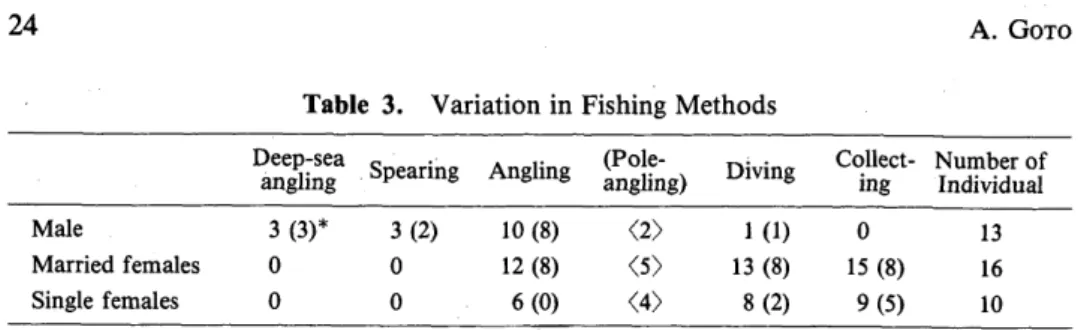
Except for the daily collection of invertebrates by women, 60 cases among the 64 observed fishing trips were for angling, and 3 were for spearing. Hand‑lining, pole‑lining, and d.eep‑sea hand‑lining were the methods used in angling. Women and two men often practice pole‑fishing when fishing in the lagoon, but the other men only used hand‑lines instead (Table 3). The choice of angling method is thus related to sex, and, probably to individual preference.
Fishing is usually done from the canoe. Abalolo villagers had .16 canoes and boats in use. Most of the canoes used for daily fishing were of the combined and dugout types. There were2combined and 14dugout canoes in the village. One household owned a motor‑boat which was mainly used for transportation. Two households had motor canoes, and one canoe was used for fishing and transport.
The villagers could identify a variety of fishing grounds, although some are no longer used now (Figure 6). In particular, stone weirs and turtle‑hunting grounds near the outer islands have been mostly abandoned. Figure 6 indicates that daily fishing activities of the villagers are largely focused in the 5 km catchment. This area is covered with approximately two‑hours round trip by paddling canoes.
In total, most zones used by the villagers are found in the southern half of the Arabara Harbor. This is because small islands, including artificial islands (e.g.
Tàalulolo, Gwaefou), are mostly distributed in this southern area. The shallow reef fiats around the island are the most productive grounds for catching .fish and
Lagoon Life 'among the Langalanga 25
e e
e
[,E]]]}
+
e
e
e e
e +
. .
e+
e
eee
ee
e
eO
a
s)
ci1;
9++ ee e e ee
+
exx ee e e e
:0
legends
e angling + collecting
e traps(ere'ere} x dive fishing O netting
Figure 6. Fishing Zones within 5 Krh Catchment
Table 4. Fishing Trips by Fishing Grounds Fishing ground Number of Trips Male Female Near reef
Ma'ngrove Lagoon
Outer reef Offshore
9 1
43 8 4
5 1
40 7 4
4 o 3 1 o
Total 65‑ 53 8
shellfish. Also the angling grounds of mela and kulaju are concentrated in this area, probably because of the distribution of reefs and channels.
Table 4 indicates how villagers used fishing zones, and it is easy to note that the angling grounds in 'the lagoon were by far the most important. Most of the fishing was done by single individuals (Table5). Occasionally, two persons, usually husband and wife, practiced angling together, and a group of three men was once observed to engage in deep‑sea angling. The largest group consisted of four men for turtle spearing at night‑.
Women frequently collected shellfish by walking on the beach or diving in front of the village and in reefs around the outer islands. Their collecting
Table 5. Fishing Trip by Number of People Number of
People Number of
Trips Male Female Male&
Female
1 2 3 4
56 5 3 1
49 2 2 1
7 1 1 o
2 o o
Total 65 54 9 2
Table 6. Successful and Unsuccessful Fishing Trips
Week Successful Unsuccessful Total
lst
2nd 3rd 4th
5 6
,17 13
1 8
2
10
6 14 19 23
Total 41 21 62
activities accompanied gardening or collecting for the coastal resources, and I could not observe the exact frequency. But married women collect much more frequently than single women. In particular, diving for shellfish was mostly practiced by married women, although all the single women said that they could dive. Women often collected shellfish, crab and other invertebrates (e.g. takwaD when they went out for line‑fishing. The shellfish collected most often were nau (conch shell, Strombidae), abuli (giant clam, 71ridacna spp.), buli (cowry, dypraea spp.), and wera (cone shell, Conus spp.). Crabs often caught were màabua (Oziu guttatus), kuka‑li‑madama (Car;pilus spp.) and upara (Geotheiphusa dehaanD. In contrast, men usually fished in or out of the lagoon, but often returned without a catch.
Among the observed 60 fishing trips for angling, 19 cases were unsuccessful.
Thus nearly one‑third of fishing trips produced no catch. The average time spent for successful and unsuccessful trips was 4.39 hr. (S.D.== 2.55; n= 35) and 2.56 hr. (S.D.= 2.04; n= 21), respectively. The latter figure indicates that villagers may give up fishing after fishing two and half hours.
The frequency of successful and unsuccessful trips in four weeks is indicated in Table 6. It is notable that the ratio of successful to unsuccessful trips changed between the second and third weeks. The second week corresponded to the period of a new moon.
Fishing eMciency also' changed by week (Table 7). The eMciency of successful trips did not change considerably, but if both successful and unsuccessful trips were combined, the actual eMciency fluctuated by the week. The energy
Lagoon Life among the Langalanga 27 Table 7. Fishing EMciency
<7.1 Only Successful Trips>
Week Time (hr) Man‑hour Catch (kg) kg/hr kg/mh No. of trip.
1st'
2nd 3rd 4th
8.8 9.0 78.4 37.0
8.8 12.0 81.9 46.5
2.4 4.4 37.1 9.7
O.28 O.49 O.47 O.26
O.28 O.36 O.45 O.21
4 4 14 9
<7.2 Including Unsuccessful Trips>
Week Time (hr) Man‑hour Catch (kg) kg/hr kg/mh No. of trip
1st
2nd 3rd 4th
9.8 28.3 81.4 67,5
9;8' 33.3 84.9 80.5
2.4 4.4 37.1 9.7
O.25 O.16 O.46 O.14
O.25 O.13 o.op O.12
5 12 16 20
1.2‑1.4kg 1.0‑1.2kg o.s‑1.okg
su
di o.6‑o.skg
‑‑.
8 O.4‑O.6kg o.2‑o.4kg o.o‑o.2kg
o.Okg
O 2 4 6 8 10 12 14 16 + No. of Trips
' Figure 7. Catch Size by Man‑Hour
expenditure for angling was about 156kcal/hour [KucHiKuRA 1988: Table 10], and the yield of the successful fishing trips in Abalolo ranged mostly between O.2 to O.6kg (Figure 7). The energy eMciency of fishing is・then estimated to range between 1.06 to 3.18 units. This is substantially lower than the eMciency (8.6) recorded at Ontong Java in 1970's [BAyLiss‑SMiTH 1982].
In the first week, most fishermen attempted to catch uala with unbaited hooks, and then tb catch kulaju and other bottom‑fish with uala‑baited hooks. In the second week, it became dithcult to catch uala, and therefore, other fish as‑
Table 8. Individual Variation ‑in Angling by Male Fishermen Fisherman Age Total Fishing Trip
Days Trips' Frequency Hour Hourl Total Catchl Fishing Spent Trip Catch Hour Grounds*'
(hr) (kg) (kg) NLRO
No. 1 No. 2 No. 3 No. 4 No. 5 No. 6
60̀
60̀
50̀
40̀
30̀
20̀
25 25 25 13 20 19
3 (1) 2 (2) , 6 (6) 9 (4) 8 (5) 10 (8)
8.3 12.5 4.1' 1.4 2.5 1.9
3.00 9.50
!9.75 25.25 38.20 56.95
1.00 4.75 3.29 2.80 4.78 7.11
1.34 3.25 5.52 4.82 18.05 10.53
O.44 O.34 O.28 O.19 O.47 O.23
3 2
429
7182
' fishing trips: total trips (successful trips)
** fishing grounds: N (near reef), L (lagoon), R (outer reefs), and O (offshore)
well. Usually, fishermen spent two or three hours searching for bait, and when they could not, they gave up fishing for that day.
In the third week, before the full moon (fiali njbla), mela came into the lagoon. This week was when fishing trips were observed most frequently. I noticed that the men who did not go fishing in the other periods went fishing during this week. Fishermen said that the best time to catch mela, that were caught with unbaited hooks, was after the rain or when it was cloudy, because mela could not see the hooks. In the third and fourth weeks, it rained almost every afternoon, creating good conditions for ,mela fishing.
Around the full moon, from the end of the third week to the fourth week, one fisherman started to catch buli during bright nights. Bu' li are a nocturnal carnivore, and fisherman could catch them even without bait. During the same bright nights, other fishermen caught baraulo and other fish by using hooks baited with uala in the channel of the lagoons.
As already noted, there is individual variation in the choice of fishing strategies. Table 8 lists the angling strategies of six men. Three men (No. 1‑3) in the table did not go fishing very often, but they were all the principal eultivator of each household. One man (No. 1) practiced hand‑lining only in front of the village, and never went out into the lagoon. Another man (No. 2) went fishing for mela only in the third week. A third man (No. 3) practiced both pole‑fishing, and collecting sheHfish and other invertebrates in each fishing trip.
Three men (No. 4‑6) who fished most often in the village all preferred hand‑
lining to pole‑fishing, and they went deep‑sea fishing・ outside the lagoon as well,
when the weather conditiofi was favorable. They never collected marine invertebrates during the fishing trips. No. 5 did not own a canoe, and he always borrowed one from his brother or non‑kin. No.6 man did not own equipment for deep‑sea fishing, but usually borrowed from his wife's brother who was away in Honiara. Thus, there does not seem to be a rigid relationship between ownership of fishing gear, and frequency or intensity of fishing.
As discussed in Appendix B, the choice of strategies is dependent on several
Lagoon Life among the Langalanga 29 other factors, such as presence of other cultivators in the family,.other methods for obtaining cash, and personal preference for fishing strategies.
4. SHELLMONEYPRODUCTION
1) Shell Money in the Solomon lslands
Shell money has been one of the most important cultural items in Melanesia, and there are several types of shell money. One type consists of cowry shells.
This type, also found in mainland Southeast Asia and East Asia, have been important items for exchange and accumulation.in Papua New Guinea.
Another type of shell money consists of shell beads, which could be used both for ornaments and for shell money. This type is widely distributed in Melanesia, such as Papua New Guinea, Bismarck Archipelago, Solomon Islands, New Caledonia, and New Hebrides. On Bougenville, northern Solomon Islands, shell money of this type (e.g. mauaD has been used. Most of them were imported from the Central Solomons [CoNNELL 1977]. One mauai could be exchanged with such items as a garden of taro, coconuts, swords, arrows, pottery, and sago powder.
There js another type of shell money in the Solomon Islands. In Western Province (the New Georgia), shell money called poata was used. Poata is a large ring (e.g. diameter between 7 cm to 15 cm) made from giant clam shells. Poata was made by a specialist, matazona, who inherited his status through descent.
Poata was used for bride price and for exchanging with slaves, stones, bark clothes, shields, necklaces, 'and bird eggs. In the Choiseul Islands, yet another type of shell money, kisa, was used. This is a drum shape money made of giant clam shells. It had different exchange rates by size [MiLLER 1978].
2) Shell Money Production in Langalanga
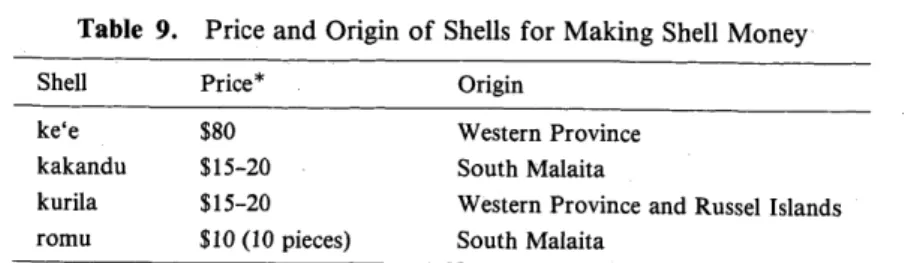
Langalanga is among the few areas where shell 'money production continues until today. The shell money produced here is shell beads type which is widely distributed in the Central Solomon Islands. Among the Langalanga, four types of shells are currently used for production of shell beads: romu (Chama pacij7ca), kele (Beguina semiorbiculata), kakandu (Anadara granosa), and kurila (Atrina vexillum). Shell beads are produced in the following procgsses.
Shells are crushed with an iron hammer on a flat stone (fbu li uD to remove the hinges and other useless parts. Shell fragments (kwaijuloa) are then held with fingers and retouched with hqmmers, to make round disks. The disks have diameters of around 1 cm, called didia suiro.
Disks of romu and kakandu shells, which retain a rough surface, are smoothed on concave lime stones (fbu li scU?i). The people place around 40 to 50 disks on a half cut smoothing stone (makeD, and smooth them on fou li scU2z by pushing down and moving the makei with both hands. This process is done with some water and broken red sand stone as grinder.