一般教養系論文
1. On acquisition of semantics of English prepositions by Japanese ELLs
As the English language became the lingua franca, more and more people have been learning it, and Eng- lish language schools can be found in almost every big city of the world. Although some linguists such as Dahl (2004) mentions that the structure of English is one of the simplest in the languages of the world, most English language learners (henceforth ELLs) would not agree with this statement, as they devote much of their precious time to becoming profi cient English speakers, (and many of them unfortunately quit learn- ing before acquiring a good command of English).
Indeed English appears to be a diffi cult language for most (if not all) ELLs, but it should be also noted that all ELLs do not experience exactly the same hardships of acquiring the language; for those who speak such a language as Japanese, the one genetically and geo- graphically unrelated to English, becoming high- profi ciency learners of English requires much more time and eff ort than those whose languages are in many ways similar to English. Among many diffi - culties for ELLs, English prepositions are oft en said
to be notoriously diffi cult to be able to use in an ap- propriate manner (e.g. Cho 1992, Kotera et al. 2001.
Tanaka 1983).
Several reasons can be claimed for why English prepositions are far more diffi cult for Japanese ELLs to learn. First, this can be att ributed to the nature of Eng- lish prepositions; they are highly polysemous, that is, each of them displays far more meanings than most English content words and also other function words.
How can Japanese teachers of English instruct such polysemous words as English prepositions? Tradition- ally, most have just made Japanese ELLs memorize prominent senses of these prepositions, but this has not helped them acquire native-like intuition of how to use prepositions in an appropriate manner. For example, most ELLs in Japan are taught that the word ‘night’ always goes with ‘at’ (at night). This may make sense, as the closely related temporal nouns,
‘morning’ and ‘aft ernoon’ are almost always paired with ‘in’ (‘in the morning’ and ‘in the aft ernoon’). On this puzzling fact, one may conclude that the preposi- tional phrase ‘at night’ should be memorized as an idiomatic expression. But as the following instances show, ‘night’ can be also used with other prepositions.
【原著論文】
On Potentiality of Cognitive Semantics and Linguistic Typology for Acquisition of the English Preposition from
by Japanese Learners of English
Kazuyuki YAMAGUCHI
山口和之 外国語研究室
Abstract: The aim of this paper is to argue that the approach based on Cognitive Semantics and Linguistic Typology has a signifi cant potential for providing English Language Learners in Japan with a bett er methodology for apprehending semantic nature of English prepositions. We will also contend that these two branches of theoretical linguistics help us comprehend the importance of image-schemas for revealing semantic nature of English prepositions. Among many English prepositions, this paper, as a case study, examines the semantic properties of the specifi c English prepositionfrom.
(Received: November 5, 2012 Accepted: December 17, 2012)
Key words: cognitive semantics, linguistic typology, English preposition, English language learners, image schema
キーワード:認知意味論,類型論,英語の前置詞,英語学習者,イメージスキーマ
(1) (a) At night, all your problems seem worse.
(b) On the night in question, she was sound asleep.
(c) In the night, they try to cross the border.
The same is true for ‘be good at’. This expression, almost always learned as the fi xed expression, can be also used with diff erent prepositions instead of ‘at’.
(2) (a) I was good at math and science, I was not also good in things like English literature and history and that kind of things. (sic)
(b) He was good with patients, as he was good with children. (Kotera and Konobe: 2001: 18)
These examples show that memorization does not help Japanese ELLs acquire proper usages of English prepositions.
Second, the linguistic structures between English and Japanese diff er greatly. To encode the spatial and non-spatial relations expressed by English preposi- tions, Japanese utilizes not only postpositions (case markers), but also nouns and verbs (e.g. Cho 1982).
Third, we are far from being fully convinced concern- ing eff ective learning methodologies of semantics of English prepositions. Many English instructors may contend that English dictionaries may be the best teachers for ELLs, but what they display is just lists of senses of English prepositions in an arbitrary fashion, so that Japanese ELLs must memorize these innumer- able senses of the prepositions one by one.
It should be mentioned that language education is intimately related to the trend of linguistic theories, and litt le interest in semantics has to do with tradi- tional linguistic theories. For example, the so called
‘Oral Approach’ was introduced into Japanese English education from the United States soon aft er World War Two, and this approach has so intimately related to the trend of linguistics then, that is, American structuralism in linguistics, the dominant linguistic assumption in the fi rst half of 20th century. Oral Approach emphasized how ELLs eff ectively learn the sound and the grammatical structures, but not seman- tic structures. Then, the idea of Transformational Gen- erative Grammar, the most infl uential linguistic theory in the latt er half of 20th century, has been utilized in English language research and pedagogy. Because of the infl uence of Transformational Generative Gram-
mar which seldom discusses semantics of polysemous words, the focus of the most second language acquisi- tion research has been on syntactic acquisition, not on lexical acquisition.
Unfortunately, as the traditional linguistic theory just mentioned above implies, the progress of the lin- guistics seems to have revealed very litt le concerning nature of polysemous words, as most still assume that senses of English prepositions are not related to each other (e.g. Bloomfi eld, 1933).
The purpose of this paper is to argue that Cognitive Semantics (henceforth CS) and Typological Linguistics (henceforth TL) will have a great potentiality in order for Japanese ELLs to understand the nature of seman- tics of English prepositions, and then to help them use English prepositions appropriately.
2. On Cognitive Semantics and its approach to English prepositions
This section sees that CS has a potentiality for pro- viding us with bett er methodologies of learning and teaching semantics of English prepositions.
2.1. Why is CS based approach better than others?
This study will make an assumption, shared with most CS based studies, that the nature of multi- functions in a single English prepositions can only be revealed in a meaningful way with reference to how our experience structures the world (see especially Heine et al. 1991; Johnson 1987; Lakoff 1987; Lakoff and Johnson 1980; Langacker 1987; Lindner 1981; Rice 1987; Talmy 2000; Sweetser 1990).
This position is a clear departure from many classi- cal approaches to meaning within the formal, or truth- conditional framework, whose basic assumption is that the meaning of a linguistic expression can be de- termined, either directly or by reduction, with refer- ence to the relationship between the expression and an entity in the world. In other words, language is just a device to describe the objective reality (or some possi- ble world), and meaning should be described inde- pendently of any particular human understanding (for more detail, see especially the discussion on the objec- tivism paradigm in Lakoff 1987: 157–370). One reason for this study to prefer a CS based approach over so-called classical approach is that the latt er does not reveal any possible motivation behind semantic regu- larities of English prepositions. Within the classical
approach, one possible explanation for these regulari- ties might be to discover the very same objective con- ditions but it seems almost impossible to imagine the necessary objective truth conditions for multiple senses of this single morpheme. Rather, such motiva- tion will only be found by taking into consideration how we conceptualize the world; indeed, an increasing number of studies based on CS argue for the idea that language structure is in many ways shaped and moti- vated by human cognitive abilities and experience (see, e.g., Heine et al. 1991; Johnson 1987; Lakoff 1987;
Lakoff and Johnson 1980; Langacker 1987; Sweetser 1990), and that this assumption allows us to cope with the issue of lexical polysemy in a more natural and convincing way.
2.2. On CS and its perspective on semantics of English prepositions
Since 1970s, more and more approaches to seman- tics have become against the objectivist world-view and truth conditional semantics, and these approaches collectively came to be called Cognitive Semantics.
Although researchers of CS diff er in their specifi c methods for linguistic analysis and their main in- terests, they seem to make the following common assumptions (see Evans and Green 2006: 157).
(3) (a) Conceptual structure is embodied.
(b) Semantic structure is conceptual structure.
(c) Meaning representation is encyclopedic.
(d) Meaning construction is conceptualization.
To cognitive semanticists, semantic structures are formulated on the basis of the nature of human inter- action with the external world. Also it is assumed that semantic structures are conceptual structures, and the conceptualization process is dynamic rather than static. And our encyclopedic knowledge plays an important role in inferring appropriate meanings out of context.
This paper will focus specifi cally on the followings discussed in previous studies of CS, as they appear the most relevant to our study.
(4) (a) the spatial sense as basic
(b) prototype and extended meanings (c) image schemas
(d) typological perspectives
2.2.1. On the spatial sense as basic
Most previous studies of CS share the localistic as- sumption; spatial senses are linguistically and psycho- logically more basic than non-spatial ones, and such other senses may be appropriately hypothesized as ultimately derived from the spatial senses (see, e.g., Croft 1991: 192, Lyons 1977: 718)(1). This assumption may be supported by the following justifi cations. First, this has in fact been assumed by most functionally and cognitively oriented linguists. Second, children ac- quire the locative before any other, more abstract use (Clark and Carpenter 1989: 11). One might ask why the spatial senses should be the sources for other, more abstract senses. Jackendoff (1983: 210) argues that “if there is any primacy to the spatial fi eld, it is because this fi eld is so strongly supported by non-linguistic cognition; it is the common ground for the essential faculties of vision, touch, and action. From an evolu- tionary perspective, spatial organization had to exist long before language”.
2.2.2. On prototypes and extended meanings Everything around us is categorized, but all the members of a category in question do not enjoy the same categorical status; some are more prominent than other members of the same category. The best or the most prominent member is oft en called the proto- typical member. Prototypical senses are usually more salient and frequently used than other members of the same category. Other, less salient members of the cate- gory in question, are linked directly or indirectly to the prototype according to their similarities to the prototype. This is called the prototype theory, and the idea behind this theory shows sharp contrast with the traditional ideas of categorization in philosophy, psychology, linguistics and an anthropology, as tra- ditionally it was (and still is) assumed that category membership is determined on the basis of a set of criterial features, and then one entity is required to have all the features in order to be included in the category. Therefore, the entities of the same category enjoy the same categorical status and they are sharply separated from other entities. On the contrary, proto- typical categories exhibit degrees of typicality; every member of the category in question does not express the same membership status. Less prototypical mem- bers are derived from more prototypical member(s), and this semantic extension is oft en triggered by cog-
nitive mechanisms such as ‘metaphor’. CS assumes that metaphor is “understanding and experiencing one kind of thing in terms of another” (Lakoff and Johnson 1980: 5).
The prototypical theory seems appealing to eff ective acquisition of English prepositions. Tanaka (1983), for example, shows that prototype use of on is learned without diffi culty by Japanese ELLs, but uses which derived from the prototype are troublesome for them.
But what exactly is prototype? Is prototype, as as- sumed by many, a concrete entity, based on which other category members are derived? There have been criticisms for such a prototype perspective. For exam- ple, some categories such as ‘US MONARCH’ or
‘OBJECT THAT WEIGH MORE THAN A GRAM’ do not seem to show any prototype entities (Laurence and Margolis 1999). Then, if prototype is not necessarily involved in categories, how can prototype eff ect occur? One answer to this was suggested by Lakoff (1987). Lakoff proposed what he calls ‘idealized cogni- tive models (henceforth ICM)’, which explains proto- type eff ects discussed by Rosch and her colleagues.
Many ICMs are structured by image schemas dis- cussed in 2.2.3.
2.2.3. On image-schemas
The notion of image schema was fi rst discussed in detail by Johnson (1987). This is intimately related to our bodies and experience. Image schemas are kinds of templates distilled from our spatial experience and we map these templates onto non-spatial structure (see Oakley 2007: 215 for more detailed explanation).
Evans and Green (2006: 179–189) argue that image schemas have the following properties.
(5) (a) Image schemas are preconceptual in origin.
(b) An image schema can give rise to more spe- cifi c concepts.
(c) Image schemas derive from interaction with and observation of the world.
(d) Image schemas are inherently meaningful.
(e) Image schemas are analogue representations (f) Image schemas can be internally complex.
Image schemas are derived from our sensory expe- rience and emerged before any concrete concepts are formulated. For the purpose of illustration, let us con- sider how the image schema CONTAINER emerges.
“You wake out of a deep sleep and peer out from beneath the covers into your room. You gradually emerge out of your stupor, pull yourself out from under the covers, climb into your robe, stretch out your limbs, and walk in a daze out of the bedroom and into the bathroom.” (Johnson 1987: 331)
The above quotation shows that our repeated expe- rience of IN and OUT come to formulate ONTAINER schema. They are preconcepts (5a) in the sense that they are unconsciously molded before any concepts, and they become the foundations, on the basis of which every concept is made (5b). Image schemas are inher- ently meaningful because they are derived from our embodied experience, which is “inherently meaning- ful in the sense that embodied experiences have pre- dictable consequences” (Evans and Green 2006: 183).
They are analogue representations (5e), as they mirror the sensory experience, and can be comprised of their components (5f).
2.2.4. On typological perspectives
Many CS based studies assume the perspectives of Linguistic Typology (henceforth LT). LT can be
“defi ned as a cross-linguistic, descriptive as well as explanatory enterprise devoted to the unity and diversity of language with respect to linguistic form or the relation between linguistic form and meaning or function” (Auwera and Nuyts 2007: 1074). This is nothing surprising, as CS and LT are highly com- patible, as researchers in both branches of Linguistics take functional perspectives. For example, the research by Croft (1990), Talmy (2000), and Heine and his colleagues (1991) are well known for their great con- tribution both to the fi elds of CS and LT.
3. A case study for the English preposition from
This section will discuss the semantics of the Eng- lish prepositionfrom on the basis of CS’s assumptions mentioned above. The reason for this choice is that this preposition is so basic that Japanese ELLs are ex- pected to use this properly, and its semantic structure seems relatively simpler than other basic English prepositions such as for. To begin with, consider the following senses of from (according to The New Oxford American Dictionary).(6) (a) indicating the point in space at which a jour-
ney, motion, or action starts: She began to walk away from him.
(b) indicating the point in time at which a par- ticular process, event, or activity starts:The show will run from 10 to 2.
(c) indicating the source or provenance of some- one or something: I’m from Hartford.
(d) indicating the starting point of a specifi ed range on a scale: men who ranged in age from seventeen to eighty-four
(e) indicating the point at which an observer is placed:you can see the island from here.
(f) indicating the raw material out of which something is manufactured: a varnish made from copal
(g) indicating separation or removal: The party was ousted from power aft er sixteen years.
(h) indicating prevention:The story of how he was saved from death
(i) indicating cause: a child suff ering from asthma (j) indicating a source of knowledge or the basis
for one’s judgment:information obtained from papers, books, and presentation
(k) indicating a distinction:the courts view him in a diff erent light from that of a manual workers.
The New Oxford American Dictionary states that the fi rst defi nition (sense) of from is the core meaning.
Similarly, Heine et al. (1991) mentions that spatial senses of prepositions are regarded as prototypical in most dictionaries, and further states that these judg- ments refl ect their intuition, which can be trusted.
Our task here is to show how the senses of fromare related to one another. This paper will discuss three prominent senses of from, that is, the spatial, temporal and cause/reason senses.
3.1. Spatial sense of from
To begin with, consider the following example.
(7) Taro has returned from Japan.
According to Lindstromberg (1997: 39), the image schema behind the semantics of the English preposi- tion from can be assumed as follows.
Fig. 1. The image schema of from
The basic assumption of most CS researchers on the semantics of prepositions is that “prepositions denote a relation involving two or more participant entities.
The relation is inherently asymmetric, in that one par- ticipant is selected for foregrounding while the other participant(s) serve as background, or reference point entity”(sic) (Taylor 1993: 153). Following Langacker (1987), the foregrounded entity is called TR, and the background entity, LM. For Figure 1, a moving entity (which is indicated by the arrow) is TR, and LM is the location from where TR moves.
In (7), TR is Taro and LM is Japan, and notice that this sentence implicitly mentions that Taro is most likely to be here. Concerning this, let us introduce the notion of ‘GOAL-oriented perspectives’ proposed by Ikegami (1987).
Examining English motion expressions (‘moving from A to B’), he argued that “the goal marker is some- times substituted where logically one would expect the source marker” (Ikegami 1987: 122). Some of his English examples are ‘averse from/to’, ‘diff erent from/
to’, ‘immune from/to’, ‘in distinction from/to’ (Ikegami 1987: 125). His important fi nding concerning this is that
“this substitution always works in one way, i.e. the goal for the source, and never the other way around” (ibid.).
Following his claim, we can argue that GOAL is psy- chologically and linguistically more prominent than SOURCE, so that we tend to focus on GOAL rather than SOURCE. This can be supported by the fact that many idiomatic fromexpressions co-occur with to as follows.
(8) from fi rst to last, from beginning to end, from start to fi nish, from bad to worse, from cover to cover, from the cradle to the grave, from day to day, from door to door, from hand to mouth, from head to foot, from pillar to post, from side to side, from start to fi nish, from stem to stern, from time to time, from top to bott om
Following this argument, we will make a litt le revi- sion of Fig. 1, as in Fig. 2.
Fig. 2. The revised image schema of from
Figure 2 shows the white circle, to which att entions of speakers/hearers go. One implication of the Figure is that the speaker of (7) may expect TR close to or at the destination, implying that TR is far from LM. And the
implication of ‘remoteness’ will explain the diff erent nuances between from andoff below. (2)
(9) (a) A rocket is taking off .
(b) A rocket is taking off from Cape Canaveral.
(Lindstromberg 1997: 40)
From implies greater separation from Landmark, while off does not. Therefore, offff and notfrom can be used for a very special situation where the rocket has lift ed ‘only’ 10 meters off the launching pad.
Notice that the spatial meaning of from, this study assumes, is not ‘prototype’, but is highly prototypical;
spatial concept just refl ects its image schema more vividly than non-spatial ones in most cases. We as- sume that how much a sense in question mirrors its image schema has much to do with its prototypicality.
3.1.1. How does LT reveal a possible origin of the English prepositionfrom?
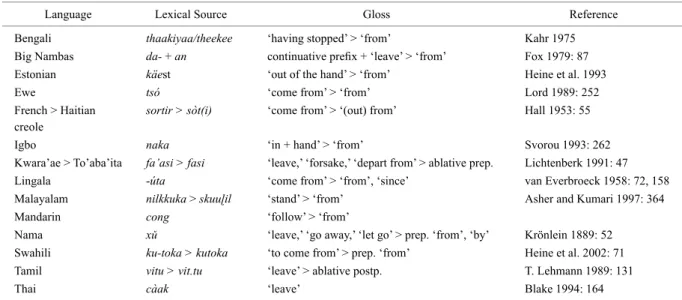
One question is where the spatial sense of from comes from? Historical documents on fromdo not pro- vide us with enough information concerning this. So let us examine the function words of other languages whose semantics are similar to from, and see if this kind of typological study would indeed help reveal the origin of semantics of from. The counterparts of the spatial sense of from are called ‘ablative’ here.
The lexical sources of the ablative are limited: for the most part they are verbal expressions meaning
‘come from’, ‘follow’, ‘leave’, and ‘stand’, but some are nominal expressions meaning ‘out of hand’ or ‘in the
hand of’. These lexical sources all share their semantic structure with the ablative sense shown in Table 1 and 2. While this conclusion is obvious for such lexical sources as ‘leave’, ‘come from’, or ‘out of hand’, some may need further explanation. In the case of the lexical source meaning ‘follow’, one aspect of this concept is that a (usually physical) entity moves aft er another, and this implies that the two together move fromone point to another. The lexical source meaning ‘stand’
implies that ‘one moves upwards from the sitt ing position’, which also involves the same semantic structure. Finally, regarding the lexical source mean- ing ‘in hand’, an entity moving into the hand come fromoutside of the hand, and this aspect of the mean- ing shares the semantic structure mentioned above.
Our discussion here leads us to a speculation that the origin of the spatial sense of from would be structured by the image schema in Fig. 1 and 2.
3.2. The temporal senses
The ‘spatial sense as basic’ assumption strongly sug- gests that the spatial sense should be the source of other ablative related sense, never vice versa. Certainly this is also true of the relation between the spatial sense and the temporal sense. This claim is also supported by typological studies. The most important sources of
‘temporal-from’ sense is ablative markers in the lan- guages of the world (see Hasplelmath 1997: 66–7).
As has been argued repeatedly (see, for example, Clark 1973; Haspelmath 1997; Jackendoff 1983; Lakoff
& Johnson 1980; Langacker 1987; Lyons 1977), how- ever, the spatial and temporal senses are intimately
Table 1. Lexical sources of the ablative
Language Lexical Source Gloss Reference
Bengali thaakiyaa/theekee ‘having stopped’ > ‘from’ Kahr 1975
Big Nambas da- + an continuative prefi x + ‘leave’ > ‘from’ Fox 1979: 87
Estonian käest ‘out of the hand’ > ‘from’ Heine et al. 1993
Ewe tsó ‘come from’ > ‘from’ Lord 1989: 252
French > Haitian creole
sortir > sòt(i) ‘come from’ > ‘(out) from’ Hall 1953: 55
Igbo naka ‘in + hand’ > ‘from’ Svorou 1993: 262
Kwara’ae > To’aba’ita fa’asi > fasi ‘leave,’ ‘forsake,’ ‘depart from’ > ablative prep. Lichtenberk 1991: 47
Lingala -úta ‘come from’ > ‘from’, ‘since’ van Everbroeck 1958: 72, 158
Malayalam nilkkuka>skuuɭil ‘stand’ > ‘from’ Asher and Kumari 1997: 364
Mandarin cong ‘follow’ > ‘from’
Nama xǔ ‘leave,’ ‘go away,’ ‘let go’ > prep. ‘from’, ‘by’ Krönlein 1889: 52 Swahili ku-toka > kutoka ‘to come from’ > prep. ‘from’ Heine et al. 2002: 71
Tamil vitu > vit.tu ‘leave’ > ablative postp. T. Lehmann 1989: 131
Thai càak ‘leave’ Blake 1994: 164
related and their boundary are not clear-cut in many cases. This is partly because these spatial and tempo- ral concepts co-occur in an inseparable fashion: when one gives an utt erance indicating one’s physical move- ment to some other place, this always implies the change of time to some other time.(3)
3.3. On Cause and Reason
Next, let us consider the cause/reason meanings of from.
(10) (a) John died from his excessive drinking.
(b) John died of alcoholism.
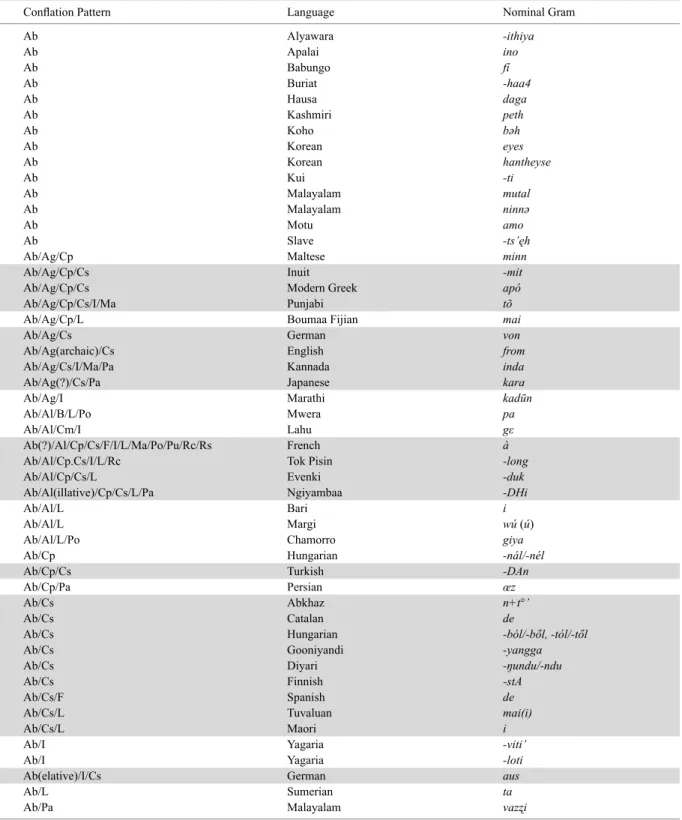
Table 2. Confl ation Patterns of the Ablative-Related Senses
(Ab=ablative; Ag=agentive; Al=allative; B=benefactive; Cm=comitative; Cp=comparative; Cs=causal; F=function; I=instrumental;
L=locative; Ma=manner; Pa=path; Po=possessive; Pu=purposive; Rc=recipient; Rs=resultative)
Confl ation Pattern Language Nominal Gram
Ab Alyawara -ithiya
Ab Apalai ino
Ab Babungo fí
Ab Buriat -haa4
Ab Hausa daga
Ab Kashmiri peth
Ab Koho bəh
Ab Korean eyes
Ab Korean hantheyse
Ab Kui -ti
Ab Malayalam mutal
Ab Malayalam ninnə
Ab Motu amo
Ab Slave -ts’ęh
Ab/Ag/Cp Maltese minn
Ab/Ag/Cp/Cs Inuit -mit
Ab/Ag/Cp/Cs Modern Greek apó
Ab/Ag/Cp/Cs/I/Ma Punjabi tõ
Ab/Ag/Cp/L Boumaa Fijian mai
Ab/Ag/Cs German von
Ab/Ag(archaic)/Cs English from
Ab/Ag/Cs/I/Ma/Pa Kannada inda
Ab/Ag(?)/Cs/Pa Japanese kara
Ab/Ag/I Marathi kadūn
Ab/Al/B/L/Po Mwera pa
Ab/Al/Cm/I Lahu gε
Ab(?)/Al/Cp/Cs/F/I/L/Ma/Po/Pu/Rc/Rs French à
Ab/Al/Cp.Cs/I/L/Rc Tok Pisin -long
Ab/Al/Cp/Cs/L Evenki -duk
Ab/Al(illative)/Cp/Cs/L/Pa Ngiyambaa -DHi
Ab/Al/L Bari i
Ab/Al/L Margi wú(ú)
Ab/Al/L/Po Chamorro giya
Ab/Cp Hungarian -nál/-nél
Ab/Cp/Cs Turkish -DAn
Ab/Cp/Pa Persian œz
Ab/Cs Abkhaz n+t°’
Ab/Cs Catalan de
Ab/Cs Hungarian -ból/-ből, -tól/-től
Ab/Cs Gooniyandi -yangga
Ab/Cs Diyari -ŋundu/-ndu
Ab/Cs Finnish -stA
Ab/Cs/F Spanish de
Ab/Cs/L Tuvaluan mai(i)
Ab/Cs/L Maori i
Ab/I Yagaria -viti’
Ab/I Yagaria -loti
Ab(elative)/I/Cs German aus
Ab/L Sumerian ta
Ab/Pa Malayalam vazʐzz i
For the above examples, Radden (1985) states thatfrom in (10a) is appropriate, for excessive drinking is not a disease which normally leads to death, while alcohol- ism is. He (1985: 189) argued on the causal meaning of from and of, that “with theff of-phrase, the cause of one’s ff death is immediately att ributable to a particular cate- gory, as expressed by a noun with thefrom-phrase, on the other hand, the cause of one’s death is only medi- ately att ributable to an action, a habit or a property, as syntactically expressed by a gerund or a descriptive modifi er”(sic). He concludes that these diff erent nuances are derived from their spatial senses, and the spatial sense of from implies the notion of distance. As we saw, we are very much in harmony with his analy- sis of the cause/reason meaning of from.
3.3.1. On cause and reason expressed by pre/post- positions of other languages
LT has shown that its fi ndings are true for a specifi c language; this is nothing surprising, as universal facts are naturally applicable to each individual language.
Therefore it seems plausible to assume that LT could reveal the semantic nature of from. The typological work by Yamaguchi (2004) shows the confl ation pat- terns of semantic roles displayed by the ablative- related pre/postpositions of other languages. The darkened parts are the confl ation patt erns with Cause.
The above confl ation patt erns of the ablative-related senses show that ablative meanings are closely related to cause/reasons meanings, although the ablative senses do not always evoke cause meanings. Based on this fact, our assumption is that the spatial sense and
cause/reason sense of from are conceptually located to each other very closely.
Another point indicated by Yamaguchi (2004) is that cause/reason meanings are expressed by more pre/
postpositions of languages than other senses (or se- mantic roles), as the following Table shows (Table 3).
One may indicate that spatial semantic roles, espe- cially Locative occur as frequently as Cause. But notice that spatial concepts are the basic ones, based on which abstract meanings are derived from. The above data imply that cause/reason meanings are expressed by several or many pre/postpositions of each individ- ual language, and indeed this is also true for English.
(11) (a) He laughedfor joy.
(b) She began to laugh atthese words.
(c) Taro complimented his son on his good grades.
(d) In her excitement, she was unable to speak.
(e) We were surprisedby his appearance.
(f) We trembled with fear.
(g) She was excited/crazyabout him.
(h) Tourists were killed through accidents.
(i) He died fromdrugs.
(j) He died of cancer.
4. Conclusions
This paper argued that CS and LT have a signifi cant potential for making contributions to acquisition of English prepositions by Japanese ELLs. Notice that our claims are very much in harmony with previous studies of semantics of English prepositions such as Dirven (1993, 1995), Lindstromberg (1997), and Radden (1985, 1989); our contribution to their discus- sion would be that we showed more explicitly how
‘remoteness’, one of the key concepts to explain the semantics of from for the above scholars, emerges.
This study just showed a potential of CS and LT for the second language acquisition, so experimental studies will be required for our future research to examine exactly how CS and LT help eff ective learning of English prepositions by Japanese ELLs.
Notes
(1) Rice (1996) found that the spatial relations were not necessarily the core usages for the other relations.
Her study showed the possibility that native speak- ers of English might recognize temporal relations and spatial relations diff erently, and neither of them Table 3. Frequency of occurrence of semantic roles expressed by
pre/postpositions of the languages sample in Yamaguchi (2004)
total 202 (the number of
pre/postpositions) (spatial meaningsp g )
Ablative 72
Allative 79
Locative 90
Path 30
(abstract meaningsg )
Agent 35
Benefactive 40
Cause 91
Comitative 50
Instrument 65
Manner 30
would not be the sources of each other.
(2) It was Radden who introduced ‘remoteness’ for the analysis of the semantics of from. For this, he ex- plains as follows: “Both in its spatial sense of ‘move- ment away from a point of origin’ and in its fi gura- tive sense of a ‘point of origin’… or ‘starting point’, from is in many ways the counterpart of to. Since a point of origin or a starting point is the remotest point from a goal, from implies the idea of remote- ness” (1989: 564). However it is unclear why the idea of remoteness would be implied if from is regarded as being the counterpart of to.
(3) See Note (1) for plausibility of separation between spatial and temporal senses.
References
Asher and Kumari 1997. Malayalam. London, New York:
Routledge.
Auwera, Johan van der and Jan Nuyts. 2007. Cognitive Linguistics and Linguistic Typology. InThe Oxford Handbook of Cognitive Linguistics. 1074–1091.
Bloomfi eld, Leonarld. 1933. Lanaguage. New York: Holt, Rinehart and Winston Inc.
Bybee, Joan and William pagliuca. 1994.The Evolution of Grammar: Tense, aspect, and modality in the language of the world. Chicago: University of Chicago Press.
Canon, Rev. and E. C. Gore. 1926. Zande grammar.
London: Sheldon Press.
Clark, Herbert H. 1973. Space, time, semantics, and the child. Moore, Timothy E. (ed.).Cognitive development and the acquisition of language, New York: Academic Press, 27–63.
Cho, Kanako. 2002. A cognitive linguistic approach to the acquisition of English prepositions. JACET Bulletin 35: 63–78.
Croft , William. 1990.Typology and universals. Cambridge:
Cambridge University Press.
—. 1991. Syntactic categories and grammatical relations:
The cognitive organization of information.Chicago: Uni- versity of Chicago Press.
Dahl, Östen. 2004. The Growth and Maintenance of Linguis- tic Complexity. Amsterdam: Benjamins.
Dirven, René. 1995. The construal of cause: The case of cause prepositions. In J. R. Taylor and R. E.
MacLaury (eds.), Language and Cognitive Constru- al of the World, 95–118. Berlin: Mouton de Gruyter.
Fox, G. J. 1979.Big Nambas grammar. (Pacifi c Linguistics, Series B, 60.) Canberra: Department of Linguistic Re- search School of Pacifi c Studies, Australian National University.
Hall, Robert A., Jr. 1953. Haitian Creole: Grammar, texts, vocabulary. American Anthropologist 55, 2, 2. Memoir 74.
Haspelmath, Martin. 1997. From Space to Time. LINCOM Europa: Germany.
Heine, Bernd, Ulrike Claudi, and Friederike Hünnemeyer.
1991. Grammaticalization: A conceptual framework.
Chicago and London: The University of Chicago Press.
Ikegami, Yoshihiko. 1987. ‘Source’ vs. ‘Goal’: a Case of Linguistic Dissymmetry. In Dirven, René and Günter Radden (eds.), Concepts of Case, 122–146. Tübingen:
Gunter Narr Verlag.
Jackendoff , Ray S. 1983. Semantics and cognition.Current Studies in Linguistics Series 8. Cambridge, Mass.:
The MIT Press.
Johnson, Mark. 1987.The Body in the Mind: The Bodily Basis of Meaning, Imagination, and Reason. Chicago: Univer- sity of Chicago Press.
Kotera, Shigeaki and Konobe Makiko. 2001. A Study of Usage on English Prepositions.Osaka Kyoiku Univer- sity’s Departmental Bulletin Paper vol. 50: 15–29.
Lakoff , George. 1987.Women, Fire and Dangerous Things:
What categories Reveal about the Mind.Chicago: Uni- versity of Chicago Press.
Lakoff George and Mark Johnson. 1980. Metaphors We Live By. Chicago: University of Chicago Press.
Langacker, Ronald. 1987. Foundations of cognitive grammar.
Lehmann, Thomas. 1989. A grammar of Modern Tamil.
Pondicherry: Pondicherry Institute of Linguistics and Culture.
Lindner, Susan. 1982. What goes up doesn’t necessarily come down: The ins and outs of oppositions. Papers from the Eighteenth Regional Meeting of the Chicago Lin- guistic Society, 305–23. Chicago: Chicago Linguistic Society.
Lindstromberg, Seth. 1998.English Prepositions Explained.
Amsterdam/Philadelphia. John Benjamins Publish- ing Company.
Lord, Carol. 1993.Historical change in serial verb construc- tions.Amsterdam: John Benjamins.
Lyons, John. 1977. Semantics vol. 1 & 2. Cambridge:
Cambridge University Press.
Margolis, Eric and Stephen Laurence. 1999. Concepts: core readings.Massachusett s: The MIT Press.
Todd, Oakley. 2007. Image Schemas. In The Oxford Hand- book of Cognitive Linguistics.ed. by Dirk Geeraerts and Hubert Cuyckens: 214–235.
Radden, Gunter. 1985. Spatial metaphors underlying prepositions of causality. Paprott é, Wolf, and René Dirven, eds. The ubiquity of metaphor, 177–207.
Amsterdam/Philadelphia: John Benjamins.
—. 1989. Figurative uses of prepositions. In René Dirven (ed.) A user’s grammar of English: Word, sentence, text, interaction. Frankfurt: Peter Lang, 551–576.
Rice, Sally. 1996. Prepositional prototypes. In M. Putz & R.
Dirven (eds.) The construal of space in language and thought. 135–165. Berlin/New York: Mouton de Gruyter.
Talmy, Leonard. 2000. Toward a Cognitive Semantics vol. 1 & 2. Cambridge, London: The MIT Press.
Tanaka, Shigenori. 1983.Language transfer as a constraint on lexico-semantic development in adults learning a sec- ond language in acquisition-poor environments. Doctoral
Dissertation. Teacher College, Columbia University.
Taylor, John R. 1989. Linguistic Categorization. Oxford:
Clarendon Press.
Traugott , Elizabeth C., and Bernd Heine (eds). 1991. Ap- proach to grammaticalization., vol.1 & 2. Amsterdam:
John Benjamins.
Traugott , Elizabeth Closs, and Ekkehard König. 1991. The semantics-pragmatics of grammaticalization revisit- ed. Approach to grammaticalization. vol.1, 189–218.eds.
Traugott and Heine. Amsterdam: Benjamins.
Van Everbroeck, R. 1958. Grammaire et exercises lingala.
Anvers-Leopoldville: Standaard-Boekhandel S.A.
Vyvyan Evans and Melanie Green. 2006. Cognitive Lin-
guistics: An introduction. Edinburgh: Edinburgh Uni- versity Press.
Yamaguchi, Kazuyuki. 2004.A Typological, Historical, and Functional Study of Adpositions in the Languages of the World. Doctoral dissertation, University of New Mexico.
〈連絡先〉
著者名:山口和之
住 所:東京都世田谷区深沢7-1-1 所 属:外国語研究室
E-mailアドレス:kazuyamaguchi@nitt ai.ac.jp