• 検索結果がありません。

Effect of Acute Paraquat Toxicity on Ascorbic Acid Levels of  Liver and Plasma in Mice

N/A
N/A
Protected

Academic year: 2021

シェア "Effect of Acute Paraquat Toxicity on Ascorbic Acid Levels of  Liver and Plasma in Mice"

Copied!
10
0
0

読み込み中.... (全文を見る)

全文

(1)

Effect of Acute Paraquat Toxicity on Ascorbic Acid Levels of  Liver and Plasma in Mice

Yoshimitsu K AWAI , Katsuhiro K UBOTA , and Hidehiko T ANAKA

( Received November  30 ,  2007

Abstract

The administration of paraquat (PQ) to mice (oral administration of  200  mg/kg body weight  and  intraperitoneal  injection  of  100   mg/kg  body  weight)  resulted  in  a  significant  increase  of  ascorbic acid (AsA) levels in the liver and plasma. The hepatic level of thiobarbituric acid reac- tive substances was significantly elevated after the treatment with PQ. We examined whether  the  metabolism  of  PQ  and  the  oxidative  stress  by  PQ  influence  the  biosynthesis  of  AsA  in  mice. The activities of AsA-synthesizing enzymes, uridine diphosphate glucuronosyltransferase,  β -glucuronidase  and  L-gulono- γ -lactone  oxidase,  were  measured  in  the  mouse  liver.  These  enzyme activities were not stimulated by the administration of PQ, presumably due to the hy- drophilic property of PQ. Reduced glutathione (GSH) level in the mouse liver was significantly  decreased by the administration of PQ. The depletion of GSH in hepatocyte causes an increased  AsA production via increased glycogenolysis. The increase of glucose concentration induced by  glycogenolysis was not observed in blood. These data suggest that neither the metabolism of  PQ nor the oxidative stress by PQ activate the AsA biosynthesis in mouse liver. It is likely that  AsA level increased by the acute toxicity of PQ may be dependent upon the reduction of dehy- droascorbic acid by GSH rather than de novo biosynthesis of AsA in mouse liver.

Department of Chemistry, Faculty of Science, Fukuoka University 8-19-1, Nanakuma, Jonan-ku, Fukuoka, 814-0180, Japan

Introduction

Reactive  oxygen  species  (ROS)  such  as  superoxide anion free radical (O

2-

) and hy- droxyl radical are responsible for the oxida- tive damages of proteins, lipids and nucleic  acids [1]. AsA is considered to be most ef- fective as a water-soluble antioxidant and  as  a  scavenger  of  ROS  and  free  radicals  in tissue and plasma [2]. It is important to  maintain  a  high  level  of  the  intracellular  concentration  of  AsA  because  a  cellular 

homeostasis  is  influenced  by  a  significant  decrease of AsA.

In the AsA-synthesizing animals, cellular 

AsA  level  is  maintained  by  the  biosyn-

thesis  of  AsA  from  D-glucose  through  the 

hepatic  D-glucuronic  acid  pathway.  Fur-

thermore,  following  mechanisms  are  also 

considered  to  maintaine  the  normal  AsA 

levels  in  tissues:  (1)  activation  of  D-gluc-

uronic acid pathway by xenobiotic agents, 

(2) reduction of dehydroascorbic acid (DHA) 

by glutathione-dependent reductase, (3) in-

(2)

by different GSH/GSSG (oxidized GSH).

Paraquat  (PQ),  1,1 ʼ -dimethyl-4,4 ʼ -bipyri- dylium  dichlorides,  is  a  widely  used  as  non-selective  herbicide  to  plants,  but  is  high toxic on mammals. It is generally con- sidered that the cytotoxicity of PQ results  from intracellular generation of ROS, since  PQ  radical  generated  from  the  reduction  of PQ by microsomal NADPH-cytochrome  P-450  reductase  induces  the  conversion  of  molecular  oxygen  to  O

2-

  and  other  free  radicals [3, 4]. It is shown that the survival  rate  of  mice  intoxicated  with  PQ  is  in- creased by the administration of AsA [5, 6].

It  has  been  shown  that  the  administra- tion  of  xenobiotic  agents  to  rats  activates  the hepatic biosynthesis of AsA [7], acceler- ates the turnover of AsA [8] and increases  in the accumulation of AsA in various tis- sues.

GSH  plays  an  important  role  in  the  enzymatic  or  non-enzymatic  protection  against ROS generated in tissues. GSH can  function  as  a  nucleophile  to  form  conju- gates with many xenobiotic agents and/or  their metabolites. It is kown that the ROS  production  induced  by  PQ  is  enhanced  upon  GSH  depletion,  probably  due  to  the  reduced  cellular  capability  to  remove  the  radical species [9].

It is considered that AsA and GSH con- centrations  in  cells  subjected  to  oxidative  stress  are  decreased  by  the  reactions  of  reductants  with  ROS.  However,  we  found  that  both  the  oral  administration  and  the  intraperitoneal  injection  of  PQ  increased  AsA levels of liver and plasma in mice. It  is the purpose of the present study to eluci- date whether the increase in AsA levels is  one of the antioxidant mechanisms and are  dependent on the activation of D-glucuron- ic acid pathway or the induction of glyco- genolysis by the decrease in the GSH level 

Materials and Methods Materials

Paraquat (1,1 ʼ -dimethyl-4,4 ʼ -bipyridinium  dichloride) and 1,1,3,3-tetra-ethoxypropane  were  obtained  from  Tokyo  Kasei  Kogyo  Co.  Ltd.,  (Tokyo,  Japan).    L-Gulono- γ - lactone was obtained from Nacalai Tesque,  Inc.  (Kyoto,  Japan).  Uridine  5 ʼ -diphospho- glucuronic acid, phenolphthalein glucuron- ic acid, and glucose oxidase were obtained  from  Sigma  Chemical  Co.  (St.  Louis,  MO,  USA).  p -Nitrophenol,  ascorbic  acid,  per- chloric acid,  α , αʼ -dipyridyl, 5-sulfosalicyl- ic  acid,  5,5 ʼ -dithiobis-(2-nitrobenzoic  acid)  and all other regents were purchased from  Wako Pure Chem. Ind., Ltd. (Osaka, Japan).

Animals and diet

Five  weeks-old  male  ddy  mice  (30g  -35g) were obtained from Kyudo Co. Ltd.,  (Kumamoto,  Japan).  Mice  were  housed  in  plastic cages with drinking water and diet  (CE-2,  Japan  Clea  Co.,  Osaka,  Japan)  ad libitum   at  room  temperature  (about  25 ℃ ). 

Mice were allowed to acclimate for at least  1 week.

Treatment for paraquat toxicity

The  mice  were  given  an  oral  adminis-

tration  (200  mg/kg  body  weight)  via  oral 

through the probe or an intraperitoneal in-

jection (100 mg/kg body weight) of 0.1 ml 

of  PQ  dissolved  in  saline.  Blood  samples 

were  obtained  from  the  back  great  vein 

with  heparinized  syringes  and  then  the 

mice  were  killed  by  deep  anesthetization 

using  diethyl  ether.  The  liver  was  thor-

oughly  perfused  in  situ  with  saline  and 

then  the  tissue  was  excised.  Plasma  and 

tissue samples were stored in liquid nitro-

gen until analyzed.

(3)

−   39   −

and Plasma in Mice

Y. Kawai et al.

Measurement of ascorbic acid

The  stored  plasma  was  added  to  9  vol- umes  of  ice-cold  2%  perchloric  acid.  The  liver  sample  was  homogenized  in  19  vol- umes of ice-cold 2% perchloric acid with a  Potter glass homogenizer. The homogenate  and  plasma  samples  were  centrifuged  at  1,600g for 15 min at 4 ℃ . The supernatant  of  liver  homogenate  was  diluted  20-fold  with 2% perchloric acid. The AsA levels in  liver  and  plasma  were  measured  with  the  high  performance  liquid  chromatography  as described previously [10].

Determination lipid peroxidation levels in liver

Lipid  peroxidation  level  in  mouse  liver  was measured according to the method of  Yagi  et al . [11].

Uridine diphosphate glucuronosyltransferase activity

Uridine  diphosphate  glucuronosyltrans- ferase  (UDPGT)  activity  in  mouse  liver  was measured as described by Illing  et al .  [12].  Liver  was  homogenized  with  9  vol- umes of ice-cold 50 mM Tris-HCl buffer (pH  7.4)  containing  0.25  M  sucrose  and  5  mM  EDTA. The homogenate was centrifuged at  2,500g for 10 min at 4 ℃ . The assay mixture  contained  the  supernatant  as  the  enzyme  sample, 66 mM Tris-HCl buffer (pH 7.4), 10  mM  MgCl

2

,  0.2  mM  p -nitrophenol,  2.7  mM  UDP glucuronic acid, 3 mM saccaro-1,4-lac- tone and 0.08% Triton X-100. The mixture  (0.6 ml) was incubated at 37 ℃  for 10 min  and then the reaction was stopped by the  addition  of  trichloroacetic  acid  (TCA)  to  0.125 M. After the precipitate was removed  by centrifugation, the supernatant (0.4 ml)  was mixed with 1.0 ml of 1 M NaOH. The  absorbance of  p -nitrophenol was measured  at 400 nm.

Assay of β -Glucuronidase activity

β -Glucuronidase activity in mouse liver  was  measured  as  described  Fishman  [13]. 

Liver  was  homogenized  with  ice-cold  0.1  M acetate buffer (pH 4.5) to 1%. The assay  mixture contained 0.1 M acetate buffer (pH  4.5),  0.5  mM  phenolphthalein  glucuronide  and enzyme sample (1% homogenate). The  mixture (1.0 ml) was incubated at 38 ℃  for  1 h and then the reaction was stopped by  heating  in  boiling  water  for  1  min.  The  mixture was mixed with 1.5 ml of distilled  water.  After  the  precipitate  was  removed  by centrifugation, the supernatant (2.0 ml)  was  mixed  with  2.5  ml  of  0.22  M  glycine  solution and 1.5 ml of distilled water. After  10 min, the absorbance of phenolphthalein  was measured at 540 nm.

Assay of L-gulono- γ -lactone oxidase activity L-Gulono- γ -lactone  oxidase  (GLO)  ac- tivity in mouse liver microsome was mea- sured  essentially  as  described  by  Horio  et al .  [14].  Liver  was  homogenized  with  9  volumes of ice-cold 50 mM Tris-HCl buffer  (pH 7.4) containing 0.25 M sucrose. The ho- mogenate was centrifuged at 20,000g for 20  min at 4 ℃ , and then the postmitchondrial  supernatant  was  centrifuged  at  100,000g  for 2 h at 4 ℃ . The microsomal pellets were  suspended in 1.15% KCl containing 10 mM  EDTA  (pH  7.4).  Microsomal  protein  was  determined by the method of Lowry  et al .  [15]. 

The  reaction  mixture  for  GLO  assay  contained 50 mM potassium phosphate buf- fer  (pH  7.0),  50  mM  sodium  citrate,  1  mM  dithiothreitol,  2.5  mM  L-gulono- γ -lactone  and  liver  microsome  as  enzyme  sample. 

The  mixture  (1.0  ml)  was  incubated  at  37 ℃  for 30 min and then the reaction was  stopped  by  the  addition  of  TCA  to  1%. 

After the precipitate was removed by cen-

trifugation,  the  amount  of  AsA  including 

(4)

the method of Zannoni  et al . using  α , αʼ

-dipyridyl [16].

Measurement of Sulfhydryl groups

Non-protein sulfhydryl content in mouse  liver was measured as described by Harris  [17]. Liver was homogenized in 5 volumes  of  6%  5-sulfosalicylic  acid.  The  homog- enate  was  centrifuged  at  1,600g  for  10  min  at  4 ℃   and  then  the  supernatant  was  filtered.  The  filtered  sample  was  diluted  with  5%  5-sulfosalicylic  acid.  The  sample  (0.2 ml) was mixed with 2 volumes of 0.5  M phosphate buffer (pH 6.8) and 0.15% 5,5 ʼ -dithiobis-(2-nitrobenzoic acid). After 5 min,  the absorbance of the reaction mixture was  measured at 412 nm. 

Glucose concentration in blood

The  glucose  concentration  in  mouse  blood  was  determined  according  to  the  method  of  Ikawa  and  Obara  [18].  Briefly,  the  plasma  sample  was  added  to  5  vol- umes  of  ice-cold  3.3%  perchloric  acid  and  then  the  precipitate  was  removed  by  cen- trifugation.  The  assay  mixture  contained  20%  methanol,  2  M  ammonium  acetate,  0.2%  acetylacetone,  1.2%  acetic  acid,  0.3% 

glucose  oxidase  and  deproteinized  plasma  sample was incubated at 37 ℃  for 1 h. After  the precipitate was removed by centrifuga- tion, the supernatant was measured the ab- sorbance at 410 nm.

Analytical and statistical methods

Data were expressed as means ± standard  error  (S.E.)  from  the  indicated  number  of  experiments. The data were analyzed using  analysis of variance followed by Student ʼt  test for independent pair comparisons.

Results

AsA level in mouse liver and plasma

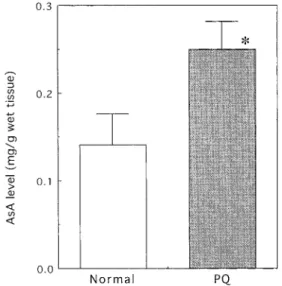
The hepatic levels of AsA in mice treated  with oral administration of PQ (200 mg/kg  body weight) are shown in Fig. 1. AsA lev- el was 1.75-fold higher than that of normal  group at 8 h after the administration.

In the case of intraperitoneal injection of  PQ  (100  mg/kg  body  weight),  AsA  levels  in  liver  and  plasma  were  significantly  in- creased at 6 hr after the injection (Fig. 2). 

AsA  levels  in  liver  were  1.1  and  1.2-fold  higher than that of normal group at 3 and  6  h  after  the  injection,  respectively  (Fig. 

2A). The plasma AsA levels were 1.7 and  3.8-fold higher than that of normal group at  3  and  6  h  after  the  injection,  respectively  (Fig. 2B).

Lipid peroxidation level in liver

Fig.  3  shows  the  effect  of  PQ  on  the  lipid peroxidation level in mice livers. The  concentrations  of  lipid  peroxide  were  ex-

Fig.  1 :   Ascorbic  acid  levels  in  mouse  liver  at  8  h after oral administration of PQ. 

Data  are  expressed  as  the  means ±  

S.E.  (n 5   each).  *p 0 . 05   compared 

with the normal group.

(5)

−   41   −

and Plasma in Mice

Y. Kawai et al.

pressed in terms of malondialdehyde (MDA)  using  1,1,3,3-tetraetoxypropane  as  a  stan- dard sample. Lipid peroxidation level was  significantly increased at 8 h after the oral  administration of 200 mg/kg.

Enzyme activities of L-ascorbic acid synthe- sizing pathway

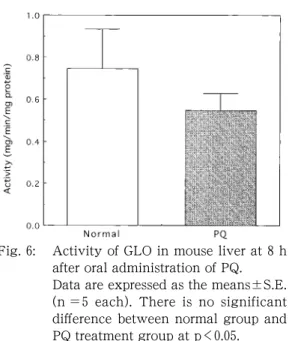
Figs. 4~6 shows the effect of PQ on the  enzyme  activities  of  AsA  synthesizing  pathway in mouse liver at 8 h after the oral  administration of 200 mg/kg PQ. Activities  of  UDPGT  (Fig.  4)  and  β -glucuronidase  (Fig. 5) were not affected by the PQ treat- ment  in  mice.  The  hepatic  GLO  activity  was slightly decreased at 8 h after PQ ad- ministration (Fig. 6). The difference of GLO  activity between the normal group and the  PQ treated group was not significant.

Hepatic GSH content

GSH level in normal mice livers was 3.07

± 0.28 mg/g liver wet weight (Fig. 7). GSH  content  in  livers  of  mice  treated  with  the  Fig.  2 :   Time course of ascorbic acid levels in mouse liver (A) and plasma (B) after 

intraperitoneal injection of PQ. 

  Data are expressed as the means ± S.E. (n = 5  each). *p < 0 . 05  compared  with the normal group.

Fig.  3 :   Increase of malondialdehyde level in  mouse liver at  8  h after oral adminis- tration of PQ. 

  Data  are  expressed  as  the  means ±  

S.E.  (n 5   each).  *p 0 . 05   compared 

with the normal group.

(6)

intraperitoneal  injection  of  100  mg/kg  PQ  was  significantly  decreased  to  2.21  mg/g  liver wet weight at 6 h. These results show  that  the  GSH  content  in  livers  of  mice  is  affected by PQ treatment under our experi- mental conditions.

Glucose concentration in blood

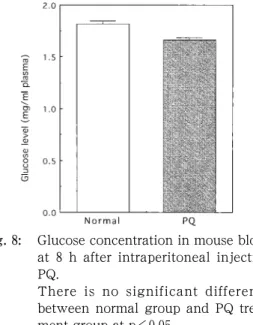
Glucose  concentration  in  mice  bloods  is  shown in Fig. 8. Although GSH content in  mouse  liver  was  decreased  by  the  intra- peritoneal injection of PQ (100 mg/kg body  weight), there was not a significant differ- ence  in  blood  glucose  concentration  com- pared to that of normal group. 

Fig.  4 :  Activity of UDPGT in mouse liver at  8  h after oral administration of PQ.

  Data are expressed as the means ± S.E. 

(n 5   each).  There  is  no  significant  difference between normal group and  PQ treatment group at p 0 . 05 .

Fig.  5 :   Activity of  β -glucuronidase in mouse  liver  at  8   h  after  oral  administration  of PQ.

  Data are expressed as the means ± S.E. 

(n 5   each).  There  is  no  significant  difference between normal group and  PQ treatment group at p 0 . 05 .

Fig.  6 :   Activity of GLO in mouse liver at  8  h  after oral administration of PQ.

  Data are expressed as the means ± S.E. 

(n 5   each).  There  is  no  significant  difference between normal group and  PQ treatment group at p 0 . 05 .

Fig.  7 :   Time course of GSH content in mouse  liver after intraperitoneal injection of  PQ.

  Data  are  expressed  as  the  means ±  

S.E. (n 5  each). 

p 0 . 05  compared 

with the normal group.

(7)

−   43   −

and Plasma in Mice

Y. Kawai et al.

Discussion

It has been described that under various  kinds of stress the requirement of AsA  in- creases to maintain the normal physiologi- cal  condition.  AsA  is  one  of  the  most  im- portant water-soluble antioxidant. The AsA  supplied  exogenously  is  presumably  used  to scavenge ROS and/or free radicals gen- erating  from  many  kinds  of  chemicals.  In  this experiment, PQ was chose as a genera- tor of oxidative stress because PQ is an in- tensive cytotoxic herbicide producing ROS  [3, 4]. We observed that AsA concentrations  in  mice  liver  and  plasma  were  increased  by both the oral administration and intra- peritoneal  injection  of  PQ  (Figs.1and  2). 

The present study is to elucidate whether a  mouse exposed to PQ initiates the synthe- sis of AsA as one of antioxidative mecha- nisms. 

It  was  reported  that  the  biosynthesis  of  AsA  was  stimulated  by  the  dietary  addition  of  xenobiotic  agents,  such  as  3-methylcholanthrene,  phenobarbital  and  polychlorinated  biphenyls  (PCB)  in  rats 

[7].  AsA  is  synthesized  from  D-glucose  in  the  liver  via  the  hexuronic  acid  pathway. 

To  elucidate  whether  the  administration  of  PQ  activates  the  enzymes  concerning  AsA synthesis, we measured the activities  of  UDPGT,  β -glucuronidase  and  GLO  in  mice. UDPGT is involved in the glucuronic  acid  pathway  and  belongs  to  a  family  of  enzymes  that  transfer  glucuronic  acid  to  variety of aglycones including endogenous  substrate and xenobiotic agents [19]. Horio  et al .  reported  that  the  hepatic  UDPGT  is  the  key  enzyme  in  the  biosynthesis  of  AsA  [8].  β -Glucuronidase  catalyzes  the  hydrolysis  of  glucuronide  formed  by  UD- PGT.  The  microsomal  β -glucuronidase  plays an important role in the hepatic AsA  biosynthesis  induced  by  xenobiotics  [20]. 

In  our  investigation  using  the  mouse  as  experimental  animal,  however,  UDPGT  and  β -glucuronidase  activities  in  mouse  liver were not affected at 8 h after the oral  administration  of  200  mg/kg  PQ  (Figs.  4  and  5).  Futhermore,  the  activity  of  GLO,  which  catalyzes  the  terminal  step  of  the  AsA  biosynthetic  pathway,  was  not  also  affected  by  the  administration  of  PQ  in  mouse  liver  (Fig.  6).  Horio  et al .  reported  that  the  activity  of  GLO  was  not  affected  with PCB feeding [20]. It has been consid- ered  that  since  an  appreciable  amount  of  AsA  is  present  in  the  microsomal  fraction  [21],  GLO  assay  are  prone  to  be  done  er- roneously when the activity is low [8]. Our  data  suggest  that  the  hepatic  activities  of  UDPGT,  β -glucuronidase and GLO are not  enhanced  in  mice  treated  with  the  acute  PQ intoxication.

As  PQ  is  a  hydrophilic  drug,  its  accu- mulation  in  various  tissues,  except  lung,  has  not  been  observed.    Although  PQ  is  not  a  fat-soluble  chemical,  Fuke  et al .  re- ported  that  PQ  was  metabolized  to  PQ- monopyridine in rat liver homogenate [22]. 

Fig.  8 :   Glucose concentration in mouse blood  at  8   h  after  intraperitoneal  injection  PQ.

  There  is  no  significant  difference 

between normal group and PQ treat-

ment group at p 0 . 05 .

(8)

of PQ absorbed into the body is excreted as  unmetabolized forms in the urine [22], the  no activities of AsA-synthesizing enzymes  is affected by PQ remaining in the mouse  liver.  From  the  result  of  our  experiments,  we concluded that the increased AsA con- centration of liver and plasma in mouse ad- ministrated PQ is not due to the activation  of the enzymes of drug metabolism. 

Under  conditions  of  oxidative  stress,  the  consumption  of  GSH  is  markedly  en- hanced.  In  the  antioxidant  defense  of  the  whole  organism,  a  major  role  of  the  liver  is to synthesize and export GSH. Bus  et al .  reported  that  PQ  significantly  decreased  GSH level in mouse liver [4]. The decrease  in  GSH  was  thought  to  result  from  the  increase  in  activity  of  GSH-peroxidase  or  the  reduction  of  PQ  radicals  by  GSH  [4]. 

The decrease of hepatic GSH level was ob- served after the administration of PQ (Fig. 

7).  It  was  suggested  that  the  decrease  of  the  GSH  level,  associated  with  an  oxida- tive  event,  stimulated  AsA  synthesis  [23,  24]. Braun  et al . demonstrated that various  agents,  which  depleted  GSH  in  hepato- cytes,  cause  an  increased  AsA  production  via  increased  glycogenolysis  [25].  GSH  depletion and/or GSH/GSSG influence gly- cogen  metabolism  directly  [26].  The  gly- cogen  breakdown  induces  the  increase  in  AsA level in plasma. The increase of AsA  level in mouse administrated PQ is specu- lated to result from glycogenolysis induced  by decrease in GSH. However, the glucose  level in mouse blood was not increased by  the administration of PQ (Fig. 8). Thus, it  seems  likely  that  no  glycogenolysis  may  occur in our experimental conditions. 

The reduction of DHA to AsA presents a  more economical process than its de novo  synthesis  in  species  able  to  produce  AsA. 

DHA  can  be  reduced  by  GSH-dependent 

[28].  Glutaredoxin  and  protein  disulfide  isomerase seem to be responsible for GSH- dependent  DHA  reductase  activity  [29]. 

Vethanayagam  et al .  reported  that  serum  albumin acts as an antioxidant and exerts  a  significant  GSH-dependent  DHA-reduc- tase activity that may be important in the  physiological recycling of AsA [30]. These  findings  show  that  there  are  many  kinds  of  DHA  reducing  system  depending  on  GSH.  It is considered that AsA synthesiz- ing species use AsA regenerating  salvage   systems in acute oxidative stress. The our  observation,  where  PQ  toxicity  in vivo   induces  the  enhancement  of  AsA  level,   shows that the mechanisms of the response  of  hole  body  to  the  oxidative  stress  may  differ from those of isolated murine hepato- cyte. 

Acknowledgement

This  work  was  supported  in  part  by  funds  (No.  :055001)  from  the  Central  Re- search Institute of Fukuoka University.

References

1 ) Halliwell  B.,  Gutteridge  J.  M.  C.,  Methods in Enzymology ,  186 ,  1 - 89  ( 1990 )

2 ) Frei B., England L., Ames B. N., Ascorbate  is  an  autostanding  antioxidant  in  human  blood plasma.  Proc Natl Acad Sci USA ,  86 ,  6377 - 6381  ( 1989 )

3 ) Bus J. S., Cagen S. Z., Olgaard M., Gibson  J. E., A mechanism for paraquat toxicity in  mice and rats.  Toxicol Appl Pharmacol ,  33 ,  461 - 470  ( 1976 )

4 ) Bus J. S., Gibson J. E., Paraquat: Model for  oxidant-initiated  toxicity.  Environ Health Perspec ,  55 ,  37 - 46  ( 1984 )

5 ) Minakata K., Suzuki O., Saito S., Harada N., 

Effects of vitamins and minerals on chron-

ic  paraquat  toxicity  in  rats.  Jpn J Forensic

(9)

−   45   −

and Plasma in Mice

Y. Kawai et al.

Toxicol ,  16 ,  215 - 220  ( 1989 )

6 ) Matkkovics B., Barabus K., In vivo study  of  the  mechanism  of  protective  effects  of  ascorbic  acid  and  reduced  glutathione  in  paraquat  poisoning.  Gen Pharmacol ,  11 ,  455 - 461  ( 1980 )

7 ) Horio F., Yoshida A., Effects of some xe- nobiotics  on  ascorbic  acid  metabolism  in  rats.  J Nutr ,  112 ,  416 - 425  ( 1982 )

8 ) Horio F., Kimura M., Yoshida A., Effect of  several xenobiotics on the activities of en- zymes affecting ascorbic acid synthesis in  rats.  J Nutr Sci Vitaminol ,  29 ,  233 - 247  ( 1983 ) 9 ) Melchiorri  D.,  Reiter  R.  J.,  Sewerynek  E., 

Hara M., Chen L., Nistico G., Paraquat tox- icity and oxidative damage.  Biochem Phar- macol ,  51 ,  1095 - 1099  ( 1996 )

10 ) Kimoto E., Tanaka H., Ohmoto T., Choami  M., Analysis of the transformation products  of  dehydro-L-ascorbic  acid  by  ion-pairing  high-performance  liquid  chromatography. 

Anal Biochem ,  214 ,  38 - 44  ( 1993 )

11 ) Ohkawa H., Ohishi N., Yagi K., Assay for  lipid  peroxides  in  animal  tissues  by  thio- barbituric acid reaction.  Anal Biochem ,  95 ,  351 - 358  ( 1979 )

12 Paul H., Illing A., Benford D., Observations  on the accessibility of acceptor substrate to  the active center of UDP-glucuronyltrans- ferase.  Biochim Biophys Acta ,  429 ,  768 - 779   ( 1976 )

13 ) Fishman W.H.,  β -Glucuronidase,  Meth- ods of Enzymatic Analysis   2 nd  Ed.  Ed  by  Bergmeyer H. U., Academic Press ( 1974 ) 14 Horio F., Shibata T., Naito Y., Nishikimi M., 

Yoshida A., L-Gulono- γ -lactone oxidase is  not induced in rats by xenobiotics stimu- lating L-ascorbic acid biosynthesis.  J Nutr Sci Vitaminol ,  39 ,  1 - 9  ( 1993 )

15 ) Lowry O. H., Rosebrough N. J., Farr A. L.,  Randall  R.  J.,  Protein  measurement  with  the folin phenol reagent.  J Biol Chem ,  193 ,  265 - 275  ( 1951 )

16 Zannoni  V.,  Lynch  M.,  Goldstein  S.,  Sato  P., A rapid micromethod for the determina- tion of ascorbic acid in plasma and tissues. 

Biochem Med ,  11 ,  41 - 48  ( 1974 )

17 ) Harris J. W., Non-proteinsulfhydryl content  of  Ehrlich  ascites  tumor  cell  exposed  to  hyperbaric  oxygen  of  x-irradiation.  Exp Cell Res ,  50 ,  293 - 305  ( 1968 )

18 ) Ikawa  S.,  Obara  T.,  Rinshou Byouri ,  13 ,  197 - 200  ( 1965 ) (in Japanese)

19 ) Horio F., Shibata T., Makino S., Machino S.,  Hayashi  Y.,  Hattori  T.,  Yoshida  A.,  UDP  Glucuronosyltransferase  gene  expression  is  involved  in  the  stimulation  of  ascorbic  acid biosynthesis by xenobiotics in rats.  J Nutr ,  123 ,  2075 - 2084  ( 1993 )

20 Horio F., Horie T., The role of microsomal  β -glucuronidase  in  ascorbic  acid  biosyn- thesis  stimulated  by  xenobiotics  in  rats. 

Biosci Biotech Biochem ,  61 ,  1109 - 1112  ( 1997 ) 21 ) Sato  P.  H.,  Zannoni  V.  G.,  Ascorbic  acid 

and hepatic drug metabolism.  J Pharmacol Exp Ther ,  198 ,  295 - 307  ( 1976 )

22 ) Fuke  C.,  Ameno  K.,  Ameno  S.,  Kinoshita  H.,  Ijiri  I.,  Detection  of  two  metabolites  of  diquat  in  urine  and  serum  of  poisoned  patients after ingestion of a combined her- bicide of paraquat and diquat.  Arch Toxicol ,  70 ,  504 - 507  ( 1996 )

23 Banhegyi G., Csala M., Braun L., Garzo T.,  Mandl  J.,  Ascorbate  synthesis-dependent  glutathione  consumption  in  mouse  liver. 

FEBS Lett ,  381 ,  39 - 41  ( 1996 )

24 ) Martensson  J.,  Meister  A.,  Glutathione  deficiency  increases  hepatic  ascorbic  acid  synthesis in adult mice.  Proc Natl Acad Sci USA ,  89 ,  11566 - 11568  ( 1992 )

25 Braun  L.,  Csala  M.,  Poussu  A.,  Garzo  T.,  Mandl J., Banhegyi G., Glutathione deple- tion  induces  glycogenolysis  dependent  ascorbate synthesis in isolated murine he- patocytes.  FEBS Lett .  388 ,  173 - 176  ( 1996 ) 26 ) Benhegyi G., Braun L., Csala M., Puskas F., 

Somogyi  A.,  Kardon  T.,  Mandl  J.,  Ascor- bate  and  environmental  stress.  Ann N Y Acad Sci ,  851 ,  292 - 303  ( 1998 )

27 Maellaro  E.,  Del  B.  B.,  Sugherini  L.,  San-

tucci A., Comporti M., Casini A. F., Purifi-

cation and characterization of glutathione-

(10)

from rat liver.  Biochem J ,  301 ,  471 - 476  ( 1994 ) 28 ) Winkler B.S., In vitro oxidation of ascorbic 

acid  and  its  prevention  by  GSH.  Biochim Biophys Acta ,  925 ,  258 - 264  ( 1987 )

29 Wells  W.  W.,  Xu  D.P.,  Yang  Y.,  Rocque  P.  A.,  Mammalian  thioltransferase  (glu- taredoxin) and protein disulfide isomerase 

J Biol Chem ,  265 ,  15361 - 1536  ( 1990 )

30 ) Vethanayagam J. G. G., Green E. H., Rose 

R.  C.,  Bode  A.  M.,  Glutathione-dependent 

ascorbate  recycling  activity  of  rat  serum 

albumin.  Free Rad Biol Med ,  26 ,  1591 - 1598  

( 1999 )

Fig.  3  shows  the  effect  of  PQ  on  the  lipid peroxidation level in mice livers. The  concentrations  of  lipid  peroxide  were 
Fig.  3 :   Increase of malondialdehyde level in  mouse liver at  8   h after oral adminis-tration of PQ. 
Fig.  6 :   Activity of GLO in mouse liver at  8  h  after oral administration of PQ.
Fig.  8 :   Glucose concentration in mouse blood  at  8   h  after  intraperitoneal  injection  PQ.

参照

関連したドキュメント

熱力学計算によれば、この地下水中において安定なのは FeSe 2 (cr)で、Se 濃度はこの固相の 溶解度である 10 -9 ~10 -8 mol dm

Insulin and glucagon levels in living related liver transplantation : Their interaction with the recovery of graft liver function(.

The mGoI framework provides token machine semantics of effectful computations, namely computations with algebraic effects, in which effectful λ-terms are translated to transducers..

An example of a database state in the lextensive category of finite sets, for the EA sketch of our school data specification is provided by any database which models the

A NOTE ON SUMS OF POWERS WHICH HAVE A FIXED NUMBER OF PRIME FACTORS.. RAFAEL JAKIMCZUK D EPARTMENT OF

A lemma of considerable generality is proved from which one can obtain inequali- ties of Popoviciu’s type involving norms in a Banach space and Gram determinants.. Key words

de la CAL, Using stochastic processes for studying Bernstein-type operators, Proceedings of the Second International Conference in Functional Analysis and Approximation The-

[3] JI-CHANG KUANG, Applied Inequalities, 2nd edition, Hunan Education Press, Changsha, China, 1993J. FINK, Classical and New Inequalities in Analysis, Kluwer Academic