5
Activities on Social Acceptance of Nanotechnology
MASAHIRO TAKEMURA
Affiliated Fellow
1 Introduction
Since the beginning of the 21st century, it has been expected that nanotechnology as an emerging technology would bring huge benefits to society.
Since beginning in the United States, Europe and Japan, nanotechnology has been designated as a prioritized area in the national science and technology policies of many countries. At the same time, the potential health and environmental risks of nanotechnology or societal implications of nanotechnology are also concerned. In all these countries, the acceptance of nanotechnology is also an important issue in their national programs.
The societal implications of nanotechnology can be generally divided into two types: EHS, environmental, health and safety issues, and ELSI, ethical, legal and societal issues (in the themes of ethical, legal and societal issues, “societal” has the narrower meaning here compared with societal implications). At present, the most important topic related to environment, health and safety is the health and environmental risk assessment and management of nanomaterials. Regarding ethical, legal and societal issues, activities are in the phase of specifying issues and organizing them through activities such as technology assessment and citizens’ panels coordinated mainly by social scientists.
In the current activities on the social acceptance of nanotechnology, not by any means should it be assumed that nanotechnology could not be accepted by society. There have never been apparent nanotechnology risks pointed out, either. To begin with, most of the expected nanotechnology is still in the research and development stage.
Consequently in the activities for the social
acceptance of nanotechnology for future society, the benefits are large and the risks are small, and in turn the concerns about of the risks should be adequately controlled. Therefore, those related to nanotechnology all mutually understand that risk should not be treated unilaterally. In reality, there are many facets of risk to be discussed, but still current new technology development can scarcely see them all, so an attitude of cooperation is recognized both by the strong interest of the research and development side and the risk assessment management side.
In addition, in the case of the words “social acceptance” in relation to science and technology, they include the meaning “society can adequately accept” the “value”, or merely referred to as the case of the “situation” of “how the public can accept it”. As for the prior example, the 2005 Special Coordination Funds for Promoting Science and Technology "Research Project on Facilitation of Public Acceptance of Nanotechnology” is notable and taken up in this article as well. However as for the latter case it is by no means few. In particular within the words
“social acceptance” and “public acceptance”, the latter words are the most often applicable so they should be given sufficient consideration.
There is a precedent of the awareness of nanotechnology risk in the backdrop of genetically modified organisms. Despite the fact that the research and development was a success and no risk whatsoever was ever confirmed, the world market did not accept it due to the great misgivings over the image of genetic modification. This precedent was a big lesson for developed nations of the United States and Europe, so within the United States the activities for the acceptance of nanotechnology began in 2000, with Europe soon
following after.
On the other hand, in the case of Japan, the precedent of genetically modified organisms had little impact on nanotechnology, and until the June 2004 “1st International Dialogue on Responsible Research and Development of Nanotechnology”, taking place in the suburbs of Washington, D.C., no broad debate had ever occurred in Japan. However it is not the case that there was total indifference.
For example the trend in Europe and the United States was to investigate when the situation called for. To that effect, after the National Institute of Advanced Industrial Science and Technology (IAI) sponsored forum “Nanotechnology and Society”was held, after a relatively short term a nanomaterial risk assessment research project got up and running.
This article will describe discussion on the societal implications of nanotechnology including mainly the health and environmental risks of nanomaterials and activities of the USA, Europe and Japan and international cooperation on its social acceptance. Finally, select points that Japan will have to tackle in the future will be discussed.
The discussion on societal implications of nanotechnology
2-1 The closest most important point: health and risk assessment and management of nanomaterials
Nanomaterials are generally defined as industrially-produced materials in factories (and laboratories) of particles, fibers and membranes in dimensions (grain size, cross - section diameter, membrane thickness, etc.) that are smaller than 100 nm.[1] In many cases particles are called industrial- use nano particles, but in the case of discussing risk assessment, you can say it is essentially the same as nanomaterials. Still “material” and “industrial- use”, unlike the “unintentional” creation of diesel exhaust particles, created nano particles tend to differ.
At this point in time the risk of nanomaterials is latent, but considering examples like asbestos particles and diesel exhaust particles, it is taken very seriously. Nanomaterials are known to have
2
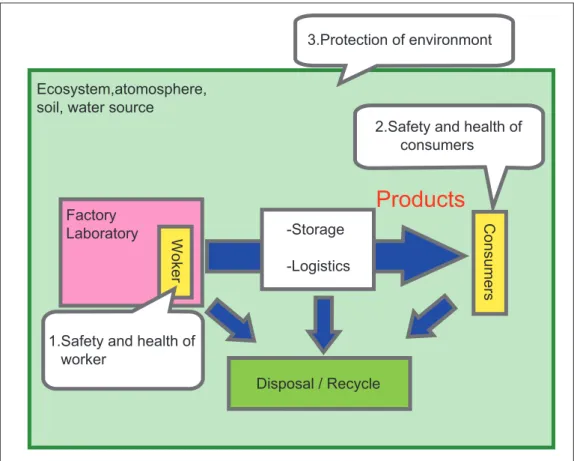
Figure 1 : Objects in risk assessment management of nano materials
Prepared by the STFC based on Reference[2]
3.Protection of environmont
Ecosystem,atomosphere, soil, water source
Factory
Laboratory Woker Consumers
Disposal / Recycle 1.Safety and health of
worker
-Storage -Logistics
2.Safety and health of consumers
Products
the same chemical formula as other bulk materials, but due to it having different characteristics, it is thought to exert more of impacts on health and the environment. The main reason for that is if you compare the same weight of bulk material and nanomaterial, the numbers and surface area differences appear enormous. Concerning nanomaterial, that characteristic is exposed and foreign material adsorption can easily occur, so its impacts on the health and environment has a high probability of appearing. In addition to this, the probability of the characteristic of nanomaterials mutating is also indicated.
The three subjects that are exposed to nanomaterial are workers (including researchers), consumers and the environment (Figure 1).[2]At this point in time the quantities of nanomaterials are relatively low, and you could say the areas where nanomaterials can float into the air are only limited to factories and laboratories. Therefore the ones who have the highest possibility of exposure are workers. Truly, the projects currently being undertaken are all focused on the safety and the health of their workers. In contrast to this for consumers, the origin of risk is from medicines, cosmetics, and foodstuffs that incorporate nanomaterial. For the environment, the origin of risk is from environmental remediation agents, fertilizers and waste material that incorporate nanomaterials. In relation to consumers especially, cosmetics and sunscreens that incorporate nanomaterial are just beginning to attract the attention of assessment management. On the other hand, in relation to the environment, because the quantity of produced nanomaterial is still so small, the degree of priority for an impact assessment appears low.
Nanomaterial can cause harm to organisms, or in other words is hazardous, so for the most part it should be examined as follows: [3]
- Impacts on immune response - Carcinogenicity
- Impacts on the nervous system - Impacts on the digestive system - Impacts on reproductive function
In the case of hazard assessment, metabolism and disposition, namely it is extremely important to grasp through what route nanomaterial arrives into an organism, and if it will remain there or break
down, and finally if it can be removed from the organism. For example in the case of a worker’s environment, as for the first phase of nanomaterial being taken into the body, examine whether it was inhaled or through dermal contact. In the case of inhalation, the possibility of accumulation from the trachea to the lungs, moreover the possibility of the material entering various organs via blood vessels, the possibility of transferring to lymph nodes, the possibility of transferring to the circulatory system from the digestive system, the possibility of transferring from olfactory bulb to the nervous system, and others have all been pointed out. On the other hand, in the case of dermal contact, the possibility of penetration into the body through stratum corneum is pointed out. While grasping metabolism and disposition, it is essential to investigate the impacts of nanomaterials will have on the effected organ. Truly it cannot be said that to experiment in artificially administering nanomaterials to an uninfected region is proper.
Conversely, even if nanomaterials have infected an area, there are cases where no harmful effects have appeared. It is wrong to jump to a conclusion that just because it exists it is evil.
As for the management of nanomaterials are concerned, it is a basic recognition that each country tries to manage it the same as a chemical substances, not as a hazard but as a risk. Quantified risk is a material’s inherent hazard multiplied by its exposure (likelihood to be exposed), or simply risk=hazard x exposure. In other words, it is a way of thinking that even if the case of the hazard is high, if you manage to decrease the chance of exposure then the risk can also be reduced.
For regulations and guidelines based on risk management to happen, risk assessment research towards those regulations and guidelines being drawn up have to gather together the necessary knowledge.
For risk management to properly occur, risk needs a quantitative evaluation. Therefore hazard and exposure also need a quantitative evaluation.
According to either, the value method is still not established for nanomaterials, and under the current situation that establishment and the accumulation of data are occurring parallel to each other. The hazard of nanomaterials and the value method for exposure are both representatives of necessary
technological issues that are brought up below in parts (1) to (4).
(1) Establishment of standard test materials The establishment of standard test material has been ranked as an urgent task for the past several years. The way things stand, the discrepancies between nanomaterials impurities, surface conditions and other properties and conditions are many, and even each batch from the same nanomaterial manufucturer has different properties and conditions. Based on the present advancement of the manufacturing process, for example a typical nanomaterial like carbon nanotubes and such, it could be said that if the composition method is the same then the properties and conditions discrepancies would be sufficiently small when an impact assessment to organisms is conducted.
However if the composition method differs, even if the chemical formula is identical the differences between the properties and conditions will be great. Therefore, if you use those materials for the purpose of testing the impact assessment to organisms, even if you intend to use identical material it is not uncommon for reciprocal conclusions to be shown.
Still most of the research that has taken place has a tendency to show that nano particles as small and as heavy as a grain are big hazards. The aspect ratio of asbestos is a precedent that carries great weight. However a way to consolidate the dose-response relationship with numbers, surface area and other factors into geometric factors has still not been sufficiently grasped. There is also ample possibility that according to the assessment categories the base control factors will differ.
Therefore in manufacturing standard test materials one condition should be that the form of the control limits be large. Based on what is written above, it is necessary that the selection of standard test material and the development of manufacturing technology occur.
(2) Establishment of methods to dosage to organisms
In the workers environment, the case of the taking in of nanomaterials into the body through the respiration system is taken seriously the most.
In the case of animal testing, a full body exposure
test, or in other words, circulating air that contains nanomaterials inside a chamber, then placing an animal inside is a dosage method that is very close to the true environment. This experiment is the latest technique required for the aerial dispersion of nanomaterial. Because there is no standardization of equipment for this experiment, it is expected that the experiment’s results would have discrepancies. On the other hand, a more simplified and widespread dosage method exists where the nanomaterial is dispersed in water then injected into the test animal’s respiratory tract. In this capacity the progression of the technique to disperse nanomaterial in water is produced. To control the clumping of nanomaterial dispersal agents (surface-active agents) are often used, but it has been pointed out that the dispersal agents themselves possibly exert some harm.
Another route that should be examined is through the skin, and this is assessed by means of an application experiment. It was reported that nanomaterial does not penetrate stratum corneum, but this was the conclusion of a limited conditioned test. After that, the necessity of a long-term test where scratched skin and others are used was pointed out. It is also possible that it can enter through the pores. Moreover it is possible to be taken in through the digestive system, but at the moment it is thought the possibility of that as compared to through the respiratory system and the skin is low. However it is a facet that sufficient corroborating data has not been obtained.
(3) Establishment of a metabolism and disposition analytical method
In the case of nanomaterial being taken in through the respiratory system, it is comparatively easy to track the accumulated nanomaterial in the trachea and pulmonary membrane. However in the case where the material transfers to the bloodstream, the effect on metabolism and disposition, moreover in the end can the material be excreted or remains inside is very important to grasp yet very difficult to discover. In the capacity of internal metabolism and disposition analytical methods, the development of highly sensitive analytical methods and markers that cause no biological reactions are expected. Also the possibility of entering via lymph nodes and nerve axons has been pointed out, so
methods to examine those need to be established.
(4) Measuring exposure
What process does some amount of nanomaterial undergo when it enters the body? To create exposure scenarios, it is essential to measure nano particles in the working environment. Nanomaterial easily clumps together in a micron order. However you cannot assert that the probable existence of micron-sized particles is zero. Moreover as the production amount increases the uses of nanomaterial expand. From storage to delivery to usage to disposal, it becomes necessary to examine exposure through the entire lifecycle. It becomes a topic of metabolism and disposition analytical method research in the atmosphere, rivers, land and such.
At this time the accumulation of scientific data for the risk assessment of nanomaterials are still not sufficient. It can be said that the amount of produced nanomaterials are less compared to the amount of chemical substances used in the past, and until controls and guidelines are established the amount of nanomaterials produced will increase.
Against this the best realistic health and safety steps have to be thought about, or in other words, the enforcement of the best practice should be
sought.
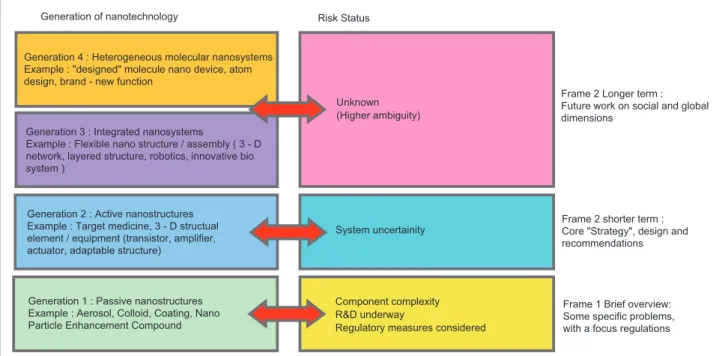
2-2 Nanotechnology’s future latent risks From when the National Nanotechnology Initiative (NNI) began in the USA in 2000, the National Science Foundation has continued to take the leading role in not only in connection to research and development but the social impact of nanotechnology as well. The NSF’s Dr. Roco has indicated that nanotechnology can be divided into four generations, and each generation has had a special characteristic. Moreover Mr. Roco has with the cooperation of the International Risk Governance Council (IRGC) written The White Paper on Nanotechnology Risk Governance, which discusses each nanotechnology generation’s latent risk and arranged a graph of those circumstances (Figure 2). [4] Each generation’s special characteristic is as follows:
(1) First Generation: Passive nanostructures (Has entered into the practical use stage in 2000)
N a n o s t r u c t u r e s o f n a n o m a t e r i a l h a d comparatively simple forms, like aerosols, colloids, coatings, nanoparticle strengthening compounds and others. It was developed to disperse in gaseous, liquid and solid states.
Figure 2: Current status of nanotechnology generation and its risk
Prepared by the STFC based on Reference[4]
Generation 4 : Heterogeneous molecular nanosystems Example : "designed" molecule nano device, atom design, brand - new function
Generation 3 : Integrated nanosystems
Example : Flexible nano structure / assembly ( 3 - D network, layered structure, robotics, innovative bio system )
Generation 2 : Active nanostructures Example : Target medicine, 3 - D structual element / equipment (transistor, amplifier, actuator, adaptable structure)
Generation 1 : Passive nanostructures Example : Aerosol, Colloid, Coating, Nano Particle Enhancement Compound
Unknown (Higher ambiguity)
System uncertainity
Component complexity R&D underway
Regulatory measures considered
Generation of nanotechnology Risk Status
Frame 1 Brief overview:
Some specific problems, with a focus regulations Frame 2 shorter term : Core "Strategy", design and recommendations Frame 2 Longer term : Future work on social and global dimensions
(2) Second Generation: Active nanostructures (Has been seen to enter into the practical use stage from about 2005)
From nano DDS (Drug Delivery System), biodevice, 3-D construction device, NEMS (Nano-Electro-Mechanical-System) and others, nano construction’s physical and chemical special characteristics when compared to the first generation are remarkable in their complexity.
Moreover within the control limits the function s ometimes mutates moment by moment (presently a lot of the research and development being promoted has been seen to fall under this characteristic). Also in the electronics field CMOS (Complementary Metal Oxide Semiconductor) has reached its performance limitations, so the time to switch to carbon nano tube semiconductors is being considered for post CMOS (but base electric charge remains intact). This kind of switch is expected to be a big contribution to nanotechnology.
(3) Third Generation: Integrated nanosystems (expected practical use to begin from 2010) Nanostrures will continue to expand the 3-D systemization and achieve some functional ability.
Also it is thought in the electronics field of base electric charge that the advent of electron spin and nuclear spin utilization will occur.
(4) Fourth Generation: Hetelrogeneous
molecular nanosystem (expected practical use to begin from 2015-2020)
From the molecular level nano construction systems will be drawn up and produced. An interface between man and machine, for example artificial sensory organs and nerves with an advanced hook up are still functions that are anticipated.
In relation to Dr. Roco’s and other scientists’
nanotechnology risk and assessment management, there is large disparity between the first and second generations, as classified with the first generation’
s response in frame 1 and the second generation’
s response in frame 2. The first generation risk includes the unavoidable introduction of nanomaterial’s risk into organisms and the environment. From here whatever the latent risks were, for the most part they were under control.
Moreover although the assessment management system and the handling of nanoscale went hand in hand with technical themes, its creation was based on existing chemical agent assessment management systems. However from the second generation the discussion on risk assessment management had only just begun.
For example, the point of the second generation case of nanomaterial being actively introduced into an organism or the environment differs greatly from the first generation.
Table 1 : Amount of investment to environment, health, and safety (EHS) by NNI
Prepared by the STFC based on Reference[7]
NSF DOD DOE NIH NIST EPA CSREES NIOSH TOTAL
FY2006 Actual
achievement 21.0 1.0 0.5 5.2 2.4 3.7 0.1 3.8 37.7
FY2007
Estimate 25.7 1.0 0.0 4.6 1.8 8.0 0.1 4.6 45.8
FY2008
Requirement 28.8 1.0 3.0 5.7 5.8 9.6 0.1 4.6 58.6
EHS Total NNI Total EHS / NNI FY2006
Actual
achievement 37.7 1351.2 2.8%
FY2007
Estimate 45.8 1392.1 3.3%
FY2008
Requirement 58.6 1444.8 4.1%
NSF : National Science Foundation DOD : Department of Defense DOE : Department of Energy NIH : National Institute of Health
NIST : National Institute on Standard & Technology EPA : Environmental Protection Agence
CSREES : Cooperative State Research, Education, and Extension Service (USDA)
NIOSH : National Institute of Occupational Safety & Health
2-3 Nanotechnology’s ethical, legal and societal Issues
Regarding nanotechnology’s ethical, legal and societal issues, technology assessment, citizen panels and others have been implemented based on the advice from social humanities scientists and such. However there are still no concrete issues that have been sufficiently selected and arranged.
As for the main reasons why, (1) Can’t get a feel for it because there are so many nanotechnologies and research and development phases that should be focused on, (2) It is interdisciplinary and too wide-ranged, (3) When it is practically implemented parts of existing industry products and technology are brought in, so the inherent effects of nanotechnology are hard to see, have been brought up. Many positions are being discussed within the coordinators of research and development, and steps are being taken to select and regulate issues.
International cooperation and the activities on social acceptance of nanotechnology in Japan, the United States and Europe
The struggle for the social acceptance of nanotechnology has progressed the furthest in the United States, with Europe and Japan following soon after. Below, the current situation of each country’s representative effort and international cooperation is explained.
3-1 The United States
Important topics such as societal, ethical and legal provisions have been raised ever since the United States government started the National Nanotechnology Initiative (NNI).[5]
The conventional response was as usual to put
existing government organizations in charge, as basically shown in Table 2.[6] Also supporting university research centers are the National Science Foundation (NSF), the Department of Energy (DOE), and the Department of Defense (DOD).
The amounts invested in the environment, health and safety (EHS) and the entire NNI percentages accounted for are shown in Table 1.[7]
As far as the fields related to nanotechnology’s connection to the environment, health and safety, the efforts of the Environmental Protection Agency (EPA) and the National Institute for Occupational Safety and Health (NIOSH) have been active from the beginning. The EPA has existing codes for nanomaterial risk that are related to comprehensive chemical agent management, for example the progress based on the Toxic Substance Control Act (TSCA) has been demonstrated, as stated in the December 2005 white paper on nanotechnology.[8]
Also the EPA has through private corporations and NGOs supported nanomaterial safety-risk assessment management programs, and university health and environment impact research with public finance support.
On the other hand, the NIOSH is not a regulatory institution but rather a research institution whose mission is to collect all the necessary information for the creation of a safe working environment.
Since the creation of nanotechnology they have designated a schedule for the solutions of ten important themes related to labor safety and health.[9] In reality they are focusing on carbon nano tubes and the comprehensive research of nano particles from their creation to their method of collection.
Besides individual institutional programs, there is also cooperation between various ministry and agency programs like the National Toxicology Program (NTP) and the Interagency Working
3
Working environment Occupational Safety & Health Administration: OSHA National Institute of Occupational Safety & Health: NIOSH Medicine Food & Drug Administration: FDA
Food US Department of Agriculture: USDA Consumable Consumer Product Safety Commission: CPSC Environment Environmental Protection Agency: EPA
Standards National Institute of Standard & Technology: NIST
Table 2: U.S.government organization concerning health and environmental impact of nanotechnology
Prepared by the STFC based on Reference[6]
Group on Nanotechnology Environmental and Health Implications (NEHI). The goal of the NTP is to assess the risks of carbon nano tubes, quantum dots and titanium dioxide, while the goal of the NEHI is to assess the current regulations regarding the industrialization of nanotechnology and if the extension of those applicable regulations are adequate or not.
Apart from public institutions, the Woodrow Wilson International Center for Scholars (WWICS) and the International Council on Nanotechnology (ICON) are actively making efforts. The WWICS is creating a public research database related to nanotechnology issues connected to the environment, health and safety.[10] On the other hand ICON, taking its lead from Rice University’
s Center for Biological and Environmental Nanotechnology (CBEN), is an international organization composed of industry, government and academia.[11] Their mission is to take up nanotechnolgy issues related to the environment, health and safety within the spirit of international cooperation. Its knowledge database connected to environment, health and safety issues (EHS Database) is particularly well known. The database has over 1300 references recorded since opening to the public.
Moreover, in relation to ethical, legal and societal issues, the NSF appealed for public assistance for its Center for Nanotechnology in Society, whose core base is related to nanotechnology and society.
Arizona State University (CNS-ASU) and the University of California at Santa Barbara (CNS- UCSB) were selected.[12,13] Also the California State University and Arizona State University systems had both appealed to international sociologists for efforts on similar topics, and the International Nanotechnology and Society Network (INSN) was established in January, 2005.[14] The organizing role of this network’s body is the University of California, the University of Arizona, Lancaster University (UK), DEMOS (UK) and NanoNed (Netherlands).
3-2 Europe
The EU’s 6th Framework Program (FP6) is an environmental, health and safety issues program that has within it the Nanosafe project, which is the representative organizing project.[1] In the
project’s first term, (1) the gathering existing information related to possible hazards, (2) damage-risk assessment of workers, consumers and the environment, (3) examination of risk mechanisms on the effects to the human body, (4) creation of a policy for preventing hazards before it occurs, (5) guideline recommendations for regulation measures, were all put into practice.
Moreover in the second term Nanosafe II, the gathering of nanomaterial hazard information, risk assessment to workers, consumers and the environment, risk assessment mechanisms towards peoples’ health, the origination of a code of good practice for preventing hazards before they occur, and the endorsement of guidelines for regulations were the goals. Also as for other projects in this 6th Framework Program, Nanopathology (diagnosis methods, apparatus development, clarification of pathological mechanisms, verification of the importance over the pathology field), and Nanoderm (research into the impact of nanomaterial and the skin) and others are to be found. Finally in the 7th Framework Program (FP7) that was opened in 2007, international cooperative research in the fields connected to the environment, health and safety were planned.
On the other hand, in connection with ethical, legal and societal issues, they were implemented within the 6th Framework Program as the notable Nanologue. The Wuppertal Institute for Climate, Environment and Energy (Germany), the Swiss Federal Laboratories for Materials Testing and Research (Empa – Switzerland), the Forum for the Future (UK), and Triple Innova (Germany) were all implemented institutions and are expected to remain so until 2010. In addition to the big impact nanotechnology will have on society, energy conversion, storage, medical diagnosis and foodstuffs packaging will all be adopted, and in relation to these, assessments will be carried out from the perspective of their function in the environment, health, privacy, access, responsibility, regulation and management. “Access” here means that the benefits of nanotechnology will be received by all, regardless of rich or poor, or in other words the prevention of a so-called “nano-divide”
problem. The main project’s report on its results,
“The Future of Nanotechnology: We Need to Talk”
has been put out.
3-3 Japan
The public debate on the societal implications of nanotechnology in Japan was organized by the National Institute of Advanced Industrial Science and Technology (IAI) as the forum
“Nanotechnology and Society”. It should be mentioned here that through this activity, the National Institute of Industrial Science and Technology (IAI), the National Institute for Material Science (IAI), the National Institute for Environmental Studies (IAI), and the National Institute of Health Sciences were the first time national research institutes controlled by different ministries formed a cooperating organization.
From this forum’s discussions, the Ministry of Education, Culture, Sports, Science and Technology’s Special Coordination Funds for Promoting Science and Technology “Research Project on Facilitation of Public Acceptance of Nanotechnology”was implemented in the FY2005.[16] The National Institute of Advanced Industrial Science and Technology (IAI) became the representing institution, and the four institutions mentioned above formed five working groups for the following subjects: (1)Risk management of nanomaterials, (2)Health impacts of nanomaterials, (3)Environmental impacts of nanomaterials, (4)Ethical and social impacts of nanotechnologies, (5)Technology assesment and research on economic effects to promote public acceptance of nanotechnologies. Through this process the roles of public research institutes, private sector related to nanotechnology and the government became gradually clarified, which were finally proposed as policy recommendations. Within the opinion it stated especially that the evaluation of health and environmental impacts of nanomaterials should be taken into serious consideration. In the capacity of public research institutions, businesses and the government’s responsible efforts, public research institution’s core research should be related to nanomaterial’s impact on organisms, amount of exposure and its lifecycle in conjunction with industry’s cooperation, and under government agencies working in concert for the creation of a best practice, the establishment of a framework related to drawing up a roadmap, outreach activities, international cooperation and others should be sought. Also on the occasion of the
settlement of the 3rd Science and Technology Basic Plan, within the promotion strategy for the area of nanotechnology and materials, a “The Promotion of Responsible Research and Development that Contribute to Efforts of Safety and Security”clause was enacted. It was thought all the results of the survey research stated above were fitting points to bring up.[17]
From the above survey research, in 2006 the same Special Coordination Funds for Promoting Science and Technology succeeded to “Multi- Disciplinary Expert Panel on Societal Implications of Nanotechnology”.[3] The National Institute for Materials Science (IAI) became the representative institute, and from within the 2005 survey research, four urgent, important points were taken up and a task force created from members focused from each managing institution. (1) Standardization of nano test material and the examination of characterization technology (managing institution:
National Institute for Materials Science {IAI}), (2) Examination of matters for priority testing of nano material impact on organisms and others (the National Institute of Health Sciences), (3) Examination of matters for controlling the movement of nano materials’ lifecycle management (the National Institute for Environmental Studies {IAI}), (4) Examination of nanotechnology’
s technology assessment and communication (Nagoya University). Due to the survey research of each taskforce and the discussions of the forty or so specialists from the multi-field expert panel, concrete topics were selected and arranged related to materials science, toxicology, humanities and social science as well as others. For example, in relation to nanomaterial risk assessment, like the point mentioned in section 2-1, standard test materials, administering to organisms, metabolism and disposition analysis, exposure assessment and lifecycle assessment connected to the establishment of technology was ranked as an urgent matter.
Not only survey research, but also experiments involving nanomaterial risk assessment research were introduced separately, and the results are still pending. In 2005 the Ministry of Economy, Trade and Industry commissioned the National Institute of Industrial Science and Technology (IAI) to start the “Standardization of Nanoparticle Risk Evaluation Method”, and that same year
the Ministry of Health, Labor and Welfare commissioned the National Institute of Health Sciences to begin the “Research Related to the Development of Evaluation Methods for Health Impacts of Nanomaterials”. Also in 2006 the New Energy and Industrial Technology Development Organization’s (IAI) “Risk Assesment of Manufacture of Nanomaterials”was begun with a five year budget of 2 billion yen, making this the world’s largest in the field. This put into operation a cooperating organization of independent administrative corporations and universities with the National Institute of Advanced Industrial Science and Technology (IAI) at its center. Its main target was to create a risk assessment report of carbon nano tubes, fullerene and titanium dioxide by 2011.
Also, within the 3rd Science and Technology Basic Plan’s Promotional Strategy “The Promotion of Responsible Research Development that Contribute to Efforts of Safety and Security”, it describes that “Each government agency should not promote its own individual policy, but rather should cooperate and co act in their efforts”. In line with this policy, the “Developing Nanotechnologies and Engaging the Public”was begun by the Council for Science and Technology Policy in 2007.
Moreover for the promotion of effectiveness and efficiency, in the capacity of survey and research towards the creation of a database index with a common foundation for promoting nanotechnology research and development, the Special Coodination Funds for Promoting Science and Technology
“Research on Database Index Development for a Basis of Facilitation of Nanotechnology R&D” was adapted.[18]
3-4 International cooperation
All countries recognize as part of their national policies the importance of international cooperation related to the social acceptance of nanotechnology which is raised within their research and development of nanotechnology.
The first international discourse was the
“International Dialogue on Responsible Research and Development of Nanotechnology”,[6] where participants from 25 countries and participants related to science and technology policy from the European Union gathered. The second conference
was hosted by Japan and held in Tokyo in June 2006.
At the first conference, the United States proposed on the occasion a form of international agreement related to nanomaterial risk assessment management be carried out by the Organization for Economic Cooperation and Development (OECD).
The OECD’s Chemicals Committee had a history of review related to chemical agent assessment for over 30 years. In relation to nanomaterial’s impact on health and the environment, the Working Party on Manufactured Nanomaterials (WPMN) was founded and promoted the following 8 projects:
Project 1: Database on Human Health and Environmental Safety Research
Project 2: Research Strategy(ies) on Human Health and Environmental Safety Research Project 3: Testing a Representative Set of
Nanomaterials
Project 4: Manufactured Nanomaterials and Test Guidelines
Project 5: Co-operation on Voluntary Schemes and Regulatory Programmes
Project 6: Co-operation on Risk Assessment:
Project 7: The Role of Alternative Methods in Nanotoxicology
Project 8: Exposure Measurement and Exposure Mitigation
Also a standard international target of nanomaterial’s impact on health and the environment had been formed. In January 2005 the International Organization for Standardization’s (ISO) established committee passed the international standardization related to nanotechnology and was inaugurated as the ISO TC-229. Within it three working groups were organized: WG1: Terminology and Nomenclature, WG2: Methology and Characterization, and WG3:
Health, Safety and Environmental Aspects of Nanotechnologies. In general it could be said on the one hand the ISO would emphasize standardizing the individual products and technology, and on the other the OECD would emphasize the creation of an assessment system for the assortment of what the ISO standardized.
In further correspondence with the ISO the actions of the United States and Japan are outlined below. In the United States within the American Standard for Testing Materials (ASTM) the E56 Nanotechnology
Committee was established in September 2004. The committee targeted the environment and work safety and security. Corresponding to Japan’s actions, in November 2004 within the Japan Standards Association the Investigating Committee Connected to the Standardization of Nanotechnology was created. Subsequently in September 2005 the Ministry of Economy, Trade and Industry created the Japan Industrial Standards Comittee’s.
Urgent issues Japan should address
Although the activities on social the acceptance of nanotechnology in Japan began three to four years later than the United States and Europe, the amount of public funds invested annually in the nanomaterial risk assessment project is more than 500 million yen, and even experts from the United States and Europe are paying attention to its contents. However at the same time since the end of the Ministry of Education, Culture, Sports, Science and Technology’s Special Coordination Funds for Promoting Science and Technology in 2006, the core of communication among industry, academia, the government and NGOs has disappeared and it is thought that communication will continue to break down. In relation to communication, the difference between the West and Japan might be expanding even more than before. To improve this sort of situation, the plans mentioned next should be put into practice.
(1) The establishment of a rigid platform by cont inuously suppor t ing var ious activities related to the social acceptance of nanotechnology.
The desired features of this rigid platform are presented as follows.
①Meeting planning and management
・Convene various stakeholders, beginning with research and development experts and risk assessment specialists
・Advance proceedings with attention to profit and risk hazards
・The writing up of meeting reports and their dispatch
② The creation and upkeep of an information platform
・Establishment of portal site features (links to principal sites, transmission of mutual information, web conferences, etc.)
・Work together with international institutions ・Dealing with unsuitable information
(responding to misgivings on risk)
③Trend investigation
・Watching principal institutions ・Multi-faceted, quantitive surveying
(comprehensive analysis based on accumulated data)
④ Selection of new issues and drawing up executable strategies
・Treatment of issues related to the environmental impact of nanomaterial
・Treatment of issues to the second generation response to nanotechnology as shown in Figure 2
・Treatment of ethical, legal and societal issues The people needed to administer these kinds of issues already exist within the country, and it is thought that if you combine the dispersed capital of public and private funds then this strong foundation can begin to take form. Under the cooperation of government agencies and the cooperation between business, academia and government, this kind of strong foundation can be established and expected to be utilized efficiently.
(2) Preparation of a comprehensive strategy for various international discussions
As was mentioned before concerning the forming of international agreements, in the end as to international institutions like the OECD, ISO and others, presently Japan also occupies a position of responsibility. There are many occasions to set up the groundwork for international discussions for the forming of international agreements. For example the “International Dialogue on Responsible Research and Development of Nanotechnology”
was the forerunner meeting where many policy leaders gathered to discuss about the framework of international cooperation. ICON, IRGC and others also had nanotechnology, risk assessment management and technology assessment experts and specialists from around the world gather. It might be that these gatherings were politically unofficial, but the gathering of the OECD and ISO discussions’ key persons occurred at the same
4
level. The Japanese people from industry, academia and government who were involved in that were aware, but they are not as actively engaged as their counterparts in the West are. Against this, Taiwan, South Korea and China’s governments are substantially beginning to actively engage in this field, and they are showing a desire to host meetings for this.
The theme of international cooperation for the social acceptance of nanotechnology is simple, yet if it becomes entangled in regulations it will come to possess a competitive angle. Similarly with research and development, as far as making international rules is concerned, Japan should consider taking on a leadership role by creating a comprehensive international strategy, freely using the international network and taking part in international discussions.
Acknowledgements
As to the writing of this article, I would like to express my heartfelt thanks to Prof. Kobayashi Takahiro, of the Tokyo Institute of Technology’s Integration Research Institute, and Prof. Ichihara Manabu, of Nagoya University’s Graduate School of Medicine Graduate Course, whose valuable views related to nanomaterial risk assessment research made this work possible.
References
[1] Verein Deutscher Ingenieure, Industrial application of nanomaterials-chances ad risks, Technology analysis (2004)
[ 2 ] R o y a l S o c i e t y & R o y a l A c a d e m y o f E n g i n e e r i n g , N a n o s c i e n c e a n d nanotechnologies: opportunities and uncertainties (2004)
[3] The National Institute for Materials Science (IAI), the National Institute of Health Sciences, the National Institute for Environmental Studies (IAC), Nagoya University, Communication on Topics of Nano Material’s Impact on Organisms and Environment (2007) (Japanese)
[4] International Risk Governance Council,
White Paper on Nanotechnology Risk Governance (2006)
[5] Roco M.C., Nanotechnology in U.S.-Research and education risk governance. 1st International Symposium on Occupational Health Implications of Nanomaterials.
Health & Safety Laboratory (slides) (2004) [6] Mer id ia n I nst it ute, P roceed i ngs of
International Dialogue on Responsible R e s e a r c h a n d D e v e l o p m e n t o f Nanotechnology (2004)
[7] National Nanotechnology Initiative, FY 2008 Budget & Highlights (2007)
[8] U.S. Environment Protection Agency:
Nanotechnology White Paper (2005)
[9] NIOSH homepage: http://www.cdc.gov.
niosh/topics/nanotech
[10] Woodrow Wilson International Center for Scholars homepage: http://www.
nanotechproject.org/index.php?id=29
[11] ICON homepage: http://www.icon.rice.edu/
about.cfm?doc_id=4379
[12] CNS-ASU homepage: http://cns.asu.edu/
[13] CNS-UCSB homepage: http://cns.ucsb.edu/
[14] INSN homepage:
http://www.nanoandsociety.com/
[15] Nanologue homepage:
http://www.nanologue.net/
[16] National Institute of Advanced Industrial Science and Technology (IAI), National Institute for Materials Science (IAI), National Institute for Environmental Studies (IAI), the National Institute of Health Sciences, Research Project on Facilitation of Public Aceptance of Nanotechnology・ Summary and Policy Recommendations (2006) (Japanese)
[17] The Council for Science and Technology Policy, Third Stage of Science and
Technology Basic Policy (2006) (Japanese) [18] Ministry of Education, Culture, Sports,
Science and Technology homepage: http://
www.mext.go.jp/b_menu/houdou/19/08/070 80129/001.htm (Japanese)
Masahiro TAKEMURA Affiliated Fellow, NISTEP General Manager International Affairs Office Planning Division
National Institute for Materials Science (IAI) http://www.nims.go.jp
Majored in aeronautics while in university, and then pursued the development of heat-resistant and anti-corrosive materials after joining a steel company. While dealing with materials from high- alloys to low-alloyed steels and ceramics, he drifted to steel bridges, waste incinerators and crude- oil tankers. Now working in NIMS international cooperation affairs on the side, he is interested in the social acceptance of nanotechnology.
(Original Japanese version: published in March 2008)