1
Status and Direction of Infectious Disease Research
— Understanding the Molecular Mechanism of Infection and Development —
JUNKO SHIMADA Life Science and Medical Research Unit
1 Introduction
Due to the worldwide epidemic of severe acute respiratory syndrome (SARS) from 2002 to the winter of 2003 and the emergence of avian influenza in 2004 in and around Asia, infectious disease measures are now an urgent issue. “Policy for the allocation of budget and human resources to science and technology for 2004 (Council for Science and Technology Policy, June 19, 2003)”
states that “measures against emerging infectious diseases and bioterrorism are new and important consider ations t hat must be resea rched.”
“Infectious disease research” and “biodefense research” are both recognized as important issues in the United States. The budget message for fiscal 2005 announced on February 2, 2004 designated infectious diseases as priority areas to be dealt with in National Institutes of Health (NIH)[1,2].
B y t h e 1970 s , a d v a n ce s i n d i a g n o s t i c, prophylactic and therapeutic agents encouraged people to believe that infectious diseases are conquerable threats. However, the emergence
of u n k now n i n fec t iou s d i s e a s e s a nd t he re- emergence of infectious diseases that were considered conquered, as well as the need for anti-bioterrorism measures, have heightened the urgency of infectious disease research.
This report provides general information on infectious diseases and discusses the importance of basic research on infection and disease development mechanisms that will serve as the basis for developing prevention and treatment methods.
2 Infectious diseases
Infectious diseases are result from infection by pathogens. Symptoms develop due to interaction between the pathogen and the infected host.
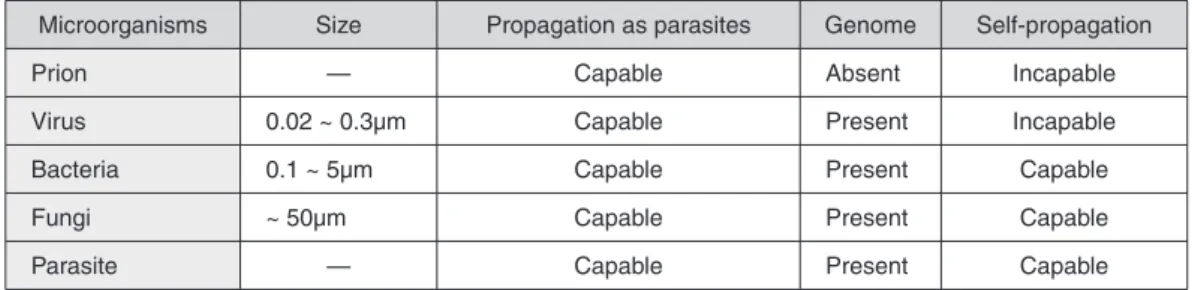
Pathogens can be parasites, fungi, viruses, bacteria or prions, which are all parasitic agents that are further classified by size, the presence or absence of genomes, and self-propagation ability (Table 1). Organisms with nuclei such as parasites and fungi are called eukaryotes, while those without nuclei such as bacteria are called prokaryotes.
Microorganisms Size Propagation as parasites Genome Self-propagation
Prion — Capable Absent Incapable
Virus 0.02 ~ 0.3µm Capable Present Incapable
Bacteria 0.1 ~ 5µm Capable Present Capable
Fungi ~ 50µm Capable Present Capable
Parasite — Capable Present Capable
Source: Prepared by Professor Akio Nomoto of the Graduate School of Medicine, the University of Tokyo.
Table 1 : Classification of pathogens
2-1 Parasitic infections
Parasites are medically defined as parasitic eukaryotes other than fungi and can be further classified into unicellular protozoans, such as malaria and tr ypanosoma, and multicellular helminth represented by filaria. Diseases caused by parasites are called parasitic infections.
The Special Programme for Research and Training in Tropical Diseases (TDR) of the World Health Organization (WHO) have designated m a l a r i a , t r y p a no s om i a s i s, le i sh m a n i a s i s, filariasis, schistosomiasis and leprosy as the six hard-to - conquer diseases, all of which are parasitic infections except leprosy.
In Japan, the number of intestinal parasites has decreased with improved water and sewerage systems, but the Japanese habit of eating raw fish is still causing a high anisakiasis infection rate. Moreover, cryptosporidiosis caused by contaminated tap water broke out in 1994 and 1996 in Kanagawa and Saitama Prefectures, respectively[3].
2-2 Bacterial infections
Bacteria are prokaryotes that can make copies of themselves through self-replication wherever nutrients are available. Based on their activities and their influence on human beings, bacteria are classified into three groups, i.e., harmless, harmful, and effective bacteria, which co-exist in the human intestine. Effective bacteria produce lactic acid by breaking down proteins, while harmful bacteria produce ammonia, amines or indoles through putrefaction. In bacterial infection, the toxins produced by the bacteria trigger disease development[4].
Typical examples of bacter ial in fections are enterohemorrhagic E. coli (strain O157) infections, pertussis and dysentery. Antibiotics are effective against bacterial infections, but their overuse has resulted in the emergence of drug-resistant bacteria such as drug-resistant tuberculosis, methicillin-resistant staphylococcus au reu s ( M R SA) a nd va ncomyci n - resi st a nt enterococcus (VRE). VRE is an especially difficult disease because most antibiotics currently used for treatment of infection prove ineffective in most cases.
2-3 Viral infections
Viruses have a simple structure consisting of a genome for replicating itself and proteins and lipids for protecting the genome. It cannot replicate by itself due to the absence of functions such as nutrient consumption, energy production and protein synthesis, and must therefore live on other cells to utilize their functions and replicate.
The first step in viral infection is the infection and propagation of the virus at the site of damage to a mucous membrane or the skin. Whether it infects the respiratory mucosa or the digestive mucosa depends on the kind of virus. Some viruses replicate and symptoms develop in the first target cell, while others enter the capillaries to travel through the body in the bloodstream to reach the final target tissue where they replicate and the disease develops[5,6].
Vaccines utilizing the immune function of the host have been used for preventing viral infections. As a result, worldwide eradication of smallpox was achieved in 1979. Eradication of poliomyelitis is also in progress under the leadership of WHO.
A mong the considerable number of viral i n fec t ion s k now n to d ay, SA R S cau s ed by coronavirus infection and influenza caused by influenza virus infection are perhaps attracting most public attention. In addition, koi herpesvirus infection found in carp cultured in Kasumigaura has become a serious problem because of its economic consequences, while avian influenza has become a great concern due to both its economic influence and the possibility that it will infect humans.
2-4 Prion diseases
Prion diseases such as sheep scrapie were considered to be special forms of viral diseases with a long incubation period following viral infection. However, in the 1980s, it was proposed that these diseases are caused by abnormal prion proteins, and this has been confirmed through an experiment demonstrating that abnormal prion proteins are capable of inducing neuronal disease.
Prion disease is a general term for diseases thought to be caused by abnormal prion proteins.
To date, little is known about the infection
mechanism or the action of prion proteins[7]. Examples of prion diseases are sheep scrapie, bovine spongiform encephalopathy (BSE) and human Creutzfeldt-Jakob disease (CJD).
3 Major problems concerning infectious diseases
Infectious diseases, the most common cause of human fatalities, have always been and will remain a problem that must be overcome.
Awareness of infectious diseases is growing.
The following are some major issues concerning infectious diseases.
3-1 Emerging and re-emerging infectious diseases
WHO defines emerging infectious diseases as
“those due to newly identified and previously unknown infections that cause public health problems either locally or internationally,” and re- emerging infectious diseases as “those due to reappearance and increase of infections that are known, but had formerly fallen to levels so low that they were no longer considered a public health problem”[6,8]. Examples of emerging and re-emerging infectious diseases are listed in Table 2.
It is unlikely that emerging infectious diseases are caused by completely new viruses; rather, they are considered to be caused by zoonotic
viruses (those infecting humans as well as other animals). Such viruses remained undiscovered, coexisting with their natural hosts away from human beings, but once they encounter human communities, they start emerging as ‘new’
diseases.
3-2 Imported infectious diseases
Aircraft and other transportation means have increased the circulation of supplies as well as people. This has also increased the risk of importing infectious diseases from other areas.
In 1967, an infection with a fatality rate of 23% attacked workers in Behring Laboratory in Marburg. This disease, named Marburg disease, was caused by a virus carried by an African green monkey shipped from Uganda. Ugandan monkeys were also exported to Japan around the same time, although they were uninfected by the virus.
I n 1976, a n A mer ica n woma n ret u r n i ng from Sierra Leone was found to be infected by the Lassa virus, and 552 people who had potentially had contact with her were placed under surveillance for 3 weeks. Fortunately, no secondary infection was observed in this case.
In 1987, a Japanese technician also returning from Sierra Leone was diagnosed as having Lassa fever after receiving medical treatment at the Research Hospital of the Institute of Medical Science, The University of Tokyo.
Table 2 : Examples of emerging and re-emerging infectious diseases
Emerging infectious diseases Re-emerging infectious diseases
Parasitic infections Cryptosporidiosis
Malaria Leishmaniasis Echinococcosis
Bacterial infections
Enterohemorrhagic E. coli (strain O157) infections
Novel strain of cholera (Bengal cholera) Legionellosis
Fulminant type-A streptococcus infections
Plague Diphtheria Tuberculosis Pertussis Salmonellosis Cholera
Viral infections
Ebola hemorrhagic fever Hantavirus pulmonary syndrome HIV (AIDS)
Adult T-cell leukemia Nipah virus encephalitis SARS
Rabies
Dengue/ dengue hemorrhagic fever Yellow fever
Source: Prepared by the author based on the Reference [3].
3-3 Drug-resistant bacteria
Since the discover y of penicillin and its first clinical application in 1941, many kinds of antibiotic have been put into practical use.
A ntibiotics are effective against infectious diseases, especially against bacterial infections, and have contributed to the dramatic reduction in many acute infections, at least in developed countries. Antibiotics have also been effective against certain chronic infections, such as tuberculosis, which has drastically reduced the number of tuberculosis patients. However, while exerting such dramatic effect against bacterial infections, antibiotics have generated the new problem of the emergence of drug - resistant bacteria.
3-4 Bioterrorism
Japan’s Aum Shinrikyo’s dispersal of anthrax and botulinum as well as sarin in a sarin gas attack and U.S. anthrax mail threats in 2001[7]
have impressed the reality of bioterrorism on the international community.
This has raised the demand for anti-bioterrorism measures, especially in the United States, where the budget for anti-bioterrorism measures has been increased[2] over the past few years.
4 Importance of understanding the molecular mechanisms of infection and development
Various factors are involved in the emergence of drug - resistant bacteria and emerging or re- emerging infectious diseases. For example, delay in public health improvement due to poverty or jungle exploitation that accompanies rapid population expansion has increased the risk of encountering unknown pathogens, and abnormal weather patterns consistent with global warming have increased or altered the distribution of the natural hosts of pathogens.
Furthermore, inadequate or excessive use of antibiotics and the aging of society have lead to the emergence of symptoms that cannot be controlled by the immune system. These problems cannot be easily solved, yet they are likely to grow into even more serious problems.
Therefore, we must work harder to strengthen measures against infectious diseases.
To establish new prevention and treatment methods other than existing vaccine-mediated prevention and symptomatic treatment, it is i mpor tant to u nderstand the molecu lar m e c h a n i s m s o f i n f e c t i o n a n d d i s e a s e development and to utilize the results to develop new prevention and treatment methods.
4-1 Importance of understanding
the molecular mechanisms of infection and development
Developing new prevention and treatment methods requires elucidation of the molecular mechanisms of the infection process and the disease development process.
For example, focusing on the fact that viruses cannot propagate without using the molecules or systems of their hosts, research projects are in progress to identify the host- derived molecules determining the species-, tissue- or cell-specificity of viruses to reveal the biological processes by which viruses adhere to or invade cells, replication of the viral genome, virus particle formation and cell death. Unfortunately, the molecular mechanisms of infection and disease development have only been partially elucidated, even for substantially eradicated viruses such as poliovirus.
Research on bacterial infections has been p r o m o t e d t o u n d e r s t a n d t h e m o l e c u l a r mechanisms underlying the processes of bacterial fixation and invasion into tissues or cells at infection sites, and inflammation resulting from bacterial phagocytosis due to the release of macrophages and cytokines. However, these mechanisms are not yet fully understood.
4-2 Process of virus infection research
The following example of virus infection research illustrates the process for elucidating infection and disease development mechanisms.
The first step of invasion into a host organism is the propagation of the virus at the first target cell. The disease then develops at this site, or travels through the host to other tissues where they propagate and where the disease develops.
However, if the host lacks the receptor that binds
to the virus, infection does not occur.
Pathogen icit y st ud ies of v i r uses a i m to e lu c i d a t e “ t h e m e c h a n i s m o f s p e c i e s o r tissue - speci f icit y deter mi nation,” “i n vivo transmission mechanism” and “the capacity to damage the final target cell.” Viral propagation depends on the compatibility of molecules between the virus and the host. The mechanism and route of the in vivo transmission of viruses to the final target cell are the important steps in disease development.
For example, poliovirus shows species-specificity t h at l i m it s it s i n fec t ion to pr i m ate s a nd tissue-specificity that limits its site of propagation to the central nervous system and the intestines.
After in vivo transmission, polioviruses release their toxins in the final target, the nerve cells.
They use a cell - surface receptor molecule (poliovirus receptor) for infection that has been cloned and that is suggested to be the determinant for species-specificity. In addition, the appl ication of genetic tr a nsfor mation technology has revealed the genomic sequence of viruses with tissue-specificity (central nervous system- specificity). The mechanism of the in vivo transmission of the virus is being currently studied using an infection model established with mice[5].
The elucidation of the molecular mechanism of viral infection and disease development is very
important, as it serves as a basis for developing infectious disease measures such as prevention and treatment methods. Findings on the process of viral invasion into the host can be applied to developing measures to be taken at the initial stages of infection, while findings on in vivo transmission and viral replication in target cells can be used to suppress disease development (Figure 1).
5 Suggestions
— Infectious disease research for public safety
and peace of mind —
As mentioned in Section 3, there are many problems concerning infectious diseases, and it is essential to promote infectious disease research to establish a safe society with peace of mind in Japan. Here are some suggestions for strategies to be taken.
5-1 Fostering and securing human resources and research funds
Emerging infectious diseases are likely to be caused by pathogens belonging to known taxonomic groups in the pathogen classification.
Therefore, basic knowledge of major known pathogens should prove useful in taking effective measures against novel pathogens. For example,
Figure 1 : Process for elucidating viral infection and disease development mechanisms
measures agai nst SA RS caused by a newly discovered coronavirus were developed based on knowledge and techniques already established for other coronaviruses.
Therefore, it is important to establish a system for supporting basic research on major pathogens.
While further research should be conducted for pathogens that have already been researched, research on non - researched pathogens must also be enhanced to encourage this entire area of research. Such projects must be promoted to prepare for the future emergence of emerging and re-emerging infectious diseases.
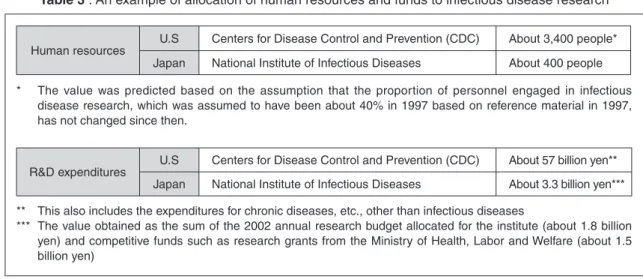
To promote research on molecular mechanisms, the routine gathering of fundamental knowledge and establishing of experimental methods and techniques, it is essential to foster and secure human resources and research funds in this area. However, compared to the United States, Japan has allocated an extremely small amount of human resources and research funds to the infectious disease research area (Table 3).
Considering the significant inf luence on public health and the unpredictable nature of their epidemics, infectious diseases are an issue that must be continuously tackled. Fundamental k nowledge on molecu lar mechan isms and experimental methods cannot be established without accumulating research results, and specialists handling peculiar pathogens cannot be raised in a short time. Reduced emphasis on infectious disease research may result in reduced research support and ultimately in the outflow of
researchers to other research areas. This must not happen.
5-2 Enhancement of Biosafety Level 4 facilities considering linkage with other countries
E x p e r i m e n t s u s i n g i n f e c t i o u s d i s e a s e pathogens require special research facilities (hardware) and appropriate action (software) by workers to prevent infection and environmental contamination.
S t a n d a r d s f o r h a n d l i n g p a t h o g e n i c m icroorgan isms have been establ ished by WHO and set out in the Laboratory Biosafety Manual. In the United States, standards have been jointly established by NIH, the largest domestic institution in U.S. responsible for biomedical research, and Centers for Disease Control and Prevention (CDC), an international organization playing a central role in infectious disease measures. In Japan, the National Institute of Infectious Diseases has established safety management principles, while the Bioscience Sector i n the Subdivision on the Focused Promotion of Basic and Fundamental Research and Development, Council for Science and Technology, has established “Manual for the Safe Management of Research Microorganisms in University Laboratories, etc.” in January 1998.
Various academic societies have also established their own guidelines (Table 4).
“ B i o h a z a r d ,” t h e a b b r e v i a t e d t e r m fo r
“biological hazard,” refers to a hazard caused
Human resources U.S Centers for Disease Control and Prevention (CDC) About 3,400 people*
Japan National Institute of Infectious Diseases About 400 people
R&D expenditures U.S Centers for Disease Control and Prevention (CDC) About 57 billion yen**
Japan National Institute of Infectious Diseases About 3.3 billion yen***
* The value was predicted based on the assumption that the proportion of personnel engaged in infectious disease research, which was assumed to have been about 40% in 1997 based on reference material in 1997, has not changed since then.
** This also includes the expenditures for chronic diseases, etc., other than infectious diseases
*** The value obtained as the sum of the 2002 annual research budget allocated for the institute (about 1.8 billion yen) and competitive funds such as research grants from the Ministry of Health, Labor and Welfare (about 1.5 billion yen)
Table 3 : An example of allocation of human resources and funds to infectious disease research
Source: Prepared by the author based on the reference material distributed in the 34th Council for Science and Technology Policy.
by organisms (microorganisms) harmful to humans or the environment. The fundamental rule in biohazard measures is the containment of pathogens, and action taken for this purpose consists of two steps, i.e., primary isolation and secondary isolation. The former is to protect workers from exposure to pathogens, while the latter is to isolate the laboratory from the outside environment. These actions are assigned Biosafety Levels (BSL) 1- 4[9] according to the degree of hazard.
In Japan, the National Institute of Infectious Diseases and the Institute of Physical and Chemical Research (RIKEN) each has a laboratory that satisfies the conditions required for BSL4 facilities. In both laboratories, maintenance such as the replacement of filters and other equipment as well as occasional inspections are conducted, but to date, neither is planned to be used as a BSL4 laboratory.
Pathogens potentia l ly causi ng i mpor ted infectious diseases include those that can only be handled in BSL4 laboratories, such as the Ebola virus and Marburg virus. Furthermore, BSL4 laboratories may be needed for handling unidentified pathogens. The lack of operational BSL4 laborator ies is retardi ng progress i n d o m e s t i c r e s e a r c h o n h i g h l y h a z a r d o u s pathogens.
To pr o m o t e s u c h r e s e a r c h pr oj e c t s , it is impor tant to establish operational BSL4 laboratories where high safety levels are ensured.
Linkage with overseas facilities should also be considered to create a research environment equipped with available BSL4 laboratories.
Acknowledgements
This report was prepared based on the lecture
“Viral infectious diseases —from poliovirus to SARS” given by Professor Akio Nomoto, Graduate School of Medicine, University of Tokyo, on August 20, 2003 at the National Institute of Science and Technology, and supplemented with information obtained through research conducted by the author. The author would like to thank Professor Nomoto for kindly offering guidance and related materials in preparing this manuscript.
References
[1] “NIH budget for 2005 has been announced in budget Message,” Science & Technology Trends, No.36, March 2004. (in Japanese) [2] AAAS, “NIH ‘Soft Landing’ Turns Hard in
2005”, Feb. 20, 2004
[3] “Infectious disease research today” edited by Takeshi Honda, Kazuyoshi Ikuta, Toshihiro Table 4 : Criteria for biosafety levels and example microorganisms
Level Criteria Examples (virus only)
1 Agents not that cause serious disease in humans or animals
Live-vaccine viruses
(other than vaccinia and rinderpest vaccine)
2
Agents that cause disease in humans or animals but has low risks of causing severe hazards among laboratory personnel or domestic animals
Dengue virus, Herpes simplex virus (1and 2), Influenza virus, Japanese encephalitis virus, Measles virus, Adult T-cell leukemia virus, Hepatitis virus (A, B, C, D and E)
3
Agents that cause serious disease in humans but are rarely transmitted from a diseased person to other individuals
Hantavirus, HIV (1 and 2), Rabies virus (street strain)
4
Agents that pose high risk of life-threatening disease and are easily transmitted either directly or indirectly from a diseased person to other individuals, or agents without any effective prevention or treatment method.
Ebola virus, Lassa virus, Marburg virus, Smallpox virus, Yellow fever virus
Source: “Manual for Safe Management of Research Microorganisms in University Laboratories, etc. (January 1998).”
Table 5 : Major Biosafety Level 4 facilities in the world
Asia Japan 2
North America U.S. 6
Canada 1
EU
Sweden 1
Germany 2
France 1
U.K. 4
Spain 1
Source: Prepared by the author based on the reference material distributed in the 34th Council for Science and Technology Policy.
Horii, Osaka University Press, 2001. (in Japanese)
[4] Ma sa m ich i A i k awa, Koich i Naga k u r a,
“Modern infectious diseases,” Iwanami Shinsho, 1997. (in Japanese)
[5] National Institute of Science and Technology Po l i c y, “L e c t u r e r e g i m e s - 124 V i r u s infectious diseases —from poliovirus to SARS,” 2003. (in Japanese)
[6] “Frontiers of infectious virus/ bacterial infection theor y” edited by Yoshifumi
Takeda, Akio Nomoto, Medical View, 1997.
(in Japanese)
[7] Kazuya Yamanouchi, lecture series:
http://wwwsoc.nii.ac.jp/jsvs/05_byouki/Pro fYamauchi.html
[8] WHO: World Health Organization:
http://www.who.int/en/
[9] Kazuya Yamanouchi “Killer virus infections”
F u t a b a sh a P u bl i she r s L t d ., 2 0 01. (i n Japanese)
(Original Japanese version: published in April 2004)