Photovoltaic Power System in Residential Area of Chinese Cities
著者 Zhang Danming, Shen Zhenjiang, Dang Anrong journal or
publication title
International Review for Spatial Planning and Sustainable Development
volume 1
number 2
page range 46‑60
year 2013‑01‑01
URL http://hdl.handle.net/2297/34407
Copyright@SPSD Press from 2010, SPSD Press, Kanazawa
Development Feasibility of Distributed Photovoltaic Power System in Residential Area of Chinese Cities
Danming Zhang
1, Zhenjiang Shen
2*, Anrong Dang
11 School of Architecture, Tsinghua University, Beijing City, China
2 School of Environmental Design, Kanazawa University, Kanazawa City, Japan
* Corresponding Author, School of Environmental Design, Kanazawa University, Kanazawa City, Japan, 920-1192n. Email: [email protected]
Key words: Distributed, Photovoltaic, Household electricity, Residential area, City, China, Feasibility, Urbanization,
Abstract: China has stepped into the accelerating phase of urbanization since the early 1980s, which has boosted the electricity consumption and CO2 emission of the urban area. Most existing studies discussed related issues on national or regional scale from the perspective of the energy sector, but little research has focused on the scale of urban level and topics in urban development. This paper intends to utilize the approach of spatial analysis and spatial statistics to identify the potential and feasibility of Chinese cities in developing distributed photovoltaic power system (D-PVPS) for meeting household electricity demand. The result shows that most Chinese cities are feasible to develop the D-PVPS which can totally cover the present household electricity consumption in residential area, based on the estimation carried out in this paper. Some of the rest cities are also suitable to develop the D-PVPS in the visible future when photoelectric ratio enhances. Finally, policy implications and suggestions are raised to promote the much broader D-PVPS application in Chinese cities under the background of future urbanization.
1. INTRODUCTION
This work intends to discuss the implementation feasibility of distributed photovoltaic power system (D-PVPS) for meeting household electricity demand in 285 prefecture-level cities of China. Accordingly, urban household electricity consumption conditions and photovoltaic (PV) power potential of the studied cities are firstly analysed. Combined with the discussion about corresponding techniques, application paradigms and policies, in-depth analysis is taken to raise suggestions for promoting D- PVPS application of Chinese cities.
With 30 years’ fast and stable development, China has become the
second largest economy, meanwhile, it also becomes the largest primary
energy consumer and contributes to the 20% of global greenhouse gas
emission in 2009 (Liu, Geng et al., 2012), which undermines the
sustainability of China’s future development. As one of the influential
factors, the accelerated urbanization process has contributed much to the
sharp energy consumption increase of China in the past 30 years (Jiang and
Lin, 2012; Liu, 2009; O'Neill, Ren et al., 2012; Dong and Yuan, 2011;
Zhang and Lin, 2012). In 2011, the urbanization ratio of China has firstly reached 51.3%, however, predicted by the UN (2012), the accelerating phase of Chinese future urbanization will generally finish around 2035-2045 (urbanization ratio reaches 70%). Consequently, in the future, the on-going urbanization process will continue to influence the structure and gross amount of energy supply and demand in Chinese urban area (Dai, Masui et al., 2012).
As the hotspot of Chinese future urban energy sector, household electricity consumption is the key (Baeumler, Ijjasz-Vasquez et al., 2012).
Firstly, household electricity demand has already and will be continued to sharply increase, as mass population will further migrate and accumulate around urbanized area, which will pull up the gross amount of power demand (Liu, 2009; Yu, Pagani et al., 2012). In the second point, with the more comprehensive utilization of electronic appliances and the increasing living conditions, the average household electricity consumption level per capita will be enhanced (Dai et al., 2012; Murata, Kondou et al., 2008).
From the other aspect, the present dominant position of urban gases and gasoline in urban household energy structure will be gradually replaced by electricity, under the trend of comprehensive application of electric vehicle, electrification in cooking and heating, and the exhaust of fossil fuels etc. in the future (Murata, Kondou et al., 2008; Pachauri and Jiang, 2008).
Another trend in Chinese energy sector is the rapid development of renewable energy, especially in solar power generation (Jackson, 2011;
Zhang, Chang et al., 2012). In the last 10 years, Chinese cumulated PV power capacity has dramatically increased from 42MWp in 2002 to 3300MWp by the end of 2011 (Xu, Charlie et al., 2012), which can demonstrate the resolution of China in promoting renewable energy. But, at present, the newly installed PV capacity is mainly large scale photovoltaic power plants (LS-PV), while the D-PVPS is relatively underdeveloped compared with the Europe and Japan (Wissing and Jülich, 2012; Xu, Charlie et al., 2012; Yamada and Ikki, 2012). As the largest solar module producer and exporter, when facing the depression of global economy, spurring the demand of PV products inside domestic market is a potential approach to maintain and optimize the development of Chinese PV industry (Jäger- Waldau, 2012; Zhao, Zhang et al., 2011). The “Golden Sun Project” of China is exactly one of the initiatives since 2009.
Because of the advantages in less land occupation by utilizing rooftop, synchronicity between power load and generation during daytime, none grid-transmit loss etc., D-PVPS is more suitable to develop in urban area, which could be comprehensively utilized by hospitals, universities, shopping mall, office building and residential area. (Eltawil and Zhao, 2010; Parida, Iniyan et al., 2011) Besides, the development of smart grid and electric vehicle will also promote the development of D-PVPS in the future (Asmus, 2010; Thornton and Monroy, 2011). As a developing country, the urban infrastructure of China is incomplete. Developing D-PVPS as part of the next generation urban infrastructure is also an important consideration during Chinese future urbanization (Bobker, 2006), which could help to wisely utilize the fiscal investment of Chinese local governments and avoid repeating construction of infrastructure.
From the above background, it can be identified that China is suffering
from energy issues, but the more intractable challenges from the aspect of
urban household energy sector will become apparent, if China would
successfully cut down energy density by increasing efficiencies in industrial
sectors. Especially, for urban household electricity issues, China has to not
only cope with the current and emergent difficulties, but make strategic plan and investment in the long run towards the potential opportunities and challenges during its future urbanization. Accordingly, the study on the feasibility of distributed and renewable power system in Chinese cities is of great importance. However, the systematic studies on this topic is limited, and the existing related studies are not from the perspective of urbanization or urban planning either.
In China, residential area is a type of land use where housing is dominated. As the price of household electricity is much lower than commercial and industrial use among Chinese cities, residential area has relatively less positivity to invest and develop the D-PVPS. Besides, in China, most urban residential areas are collective apartments, where the rooftop is shared among multiple households. In consequence, it is more difficult to initiate D-PVPS in residential area compared with commercial and industrial land use, as it needs efforts to reach a consensus among stakeholders. Accordingly, to promote D-PVPS in the residential area of Chinese cities, local governments should be the sponsors, financiers, coordinators and sometimes direct investors, and more attractive policies and fiscal subsidies should be introduced as well.
However, for local city governments, whether it is feasible to develop residential D-PVPS needs systematic analysis about their local conditions and potential benefits. Specifically, based on the collected data, this paper intends to focus on the discussion of these conditions and benefits, and try to raise suggestions for the local governments of the study cities.
The remainder of this paper is organized as follows. In the next section, we introduce the methodology and study cities. Respectively, Section 3 and 4 discuss household electricity consumption and solar power potential of the study cites. Section 5 will discuss the feasibility of developing residential D- PVPS of the study cities in detail. The paper ends with a brief conclusion of our study and practical suggestions for decision makers.
2. METHODOLOGY AND STUDY CITIES
2.1 Methodology
Developing D-PVPS is a strategic investment for Chinese urbanization and low-carbon development in the future, which has fundamental social meanings in the long run. At present, the levelized generation cost of solar power is much higher than the power generated from the source of fuels, hydropower or even wind. Besides, the cost of D-PVPS is higher than LS- PV as well. Most pioneering countries in D-PVPS, including Germany, Spain, Japan and the US etc., have propelled high subsidies of feed-in tariff to encourage the accumulation of social capital towards the sector of D- PVPS, because of the high return rate of the investment. Comparatively, Chinese present D-PVPS subsidy is initial installation oriented, but the related governmental departments are regulating new policies to extend the development of feed-in tariff subsidy in D-PVPS. In the other aspect, with the development of technologies in PV industry, the future cost of D-PVPS will be significantly diminished, which will appeal more investors and further boost the development of D-PVPS.
Even at present conditions, with the subsidies from Chinese central
government, developing D-PVPS in most Chinese cities is already cost-
effective or even profitable. In this regard, the D-PVPS investment and maintaining cost will be gradually reclaimed by the electricity generated in the first 20-25 years of its life-cycle, as the solar panel efficiency will drop dramatically afterwards. Therefore, most Chinese cities are already feasible for developing D-PVPS economically. However, the judgement whether a city is suitable to extensively promote residential D-PVPS inside its municipal territory from the perspectives of renewable energy and infrastructure is also needed. In this study, the cities where the potential PV power generated through D-PVPS meet the urban household electricity consumption are identified as the suitable cities to develop the D-PVPS.
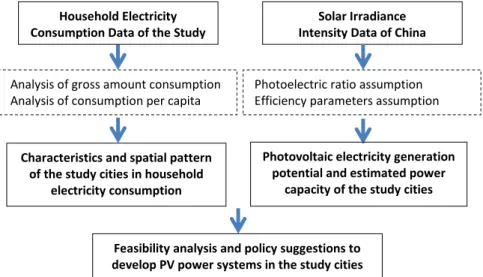
Accordingly, issues about household power conditions, solar power potential, residential rooftop area needed and suitable point-in-time to develop the D-PVPS of the study cities are analysed by following the below steps (Figure.1).
Firstly, this paper intends to compare and analyse household electricity consumption conditions of the study cities, and specifically both gross amount and consumption level per capita are calculated. Further, spatial statistics method (Getis-Ord Gi*) is utilized to analyse the spatial patterns of the cities in terms of household electricity consumption. In the second step, the potential of photovoltaic power generation of each city is estimated based on the “annual average solar irradiance estimation data”. On the basis of the former two steps, this paper intend to analyse feasibility of the study cities in developing D-PVPS, and, based on the analysis, related suggestions are raised to decision makers for making a smart strategic arrangement in residential D-PVPS application.
Figure 1. Framework and main procedures of this study
Specifically, suitability of the cities to develop the D-PVPS is firstly identified by making a balance calculation between household electricity consumption and potential solar power generated per unit of residential area, which considers the potential available rooftop area that can be installed with PV panels inside the residential area. Further, the suitable point-in-time to develop the D-PVPS for the study cities are discussed as well, which is based on the discussion about the development of future photoelectric transferring ratio in the visible future and in the relatively longer future as well.
Solar Irradiance Intensity Data of China Household Electricity
Consumption Data of the Study Cities
Analysis of gross amount consumption Analysis of consumption per capita
Photoelectric ratio assumption Efficiency parameters assumption
Photovoltaic electricity generation potential and estimated power
capacity of the study cities
Feasibility analysis and policy suggestions to develop PV power systems in the study cities Characteristics and spatial pattern
of the study cities in household electricity consumption
2.2 Study cities
This study is carried out by analysing 285 prefecture level cities of China (Figure.2). Most Chinese prefecture level cities are distributed in the east and the middle region of China, which covers almost half territory of the country (for lacking of data, cities in Taiwan province, Hong Kong SAR and Macao SAR are not included). These prefecture level cities will be responsible for accommodating the newly immigrated urban population from the rural area during Chinese future urbanization process.
Figure 2. Spatial distribution of the studies cities
3. HOUSEHOD ELECTRICITY CONSUMPTION
3.1 Gross amount of household electricity consumption
Based on the data of “China city statistical yearbook 2011 (Data in
2010)”, it can be identified that the variance of annual urban household
electricity consumption among Chinese cities is significant. For the top two
largest household electricity consumption cities, the total amount is 5000
times larger than the smallest household electricity consumer of Chinese
cities. Figure.3 shows the spatial distribution of different cities in annual
total urban household electricity consumption. In general, the cities located
in the eastern part of China consume more household electricity compared
with the western and central part of the country.
Figure 3. Annual urban household electricity consumption of the study cities
Further, this paper also analysed the local autocorrelationship through the Getis-Ordi G* statistical analysis, which is used to identify statistically significant spatial clusters of high values (hot spots) and low values (cold spots). The hot spots in this analysis means the cities and its surrounding neighbour cities (within a radius of 300km) have the gross amount of household electricity consumption that is significantly higher than the average level of all the study cities, while the cold spots means the cities and its neighbours have relatively lower value compared with the global average (Prasannakumar, Vijith et al., 2011). From the analysis, the hot spots Jing- Jin-Ji , Pearl River delta, Yangtze River Delta are obvious, and the clusters are significant at a confidence level of 99%, while there are no cold spots identified during this analysis (Figure.4).
Figure 4. Hot and cold spots analysis of study cities in household electricity consumption
3.2 Household electricity consumption per capita
In another aspect, the value of annual household electricity consumption per capita is also analysed, and the result is shown as follows. Most cities have a relatively lower household electricity consumption density, which is under the amount of 500kw*h per capita, while the value of some other cities are over 1000kw*h per capita (Figure.5).
Figure 5. Annul household electricity consumption per capita of the study cities
Similarly , the spatial pattern of household electricity consumption per capita of Chinese cities is also highly clustered. The hot spot is concentrated along southeast coastal area, including part of Jiangshu, Shanghai, Zhejiang, Fujian and Guangdong provinces, while the cold spot is around western region, including part of Gansu, Ningxia, Shanxi and Sichuan Provinces (Figure.6).
Figure 6. Hot and cold spot analysis of household electricity consumption per capita
4. SOLAR POWER CAPACITY ESTIMATION
From the above analysis, it can be concluded that the quantitive variance of annual urban household electricity consumption among study cities is extremely obvious, which indicates the huge gap in city size, economic development etc.
of Chinese cities. The spatial cluster pattern analysis further supports this perspective.
Comparatively , the variance of annual urban household electricity consumption per capita is small, and the spatial cluster pattern of this aspect is potentially correlated with both economic development and climate conditions of the study cities.
Accordingly , the spatial distribution pattern of urban household electricity consumption of the study cities is more related to economic conditions.
However, the solar power capacity of the study cities is more connected to natural factors. The following sub-sections will discuss this topic in details.
4.1 Data
One of the most determinative factors to judge the feasibility of photovoltaic system application is the solar irradiance that arrives at the earth’s surface. In this paper, “annual average solar irradiance estimation dataset” in the national database of “Data Sharing Infrastructure of Earth System Science, China (DSIESS)” is utilized to evaluate the PV power potential of the study cities.
This dataset is processed and interpolated based on the solar irradiance observational time-series data from 1950-1980 from almost 600 weather stations distributed nationally. Estimation approach is based on the multiple stepwise regression method raised by Tian, Zhu et al. (2005) and Zhu, Tian et al. (2005), which considered 6 primary influencing parameters, and that is:
X
1— annual sunshine duration (0.1 hour), X
2— percentage of possible sunshine (%), X
3— annual average cloud cover (%), X
4— absolute humidity (100Pa), X
5— elevation (0.1m),
X
6— altitude (degree).
Consequently, the regression equation is as follows:
Q=170292+20.73189*x
1-0.19171*x
1*x
6+0.07212*x
5*x
6, (1)
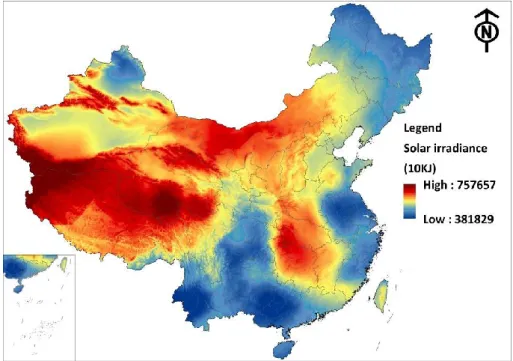
With the equation above, the estimated spatial data is shown in Figure.7.
Nationally, the western part and middle part of China are inherited with
higher solar energy, while northeast, southwest and east part of the country
has lower irradiance potential comparatively.
Figure 7. Solar irradiance spatial distribution of China
4.2 Solar power potential calculation of the study cities
Except for the dominant influencing factor---solar energy irradiance, the exact amount of the harvested electricity at the end-use point could be various depending on the specific PV system applied, the efficiency of solar cell, auxiliary techniques, management schemas and other related climate parameters etc.
(1) Solar cell efficiency
At present, the dominant and commercialized products are mono- crystalline and poly-crystalline silicon solar cell in the market. The average transferring ratio of solar panels from solar energy to electricity is between 10-18%, which is predicted to be improved to approximately 30% and with lower cost in the visible future (El Chaar, Lamont et al., 2011). Considering Chinese current condition and to make a more founded and conservative estimation, the transferring ratio is chosen at 10% in this paper for most analysis.
(2) PV system
Except for the efficiency during photoelectric conversion, another main character that will significantly influence the electricity output is the type of PV system, as the specific system components and system design will determine the efficiency and energy loss during the process of energy type transferring and power transmit.
The most two typical systems at present are stand-alone system and grid connected system, while retrofits based on the above two paradigms are various. Based on related study and monitoring of practical projects, the general efficiency of the above two systems is around 65%-85% (Drif, Pérez et al., 2007; Rehman and El-Amin, 2012)
(3) Management Schemas and ambient conditions
Even it is less important, The management manner of PV system such as
depth of battery discharge, automatic adjustment of PV panel tilt angle and
orientation, and ambient conditions of the PV module such as temperature,
dust and dirt on the panel, air humidity etc., will influence the performance
of solar panel not to be working at the peak watt.
(4) Equation to estimate the potential power generation capacity
Accordingly, to cast relatively a more applicable analysis and based on the consideration of the above aspects, more conservative calculation is employed in this paper, and based on the related studies (Meral and Dinçer, 2011; Vardimon, 2011), the employed equation in this paper is as follows.
Capacity
Solar Power= Capacity
Solar Irradiance*η
1*η
2*η
3*η
4, (2)
CapacitySolar Power— solar electricity generation capacity of each study city
CapacitySolar Irradiance—average annual solar irradiance in each study city
η
1—efficiency of the PV module ( depends on type of cell, connection manner of the panel, loss during power transmitting etc.)
η
2—type of PV system (depends on the efficiency of charge controller, inverter, battery, loss during power transmitting etc.)
η
3—ambient conditions ( temperature of the solar panel, dust or dirt on the panel, air humidity and wind speed etc.)
η
4— other factorings influencing total efficiency
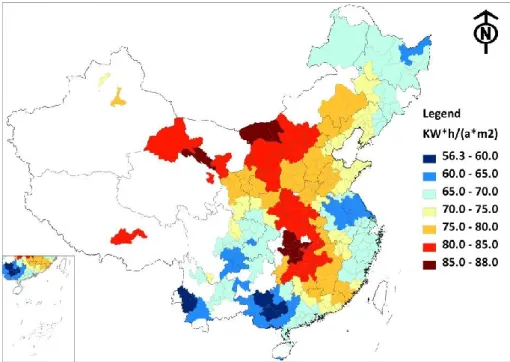
Based on the equation above, the annual average solar power generation capacity per square meter in the study cities is calculated and the result is illustrated in Figure.8. In the calculation, the photoelectric ratio η
1=10% is taken, which is relatively low value, while the sum of η
2*η
3*η
4is fixed at 50%, which is also a conservative parametric value (Leloux, Narvarte et al., 2012; Meral et al., 2011).
From the result, it can be summarized that the solar power capacity of Chines cities is generally between 60-90 kw*h/(a*m
2). The cities that have high solar power generation capacity potential are mostly distributed in the provinces that located in the western and middle part of China, such as Gansu, Inner Mongolia, Henan, Hubei, Hunan etc., while the cities with less capacity of solar power generation are mostly located in the northeastern, southwestern and eastern coastal part of China.
Figure 8. Estimation of annual average solar power capacity of the study cities
5. FEASIBILITY ANALYSIS
5.1 Suitability to develop the D-PVPS
Distributed PV power supply system is the most suitable and feasible solar power application approach for urban area at present and in the visible future. Especially, Building attached PV (BAPV) and Building integrated PV (BIPV) systems have already been comprehensively applied, which can utilize the roofs or facades of the building to arrange solar modules.
The main purpose of this paper is to analyse the suitability to development D-PVPS of the study cities by discussing the roof area needed to arrange PV modules in the residential area. For residential land use in China, the average roof area or building density is around 30% of the whole residential area, based on the “Code of urban Residential Areas Planning &
Design GB 50180-93, revised 2002”, which mainly considers natural lighting of each household in the winter.
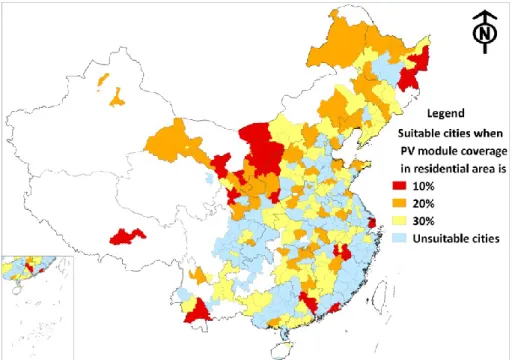
Figure 9. Suitable cities when PV module covers a certain area of rooftop in residential areas
As the amount of electricity consumption per residential area is fixed, the suitability can be estimated by calculating how much roof area is needed to meet the power consumption demand in residential areas. In this paper, we assumed three levels to compare, and that is 10%, 20% and 30% of the urban residential area, and the suitability estimation result is as shown in Figure.9.
From the result, we can judge that nearly half of the study cities are not suitable to develop the D-PVPS, while the other cities can make a balance between household power consumption and PV power supply in the residential area.
For the different percentage of roof area needed, the related energy
policies and governmental promotion activity should be different. For those
cities that only need 10% of the residential area’s surface to install PV
module, it is encouraged to develop stand-alone PV system, which will take
residential area as the basic unit to modify the local community-level grid
and establish power storage systems, as these cities have relatively more
stable and sufficient power supply. Besides, the financial support from the government should be subsidy for the cost of PV system installation.
In the other aspect, for the cities need more roof area to arrange PV modules to meet the demand of household power consumption, it is more feasible and cost-effective to restructure the whole city grid or regional grid to support and meet the technical requirement of grid connect PV system from specific buildings. Besides, financially, the government should develop the concept of smart grid and offer attractive on-grid tariff to encourage people to build grid connect PV system.
5.2 Point-in-time to develop the D-PVPS
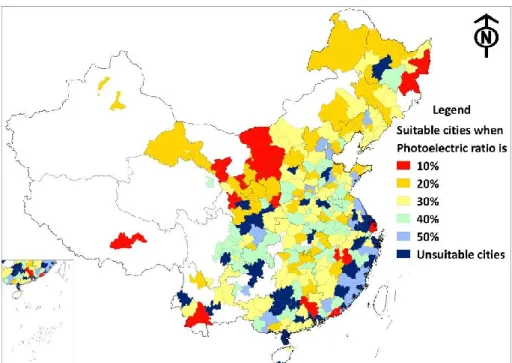
Considering the photoelectric transferring ratio change in the future, the suitability of the study cities to develop the D-PVPS will also change with the development of techniques, and that means, for some cities, the cost- effective time to dominantly promote PV system will be different.
Therefore, if assume the area to install the PV module is fixed (10%
coverage of the residential area), common and commercialized photoelectric transferring ratio will change to 20%, 30% sooner (El Chaar et al., 2011), or even reaches 40%, 50% in the future, which has been approximately achieved under the laboratory conditions (Green, Emery et al., 2012;
Razykov, Ferekides et al., 2011). Accordingly, the suitability calculation based on the future photoelectric ratio development is as follows (Figure.10).
Two thirds of the study cites will be suitable to develop the D-PVPS when the photoelectric ratio reaches 30%, which are mainly located in the northeast, western and central part of the country, and this can be achieved in the visible future. If the photoelectric ratio can reach 40-50% when the existing laboratory techniques are commercialized with lower cost in the long future, most of the cities will be feasible to develop the D-PVPS.
However, this is relatively unpredictable at present.
Figure 10. Suitable cities when photoelectric ratio of solar module increases in the future.
6. CONCLUSION AND POLICY IMPLICATION
Compared with the most existing studies, the contribution of this paper is to study the urban PV power issues at a more detailed spatial scale and from the perspective of urban studies. However, for the future development of Chinese residential D-PVPS, there are still more preparations to be finished.
Especially, there are 4 important aspects, and that is the modification of regional and city-level grid to facilitate the development of on-grid D-PVPS, encouraging on-grid tariff subsidies to absorb more investment from multiple social and private sectors, experiment of advanced techniques and pilot projects exhibition to offer technical experience, electrification in urban energy structure to optimize household electricity portfolio etc. .
For the future studies, there are still many aspects to be improved.
Firstly, in this study, the balance calculation of household electricity consumption and potential solar power generated is based on the current condition of study cities. In the future, studies should consider the future increment of household electricity demand, therefore the study will be more applicable to the reality. Secondly, the estimation of the present study has considered the city as a unified space, which means the residential area in the specific study city has a similar floor area ratio or building density. But in reality, the urban form and inner spatial pattern of study cities are various.
Therefore, to enhance the accuracy of the estimation in the future, the compactness of the city and the general residential area pattern should be considered etc.
Furthermore, because most of the study cities are suitable to develop the D-PVPS in the visible future, it is necessary to conduct cost-effective evaluation to the study cities based on the household electricity consumption and the utilization of the D-PVPS by discussing spatial characteristics of urban form. Thus spatial-temporal approach regarding the cost-effective analysis is helpful to consider the development scheme of the D-PVPS in urban areas. Besides, there is still improvability in photoelectric ratio for present solar modules that will have substantial influences on the development of D-PVPS in those cities.
REFERENCES
Asmus, P. (2010). "Microgrids, Virtual Power Plants and Our Distributed Energy Future", The Electricity Journal, 23(10), 72-82.
Baeumler, A., Ijjasz-Vasquez, E., et al. (2012). Sustainable Low-Carbon City Development in China, World Bank, Washington.
Bobker, M.F. (2006). "Infrastructure conundrums: Investment and urban sustainability", Technology in Society, 28(1–2), 125-135.
Dai, H., Masui, T. et al. (2012). "The impacts of China’s household consumption expenditure patterns on energy demand and carbon emissions towards 2050", Energy Policy, 50, 736- 750.
Drif, M., Pérez, P.J., et al.(2007). "Univer Project. A grid connected photovoltaic system of at Jaén University. Overview and performance analysis", Solar Energy Materials and Solar Cells, 91(8), 670-683.
Dong, X.Y. and Yuan, G.Q. (2011). "China's Greenhouse Gas emissions’ dynamic effects in the process of its urbanization: A perspective from shocks decomposition under long-term constraints", Energy Procedia, 5, 1660-1665.
El Chaar, L., Lamont, L.A., et al. (2011). "Review of photovoltaic technologies", Renewable and Sustainable Energy Reviews, 15(5), 2165-2175.
Eltawil, M.A. and Zhao, Z. (2010). "Grid-connected photovoltaic power systems: Technical and potential problems—A review", Renewable and Sustainable Energy Reviews, 14(1), 112-129.
Green, M.A., Emery,K., et al. (2012). "Solar cell efficiency tables (version 39)", Progress in Photovoltaics: Research and Applications, 20(1), 12-20.
Jäger-Waldau, A. (2012). "Overview of the Global PV Industry", in: Comprehensive Renewable Energy (Editor-in-Chief: Ali, S., ed.), Elsevier, Oxford, 161-177.
Jackson, F.(2011). "China's renewable energy revolution", Renewable Energy Focus, 12(6), 16-18.
Jiang, Z. and Lin, B. (2012). "China's energy demand and its characteristics in the industrialization and urbanization process", Energy Policy, 49, 608-615.
Leloux, J., Narvarte, L., et al. (2012). Review of the performance of residential PV systems in France, Renewable and Sustainable Energy Reviews, 16(2), 1369-1376.
Liu, Y. (2009). "Exploring the relationship between urbanization and energy consumption in China using ARDL (autoregressive distributed lag) and FDM (factor decomposition model)", Energy, 34(11), 846-1854.
Liu, Z., Geng, Y., et al. (2012). "Uncovering China’s greenhouse gas emission from regional and sectoral perspectives", Energy, 45(1), 1059-1068.
Meral, M.E. and Dinçer, F. (2011). "A review of the factors affecting operation and efficiency of photovoltaic based electricity generation systems", Renewable and Sustainable Energy Reviews, 15(5), 2176-2184.
Murata, A., Kondou, Y., et al. (2008). "Electricity demand in the Chinese urban household- sector", Applied Energy, 85(12), 1113-1125.
O'Neill, B.C., Ren, X., et al. (2012). "The effect of urbanization on energy use in India and China in the iPETS model", Energy Economics, 34, S339-S345.
Pachauri, S. and Jiang, L. (2008). "The household energy transition in India and China", Energy Policy, 36(11), 4022-4035.
Parida, B., Iniyan, S., et al. (2011). "A review of solar photovoltaic technologies", Renewable and Sustainable Energy Reviews, 15(3), 1625-1636.
Prasannakumar, V., Vijith, H., et al. (2011). "Spatio-Temporal Clustering of Road Accidents:
GIS Based Analysis and Assessment", Procedia - Social and Behavioral Sciences, 21(0), 317-325.
Razykov, T.M., Ferekides, C.S., et al. (2011), "Solar photovoltaic electricity: Current status and future prospects", Solar Energy, 85(8), 580-1608.
Rehman, S. and El-Amin, I. (2012). "Performance evaluation of an off-grid photovoltaic system in Saudi Arabia", Energy, 46(1), 451-458.
Thornton, A. and Monroy, C.R. (2011). "Distributed power generation in the United States", Renewable and Sustainable Energy Reviews, 15(9), 4809-4817.
Tian, Y., Zhu, L., et al. (2005). "Comparative Study on Spatial Simulation of Solar Radiation on Level Surfaces", Geo-information Science, 7(4), 95-100. [in Chinese].
United Nations (UN), Department of Economic and Social Affairs, Population Division.
(2012), World Urbanization Prospects, the 2011 Revision. Final Report with Annex Tables, New York.
Vardimon, R. (2011). "Assessment of the potential for distributed photovoltaic electricity production in Israel", Renewable Energy, 36(2), 591-594.
Wissing, L. and Jülich, P. (2012). National Survey Report of PV Power Applications in Germany 2011, International Energy Agency, Paris, France.
Xu, H., Charlie, D., et al. (2012). National Survey Report of PV Power Applications in China 2011, International Energy Agency, Paris, France.
Yamada, H. and Ikki, O. (2012). National Survey Report of PV Power Applications in Japan 2011, International Energy Agency, Paris, France.
Yu, W., Pagani, R. et al. (2012). "CO2 emission inventories for Chinese cities in highly urbanized areas compared with European cities", Energy Policy, 47, 98-308.
Zhang, C. and Lin, Y. (2012). "Panel estimation for urbanization, energy consumption and CO2 emissions: A regional analysis in China", Energy Policy, 49, 488-498.
Zhang, X., Chang, S. et al. (2012). "Renewable energy in China: An integrated technology and policy perspective", Energy Policy, 51, 1-6.
Zhao, Z., Zhang S., et al. (2011). "A critical analysis of the photovoltaic power industry in China – From diamond model to gear model", Renewable and Sustainable Energy Reviews, 15(9), 4963-4971.
Zhu, L., Tian, Y., et al. (2005). "Simulation of solar radiation on ground surfaces based on 1 km grid-cells", Transactions of The Chinese Society of Agricultural Engineering, 21(5), 6- 19. [in Chinese].