ABSTRACT
In Japan, university students study English for several years but have little opportunity to use English in any meaningful way outside the classroom, and often find themselves in teacher-centred learning environments. For many, English pronunciation is an area of their language learning education that is not addressed as much as they would like. Many teachers also feel they have difficulties in addressing pronunciation, but one resource which may be underutilised is the students themselves. This paper describes a project in which university students from two universities in Japan telecollaborated using podcasting technology and peer-feedback via the Internet to attempt to identify and address problematic aspects of pronunciation, and reports on the results of their perceptions of the project.
Keywords: EFL, English Language Pronunciation, Podcast, Student Impressions, Peer Evaluation
Ⅰ INTRODUCTION
Dum docemus discimus (When we teach, we learn)
Nearly all Japanese people study English in formal classroom situations from primary school through to university, and millions also study in commercial language schools at great financial cost1). Unfortunately, there are numerous aspects of the Japanese language which differ greatly from English, from the written script to morphology, phonotactics and more, creating unique issues for Japanese learners of English (Parsons & Walker, 2006; Walker et. al., 2011). Exacerbating this is the fact that Japan was all but closed to the rest of the world for well over 200 years from the early 17th century until the second half of the 19th century, resulting in extremely limited knowledge of the West and of foreign languages. In the early days of Japan’ s re-opening to the world, various measures for dealing with English
MartinParsons
StudentPerceptionsoftheEfficacyof
TelecollaborationandPeer-feedbackasaMeans forImprovingEnglishPronunciation
1) Ministry of Economy, Trade and Industry statistics indicate that in 2018 commercial foreign language conversation schools had sales of 91,218,000,000 yen (METI, 2019).
were devised, including efforts to ‘map’ Japanese expressions on to English phrases based on perceived phonetic similarities, even if there were no relation in meaning. Attempts to approximate English pronunciation through the use of kana, the Japanese syllabic script which is also fundamentally different from the English alphabet, were made for decades (Parsons &
Walker, 2006; Asahi Shimbun, 2005), a practice which is still used by many in the 21st century.
One consequence of this is a deficit in the opportunities experienced by Japanese people in learning English in comparison to many other countries in the world. As Kikuchi and Sakai
(2009) have noted, Japanese pupils and students study English for several years but have little opportunity to use English in any meaningful way outside the classroom. The concept of a language gap often implies issues of class, economic advantage or disadvantage, including access to educational possibilities and other social inequalities (Johnson & Zentella, 2017).
However, in the modern world, where English has more or less become the global lingua franca in various domains, it may be argued that a language gap exists on another two levels:
most obviously between native and non-native speakers of English, but also between those non-native speakers with access to quality English language education and/or examples of the English language in practice, and those without.
Japan has a large population with a correspondingly large domestic economy mainly supplied by Japanese companies. Goods and services from abroad are available in Japan, but in order to make inroads into the local economy companies need to adapt to the Japanese market. For example, foreign movies and television shows are routinely dubbed into Japanese, imported products will as a matter of course require manuals or explanations written in Japanese, and so on, meaning that despite the apparent importance of English in an international sense, the average Japanese person has no particular need to learn or use English in daily life. In recent years, a trend of fewer students studying abroad has emerged
(Dujarric & Takenaka, 2014; IIE, 2015; MEXT, 2015; Tanikawa, 2011), and surveys of newly employed company workers by the Sanno Institute of Management (2017) reveal that the number of those unwilling to work abroad is increasing, with one of the main reasons being a lack of confidence in language skills. For many, teacher-centred learning environments with a focus on preparation for paper-and-pencil entrance examinations which do not allow the kinds of opportunities for interaction that would assist in improving facets of their spoken language, including pronunciation, are the norm. Many Japanese pupils and students, having no readily perceived need or opportunity to use English communicatively, even in the classroom, become passive learners who have difficulty expressing their opinions (Shimizu, 2006; Turner & Hiraga, 1996).
In response to these issues, the Japanese Ministry of Education, Culture, Sport, Science and Technology (MEXT) has for many years been encouraging educators to develop more technologically-capable, internationally-minded students. The Ministry and employer groups, such as the Japan Business Federation (Keidanren), have long urged improvements in English language education, particularly at the tertiary level by calling for educational approaches which promote ICT (information and communications technology), with the aim of developing a knowledge-based society based on ‘global human resources’ (Keidanren,
2000, 2013; MEXT, 2003; 2008; 2010; 2013; 2014), with a specific call for the implementation of active learning approaches in education (MEXT, 2013).
Therefore, educators in a context such as Japan must attempt to develop ways of providing learners with innovative methods to practice their oral and aural English language skills. The clear need for greater opportunity for communication suggests that developing collaborative models of educational practice may prove to be of benefit for learners in these situations.
In lieu of face-to-face personal interaction, which is often difficult to schedule because of educational and personal timetables, digital interaction using the affordances provided by the Internet is a realistic alternative. Podcasting, which has emerged in recent years as a powerful technology in education (e.g. Al Qasim & Al Fadda, 2013; Kay, 2012), is something that can be brought to bear here. It is a technology which has also been well received by language learners in Japan (Parsons, 2019a; 2019b; 2020). This paper presents the results of such a project in which students from two different universities in Japan produced short audio podcasts on topics of personal interest, which were then exchanged by means of a password- protected website. Students provided one another with feedback on their pronunciation before a final version of their podcast was produced. Results from pre- and post-project surveys will be presented.
Ⅱ ON THE TEACHING OF PRONUNCIATION
It has been noted for some time that the teaching of pronunciation in English language education can be overlooked by teachers (Derwing, 2010; Elliott, 1995; Macdonald, 2002), and that in at least some domains is under researched (Baker & Murphy, 2011). Bai and Yuan
(2019) report that non-native-English-speaking EFL teachers in Hong Kong are aware of the importance of pronunciation teaching for students but feel they lack the confidence and training to do it well, reflecting their self-perceived socio-cultural status as non- native-English speakers. However, the perception of a lack of speaking ability, including pronunciation which is variant to the wider society, can have adverse effects on social mobility and employment opportunities in countries where English is the official or main language
(Fraser, 2000).
The are other issues also at play in the Japanese context, where most students learn English with the assistance of mass-produced textbooks which have few models of spoken English. Most typically, General American (GA) is the model used, meaning many learners have difficulties understanding other varieties of English, whether uttered by native speakers of English or other L2 speakers.
L1 transference to English tends to be similar for all learners within a given nation or region. Within Japan, the effects of L1 transference to English will tend to be reinforced by the closed nature of a shared learning experience. That is to say, most learners will be surrounded by other learners (and teachers) with the same L1 background, who tend to speak English in a similar way, which will be different from the way learners in a different context speak. However, in a globalising world English is most likely language to be used
in intercultural communication settings. For many of these students their potential future use of English is at least as likely, and possibly more likely, to be with L2 speakers from various backgrounds than with native speakers of any variety of English. Consequently, it is important that students are given the advantage of all resources at their possible disposal.
Most importantly though, Japanese learners of English simply do not get enough opportunities to speak English in context, or to listen to their own voices. There are some opportunities to engage in speaking drills with classmates, but these are often rote exercises focussed on form. Thus, they rarely hear their own spoken English or by their classmates in contextualised situations. Learners are aware of difficulties they experience in pronunciation, and with few other sources of native English available to them other than what comes bundled with textbooks, many feel that English pronunciation is an area of their language learning education that is not addressed as much as they would like (Matsuura, et. al., 2001).
In fact, Uchida and Sugimoto (2017) also note that, as in Hong Kong, the problems of a lack of knowledge and confidence in teaching also exist for non-native speaking teachers of English in the Japanese context. However, any efforts to address pronunciation issues may be underutilising a potentially powerful resource – the students themselves. Benefits may be found in asking students to give feedback to one another on their spoken English. Firstly, students will need to use English more than they normally would. This would help address one of the factors believed to be causing difficulties for Japanese learners. Secondly, feedback from their peers may prove to be motivating for students. They may feel a strong desire to produce their best work when it is not simply a routine class assignment for their teacher, but something that will be scrutinised by their peers, thereby making more effort to achieve accuracy in pronunciation. Thirdly, by actively analysing the speech of their peers, students will likely become aware of issues that exist in their own pronunciation and may be able to apply that to their learning.
Ⅲ PEER LEARNING
Peer feedback and self-correction by students based on that feedback has become a topic of interest to educators in recent times. It may be of particular value now in Japan due to the adoption of active learning and student-centred educational practice being promoted by MEXT.
Some potential benefits of learning through peer-feedback include the fact that by definition peer-learning requires students to collaborate with one another. This can lead to improved communication skills as learners work in pairs or teams to negotiate areas of concern in their production of English. Another potential benefit is the amount of time a given learner can spend on learning the language. In a traditional classroom, a teacher may present information or materials to the entire group of learners at the same time, or address an individual’ s issues by presenting feedback to that individual or the entire group. Such information and feedback may not be of interest or import to all leaners in the group, members of which may lose interest. However, the adoption of peer-learning can mean that learners are focussed for
longer periods on the language and on repairing errors they may have made.
The concept of peer learning is supported by research, particularly as demonstrated in Vygotsky’ s theory of the zone of proximal development (ZPD), which represents the difference between what a learner can do on their own, and what they are capable of doing with the assistance of a more skilled person (Vygotsky, 1978: 86). Vygotsky’ s work was with children, and the ZPD was originally conceived as the difference between what a child could do alone, and what that child could do with the help and guidance of an adult or more skilled older child or peer. The term ‘proximal’ suggests that a learner is on the cusp of being able to do something, or ready to learn to do something, but cannot yet do it alone. In language acquisition, this concept has been applied in the idea of providing ‘scaffolding’ for learners and has become influential in the development of curricula for learners of all ages. Indeed, it has been found that engaging students in the analysis of their own learning and that of their peers may lead to concrete improvements in language proficiency (Lyster and Ranta, 1997).
Using telecollaboration in the form of podcasting technology to carry out this peer interaction gives students a chance to carefully reflect on what they do and how they analyse the work of their peers. Hung found that peer-feedback via video was valued by students, and believed that it can ‘promote more interaction but also foster more personalized learning and attentive engagement’ (Hung, 2016: 98), which is exactly the type of learning sought by educational stakeholders in Japan. Ware and O’ Dowd (2008) also claim that peer feedback in telecollaboration interactions is perceived as valuable by students. Perez, et. al.
(2011) conducted a project which aimed to promote listening comprehension through the use of podcasts and online interaction, the results of which indicated that students actively participated in the project and also expressed satisfaction with it.
Two studies on the use of podcasts on pronunciation have found slightly different outcomes.
Ducate and Lomicka (2009), in a study with learners of French and German found students reported positive attitudes to making podcasts, but that there was little evidence of improved pronunciation. Lord (2008), on the other hand, found peer-feedback using podcasts to be beneficial for improving pronunciation and attitudes towards an L2.
Ⅳ THE STUDY
4.1 PROCEDURE
This study, which focussed on student perceptions of pronunciation and peer feedback on their pronunciation, involved 30 students majoring in calligraphy and early childhood education at a national university, and 23 students majoring in business at a private tertiary institution in Japan, who wrote, recorded and edited podcast-like stories about topics they were interested in, and which they felt others would be interested in hearing about. All students were in their first year of tertiary study, except two from the national university who were second year students. All students were at a preliminary level of proficiency in English. While no objective test of English was undertaken by both sets of students, the observations of the teacher suggested that the students in the national university were
generally slightly more advanced in their English language competence and also had more confidence in their ability to communicate in English.
The study was undertaken according to the following procedure:
1. Students wrote a short script in English on a topic they felt may be of interest to a listener in a different university, which was lightly edited by their English teacher for general intelligibility.
2. Students recorded their scripts and submitted them to their teacher.
3. The recordings were then distributed among same-class peers, who evaluated them and provided written and oral feedback based on a rubric designed by the teacher.
4. The scripts were then re-recorded taking into account the feedback they had received and then exchanged with peers in another university, through the use of a password-protected website.
5. The peers from the other university also evaluated the recordings and provided written feedback using the same rubric.
6. Students then re-recorded their script for a final time, taking into account the new feedback they had received.
7. Students reviewed and evaluated their own recorded work by comparing their final podcast with their original podcast.
Pre- and post-study surveys were conducted to evaluate students’ impressions of their own pronunciation, the level of interest they have in improving their pronunciation, and their impressions of the feedback they had received from their peers. The pre-study survey was based on and drew heavily from Elliot’ s (1995) Pronunciation Attitude Inventory. The post- study survey was developed specifically for this study.
Students were given no particular instruction in pronunciation. They were simply asked that in giving advice they should attempt to find something positive, and something in need of improvement in the recording the listened to. All students were provided with the same evaluation rubrics, which were very similar in design for both peer and self-evaluation.
4.2 RESEARCH QUESTIONS
Three research questions were posited as the basis for carrying out this research:
RQ 1. Do students in the Japanese context perceive a need or have a desire to improve their English language pronunciation?
RQ 2. Do students consider peer-feedback on pronunciation valuable?
RQ 3. Do students feel their pronunciation and/or ability to understand spoken English improved as a consequence of engaging in a telecollaborative exchange incorporating feedback from other students?
Ⅴ RESULTS
The pre-project survey asked students a series of questions regarding their attitude to pronunciation and spoken English, which relate to Research Question 1. The relevant questions were as follows:
5. How well do you think native speakers of English can understand your spoken English?
6. How well do you think people in other countries can understand your spoken English?
7. I’ d like to sound as native as possible when speaking English.
8. Acquiring proper pronunciation in English is important to me.
9. I will never be able to speak English with a good accent.
10. I believe I can improve my English pronunciation skills.
12. One of my personal goals is to acquire proper pronunciation skills and preferably be able to pass as a near-native speaker of the language.
13. I try to imitate English speakers as much as possible.
14. Communicating is much more important than sounding like a native speaker of English.
15. Good pronunciation skills in English are not as important as learning vocabulary and grammar.
16. I want to improve my accent when speaking English.
17. I’ m concerned with my progress in my pronunciation of English.
18. Sounding like a native speaker is very important to me.
All questions, except Questions 5 and 6 were assessed using a five-point Likert scale according to the following criteria:
5 = Always or almost always true of me 4 = Usually true of me
3 = Somewhat true of me 2 = Usually not true of me
1 = Never or almost never true of me
In the case of Questions 5 and 6, the possible responses were:
5 = They can understand me very well 4 = They can understand me fairly well 3 = They can understand me sometimes 2 = They cannot understand me very well 1 = They can hardly understand me at all
Results from students’responses appear to answer Research Question 1 in the affirmative.
Students felt pronunciation was important, and that they wanted to improve that area of their English language proficiency (see Table 1).
Students in particular responded with a high level of agreement to Questions 8, 14 and 16. Questions 8 and 16 refer to how much they would like to pronounce English well, but Question 14, the item with the highest overall level of agreement, posits that communication is more important than sounding native-like. This suggests that while students do want to improve the quality of their spoken English, they understand that communication is the ultimate goal of second language acquisition. This impression is reinforced by the response to Question 15 (the lowest level of agreement overall) which posits that pronunciation is not as important as grammatical form and lexical knowledge of English. The pre-project survey appears to answer Research Question 1 in the affirmative, but with the qualification that students do not see improved pronunciation as their main goal, which is communication.
The responses to the post-project survey are more relevant to answering Research Questions 2 and 3. In these responses we see a strong sense that students found meaning and value in the project. For the sake of a more granular analysis, results from each cohort are presented side-by-side.
As can be seen from Figure 1, students generally were very favourable regarding feedback from their peers. Students from the national university, most of whom were considered to have higher levels of proficiency and confidence in their English, tended to prefer feedback from their own cohort. Students from the private university, most of whom were considered to have lower levels of proficiency and confidence in their English, tended to prefer feedback from the students in the university with a higher level of English proficiency, lending credence to Vygotsky’s theory regarding the ZPD (1978).
Table 1. Basic Statistics on Pre-project Survey Items Likert Scale - Percentage of Responses
Item Mean 1 2 3 4 5
5 2.7 6% 31% 51% 12% 0%
6 2.6 12% 27% 49% 10% 2%
7 3.3 2% 22% 33% 33% 10%
8 3.9 0% 2% 33% 39% 27%
9 2.7 12% 20% 59% 6% 2%
10 3.5 0% 4% 51% 39% 6%
11 3.5 0% 12% 37% 43% 8%
12 3.5 0% 20% 24% 41% 14%
13 3.6 0% 6% 37% 53% 4%
14 3.9 0% 2% 31% 47% 20%
15 2.4 4% 61% 27% 8% 0%
16 3.8 0% 6% 29% 49% 16%
17 3.3 2% 16% 35% 39% 8%
18 3.3 2% 16% 39% 37% 6%
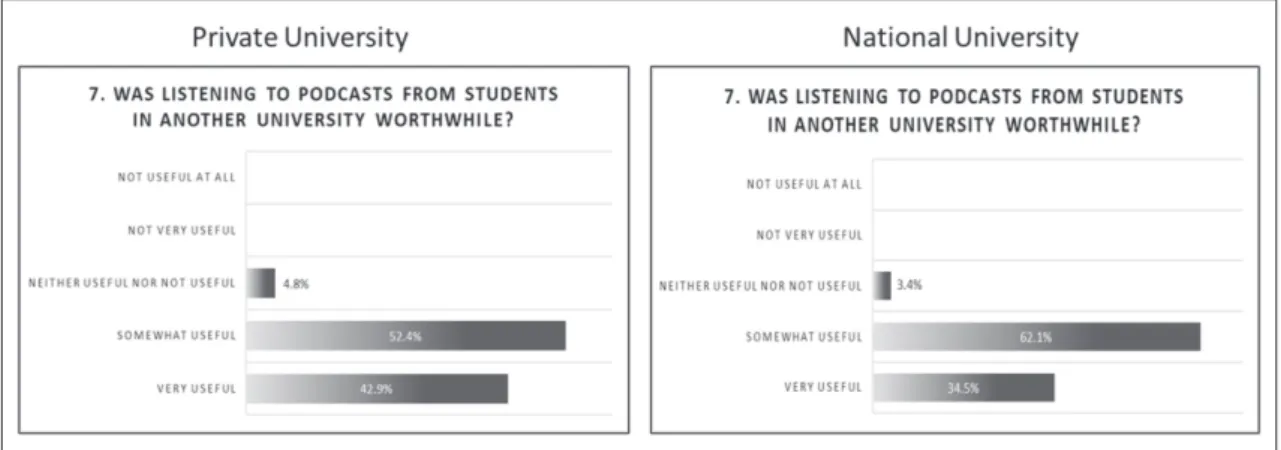
Figure 2 shows that students in both universities highly valued the opportunity to listen to podcasts produced by students from the other university. There is little difference in the rates of agreement to the question, suggesting that students found a similar degree of value in the project, regardless of their own proficiency.
Figure 2. Was listening to podcasts worthwhile?
Figure 1. How useful was the advice from your peers in the same/other university?
Together, these data tend to answer Research Question 2 (Do students consider peer- feedback on pronunciation valuable?) in the affirmative. Students from both universities also expressed a high degree of satisfaction in listening to podcasts from peers in the same class.
Additionally, Figure 3 shows that the great majority of students would like to engage in similar exchanges in the future, further suggesting satisfaction with the project.
Figure 4 demonstrates that most students considered the project to have been helpful in improving their pronunciation of English. However, it can be seen that the higher proficiency students perceived slightly less value in the project. This again lends credence to Vygotsky’ s ZPD theory (1978), suggesting that the students who had received help from a more proficient peer were able to perceive greater improvement as a consequence of the project.
Students also considered that the project had been helpful in improving their ability to understand spoken English, as Figure 5 shows, though again the greater value appears to have been experienced by those students with the lower initial proficiency and confidence.
Figure 3. Would you like to exchange podcasts again?
Figure 4. How useful was the advice from your peers in the same/other university?
These data suggest that Research Question 3 (Do students feel their pronunciation and/or ability to understand spoken English improves as a consequence of engaging in a telecollaborative exchange incorporating feedback from other students?) has also been answered in affirmative.
Ⅵ CONCLUSIONS AND DISCUSSION
This study indicates that podcasting technology has the potential to be an aid in assisting students in improving their pronunciation. All three research questions posited prior to beginning the project were answered in the affirmative. The study also indicates that using podcasting technology in telecollaboration projects was viewed positively by participants in Japan, and perhaps represents a model that can be replicated in similar contexts. However, at least one caveat should be mentioned. Finding appropriate spaces for recording was difficult at one of the universities and many recordings suffered from extraneous noise. Although students generally were very positive about the project, it is possible that this technical difficulty may have contributed to comprehension problems.
Responses to other survey questions not highlighted in the results section show that the overwhelming number of students would like to receive more instruction in pronunciation from their teachers. This hints at the possibility of enhancing pronunciation instruction through a hybrid system of feedback and assistance from both teachers and peers. Future research ought to look into the effects of teacher feedback on pronunciation, both in conjunction with and independent from peer feedback.
Another factor that may have salience is whether or not actually posting recordings to the open internet as fully-fledged podcasts, rather than solely to a password-protected site, would have an effect on students’ attitude and application to the task of recording. This also represents a possible line of future research.
Figure 5. Did your comprehension of spoken English improve?
ACKNOWLEDGEMENT
This study was undertaken with the assistance of a grant from the Society of Hannan University (C), ‘Exploring the Value of Digital Resources (Audio/Video Podcasts) for Learner-Centred English Language Education in Japan’ .
REFERENCES
Al Qasim, N. & Al Fadda, H. (2013). From Call to Mall: The Effectiveness of Podcast on EFL Higher Education Students’ Listening Comprehension. English Language Teaching, 6(9), 30-41.
Asahi Shimbun, September 14, 2005 天声人語 , Vox Populi, Vox Dei
Bai, B. & Yuan, R. 1(2019). EFL Teachers’ Beliefs and Practices about Pronunciation Teaching, ELT Journal, 73(2), 134-143.
Baker, A. and Murphy, J. (2011). Knowledge Base of Pronunciation Teaching: Staking Out the Territory, TESL Canada Journal, 28(2), 29-50.
Derwing, T. M. (2010). Utopian goals for pronunciation teaching. In J. Levis & K. LeVelle (Eds.), Proceedings of the 1st Pronunciation in Second Language Learning and Teaching Conference, Iowa State University, Sept. 2009. (pp.
24-37), Ames, IA: Iowa State University.
Dujarric, R. & Takenaka, A. (2014). Parochialism: Japan’ s Failure to Internationalize, In J. Kingston (Ed.), Critical Issues in Contemporary Japan (pp. 276-286), Abingdon: Routledge.
Elliot, A. (1995). Foreign Language Phonology: Field Independence, Attitude, and the Success of Formal Instruction in Spanish Pronunciation, The Modern Language Journal, 79(4), 530-542.
Fraser, H. 2000. Coordinating Improvements in Pronunciation Teaching for Adult Learners of English as a Second Language. Canberra: DETYA (ANTA Innovative Project).
Hung, S. A. (2016). Enhancing Feedback Provision through Multimodal Video Technology, Computers and Education, 98, 90-101.
Institute of International Education (IIE). (2015). Open Doors Data: Fact Sheets by Country. Retrieved from https://
www.iie.org/en/Research-and-Insights/Open-Doors
Japan Business Federation (Keidanren). (2000). Guroobaruka jidai no jinzai ikusei ni tsuite [Regarding the Development of Human Resources in the Era of Globalisation]. Retrieved from http://www.keidanren.or.jp/
japanese/policy/2000/013/index.html
Japan Business Federation (Keidanren). (2013). Fostering people who Can Excel in Global Arena. Retrieved from http://www.keidanren.or.jp/en/policy/2013/059.html
Johnson, E. J. and Zentella, A. C. (2017). Introducing the Language Gap, International Multilingual Research Journal, 11(1), 1-4, DOI: 10.1080/19313152.2016.1258184
Kay, R. H. (2012). Exploring the use of video podcasts in education: A comprehensive review of the literature.
Computers in Human Behavior, 28, 820-831.
Kikuchi, K. and Sakai, H. (2009). Japanese Learners’ Demotivation to Study English: A Survey Study. JALT Journal, 31(2), 183-204.
Lord, G. (2008). Podcasting communities and second language pronunciation. Foreign Language Annals, 41(2), 364- 379.
Lyster, R. and Ranta, L. (1997). Corrective Feedback and Learner Uptake, Studies in Second Language Acquisition, 20, 37-66.
Macdonald, S. (2002). Pronunciation – views and practices of reluctant teachers, Prospect, 17(3), 3-18.
METI (2019). Tokutei saabisu sangyou doutai toukei chosa (特定サービス産業動態統計調査) [Statistics from a survey of selected service industries]. Retrieved from https://www.meti.go.jp/statistics/tyo/tokusabido/
result-2.html
MEXT (2003). White Paper on Education, Culture, Sports, Science and Technology. Retrieved from https://www.
mext.go.jp/b_menu/hakusho/html/hpac200301/index.html
MEXT (2008). Basic Plan for the Promotion of Education. Retrieved from http://www.mext.go.jp/en/policy/
education/lawandplan/title01/detail01/1373797.htm.
MEXT (2010). The Concept of Global Human Resource Development Focusing on the East Asian Region. Retrieved from https://www.mext.go.jp/en/policy/education/highered/title02/detail02/sdetail02/1373900.htm
MEXT (2013). Measures based on the Four Basic Policy Directions. Retrieved from https://www.mext.go.jp/en/
policy/education/lawandplan/title01/detail01/sdetail01/1373805.htm
MEXT (2014). Report on the Future Improvement and Enhancement of English Education (Outline): Five Recommendations on the English Education Reform Plan Responding to the Rapid Globalization, Retrieved from https://www.mext.go.jp/en/news/topics/detail/1372625.htm
MEXT (2015). Overseas Studies by Japanese Nationals. Retrieved from https://www.mext.go.jp/en/news/topics/
detail/__icsFiles/afieldfile/2015/05/08/1357495_01.pdf
Parsons, M. (2019a). Applying podcasts to English language education and social issues in a Japanese university, in Going Beyond the Task: Engaging higher education students in the foreign language teaching-learning process.
In José Domingues de Almeida, Simone Auf der Maur, Tomé Françoise Bacquelaine, Mónica Barros Lorenzo, Isabel Margarida Duarte, Nicolas Hurst, Anette Kind, Pilar Nicolás Martínez, Sónia Valente Rodrigues (Eds.),
(pp. 260-274), Porto: University of Porto, Faculty of Letters.
Parsons, M. (2019b). The Potential for Increasing the Use of Digital Technology via Podcasts in English Language Learning in Japan, Hannan Ronshu, 54(2), 57-68.
Parsons, M. (2020). Preparing for Society 5.0: Podcasting with Children, Hannan Ronshu, 55(2), 83-90.
Parsons, M. and Walker, L. (2006). Vowel Phonemes in Japanese and American English: Similarities and Differences, Hannan Ronshu, 41(2), 16-26.
Sanno Institute of Management. (2017). Shinnin shain no gurobaru ishiki chosa [Survey of the Global Consciousness of New Company Employees]. Sangyo-noritsu University. Retrieved from https://www.sanno.ac.jp/admin/
research/global2017.html
Shimizu, J. (2006). Why are Japanese Students Reluctant to Express Their Opinions in the Classroom? The Hiyoshi Review of English Studies (48), 33-45.
Tanikawa, M. (2011, February 20). Fewer Japanese Students Studying Abroad. The New York Times. Retrieved from https://www.nytimes.com/2011/02/21/world/asia/21iht-educLede21.html?pagewanted =all&_r=0
Turner, J. & Hiraga, M. K. (1996). Elaboration in academic tutorials: changing cultural assumption. In J. Coleman and L. Cameron (Eds.), Change and Language, (pp.131-140). BAAL and Multilingual Matters, Clevedon.
Uchida, Y. & Sugimoto, J. (2018). A Survey of Pronunciation Instruction by Japanese Teachers of English: Phonetic Knowledge and Teaching Practice, Journal of the Tokyo University of Marine Science and Technology, Vol. 14, pp. 65-75.
Vygotsky, L. (1978). Mind in society: The development of higher psychological processes. Cambridge, MA: Harvard University Press.
Walker, L., M., Parsons, Garant, M., Bergan, D. and Muth, R. (2011). Comparative Phonology and Intelligible Auditory Perception: Practical Articulation Strategies for English as an International Language in a Case Study of Finnish Learners’ Auditory Perceptions of English Pronunciation by Japanese Speakers. Journal of English Phonetic Society of Japan. 14 & 15, 85-98.
Ware, P. and O’ Dowd, R. (2008). Peer feedback on language form in telecollaboration, Language, Learning and Technology, 12(1), 43-63.
(2020 年 11 月19日掲載決定)