北極海環境変動研究:海氷減少と海洋生態系の変化
菊地 隆1、他40名超の研究協力者・特任研究員
1国立研究開発法人海洋研究開発機構
Ecosystem Studies of the Arctic Ocean with declining Sea ice (ECOARCS/GRENE Arctic)
Takashi Kikuchi 1, and more than 40 co-researchers
1Japan Agency for Marine Earth Science and Technology (JAMSTEC)
The recent drastic decrease in Arctic sea ice causes various changes in the Arctic climate and ecosystems. For instance, melting of sea ice improves light environment for phytoplankton growth but at the same time it increases surface stratification to suppress nutrient supply from lower layer. The benthic organisms are also threatened by changes in Arctic environments.
Currently, they feed on the ice-edge bloom of phytoplankton that sinks to the seafloor (Pelagic-Benthic type). However, warming of the Arctic Ocean may increase the population of zooplanktons and fishes, which will feed on phytoplankton at the ice-edge (Pelagic-Pelagic type). Furthermore, reduction of sea ice also changes habitat distributions for species in the Arctic and sub-Arctic seas. For better understanding changes in Arctic marine ecosystems, we conduct multi-disciplinary studies examining not only biological but also physical and chemical aspects of the drastically changing Arctic environments.
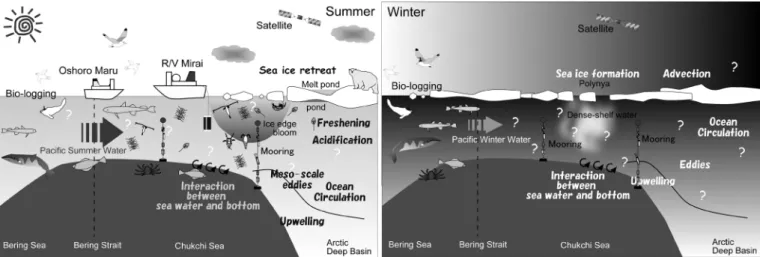
The research project, “Ecosystem studies on the Arctic Ocean with declining sea ice”, was initiated in 2011 under the GRENE Arctic Climate Change Research Project in Japan (ECOARCS/GRENE). In this project, we mainly focus on the Pacific sector of the Arctic and sub-Arctic seas (Pacific Arctic region: PAR), where various environmental changes have already accompanied the sea ice reduction. Hydrographic surveys by R/V Mirai (JAMSTEC), TS Oshoro Maru (Hokkaido University), and various ice-breakers under international collaboration were carried out. We also conducted year-round mooring observations that are useful for obtaining hydrographic, chemical and biological data even in winter time. To clarify the feeding behavior of higher trophic levels, we use the techniques of bio-logging and monitor large areas of the Arctic Ocean via satellite throughout the year. Furthermore, we are developing sea ice and marine ecosystem models for the Arctic Ocean that can diagnose in detail the ongoing changes in the Arctic marine ecosystem and may predict its future.
Figure 1. Schematics of marine ecosystem in the Pacific sector of the Arctic Ocean in summer (left) and winter (right).
Under the project, many scientific results have already published and more will be published soon. Nishino et al. (2011;
2013) shows responses of sea ice reduction to distribution of nutrients, biological pump and primary production in the PAR.
Whereas enhanced Beaufort Gyre due to sea ice reduction and accumulated freshwater prevent biological production in the Canada Basin, nutrient supply from shelves and greater light penetration enhanced biological pump outside the Beaufort Gyre, i.e., western Canada Basin and Makarov Basin. First observational evidence of ocean acidification, which is described as aragonite under-saturation, was found in the surface layer in the Canada Basin of the Arctic Ocean due to melting of sea ice [Yamamoto-Kawai et al., 2009], and such aragonite under-saturation has continued with changes in ocean conditions.
Mooring observation data in the southern Chukchi Sea suggests that bottom water was also under-saturated with respect to aragonite over half a year [Yamamoto-Kawai et al., 2015].
There are clear evidences of linkage between recent sea ice reduction and increase in primary production in the PAR (e.g., Frey et al., in the Arctic Report Card 2014). Timing of sea ice retreat (TSR) is also one of the key factors to determine distribution, size, and community structure of phytoplankton. Fujiwara et al. (2015) examined influence of TSR on phytoplankton size during the period of marginal ice zone bloom. For example, earlier sea-ice retreat was associated with a dominance of larger phytoplankton in the period. Sea ice ecosystem model with ice algae was newly incorporated into the lower-trophic marine ecosystem model, which was previously coupled with a high-resolution general ocean circulation model.
Using this model, Watanabe et al. (2015) examined seasonal and interannual variability of ice algal production and biomass in the PAR.
Regarding a change of dominant spices in the PAR, some of observational evidences were reported. Fujiwara et al.
(2014) showed a statistically significant difference in temperature between the haptophyte-dominated cluster and the other clusters, suggested that the change in the phytoplankton communities was related to TSR and the corollary increase in sea surface temperature. Northward shifts of distributions on the zooplankton community in the PAR were shown from results of TS Oshoro-maru 2008 cruises, which suggested that sea ice reduction would have a negative (positive) influence to Arctic (Pacific) species (e.g., Matsuno et al., 2011; Sasaki et al., 2015). Arctic cod, Boreogadus saida, is a key species in the Arctic Ocean food web. Kono et al. (2015) examined the distribution pattern of B. saida and other fish larvae in relation to environmental conditions in the northern Bering and Chukchi seas. The result suggested that TSR presumably affects recruitment of B. saida larvae. Nakano et al. (2015) investigated trophic responses of Arctic cod, B. saida, to changes in zooplankton and benthic invertebrate communities (prey) in the PAR. Yoon et al. (2015) suggested from results of bioenergetic model for chum salmon with 3-D marine ecosystem model that potential habitat which is an area where chum salmon could grow will expand northward into the PAR and may shrink regionally south of 71 N because the water temperature exceeded the optimal condition.
Under ECOARCS/GRENE-Arctic project, public symposium will be held in Tokyo on November 9, 2015. The outcome of the symposium will be also reported in this presentation.
References
Frey, K. E. et al, Arctic Ocean Primary Production [In Arctic Report Card 2014], http://www.arctic.noaa.gov/reportcard, 2014.
Fujiwara, A. et al, Timing of sea ice retreat can alter phytoplankton community structure in the western Arctic Ocean, Biogeosciences, 11, 1705–1716, doi:10.5194/bg-11-1705-2014, 2014.
Fujiwara, A., et al., Influence of timing of sea ice retreat on phytoplankton size during marginal ice zone bloom period in the Chukchi and Bering shelves, Biogeosciences Discuss., 12, 1-41, doi:10.5194/bgd-12-1-2015, 2015.
Kono, Y. et al., Distribution pattern of Arctic cod (Boreogadus saida) larvae in the northern Bering Seaand Chukchi Sea in the summers of 2008, 2009, and 2013, Submitted to Polar Biology, 2015.
Matsuno, K., et al., Year-to-year changes of the mesozooplankton community in the Chukchi Sea during summers of 1991, 1992 and 2007, 2008, Polar Biology, doi: 10.1007/s00300-011-0988-z, 2011
Nakano, T. et al., Diets and body condition of polar cod (Boreogadus saida) in the northern Bering Sea and Chukchi Sea, Accepted to Polar Biology, doi: 10.1007/s00300-015-1769-x, 2015.
Nishino, S. et al, Enhancement/reduction of biological pump depends on ocean circulation in the sea-ice reduction regions of the Arctic Ocean, J. Oceanogr., 67, 305-314, doi: 10.1007/s10872-011-0030-7, 2011.
Nishino, S. et al., Shoaling of the nutricline with an increase in near-freezing temperature water in the Makarov Basin, J.
Geophys. Res.-Oceans, 118, 1–15, doi: 10.1029/2012JC008234, 2013.
Sasaki, H. et al., The species habitats of Arctic small and large and Pacific copepods in the northern Bering Sea and Chukchi Sea, To be submitted to Biogeosciences Discuss., 2015.
Watanabe, E. et al, Wind-driven interannual variability of sea ice algal production over the western Arctic Chukchi Borderland, Biogeosciences Discuss., 12, 7739–7781, doi:10.5194/bgd-12-7739-2015, 2015.
Yamamoto-Kawai, M. et al, Aragonite undersaturation in the Arctic Ocean: effects of ocean acidification and sea ice melt, Science, 326, 5956, doi: 10.1126/science.1174190, 2009.
Yamamoto-Kawai, M. et al., Arctic Ocean Acidification: Results from GRENE and JOIS, The Sixth Symposium on Polar Science, Tachikawa, Tokyo, Nov. 2015.
Yoon, S. et al, Potential habitat for chum salmon (Oncorhynchus keta) in the Western Arctic based on a bioenergetics model coupled with a three-dimensional lower trophic ecosystem model, Prog. Oceanogr., 131, 146-158,
doi:10.1016/j.pocean.2014.12.009, 2015.