CLINICAL ARTICLE
Health-related quality of life among women in rural Bangladesh after surgical repair of obstetric fistula
Atsuko Imoto a,*, Akiko Matsuyama b, Beatrice Ambauen-Berger c, Sumihisa Honda a
a Department of Community-based Rehabilitation Sciences, Graduate School of Biomedical Sciences, Nagasaki University, Nagasaki, Japan
b Department of International Health Development, Graduate School of International Health Development, Nagasaki University, Nagasaki, Japan
c Department of Obstetrics and Gynaecology, LAMB-Hospital, Integrated Rural Health and Development Project, Dinajpur, Bangladesh
* Corresponding author: Atsuko Imoto
Department of Community-based Rehabilitation Sciences, Graduate School of Biomedical Sciences, Nagasaki University, 1-12-4 Sakamoto, Nagasaki 852-8523, Japan. Tel.: +81 95819 7905; fax: +81 95819 7907.
E-mail address: [email protected]
Keywords: Bangladesh; Obstetric fistula; Quality of life; Repair surgery
Synopsis: A comprehensive approach to care is needed to improve the health- related quality of life of Bangladeshi women after surgical repair of obstetric fistula.
ABSTRACT
Objective: To identify factors influencing health-related quality of life (QOL) among
women in Bangladesh after successful surgical repair of obstetric fistula.
Methods: In 2012, a cross-sectional study was conducted of women who had
undergone a successful surgical repair of an obstetric fistula at a hospital in northwest Bangladesh between June 2005, and May 2012. Sociodemographic, obstetric, and fistula-related information was collected by interview. Health-related QOL was assessed using the 36-item Short Form Health Survey (SF-36).
Results: A total of 113 women were included. Linear regression analysis showed that
discrimination experiences negatively affected four of the eight scales of SF-36, as well as both the physical and mental component summaries (P<0.05 for all). Married status had a positive effect on four scales and the mental component summary (P<0.05 for all). Age inversely affected two scales and the physical component summary (P<0.01 for all). Internalized stigma negatively influenced two scales (P<0.05 for both). Not having living children and experiencing two or more previous stillbirths negatively influenced one scale (P<0.05 for both).
Conclusion: Several factors influence health-related QOL after obstetric fistula repair;
a comprehensive approach is needed to address these issues.
1. Introduction
Obstetric fistula can occur as a serious complication of prolonged obstructed labor.
The condition is characterized by the development of an abnormal connection between the vagina and the bladder or the rectum, or both, which in turn results in constant leakage of urine and/or stool. Approximately 2 million women worldwide have obstetric fistula [1]. Furthermore, estimates suggest that 71 000 women in Bangladesh have an unrepaired obstetric fistula, with a prevalence of 1.69 per 1000 women who have ever been married [2].
Obstetric fistula causes severe physical, social, and economic problems for affected women. The fetal outcome is usually stillbirth. In addition to obstetric fistula, women might also exhibit extensive complications that affect gynecologic, skeletal,
neurological, and other systems owing to a long obstructed labor [3]. Women with obstetric fistula experience social and cultural distress, including divorce, social isolation, increasing poverty, and malnutrition [3]. Affected individuals often encounter stigmatization and discrimination [4,5]. Research shows a high risk of mental health dysfunction among women with obstetric fistula [6,7].
Surgical closure is considered to be the operational solution for the immediate physical symptoms of obstetric fistula, and most patients can be cured [8].
Nevertheless, many women still remain unaware of treatment possibilities [9]. Among those who have undergone surgical repair, health-related quality of life (QOL) is a key issue; however, most studies conducted to date have focused on QOL before rather than after surgery [4,5,7]. In the studies that have assess postsurgical QOL
[6,10–12], surgery has been shown to improve social life, physical activity, and psychological condition. However, some women who underwent obstetric fistula repair remained incontinent [10–12], and other health problems (e.g. gynatresia, amenorrhea, and leg weakness) have also been reported [13]. Furthermore, some women still experienced social and economic difficulties, stigma, or emotional pain [10,14].
At present, little is known about health-related QOL among women in Bangladesh after surgical repair of obstetric fistula. The aim of the present study was to
investigate factors influencing health-related QOL in this population.
2. Materials and methods
A cross-sectional study was conducted in three rural districts of northwest
Bangladesh (Dinajpur, Rangpur, and Nilphamari) between September 25, 2012, and November 1, 2012. Inclusion criteria for enrollment were successful fistula repair surgery (defined as no leakage on inspection and self-report at discharge from hospital) at the Lutheran Aid to Medicine in Bangladesh (LAMB) Hospital (Dinajpur, Bangladesh) between June 2005 and May 2012, fistula caused by prolonged and/or obstructed labor, and residence in one of the three named districts. Women who experienced physical or mental difficulty when completing the questionnaire were excluded. Women were also excluded if there was difficulty in locating the recorded address or they had relocated to outside the study area.
The study was approved by the research ethics committees of the LAMB Hospital,
the James P Grant School of Public Health of BRAC University (Dhaka, Bangladesh), and Nagasaki University (Nagasaki, Japan). Trained research assistants explained the present study objective, procedure, questions, risks, and benefits to each potential participant and obtained a signed consent form before data collection.
Potential participants were identified through records held at the LAMB Hospital, a private non-profit facility that has offered free treatment of obstetric fistula since 2005 for patients residing anywhere within the entire northwest region of Bangladesh.
Address information was obtained from hospital records and provided by hospital staff. Five trained research assistants, who were resident in Dinajpur and had completed primary school as a minimum level of education, visited homes, and performed interviews using a structured questionnaire.
The questionnaire obtained information about demographics (age, education, and marital status), obstetric history and fistula (number of living children, previous stillbirths, duration of incontinence before surgical repair, and time since surgery), incontinence (irrespective of the amount of leakage), and experiences of
discrimination and internalized stigma during the past 6 months. The questions posed to participants as part of this questionnaire were first prepared in English and then translated into Bengali. The questions on discrimination experiences and internalized stigma were created by review of previous studies [15,16]. Five
questions with either “yes” or “no” as the possible answer assessed discrimination experiences resulting from obstetric fistula during the previous 6-month period.
Experiences assessed included: being avoided by others; being laughed at;
awareness of being gossiped about; being verbally insulted, harassed, and/or threatened; and being physically harassed and/or threatened. To measure
internalized stigma, participants were asked 11 questions (yes/no answers) about their feelings and willingness regarding certain experiences. These questions assessed: feelings of shame; low self-esteem; self-blame; unwillingness to go to health facilities; unwillingness to go outside; unwillingness to have more children;
fear of being avoided by others; fear of being laughed at by others; fear of being gossiped about; fear of being verbally insulted, harassed, and/or threatened; and fear of being physically harassed and/or threatened (irrespective of whether or not these events had actually happened). All “yes” and “no” answers were given a score of 1 and 0, respectively. The cumulative scores were calculated individually, with a potential score of 0–5 for questions about discrimination experience and 0–11 for questions about internalized stigma. Scores of at least 1 indicated the presence of these factors.
Health-related QOL was assessed using the 36-item Short Form Health Survey (SF- 36) [17], a generic instrument that is widely used in many countries. The survey comprises eight scales that measure physical function, role limitations owing to physical problems, body pain, general health, vitality, social function, role limitations owing to emotional problems, and mental health. The SF-36 score ranges from 0 (worst possible health state) to 100 (best possible health state). The eight scales can be expressed as two dimensions: the physical component summary (PCS) and the mental component summary (MCS). The Bengali version of SF-36 developed by
Ahmed et al. [18] was used in the present study. Internal consistency of the eight SF- 36 scales was determined using a Cronbach α value greater than 0.7. In Ahmed et al.’s study [18], only the vitality scale failed to exceed the required value (α=0.59);
however, the vitality scale in the present study exceeded the 0.7 cutoff. Two other scales used in the present study—discrimination experience and internalized
stigma—also displayed good internal consistency (α=0.82 and α=0.95, respectively).
Medical charts were reviewed to obtain the cause of obstetric fistula, type of obstetric fistula (vesicovaginal and/or rectovaginal), date of surgery, and surgical outcome.
Data were analyzed using SPSS version 20.0 (IBM, Armonk, NY, USA). Descriptive statistics were used to examine the participants’ demographic, obstetric-related, and fistula-related information. The Mann–Whitney U test or Spearman correlation were used to assess the relationship between demographic, obstetric-related, and fistula- related variables and the SF-36 scores. Stepwise linear regression was performed to identify factors independently associated with the eight scales and two summary scores of the SF-36. P<0.05 was considered statistically significant.
3. Results
Of the 390 potential participants identified, 165 met the inclusion criteria and 113 participated in the present study. Among the 113 participants, 78 (69.0%) underwent obstetric fistula surgery only once and 35 (31.0%) had undergone repeat surgery.
The mean age of participants was 41.7 years (range 21–81). Most women had not completed primary school and most were married (Table 1).
Many of the women had at least one living child (Table 2). The mean number of previous stillbirths was 2.4 (range 0–11). More than half the participants had undergone surgery at least 4 years previously (Table 2). Most women had not experienced discrimination in the past 6 months; by contrast, more than three- quarters scored at least 1 on the questions related to internalized stigma (Table 2), with a median score of 3 (range 0–11). Women who had experienced discrimination were more likely to be divorced, separated, or widowed, or have no living children than were women who had not experienced such discrimination (data not shown).
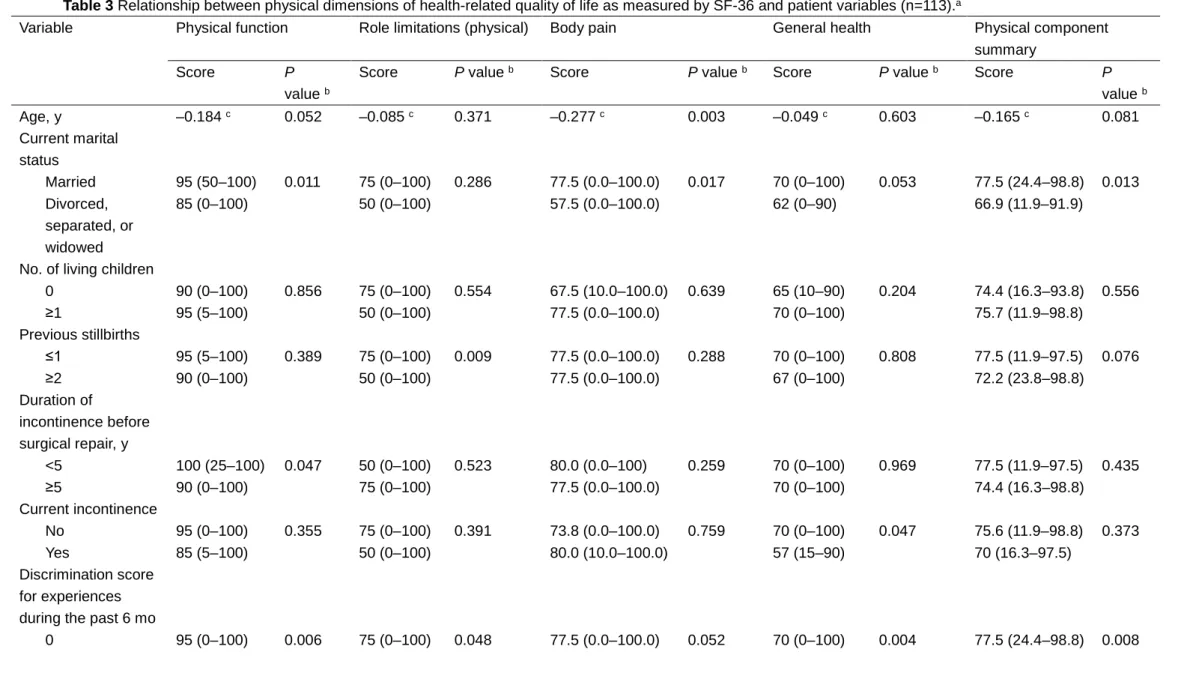
Discrimination experience was the strongest factor affecting physical dimension, exerting a substantial negative effect on all four scales and PCS, although body pain was just above the level of significance (Table 3). Being currently married positively influenced the scores for physical function, body pain, and PCS; however, the score for general health did not reach significance (Table 3). Internalized stigma was inversely associated with physical function and general health, but did not affect the summary scores (Table 3). Other variables that were negatively related to one scale in the physical dimension included age, two or more previous stillbirths, duration of incontinence before surgery of more than 5 years, and the presence of incontinence (Table 3).
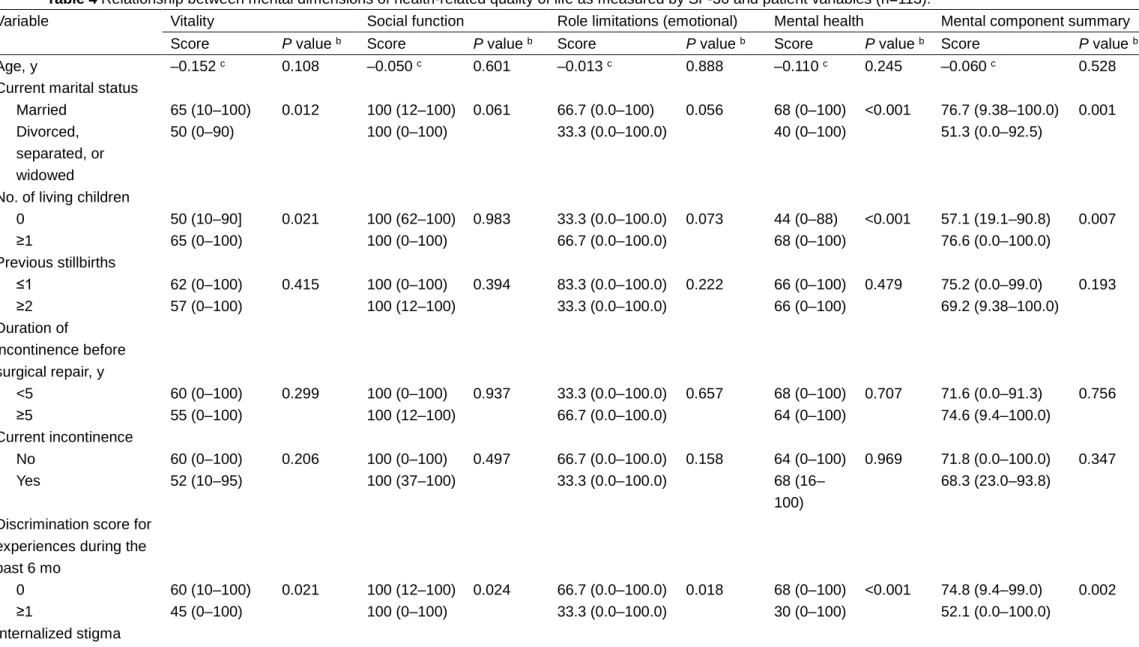
Discrimination experience was the strongest factor affecting the mental dimension, being significantly and negatively associated with all four scales of this dimension, as well as the MCS (Table 4). Being currently married was significantly and positively
associated with vitality, mental health, and MCS; however, the associations of this variable with social function and role limitations owing to emotional issues were not statistically significant (Table 4). Women with no living children had lower scores than those with living children for vitality, mental health, and MCS (Table 4). Internalized stigma was inversely correlated with vitality. No significant relationships were
observed between health-related QOL and obstetric fistula type, time elapsed since repair surgery, or level of education (data not shown).
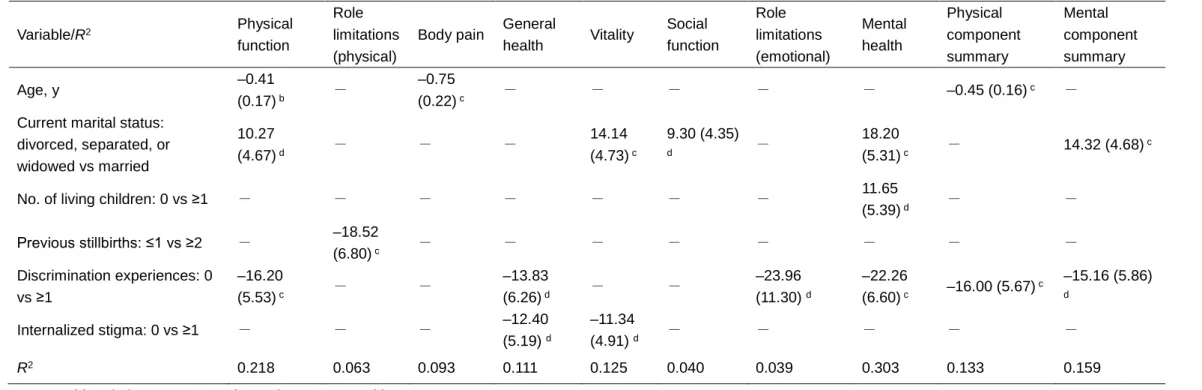
The stepwise linear regression for the SF-36 scores is presented in Table 5.
Discrimination experience was the most influential factor for health-related QOL, exerting significant negative effects on physical function, general health, role
limitations (emotional), mental health, PCS, and MCS. Being currently married had a significant positive effect on physical function, vitality, social function, mental health, and MCS. This trend was similar to that identified in the univariate analyses (Tables 3 and 4). Age had a significant inverse effect on physical function, body pain, and PCS. Internalized stigma was negatively associated with general health and vitality, but no associations were detected with PCS and MCS. Other variables significantly correlated with one scale of the SF-36 were having living children (better mental health) and experiencing two or more previous stillbirths (worsened role limitations owing to physical problems).
4. Discussion
The present study investigated factors influencing health-related QOL among women living in a rural area of Bangladesh after they had undergone surgical repair of
obstetric fistula. Variables significantly associated with health-related QOL included age (PCS), current married status (MCS), and discrimination experience (both PCS and MCS). The observed relationship between increased age and poor physical QOL is consistent with a previous report [19].
Being divorced, separated, or widowed was associated with poor mental QOL. In the traditional patriarchal society of Bangladesh, women are expected to be wives and mothers, especially in rural areas. Marriage provides women with social and
economic security, and individuals affected by obstetric fistula often lose these sources of security owing to difficulty in performing their expected roles [4,9]. Bhuiya et al. [20] reported that women who experience marital disruption in rural
Bangladesh are extremely vulnerable both socially and economically. In addition, some research has shown a relationship between marital disruption and mental disorders [21]. Childlessness is also likely to worsen mental health for similar reasons. These findings indicate a potential need for psychosocial assistance in postoperative care programs, particularly for women without a husband and/or any living children. For example, the provision of counseling by peers and professionals, literacy services, and training to offer the skills necessary to earn an income could help women to improve their economic and psychosocial status [22]. Healthcare providers need to focus on identifying these factors, as well as assessing the psychosocial status of individuals, to provide optimum care both during
hospitalization for repair surgery and/or at follow-up visits after hospital discharge.
In the present study, experiencing discrimination within the past 6 months was found
to be strongly associated with both physical and mental health. Discrimination exerts negative psychological and physiological effects on health [23]. Women with
obstetric fistula are often discriminated against and isolated by their families and communities owing to issues surrounding their incontinence (e.g. unpleasant smell) [4]. The present study revealed that 15.0% of women reported experiencing
discrimination, even after surgery. These women were more likely to be divorced, separated, or widowed, or have no living children than were women who had not experienced such discrimination. The role failure as a wife and mother, apart from the stigmatized illness itself, might perpetuate discrimination within the Bangladeshi context. Another possible reason for the perpetuation of discrimination could be that once a label is attached to a woman with an illness, that label marks her as “socially polluted” [14]; consequently, the label might be difficult to remove.
Internalized stigma was found to reduce both physical and mental health among participants in the present study, an observation consistent with previously published data. For example, one study stated that “long after corrective surgery, the women were still living with memories of fistula and made every effort to block out any
linkage to fistula” [14]. Stillbirth was also found to markedly reduce women’s physical health [24].
The present study had several limitations. Sexual functioning—an important aspect of health-related QOL after surgical repair [14]—was not included in the SF-36 questionnaire [25]. Additionally, the current findings cannot be generalized to women outside northwestern Bangladesh; the sample size was insufficient to extend the
association. Furthermore, the scales for discrimination experiences and internalized stigma used in the present study were not validated. Further research is needed to explore how people perceive and treat women with obstetric fistula after corrective surgery. A qualitative approach might contribute to determining the effects of
perpetuating discrimination in the sociocultural context of Bangladesh. Moreover, the present study did not investigate other services, such as counseling and social support, that could affect health-related QOL of women after surgery. Despite these limitations, the findings of the present study add to the data currently available on health-related QOL after obstetric fistula repair surgery.
In conclusion, the present study identified several factors that influenced health- related QOL among women who had undergone surgery for obstetric fistula. These factors must be addressed during postoperative care to improve measures of health- related QOL. A comprehensive approach is needed for fistula care in addition to standard surgical treatment.
Conflict of interest
The authors have no conflicts of interest.
References
[1] UNFPA. The Second Meeting of the Working Group for the Prevention and Treatment of Obstetric Fistula: Addis Ababa. 30 October–1 November, 2002.
http://www.unfpa.org/sites/default/files/pub-pdf/fistula_meeting02_eng.pdf. Published 2003. Accessed December 4, 2014.
[2] EngenderHealth Bangladesh Country Office. Situation Analysis of Obstetric Fistula in Bangladesh. Report: September 2003.
http://www.engenderhealth.org/files/pubs/maternal-health/bangladesh-fistula- report.pdf. Accessed November 1, 2014.
[3] Arrowsmith S, Hamlin EC, Wall LL. Obstructed labor injury complex: obstetric fistula formation and the multifaceted morbidity of maternal birth trauma in the
developing world. Obstet Gynecol Surv 1996;51(9):568–74.
[4] Mselle LT, Moland KM, Evjen-Olsen B, Mvungi A, Kohi TW. "I am nothing":
experiences of loss among women suffering from severe birth injuries in Tanzania.
BMC Womens Health 2011;11:49.
[5] Women’s Dignity Project, EngenderHealth. Risk and Resilience: Obstetric Fistula in Tanzania. http://www.engenderhealth.org/files/pubs/maternal-health/risk- and-resilience-obstetric-fistula-in-tanzania.pdf. Published November 2006. Accessed November 1, 2014.
[6] Browning A, Fentahun W, Goh JT. The impact of surgical treatment on the mental health of women with obstetric fistula. BJOG 2007;114(11):1439–41.
[7] Goh JT, Sloane KM, Krause HG, Browning A, Akhter S. Mental health screening in women with genital tract fistulae. BJOG 2005;112(9):1328–30.
[8] World Health Organization. Obstetric fistula: guiding principles for clinical management and programme development.
http://whqlibdoc.who.int/publications/2006/9241593679_eng.pdf. Published 2006.
Accessed March 22, 2015.
[9] Miller S, Lester F, Webster M, Cowan B. Obstetric fistula: a preventable tragedy. J Midwifery Womens Health 2005;50(4):286–94.
[10] Muleta M, Hamlin EC, Fantahun M, Kennedy RC, Tafesse B. Health and social problems encountered by treated and untreated obstetric fistula patients in rural Ethiopia. J Obstet Gynaecol Can 2008;30(1):44–50.
[11] Browning A, Menber B. Women with obstetric fistula in Ethiopia: a 6-month follow up after surgical treatment. BJOG 2008;115(12):1564–9.
[12] Nielsen HS, Lindberg L, Nygaard U, Aytenfisu H, Johnston OL, Sørensen B, et al. A community-based long-term follow up of women undergoing obstetric fistula repair in rural Ethiopia. BJOG 2009;116(9):1258–64.
[13] Elkins TE. Surgery for the obstetric vesicovaginal fistula: a review of 100 operations in 82 patients. Am J Obstet Gynecol 1994;170(4):1108–20.
[14] Khisa AM, Nyamongo IK. Still living with fistula: an exploratory study of the experience of women with obstetric fistula following corrective surgery in West Pokot, Kenya. Reprod Health Matters 2012;20(40):59–66.
[15] International Planned Parenthood Federation. The people living with HIV stigma index: an index to measure the stigma and discrimination experienced by people living with HIV questionnaire. London: International Planned Parenthood Federation; 2008.
[16] Hasan MT, Nath SR, Khan NS, Akram O, Gomes TM, Rashid SF. Internalized
HIV/AIDS-related stigma in a sample of HIV-positive people in Bangladesh. J Health Popul Nutr 2012;30(1):22–30.[17] Ware JE Jr, Sherbourne CD. The MOS 36-item short-form health survey (SF-36). I. Conceptual framework and item selection. Med Care 1992;30(6):473–83.
[18] Ahmed SM, Rana AK, Chowdhury M, Bhuiya A. Measuring perceived health outcomes in non-western culture: does SF-36 have a place? J Health Popul Nutr 2002;20(4):334–42.
[19] Mishra G, Schofield MJ. Norms for the physical and mental health component summary scores of the SF-36 for young, middle-aged and older Australian women.
Qual Life Res 1998;7(3):215–20.
[20] Bhuiya A, Mushtaque A, Chowdhury R, Momen M, Khatun M. Marital
disruption: determinants and consequences on the lives of women in a rural area of Bangladesh. J Health Popul Nutr 2005;23(1):82–94.
[21] Jacobi F, Wittchen HU, Holting C, Höfler M, Pfister H, Müller N, et al.
Prevalence, co-morbidity and correlates of mental disorders in the general population: results from the German Health Interview and Examination Survey (GHS). Psychol Med 2004;34(4):597–611.
[22] Mohammad RH. A community program for women's health and development:
implications for the long-term care of women with fistulas. Int J Gynecol Obstet 2007;99 Suppl 1:S137–42.
[23] Pascoe EA, Smart Richman L. Perceived discrimination and health: a meta- analytic review. Psychol Bull 2009;135(4):531–54.
[24] Erbaydar NP, Bilir N, Ozcebe LH, Vaizoğlu S, Aslan D. Evaluation of health- related quality of life of women living in a city center in the east of Turkey. Turk J Med
Sci 2011;41(2):307.
[25] Ware JE Jr, Gandek B. Overview of the SF-36 Health Survey and the International Quality of Life Assessment (IQOLA) Project. J Clin Epidemiol 1998;51(11):903–12.
Table 1 Demographic characteristics (n=113).
Characteristic No. (%)
Age, y
≤24 6 (5.3)
25–29 14 (12.4)
30–39 31 (27.4)
40–49 33 (29.2)
≥50 29 (25.7)
Level of education
None or did not complete primary school 90 (79.6)
Primary school 18 (15.9)
Secondary school or higher 5 (4.5) Current marital status
Married 84 (74.3)
Divorced, separated, or widowed 29 (25.7)
Table 2 Obstetric and fistula-related characteristics (n=113).
Abbreviations: RVF, rectovaginal fistula; VVF, vesicovaginal fistula.
a Data available for 112 women.
Characteristic No. (%)
No. of living children
0 29 (25.7)
≥1 84 (74.3)
Previous stillbirths
≤1 44 (38.9)
≥2 69 (61.1)
Fistula type
VVF 105 (92.9)
RVF or RVF plus VVF 8 (7.1)
Duration of incontinence before surgical repair, y
<5 23 (20.4)
≥5 90 (79.6)
Time since surgery, y
<1 13 (11.5)
1–3 39 (34.5)
≥4 61 (54.0)
Current incontinence
No 90 (79.6)
Yes 23 (20.4)
Discrimination score for experiences during the past 6 mo
0 96 (85.0)
≥1 17 (15.0)
Internalized stigma score for the past 6 mo a
0 26 (23.2)
≥1 86 (76.8)
Table 3 Relationship between physical dimensions of health-related quality of life as measured by SF-36 and patient variables (n=113).a
Variable Physical function Role limitations (physical) Body pain General health Physical component
summary
Score P
value b
Score P value b Score P value b Score P value b Score P
value b
Age, y –0.184 c 0.052 –0.085 c 0.371 –0.277 c 0.003 –0.049 c 0.603 –0.165 c 0.081
Current marital status
Married 95 (50–100) 0.011 75 (0–100) 0.286 77.5 (0.0–100.0) 0.017 70 (0–100) 0.053 77.5 (24.4–98.8) 0.013 Divorced,
separated, or widowed
85 (0–100) 50 (0–100) 57.5 (0.0–100.0) 62 (0–90) 66.9 (11.9–91.9)
No. of living children
0 90 (0–100) 0.856 75 (0–100) 0.554 67.5 (10.0–100.0) 0.639 65 (10–90) 0.204 74.4 (16.3–93.8) 0.556
≥1 95 (5–100) 50 (0–100) 77.5 (0.0–100.0) 70 (0–100) 75.7 (11.9–98.8)
Previous stillbirths
≤1 95 (5–100) 0.389 75 (0–100) 0.009 77.5 (0.0–100.0) 0.288 70 (0–100) 0.808 77.5 (11.9–97.5) 0.076
≥2 90 (0–100) 50 (0–100) 77.5 (0.0–100.0) 67 (0–100) 72.2 (23.8–98.8)
Duration of
incontinence before surgical repair, y
<5 100 (25–100) 0.047 50 (0–100) 0.523 80.0 (0.0–100) 0.259 70 (0–100) 0.969 77.5 (11.9–97.5) 0.435
≥5 90 (0–100) 75 (0–100) 77.5 (0.0–100.0) 70 (0–100) 74.4 (16.3–98.8)
Current incontinence
No 95 (0–100) 0.355 75 (0–100) 0.391 73.8 (0.0–100.0) 0.759 70 (0–100) 0.047 75.6 (11.9–98.8) 0.373
Yes 85 (5–100) 50 (0–100) 80.0 (10.0–100.0) 57 (15–90) 70 (16.3–97.5)
Discrimination score for experiences during the past 6 mo
0 95 (0–100) 0.006 75 (0–100) 0.048 77.5 (0.0–100.0) 0.052 70 (0–100) 0.004 77.5 (24.4–98.8) 0.008
≥1 67 (5–100) 25 (0–100) 56.3 (0.0–100.0) 45 (0–90) 50.9 (11.9–96.3) Internalized stigma
score for the past 6 mo
0 100 (60–100) 0.009 50 (0–100) 0.585 80.0 (10.0–100.0) 0.510 75 (5–100) 0.001 79.1 (33.1–97.5) 0.151
≥1 90 (0–100) 75 (0–100) 73.7 (0.0–100) 65 (0–100) 73.5 (11.9–98.8)
Abbreviation: SF-36, 36-item Short Form Health Survey.
a Values are given as median (range) unless indicated otherwise.
b Spearman rank correlation or Mann–Whitney U test.
c Spearman rank correlation coefficient.
Table 4 Relationship between mental dimensions of health-related quality of life as measured by SF-36 and patient variables (n=113).a
Variable Vitality Social function Role limitations (emotional) Mental health Mental component summary
Score P value b Score P value b Score P value b Score P value b Score P value b
Age, y –0.152 c 0.108 –0.050 c 0.601 –0.013 c 0.888 –0.110 c 0.245 –0.060 c 0.528
Current marital status
Married 65 (10–100) 0.012 100 (12–100) 0.061 66.7 (0.0–100) 0.056 68 (0–100) <0.001 76.7 (9.38–100.0) 0.001 Divorced,
separated, or widowed
50 (0–90) 100 (0–100) 33.3 (0.0–100.0) 40 (0–100) 51.3 (0.0–92.5)
No. of living children
0 50 (10–90] 0.021 100 (62–100) 0.983 33.3 (0.0–100.0) 0.073 44 (0–88) <0.001 57.1 (19.1–90.8) 0.007
≥1 65 (0–100) 100 (0–100) 66.7 (0.0–100.0) 68 (0–100) 76.6 (0.0–100.0)
Previous stillbirths
≤1 62 (0–100) 0.415 100 (0–100) 0.394 83.3 (0.0–100.0) 0.222 66 (0–100) 0.479 75.2 (0.0–99.0) 0.193
≥2 57 (0–100) 100 (12–100) 33.3 (0.0–100.0) 66 (0–100) 69.2 (9.38–100.0)
Duration of
incontinence before surgical repair, y
<5 60 (0–100) 0.299 100 (0–100) 0.937 33.3 (0.0–100.0) 0.657 68 (0–100) 0.707 71.6 (0.0–91.3) 0.756
≥5 55 (0–100) 100 (12–100) 66.7 (0.0–100.0) 64 (0–100) 74.6 (9.4–100.0)
Current incontinence
No 60 (0–100) 0.206 100 (0–100) 0.497 66.7 (0.0–100.0) 0.158 64 (0–100) 0.969 71.8 (0.0–100.0) 0.347
Yes 52 (10–95) 100 (37–100) 33.3 (0.0–100.0) 68 (16–
100)
68.3 (23.0–93.8)
Discrimination score for experiences during the past 6 mo
0 60 (10–100) 0.021 100 (12–100) 0.024 66.7 (0.0–100.0) 0.018 68 (0–100) <0.001 74.8 (9.4–99.0) 0.002
≥1 45 (0–100) 100 (0–100) 33.3 (0.0–100.0) 30 (0–100) 52.1 (0.0–100.0)
Internalized stigma
score for the past 6 mo
0 75 (10–100) 0.010 100 (25–100) 0.888 33.3 (0.0–100.0) 0.486 70 (0–100) 0.205 79.8 (23.0–93.8) 0.542
≥1 55 (0–100) 100 (0–100) 50.0 (0.0–100.0) 64 (0–100) 71.1 (0.0–100.0)
Abbreviation: SF-36, 36-item Short Form Health Survey.
a Values are given as median (range) unless indicated otherwise.
b Spearman rank correlation or Mann–Whitney U test.
c Spearman rank correlation coefficient.
Table 5 Stepwise linear regression model for SF-36 scores.a
Variable/R2 Physical
function
Role limitations (physical)
Body pain General
health Vitality Social function
Role limitations (emotional)
Mental health
Physical component summary
Mental component summary
Age, y –0.41
(0.17) b - –0.75
(0.22) c - - - - - –0.45 (0.16) c -
Current marital status:
divorced, separated, or widowed vs married
10.27
(4.67) d - - - 14.14
(4.73) c
9.30 (4.35)
d - 18.20
(5.31) c - 14.32 (4.68) c
No. of living children: 0 vs ≥1 - - - - - - - 11.65
(5.39) d - -
Previous stillbirths: ≤1 vs ≥2 - –18.52
(6.80) c - - - - - - - -
Discrimination experiences: 0 vs ≥1
–16.20
(5.53) c - - –13.83
(6.26) d - - –23.96
(11.30) d
–22.26
(6.60) c –16.00 (5.67) c –15.16 (5.86)
d
Internalized stigma: 0 vs ≥1 - - - –12.40
(5.19) d
–11.34
(4.91) d - - - - -
R2 0.218 0.063 0.093 0.111 0.125 0.040 0.039 0.303 0.133 0.159
Abbreviations: SF-36, 36-item Short Form Health Survey.
a Values given as coefficient (standard error) unless indicated otherwise.
b P<0.001.
c P<0.01.
d P<0.05.