• 検索結果がありません。

(ProgressreportoftheDIRAC-JapangroupofFiscalYear2006) TestandtuningofthenewSFDdetectorsatT11beamline Detectionofastrangemesonanditslife-timemeasurement−TestofQCDinthenon-perturbativeregion

N/A
N/A
Protected

Academic year: 2021

シェア "(ProgressreportoftheDIRAC-JapangroupofFiscalYear2006) TestandtuningofthenewSFDdetectorsatT11beamline Detectionofastrangemesonanditslife-timemeasurement−TestofQCDinthenon-perturbativeregion"

Copied!
20
0
0

読み込み中.... (全文を見る)

全文

(1)

I Introduction

The aim of the DIRAC experiment[1] at CERN PS was to test the QCD, namely the standard theory in the strong interaction sector, in the non-perturbative region by measuring a hadronic atom A

ππ

. The objective of the current study is actually an extension of the DIRAC experiment aiming at testing the QCD, where the quarks having strangeness flavor are involved. In reality, we shoot the nuclear target with a proton beam and identify the A

atom produced, and then measure the life time of this exotic atom. As the production probability of this atom is very small, we need a very intense proton beam. In addition, we need a very powerful detector which can detect this rare strange object in the environment where a lot of background particles are present. Here, the 4-th dimensional topological trigger device that we have been developing plays an important role.

Detection of a strange meson and its life-time measurement − Test of QCD in the non-perturbative region

Test and tuning of the newSFD detectors at T11 beam line

(Progress report of the DIRAC-Japan group of Fiscal Year 2006)

Fujio TAKEUTCHI

1

Masami CHIBA

2

Alexander GORIN

3

Kenji OKADA

1

Andrey RYAZANTSEV

3

Abstract

Extension of DIRAC experiment at CERN PS is approved for 3 years. The Japan group developed a new scintillating-fiber hodoscope for the new experiment, with a help of IHEP group, together with the silicon strip detectors among other things. In fiscal year 2007, a test and the tuning of the newly constructed hodoscopes, together with their new readout electronics, F1-TDC-ADC have been performed at T11 beam line of CERN PS.

!!!!!!!!!!!!!!!!!!

1

Faculty of Science, Kyoto Sangyo University, Kyoto, Japan

2

Physics Department, Tokyo metropolitan university, Tokyo, Japan

3
IHEP, Protvino, Russia

57

(2)

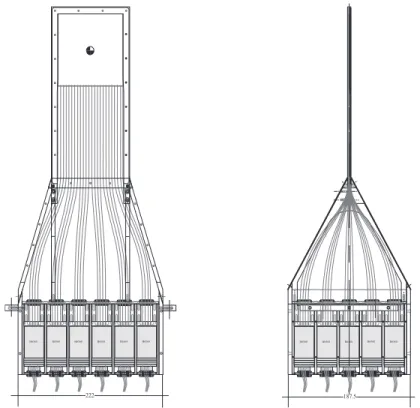
We take care of the development and the maintenance of scintillating fiber hodoscope (Scifi), silicon strip detector, and the F1-TDC-ADC circuit which is to be used for the readout. The Scifi thus developed obtained a very good reputation by virtue of its high reliability, good efficiency and spatial and time resolution. For the extension of DIRAC, we developed a new Scifi hodoscope (newSFD) using 0.28 mm φ scintillating fibers[2]. This detector has a spatial resolution of 64 µm RMS, thus almost as good as that of a MWPC. Yet it has a time resolution better than 500 ps, and efficiency as high as 98% in a very intense beam. This epoch-making detector can be used for both triggering and for tracking. The structure of this counter is sketched in Fig. 1.

Together with micro-drift chamber developed by the Dubna group, now the experiment to study the lifetime of A

became possible. The beam is approved for 3 years from now, and we plan to actively participate in developing the spectrometer, taking the data, and analyzing the data.

In this fiscal year, we produced 2 planes of newSFD, which have both the sensitive area

Fig. 1 Sketch of the newSFD structure. The sensitive area is 10 cm × 10 cm. The thickness of the material is 3mm corresponding to 1% X

0

. The design of the housing and the drawing is by K.

Kuroda (Charles University, Prague)

58 Test and tuning of the newSFD detectors at T11 beam line

(3)

of 10 cm by 10 cm. They will be used for X and Y planes in the forward detector group. The picture of those two detectors mounted on a support plate is shown in Fig. 2. Our activity of this fiscal year is to test and tune these planes, and also test the newly developed F1-TDC- ADC module for the readout of X plane.

II Experiment

We need to read out 480 channels from each of these two planes. We read out the Y plane by using the LeCroy 3377 multihit TDC together with the PSC circuit[3] which we have developed for the DIRAC experiment. The LeCroy company has stopped producing the 3377 modules, and also because the time resolution of 3377 is not so good (0.5 ns). To solve this problem, V. Karpukhin of Dubna group has designed a TDC-ADC device using the F1 module produced by ACAM Messelectronic GMBH. This device has a time resolution as good as 120 ps, and allows to obtain the timing and amplitude information for each hit at a time. The DIRAC group plans to use this device for all the detectors using photomultipliers.

We made a test of this device a couple of years ago, and we noticed some instability in the real beam environment. This time, we were going to test an improved module together with newSFD hodoscope.

We use also another oblique U plane hodoscope made with 0.5 mmφ fibers which is also Fig. 2 The picture of the 2 planes, X and Y of the newSFD mounted on the support frame. The

oblique module is the U plane.

59

Test and tuning of the newSFD detectors at T11 beam line

(4)

shown in Fig. 2. We did not do anything special for this counter this time.

Due to the funding limitations, and also because F1-TDC-ADC was not yet extensively tested, we’ve decided to use F1-TDC-ADC only for the readout of X plane, and to read out Y plane with the existing PSC together with 3377.

The main objective of this test is the tuning of X and Y planes. The planes are made of Position-Sensitive Photomultipliers (H6568MOD), but the character of those tubes vary from tube to tube. Thus we need to select the most appropriate high voltage (HV) for each

Fig. 3 Difference in height of particles measured by the A(Y) plane and by the B(X) plane (run 835, module 27-28, HVB : 747 V, HVA : 700V)

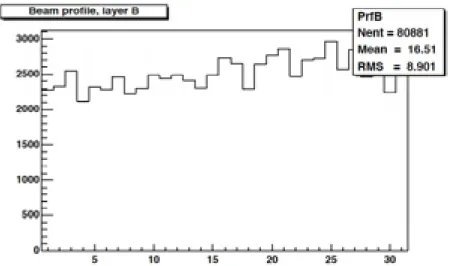
Fig. 4 Beam profile measured with the B(X) plane already tuned (run 835, module 27-28, HVX : 747 V)

60 Test and tuning of the newSFD detectors at T11 beam line

(5)

PSPM, then for the Y plane, we need to optimize the threshold of each 480 channels. The aim is to obtain a good and uniform efficiency for these planes.

In the initial plan, we wanted to tune X plane first, then to tune Y plane against the X plane. But enough number of F1-ADC-TDC were not ready by the time we obtained the test beam. Thus we’ve decided to read out also X plane using PSC + 3377 combination, and then tune the Y plane. Four modules of 3377 were available, thus we can read 2 modules, 64

Fig. 5 Beam profile measured with the A(Y) plane (run 835, module 27-28, HVY : 700V)

Fig. 6 1 : 1-efficiency of the B(X) plane already tuned (run 835, module 27-28, HVX : 747 V, HVY : 700V)

61

Test and tuning of the newSFD detectors at T11 beam line

(6)

channels from each plane. (1 module consists of 2 PSPM’s.)

The test beam is about 5 GeV/c and consists of pions, muons and electrons. We overlap X and Y plane exactly aligned, so that one beam particle goes through two planes at the same height. We lower the HV of the reference plane (called A plane) so that all the particles detected by the A plane is detected by the tested plane (called B plane). By counting the number of particles first defined by the A plane, and then detected by the B plane, we

Fig. 7 1 : 1-efficiency of the A(Y) plane (run 835, module 27-28, HVX : 747 V, HVY : 700V)

Fig. 8 Global efficiency of the B(X) plane already tuned (run 835, module 27-28, HVX : 747 V, HVY : 700V)

62 Test and tuning of the newSFD detectors at T11 beam line

(7)

measure the efficiency of the B plane.

Fig. 3 shows the difference in height of particles measured by the A plane and by the B plane. This figure shows that the geometrical alignment of these planes is quasi-perfect. Fig.

4 and Fig. 5 show the beam profile measured with the B plane and the A plane, respectively.

The HV of the A plane is lower, and thus the efficiency is lower, and the statistical fluctuation is larger in the A plane.

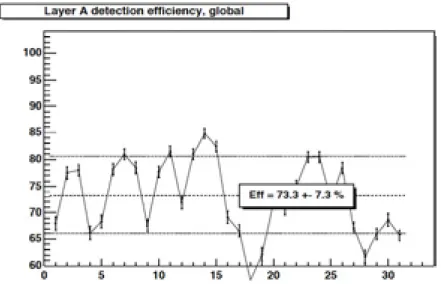
Fig. 9 Global efficiency of the A(Y) plane (run 835, module 27-28, HVX : 747 V, HVY : 700V)

Fig. 10 Multiplicity of the B(X) plane already tuned (run 835, module 27-28, HVX : 747 V, HVY : 700V)

63

Test and tuning of the newSFD detectors at T11 beam line

(8)

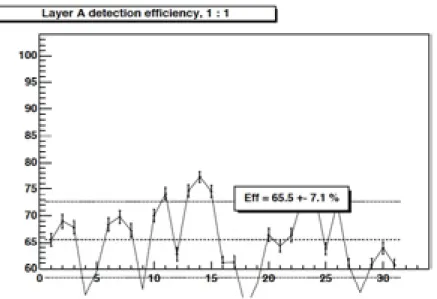
We will show the typical result of the tuning. Fig. 6 and Fig. 7 show the so-called 1 : 1- efficiency of each plane. The 1 : 1-efficiency requires that a particle detected by a reference counter is detected in the tested counter exactly at the same height, otherwise considered as a loss. Naturally there is a multiple scattering of the test beam particles by the hodoscope planes, and the particles defined by the reference counter are spread on the tested counter.

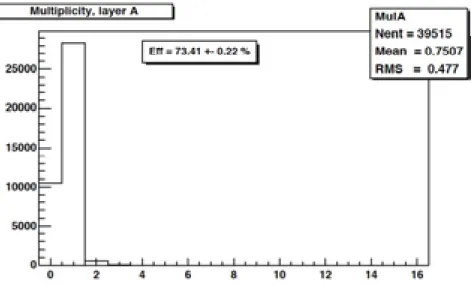
Fig. 11 Multiplicity of the A(Y) plane (run 835, HVX : 747 V, HVY : 700V)

Fig. 12 Global efficiency of the Y plane already tuned (run 830, module 29-30, HVY : 780 V, HVA : 700V)

64 Test and tuning of the newSFD detectors at T11 beam line

(9)

Wall B-layer

835.run HVB: 747V HVA: 700V

The efficiency where one considers efficient those particles which are defined by the reference counter, and are detected by the tested counter at any height is called global efficiency. Figs. 8 and 9 show the global efficiency of the B plane and the A plane respectively. The efficiency of the tested plane B is very good, as good as 98.9 %.

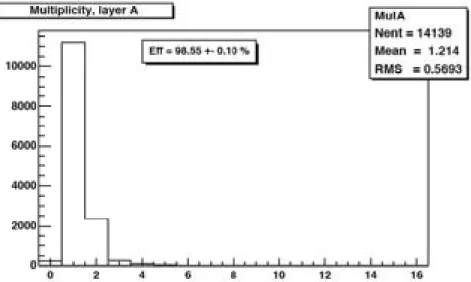
The number of channels which fire when one particle goes through a plane is called multiplicity. If a plane is to be used for the triggering, a lower multiplicity is desirable, as Fig. 13 Multiplicity of the Y plane already tuned (run 830, module 29-30, HVY : 780 V, HVA : 700V)

Fig. 14 Correlation between the heights of the beam particles measured by the overlaped two planes (run 835, module 27-28, HVX : 747 V, HVY : 700V)

65

Test and tuning of the newSFD detectors at T11 beam line

(10)

one can determine more easily the number of particles hitting the plane. Thus the PSC acts to lower the multiplicity by sacrificing a little bit the efficiency. F1-ADC-TDC does not have such a feature. Figs. 10 and 11 show the multiplicity measured by the B plane and the A plane, respectively. The tuned plane B shows a multiplicity of about 1.18, which is a very good value. In the plane A, the channel 0 indicates about 10000 events. This corresponds to the inefficiency of the A plane. In this measurement, the trigger signal is taken from the B Fig. 15 The pulse-height spectrum measured at threshold 50 mV of F1-TDC-ADC with X plane (run

865, module 9-10, HVX : 740V, HVY : 700V)

Fig. 16 The pulse-height spectrum measured at threshold 20 mV of F1-TDC-ADC with X plane (run 864, module 9-10, HVX : 740V, HVY : 700V)

66 Test and tuning of the newSFD detectors at T11 beam line

(11)

plane. The low multiplicity of the A plane demonstrates the good performance of PSC.

We did the same exercise with Y plane as tested plane, and the results are shown in Figs.

12 and 13. Fig. 12 indicates that the global efficiency is 98.6%, and the multiplicity shown in Fig. 13 is about 1.2, which is both acceptable.

Fig. 14 shows the correlation between the heights of the beam particles measured by the overlapped two planes.

Fig. 17 The pulse-height spectrum measured at threshold 10 mV of F1-TDC-ADC with X plane (run 862, module 9-10, HVX : 740V, HVY : 700V)

Fig. 18 The pulse-height spectrum measured at threshold 5 mV of F1-TDC-ADC with X plane (run 863, module 9-10, HVX : 740V, HVY : 700V)

67

Test and tuning of the newSFD detectors at T11 beam line

(12)

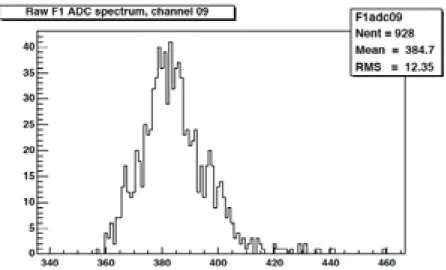
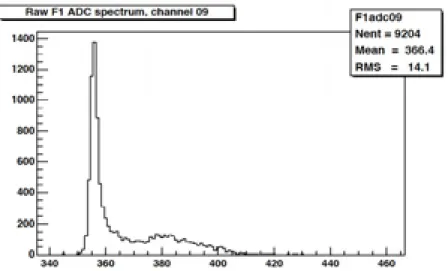
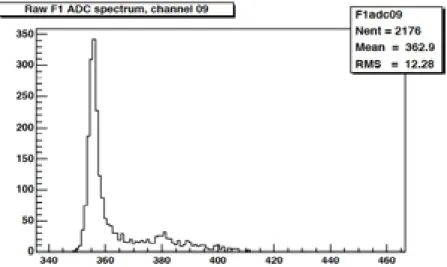
Now, we switch to the readout using F1-TDC-ADC module. The pulse-height spectrum measured with the module is shown in Fig. 15. The instability of the F1-TDC-ADC was observed when the threshold was low in the past experimental test. In this measurement shown in Fig. 15, the threshold was set to 50 mV, relatively high. We show the pulse-height spectra observed when we lower the threshold to 20, 10, 5, 3, up to 1 mV in Figs. 16 - 20.

Below 3 mV thresholds, plenty of noise signals make the detection of real hits impossible.

Fig. 19 The pulse-height spectrum measured at threshold 3 mV of F1-TDC-ADC with X plane (run 860, module 9-10, HVX : 740V, HVY : 700V)

Fig. 20 The pulse-height spectrum measured at threshold 1 mV of F1-TDC-ADC with X plane (run 861, module 9-10, HVX : 740V, HVY : 700V)

68 Test and tuning of the newSFD detectors at T11 beam line

(13)

We acquire the data with a trigger signal made with one of the beam counters. Thus, the timing of the particles observed by the X plane should show a narrow peak. Figs. 21, 22 and 23 show the timing of the beam particles when the threshold was 5, 10 and 20 mV, respectively. At threshold 5 mV, we see that fairly many noise signals make this spectrum dirty. The beam profile has been measured with different thresholds and are shown in Figs.

24-26. At 3 mV, peaks due to the noise (or instability) are observed. In this measurement the Fig. 21 Timing of the beam particles (plane X) when the threshold of F1-TDC-ADC was 5 mV (run

863, module 9-10, HVX : 740V, HVY : 700V)

Fig. 22 Timing of the beam particles (plane X) when the threshold of F1-TDC-ADC was 10 mV (run 862, module 9-10, HVX : 740V, HVY : 700V)

69

Test and tuning of the newSFD detectors at T11 beam line

(14)

channel 14 was defective.

Which threshold would allow us a reasonable measurement in the real experimental environment? This question is rather difficult to answer. We should probably decide it with the absolute efficiency of the plane corresponding to the threshold. At 30 mV, the global efficiency of the X plane is about 98.3%, as shown in Fig. 27, thus a little lower than when is was read out with PSC + 3377 combination. The problem is the multiplicity shown in Fig. 28.

Fig. 23 Timing of the beam particles (plane X) when the threshold of F1-TDC-ADC was 20 mV (run 864, module 9-10, HVX : 740V, HVY : 700V)

Fig. 24 Beam profile has been measured with plane X at 3 mV of the threshold of F1-TDC-ADC (run 860, module 9-10, HVX : 740V, HVY : 700V)

70 Test and tuning of the newSFD detectors at T11 beam line

(15)

It is as high as 1.6. The threshold is always at 30 mV. If one reduces the threshold to obtain a better efficiency, the multiplicity will increase. If one uses the counter only for tracking, then this high multiplicity might not be such a problem. It would, however, be necessary to apply an off-line PSC algorithm if one want to know the number of particles going through the detector (see next chapter).

In Fig. 29 are shown the efficiency of the tuned plane read out with F1-TDC-ADC and Fig. 25 Beam profile has been measured with plane X at 5 mV of the threshold of F1-TDC-ADC (run

863, module 9-10, HVX : 740V, HVY : 700V)

Fig. 26 Beam profile has been measured with plane X at 10 mV of the threshold of F1-TDC-ADC (run 862, module 9-10, HVX : 740V, HVY : 700V)

71

Test and tuning of the newSFD detectors at T11 beam line

(16)

Multiplicity B-layer

854.run thresh = 30 mV Efficiency B-layer

854.run thresh = 30 mV

PSC + 3377 combination. From the point of view of the uniformity, PSC gives a much better result. Fig. 30 compares also the multiplicity in two cases.

Where are they recorded, the high multiplicity hits? To see it, Fig. 31 records the Fig. 27 Global efficiency of the X plane at 30 mV of the threshold of F1-TDC-ADC (run 854, module

9-10, HVX : 740V, HVY : 700V)

fig. 28 Multiplicity of the X plane at 30 mV of the threshold of F1-TDC-ADC (run 854, module 9-10, HVX : 740V, HVY : 700V)

72 Test and tuning of the newSFD detectors at T11 beam line

(17)

correlation between the heights measured in two counters. This time, the histogram is incremented multiple times when a multiple hits are recorded. It is not as clean as Fig. 12, but we do not observe hits at very far positions, far from the diagonal line.

One of the major reasons for the introduction of F1-TDC-ADC was its good time resolution. Fig. 32 shows again the timing of the beam particle. The FWHM of the peak is 21 channels. The nominal precision of the F1-TDC is 120 ps/chan, but when we measured in the realistic environment, it was 136.3 ps/chan. By using this the FWHM of the peak is Fig. 29 Efficiency of the X plane already tuned. Comparison between the readout with F1-TDC-ADC (top) at threshold 30 mV (run 854, module 9-10, HVX : 740V, HVY : 700V) and PSC-3377 combination (bottom) (run 835, module 27-28, HVX : 747V, HVY : 700V)

73

Test and tuning of the newSFD detectors at T11 beam line

(18)

either 2.52 ns or 2.86 ns. This includes the timing uncertainty of the beam counter.

III Conclusions

The two planes X and Y are successfully tuned to be used for the experiment starting from 2007. Also the threshold tuning of PSC looks perfect. The behavior as well as the threshold setting of the newly introduced F1-TDC-ADC module is yet to be studied more carefully.

Fig. 30 Multiplicity of the X plane already tuned. Comparison between the readout with F1-TDC-ADC (top) at threshold 30 mV (run 854, module 9-10, HVX : 740V, HVY : 700V) and PSC-3377 combination (bottom) (run 835, module 27-28, HVX : 747V, HVY : 700V)

74 Test and tuning of the newSFD detectors at T11 beam line

(19)

Timing 864.run thresh = 20 mV

21 channels nominal 120 ps/chan -> 2.52 ns (beam + ch09) measured in 2004 136.3 ps/chan -> 2.86 ns (beam + ch09) Where are the

high-multiplicity events?

854.run thresh = 30 mV Sorry! no good statistics!

In Fig. 33 is shown the efficiency and the multiplicity of newSFD read out using F1-TDC- ADC, obtained by using an offline PSC algorithm. This study was made to see if, by setting the F1-TDC-ADC at an appropriate position, relatively low, one can still potentially obtain Fig. 31 Correlation between the heights of the beam particles measured by the overlaped two planes.

The X plane has been read out with F1-TDC-ADC at threshold 30mV. The Y plane has been read out with PSC-3377 combination.(run 854, module 9-10, HVX : 740V, HVY : 700V)

Fig. 32 Timing of the beam particle measured with X plane read out with F1-TDC-ADC at threshold 20 mV (run 864, module 9-10, HVX : 740V, HVY : 700V)

75

Test and tuning of the newSFD detectors at T11 beam line

(20)

Offline PSC

multiplicity

global efficiency

Threshold  (arbitrary unit)

offline the good performance of PSC, recovering from the high multiplicity, and not too much sacrificing the efficiency. It seems at the threshold 55 (arbitrary unit) a multiplicity of 1.08 is obtainable, leaving the efficiency as high as 0.98.

References

[1] First measurement of the π

π

atom lifetime, B. Adeva et al. ,Phys. Letters B 619 (2005) 50-60 ;

Detection of π

π

atoms with the DIRAC spectrometer at CERN, B. Adeva et al., Journal of Physics G 30 (2004) 1929-1946 ;

DIRAC : A high resolution spectrometer for pionium detection, B. Adeva et al., Nucl.

Inst. Meth. in Phys. Res. A515 (2003)467-496

The multilevel trigger system of the dirac experiment, L. Afanasyev et al., Nucl.

Instrum.Meth. A491 (2002) 376-389

[2] High resolution scintillating-fibre hodoscope and its readout using Peak-sensing algorithm, A. Gorin et al., Nucl. Instr. Meth. in Phys. Res. A566 (2006) 500-515

[3] Peak-sensing discriminator for multichannel detectors with cross-talk, A. Gorin et al., Nucl. Instr. Meth. in Phys. Res. A452 (2000) 280-288

Fig. 33 Efficiency and the multiplicity of newSFD read out using F1-TDC-ADC, obtained by using an offline PSC algorithm as functions of the PSC threshold (arbitrary unit)

76 Test and tuning of the newSFD detectors at T11 beam line

Fig. 1 Sketch of the newSFD structure. The sensitive area is 10 cm × 10 cm. The thickness of the material is 3mm corresponding to 1% X 0
Fig. 4 Beam profile measured with the B(X) plane already tuned (run 835, module 27-28, HVX : 747 V)
Fig. 5 Beam profile measured with the A(Y) plane (run 835, module 27-28, HVY : 700V)
Fig. 7 1 : 1-efficiency of the A(Y) plane (run 835, module 27-28, HVX : 747 V, HVY : 700V)
+7

参照

関連したドキュメント

Eskandani, “Stability of a mixed additive and cubic functional equation in quasi- Banach spaces,” Journal of Mathematical Analysis and Applications, vol.. Eshaghi Gordji, “Stability

An easy-to-use procedure is presented for improving the ε-constraint method for computing the efficient frontier of the portfolio selection problem endowed with additional cardinality

Let X be a smooth projective variety defined over an algebraically closed field k of positive characteristic.. By our assumption the image of f contains

In section 2 we present the model in its original form and establish an equivalent formulation using boundary integrals. This is then used to devise a semi-implicit algorithm

Kilbas; Conditions of the existence of a classical solution of a Cauchy type problem for the diffusion equation with the Riemann-Liouville partial derivative, Differential Equations,

Then it follows immediately from a suitable version of “Hensel’s Lemma” [cf., e.g., the argument of [4], Lemma 2.1] that S may be obtained, as the notation suggests, as the m A

Our method of proof can also be used to recover the rational homotopy of L K(2) S 0 as well as the chromatic splitting conjecture at primes p > 3 [16]; we only need to use the

The proof uses a set up of Seiberg Witten theory that replaces generic metrics by the construction of a localised Euler class of an infinite dimensional bundle with a Fredholm