
• 検索結果がありません。

丹下 基生 ( 筑波大学 )

N/A
N/A
Protected

Academic year: 2021

シェア "丹下 基生 ( 筑波大学 )"

Copied!
4
0
0

読み込み中.... (全文を見る)

全文

(1)

Nonorientable genus of a knot in punctured CP 2

佐藤 光樹 (東京学芸大学)

1

丹下 基生 ( 筑波大学 )

2

概 要

本稿では,

S

3内の結び目

K

を境界にもつ

nCP

2

B ˚

4内の向き付け不可能曲 面

F

について考察し、

F

null-homologous

な場合に得られた不等式

β

1

(F ) σ(K)

2 + d(S

31

(K)) n

およびその応用よって得られた結果ついて紹介する。

1. 結び目の向き付け不可能 4 次元種数とその拡張

本稿を通して, category は smooth category を仮定する.また 4 次元多様体は全て単 連結で向き付け可能,かつ向き付けられているもののみを考え,曲面はコンパクトな もののみを考える.さらに, M を 4 次元閉多様体とするとき, M から 4 次元開球体を 取り除いた空間を puncM と表し, Mn 個連結和した多様体を nM と表す.

結び目 K の向き付け不可能 4 次元種数 γ

4

(K) とは、 K を境界にもつ B

4

内の向け付 け不可能曲面の 1 次ベッチ数の最小値のことをいう. γ

4

(K) については, [2] , [3] , [5] , [12] ,および [13] において研究が行われてきた.本節では, γ

4

(K) の定義を次のように 拡張する.

定義

M を 4 次元閉多様体, K∂(puncM ) 内の結び目とする.このとき, γ

M

(K) お よび γ

M0

(K) を以下のように定義する.

γ

M

(K) = min

{

β

1

(F )

FpuncM 内の向き付け不可能曲面

∂F = K

}

γ

M0

(K) = min

 

 

 

β

1

(F )

FpuncM 内の向き付け不可能曲面

∂F = K

[F, ∂F ] = 0 H

2

(puncM, ∂(puncM ); Z

2

)

 

 

 

定義から,任意の KM に対して以下の 4 つの関係式がなりたつことは容易に確かめ られる.ただし, O は自明な結び目を, KK の鏡像を表す.

1. γ

4

(K) = γ

S4

(K) = γ

S04

(K) 2. γ

M

(O) = γ

M0

(O) = 1

3. γ

M

(K) γ

M0

(K) γ

S4

(K ) 4. γ

M

(K) = γ

M

(K)

1〒

184-8501

 東京都小金井市貫井北町4-1-1 東京学芸大学 大学院教育学研究科

e-mail: [email protected]

2

e-mail: [email protected]

(2)

+1

{

2k

{

2k

-1 full-twist handle

  slide

+1

図 1: ( 2k, 2k 1)- トーラス結び目 T

2k,2k1

については, γ

S4

(T

2k,2k1

) = k 1 , γ

CP0 2

(T

2k,2k1

) = 1 となることが知られている.

2. 問題の提示と主結果

本節以降では,次の問題について考察する.

問題

1 γ

M

および γ

M0

は任意に大きい値をとり得るか?

この問題の解答は M の選び方に依存する.例えば,鈴木氏は [11] において,任意の結 び目 KpuncS

2

× S

2

および puncCP

2

#CP

2

内の円板の境界になることを示している.

このことから, γ

S2×S2

(K) = γ

CP2#CP2

(K) = 1 が任意の K について成り立つことがわ かる.

一方で,2012 年に Batson 氏は [2] の中で次の定理を用いて γ

S4

におけるこの問題を 肯定的に解決した.

定理

1 (Batson,[2]) K S

3

を結び目とする.このとき,次の不等式が成り立つ.

γ

S4

(K) σ(K)

2 + d(S

13

(K ))

ここで, σ(K ) は K の符号数, d(S

13

(K)) は K に沿った 1-surgery により得られる 3 次元 多様体の d 不変量を表す.

d 不変量は Heegaard Floer homology から得られる有理係数ホモロジー球面の不変量

であり, Ozsv´ ath 氏と Szab´ o 氏 [6] によって定義されている. Batson 氏の結果より以前 は 3 より大きい γ

S4

を持つ結び目が発見されていなかったことを考えると,この定理は 向き付け不可能種数の研究に飛躍的な進歩をもたらしている.

本研究では,定理1を次のように γ

nCP0 2

に拡張した.

定理

2 K ∂(punc(nCP

2

)) を結び目とする.このとき,次の不等式が成り立つ.

γ

nCP0 2

(K ) σ(K )

2 + d(S

13

(K)) n

定理 2 を用いることで, γ

nCP0 2

の場合において問題1の肯定的解決が得られた.

定理

3 任意の自然数 k について,γ

nCP0 2

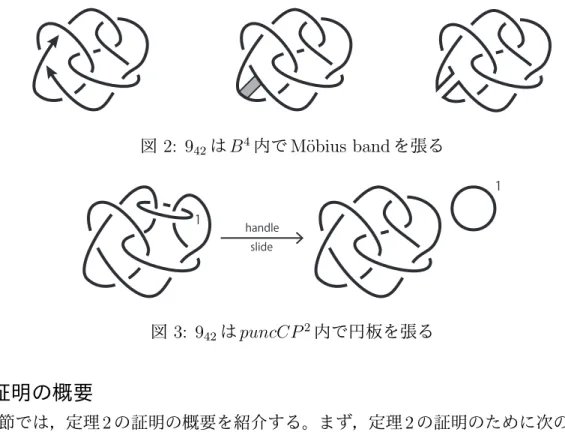
(K) = k をみたすような結び目 K が存在する.

実際, k に対して Rolfsen table[9] の 9

42

という結び目を (n + k) 個だけ連結和した結

び目を K とすれば定理 3 は示されることがわかる.このとき,σ(K ) は容易に計算でき

るが, d(S

13

(K )) の計算のためには工夫を要している.

(3)

図 2: 9

42

B

4

内で M¨ obius band を張る

1

1

handle   slide

図 3: 9

42

puncCP

2

内で円板を張る

3. 証明の概要

本節では,定理 2 の証明の概要を紹介する。まず,定理 2 の証明のために次の補題を 証明した.

補題

4 K ∂(punc(nCP

2

)) を結び目, F punc(nCP

2

) を K を境界にもつ向き付け 不可能曲面とする.このとき,次の不等式が成り立つ.

β

1

(F ) e(F )

2 2d(S

31

(K)) ここで,e(F ) は F の法オイラー数を表す.

この不等式は Batson が [2] で γ

S4

の場合において示した不等式とまったく同じもので ある.また,この不等式自体は γ

nCP2

の lower bound にもなっている.しかし, e(F ) が F の選び方に依存するためこのままでは種数を評価することができない.そこで我々 は次の定理を用いた.

定理
5 (Yasuhara, [13] ) M を 4 次元閉多様体, K (puncM ) を結び目, F puncMK を境界にもつ向き付け不可能曲面とする.このとき, [F, ∂F ] = 0 H

2

(puncM, ∂(puncM ); Z

2

) ならば,次の不等式が成り立つ.

β

2

(M ) + β

1

(F ) σ(K ) + σ(M) e(F ) 2

ただし, σ(M ) は M の符号数を表す.

この定理を nCP

2

に適用し,e(F ) の項を削除することで定理 2 の不等式が得られる.

参考文献

[1] M. Ait Nouh. Genera and degrees of torus knots in CP

2

, Journal of Knot Theory and Its Ramifications Vol.18, No.9(2009) 1299-1312.

[2] J. Batson. Nonorientable four-ball genus can be arbitrarily large, arXiv:1204.1985(2012).

(4)

[3] P.M. Gilmer and C. Livingston. The nonorientable 4-genus of knots, Journal of the Lon- don Mathmatical 84(2011), 559-577.

[4] S.J. Kaplan. Twisting to algebraically slice knots, Pacific Journal of Mathematics Vol.102, No.1, 55-59.

[5] H. Murakami and A. Yasuhara. Four-genus and four-dimensional clasp number of a knot, Proc. Amer. Math. Soc. 128(2000), 3693-3699.

[6] P. Ozsv´ ath and Z. Szab´ o. Absolutely graded Floer homologies and intersection forms for four-manifolds with boundary, Advances in Mathematiccs 173(2003), 179-261.

[7] P. Ozsv´ ath and Z. Szab´ o. Holomorphic disks and knot invariants, Advances in Mathe- maticcs 186(2004), 58-116.

[8] T.D. Peters. A concordance invariant from the Floer homology of ± 1 surgeries, arXiv:1003.3038(2010).

[9] D. Rolfsen. Knots and links, Mathematics Lecture Series, No. 7. Publish or Perish, Inc., Berkeley, Calif., 1976. MR 58:24236; corrected reprint MR 95c:57018

[10] V.A. Rohlin. Two-dimentional submanifolds of four-dimentional manifolds, Funct. Anal.

Appl. 5(1971), 39-48.

[11] S. Suzuki. Local knots of 2-sphere in 4-manifolds, Proc. Japan Acad. 45 (1969), 34-38.

[12] O.Viro. Positioning in codimension 2, and the boundary, Uspehi Mat. Nauk 30(1975), 231-232.

[13] A. Yasuhara. Connecting lemmas and representing homology classes of simply connected

4-manifolds, Tokyo Journal of Mathematics 19 (1996), 245-261.

図 2: 9 42 は B 4 内で M¨ obius band を張る 1 1 handle   slide 図 3: 9 42 は puncCP 2 内で円板を張る 3

参照

関連したドキュメント

In addition, this invariant is used to show that many symplectic 4–manifolds have nontrivial homology classes which are represented by infinitely many pairwise inequivalent

Moreover, it is important to note that the spinodal decomposition and the subsequent coarsening process are not only accelerated by temperature (as, in general, diffusion always is)

If ζ is grounded over all of Spec(R) we will simply say it is grounded. We recall that A ic denotes the class of integrally closed domains, and K ic denotes its limit closure.

(ii) The cases discussed in Theorem 1.1 were chosen as representative of the basic method, but there are pairs of positive integers not covered by the conditions of Theorem 1.1

de la CAL, Using stochastic processes for studying Bernstein-type operators, Proceedings of the Second International Conference in Functional Analysis and Approximation The-

[3] JI-CHANG KUANG, Applied Inequalities, 2nd edition, Hunan Education Press, Changsha, China, 1993J. FINK, Classical and New Inequalities in Analysis, Kluwer Academic

In section 4, with the help of the affine deviation tensor, first we introduce the basic curvature data (affine and projective curvatures, Berwald curvature, Douglas curvature) of

Classical definitions of locally complete intersection (l.c.i.) homomor- phisms of commutative rings are limited to maps that are essentially of finite type, or flat.. The