原子力バックエンド研究 June 2010
Sorption behavior of thorium onto montmorillonite and illite
Yoshihisa IIDA*1 Logan BARR*1 Tetsuji YAMAGUCHI*1 Ko HEMMI*1
高レベル放射性廃棄物処分の安全評価において,Th-229は重要核種の一つである.モンモリロナイトおよびイライト を対象としたThのバッチ収着試験を,pHおよび炭酸濃度をパラメータとして実施した.モンモリロナイトに対する分 配係数はイライトに比べ高い値を示した.分配係数は炭酸濃度の上昇に伴い減少し,pH 10付近で極小値を示した.
Thの収着挙動を,静電項を考慮しない表面錯体モデル(NEM)により解析した.モデル計算は実験結果をよく説明し,
分配係数の減少は、Thの水酸化炭酸錯体形成による溶存種の安定化によるものであることが示唆された.
Keywords: トリウム,炭酸,分配係数,表面錯体,モンモリロナイト,イライト
Thorium (Th) –229 is one of the important radionuclides for the performance assessment calculations for high–level radioactive waste repositories. The sorption behavior of Th onto montmorillonite and illite were investigated by batch sorption experiments.
Experiments were carried out under variable pH and carbonate concentrations. The sorbability of montmorillonite was higher than that of illite. Distribution coefficients, Kd (m3 kg-1), decreased with increased carbonate concentrations and showed the minimal value at around pH 10.
The sorption behaviors of Th were analyzed by the non-electrostatic surface complex model with PHREEQC computer program.
The model calculations were able to explain the experimental results reasonably well. The decreases of Kd was likely due to the stabilization of aqueous species by hydroxo–carbonate complexations in the solutions.
Keywords: thorium, carbonate, distribution coefficient, surface complex, montmorillonite, illite
1 Introduction
Retardation of radionuclide migration by sorption in natural barrier systems is one of the important factors that influence the performance of a radioactive waste disposal system.
Performance assessment calculations for hypothetical high-level radioactive waste (HLW) repositories [1] show that 229Th which is a member of the neptunium series (4n+1) is one of the radionuclides dominating the long-term radiological hazard.
Thorium exists only in the tetravalent oxidation state independent of the redox conditions of the groundwater [2,3].
The carbonate concentrations in reference groundwaters for the performance assessment of HLW repositories are 3.4 × 10⁻³ mol dm-3 (fresh type) and 1.2 × 10⁻² mol dm-3 (saline type) [4], and that in the reference groundwater at Horonobe area are 3.0 × 10⁻² mol dm-3 [5]. The dominant aqueous species of Th in the reference groundwaters were estimated to be hydroxide- carbonate complexes from thermodynamic calculations [6]. In the long term, the sorption behavior of Th would change because the pH and carbonate concentration of groundwater is likely to be changed [4-7]. Hence, it is necessary to understand the sorption behavior of Th under variable groundwater conditions for a long–term safety assessment of geological disposal of HLW.
Clay minerals such as smectite and illite are important components in sedimentary rocks because of their strong radionuclide retention properties [5,8,9]. Several sorption data of Th onto clay minerals have been reported [9-11]. For montmorillonite which is a member of the smectite group, sorption data of Th in 0.1 mol dm-3 NaClO4 solutions were reported by Bradbury and Baeyens [11] and the pH dependence
of the sorption has been modeled [12]. Bradbury and Baeyens [9] also reported the sorption data of Th onto illite in 0.1 mol dm-3 NaClO4 solutions and modeled the pH dependence of the sorption. However, the influence of carbonate on the sorption has not been clarified.
In the present study, sorption data of Th onto montmorillonite and illite were obtained by batch sorption experiments.
Experiments were carried out under variable pH and carbonate concentrations. The sorption behaviors of Th were analyzed by surface complexation model (SCM) with a widely-used and verified geochemical code, PHREEQC ver. 3.3.0 [13].
2 Experimental
2.1 Experimental solutions
A Th stock solution was prepared by the following procedure.
Thorium nitrate hydrate (Th(NO3)4nH2O, 4 ≤ n ≤ 5) was purchased from Fluka Chemika Co. One gram of Th(NO3)4nH2O was dissolved in 10 cm3 volume of 0.1 mol dm-3 hydrochloric acid (HCl). Diluting 0.1 cm3 volume of the solution to 10 cm3 with 0.1 mol dm-3 HCl, Th stock solution was prepared (the concentration of Th is approximately 210-3 mol dm−3). Experimental solutions were prepared in a controlled- atmosphere glove box under Ar to avoid dissolution of carbon dioxide gas from the atmosphere. Three types of solutions, 0.01, 0.05, and 0.1 mol dm-3 sodium hydrogen carbonate (NaHCO3), were prepared. Considering the solubility of Th [2,3], experimental solutions were prepared by adding the Th stock solution into the above-mentioned NaHCO3 solutions. The initial concentrations of Th in the experimental solutions were determined by inductively coupled plasma mass spectrometry (ICP-MS, ELAN DRC, PerkinElmer Inc.) to be 2.110-9, 4.210-9 and 2.210-8 mol dm-3 for the 0.01, 0.05 and 0.1 mol dm-3 NaHCO3 solutions, respectively.
2.2 Solid samples
The employed montmorillonite material was Kunipia F
Sorption behavior of thorium onto illite and montmorillonite and illite by Yoshihisa IIDA ([email protected]), Logan BARR, Tetsuji YAMAGUCHI, Ko HEMMI
*1 日本原子力研究開発機構 安全研究センター 廃棄物安全研究グループ Waste Safety Research Group, Nuclear Safety Research Center, Japan Atomic Energy Agency
〒319-1195 茨城県那珂郡東海村白方2-4 (Received 5 November 2015; accepted 21 January 2016)
原子力バックエンド研究 June 2010 montmorillonite (Kunimine Industries Co. Ltd.). Illite sample in
granulated form (< 100 μm) was purchased from Nichika Inc.
These samples were used without pretreatment. The specific surface area of illite sample was measured as 9.1 m2 g-1 by the Brunauer-Emmett-Teller (BET) N2 gas adsorption method [14]
(NOVA 1200e, Quantachrome Instruments). The specific surface area of Kunipia F has been measured by the BET method and ethylene glycol monoethyl ether (EGME) adsorption method by Ohashi et al. [15]. The measured specific surface areas by the BET method were 45 m2 g-1 for coarse-grained samples and 62 m2 g-1 for fine-grained samples, and those by EGME method for both samples were 700 m2 g-1.
2.3 Sorption experiments
Sorption experiments were performed in a controlled- atmosphere glove box under Ar. The experimental runs were made following the procedure of the “Measurement Method of the Distribution Coefficient on the Sorption Process”
compiled by the Atomic Energy Society of Japan [16].
Liquid-to-solid ratio of 10 cm3 g-1 is recommended in this literature, but 1000 cm3 g-1 was selected because of the water-absorbing property of montmorillonite and high sorbability of Th [16]. The solid samples (0.01 g) were immersed in 10 cm3 volume of the Th experimental solutions in polypropylene test tubes. The pH of the sample suspension was adjusted to 8.5-11 with NaOH solution. Dissolution of montmorillonite and illite can be negligible at pH 4-11 [8,17].
The sample suspensions were agitated once a day. After two weeks, the pH and the concentration of Th were measured. The pH was measured with a Sure-Flow combination glass electrode (ROSS 8172BNWP, Thermo Fisher Scientific Inc.) calibrated with standard pH buffer solutions of 7.00, 10.01, and 12.46. A 1 cm3 aliquot was sampled and filtered through a 10,000 NMWL ultrafilter (USY-1, Toyo Roshi Kaisha, Ltd.). The filtrate was sampled (0.5 cm3 for 0.01 and 0.05 mol dm-3 NaHCO3, or 0.2 cm3 for 0.1 mol dm-3 NaHCO3) and diluted to 3 cm3 with 5%
HNO3. The concentrations of Th were determined by ICP-MS.
3 Results and discussion
3.1 Experimental results
The distribution coefficient, Kd (m3 kg-1), was calculated from the following equation
M V c
c K c in i
eq eq in i
d –
(1)
cini : initial concentration of Th [mol dm-3] ceq: equilibrated concentration of Th [mol dm-3] Vini : initial volume of the solution [m3] M : weight of the solid phase [kg]
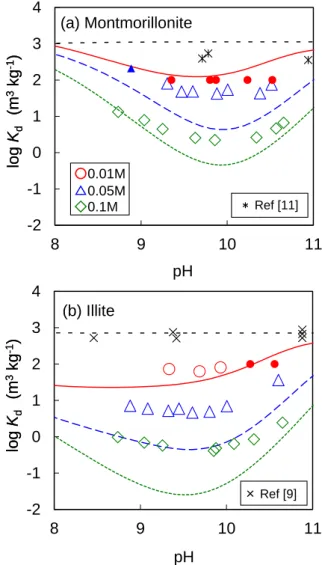
The Kd values for montmorillonite are plotted versus pH in Figure 1(a). For the Kd data obtained from the lower
concentrations of Th than the detection limit of ICP-MS (2 × 10-11 mol dm-3 for 0.01 and 0.05 mol dm-3), the lowest Kd values were plotted in the figure. All the Kd values for 0.01 mol dm-3 NaHCO3 were higher than 100 m3 kg-1 at pH 9.35-10.53. The Kd values for 0.05 mol dm-3 NaHCO3 were from 42 to 81 m3 kg-1 at pH 9.31-10.52. The Kd values for 0.1 mol dm-3 NaHCO3 were from 2.2 to 13 m3 kg-1 at pH 8.74-10.66. The Kd values decreased with increasing NaHCO3 concentration and the minimal value was seen at around pH 10 under 0.1 mol dm-3 NaHCO3. The values were lower than the literature Kd values for Wyoming Na-montmorillonite (SWy-1) under the conditions of 0.1 mol dm-3 NaClO4 reported by Bradbury and Baeyens [11]
those are the only existing dataset of Th for montmorillonite reported with pH values of the experimental solutions.
-2 -1 0 1 2 3 4
8 9 10 11
log K
d(m
3kg
-1) log K
d(m
3kg
-1)
pH (b) Illite
×Ref [9]
-2 -1 0 1 2 3 4
8 9 10 11
log K
d(m
3kg
-1) log K
d(m
3kg
-1)
pH
○0.01M
△0.05M
◇0.1M
(a) Montmorillonite
*Ref [11]
Fig. 1 Comparison of Kd values obtained in this study and literature values (0.1 mol dm-3 NaClO4 conditions):
(a) montmorillonite [11] and (b) illite [9]. Closed marks show the lowest values. “0.01 M” represents the 0.01 mol dm-3 NaHCO3 concentration. Lines show the predicted values by the NEM (NaClO4
and NaHCO3 conditions)
The Kd values for illite are plotted versus pH in Figure 1(b).
The Kd values for 0.01 mol dm-3 NaHCO3 were from 63 to 80
m3 kg-1 at pH 9.34–9.93 and higher than 100 m3 kg-1 at pH 10.28-10.56. The Kd values for 0.05 mol dm-3 NaHCO3 were from 4.6 to 36 m3 kg-1 at pH 8.88-10.60. The Kd values for 0.1 mol dm-3 NaHCO3 were from 0.41 to 2.4 m3 kg-1 at pH 8.74-10.65. The Kd values decreased with increasing NaHCO3
concentration and increased at higher pH than 10. The Kd values for illite were lower than those for montmorillonite, the pH dependences of Kd for illite showed the same tendency as those for montmorillonite. The obtained Kd values for illite were lower than the literature values for Na-illite (illite du Puy) under the conditions of 0.1 mol dm-3 NaClO4 reported by Bradbury and Baeyens [9] those are the only existing dataset of Th for illite reported with pH values of the experimental solutions.
3.2 Analysis of the sorption behavior by the SCM The mole fractions of aqueous species of Th under 0.01 mol dm-3 NaHCO3 conditions calculated using thermodynamic data (Table 1) [3] are shown in Figure 2. The dominant aqueous species are neutral or negatively charged; the cation-exchange sorption was ignored although montmorillonite and illite have large cation exchange capacities. Considering the surface complexation of Th with surface hydroxyl groups of the minerals, the sorption behaviors onto montmorillonite and illite were analyzed by the non-electrostatic surface complex model (NEM) [9,12]. The NEM was calculated by the PHREEQC computer program. The protonation and deprotonation reactions of surface hydroxyl groups (≡SOH) are expressed by
≡SOH + H+ = ≡SOH2+
} H { SOH]
[
] SOH
[ 2
a1
K (2)
≡SOH = ≡SO− + H+
SOH]
[
} H { ] SO [
a2
K (3)
where the square brackets represent concentrations (mol dm−3) and the curly brackets represent activities. Based on the aqueous Th species (Table 1), the surface species were assumed as follows.
≡SOH + Th4+ = ≡SOTh3+ + H+
K1 (4)
≡SOH + Th4+ + H2O = ≡SOThOH2+ + 2H+ K2 (5)
≡SOH + Th4+ + 3H2O = ≡SOTh(OH)30 + 4H+ K3 (6)
≡SOH + Th4+ + 4H2O = ≡SOTh(OH)4- + 5H+
K4 (7)
≡SOH + Th4+ + H2O + 2CO32-
= ≡SOThOH(CO3)22- + 2H+ K5 (8)
≡SOH + Th4+ + 4CO32-
= ≡SOTh(CO3)45-
+ H+ K6 (9)
≡SOH + Th4+ + 3H2O + CO32-
= ≡SOTh(OH)3CO32- + 4H+ K7 (10)
The sorption of Th was estimated as inner-sphere surface complexation [18,19]. On the other hand, the sorption of the electrolyte ions was outer-sphere surface complexation [20,21].
The NEM assumes only one sorption plane, it cannot distinguish these sorption mechanisms. Therefore, the sorption of background electrolytes was ignored [22,23]. The Kd value was calculated as
species]
Th aqueous [
species]
Th surface
[ ini
d M
K V
(11)
Nuclear energy agency (NEA) [24] reported the indicative values for SCM parameters of important minerals. In the calculations for montmorillonite, the surface site density (ns = 2.41 sites nm−2) reported by NEA [24] was adopted. The specific surface area of Kunipia F montmorillonite measured by N2-BET method (45 or 62 m2 g-1) was about 1 order of magnitude lower than that by EGME method (700 m2 g-1) [15].
Nitrogen gas cannot access the interlayer planes of expandable clay minerals such as montmorillonite, therefore the external surface areas can be estimated by N2-BET method. In contrast, EGME can penetrate into interlayer planes and can estimate the total surface area. The surface complexation sites exist on the edges of clay mineral crystallites, the external surface area measured by N2-BET method is appropriate for the SCM. The montmorillonite sample used in this study was not preconditioned; the value of 45 m2 g-1 for
Table 1 Thermodynamic data for aqueous Th species
Reaction log K
Th4+ + H2O = Th(OH)3+ + H+ -2.500 ± 0.500 Th4+ + 2H2O = Th(OH)22+ + 2H+ -6.200 ± 0.500
Th4+ + 4H2O = Th(OH)40
+ 4H+ -17.400 ± 0.700 2Th4+ + 2H2O = Th2(OH)26+
+ 2H+ -5.900 ± 0.500 2Th4+ + 3H2O = Th2(OH)35+ + 3H+ -6.800 ± 0.200 4Th4+ + 8H2O = Th4(OH)88+
+ 8H+ -20.400 ± 0.400 4Th4+ + 12H2O = Th4(OH)124+
+ 12H+ -26.600 ± 0.200 6Th4+ + 14H2O = Th6(OH)1410+ + 14H+ -36.800 ± 1.200
6Th4+ + 15H2O = Th6(OH)159+
+ 15H+ -36.800 ± 1.500 Th4+ + 5CO32-
= Th(CO3)56-
31.000 ± 0.700 Th4+ + 2H2O + 2CO32-
= Th(OH)2(CO3)22-
+ 2H+ 8.798 ± 0.501 Th4+ + H2O + 4CO32-
= ThOH(CO3)45-
+ H+ 21.599 ± 0.500 Th4+ + 4H2O + CO32-
= Th(OH)4CO32-
+ 4H+ -15.605 ± 0.603
原子力バックエンド研究 June 2010 coarse-grained samples was adopted. This value is almost the
same as 41 m2 g-1 reported by NEA for montmorillonite [24].
The surface acidity constants (log Ka1 = 4.5 and log Ka2 = -7.9) and the equilibrium constants of K1-K4 reported by Bradbury and Baeyens [12] were adopted. Bradbury and Baeyens [12] assumed that the Th hydroxo-complex species sorbed on the strong site which account for about 2.4% of all sorption sites. In the same manner, 2.4% of the total site density was assigned to the strong site density (0.06 sites nm-2) in this calculation. The model parameters for the surface carbonato-complex species of Th are not available.
Fernandes et al. [25] modeled the sorption of U onto montmorillonite in the presence of carbonate and reported that the ternary uranyl-carbonate complex (≡SOUO2CO3-
) on the weak site was necessary to reproduce the obtained sorption data in addition to that on the strong site. Therefore, the carbonate-complex species of Th were assumed to be sorbed on all sites. The formation constants of surface carbonato-complex species (K5-K7) were estimated by linear free energy relationships (LFER). Bradbury and Baeyens [12] formulates the interrelation between the formation constants of aqueous hydroxo-complex species of metal ions (OHKx) and those of surface species for montmorillonite (sKx-1) as
log sKx-1 = 8.1 ± 0.3 + (0.90 ± 0.02) log OHKx (12)
The K5–K7 values were estimated from the formation constants of aqueous carbonate complex species (aqKx) listed in Table 1
Th4+ + xH2O + yCO32-
= Th(OH)x(CO3)y4-x-2y + xH+ aqKx (13)
and those of surface species for montmorillonite (surKx-1).
≡SOH + Th4+ + (x-1)H2O + yCO32-
= ≡SOTh(OH)(x-1)(CO3)y4-x-2y
+ xH+ surKx-1 (14)
0.01 0.1 1
8 9 10 11
pH
ThOH(CO3)45-
Th(OH)40
Fraction of Th species
Th(OH)4CO32- Th(OH)2(CO3)22-
Fig. 2 Calculated mole fraction of aqueous Th species under 0.01 mol dm-3 NaHCO3 conditions
as
log surKx-1 = 8.1 + 0.90 log aqKx (15)
The employed surface parameters and equilibrium constants are summarized in Table 2.
Table 2 Surface parameters and equilibrium constants for the NEM calculation
Montmorillonite Illite Strong Total Strong Total Surface area
(m2 g-1) S 45 36
Site density
(sites nm-2) ns 0.06 2.41 0.06 2.39
Equilibrium constant
log Ka1 4.5 4.5 4.0 4.0
log Ka2 -7.9 -7.9 -6.2 -6.2
log K1 7.2 – 7.4 –
log K2 2.7 – 2.3 –
log K3 -9.1 – -8.8 –
log K4 -16.9 – -15.3 –
log K5 – 16.0 – 15.2
log K6 – 27.5 – 25.8
log K7 – -5.9 – -5.1
Figure 1(a) shows the comparison of the predicted Kd values for montmorillonite with the experimentally measured ones and the literature values [11]. The calculation results explain the experimental results reasonably well, but slightly underestimated.
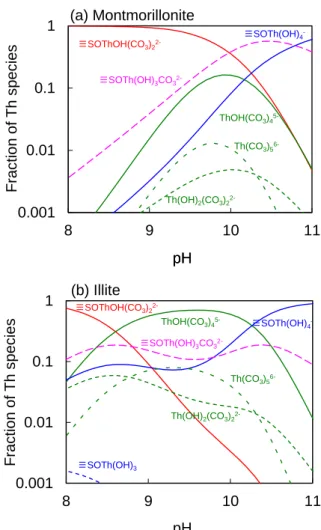
The strong site density might be underestimated because of the difference between Kunipia F and SWy-1. Figure 3(a) shows the calculated mole fractions of Th species under 0.1 mol dm-3 NaHCO3 conditions. It is shown that the dominant sorption species are ≡SOThOH(CO3)22-, ≡SOTh(OH)3CO32- and
≡SOTh(OH)4-
, and the dominant aqueous species is ThOH(CO3)45-. The relation equation between these sorption species and ThOH(CO3)45-
are
≡SOThOH(CO3)22-
+2CO32-
+ H+
= ≡SOH + ThOH(CO3)45-
(16)
≡SOTh(OH)3CO32-
+3CO32-
+ 3H+
= ≡SOH + ThOH(CO3)45- + 2H2O (17)
≡SOTh(OH)4- + 4CO32- + 4H+
= ≡SOH + ThOH(CO3)45-
+ 3H2O (18)
involving CO32- ions on the left-hand side. Therefore, the stability of aqueous ThOH(CO3)45-
species increased with increasing NaHCO3 concentration more than those of sorption species, the Kd values decreased with increasing NaHCO3
concentration. The minimal Kd value at around pH 10 was also
due to the stabilization of aqueous species by hydroxo-carbonate complexation.
In the calculations for illite, the surface site density (2.39 sites nm-2) reported by NEA [24] was adopted. The specific surface area of illite measured by N2-BET method (9.1 m2 g-1) is about 1 order of magnitude lower than that reported by Bradbury and Baeyens [9] (97 m2 g-1), and that reported by NEA [24] (36 m2 g-1) is the intermediate value between the two. In this calculation, the value of 36 m2 g-1 was adopted by considering the consistency with the site density. The surface acidity constants (log Ka1 = 4.0 and log Ka2 = -6.2) and the equilibrium constants of K1–K4 reported by Bradbury and Baeyens [9] were adopted. For illite, Bradbury and Baeyens [9] assumed that the Th hydroxo-complex species sorbed on the strong site which account for about 2.4% of all sorption sites, as well as montmorillonite. The strong site density was estimated to be 0.06 sites nm-2 in this calculation. The carbonate-complex species of Th were assumed to be sorbed on all sites. The formation constants of carbonato-surface complex (K5-K7) were estimated by LFER. Bradbury and Baeyens [9]
formulates the interrelation between OHKx and sKx-1 for illite as
log surKx-1 = 7.9 ± 0.4 + (0.83 ± 0.02) log aqKx (19)
The values of K5-K7 were calculated from the formation constants of aqueous carbonate complex species as
log surKx-1 = 7.9 + 0.83 log aqKx (20)
Figure 1(b) shows the comparison of the predicted Kd values for illite with the experimentally measured ones and the literature values [9]. The calculation results explain the experimental results reasonably well, but underestimated especially at low pH and high carbonate concentration. Figure 3(b) shows the calculated mole fractions of Th species under 0.1 mol dm-3 NaHCO3 conditions. This underestimation might be due to the underestimation of the formation constant of ≡SOThOH(CO3)22- (K5) estimated by the extrapolation of data for some metal species [9] using equation (20). The mole fractions of aqueous species, ThOH(CO3)45-
, Th(CO3)56-
and ThOH2(CO3)22-
, are higher than the case for montmorillonite, which causes the lower Kd values than montmorillonite.
4 Conclusion
The Kd values of Th for montmorillonite and illite were obtained at pH 8.5-11 under 0.01, 0.05 and 0.1 mol dm-3 NaHCO3 conditions. The sorbability of montmorillonite was higher than that of illite. The obtained Kd values were lower than the literature values obtained under 0.1 mol dm-3 NaClO4
conditions. The Kd decreased with increased carbonate concentrations, and the minimal value was seen at around pH 10.
The NEM calculations using the existing model parameters and estimated formation constants of surface carbonato-complex species were able to explain the experimental results well. It was indicated that the decreases of Kd value under high concentration of carbonate and around pH 10 were due to the stabilization of aqueous species by hydroxo-carbonate complexations.
Acknowledgements
The authors acknowledge Mr. Y. Kawasaki for experimental measurements.
References
[1] Japan Nuclear Cycle Development Institute (JNC): H12:
Project to establish the scientific and technical basis for HLW disposal in Japan - Second Progress Report on Research and Development for the Geological Disposal of HLW in Japan, JNC (2000).
[2] Rand, M. H., Fuger, J., Grenthe, I., Neck, V., Rai, D.:
Chemical thermodynamics of thorium. OECD Publications, Paris (2009).
[3] Kitamura, A., Fujiwara, K., Doi, R., Yoshida, Y.: Update of JAEA-TDB: Additional selection of thermodynamic data for solid and gaseous phases on nickel, selenium, 0.001
0.01 0.1 1
8 9 10 11
pH
≡SOTh(OH)4-
≡SOThOH(CO3)22-
pH
ThOH(CO3)45-
Fraction of Th species
(a) Montmorillonite
≡SOTh(OH)3CO32-
Th(CO3)56-
Th(OH)2(CO3)22-
0.001 0.01 0.1 1
8 9 10 11
pH
ThOH(CO3)45- ≡SOTh(OH)4-
≡SOThOH(CO3)22-
Th(OH)2(CO3)22-
≡SOTh(OH)3
Th(CO3)56-
Fraction of Th species
(b) Illite
≡SOTh(OH)3CO32-
Fig. 3 Calculated mole fraction of Th species under 0.1 mol dm-3 NaHCO3 conditions
原子力バックエンド研究 June 2010 zirconium, technetium, thorium, uranium, neptunium,
plutonium and americium, update of thermodynamic data on iodine, and some modifications. JAEA-Data/Code 2012-006, Japan Atomic Energy Agency (JAEA) (2012).
[4] Sasamoto, H., Yui, M., Arthur, R.C.: Estimation of in situ groundwater chemistry using geochemical modeling: A test case for saline type groundwater in argillaceous rock.
Phys. Chem. Earth., 32, 196-208 (2007).
[5] Tachi, Y., Ochs, M., Suyama, T., Trudel, D.: Kd setting approach through semi-quantitative estimation procedures and thermodynamic sorption models : A case study for Horonobe URL conditions. Scientific Basis for Nuclear Waste Management XXXVII (Mater. Res. Soc. Symp. Proc.
Vol. 1665) (Duro, L., Giménez, J., Casas, I. and Pable, J.
ed.), Barcelona, Spain, September 29 - October 3, 2013, pp.149-155 (2014).
[6] Yamaguchi, T., Takeda, S., Nishimura, Y., Iida, Y., Tanaka, T.: An attempt to select thermodynamic data and to evaluate the solubility of radioelement with uncertainty under HLW disposal conditions. Radiochim. Acta, 102(11), 999-1008 (2014).
[7] Japan Atomic Energy Agency, Federation of Electric Power Companies of Japan (FEPC): Second progress report on research and development for TRU waste disposal in Japan-repository design, safety assessment and means of implementation in the generic phase. JAEA and FEPC (2007).
[8] Bradbury, M. H., Baeyens, B.: Sorption modeling on illite Part I: Titration measurements and the sorption of Ni, Co, Eu and Sn. Geochim. Cosmochim. Acta, 73, 990-1003 (2009).
[9] Bradbury, M. H., Baeyens, B.: Sorption modelling on illite.
Part II: Actinide sorption and linear free energy relationships. Geochim. Cosmochim. Acta, 73, 1004-1013 (2009).
[10] Lauber, M., Baeyens, B., Bradbury, M. H.:
Physico-chemical characterisation and sorption measurements of Cs, Sr, Ni, Eu, Th, Sn and Se on Opalinus Clay from Mont Terri. PSI 00-10, Paul Scherrer Institute (2000).
[11] Bradbury, M. H., Baeyens, B.: Near field sorption data bases for compacted MX-80 bentonite for performance assessment of a high-level radioactive waste repository in Opalinus clay host rock. PSI 03-07, Paul Scherrer Institute (2003).
[12] Bradbury, M. H., Baeyens, B.: Modelling the sorption of Mn(II), Co(II), Ni(II), Zn(II), Cd(II), Eu(III), Am(III), Sn(IV), Th(IV), Np(V) and U(VI) on montmorillonite:
Linear free energy relationships and estimates of surface binding constants for some selected heavy metals and actinides. Geochim Cosmochim Acta, 69, 875-892 (2005).
[13] Parkhurst, D. L., Appelo, C. A. J.: Description of input and examples for PHREEQC version 3—a computer program
for speciation, batch-reaction, one-dimensional transport, and inverse geochemical calculations. U.S. Geological Survey Techniques and Methods (2013).
[14] Brunauer, S., Emmett, P. H., Teller, E.: Adsorption of gasses in multimolecular layers. J. Am. Chem. Soc., 60, 309-319 (1938).
[15] Ohashi, H., Sato, S., Kozaki, T.: Effects of microstructure of clay on diffusion behavior of radionuclides in buffer materials. JNC-TJ 8400 2001-005, JNC (2001) (in Japanese).
[16] Atomic Energy Society of Japan (AESJ): Measurement method of the distribution coefficient on the sorption process. AESJ (2006) (in Japanese).
[17] Baeyens, B., and Bradbury, M. H.: A mechanistic description of Ni and Zn sorption on Na-montmorillonite.
Part I: titration and sorption measurements. J. Contam.
Hydrol., 27, 199-222 (1997).
[18] Quigley, M. S., Honeyman, B. D., Santschi, P. H.:
Thorium sorption in the marine environment: equilibrium partitioning at the hematite/water interface, sorption/desorption kinetics and particle tracing. Aquat Geochem., 1, 277-301 (1996).
[19] Hongxia, Z., Zheng, D., Zuyi, T.: Sorption of thorium(IV) ions on gibbsite: effects of contact time, pH, ionic strength, concentration, phosphate and fulvic acid. Colloids Surf A, 278, 46–52 (2006).
[20] Hayes, K. F., Papelis, C., Leckie, J. O.: Modeling ionic strength effects on anion adsorption at hydrous oxide/solution interfaces. J Colloid Interf Sci., 125, 717–726 (1988).
[21] Zachara, J. M., Girvin, D. C., Schmidt, R. .L., Resch C. T.:
Chromate adsorption on amorphous iron oxyhydroxide in the presence of major groundwater ions. Environ. Sci.
Technoi., 21, 589-594 (1987).
[22] Turner, D. R., Pabalan, R. T., Bertetti, F. P.: Neptunium (V) sorption on montmorillonite: an experimental and surface complexation modeling study. Clays Clay Miner., 46, 256–269 (1998).
[23] Davis, J. A., Kent, D. B.: Surface complexation modeling in aqueous geochemistry. Rev. Mineral., 23, 177-260 (1990).
[24] Nuclear Energy Agency (NEA): Thermodynamic sorption modelling in support of radioactive waste disposal safety cases: NEA Sorption Project Phase III. OECD Publications, Paris (2012).
[25] Fernandes, M. M., Baeyens, B., Dähn, R., Scheinost, A. C., Bradbury, M. H.: U(VI) sorption on montmorillonite in the absence and presence of carbonate: A macroscopic and microscopic study. Geochim. Cosmochim. Acta, 93, 262-277 (2012).