Sapovirus epidemiological study & Quick diagnostic system for diarrheal viruses
Fang-Tzy Wu
Centers for Disease Control, Taiwan
Summary: In this study, a total of 1454 stool specimens collected from 303 outbreaks of diarrhea in Taiwan were screened for viral agents in 2012. Forty-three percent (625/1454) was lab-confirmed with viral positive, including 175 Noroviruses (NoVs) and 9 Sapoviruses (SaVs) outbreaks. We also retrospective survey the outbreak specimens which were lab- confirmed with norovirus-negative during 2007 to 2011. There were at least isolated 13 different norovirus genotypes and 4 different sapovirus genotypes in the period. Norovirus strains belonging to the GII.4 were dominant. Furthermore, the GII.4 strains were isolated throughout Taiwan, demonstrating their widespread distribution. We also found that 24 sapovirus outbreaks belong to GI.1, GI.2, GI.3 and GV genotypes. Our results have shown for the first time that concluded noroviruses and sapoviruses in reporting diarrhea and foodborne outbreaks in Taiwan. It’s an important evidence that viral causes of diarrhea outbreaks in Taiwan.
I. Purpose:
Diarrhea viruses are becoming important causes of acute gastroenteritis outbreaks. Up to 90%
of nonbacterial gastroenteritis and related outbreaks were caused by NoVs, and rotaviruses worldwide. Transmissions of these viruses can be due to food-related, person-to-person close contact, and environmental contaminations. Noroviruses are the leading cause of nonbacterial acute gastroenteritis outbreaks worldwide, a disease that usually occurs in family or community-wide epidemic. Rotavirus was reported as major etiology which causes diarrhea of children under 5. Sapoviruses (SaVs) also belong to Caliciviridae family as Noroviruses (NoVs). However, the impact of the sapoviruses has not been fully established yet. Therefore, this study will focus on the establishment of surveillance of viral diarrhea including sapovirus in Taiwan, and collaborated together with NIID to evaluate the quick screening testing for setting-up the standard protocol to detect infectious agents. The results will be critical for displaying preventative measures and blocking further transmission of infectious pathogens.
II. Methods:
Sample collection and Reporting system in Taiwan
For Sapovirus surveillance study, the specimens were collected from reporting of diarrhea- associated outbreaks were by local health institute through food-borne outbreak reporting system and diarrhea syndrome outbreak reporting system.
For evaluation the detection methods for variations strains of Norovirus, freeze stool specimens were selected from sporadic cases with acute gastroenteritis during 2010-2011. All stool samples were examined for enteric bacteria and viruses.
Specimen preparation
A total of 1454 stool specimens were collected from 303 outbreak patients suffering diarrhea in 2012 in Taiwan. Also, specimens of reporting outbreaks with NoV-negative during 2007 to 2010 were selected for sapovirus screening. A 10% (w/v) stool suspension was prepared by 1X PBS then centrifuged 3000 rpm for 15 min at 4℃. Clarified suspension would be prepared for RNA extraction and stored at -80℃ for next extraction.
RNA extraction and Reverse-transcript reaction
Viral RNA was extracted from 200 μL stool suspension using MagConpact (Roche) and dissolved in 100 μL of elution buffer with added 1μL (40U) RNase inhibitor. cDNA was prepared using the Superscript III Reverse Transcriptase kit (Invitrogen Corp., Carlsbad, CA).
Briefly, 5 μl of extracted RNA was added to 15 μl of RT mixture containing 4 μl of 5×
reverse transcription buffer, 2μl of 0.1 M dithiothreitol ,2μl of 20 mM deoxynucleoside triphosphates (dNTPs), 1 μl of 10 μM random hexamers, 200 U of Reverse Transcriptase, and 20 U of RNase inhibitor. The RT reaction mixture was incubated at 25°C for 10 min, 50°C for 60 min, and 85°C for 5 min to inactivate the enzyme.
SaV PCR amplification
The first PCR was performed in 50 μl of reaction volume containing 5 μl of cDNA, 2.5 U of Taq DNA polymerase, and 20 pmol of SaV-124F, SaV-1F, SaV-5F, SV-R13, and SV-R14 primers. These primers generated approximately an 800-bp product. PCR amplification was performed under the following conditions: initial denaturation at 94°C for 2 min, followed by 35 cycles of amplification with denaturation at 94°C for 30 s, primer annealing at 48°C for 30 s, extension reaction at 72°C for 2 min, and then a final extension at 72°C for 10 min. The second PCR was performed in 50 μl of reaction volume containing 2 μl of the first PCR product, 2.5 U of Taq DNA polymerase, and 20 pmol of 1245Rfw and SV-R2 primers. PCR amplification was performed under the following conditions: initial denaturation at 94°C for 2 min, followed by 35 cycles of amplification with denaturation at 94°C for 30 s, primer annealing at 48°C for 30 s, extension reaction at 72°C for 2 min, and then a final extension at 72°C for 10 min. These primers generated approximately a 420-bp product.
NoV PCR amplification
For norovirus genogroup I (GI) and genogroup II (GII) PCR, G1SKF/G1SKR and G2SKF/
G2SKR primer sets were used as described(18). The PCR was performed in 25 μl of reaction volume containing 2.5 μl of cDNA, 12.5μl Mater Mix buffer (QIAGEN, Hot star), and 20 pmol of each primer. These primers generated approximately a 343-bp product. PCR amplification was performed under the following conditions: initial denaturation at 94°C for 15 min, followed by 40 cycles of amplification with denaturation at 94°C for 30 s, primer
3 Real-time RT-PCR for Norovirus
Real-time quantitative RT-PCR(TaqMan). To prevent carryover contamination by NLV cDNA and to reduce nonspecific amplification, viral RNA extracted with a QIAamp viral RNA kit was treated with DNase I before RT. Viral RNA (12.5μl) was added to a reaction mixture (2.5μl) containing DNase I buffer (150 mM Tris-HCl [pH 8.3], 225 mM KCl, 9 mM MgCl2) and 1 U of RQ1 DNase (Promega Madison, Wis.). The reaction mixture was incubated at 37°C for 30 min to digest DNA and then at 75°C for 5 min to inactivate the enzyme. DNase I-treated RNA (15μl) was added to 15μl of another mixture containing 100 mM Tris-HCl (pH 8.3), 150 mM KCl, 6 mM MgCl2, a 1 mM concentration of each deoxynucleoside triphosphate, 10 mM dithiothreitol, 75 pmol of random hexamers (pdN6;
Amersham Pharmacia Biotech, Piscataway, N.J.), 30 U of RNasin (Promega), and 200 U of SuperScript II RNase H (-) reverse transcriptase (Gibco BRL, Gaithersburg, Md.). RT was performed at 42°C for 2 h, and the enzyme was inactivated at 70°C for 15 min. cDNA solutions were stored at -20°C.
The real-time quantitative RT-PCR was carried out in 50μl of a reaction mixture containing 5 μl of cDNA, 25μl of TaqMan Universal PCR Master Mix (Applied Biosystems) containing dUTP and uracyl N-glycosylase (UNG), a 400 nM concentration of each primer, and either 15 pmol of RING1(a)-TaqMan Probe (TP) and 5 pmol of RING1(b)-TP fluorogenic probes for NLV GI detection or 5 pmol of RING2-TP fluorogenic probe for NLV GII detection. PCR amplification was performed with an ABI Prism 7700 sequence detector (Applied Biosystems) under the following conditions: incubation at 50°C for 2 min to activate UNG, initial denaturation at 95°C for 10 min, and then 45 cycles of amplification with denaturation at 95°C for 15 s and annealing and extension at 56°C for 1 min. Amplification data were collected and analyzed with Sequence Detector software version 1.6 (Applied Biosystems).
In each operation, an NLV GI- or GII-specific standard curve was generated by a 10-fold serial dilution (107 to 101 copies) of purified NLV GI or GII cDNA plasmids. Plasmid standards containing PCR products of the ORF1-ORF2 junction were prepared with strains SzUG1 and U201 with primer sets G1FF-G1SKR and G2FB-G2SKR, respectively.
Direct RT-PCR Kit for Norovirus Detection
10% fecal sample suspended in saline and centrifuged for 5 min. 1μl centrifugal suspension mix thoroughly with 19μl Sample Treatment Reagent [G2]. Mixture was heated 90 °C for 1-2 min and cooled on ice. Reverse transcription(RT) containing 24.75μl RT Reagent [G2] and 0.25μl RT Enzyme [G2]. Add 25μl of the RT reaction mixture to 20μl preheated sample.
Temperature conditions of RT reaction were 37°C for 30 min, 90°C for 5 min and cooling on ice. PCR reaction contained 4.75μl PCR Reagent [G2], 0.25μl PCR Enzyme, 1μl 125X SYBR Green I solution and 1μl 25μM ROX Reference Dye. Add 7μl of the PCR reaction mixture to 45μl RT reaction. PCR temperature conditions were denatured 95°C for 10 min and 45 cycles followed 95°C for 15 sec, 56°C for 30 sec and 72°C for 45 sec. Final extension was 72 C for 1 min.
Sequencing for genotyping
The PCR products were purified with a PCR purification kit (Qiagen), and both strands were sequenced with the BigDye cycle sequencing kit, version 3.1, and the 3130 genetic analyzer (Applied Biosystems). Nucleotide sequences were assembled using the program Sequencher version 4.1.4 (Gene Codes Corporation, Ann Arbor, MI) and aligned with MEGA version 4 (http://www.megasoftware.net/). The phylogenetic dendrograms from a bootstrap analysis with 1,000 replicates were generated by the neighbor-joining method.
III.Results:
1) Surveillance of Sapovirus during 2007-2012
Though, the first sapovirus-associated outbreak was identified in college students with gastroenteritis that occurred during May 4–8, 2007 in Taiwan. Meanwhile, sapovirus is considered a common cause of viral gastroenteritis in infants and young children in the world.
However, its prevalence is unknown because of the absence of routine screening procedures and sensitive diagnostic tests.
In this study, we screened the specimens from reporting diarrhea and foodborne outbreaks in 2012, and combined with the retrospective study of selected lab-confirmed NoV-negative specimens during 2007-2011. SaVs were isolated in a total of 24 outbreaks throughout Taiwan during 2007-2012. Most of the outbreaks separated in the west part of Taiwan (Fig1), demonstrating their widespread distribution. From the reporting system and outbreak investigation, we collected epidemiological informations. Review the reporting and investigation information of SaV outbreaks, half of outbreaks were reported in school (12/24), then restaurant (6/24), hospital (4/24), and populous institute. The most age distribution was age 0-10 then 11-20 years old. Half of the outbreaks showed age discrete which displayed the outbreak happened in the school, restaurant, populous institute and hospital. The transmission caused by person-to -person (workers to the patient) (Fig2). The monthly distribution of Sapovirus outbreaks was most in January to June, some in September and November. The monthly distribution curve wasn’t so clear because of less outbreak numbers. Comparing to Norovirus-outbreaks happened in Taiwan, the Sapovirus-season was from winter to spring as Norovirus-season was since September to next March; most of the sapovirus infected patients were at younger age but norovirus could cause all ages (Fig 3).
By molecular analysis and sequencing, we isolated at least 4 different sapovirus genotypes GI.1, GI.2, GI.3 and GV. Sapovirus strains belonging to the GI.2 were dominant, were isolated from 18 of 24 (75%) outbreaks (Fig 4). Phylogenetic tree was generated by VP1 gene of sapovirus via neighbor-joining method using MEGA 4.0 software. Bootstrap values of 1000 replication were shown on the branches (Fig 5).
2) Evaluation of detection methods for variations strains of Norovirus
5
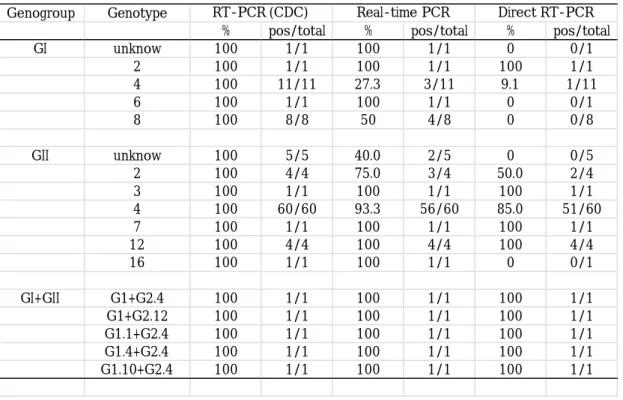
total of 113 specimens were selected, including 4 group which were genogroup I, genogroup II, mixed genogroup I and II, and control group. Those cases determined NoVs by RT-PCR and genotyping by sequencing. NoVs genogroup I included GI.2, GI.4, GI.6, GI.8, and GI untyped. NoVs genogroup II included GII.2, GII.3, GII.4, GII.7, GII.12, GII.16, and GII untyped. NoVs mixed genogroup included GI.1, GI.4, GI.10, GII.4, GII.12 mix as list in Table 1.
The evaluations were compared the tranditional RT-PCR with 2 kinds of real-time RT-PCR.
The most dominant strains isolated in sporadic cases were GI.4 and GII.4 in Taiwan. Based on the traditional RT-PCR, the real-time RT-PCR(TaqMan) can recognize most of the genotypes but part of GI.4, GI.8, GII.2 and GII.4. However, the identified genotypes of Direct RT-PCR is lower than real-time RT-PCR(TaqMan) method. It cannot identify most of GI genotypes and GII.2. But the evaluation should be continued for testing sensitivity of all of the methods by quantitation of norovirus in each stool.
IV.Discussion:
Norovirus gastroenteritis remains a public health problem worldwide and is second ranked to rotavirus diarrhea in children visiting hospitals. Rotavirus is most caused diarrhea of children under 5, and mostly were published to be sporadic cases. However, Noroviruses were reported to cause outbreaks in restaurant, hospital, nursing center, school etc. in all ages. The prevalence of sapovirus infection was not clear in the world, but some manuscripts reported it caused sporadic or outbreaks in young children. In this study, we established the first overall surveillance data and viral strains in Taiwan during 2007-2012. Moreover, in order to improve the decision time schedule for policy control of a suspected diarrhea or foodborne outbreak. We evaluated and selected a proper diagnosis method for norovirus outbreaks, though it needs further testing for suggestion.
V. Reference list:
1) Kageyama T, Kojima S, Shinohara M, Uchida K, Fukushi S, Hoshino FB, Takeda N, Katayama K. 2003. Broadly reactive and highly sensitive assay for Norwalk-like viruses based on real-time quantitative reverse transcription-PCR. J. Clin. Microbiol. 2003, 41(4):
1458-1557.
2) Kojima S, Kageyama T, Fukushi S, Hoshino FB, Shinohara M, Uchida K, et al.
Genogroup-specific PCR primers for detection of Norwalk-like viruses. J Virol Methods.
2002;100,107-14.
Fig1.
Fig2.
Fig1. Distribution
Fig2. Epidemiology
Distribution of Taiwan
Epidemiology of Sapovirus
Sapovirus during
Sapovirus-outbreak
during 2007-2012
outbreak during 2007 2012
2007-2012, TaiwanTaiwan
Fig 3.
Fig 4.
3. Monthly distribution
Fig 4. Genotypes isolated distribution of
Genotypes isolated from
of Norovirus
from Sapovirus
7
Norovirus and Sapovirus
Sapovirus-outbreaks
Sapovirus outbreaks
outbreaks in 2007~2012
outbreaks in Taiwan,
2007~2012
Taiwan, 2007-2012
Fig 5.5. Phylogenetic 437 bp using MEGA branches.
Phylogenetic analysis bp of all strains
MEGA 4.0 software.
branches.
analysis according to strains aligned and
software. Bootstrap
to partial VP1 and the tree was Bootstrap values
VP1 region of sapovirus was generated
values of 1000 replication sapovirus generated via neighbor
replication were
neighbor-joining method were shown on
method on the
9
Table 1. Comparison of the traditional RT-PCR, Real-time quantitative RT-PCR(TaqMan) and Direct RT-PCR methods.
Genogroup Genotype RT-PCR (CDC) Real-time PCR Direct RT-PCR
% pos/total % pos/total % pos/total
GI unknow 100 1/1 100 1/1 0 0/1
2 100 1/1 100 1/1 100 1/1
4 100 11/11 27.3 3/11 9.1 1/11
6 100 1/1 100 1/1 0 0/1
8 100 8/8 50 4/8 0 0/8
GII unknow 100 5/5 40.0 2/5 0 0/5
2 100 4/4 75.0 3/4 50.0 2/4
3 100 1/1 100 1/1 100 1/1
4 100 60/60 93.3 56/60 85.0 51/60
7 100 1/1 100 1/1 100 1/1
12 100 4/4 100 4/4 100 4/4
16 100 1/1 100 1/1 0 0/1
GI+GII G1+G2.4 100 1/1 100 1/1 100 1/1
G1+G2.12 100 1/1 100 1/1 100 1/1
G1.1+G2.4 100 1/1 100 1/1 100 1/1
G1.4+G2.4 100 1/1 100 1/1 100 1/1
G1.10+G2.4 100 1/1 100 1/1 100 1/1
VI. Publication list for this work NIL