Investigation on characteristic of flow field with moving body based on the bubble function FEM using the fictitious domain method
Nguyen Tuan Long, Takahiko Kurahashi and Toshikazu Fujino
Nagaoka University of Technology, Nagaoka, Japan 940-2188, [email protected]
In general, the adaptive mesh refinement method is applied to solve the flow problems with moving body. However, it is known that computational process is complex due to consider the re-construction of meshes, and a lot of computational time is required.
On the other hand, there is computational method that the flow problem with moving body is solved without using the adaptive mesh refinement process. The method is referred to as the fictitious domain method [1], and the background and foreground meshes, i.e., the fluid and the body domains, are prepared when the flow problem with moving body is solved (See Figure 1). The foreground mesh can be freely moved in the background mesh, the adaptive mesh refinement process is not needed in the moving body problem. The fictitious domain method is employed in the formulation based on the finite element method. The feature of the fictitious domain method is that the physical value in the foreground mesh is given to the background mesh by the interpolation method.
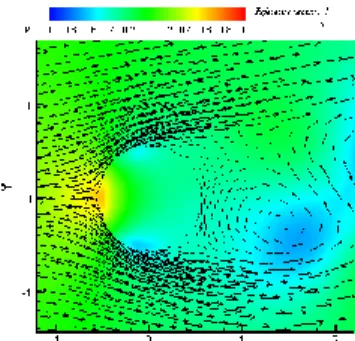
In this study, numerical experiments are carried out to investigate the characteristic of the flow field considering the moving body based on the bubble function finite element method using the fictitious domain method (See Figure 2).
Figure 1 Example of finite element mesh Figure 2 Numerical example of fluid analysis in present method by present method
REFERENCE
[1] R.Glowinski et. al., A distributed Lagrange multiplier/fictitious domain method for particulate flows, Multiphase Flow, 25 (1999) 755-794