Japan Advanced Institute of Science and Technology
JAIST Repository
https://dspace.jaist.ac.jp/
Title ドラッグデリバリー応用を目指したマイケル付加酸化
デキストランハイドロゲルの分解性制御
Author(s) Nonsuwan, Punnida Citation
Issue Date 2018‑12
Type Thesis or Dissertation Text version ETD
URL http://hdl.handle.net/10119/15760 Rights
Description Supervisor:松村 和明, マテリアルサイエンス研究科
, 博士
Doctoral Dissertation
Degradation control of oxidized dextran-based hydrogel via Michael addition for
drug delivery application
Punnida Nonsuwan
Supervisor: Associate Professor Kazuaki Matsumura
School of Materials Science
Japan Advanced Institute of Science and Technology
December 2018
Referee-in-chief:
Associate Professor Dr. Kazuaki Matsumura
Japan Advanced Institute of Science and Technology
Referees:
Professor Dr. Masayuki Yamaguchi
Japan Advanced Institute of Science and Technology Professor Dr. Tatsuo Kaneko
Japan Advanced Institute of Science and Technology Professor Dr. Nongnuj Muangsin
Chulalongkorn University
Associate Professor Dr. Takumi Yamaguchi
Japan Advanced Institute of Science and Technology
Abstract
Abstract
Previously the biomedical application of polysaccharide hydrogel that was derived from aldehyde-introduced dextran by periodate oxidation and polyamine was reported and the hydrogels showed rapid degradation through main chain scission in the oxidized dextran which was triggered by Schiff base formation with amine and subsequent Maillard reaction [1, 2].
However, the formation and degradation of this hydrogel was simultaneously occurred after multiple Schiff base formation reaction between aldehyde and amino groups, therefore the degradation timing control was difficult [1, 3]. To overcome this uncontrollable degradation of the hydrogel, the oxidized dextran hydrogel was prepared with the aldehyde groups preserved. In this thesis, the oxidized glycidyl methacrylate derivatized dextran (Dex-GMA)-based hydrogel formed via thiol-en cross-linking by Michael addition without using aldehyde group was prepared. The prepared hydrogel was stable in phosphate buffer solution (PBS) but degradation could be initiated by addition of amino compounds by causing Maillard reaction. These findings indicate that the degradation of hydrogel can be controlled by the amino group addition. In addition, the degradation speed of oxidized Dex-GMA-based hydrogel was also controlled independently of mechanical properties because the crosslinking points and degradation points are different. And by kinetic analysis with NMR measurement, molecular mechanism behind the crosslinking between thiol and aldehyde groups was observed to explain control of the degradation of dextran derivatives. To lead this hydrogel to a smart material, the release of amino source should be controlled for further controlling the degradation of hydrogel. In this part, amino compounds were functionalized on carrageenan chain (amino-CG) to act as dual-functioned material of being amino source and showing temperature-responsive behavior. The polydopamine microspheres (PDA), which is an NIR photothermal agent, were composited with carrageenan
Abstract
derivative (amino-CG@PDA micromposite). The role of PDA is to convert NIR light to energy and then to transform it to heat. The amino-CG@PDA beads are sens 4 C - - 37 C T transition of amino-CG@PDA microcomposites was enhanced by increasing temperature and more greatly under external NIR light. Thus, the release rate of amino compounds can be controlled by switching NIR-light irradiation. In addition, the degradation of oxidized Dex-GMA by amino groups release from amino-CG@PDA was investigated. The amino-CG provides the ability to be the amino source for the reaction with aldehyde groups from oxidized Dex-GMA to introduce the main chain degradation. The release of doxorubicin (DOX) from oxidized Dex- GMA-based hydrogel was controlled under NIR irradiation due to the Schiff base reaction of amino compound release from amino-CG and the preserved aldehyde on hydrogel, consequently, the degradation occurred and drug can be released. Thus, this work presents an alternative way for controlling the degradation of hydrogel to potentialize in clinical applications for cell scaffolds in regenerative medicine and drug delivery system carriers.
Keywords: hydrogel, biodegradation, aldehyde dextran, NIR irradiation, drug delivery References
1. Hyon, S.-H.; Nakajima, N.; Sugai, H.; Matsumura, K., Low cytotoxic tissue adhesive based on oxidized dextran and epsilon-poly-l-lysine. J. Biomed. Mater. Res. A 2014, 102 (8), 2511-2520.
2. Chimpibul, W.; Nagashima, T.; Hayashi, F.; Nakajima, N.; Hyon, S.-H.; Matsumura, K., Dextran oxidized by a malaprade reaction shows main chain scission through a maillard reaction triggered by schiff base formation between aldehydes and amines. J. Polym. Sci. A 2016, 54 (14), 2254-2260.
3. Matsumura, K.; Nakajima, N.; Sugai, H.; Hyon, S. H., Self-degradation of tissue adhesive based on oxidized dextran and poly-L-lysine. Carbohydr. Polym. 2014, 113, 32-38.
Contents
Contents
Chapter 1 1
1.1 Research background 1
1.2 Hydrogel 2
1.2.1 Hydrogel in drug delivery 2
1.2.2 Hydrogel degradation 3
1.3 Polysaccharides based hydrogel 4
1.3.1 Dextran based hydrogel and its degradation 5 1.3.2 Carrageenan thermo-sensitive gelation and its degradation 8 1.4 Photothermal agent triggered by near-infrared (NIR) for temperature-
sensitive materials 11
1.5 Polysaccharide chemical reactions 13
1.5.1 Thiol-Michael addition 13
1.5.2 Malaprade reaction 14
1.5.3 Schiff base reaction 15
1.5.4 Maillard reaction 16
1.6 Research objective 18
Chapter 2 27
2.1 Introduction 27
2.2 Materials and methods 30
2.2.1 Materials 30
2.2.2 Synthesis and characterization of the oxidized Dex-GMA 31
2.2.3 Gelation time measurement 32
Contents
2.2.4 Determination of the thi y E ’ y 32
2.2.5 Rheological characterization 33
2.2.6 Determination of the amount of quantitative gel degradation 33 2.2.7 Determination of the molecular weight (Mw) by GPC 34
2.2.8 Kinetic analysis by NMR spectroscopy 34
2.2.9 Determination of cytotoxicity 35
2.3 Results and discussion 36
2.3.1 Characterization of the oxidized Dex-GMA 36
2.3.2 Cytotoxicity assay 42
2.3.3 Gelation time of the oxidized Dex-GMA with DTT 44
2.3.4 Rheological measurements 46
2.3.5 Quantitative gel degradation 48
2.3.6 Determining the molecular weight via GPC 50 2.3.7 Determination of the reaction between the aldehyde and thiol 53 2.3.8 Kinetic analysis of the reaction between the GMA and thiol,
and the aldehyde and thiol by NMR 56
2.4 Conclusion 66
Chapter 3 72
3.1 Introduction 72
3.2 Material and method 77
3.2.1 Materials 77
3.2.2 Synthesis and characterization of amino-CG 77
3.2.3 Determination of amino content 78
3.2.4 Synthesis and characterization of polydopamine (PDA)
Microspheres 78
Contents
3.2.5 Preparation of amino-CG@PDA beads 79
3.2.6 Swelling study 79
3.2.7 Temperature and light-responsive amino releasing test 80
3.3 Results and discussion 81
3.3.1 Synthesis and characterization of amino-CG 81 3.3.2 Synthesis and characterization of PDA microspheres 86 3.3.3 Amino-CG@PDA beads preparation and characterization 89 3.3.4 Temperature responsive amino release test 94 3.3.5 NIR light-responsive amino release test 95
3.4 Conclusion 98
Chapter 4 104
4.1 Introduction 104
4.2 Materials and methods 107
4.2.1 Materials 107
4.2.2 Mw determination of oxidized Dex-GMA by GPC 107 4.2.3 Drug loaded into oxidized Dex-GMA based hydrogel 107
4.2.4 Light-Responsive drug releasing test 108
4.3 Results and discussion 109
4.3.1 Mw determination of oxidized Dex-GMA 109
4.3.2 NIR light-responsive DOX release from hydrogel degradation test 110
4.4 Conclusion 114
Chapter 5 117
General conclusion 117
Achievement 119
Acknowledgement 121
Contents
This dissertation was prepared according to the curriculum for the Collaborative Education Program organized by Japan Advanced Institute of Science and Technology and
Chulalongkorn University.
Chapter 1 General introduction
1
Chapter 1
General introduction
1.1 Research background
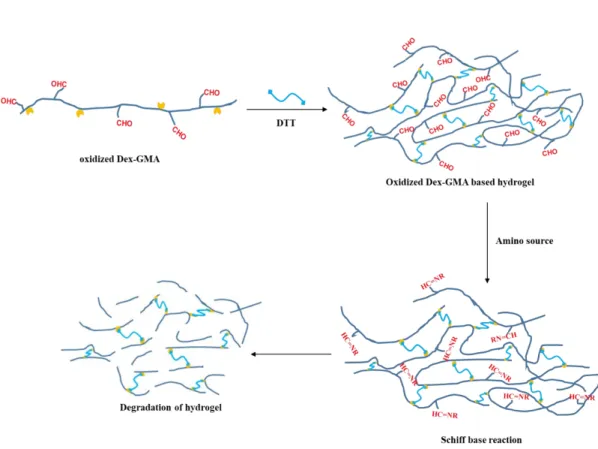
Hydrogels are crosslinked polymer networks that are able to swell in many solvents and aqueous environments without dissolving. The development of hydrogel technologies has been more interested in biomedical fields. Hydrogels particularly polysaccharide degradable hydrogel now pay attention to many tissue engineering scaffolds, wound dressings and drug delivery system [1,2,3]. Among of these applications drug delivery has become attractiveness. Hydrogel degradation can be used to control the release rate of the delivered component and also be safety to body when it is no longer needed. In our laboratory, successfully prepared degradation hydrogel by the reaction between the aldehyde-dextran and amino groups [4,5]. The formation of Schiff base and multiple crosslinking points were formed leading to hydrogel formation and suddenly started degradation. However, the unfovourableness of this hydrogel is lack of control the degradation time of hydrogel after Schiff base is formed. Thus, to overcome an unexpected degradable time and prolong the stability of hydrogel, the preparation of oxidized dextran based hydrogel without amino groups was suggested for degradation control and applying in drug delivery system. The aldehyde groups are left after hydrogel formation and the degradation of this hydrogel was controlled by amino source addition dependently mechanical properties.
Another newly emerged system, namely, near-infrared (NIR) light-responsive materials, has been intensively explored for biomedical application owing to their greater penetration
Chapter 1 General introduction
2 abilities and less damage to the tissue [6]. NIR optical stimulus is attractive as it can be remotely applied for a short period of time with high spatial and temporal precision. It would be more advantageous to materials that show thermoresponsive ability upon NIR light exposure can be controlled stimuli-responsive release systems. Therefore, to be control the release of amino groups at the desired time, the amino-carrageenan was introduced. The temperature-responsive polymer, carrageenan, was functionalized by amine group to obtain the amino-carrageenan product. The control release of amino source was triggered by photothermal agent stimulated by NIR. Hence, the degradation of oxidized dextran based hydrogel by the release of amino groups when amino-carrageenan absorbs heat was studied and reported in detail in this thesis.
1.2 Hydrogel
1.2.1 Hydrogel in drug delivery
In recent years, the hydrogel technology has been an integral part of human health care.
The pharmaceutical industry has been developing hydrogel based drug delivery system in an advanced manner by tuning the structure, shape and surface modifications of the biopolymers.
The highlighted properties of some natural and synthetic polymers such as dextran, carboxymethyl cellulose, poly(acrylic acid), and poly(2‑ hydroxyethylmethacrylate) etc. as a highly water swollen, soft and elastic gel leading to the keen interest in hydrogels as a class of biomaterials and their application as drug delivery systems. Three dimensional network formation occurs by the cross linking of the polymeric chains via physical interactions, covalent bonding, hydrogen bonding and by van der walls interactions [7]. The presence of the specific functional groups such as -OH, -CONH2, -SO3H, -CONH, and -COOR which have a hydrophilic tendency lead to the high content of water and biological fluids absorption (typically 70–99%) [8,9]. The soft and rubbery surface, structure and physicochemical properties of hydrogels similarity to that
Chapter 1 General introduction
3 of human tissue and can give the hydrogels excellent biocompatibility and the capability to easily encapsulate drugs. These characteristic features make hydrogels potential candidate for drug delivery systems.
Potentiality of hydrogel for drug delivery have been explored to reduce the release rate of drug from hydrogels by enhancing the interactions between drug and hydrogel. Both physical and chemical strategies can be manipulated to enhance the binding between a loaded drug and the hydrogel matrix. In case of physical interactions, the charge interactions between ionic polymers and charged drugs have been employed to increase the binding strength of target drugs and hydrogel. For example, the modification of gelatin hydrogels with amino acid could prolong the release of lysozyme and trypsin inhibitor protein because of the charge interactions between the amino acid chain and the entrapped proteins [10]. The anionic polymer, phosphate-functionalized N-isopropylacrylamide-based hydrogels (PNIPAM-based hydrogel) showed high uptake of cationic lysozyme comparing to non-functionalized PNIPAM hydrogels [11]. Similarly, our hydrogel; oxidized Dex-GMA based hydrogel performed the charge interaction with positive charge drug, consequently, drugs can be entrapped by this hydrogel.
1.2.2 Hydrogel degradation
Hydrogels have been a focus of attention for many years and are widely used in a variety of bio-related applications since they are typically biocompatible; furthermore, their moisture content can mimic the natural water content of human tissue [12,13]. The controlling mechanical properties and degradation behavior of hydrogel have focused to design and tailor appropriate materials for drug delivery and tissue engineering [14,15]. The degradation behavior control has been one of critical topics in general biomaterials research, and widely investigated until now. In general, biomaterials need to be gotten rid of from the body once they complete their roles in the
Chapter 1 General introduction
4 body, and degradable materials could be ideal for this purpose. The degradable hydrogels were typically obtained by two approaches. In the first case, the backbone of design gelling polymer is degradable hydrolysis and/or enzymatic action such as the degradation of aliphatic polyester and collagen were undergone main chain scission by hydrolysis and enzymatic action, respectively [16,17]. The second approach involves introduction of degradable cross-linking points to systems that are comprised of non-degradable polymer chains, for instance, hydrogel formation by crosslinking four-arm amine-terminated poly(ethylene glycol) (4-arm-PEG-NH2) using an azo- containing linker was rapidly degraded by NIR laser and photolysis with ultraviolet light [18].
1.3 Polysaccharides-based hydrogel
Polysaccharides are carbohydrate polymers in which monosaccharide ((CH2O)n) units are covalently joined by an O-glycosidic bond in either a branched or linear configuration.
Polysaccharide can be a homopolysaccharide, in which all the monosaccharides are the same, or a heteropolysaccharide in which the monosaccharides vary. Depending on which monosaccharides are connected, and which carbons in the monosaccharides connects, polysaccharides take on a variety of forms. Due to their structure, polysaccharides can have a wide variety of functions in nature. Some polysaccharides serve as stores of energy, as in glycogen (branched polysaccharide of glucose), some for sending cellular messages and others as a structural component providing support to cells and tissues, as in cellulose (linear polysaccharide of glucose).
Polysaccharides are produced from different sources obtained from microorganisms, plants, and animals. Polysaccharides made by microrganisms are secreted from the cell to form a layer over the surface of the organism. Microbial polysaccharides such as xanthan, xylinan, gellan, curdlan, pullulan, dextran, scleroglucan, schizophyllan, and cyanobacterial polysaccharides are available in commercial using for food, pharmaceutical, and medical
Chapter 1 General introduction
5 applications [19,4,20]. Polysaccharides in plants such as starch (a polymer of glucose, being found in the form of both amylose and the branched amylopectin) and cellulose are well known plant polysaccharides which used as a storage and support polysaccharide in plants. Chitin, an example of animal polysaccharide, is the exoskeleton of many arthropods, and is the main component of cell walls in fungi, radulas of mollusks etc. The utilization of polysaccharide should consider the structure, properties, production and modification to potentialize its applications.
1.3.1 Dextran-based hydrogel and its degradation
D x y y α-1,6 linked y α-1,3 linked residues. It contains the large amount of hydroxyl groups leading to high hydrophilicity and capability for chemical functionalization [1,21]. Dextran has been chosen in many biomedical applications due to its biocompatibility [22], low toxicity [4], high abundant in nature and degradation by enzyme in various part of the human body such as spleen, liver and colon [1,23]. It is slowly degraded by human enzymes as compared to other polysaccharides (e.g. glycogen with α-1,4 linkages) and cleaved by microbial dextranases in the gastrointestinal tract. In addition, it has been used as macromolecular carrier for delivery of drugs and proteins to increase the prolongation of therapeutic agents in systemic circulation. The elimination of dextran depends on its molecular weight (Mw). Low Mw, Mw < 40 kDa can be eliminated through renal clearance and have a half- life of 8 h, in contrast molecules with Mw > 40 kDa have larger half-lives and would be shortened in the liver and spleen and then hydrolysed by endo and exodextranases [1,23]. Moreover, the control degradation of dextran by enzymes or other methods to the target site and desirable time has been widely studied for utilization in drug delivery system.
Chapter 1 General introduction
6 Figure 1.1 Dextran structure.
Focusing on dextran degradation, the main goal of this research has been descripted by both of two approaches. Enzymatic degradation of dextran and its derivatives were performed using dextranase and proceeds through the selective chain scission at the 1,6-α-glycosidic linkage between the saccharide units to generate D-glucose [24,23,25]. Enzymatically degradable nitric oxide (NO) releasing S-nitrosated dextran thiomers using for the treatment of drug resistant cancer cells was reported [26]. The release of NO under arterial blood conditions, followed by their sensitivity to undergo enzymatic degradation by dextranase presented in Figure 1.2. There is the reports on the degradation behavior of in situ gelling hydrogel matrices composed of positively and negatively charged dextran microspheres by hydrolysis of the carbonate ester bond
Chapter 1 General introduction
7 between the dextran backbone and the crosslinked HEMA side chains results in degradation of the dex-HEMA gels at physiological pH making them suitable for various biomedical applications in drug delivery, tissue engineering, and tissue adhesion [4,27]. The adhesive hydrogel formed by the Schiff base reaction of aldehyde dextran and epsilon-poly-L-lysine (ɛ-PL) was reported [4]. Its low cytotoxicity, good adhesive strength, and self-degradation were obtained which can be developed as a biological glues in wound healing process. Interestingly, the Schiff base formation between the reaction of aldehyde groups from oxidized dextran and the primary amino group showed the self-degradation of dextran chain which could be ascribed to a Maillard reaction (see 1.5.4) [4,28]. Chimpibul et al. (2016) suggested that the main chain degradation of oxidized dextran via Schiff base formation depended on the oxidation ratio and amino acid concentration and also descripted main chain scission mechanism of oxidized dextran triggered by reaction with amine which shows the degradation pathways in Figure 1.3. The degradation proceeded via Amadori rearrangement, Strecker degradation and melanoidin formation, leading to produces the brown color during polysaccharide degradation. The findings help to elucidate the reaction mechanism of polysaccharide degradation and develop novel biodegradable polysaccharide materials for biomedical applications.
Figure 1.2 Schematic illustration of chain scission at 1,6-α-glycosidic linkage by dextranase [26].
Chapter 1 General introduction
8 Figure 1.3 Degradation pathways for the reaction of aldehyde saccharides and amino acids via Maillard reaction [5].
1.3.2 Carrageenan thermo-sensitive gelation and its degradation
Carrageenan, a naturally occurring anionic sulfated linear polysaccharides extracted from edible red seaweeds [29]. The basic structure of carrageenan is based on alternating copolymers of 1,3-linked β-D-galactose and 1,4-linked α-D-galactose, with varying degrees of sulfatation.
Chapter 1 General introduction
9 The units are joined by alternating α-1,3 and β-1,4 glycosidic linkages forming the disaccharide repeating unit of carrageenans [30,31,32]. The most common types of carrageenan are traditionally labeled kappa (κ), iota (ι), and lambda (λ) (Figure 1.4) [33]. The structures of the three main forms of carrageenan differ only in the number of sulfate groups per disaccharide having one, two, and three for κ, ι, and λ, respectively [34,35]. The carrageenan biocompatibility has been increasingly used in the cosmetic and pharmaceutical industries, it does not induce a toxic reaction [30,36].
κ- and ι-carrageenan are known to undergo a thermally-induced disordered-ordered transition, both chains exist as random coils with a larger amount of conformational entropy when elevated temperature. Upon cooling, entropy is decreased and chains re-orient into a more ordered conformation, which is accepted to consist of various form such as a double helix, aggregated mono-helices or aggregated helical dimers [37]. κ- and ι-carrageenan also form gelation in the presence of mono- (such as KCl, LiCl, and NaCl) and di-valent cations (such as MgCl2, CaCl2, and SrCl2). In contrast, λ-carrageenan does not show gelation in the presence of cation and displays only viscous behavior. It has been explained that the formation of ordered three-dimensional networks of κ- and ι-carrageenan compose of double helices resulting from crosslinking of the adjacent chains in which the sulfate groups are oriented externally [38,39].
Chapter 1 General introduction
10 Figure 1.4 Idealized structures of the three types of carrageenan.
The degradation of carrageenan would appear in the stomach, which is only partially degraded and this limited degradation has no effect on the wall of the stomach, where the pH is very low and acid hydrolysis undoubtedly occurs [40]. The enzymatic degradation of κ- carrageenan was conducted using recombinant Pseudoalteromonas carrageenovora κ- carrageenase has been reported [41] which undertook the study of the effect of salt conditions on enzymatic degradation of carrageenan. The proposed that the presence of I- binding is the main parameter which impedes carrageenan degradation by enzyme. The κ- carrageenan also be degraded by irradiation with gamma rays in the solid state, gel state or solution with various doses in air at ambient temperature [29]. The Mw of κ- carrageenan decreased continuously with
Chapter 1 General introduction
11 increasing the gamma ray intensity and the gel state needed lesser dose than solid state due to the indirect effect of radiation brought about by the water molecules.
In this research, κ-carrageenan was used to apply in the development of new carrier formulations because of its gelation properties. It can form gel when cooling or under appropriate salt conditions. γ-C κ- type dissolves only when heated and forms strong gels which is firm and brittle [34,42,43]. So, the κ-form could be the most appropriate type for releasing the carried substance when earning heat.
1.4 Photothermal agent triggered by near-infrared (NIR) for temperature-sensitive materials
Infrared radiation (IR) is electromagnetic radiation with longer wavelength than those of visible light, so, its higher energy allows the applications when using light. Among this region, near infrared (NIR) light have been strongly designed to utilize. NIR can penetrate up to 10 cm deep into tissue [44] with less damage and absorption or scattering and is more desirable for in vivo applications [45,46]. Thus, NIR laser was employed for photothermal therapy (PTT) to develop and encourage therapeutic strategy, especially advantages in cancer therapy. It shows high specificity, minimal invasiveness, precise selectivity and no systemic effects. The therapeutic efficacy of PTT significantly depends on the transformation of light to sufficient heat with photothermal agents, which absorb light-energy and then transform it to heat. In case of the tumor site, killing cancer cells via hyperthermia need the thermal energy 40-45 °C or higher [47].
The photothermal agents (PTA) such as noble metal nanostructures, carbon nanostructures, transition metal sulfide/oxides nanomaterials, and organic nanoagents have been extensively explored. For example, a trifolium like platinum nanoparticles were designed as a PTA for
Chapter 1 General introduction
12 photothermal ablation of bone metastasis by PTT treatment with effectiveness (Figure 1.5A) [48].
Considering the deeper tissue penetrating ability of laser and specific targeting of PTA, deep tumor-penetrating NIR probe (DiR) loaded DPN as a PTA for PTT of tumor progression and metastasis of breast cancer was developed (Figure 1.5B) [49]. Found that, the nanosized DPN could penetrate into the deep of tumor tissues and heat generated upon NIR irradiation for photothermal ablation of cancer cells which obviously inhibited the proliferation and migration activities of metastatic breast cancer cells.
Figure 1.5 (A) The TPN-mediated PTA therapy in a bone metastasis model [48]. (B) DiR-loaded photothermal nanotherapeutics (DPN) for PTT of breast cancer [49].
Another application of NIR photothermal agent is to collaborate with the thermo- responsive polymer for remote activation and spatiotemporal control of the stimulation. The NIR light-responsive hydrogel that undergoing the gel to sol transition upon light exposure based on a photothermal effect was reported [50]. Gold nanorods (AuNRs) were loaded into an ABA-type triblock copolymer hydrogel in form of micelle whose constituted by thermoresponsive polymer
Chapter 1 General introduction
13 displaying an upper critical solution temperature (UCST). The hydrogel structure is stable at T<UCST while exposed to NIR light heat release from AuNRs can increase the temperature above UCST, resulting in gel-to-sol transition. The hydrogel became water soluble and the target drug molecules can be released. The organic agent such as polydopamine (PDA) were descripted to possess a PTA which shows higher photothermal efficiency than that of widely used gold nanorod [51]. Xu et al., 2017 reported the capping of PDA microspheres with a PNIPAm y − PDA@PNIPA y y I application was to use an NIR light-controlled release-targeted system for pesticide loaded [52].
In this research, we fabricated the new material, amino-CG@PDA, for control release the amine groups conjugated on carrageenan backbone by NIR light stimulus to induce the gel-to sol phase transition of carrageenan after getting enough heat. The intense information was detailed in chapter 3.
1.5 Polysaccharide chemical reactions
1.5.1 Thiol-Michael addition
The Michael addition reaction is the reaction of an enolate-type nucleophile in the presence of a catalyst to α, β- unsaturated carbonyl which involves reactions in a myriad of organic synthesis to yield highly selective products. It is a simple, and highly effective reaction C−C y O attractive and longtime known of Michael addition reaction paradigm, thiol Michael reaction or thiol-ene addition reaction, has become popular in polymer chemistry [53,54]. Thiol Michael addition reactions can be readily actioned under base catalysis which can generate a thiolate anion by base abstract a proton from thiol. Then, the nucleophile thiolate anion attacks the electrophilic 𝛽-carbon of the C=C, forming the intermediate carbon-centered anion which, being a strong base,
Chapter 1 General introduction
14 abstracts a hydrogen from the conjugate acid to yield the thioether as a product [55,56]. The mechanism of base-catalyzed thiol Michael addition presents in Figure 1.6. In this thesis, glycidyl methacrylate (GMA) was introduced to oxidized dextran (oxidized Dex-GMA) and hydrogel was formed through thiol Michael addition when dithiothreitol (DTT) was added to oxidized Dex- GMA solution. The aldehyde groups from the oxidative cleavage of oxidized dextran were remained to react with primary amine for degradation trigger.
Figure 1.6 Schematic presentation of mechanism of base-catalyzed thiol Michael addition [56].
1.5.2 Malaprade reaction
Polysaccharide provide a profusion of compounds that contain hydroxyl groups on two or more adjacent carbon atoms, and its C-C bond can undergo oxidative scission selectively.
Periodate oxidative cleavage of vicinal glycols was discovered by Malaprade as knows Malaprade reaction [57]. Malaprade reaction of carbohydrates by periodate ion was a classical method for a long time used for structure determination of complex carbohydrates. The using of periodate oxidation to introduce dialdehydes into polysaccharides (Figure 1.7) provides a number of interesting applications in tissue engineering, and drug delivery [58,59]. For drug carrier application, the degradation of hydrogel has been become interestingness. Thus, the scission of
Chapter 1 General introduction
15 aldehyde polysaccharide chain was developed by reaction with amino source to form Schiff base reaction, consequently, the main chain scission is started.
Figure 1.7 (1→4)-linked residues where cleavage occurs between C2 and C3 [60].
1.5.3 Schiff base reaction
Schiff bases (also known as imine or azomethine) is the reaction between any primary amine and an aldehyde or a ketone under specific conditions [61]. The electrophilic carbon atoms of aldehydes and ketones can be targets of nucleophilic attack by amines. The end result of this reaction is a compound in which the C=O double bond is replaced by a C=N double bond (Figure 1.8).
Figure1.8 Schiff base reaction.
Chapter 1 General introduction
16 Schiff base reaction has been exceedingly used in situ cross-linked hydrogel systems for tissue engineering and drug delivery applications. For example, Tan et al. reported the biocompatible and biodegradable composite hydrogels for cartilage tissue engineering [62]. The hydrogel derived from N-succinyl-chitosan (S-CS) and aldehyde hyaluronic acid (A-HA), upon mixing by the Schiff base reaction between amino and aldehyde groups. In addition, the other types of polysaccharides can be oxidized and used for Schiff base mediated cross-linking, such as dextran, gum arabic, and cellulose [5,63,64,65]. In previous study, our group reported the adhesive hydrogel formation between the aldehyde dextran and ɛ-poly-L-lysine (ɛ-PL) via Schiff base reaction [4]. The gelation time of the hydrogel was easily controlled by the extension of oxidation degree in dextran and of the acylation in ɛ-PL by anhydrides. The prepared hydrogel were lower cytotoxicity than that of glutaradehyde and poly(allylamine). Moreover, the self- degradation rate of this hydrogel bioadhesive through Maillard reaction can be controlled by its oxidation degree and type of anhydride species in the acylate poly-L-lysine which can develop in biomedical applications as a bioadhesive [66].
1.5.4 Maillard reaction
The Maillard or browning reaction, interaction between amino and carbonyl compounds, resulting in complex changes in biological and food systems, refers to a complex set of amino- carbonyl reaction with multiple mechanisms, pathways, and products. These reactions affect the color, taste, aroma, texture, nutritional value, and toxicity of foods during cooking [67]. The chemical aspects emphasize the importance of the amino-carbonyl reactions in food and biological systems which explore three types of the main constituents of all biological systems:
proteins, polysaccharides, and lipids. The functional groups of their structural unit contained four groups of COOH, -OH, -NH2, and –CHO. In case of the reaction of enzymatic mediation, the
Chapter 1 General introduction
17 formation of polymeric biological constituents by one-step reversible condensation such as enzymatic polymerization of amino acids, which goes as far as to form protein. However, the nonenzymatic reaction of -CHO and –NH2 is quite different [68]. The first step of reaction between these groups is reversible process between formation and decomposition of glycosyl- amino products but its products undergo Amadori rearrangement to form ketosyl-amino products which undergo complex irreversible reactions involving dehydration, rearrangement, scission, and so on to yield decomposed products (Figure 1.9). It shows the unique features of the Maillard reaction involving irreversibility and complexity of the two functional groups -CHO and -NH and can recognizably different from the combinations formed by the other functional groups.
Figure 1.9 Scheme of Maillard reaction adapted from Hodge (1953) [69].
Chapter 1 General introduction
18 1.6 Research objective
The main goal of the study is to overcome the drawback of uncontrollable degradation timing of oxidized dextran-based hydrogel prepared by the reaction between aldehyde group in oxidized dextran and amino group in poly-L-lysine which was started degradation after Schiff based reaction form. And as mechanical property of the hydrogel was decided by the number of cross-linking points, degradation time also depended on the mechanical property. Hence, if the degradation time is independent with mechanical properties, the widely application in biomedical field will be provided. Therefore, the hydrogel formation of oxidized dextran without using aldehyde groups was prepared. The remaining aldehyde of hydrogel was reacted with amino groups and the degradation is stared. The posteriori degradation was controlled by addition of amine source to aim the controllable degradation independently of mechanical properties of hydrogels. Moreover, I also considered the control release of amino source which is stimulated by NIR light to irradiate the temperature-sensitive material (amino functionalized carrageenan or amino-CG) for release its amino group to react with aldehyde remaining. Thus, the degradation of oxidized dextran-based hydrogel was controlled.
Chapter 1 General introduction
19 References
1. Mehvar, R., Dextrans for targeted and sustained delivery of therapeutic and imaging agents. Journal of controlled release : official journal of the Controlled Release Society 2000, 69 (1), 1-25.
2. Ferreira, L. S.; Gerecht, S.; Fuller, J.; Shieh, H. F.; Vunjak-Novakovic, G.; Langer, R., Bioactive hydrogel scaffolds for controllable vascular differentiation of human embryonic stem cells. Biomaterials 2007, 28 (17), 2706-2717.
3. Van Tomme, S. R.; Hennink, W. E., Biodegradable dextran hydrogels for protein delivery applications. Expert review of medical devices 2007, 4 (2), 147-164.
4. Hyon, S. H.; Nakajima, N.; Sugai, H.; Matsumura, K., Low cytotoxic tissue adhesive based on oxidized dextran and epsilon-poly-L-lysine. Journal of biomedical materials research.
Part A 2014, 102 (8), 2511-2520.
5. Chimpibul, W.; Nagashima, T.; Hayashi, F.; Nakajima, N.; Hyon, S.-H.; Matsumura, K., Dextran oxidized by a malaprade reaction shows main chain scission through a maillard reaction triggered by schiff base formation between aldehydes and amines. Journal of Polymer Science Part A 2016, 54 (14), 2254-2260.
6. Fomina, N.; McFearin, C. L.; Sermsakdi, M.; Morachis, J. M.; Almutairi, A., Low Power, Biologically Benign NIR Light Triggers Polymer Disassembly. Macromolecules 2011, 44 (21), 8590-8597.
7. Qiu, Y.; Park, K., Environment-sensitive hydrogels for drug delivery. Advanced drug delivery reviews 2001, 53 (3), 321-339.
8. Arti Vashist, S. A., Hydrogels: Smart Materials for Drug Delivery. Oreiental Journal of Chemistry 2013, 29 (3), 861-870.
Chapter 1 General introduction
20 9. Li, J.; Mooney, D. J., Designing hydrogels for controlled drug delivery. Nature Reviews Materials 2016, 1, 16071-16081.
10. Sutter, M.; Siepmann, J.; Hennink, W. E.; Jiskoot, W., Recombinant gelatin hydrogels for the sustained release of proteins. Journal of controlled release 2007, 119 (3), 301-312.
11. Nakamae, K.; Nishino, T.; Kato, K.; Miyata, T.; Hoffman, A. S., Synthesis and characterization of stimuli-sensitive hydrogels having a different length of ethylene glycol chains carrying phosphate groups: loading and release of lysozyme. Journal of biomaterials science 2004, 15 (11), 1435-1446.
12. Lee, K. Y.; Mooney, D. J., Hydrogels for Tissue Engineering. Chemical Reviews 2001, 101 (7), 1869-1880.
13. A Peppas, N.; Zach Hilt, J.; Khademhosseini, A.; Langer, R., Hydrogels in Biology and Medicine: From Molecular Principles to Bionanotechnology. Advanced Materials 2006, 18 (11), 1345-1360.
14. Behravesh, E.; Jo, S.; Zygourakis, K.; Mikos, A. G., Synthesis of in Situ Cross-Linkable Macroporous Biodegradable Poly(propylene fumarate-co-ethylene glycol) Hydrogels.
Biomacromolecules 2002, 3 (2), 374-381.
15. Meyvis, T. K. L.; De Smedt, S. C.; Demeester, J.; Hennink, W. E., Influence of the Degradation Mechanism of Hydrogels on Their Elastic and Swelling Properties during Degradation. Macromolecules 2000, 33 (13), 4717-4725.
16. Eliaz, R. E.; Kost, J., Characterization of a polymeric PLGA-injectable implant delivery system for the controlled release of proteins. Journal of biomedical materials research 2000, 50 (3), 388-396.
Chapter 1 General introduction
21 17. Olde Damink, L. H.; Dijkstra, P. J.; van Luyn, M. J.; van Wachem, P. B.; Nieuwenhuis, P.; Feijen, J., In vitro degradation of dermal sheep collagen cross-linked using a water-soluble carbodiimide. Biomaterials 1996, 17 (7), 679-684.
18. Hu, J.; Chen, Y.; Li, Y.; Zhou, Z.; Cheng, Y., A thermo-degradable hydrogel with light- tunable degradation and drug release. Biomaterials 2017, 112 (2017), 133-140.
19. Ahmad; Mustafa; Man, C., Microbial Polysaccharides and Their Modification Approaches: A Review. International Journal of Food Properties 2015, 18 (2), 332–347.
20. Kar, R.; Mohapatra, S.; Bhanja, S.; Das, D.; Barik, B., Formulation and In Vitro Characterization of Xanthan Gum-Based Sustained Release Matrix Tables of Isosorbide-5- Mononitrate. Iranian Journal of Pharmaceutical Research 2010, 9 (1), 13-19.
21. Levesque, S. G.; Shoichet, M. S., Synthesis of enzyme-degradable, peptide-cross-linked dextran hydrogels. Bioconjugate chemistry 2007, 18 (3), 874-885.
22. Ferreira, L.; Rafael, A.; Lamghari, M.; Barbosa, M. A.; Gil, M. H.; Cabrita, A. M.;
Dordick, J. S., Biocompatibility of chemoenzymatically derived dextran-acrylate hydrogels.
Journal of biomedical materials research. Part A 2004, 68 (3), 584-596.
23. Khalikova, E.; Susi, P.; Korpela, T., Microbial dextran-hydrolyzing enzymes:
fundamentals and applications. Microbiology and molecular biology reviews 2005, 69 (2), 306- 325.
24. Jain, A.; Gupta, Y.; Jain, S. K., Perspectives of biodegradable natural polysaccharides for site-specific drug delivery to the colon. Journal of pharmacy & pharmaceutical sciences 2007, 10 (1), 86-128.
25. Covacevich, M. T.; Richards, G. N., Frequency and distribution of branching in a dextran: an enzymic method. Carbohydrate Research 1977, 54 (2), 311-315.
Chapter 1 General introduction
22 26. Damodaran, V. B.; Place, L. W.; Kipper, M. J.; Reynolds, M. M., Enzymatically degradable nitric oxide releasing S-nitrosated dextran thiomers for biomedical applications.
Journal of Materials Chemistry 2012, 22 (43), 23038-23048.
27. Van Tomme, S. R.; van Nostrum, C. F.; de Smedt, S. C.; Hennink, W. E., Degradation behavior of dextran hydrogels composed of positively and negatively charged microspheres.
Biomaterials 2006, 27 (22), 4141-4148.
28. Ding, Y. Q.; Cui, Y. Z.; Li, T. D., New views on the reaction of primary amine and aldehyde from DFT study. The journal of physical chemistry. A 2015, 119 (18), 4252-4260.
29. Relleve, L.; Nagasawa, N.; Luan, L. Q.; Yagi, T.; Aranilla, C.; Abad, L.; Kume, T.;
Yoshii, F.; dela Rosa, A., Degradation of carrageenan by radiation. Polymer Degradation and Stability 2005, 87 (3), 403-410.
30. Francis, S.; Kumar, M.; Varshney, L., Radiation synthesis of superabsorbent poly(acrylic acid)–carrageenan hydrogels. Radiation Physics and Chemistry 2004, 69 (6), 481-486.
31. Abad, L. V.; Relleve, L. S.; Aranilla, C. T.; Dela Rosa, A. M., Properties of radiation synthesized PVP-kappa carrageenan hydrogel blends. Radiation Physics and Chemistry 2003, 68 (5), 901-908.
32. Chronakis, I. S.; Piculell, L.; Borgström, J., Rheology of kappa-carrageenan in mixtures of sodium and cesium iodide: two types of gels. Carbohydrate Polymers 1996, 31 (4), 215-225.
33. Maolin, Z.; Hongfei, H.; Yoshii, F.; Makuuchi, K., Effect of kappa-carrageenan on the properties of poly(N-vinyl pyrrolidone)/kappa- y y z y γ- radiation technology. Radiation Physics and Chemistry 2000, 57 (3), 459-464.
34. Yuguchi, Y.; Thu Thuy, T. T.; Urakawa, H.; Kajiwara, K., Structural characteristics of carrageenan gels: temperature and concentration dependence. Food Hydrocolloids 2002, 16 (6), 515-522.
Chapter 1 General introduction
23 35. Langendorff, V.; Cuvelier, G.; Michon, C.; Launay, B.; Parker, A.; De kruif, C. G., Effects of carrageenan type on the behaviour of carrageenan/milk mixtures. Food Hydrocolloids 2000, 14 (4), 273-280.
36. Cohen, S. M.; Ito, N., A critical review of the toxicological effects of carrageenan and processed eucheuma seaweed on the gastrointestinal tract. Critical reviews in toxicology 2002, 32 (5), 413-444.
37. Song, K.-H.; Eddington, N. D., The impact of AT1002 on the delivery of ritonavir in the presence of bioadhesive polymer, carrageenan. Archives of Pharmacal Research 2012, 35 (5), 937-943.
38. Campo, V. L.; Kawano, D. F.; Silva, D. B. d.; Carvalho, I., Carrageenans: Biological properties, chemical modifications and structural analysis – A review. Carbohydrate Polymers 2009, 77 (2), 167-180.
39. Running, C. A.; Falshaw, R.; Janaswamy, S., Trivalent Iron Induced Gelation in Lambda- Carrageenan. Carbohydr Polym 2012, 87 (4), 2735-2739.
40. Necas, J.; Bartosikova, L., Carrageenan: A review. Veterinarni Medicina 2013, 58 (4), 187-205.
41. Nyvall Collen, P.; Lemoine, M.; Daniellou, R.; Guégan, J.-P.; Paoletti, S.; Helbert, W., E zy D κ-Carrageenan in Aqueous Solution. Macromolecules 2009, 10 (7), 1757–1767
42. Öz k H ; P k Ö C x κ-carrageenan- water system. Journal of Molecular Structure: THEOCHEM 2004, 676 (1), 19-27.
43. Bixler, H. J., The Carrageenan Connection IV. British Food Journal 1994, 96 (3), 12-17.
44. Weissleder, R., A clearer vision for in vivo imaging. Nature Biotechnology 2001, 19, 316.
Chapter 1 General introduction
24 45. Braun, G. B.; Pallaoro, A.; Wu, G.; Missirlis, D.; Zasadzinski, J. A.; Tirrell, M.; Reich, N. O., Laser-Activated Gene Silencing via Gold Nanoshell-siRNA Conjugates. ACS nano 2009, 3 (7), 2007-2015.
46. Arnold, M. A., Near-Infrared Applications in Biotechnology Edited by R. Raghavachari (Corning Microarray Te y C NY) M D kk : N Y k B Journal of the American Chemical Society 2001, 123 (50), 12746-12747.
47. Li, Y.; Lu, W.; Huang, Q.; Huang, M.; Li, C.; Chen, W., Copper sulfide nanoparticles for photothermal ablation of tumor cells. Nanomedicine 2010, 5 (8), 1161-1171.
48. Wang, C.; Cai, X.; Zhang, J.; Wang, X.; Wang, Y.; Ge, H.; Yan, W.; Huang, Q.; Xiao, J.;
Zhang, Q.; Cheng, Y., Trifolium-like Platinum Nanoparticle-Mediated Photothermal Therapy Inhibits Tumor Growth and Osteolysis in a Bone Metastasis Model. Small 2015, 11 (17), 2080- 2086.
49. He, X.; Bao, X.; Cao, H.; Zhang, Z.; Yin, Q.; Gu, W.; Chen, L.; Yu, H.; Li, Y., Tumor- Penetrating Nanotherapeutics Loading a Near-Infrared Probe Inhibit Growth and Metastasis of Breast Cancer. Advanced Functonal Materials 2015, 25 (19), 2831-2839.
50. Zhang, H.; Guo, S.; Fu, S.; Zhao, Y., A Near-Infrared Light-Responsive Hybrid Hydrogel Based on UCST Triblock Copolymer and Gold Nanorods. Polymers 2017, 9 (6), 1-9.
51. Liu, Y.; Ai, K.; Liu, J.; Deng, M.; He, Y.; Lu, L., Dopamine-melanin colloidal nanospheres: an efficient near-infrared photothermal therapeutic agent for in vivo cancer therapy.
Advanced materials 2013, 25 (9), 1353-9.
52. Xu, X.; Bai, B.; Wang, H.; Suo, Y., A Near-Infrared and Temperature-Responsive Pesticide Release Platform through Core–Shell Polydopamine@PNIPAm Nanocomposites. ACS Applied Materials & Interfaces 2017, 9 (7), 6424-6432.
Chapter 1 General introduction
25 53. J. Kade, M.; J. Burke, D.; J. Hawker, C., The Power of Thiol-ene Chemistry. Journal of Polymer Science: Part A 2010, 48 (4), 743-750.
54. Liu, Z. Q.; Wei, Z.; Zhu, X. L.; Huang, G. Y.; Xu, F.; Yang, J. H.; Osada, Y.; Zrinyi, M.;
Li, J. H.; Chen, Y. M., Dextran-based hydrogel formed by thiol-Michael addition reaction for 3D cell encapsulation. Colloids and surfaces. B 2015, 128, 140-8.
55. Nair, D. P.; Podgórski, M.; Chatani, S.; Gong, T.; Xi, W.; Fenoli, C. R.; Bowman, C. N., The Thiol-Michael Addition Click Reaction: A Powerful and Widely Used Tool in Materials Chemistry. Chemistry of Materials 2014, 26 (1), 724-744.
56. Sun, Y.; Liu, H.; Cheng, L.; Zhu, S.; Cai, C.; Yang, T.; Yang, L.; Ding, P., Thiol Michael Addition Reaction: A facile Tool for Introducing Peptides into Polymer-based Gene Delivery Systems. Polymer International 2017, 67 (1), 35-31.
57. Jackson, E. L.; Hudson, C. S., Application of the Cleavage Type of Oxidation by Periodic Acid to Starch and Cellulose1. Journal of the American Chemical Society 1937, 59 (10), 2049- 2050.
58. Inci, I.; Kirsebom, H.; Galaev, I. Y.; Mattiasson, B.; Piskin, E., Gelatin cryogels crosslinked with oxidized dextran and containing freshly formed hydroxyapatite as potential bone tissue-engineering scaffolds. Journal of tissue engineering and regenerative medicine 2013, 7 (7), 584-8.
59. Li, X.; Weng, Y.; Kong, X.; Zhang, B.; Li, M.; Diao, K.; Zhang, Z.; Wang, X.; Chen, H., A covalently crosslinked polysaccharide hydrogel for potential applications in drug delivery and tissue engineering. Journal of Materials Science 2012, 23 (12), 2857-2865.
60. Kristiansen, K. A.; Potthast, A.; Christensen, B. E., Periodate oxidation of polysaccharides for modification of chemical and physical properties. Carbohydrate Research 2010, 345 (10), 1264-1271.
Chapter 1 General introduction
26 61. da Silva, C. M.; da Silva, D. L.; Modolo, L. V.; Alves, R. B.; de Resende, M. A.; Martins, C. V. B.; de Fátima, Â., Schiff bases: A short review of their antimicrobial activities. Journal of Advanced Research 2011, 2 (1), 1-8.
62. Tan, H.; Chu, C. R.; Payne, K. A.; Marra, K. G., Injectable in situ forming biodegradable chitosan-hyaluronic acid based hydrogels for cartilage tissue engineering. Biomaterials 2009, 30 (13), 2499-2506.
63. Ito, T.; Yeo, Y.; Highley, C. B.; Bellas, E.; Benitez, C. A.; Kohane, D. S., The prevention of peritoneal adhesions by in situ cross-linking hydrogels of hyaluronic acid and cellulose derivatives. Biomaterials 2007, 28 (6), 975-983.
64. Maia, J.; Ferreira, L.; Carvalho, R.; Ramos, M. A.; Gil, M. H., Synthesis and characterization of new injectable and degradable dextran-based hydrogels. Polymer 2005, 46 (23), 9604-9614.
65. Nishi, K. K.; Jayakrishnan, A., Preparation and in vitro evaluation of primaquine- conjugated gum arabic microspheres. Biomacromolecules 2004, 5 (4), 1489-1495.
66. Matsumura, K.; Nakajima, N.; Sugai, H.; Hyon, S. H., Self-degradation of tissue adhesive based on oxidized dextran and poly-L-lysine. Carbohydr Polym 2014, 113, 32-38.
67. B y J W T M R : C y B y I By Harry Nursten. Journal of the American Chemical Society 2005, 127 (41), 14527-14528.
68. Namiki, M., Chemistry of Maillard Reactions: Recent Studies on the Browning Reaction Mechanism and the Development of Antioxidants and Mutagens. In Advances in Food Research, 32, 115-184.
69. Hodge, J. E., Dehydrated Foods, Chemistry of Browning Reactions in Model Systems.
Journal of Agricultural and Food Chemistry 1953, 1 (15), 928-943.
Chapter 2 Controlling degradation of oxidized dextran-based hydrogel
27
Chapter 2
Controlling degradation of oxidized dextran-based hydrogel
2.1 Introduction
Hydrogels are cross-linked polymer networks that have a high number of hydrophilic domains and are able to expand in many solvents and aqueous environments without dissolving due to the chemical or physical bonds formed between the polymer chains [1, 2]. Natural polymers, specifically polysaccharides, are often used for hydrogel preparation because of their biocompatibility and chemical structure that facilitates the development of desirable functionalized materials [3]. To date, low toxicity, biocompatible, and degradable hydrogels have been designed using polysaccharides and functionalized polysaccharides for biomedical applications, such as tissue engineering scaffolds, wound dressings, and controlled drug delivery systems [4-8]. For example, alginate and its derivative hydrogels are compatible with a variety of techniques to control gelling and possess desirable physical and chemical properties that can be used to facilitate cell adhesion and control the speed of degradation, all of which can be combined to promote cell transplantation [9]. The periodate oxidation of alginate, which can be cross-linked with multivalent cations (Ca2+) to produce hydrogels, was observed to degrade in vitro in a phosphate buffer saline solution (PBS) (pH 7.4, 37 °C) within nine days [10]. These hydrogels can potentially be used in cartilage-like tissue formation. In drug delivery systems, an active
Chapter 2 Controlling degradation of oxidized dextran-based hydrogel
28 therapeutic agent is integrated with a polymeric network structurethat can control its release rate by allowing the hydrogel to safely degrade in the body when it is no longer needed [11].
Biodegradable polysaccharides, such as chitosan, alginate, xanthan gum, and dextran, have been widely researched for potential applications in drug carriers [12-15]. Among these, dextran has received significant attention.
Dextran is a bacterial polysaccharide that is broadly applicable in the biomedical field due to its biocompatibility [16, 17], low toxicity [18], high natural abundance, and ability to degrade via enzymes in various parts of the human body, such as the spleen, liver, and colon, and is available in a wide range of molecular weights [4, 19]. Furthermore, dextran contains a large number of hydroxyl groups, which give it a high hydrophilicity and allow it to be used in chemical functionalization [3, 4, 20, 21]. The structure of dextran presents in Figure 1.1. In a previous report, Hyon et al. prepared hydrogels via the reaction between the aldehyde groups in the periodate oxidized dextran and the amino groups in the poly-L-lysine [18]. In that case, the hydrogels exhibited degradation in PBS and found that the degradation time could be controlled by the rate of aldehyde introduction and the amine concentration. The mechanism behind the degradation was reported as follows: the main chain of the oxidized dextran was degraded by the Maillard reaction that was triggered by the Schiff base formation between the aldehyde and amino groups. A two-dimensional (2D) nuclear magnetic resonance (NMR) scan revealed that the partial hemiacetal structures produced by the periodate oxidation reacted with the amino groups and underwent an Amadori rearrangement, which led to the scission of the glucose unit ring [22]
(Figure 2.1). This study is based on and utilizes this reaction to overcome the following drawback. From the previous report, because the crosslink points formed by the reaction between the aldehyde groups in the oxidized dextran and the amino groups in the poly-L-lysine triggered the degradation of the hydrogel, the degradation speed was found to depend on the number of
Chapter 2 Controlling degradation of oxidized dextran-based hydrogel
29 chemical crosslink points during gelation [15, 23]. However, as the formation and degradation of this hydrogel occurred simultaneously after the Schiff base formation reaction between the aldehyde and amino groups, it was difficult to control the timing of the degradation. In addition, as the mechanical properties of the hydrogel were determined by the number of crosslinking points, the degradation time also depended on the mechanical properties, much like stiff hydrogels exhibit longer degradation times while soft hydrogels exhibit shorter degradation times.
If a degradation control with respect to time and space can be identified that is independent of the mechanical properties, such as hard/fast or soft/slow combinations, these hydrogels could prove to be valuable platform materials for the fabrication of biodegradable scaffolds and drug carriers.
Chapter 2 Controlling degradation of oxidized dextran-based hydrogel
30
Figure 2.1 (A) Maillard reaction pathway for the reaction of aldehyde saccharides and amino acids. (B) Molecular scission mechanism of oxidized dextran by the reaction with amine [22].
In this study, glycidyl methacrylate (GMA) was immobilized into dextran (Dex-GMA) and oxidized by sodium periodate to introduce aldehyde groups, thereby creating oxidized Dex- GMA. The oxidized Dex-GMA was crosslinked with dithiothreitol (DTT) by a thiol-ene-Michael addition reaction to form a hydrogel with the remaining aldehyde groups. Then, the a posteriori degradation was controlled by the addition of an amine source so that the degradation was independent of the mechanical properties of the hydrogels. It was thought that this novel strategy may open new avenues of approach to create tissue engineering and drug delivery system materials via a unique chemical stimuli (amino group) responsive degradation control.
2.2 Materials and methods
2.2.1 Materials
Dextran (molecular weight (Mw) = 70 kDa) was acquired from Meito Sangyo (Nagoya, Japan), while GMA and DTT were purchased from TCI (Tokyo, Japan) and 4-
Chapter 2 Controlling degradation of oxidized dextran-based hydrogel
31 Dimethylaminopyridine (DMAP) was obtained from Sigma Aldrich (St. Louis, MO, USA).
Acetyl cysteine (Ac-Cys-OH) was obtained from Watanabe Chemical Ind., Ltd. (Hiroshima, Japan) and sodium periodate (NaIO4), disodium hydrogen phosphate (Na2HPO4), sodium dihydrogen phosphate (NaH2PO4), glycine, and other chemicals were purchased from Nacalai Tesque, Inc., (Kyoto, Japan). All chemicals were used without purification.
2.2.2 Synthesis and characterization of the oxidized Dex-GMA
Dex-GMA was synthesized by applying the method reported by Liu et al. [24]. In brief, 5 g of dextran was combined with 20 mL of dimethyl sulfoxide (DMSO) and the solution was stirred until the dextran was completely dissolved. The transparent solution was then stirred for 30 min under nitrogen gas. Then, 0.8 g of DMAP and 2.2 g of GMA were added to the solution under nitrogen gas for 30 min. The solution was stirred at 50 °C for 12 h before an equimolar amount of hydrochloric acid (HCl) was added to the solution mixture to neutralize the DMAP.
The mixture was dialyzed against distilled water for one week using a dialysis membrane (MWCO = 3.5 kD). The resulting product was air dried for 48 h at 47 °C and vacuum dried for 48 h at 25 °C to obtain Dex-GMA derivative as a pale yellow-brown flake product.
Oxidized Dex-GMA was synthesized by the oxidation of dextran-GMA with sodium periodate [18]. Here, 2.5 g of Dex-GMA was dissolved in 10 mL of distilled water and various amounts of sodium periodate (0.375 to 1.25 g) were dissolved in 5 mL water. After dissolution, both solutions were mixed and the reaction was allowed to continue at 50 °C for 1 h. The mixture was dialyzed against running water overnight and water for one day using a dialysis membrane (MWCO = 3.5 kD). The resulting product was processed by air drying for 48 h at 47 °C and freeze drying for 48 h to obtain oxidized Dex-GMA, which was then characterized by 1H nuclear magnetic resonance (NMR) (600, 700, and 900 MHz equipped with a cryogenic probe, Bruker).
The results of the 1H-NMR spectroscopy were used to investigate the degree of substitution (%
Chapter 2 Controlling degradation of oxidized dextran-based hydrogel
32 DS). In addition, oxidized dextran without GMA was synthesized by following the same method, except that dextran was employed as the starting material. The amount of aldehyde content in the functionalized dextran was determined using the fluorometry method [25]. Briefly, to prepare the mixture solution, 2.5 ml of 4.0 M ammonium acetate, 1.0 ml of 0.2 M acetoacetanilide (AAA), 1.0 ml of ethanol, and a series of standard glutaraldehyde solutions or samples were combined.
Then, the mixtures were diluted to 5 mL with purified water and left for 10 min. The relative fluorescence intensities of the reagent blank, standard glutaraldehyde, and the sample solutions were measured at 470 nm with an excitation wavelength of 370 nm. The aldehyde content was determined from the standard calibration graph.
2.2.3 Gelation time measurement
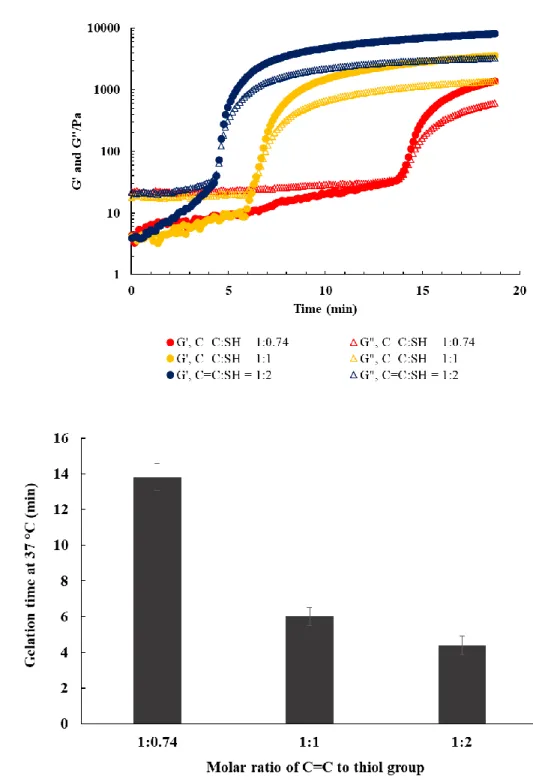
Gels can form when oxidized Dex-GMA is crosslinked by DTT. The same volume of 10% (w/v) of oxidized Dex-GMA and 1.00, 1.36, or 2.72% (w/v) of DTT in PBS in which the molar ratio of C=C and thiol was equivalent at 1:0.74, 1:1, and 1:2, respectively, were mixed in a test tube and the gelation time was investigated by rheology analysis at a temperature of 37 °C.
The molar ratio of the functional groups was varied by changing the concentration of the DTT to determine the gelling time.
2.2.4 Determination of the thiol content by Ellman’s assay
To characterize the reaction of the aldehyde in the oxidized Dex-GMA with DTT, oxidized dextran without GMA was used as model to react with the mono- E ’ reagent, also known as 5,5'-Dithio-bis-(2-nitrobenzoic acid) or DTNB, was employed to evaluate the sulfhydryl group in the sample. Briefly, a set of test tubes was prepared, each of which contained 2.5 mL of reaction buffer (0.1 M phosphate buffer, pH 8), 1 mM of y (EDTA) 5 μL E ’ ( y
Chapter 2 Controlling degradation of oxidized dextran-based hydrogel
33 4 E ’ 1 L ) T y ( – 1.5 M) 25 μL k t tube. The solution was mixed and incubated at 25 °C for 15 min, and then the absorbance was measured at 412 nm. The concentration of the experimental sample was determined by comparison to the calibration graph of standard cysteine.
2.2.5 Rheological characterization
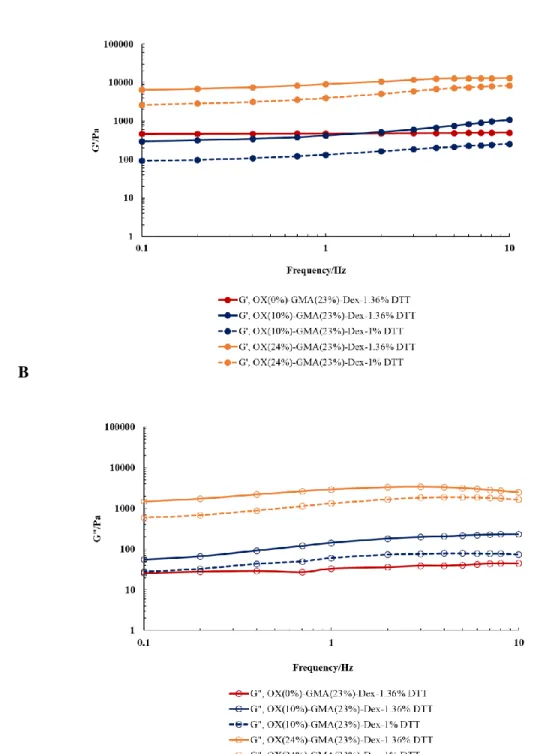
The rheological properties were evaluated using a rheometer equipped with a 24.99 mm, 2.069° cone (Rheosol G5000, UBM Co., Ltd., Kyoto, Japan). Briefly, 10% (w/v) of oxidized Dex-GMA (23% DS of GMA with varying degrees of oxidation) and 1 or 1.36% (w/v) of DTT in PBS with the same volume were mixed and placed into the gap between the lower plate and cone 37 °C T y (G’) (G”) hydrogels were determined via a frequency dispersion mode from 0.01 to 10 Hz.
2.2.6 Determination of the amount of quantitative gel degradation
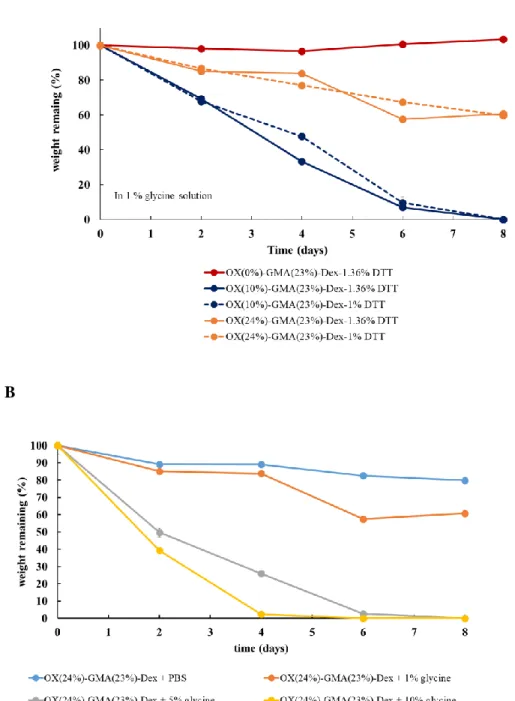
To quantitatively evaluate the degradation of the gel, 0.5 mL of a 10% (w/v) oxidized Dex-GMA (23% DS of GMA with varying degrees of oxidation) aqueous solution and 0.5 mL of 1.36 wt% DTT were mixed in a centrifuge tube (15 mL capacity). The mixture was incubated at 37 °C for 30 min in water bath to allow for gelation. After the addition of 10 mL of PBS and an amino compound solution (1–10% (w/v) glycine solution), the tube was tightly sealed and incubated at 37 °C while being gently rotated. After the time interval had elapsed, the supernatant was removed and the remaining gel was rinsed with distilled water. Then, the remaining gel was freeze-dried (48 h) and vacuum dried (50 °C for 24 h). The weight of the remaining hydrogel was recorded versus the incubation periods. Samples were taken in triplicate (n = 3).
Chapter 2 Controlling degradation of oxidized dextran-based hydrogel
34 2.2.7 Determination of the molecular weight (Mw) by GPC
Oxidized dextran and oxidized Dex-GMA at the same %oxidation were dissolved in a phosphate buffer solution (pH 7.4, 0.1 M) to achieve the desired final concentration of 2% (w/v).
In this section, a monothiol reagent (Ac-Cys-OH) was used instead of DTT so as to not form a hydrogel. The same volume of glycine (or Ac-Cys-OH) with a concentration of 0.6% and 5%
(w/v) was added to the dextran derivatives solution, which was then incubated at 37 °C. Glycine was used as an amine source and Ac-Cys-OH was used as an SH source. Gel permeation chromatography (GPC) (Shimadzu, Japan, BioSep-s2000 column, Phenomenex, Inc., CA, USA) was employed to determine the molecular weight of the dextran derivatives at the desired time after the reaction. Here, PBS was used as the mobile phase (flow rate = 0.50 mL/min) and pullulan was used as the standard.
2.2.8 Kinetic analysis by NMR spectroscopy
The NMR data was recorded on a Bruker Avance III 600, 700 and 900 MHz spectrometer equipped with a cryogenic probe at 25 °C for use in a kinetic analysis of the reactions between the oxidized dextran-GMA and the Ac-Cys-OH or glycine. Two-dimensional NMR techniques, including 1H–13C hetero-nuclear single quantum correlation spectroscopy (HSQC), 1H–13C hetero-nuclear multiple-bond correlation spectroscopy (HMBC), total correlation spectroscopy (TOCSY), and double quantum filtered-correlation spectroscopy (DQF-COSY), were used to analyze the oxidized Dex-GMA. In the kinetic analysis experiments, oxidized Dex-GMA [10%
(w/w)), oxidized with NaIO4 (30% (w/w)], and 6% (w/w) Ac-Cys-OH or glycine, both in a PBS/D2O solution at pH 7, were mixed at a 1:1 ratio in an ice bath to delay degradation. The final concentration was 5% oxidized Dex-GMA and 3% Ac-Cys-OH or glycine. As the peak was broadened due to the high concentration of Ac-Cys-OH, the reaction between the 5% oxidized
Chapter 2 Controlling degradation of oxidized dextran-based hydrogel
35 Dex-GMA and 0.75% Ac-Cys-OH (low concentration Ac-Cys-OH) was monitored via NMR.
Once the solution was mixed, it was immediately transferred to the NMR spectrometer, and the first 1H NMR spectrum was recorded 12 to 17 min later. Subsequently, one-dimensional 1H NMR spectra with presaturation were recorded every 5 min, and 24 scans were accumulated with a recycle time of 12.5 s.
2.2.9 Cytotoxicity test
Cell viability was determined by measuring the ability of the cells to convert 3-(4,5- dimethyl thial-2-yl)-2, 5-diphenyltetrazalium bromide (MTT) to a purple formazan dye. L929 cells suspended in a 0.1 mL medium at a concentration of 1.0 ×10⁴/mL were placed in 96-well culture plates. After 72 h incubation at 37 ℃, 0.1 mL medium containing different concentrations of oxidized Dex-GMA was added to the cells, followed by 48 h incubation. To evaluate the cell viability, 0.1 mL MTT solution (300 mg/mL in medium) was added to the cultured cells, which were further incubated for 4 h at 37 ℃. After removing the remaining medium, 0.1 mL DMSO was added to each well to dissolve the precipitation. The resulting color intensity, which was proportional to the number of viable cells, was measured by a microplate reader (versa max, Molecular Devices Co., CA, USA) at 540 nm. The cytotoxicity of the test substances was expressed as the 50% inhibition concentration of growth (IC50), which was defined as the concentration in the culture at which the cell activity was reduced to 50% of that of the untreated control cells.
![Figure 1.2 Schematic illustration of chain scission at 1,6-α-glycosidic linkage by dextranase [26]](https://thumb-ap.123doks.com/thumbv2/123deta/6135322.1079922/16.918.217.734.762.1003/figure-schematic-illustration-chain-scission-glycosidic-linkage-dextranase.webp)
![Figure 1.6 Schematic presentation of mechanism of base-catalyzed thiol Michael addition [56]](https://thumb-ap.123doks.com/thumbv2/123deta/6135322.1079922/23.918.224.753.378.519/figure-schematic-presentation-mechanism-catalyzed-thiol-michael-addition.webp)
![Figure 1.9 Scheme of Maillard reaction adapted from Hodge (1953) [69].](https://thumb-ap.123doks.com/thumbv2/123deta/6135322.1079922/26.918.216.774.501.1003/figure-scheme-maillard-reaction-adapted-hodge.webp)