Ⅰ.Introduction
In most Japanese companies, personnel transfers are primarily transfers to other workplaces within a company, i.e. lateral shifts to expand the breadth of employee experience.
Other cases include vertical transfers associated with promotions, and changes of position made to effect a career change. Transfers between workplaces are often known as job rotations, and furthermore there are personnel transfers outside the company in what are termed
“Shukko” or “Tenseki”. Based on a series of previous researches by Koike, these kinds of personnel transfers in Japan have been above all performed as a part of on the job training (OJT), and have been emphasized as way to expand employee’s work experience1 ).
What kind of effects do these personnel transfers have that focuses on an expansion of work experience? Previous researches in Japan mainly using interviews show that personnel transfers lead to an increase of skills related to the fulfillment of work duties by broadening work experiences, with the result of improved
work output. However, there have not been sufficient researches to date regarding quantitative data analysis and issues other than the effectiveness of skill improvement. Therefore, this paper aims at clarifying that the broad effects of personnel transfers with regard to engineer’s human capital and individual performance, based on the quantitative data in the survey. Our analytical target is engineers belonging to one of major Japanese manufacturing company groups.
The structure of this study is as follows. In the following section, we show our focuses by reviewing previous researches related to personnel transfers. Section 3 explains the data used in the analysis, after which an outline is provided of the features of personnel transfers in the purpose of this paper. Next, Section 4 validates our hypotheses presented in Section 2.
Finally, in Section 5 we summarize our findings and concluding remarks.
Ⅱ.The focus of this paper
As discussed above, personnel transfer is something that causes the expansion of work experience, therefore in this part, we will review researches not only with transfers between workplaces but also work experience.
First of all, we look at its relationship with
《論 文》
Effects of Personnel Transfer on Engineer’s Human Capital and Performance*
MIYAMOTO DAI
Keywords
personnel transfer, human capital accumulation, individual performance
(063)
* This work was supported by JSPS KAKENHI Grant Number 23530489.
1 )Koike (1988, 1991, 1994a, 1994b) and Koike and Inoki
(1990)
(064) work performance. Findings of researches centering on human capital theory show that personnel transfers contribute to improvement of work performance. The researches of Koike mentioned above also correspond to this context.
Koike’s works point out that personnel transfers accompanying a shift between workplaces expand the breadth of an employee’s experience, and leads to the improvement of intellectual skills. These intellectual skills are defined as skills used to overcome uncertainty, and past experience in dealing with the varied problems at work heighten the skills, which are problem- finding and solving abilities, used to resolve uncertainty in the employee’s current work, as a result improving an employee’s output. In many studies based on human capital theory, greater work experience has been clearly shown to heighten a worker’s individual output (Maranto and Rodgers 1984, McEnrue 1988, Avolio, Waldman and McDaniel 1990, Jung and Magrabi 1991, Dolton and Kidd 1998, Toda 2011). There are also many studies in the field of psychology concerning the effects of work experience and transfers between different work duties, and a positive relationship has been shown between work experience and job performance.(McDaniel, Schmidt and Hunter 1988, Quinones, Ford, and Teachout 1995, Kolz, Mcfarland and Silverman 1998, Tesluk and Jacobs 1998)
Furthermore, related domestic researches targeting Japanese engineers regarding transfers between research and development (R&D) has shown that individuals experience broad work duties in their own technical field, and form skills critical to dealing with problems through these kinds of transfers to different work duties (Japan Productivity Center 1990; 1991, Murakami 2003).
The aforementioned debate is applicable to engineers in Japan as well. We set the following hypotheses for validation.
Hypothesis 1: The individual performance of engineers is heightened through personnel transfers.
In this paper we will proceed with the following discussion paying heed to the effects on individual performance in human capital theory. Then, in what manner is human capital accumulated through personnel transfers? The human capital theory focuses on the increase of work performance ability like technical skills and knowledge by OJT including personnel transfers, so one can expect this ability improvement brings high work performance. Therefore, the following validation hypothesis can be set forth.
Hypothesis 2-1a: An engineer’s work performance ability is heightened by personnel transfers.
Koike’s researches note in particular the heightening of skills to deal with problems, so we shall also examine problem-finding and solving ability, which is an element of work performance ability.
Hypothesis 2-1b: An engineer’s problem- finding and solving ability increases with personnel transfers.
Next, according to Becker’s work, the accumulation of human capital does not rest solely on the knowledge, technical skills and other abilities which are improved by education and training, rather it is pointed out that information search activities such job searches also increase the value of human capital. In other words, the human capital investment by companies making personnel transfers can be viewed as information searches that seek
(065) suitable duties in order to best make use of an employee’s skills and characteristics. In the more suitable work, employee can make more effective use of his or her work performance abilities, thus heightening individual performance.
We can pose the following hypothesis.
Hypothesis 2-2: Current highly suitable work can be found with personnel transfers.
Finally, researches in recent years based on network theory have shown that when there is a human network advising an individual with the necessary knowledge and information related to work duties, that individual’s performance improves. By supplementing an individual’s work performance abilities, this kind of advice network can be seen as enabling a higher degree of human capital accumulation.
Personnel transfers can be thought of as providing opportunities to meet new people and to broaden one’s network for exchanging and gathering information. Therefore, we can pose the following hypothesis.
Hypothesis 2-3: It is possible to construct a broad advice network with personnel transfers.
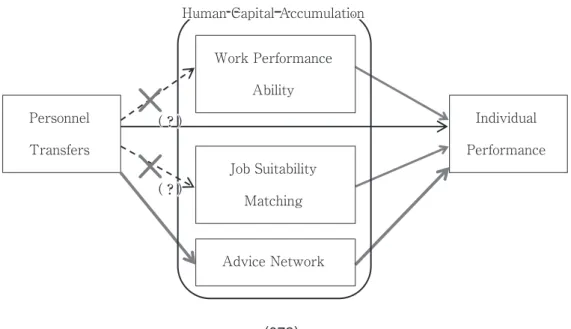
Based on previous researches, we see that the heightening of an individual’s work performance through personnel transfers can be seen as a result of the progress made in the accumulation of human capital, i.e. building up work performance abilities, finding suitable jobs, and building a broad advice network.
Ⅲ. Engineer’s personnel transfer in our data
Let us first explain the data used in this paper.
A questionnaire survey was implemented in 2012 regarding ways in which to create innovation,
targeting companies belonging to a manufacturing group and engineers working in the group companies. We use 1,807 engineers personal data (1421 union members (ordinary employees) and 387 management personnel) gathered from 35 companies.
First, when investigating areas of work duty categories of the engineers, we found 4.5% work in survey and research, 63.1% in development and design, 22.5% in production technology, 3.5%
in technology patent management, 2.5% in quality assurance, 2.0% in information processing and software development, 0.7% in sales and technology services, and 3.1% in other areas.
Therefore we confirmed that the majority is responsible for development and design work2 ) (See Table 1).
Next, with regard to experience with personnel transfers, 51.7% of employees have experienced personnel transfers one or more times (See Table 2). Most such personnel transfers are transfers within the company, but the above figure also includes those having experienced transfers to workplaces outside the company. Also, the average number of personnel transfers experienced
2 )Multiple responses were allowed. Out of the valid replies from 1,807 people, the total number of responses was 1,843 and approximately 2% of the total was multiple responses.
Table 1. Distribution of current work duty frequancy %
survey and research 82 4.5
quality assurance 46 2.5
development and design 1141 63.1
production technology 406 22.5
technology and patent management 63 3.5 information processing etc 36 2.0
sales and tech-services 13 0.7
ohters 56 3.1
total 1843 101.9
Note: M.A. N=1807, % is share in N.
(066) was 1.3, and the average age at which an individual first experienced a personnel transfer was 29.1. The state of transfers between different work duties is not clear, but the result is that there are many transfers between research and development, and approximately half of engineers in both the U.S. and Japan have experienced working in both areas, which conforms to the findings of previous research3 ).
Regarding this personnel transfer, the number of transfers experienced can be expected to increase the longer one is employed, so let us also examine the relationship to years of employment. The number of years employed is also used as an index of specific human capital accumulation in companies, so it may be possible to think of personnel transfers as reflecting the breadth of specific human capital, while the number of years employed reflects its depth.
Therefore, it is important to consider the mutual relationship between them. In Figure 1, we have
divided the number of years worked and employee age into 5-year intervals, and calculated the average values for each layer. It is possible to confirm that as the number of years employed and age increase, the number of personnel transfers experienced also increases.
However, that increase is not linear. Rather, a trend can be seen in which, as the number of years employed and age increase, increases in personnel transfers gradually diminish. In other words, the implication is that personnel transfers are generally conducted among the younger generation that has relatively little work experience. This conforms to the approach of human capital theory, which says that companies generally conduct skill development among the young generation.
Ⅳ.The effects of personnel transfers
1 .Theeffectsonindividualtechnicalachievement Here we will validate Hypothesis 1. Firstly,
3 )Japan Productivity Center (1991)
7 0
0.5 1 1.5 2 2.5 3
0 10 20 30 40 50 60
number of transfer
years employed, age
Figure 1. Personnel transfer, years employed, and age
years employed age
IV. The effects of personnel transfers
1. The effects on individual technical achievement
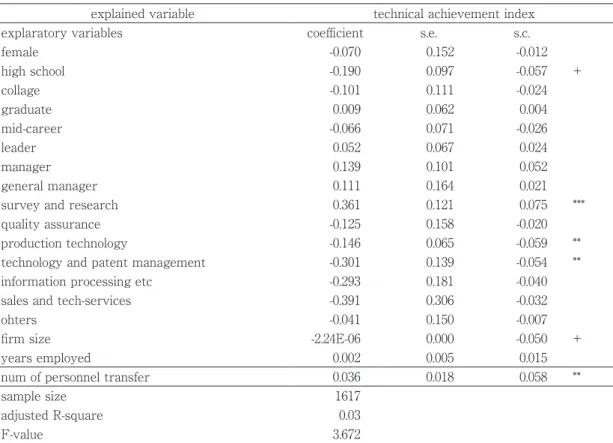
Here we will validate Hypothesis 1. Firstly, in the survey of engineers, four questions were asked regarding individual technical achievements made in the past three years: “number of patent applications”; “total cash amount of bonuses related to patents granted to the individual”; “number of internal technical reports”; and “number of external technical reports”. Bonuses depend on issues such as the company’s size and bonus system, and are expected to differ greatly among companies, so we use three items except bonus data and create a composite index of individual technical achievement
4. We set this to be the explained variable for technical achievement. With regard to explanatory variables, for personnel transfers we next use the number of personnel transfers experienced in the past, which we noted in Section III. We control sex (reference group; male), academic degree (university), number of years employed, type of hiring (graduate recruitment), current work duties (development and design), and company size as other variables in this analysis (OLS)
5.
The results of the analysis are shown in Table 3. Looking at the control variables,
4 This composite index is a first component score by a principle component analysis. This first component can be seen as overall individual technical achievement.
5 Control variables are dummy variables except number of years employed and company size.
Figure 1. Personnel transfer, years employed, and age Table 2. Statistical indices on personnel transfer
N share of engineers experienced transfer (%) 51.7 1807
average times 1.3 1807
ave. age in first transfer 29.1 967
Note: Ave. age is calculated in engineers experienced transfer.
(067) in the survey of engineers, four questions were asked regarding individual technical achievements made in the past three years:
“number of patent applications”; “total cash amount of bonuses related to patents granted to the individual”; “number of internal technical reports”; and “number of external technical reports”. Bonuses depend on issues such as the company’s size and bonus system, and are expected to differ greatly among companies, so we use three items except bonus data and create a composite index of individual technical achievement4 ). We set this to be the explained variable for technical
achievement. With regard to explanatory variables, for personnel transfers we next use the number of personnel transfers experienced in the past, which we noted in Section III. We control sex (reference group; male), academic degree (university), number of years employed, type of hiring (graduate recruitment), current work duties (development and design), and company size as other variables in this analysis (OLS)5 ).
The results of the analysis are shown in Table 3. Looking at the control variables, when arranged by academic degree the technical achievement of engineers who are only high
4 )This composite index is a first component score by a principle component analysis. This first component can be seen as overall individual technical achievement.
Table 3. Results of effects on individual technical achievement (OLS)
explained variable technical achievement index
explaratory variables coefficient s.e. s.c.
female -0.070 0.152 -0.012
high school -0.190 0.097 -0.057 +
collage -0.101 0.111 -0.024
graduate 0.009 0.062 0.004
mid-career -0.066 0.071 -0.026
leader 0.052 0.067 0.024
manager 0.139 0.101 0.052
general manager 0.111 0.164 0.021
survey and research 0.361 0.121 0.075 ***
quality assurance -0.125 0.158 -0.020
production technology -0.146 0.065 -0.059 **
technology and patent management -0.301 0.139 -0.054 **
information processing etc -0.293 0.181 -0.040
sales and tech-services -0.391 0.306 -0.032
ohters -0.041 0.150 -0.007
firm size -2.24E-06 0.000 -0.050 +
years employed 0.002 0.005 0.015
num of personnel transfer 0.036 0.018 0.058 **
sample size 1617
adjusted R-square 0.03
F-value 3.672
Note: ***p<.001, **p<.05, +p<.01. Explaratory variables are dummy variables except firm size, personnel transfer and years employed. s.e. and s.c. is standard error and standardized coefficient respectively.
5 )Control variables are dummy variables except number of years employed and company size.
(068) school graduates is lower compared to university graduates. When arranged according to work duties, survey and research engineers achieve more easily than development and design engineers, while production technology and technology management engineers find it more difficult to achieve. The number of years worked is shown not to have an impact on an individual technical achievements. In addition, we found evidence that personnel transfers have a positive effect on the individual achievements of engineers, and that breadth of work experience contributes to the improvement of individual achievement. In other words, these findings conform to those of previous researches, and support Hypothesis 1.
2 .Theeffectsonthehumancapitalaccumulation Next, let us clarify the manner in which personnel transfers heighten human capital and increase technical achievements.
1 )Workperformanceability
First, we will examine the effects on work performance ability. To do so, we will define work performance ability. In our survey of engineers, we have asked them about the state of maintenance of twelve subjective abilities and characteristics comprising work performance ability that are personally possessed by engineers themselves. These twelve abilities and characteristics are wide ranging, from intellectual abilities to work attitudes, and include: “sense of responsibility”,
“problem-finding ability”, “leadership”, “problem- solving ability”, “ability to plan and propose projects”, “logical and systematic thinking”,
“ability to negotiate”, “consciousness in training one’s juniors”, “tenacity”, “willingness to take up challenges”, “time management ability” and
“communications skills”. The survey sought
evaluation of the degree to which the individual possesses each of these abilities and characteristics, allowing four levels of intensity from “lacking” to
“sufficiently possessing” them. In other words, it is necessary to understand that the data used does not reflect possession of objective abilities or characteristics, but rather are subjective evaluations6 ).
In this paper, we have extracted features from these twelve abilities and characteristics, and implemented principal component analysis in order to gather deeply related elements from them. According to the results of this analysis, only one feature from among these twelve abilities and characteristics could be extracted as only one component, and the resulting primary component score was used as an indicator showing possession of overall work performance ability. Therefore, the analysis of Hypothesis 2-1a is based on the relationship between this index and personnel transfers. Also, one can expect the ability to deal with problems to improve through personnel transfer, so we created an index called “problem-finding and solving ability” by combining two of the twelve abilities and characteristics, namely “problem-finding ability” and “problem-solving ability”.7 ) The analysis of Hypothesis 2-1b is based on the relationship between this index and personnel transfer. Now, let us perform multiple regression
6 )Dunning and Kreuger (1999) point out that it is difficult to recognize one’s own unskilled and incompetence, as a result, self-evaluation by unskilled workers tends to be overestimated in the subjective evaluations. There are no objective indicators of workers’ abilities in our data.
We use subjective indicators based on the recognition of this problem.
7 )Here the combination of indices was calculated by taking a weighted average from the component score coefficient found for the primary component. “Problem- finding ability” was 0.784 and “problem-solving ability”
was 0.778.
(069) analysis (OLS) using as the explained variable this overall combination of work performance ability and the problem-finding and solving ability. Note that the explanatory variable is the same as that used in validating technical achievement.
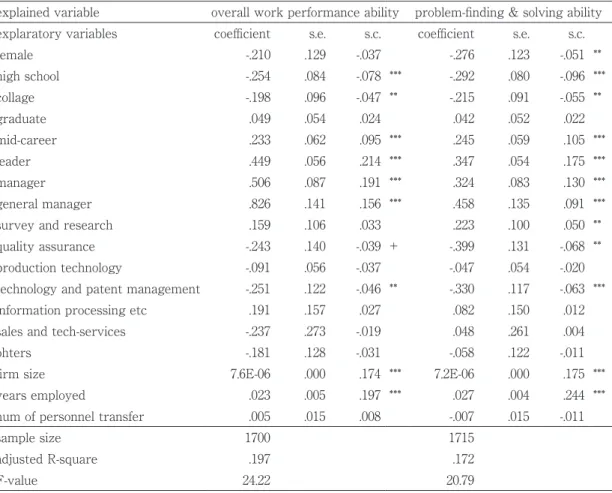
The analytical results are shown in Table 4.
When we look at where the control variables showed effects, compared to men, women have the same level of work performance ability overall, but are slightly weaker than men in the problem-finding and solving ability. Next, engineers recruited in mid-career had high overall work performance ability compared to other engineers, but no difference was seen
with regard to the problem-finding and solving ability. In viewing data in light of academic degree, high school and junior college graduates were lower than university graduates, and, on the basis of official responsibilities, leaders and management class engineers were higher than other engineers in general. Furthermore when looking at job positions, trends were confirmed showing that engineers responsible for duties such as quality assurance and production technology were lower, and that if limited to examining only the problem-finding and solving ability, engineers responsible for surveys and research were higher, compared to development and design. The number of years employed
Table 4. Results of effects on work performance ability (OLS)
explained variable overall work performance ability problem-finding & solving ability
explaratory variables coefficient s.e. s.c. coefficient s.e. s.c.
female -.210 .129 -.037 -.276 .123 -.051 **
high school -.254 .084 -.078 *** -.292 .080 -.096 ***
collage -.198 .096 -.047 ** -.215 .091 -.055 **
graduate .049 .054 .024 .042 .052 .022
mid-career .233 .062 .095 *** .245 .059 .105 ***
leader .449 .056 .214 *** .347 .054 .175 ***
manager .506 .087 .191 *** .324 .083 .130 ***
general manager .826 .141 .156 *** .458 .135 .091 ***
survey and research .159 .106 .033 .223 .100 .050 **
quality assurance -.243 .140 -.039 + -.399 .131 -.068 **
production technology -.091 .056 -.037 -.047 .054 -.020
technology and patent management -.251 .122 -.046 ** -.330 .117 -.063 ***
information processing etc .191 .157 .027 .082 .150 .012
sales and tech-services -.237 .273 -.019 .048 .261 .004
ohters -.181 .128 -.031 -.058 .122 -.011
firm size 7.6E-06 .000 .174 *** 7.2E-06 .000 .175 ***
years employed .023 .005 .197 *** .027 .004 .244 ***
num of personnel transfer .005 .015 .008 -.007 .015 -.011
sample size 1700 1715
adjusted R-square .197 .172
F-value 24.22 20.79
Note: ***p<.001, **p<.05, +p<.01.
(070) showed a positive effect regarding both indices, and it was shown that the length of experience in a company improves not only the ability to find and solve problems, but also overall human capital such as work performance ability. On the other hand, no effects were detected with either index in regards to the effect of personnel transfers. These findings reject the Hypotheses 2-1a and 2-1b.
2 )Jobsuitabilityandadvicenetworks Here we shall clarify what kind of relationship job suitability matching and advice networks have with personnel transfers. With regard to the job suitability matching of Hypothesis 2-2, the following three items were used as indices indicating whether an individual is in a job of high suitability. We used responses to three questions, of which the first was, “Do you think your job is interesting,” the second was,
“Do you enjoy your job,” and the third was,
“In your current job are you able to make the best of your abilities.” The responses to these questions were four levels for goodness of fit, therefore, used as explained variables in an ordered logit model analysis. Next with regard to Hypothesis 2-3, in the survey of engineers we asked about the extent of exchange of ideas and meetings with others related to work. Here subjects were asked to select from seven possible choices regarding the extent of their exchanges of ideas: “engineers at the same workplace”; “engineers in the same technical field but of a different workplace in the company”; “engineers in a different technical field and different workplace in the company”; “non-engineering staff in the company”; “engineers, researchers, etc. in other domestic companies”; “engineers, researchers, etc. in other overseas companies”;
and “customers.” In other words, the number
of targets with which information was exchanged was used as an explained variable.
Note that the explanatory variable is the same as that of the analysis of individual technical achievement.
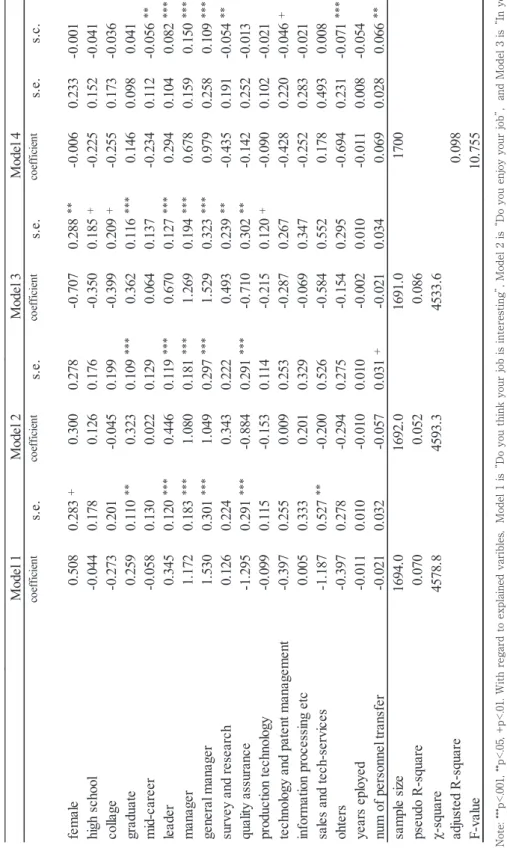
The results are shown in Table 5. These results suggest that personnel transfers do not affect job suitability matching, nor do they have a negative effect. In other words, there is a possibility that job suitability matching weakens with increasing personnel transfers, thus Hypothesis 2-2 was not supported by the results. However, personnel transfers were shown to have a positive relationship with advice networks, and we were able to confirm that increasing numbers of personnel transfers lead to a broader network for information exchange. In other words, Hypothesis 2-3 was supported.
Finally, when we look at the three points that stimulate human capital accumulation and their relationship with individual technical achievement, a statistically significant and strong positive correlation was discovered between the achievement index and each of the three items of work performance ability, job suitability matching, and advice networks.
From these findings, it was discovered that in this corporate group the effect of personnel transfers is primarily that of expanding human networks, and improving an individual human capital through information exchange and advice necessary for one’s work. This forms a route leading to much technical achievement.
Ⅴ.Conclusion
This paper used individual data from engineers belonging to a Japanese manufacturing group, and analyzed the effects of personnel transfers on
(071) 13
Table 5. Results of effects on job suitablity and advice network (Model 1-3; orderd logit model, Model 4; OLS) Model 1Model 2Model 3Model 4 coefficients.e.coefficients.e.coefficients.e.coefficients.e.s.c. female0.5080.283+0.3000.278-0.7070.288**-0.0060.233-0.001 high school-0.0440.1780.1260.176-0.3500.185+-0.2250.152-0.041 collage-0.2730.201-0.0450.199-0.3990.209+-0.2550.173-0.036 graduate0.2590.110**0.3230.109***0.3620.116***0.1460.0980.041 mid-career-0.0580.1300.0220.1290.0640.137-0.2340.112-0.056** leader0.3450.120***0.4460.119***0.6700.127***0.2940.1040.082*** manager1.1720.183***1.0800.181***1.2690.194***0.6780.1590.150*** general manager1.5300.301***1.0490.297***1.5290.323***0.9790.2580.109*** survey and research0.1260.2240.3430.2220.4930.239**-0.4350.191-0.054** quality assurance-1.2950.291***-0.8840.291***-0.7100.302**-0.1420.252-0.013 production technology-0.0990.115-0.1530.114-0.2150.120+-0.0900.102-0.021 technology and patent management-0.3970.2550.0090.253-0.2870.267-0.4280.220-0.046+ information processing etc0.0050.3330.2010.329-0.0690.347-0.2520.283-0.021 sales and tech-services-1.1870.527**-0.2000.526-0.5840.5520.1780.4930.008 ohters-0.3970.278-0.2940.275-0.1540.295-0.6940.231-0.071*** years eployed-0.0110.010-0.0100.010-0.0020.010-0.0110.008-0.054 num of personnel transfer-0.0210.032-0.0570.031+-0.0210.0340.0690.0280.066** sample size1694.01692.01691.01700 pseudo R-square0.0700.0520.086 χ-square4578.84593.34533.6 adjusted R-square0.098 F-value10.755 Note: ***p<.001, **p<.05, +p<.01. With regard to explained varibles, Model 1 is “Do you think your job is interesting”, Model 2 is “Do you enjoy your job”, and Model 3 is “In your current job are you able to make the best of your abilities”, and Model 4 is the number of contacts to exchange information.
Table 5. Results of effects on job suitablity and advice network (Model 1-3; orderd logit model, Model 4; OLS Note: ***p<.001, **p<.05, +p<.01. With regard to explained varibles, Model 1 is “Do you think your job is interesting”, Model 2 is “Do you enjoy your job”, and Model 3 is “In your current job are you able to make the best of your abilities”, and Model 4 is the number of contacts to exchange information.
(072) the accumulation of human capital and individual performance. The main findings from this study are as follows.
First, as expected, a positive relationship was discovered between improved individual performance, which is used as an indicator of technical achievement, and increased experience with personnel transfers. Next, when the correlation between personnel transfers and individual performance was considered from the three standpoints of work performance ability, job suitability matching and advice networks, no effect was seen concerning work performance ability centering on the ability to find and solve problems, or on job suitability matching.
However, human networks for information exchange were shown to expand as experience with personnel transfers increases, and are implied as an intermediary between personnel transfer and individual achievement.
Here we would finally like to state some of important issues this study raises, and offer our concluding remarks. In this paper, one is the problem of reverse causality. Our study has
discussed on the assumption of a causal relationship of personnel transfer that increase workers’ human capital and improve their work performance. However, in our factor analysis of personnel transfer, there is also a fact that workers, who accumulate high human capital like high education background and job responsibility, are selected to personnel transfer.
In other words, it is possible that our results simply show the latter relationship between personnel transfer and human capital. Second, the personnel transfer of engineers was captured in the number of transfers experienced. Despite that, however, the qualitative side concerning company’s purpose of personnel transfers is important, though not considered as part of this study. Also, we considered work performance ability, primarily the ability to find and solve problems. But from an engineer’s perspective, ingenuity or creativity may be what is truly important. Effective work performance development from this kind of perspective must also be considered. The above issues are topics which will be examined in our future studies.
Figure 2. Relationship between personnel transfer and individual performance
Personnel Transfers
Individual Performance Work Performance
Ability
Job Suitability Matching
Advice Network Human Capital Accumulation Human Capital Accumulation
(?)
(?)
(073) References
Avolio, Bruce J., Waldman, David A. and McDaniel, Michael A. (1990) “Age and Work Performance in Nonmanagerial Jobs: The Effects of Experience and Occupational Type”, Academy of Management Journal, 33(2), pp.407-22.
Becker, Gary S. (1975) Human Capital (2nd Edition), University of Chicago Press, Chicago.
Dolton, Peter J. and Kidd, Michael P. (1998) “Job Changes, Occupational Mobility and Human Capital Acquisition: An Empirical Analysis”, Bulletin of Economic Research, 50(4), pp.265-95.
Dunning, D. and Kreuger, J. (1999) “Unskilled and unaware of it: how difficulties in recognizing one’s own incompetence lead to inflated self- assessments”, Journal of Personality and Social Psychology, 77 (6), pp.1121–1134.
Japan Productivity Center (1990) Eikoku no Gijutsusha Nihon no Gijutsusha: Gijutsusha no Kyaria to Noryoku Kaihatsu (UK Engineer, Japanese Engineer: Engineer’s Career and Human Resource Development), Tokyo (in Japanese).
Japan Productivity Center (1991) Beikoku no Gijutsusha Nihon no Gijutsusha: Gijutsusha no Kyaria to Noryoku Kaihatsu (US Engineer, Japanese Engineer: Engineer’s Career and Human Resource Development), Tokyo (in Japanese).
Jung, Jin Hwa and Magrabi, Frances M. (1991) “Work Experience, Specific Human Capital, and Earnings”, Quarterly Review of Economics and Business, 31(1), pp.15-27.
Koike, Kazuo (1988) Understanding Industrial Relations in Modern Japan, Macmillan, New York.
Koike, Kazuo (1991) Shigoto no Keizaigaku (Economics of Work), Toyo Keizai Shinposha, Tokyo (in Japanese).
Koike, Kazuo (1994a) “Learning and Incentive Systems in Japanese industry” The Japanese Firm: The Sources of Competitive Strength, Masahiko Aoki and Ronald Dore eds, Oxford University Press,
New York, pp.41-65.
Koike, Kazuo (1994b) “White-Collar Workers in Japan and the United States: Which Are More Ability Oriented?” Japanese Economy, 22(1), pp.3-49.
Koike, Kazuo and Inoki, Takenori (1990) Skill Formation in Japan and Southeast Asia, University of Tokyo Press, Tokyo.
Kolz, Arno R., Mcfarland, Lynn A. and Silverman, Stanley B. (1998) “Cognitive Ability and Job Experience as Predictors of Work Performance”, Journal of Psychology, 132(5), pp.539-48.
Maranto, Cheryl L. and Rodgers, Robert C. (1984) “Does Work Experience Increase Productivity? A Test of the On-The-Job Training Hypothesis”, Journal of Human Resources, 19(3), pp. 341-57.
McDaniel, Michael A., Schmidt, Frank L. and Hunter, John E. (1988) “Job Experience correlates of Job Performance”, Journal of Applied Psychology, 73(2), pp.327-30.
McEnrue, Mary Pat (1988) “Length of Experience and the Performance of Managers in the Establishment Phase of their Careers”, Academy of Management Journal, 31(1), pp.175-85.
Murakami Yukiko (2003) Gijutsusha no Tenshoku to Rodo Shijo (Engineer’s Turnover and Labor Market), Hakuto Shibo, Tokyo (in Japanese).
Quinones, Miguel A., Ford, Kevin J. and Teachout, Mark S. (1995) “The Relationship between Work Experience and Job Performance: A Conceptual and Meta-Analytic Review”, Personnel Psychology, 48(4), pp.887-910.
Tesluk, Paul E. and Jacobs, Rick R. (1998) “Toward an Integrated Model of Work Experience”, Personnel Psychology, 51(2), pp.321–55.
Toda, Akihito (2011) “How Important is Occupational Experience in Current Japan?: Analysis with Focus on Occupation-Specific Human Capital”, Japan Labor Review, 8(3), pp.56-77.
(074)
Appended table 1. Descriptive statistics
N average s.d. min max
Explaratory variables:
female 1802 .03 .172 0 1
high school 1801 .11 .312 0 1
collage 1801 .06 .242 0 1
university 1801 .47 .499 0 1
graduate 1801 .36 .479 0 1
mid-career 1803 .21 .406 0 1
ordinary employee 1798 .44 .496 0 1
leader 1798 .35 .476 0 1
manager 1798 .18 .381 0 1
general manager 1798 .04 .189 0 1
survey and research 1807 .05 .208 0 1
quality assurance 1807 .03 .158 0 1
development design 1807 .63 .483 0 1
production technology 1807 .22 .417 0 1
technology and patent management 1807 .03 .183 0 1
information processing etc 1807 .02 .140 0 1
sales and tech-services 1807 .01 .085 0 1
ohters 1807 .03 .173 0 1
firm size 1748 22670 23055 100 69125
years eployed 1796 12.116 8.566 0.00 44.00
num of personnel transfer 1807 1.262 1.634 0.00 10.00
Explained variables:
technical achievement index 1716 .00 1.00 -.33 19.58
overall work performance ability 1779 .00 1.00 -3.54 2.59
problem-finding & solving ability 1796 4.473 0.940 1.58 6.32
Model 1 1804 2.850 0.776 1 4
Model 2 1801 2.493 0.784 1 4
Model 3 1799 2.705 0.657 1 4
Model 4 1807 3.085 1.698 0 7