A Study of Cross-Disciplinary Learning Based Music Lesson Programs:
Referencing a Case Study of an American Teacher’s College
TOKIE Noriko
(Joetsu University of Education)
Keywords: Cross-Disciplinary Learning, Music Lesson Programs, American Methods, Arts Curriculum
1. Introduction
This study is based on an analysis and examination of curricula in an American graduate school, which has for many years continued a cross-disciplinary approach as well as fulfilling the role as a teacher’s college to obtain suggestions for Japan. The model program used is Columbia University Teacher’s College, which is traditionally a major college, and will be focused on the college’s open courses’ references. The author would like to focus on the fact that Master’s and Doctoral students have the ability to transfer credits from surrounding universities in the New York area, thus introducing a cross-disciplinary credit acquisition system.
Unlike Japan, America is not limited to a few educational colleges offering music, arts, dance and theater. In addition, due to credit transfer systems, students have the option to take classes unrelated to music, such as other arts classes, psychology classes, information technology classes, etcetera. Thus, bringing cross-disciplinary credit options into reality.
At the same university, postgraduate students of music are encouraged to take classes initially directed towards dance and arts education students in order to receive combined credits. An example of credit transfer is taking classes related to Dalcroze Eurhythmics at Juilliard School of performing arts or Manhattan School of Music and receiving credits. Thanks to this transfer system, out of the 90 credits required for doctoral acquisition, Ph.D. (Doctor of Philosophy) students can take 30 credits, and Ed.D.
(Doctor of Education) students can take as many as 45 credits from other schools. This
flexible system has already been in place for over 30 years across New York State schools.
Table 1. Arts Curriculum
Table 2. Teachers College Course Titles in Japan
Table 3. Elementary and Junior High School Subject Titles in Japan
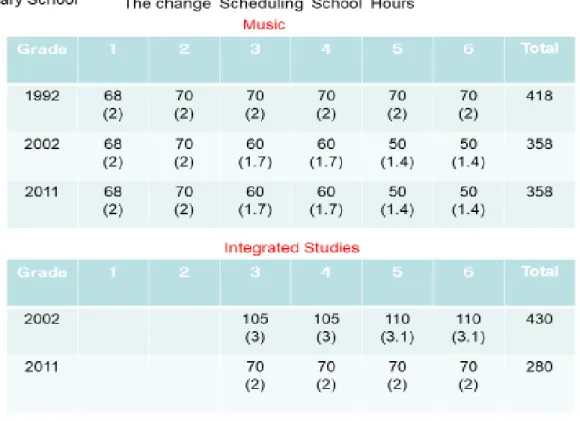
Table 4. Changes in Scheduled School Hours of “Music” and “Integrated Studies”
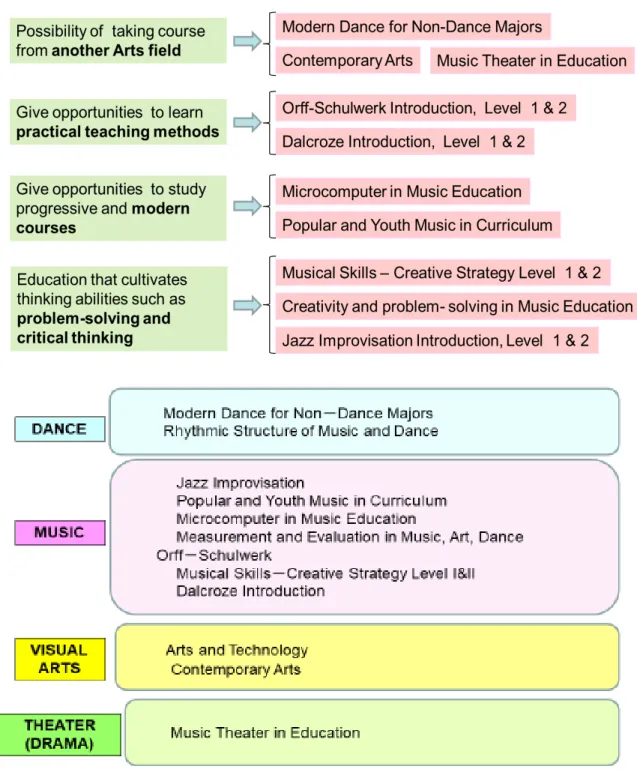
Classes, such as “Musical Skills – Creative Strategy I & II” and “Jazz Improvisation”
are examples of music and dance classes where students learn problem solving and critical thinking through expressive activities which incorporate improvisation as well as the process of fostering creativity in stages. As shown below, this paper will focus on the curriculum of Master’s and Doctoral Curriculum of Music Education majors, and the curriculum’s arts education will be further categorized by objective. (See Table 1)
2. Japanese School Curriculum and Integrated Study
The addition of English, IT, Moral Education, and other subjects into the curriculum in Japanese schools has led to the problematic situation of Music and Visual Arts classes being allotted only 1.4 ~ 2 hours per week in elementary schools and 1 ~ 1.3 hour per week in junior high schools. (See Table 4)
However, a new class that is designed to integrate music classes with other subjects has the potential to provide students with more and better opportunities to incorporate music into their lives (Tokie, Iimura 2015).
The Ministry of Education, Culture, Sports, Science and Technology (MEXT) recommended that from 2002, all elementary, junior high and high schools should provide Integrated Study. This is to enable students to push beyond the traditional borders of separate subjects and study in a cross-curricular fashion.
For a century and a half, Japanese music education has focused almost entirely on Western classical music. Despite this, it has long been an issue that, even after six years of elementary school music classes, junior high school students still do not possess
“musical independence”; the ability to read and understand music and to assimilate it into their lives, and this matter is an even greater bone of contention today. Nonetheless, the author believes that Integrated Study can solve Japan’s problems with its music education programs as well as provide students with valuable life skills.
In Integrated Studies, what was learned in various subjects has been developed. And Integrated Arts curriculum, which means cross-sectional, comprehensive learning, has
been becoming active. Many elementary and junior high schools in Japan have already produced good examples that compile what was learned in each class into a single work such as a musical.
But teacher colleges in Japan are limited to the study of music and visual arts, while those in U.S.A. include not only music and visual arts but also drama and dance.
Moreover, some of the colleges cover even films and art management.
From the viewpoint of teacher education, too, curricula that are very different from those of Japan have been adopted for prospective teachers to learn a broader and new genre. Dance and drama as subjects at school in U.S.A. are enriched, and the
educational environment of arts is well-balanced and in order. Compared with that of USA, the educational environment in Japan has a lot of barriers. Because of the curriculum in Japan, teachers concerned can’t have many opportunities to attend Integrated Study. (See Table 2, Table 3)
National standards in U.S.A. show that four fields of arts should not be separated but related to each other. This approach helps young children cultivate the point of view that they can look at arts from many different angles. The appearance of this standard had a great influence on local arts education standards as a model. A lot of intellectuals and psychologists were involved in compiling National Standard, which proposes the standard that every young American should know.
3. Music Methods and Music Education in U.S.A.
Music education in U.S.A. actively introduces Orff, Kodaly, Dalcroze and Suzuki methods. With the introduction of improvisational activities, a transition from
kindergarten to elementary school takes place smoothly. Especially at school, creativity, originality and cooperativeness can be cultivated by introducing those methods in to school music. Japan announced that all subjects at school should include language activities. This author, through a ten-year comparative research both in Japan and in U.S.A., found that creative activities in U.S.A. help young Americans develop their language abilities. This suggests to Japanese arts education that improvisational activities must be emphasized much more than now.
The author believes that young Japanese should develop broader expressional and communicational abilities through arts education. Japanese arts education should innovate current art fields into well-balanced art fields, like U.S.A. took in various art genre, and make the curriculum broader. USA has been flexible enough to include Orff, Kodaly, Dalcroze and Suzuki methods in its Arts education. And it is now successful to cultivate children’s cooperativeness and creativity. Thus, Japan should follow its model and actively use improvised activities like U.S.A. does. And also, you can see at
colleges in U.S.A., graduate students in master and doctor courses will teach in the classroom. Through this course, they can bring a leading–edge method into the class, which makes it possible to develop educational methods. This is true of arts education.
4. Music Appreciation and Physical Expression ― Method 1 (1) Representing the Characteristics of Music
In the past, appreciation activities were mainly ones where the students passively listened to songs and expressed their opinions. However, in the revised curriculum, it was newly shown that physical expression activities are effective not only in the direction of “expression” but also in various situations including “appreciation”. In response, the author devised and created the following lesson program to be incorporated into junior high school music classes. These practice examples are
activities where students listen to various musical elements of the song (pace, dynamics, overlap of melody) and composition, and replace them with physical expression.
a) Music example “West Side Story” composed by Leonard Bernstein
While grasping the characteristics of Latin music mambo, CHA-CHA-CHA the students tried to perform the dance steps.
By comparing the differences between modern rhythm dances such as hip hop which are familiar to the students, and the students previously unknown characteristics of Latin music the students will gain a better understanding of a wide range of dance styles and diverse music.
During these activities it is important to guide the students to understand Latin
rhythms through their bodies.
b) Music example “Waltz for Devi” composed by Bill Evans
Create a waltz step improvising solo or in a group to a triple beat jazz piano accompaniment.
Changes in the main melody due to adlibbing, listening to changes in chords,
improvising expression with facial movements and the use of hands and feet to express the feeling of the music.
(2) Appreciation Focused on Dance and Music
In ballet music such as “Firebird” and “Petruska” composed by Tchaikovsky, the story unfolds through dance and pantomime matched to the music.
Through discussing the appeal of nonverbal body expression students can deepen their understanding.
Students viewed certain scenes from in the opera “Aida” and the musical “West Side Story” which are only expressed through dance. Then they appreciate the scenes that are expressed only in dance without words or singing and discuss the effects.
The author believes while sharing ideas with classmates as described above, it is important for students to have an opportunity to recognize and think about the role and significance of physical expression, and to deepen their discussion on the role of dance in general art.
(3) Practical Examples of Singing Japanese Folk Songs and Using Physical Expression
a) Music example “Soran Bushi” Hokkaido folk song
Comparing this with the rock-like “TAKIO’S SORAN 2” by Takio Ito, students make movements of a fisherman while singing.
b) Music example “Awa Odori” Bon festival dance from Tokushima Prefecture
From referring to videos etc., the characteristics of male and female dance steps can be grasped, and then the students perform the steps while hollering.
These follows a practical example of integrated music with other fields. As a study of cross-disciplinary learning based music lesson program, the author had been concerned with this activities over 20 years. To support this musical stage performance, teacher will require to have knowledge and basic ability in music as well as dance, visual arts, and drama.
5. Integrated Study and Create Musical Stage Performance ― Method 2 (1) A Practical Example from a Junior High School
In the midst of a situation where almost no schools nationwide have practice
examples of where bodily expression is actively incorporated into lessons, a few schools who implemented the practice could be found. Amongst them, at junior high school F, they have for more than 20 years been working on activities where students create their own musicals, and the author got the opportunity to be in involved in this activity for many years. Over the course of one year, third year students will work in music, art and physical education dance classes to create and perform a musical.
On stage, students can understand from experience that dance can convey their message to the audience rather than only using scripted lines. During the creative process, the students wanted to convey the message of the lyrics in the chorus directly to the audience through movement of the body. They also devised a choral expression that combines singing and body movement, titled “Harmony with Voice and Body – Let’s Enjoy Chorus and Dance”. A directing effect that specifically conveys the message of the music was obtained through physical expression (Tokie 2018).
(2)Awareness and Comments by Teachers College Student in Japan
The above-mentioned method was practiced in the “Secondary Music Instruction Method” class for teachers’ training college students. In response to the contents of the
new course of study, students who have experienced classes incorporating various body expressions have become aware of the following:
・By mobilizing various body sensations and expressing them with body movements, they were able to cultivate their concentration skills in listening to music.
・In order to become familiar with music from around the world and Japanese folk songs, by moving the body to learn, you can get a grasp of the music from a sensory perspective.
・I felt that“Motion”and“Emotion”are closely connected to each other. By tasting music it becomes possible to express finer nuances.
・In order to become familiar with Latin music and Japanese folk songs, moving your body to learn them is a way of grasping the music intuitively. Surely it is also desirable to use physical expression as a method of learning and understanding music of various ethnic groups from around the world.
From these students’ written descriptions of their thoughts, it became clear that the students increased their awareness regarding the fact that physical expression activities have various effects in understanding music.
Currently it is not fully guaranteed that there is sufficient amount of time to allocate to learn deeply about art culture in cultural contexts such as people’s lives and social relations, and to work on physical expression as a means of doing so within the number of classes for the music department. However, as cross-disciplinary learning is
promoted internationally, it is extremely important for students to learn about art and culture from a broad perspective, and this is reflected in the newly revised curriculum.
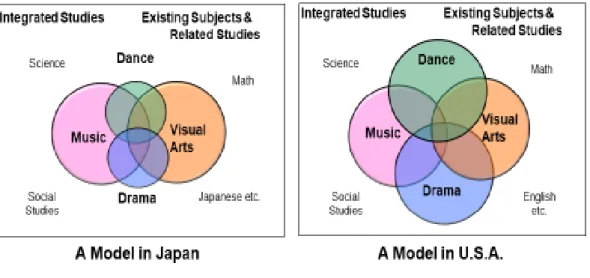
Like the previously mentioned student-created musical, collaborating using several subjects such as physical education, social studies, history, Japanese and comprehensive learning time is a form of lesson-planning that will increase in demand in order to deepen the understanding of music from a wide range of activities. (See Figure 1) The cases that incorporate physical expression proposed in this study are also
beginning to be practiced in some public junior high schools, and through research after continuing these practices, the author wishes to explore further what kind of results and challenges the aforementioned practices will bring.
6. Implications for Music Education
In conclusion, at this moment in our country, in accompaniment of the transition from doctoral courses to graduate schools of teacher training on a countrywide level, the opportunities to train instrumental and singing skills will unavoidably decrease. In this manner, the imminent issue for the universities is how they will be able to ensure the students specialized learning that is related to musical education.
Also, to be considered a response to this issue, the American program featured in this study has a long continuing cross-disciplinary approach which has played the role of graduate school of teacher training, which means this program can suggest
improvements for our future lesson programs as well.
Moreover, the recently revised Music Course of Study for Elementary and Junior High Schools suggests that in order to “put musical viewpoints and thinking to work”
(MEXT 2018), it is essential that teachers do not stop at mastering music itself, but they need to deepen their knowledge through peripheral art areas and a wide range of
perspectives from different fields of study. For that purpose, we must utilize the examination and analysis of this research based on the American program. In order to construct a new class program we will also need to continue practical research of this subject.
Acknowledgement
This research was supported by a Grant-in-Aid for Scientific Research (C) from the Japan Society for the Promotion of Science and by a grant from the Joint Graduate School (PhD Program) in Science of School Education, Hyogo University of Teacher Education.
References
・Ministry of Education, Culture, Sports, Science and Technology (MEXT) (2018). The teaching guide for the Junior High School Study for Music, Tokyo: Kyouiku Geijutsu Sha Co., Ltd.
・Music & Music Education, Doctor of Education. n.d., Teachers College, Columbia University, accessed 1 November 2019, < https://www.tc.columbia.edu/arts-and- humanities/music-and-music- education/degrees--requirements/ >
・Tokie, N. (2018). Integrating Music with Physical Expression. Proceedings of the International Society for Music Education 33rd World Conference on Music Education, Baku, Azerbaijan, ISME. pp. 177-184.
・Tokie, N., Iimura, Y., (2015). Using Active Learning Methods to Teach Music:
Based on Elementary School Teacher Education Lesson Examples, The Proceedings of the Sixth Japan-China Teacher Education Conference, Naruto University of Education 2015, pp.3-9.
Abstract
The purpose of this study is to clarify and examine the construction of new lesson programs in order to cultivate and develop Master’s and Doctoral students majoring in music. This is in response to how music as a school subject is expected to develop learning activities traversing into other art subjects such as art or dance according to 21st century patterned academic ability training.
At this moment in our country, in accompaniment of the transition from doctoral courses to graduate schools of teacher training on a countrywide level, the opportunities to train instrumental and singing skills will naturally decrease. In this manner, the imminent issue for the universities is how they will be able to ensure the students’
specialized learning that is related to musical education.
The American program featured in this study has a long continuing cross-disciplinary approach which has played the role of graduate school of teacher training. This means
the program can suggest improvements for our future lesson programs as well.
As part of this research, the author created new lesson plans for junior high school level. These were based on current practice in U.S. college curricula. It is the author’s hope that Japan’s colleges will implement similar curricula in the future.
A Model in U.S.A.
Visual Arts Drama
Math
Figure 1. Integration between Music, Visual Arts, Dance, Drama and other Subjects
English etc.