九州大学学術情報リポジトリ
Kyushu University Institutional Repository
ミャンマーの択伐生産林における人為撹乱と林分動 態
トゥアル, シン, カイ
https://doi.org/10.15017/4060236
出版情報:Kyushu University, 2019, 博士(農学), 課程博士 バージョン:
権利関係:
Human Disturbance and Stand Dynamics in Selectively Logged Production Forests in Myanmar
Tual Cin Khai
2020
i
Human Disturbance and Stand dynamics in Selectively Logged Production Forests in Myanmar
By
Tual Cin Khai
A dissertation submitted in partial fulfillment of the requirements for the degree of Doctor of Philosophy (Ph.D.)
Supervisory committee Professor Nobuya Mizoue Professor Atsushi Kume
Associate Professor Tsutomu Enoki Associate Professor Tetsuji Ota
Nationality Myanmar
Previous degree Bachelor of Science (Forestry)
University of Forestry, Yezin, Myanmar
Master of Science (Agro-environmental Science) Kyushu University, Japan
Scholarship donor Japanese Grand Aid for Human Resource Development Scholarship Program (JDS)
Laboratory of Forest Management
Graduate School of Bioresource and Bioenvironmental Sciences Kyushu University
March 2020
ii
iii Contents List of Tables
List of Figures Summary
Chapter 1
General Introduction 1
1.1 Background 1
1.2 Research objectives 3
1.3 Organization of the dissertation 5
Chapter 2
Overview of selectively logged production forests in Myanmar 7
2.1 Tropical seasonal forests 7
2.2 Selective logging under polycyclic silvicultural system 8
2.3 Status of natural forests and management in Myanmar 10
2.4 Timber extraction in Myanmar 13
Chapter 3
Harvesting intensity and disturbance to residual trees and ground under Myanmar selective logging; Comparing four sites
17
3.1 Introduction 17
3.2. Materials and methods 19
3.2.1 Study site 19
3.2.2 Timber harvesting in the study areas 21
3.2.3 Logging operations 22
3.2.4 Sampling plots 22
3.2.5 Minimum diameter cutting limit for commercial species 23
3.2.6 Data analysis 24
3.2.7 Comparison with other tropical studies 25
3.3 Result 25
iv
3.3.1 Forest structure at pre-harvest 25
3.3.2 Harvesting intensity and species 26
3.3.3 Felling damage 28
3.3.4 Disturbance caused by elephant skidding 29
3.3.5 Ground disturbance by forest road, log landings and the other machine- disturbed areas
30
3.4 Discussion 32
3.4.1 Harvesting intensity 32
3.4.2 Felling damage and effectiveness of directional felling toward bamboo 33 3.4.3 Ground disturbance and effectiveness of elephant skidding 33
3.5 Conclusions 34
Chapter 4
Using a tree-based approach to evaluate logging damage in a tropical mixed deciduous forest of Myanmar: comparison with cases in Cambodia
35
4.1 Introduction 35
4.2 Material and methods 36
4.2.1 Study Site 36
4.2.2 Timber harvesting 36
4.2.3 Field survey 37
4.2.4 Data analysis at the 0.1-ha scale 38
4.3 Results 38
4.3.1 Stand structure, felled trees, and felling damage 38 4.3.2 Probability of damage to residual trees caused by felling one tree per 0.1-ha
plot
40
4.4 Discussion 42
4.5 Conclusions 44
v Chapter 5
Stand structure, composition and illegal logging in selectively logged
production forests of Myanmar: Comparison of two compartments subject to different cutting frequency
46
5.1 Introduction 46
5.2 Methods 47
5.2.1 Study site 47
5.2.2 Logging operations 48
5.2.3 Field measurements and data analysis 48
5.2.3.1 Compartment 93 or low cutting-frequency site (LFC) 48 5.2.3.2 Compartment 29 or high cutting-frequency site (HCF) 50
5.3 Result 50
5.3.1 Stand structure and species composition prior to most recent logging 50 5.3.2 Legally and illegally cut trees, and residual stands structure and composition 53
5.4 Discussions 53
5.4.1 Forest degradation 53
5.4.2 Illegal logging 55
5.5 Conclusions 57
Chapter 6
Post-harvest stand dynamics over 5 years in selectively logged forests in Bago, Myanmar
58
6.1 Introduction 58
6.2 Materials and methods 60
6.2.1 Study site 60
6.2.2 Timber harvesting operation 61
6.2.3 Field Measurements 62
6.2.4 Sampling of illegally cut trees 63
6.2.5 Data analysis 63
6.3 Results 64
6.3.1 Stand Structure at pre-harvest 64
6.3.2 Human disturbance 65
vi
6.3.2.1 Disturbances caused by official logging operations 65
6.3.2.2 Disturbances from illegal logging 65
6.3.3 Natural occurrences 67
6.3.3.1 Mortality, recruitment and living tree growth 67
6.3.3.2 Diameter growth rates 68
6.3.3.3 Changes over the 5-year post-harvest period 68
6.4 Discussions 69
6.4.1 Human disturbances 69
6.4.2 Natural occurrences: Mortality, recruitment and living tree growth 70
6.4.3 Diameter increment 71
6.5 Conclusions 72
Supplementary 73
Chapter 7
General discussion and conclusion 75
7.1 Harvesting intensity regulated by minimum diameter cutting limit (MDCL) 75
7.2 Logging induced disturbances 76
7.3 Past disturbances/repeated cutting 78
7.4 Impact of human disturbances on stand dynamics 79
7.5 Conclusion 80
References 81
Appendix 96
Acknowledgment 98
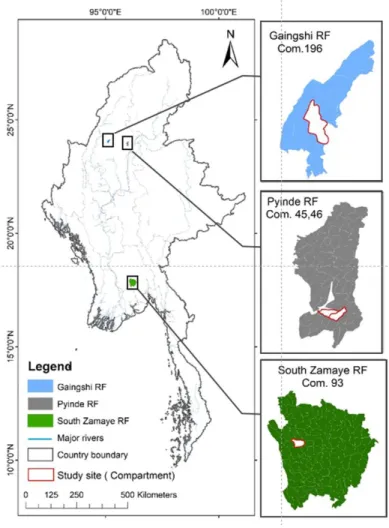
vii List of Figures Figure 3.1 Location of the study area
Figure 3.2 Layout of the nine 1-ha subplots
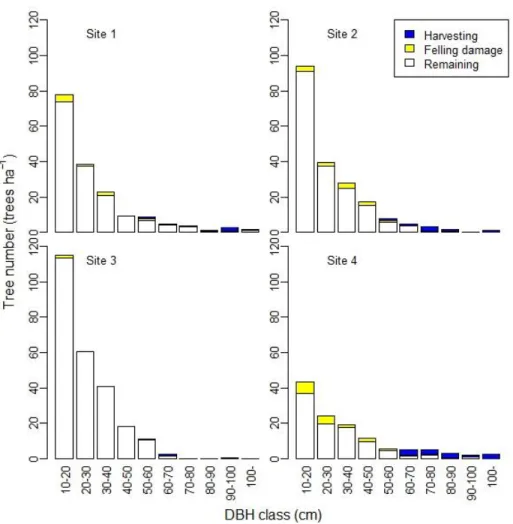
Figure 3.3 DBH distributions before harvesting, which are classified into harvested, damage and remaining trees in four sites
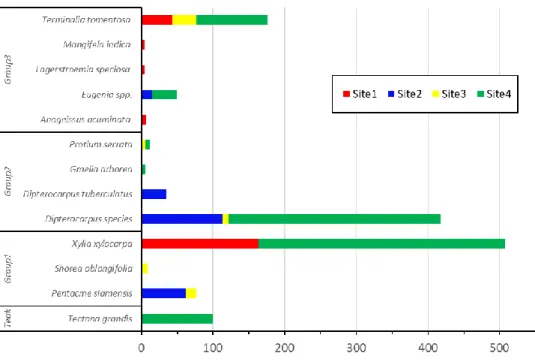
Figure 3.4 Stem volume (m3) of harvested tree species in the 9-ha plot for each of four sites
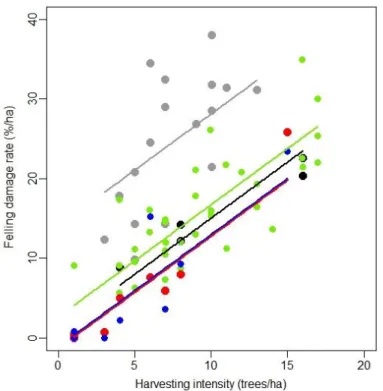
Figure 3.5 Relations between harvesting intensity (tree ha-1) and felling damage (%) for residual trees (red) and bamboo clumps (blue) from this MSS study ( Figure 3.6 Ground disturbance; road, log landings and machine disturbed area at the
four study sites (Site 1 data includes road plus log landings).
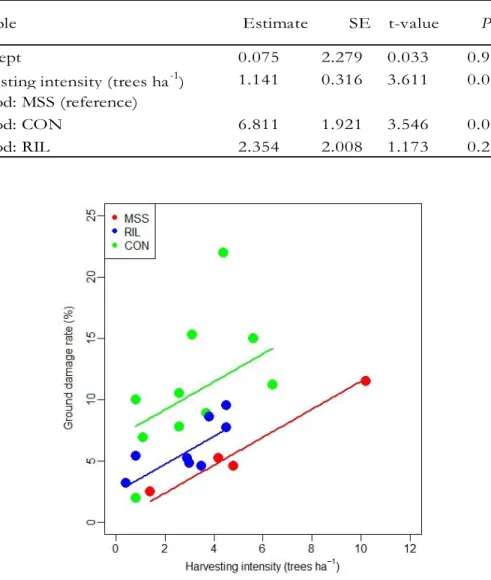
Figure 3.7 Relations between harvesting intensity (tree ha-1) and ground disturbance (%) caused by logging road, skid tails, log landings and other machine disturbed areas) for this MSS study (n=4), the RIL and CON data from six references .
Figure 4.1 Number of residual trees with different damage levels (a) and the damage proportion within each DBH class, using pooled data of all 175 residual trees from the twenty 0.1-ha plots.
Figure 4.2 Effects of DBH of the residual trees on the predicted probability of a residual tree exhibiting severe, minor, or no damage.
Figure 4.3 Effects of DBH of the felled trees on the predicted probability of a residual tree exhibiting severe, slight, or no damage.
Figure 5.1 Locations of study sites in compartment 93 with low cutting frequency (LCF) and compartment 29 with high cutting frequency (HCF). South Zamaye Reserved Forest, Bago Yoma, Myanmar.
Figure 5.2 DBH distribution for low cutting frequency (LCF) and high cutting frequency (HCF) sites.
viii
Figure 5.3 DBH distribution of each species group (teak and groups I-V) for low cutting frequency LCF (a) and high cutting frequency HCF (b) sites.
Figure 5.4 DBH distribution of legally cut, illegally cut and remaining trees for low cutting frequency LCF (a) and high cutting frequency HCF(b) sites.
Figure 6.1 Location of the study site in Compartment 93, South Zamaye Reserved Forest, Bago Yoma, Myanmar.
Figure 6.2 Layout of the nine 1-ha subplots in Compartment 93, South Zamaye Reserved Forest, Bago Yoma, Myanmar.
Figure 6.3 DBH distribution for each species group in Compartment 93, South Zamaye Reserved Forest, Bago Yoma, Myanmar in 2012 and their classifications in 2017.
Figure 6.4 Changes in the volume ( m3 ha-1) of trees with DBH ≥ 20 cm for each component of stand dynamics during the legal logging operations in 2012 and during the 5-year post-harvest period (2012-17) in Compartment 93, South Zamaye Reserved Forest, Bago Yoma, Myanmar.
Figure 6.5 The volume of trees with DBH ≥ 20 cm for each species group before and after the legal operations in in 2012 and 2017 in Compartment 93, South Zamaye Reserved Forest, Bago Yoma, Myanmar.
Figure S1 Annual DBH Increment for each species group
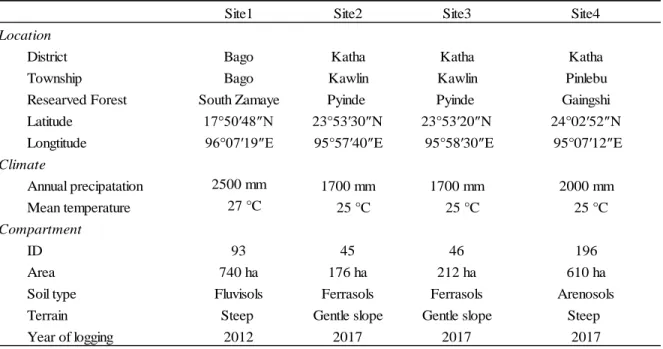
ix List of Tables Table 3.1 Description of the study site
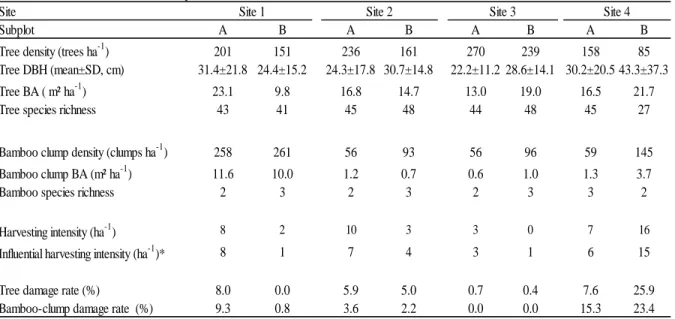
Table 3.2 General statistics of subplots A and B in four sites Table 3.3 Harvesting intensity in nine subplots for four study sites Table 3.4 The result of the linear model for felling damage (%) Table 3.5 The result of the linear model for ground disturbance (%)
Table 4.1 Stand structure before and after felling, size of felled trees, and percentage of damaged trees for the twenty 0.1-ha sample plots.
Table 4.2 The results of two equations from the multinomial generalized linear mixed model using slight or severe damage probability relative to no damage probability as the dependent variable.
Table 5.1 Stand structure before and after most recent logging, and legally and illegally cut trees for low cutting frequency (LCF) and high cutting frequency (HCF).
Table 5.2 Tree density (ha-1) for each species group before and after cutting for low cutting frequency (LCF) and high cutting frequency (HCF).
Table 6.1 Changes in the volume (m3 ha-1) of trees with DBH ≥ 20 cm for all and each species group
Table S1 Changes in the density (trees ha-1) of trees with DBH > 10 cm for all and each species group.
Table S2 Changes in basal area (m2 ha-1) of trees with DBH 10 > cm for all and each species group.
Table S3 Annual DBH increment (cm year-1) for species group.
x Abbreviation
AAC = Annual Allowable Cut
CON = Conventional Logging
DBH = Diameter at Breast Height
EITI = Extractive Industries Transparency Initiative
FAO = Food and Agriculture Organization of United Nations
FC = Felling Cycle
FD = Forest Department
FMU = Forest Management Unit
GLMM = Generalize Linear Mixed Model
Ha = Hectare
HSWC = Hardwood Supply Working Cycle
ITTO = International Tropical Timber Organization LMDF = Lower Mixed Deciduous Forest
MDCL = Minimum Diameter Cutting Limit
MTE = Myanmar Timber Enterprise
MUMD = Moist Upper Mixed Deciduous Forest
NBSAP = National Biodiversity Strategy and Action Plan ( FD, Myanmar)
PFE = Permanent Forest Estate
PPF = Protected Public Forest
PSD,FD = Planning & Statistics Division, Forest Department
REDD+ = Reducing Emissions from Deforestation and Forest Degradation, Conservation, Sustainable Management of Forests and
Enhancement of Forest Carbon Stocks
RF = Reserved Forest
RIL = Reduced Impact Logging
TSWC = Teak Selection Working Cycle
xi Summary
The conservation values of selectively logged forests, which shares approximately 20% of the world’s tropical forests have been considered important from the viewpoints of timber production, global carbon cycle and biodiversity conservation. A critical global concern in recent decades is that selective logging may cause tropical forests degradation and associated carbon emission and then leading to deforestation. When the Myanmar forest policy had to exercise one-decade fallow period in the legendary Bago Yoma production forests after the 160-year history of Myanmar selection system (MSS), the question is what the underlying causes are or to what extent the MSS operations are responsible for the prevailing problem of production forest degradation? This study aims to evaluate the impact of human disturbances and stand dynamics at post-harvest condition in the selectively logged production forests, and to identify possible ways to improve the MSS operations (Chapter 1).
For the research, we established 9-ha rectangular plots (300 ×300 m) at four different site; one at Bago Yoma in 2011 and another three plots at Katha during 2017, respectively.
In Chapter 2, the overview of selectively logged production forests in Myanmar and the MSS are briefly introduced. In tropical Myanmar, the production forests were found mainly in mixed deciduous forests, encompassing about 38% of the total forests. Tectona grandis (teak) and Xylia xylocarpa, as the two main characterizing species proportion approximately one third of the forest stocks while other species seldom exceeds 3% or one tree ha-1. The MSS, evolved in 1860s, is oriented toward the sustainable production of teak, from which the basic theories and practices are subsequently applied in other forests. Under it, harvesting tree is determined by prescribed minimum diameter cutting limit (MDCL) and a 30-year felling cycle. Elephant is mainly use in the skidding operation in the logging sites. After 160-year experiences of selectively logging, logging was temporarily banned for one year in 2016, and the legendary Bago Yoma, the main extraction site has given 10-year fallow period. When the logging was resumed in 2017, the timber harvesting plan set at the national scale was to extract only 55% of teak and 33% of non-teak hardwood, respectively than the prescribed annual yield. However, it is still unknown to what extent the MSS operation will be responsible for disturbances at the operational level or how to improve the MSS operation.
Chapter 3 aimed to evaluate the levels of MSS disturbance to standing trees and the ground as compared with those reported for other tropical countries, and to identify possible ways to improve MSS operations. At each of four study sites (nine 1-ha subplots), all the living trees ≥ 10 cm dimeter at breast height (DBH) and their damage caused from felling trees were measured in two of the subplots,
xii
and the harvested trees and the disturbance to the ground were measured in all the nine subplots.
Harvesting intensity varied from 0 to 18 trees ha-1 (143.7 m3 ha-1) with the mean of 5.2 trees ha-1 (39.0 m3 ha-1) among a total of 36 1-ha subplots. The harvesting intensity was linearly related to felling damage (% in number) to residual trees and bamboo clumps, and to ground disturbance (% in area) (roads, log landings, skid trails, and machine-disturbed areas). These linear relationships for MSS were at the lowest level of, or not significantly different from, those reported in other studies. The lowest level of ground disturbance is because of the use of elephants for skidding, resulting in no visible ground disturbance only a few months after the operation. However, this low impact was confined only to low harvesting intensity ≤ 5 trees ha-1 (~ 25 m3 ha-1). When felling intensity exceeded 10 trees/ha (98 m3 ha-1) the ground disturbed area under MSS achieved even higher than those RIL studies.
In high felling intensity of MSS case, 36 % of total harvested trees were too large (> 100 cm DBH) for elephant skidding, and so machines were used instead. The use of machines for skidding resulted in a greater proportion of disturbed area (2.5% of the area at Site 4). To minimize disturbance to residual trees and the ground, we suggest to limit the maximum harvesting intensity and avoid harvesting trees too big for elephants to drag. Retaining such large trees may also be beneficial to provide seed sources and for biodiversity conservation.
In Chapter 4, a proposed tree-based approach was applied to evaluate the felling damage to residual trees in a tropical mixed deciduous forest in Bago Yoma, Myanmar and compared the cases with semi- evergreen forests of Cambodia. The logging damage was assessed in twenty 0.1-ha plots (25 m × 40 m) each of which contained the stump and crown of one felled tree, and multinomial logistic regression was used to quantify the probability of the felled tree causing severe, slight, or no damage to residual trees. In both cases of Myanmar and Cambodia, severe damage was dependent on the size of the residual and felled trees, while slight damage was independent of the size of felled trees. There was no slight damage of residual trees with ≥50 cm diameter at breast height (DBH) in Myanmar, whereas slight damage increased with residual tree size in Cambodia and in tropical rain forests of other countries. Additionally, the probability of increasingly severe damage with increasing DBH of the felled trees was higher in Myanmar than in Cambodia; one of the reasons may be the steeper terrain at the Myanmar site. In overall, the residual tree damage (%) rate per felling of one tree, 1.77%
is relatively small as compared to those widely reported value ranges of 1.64- 2.02%.
Chapter 5 revealed an evidence of forest degradation in selectively logged production forests of Myanmar which are subject to inadequate cutting frequency. We compared stand structure,
xiii
commercial species composition, and incidence of illegal logging between two compartments with low (LCF; 1 time) and high (HCF; 5 times) cutting frequency over a recent 18 years. Prior to the latest cutting, LCF had 176 trees ha−1 with an inverted-J shape distribution of diameter at breast height (DBH), including a substantial amount of teak (Tectona grandis) and other commercially important species in each DBH class. HCF prior to the latest cut had only 41 trees ha−1 without many commercially important species. At HCF, nearly half the standing trees of various species and size were illegally cut following legal operations; this was for charcoal making in nearby kilns. At LCF, two species, teak and Xylia xylocarpa, were cut illegally and sawn for timber on the spot. More extensive and systematic surveys are needed to generalize the findings of forest degradation and illegal logging.
However, our study calls for urgent reconsideration of logging practices with high cutting frequency, which can greatly degrade forests with accompanying illegal logging, and for rehabilitating strongly degraded, bamboo-dominated forests. To reduce illegal logging, it would be important to pay more attention on the MSS regulations stating logging road should be destroyed after logging operations.
In Chapter 6, the stand structural changes over 5 years after official legal logging operations was investigated using two 1-ha (100 × 100 m) sample plots. For 5 years after logging, the volume of trees with DBH ≥ 20 cm decreased by 46.0% from 121 to 65.1 m3 ha−1, with a significant loss of the first and second grade species group (teak and Xylia xylocarpa) from 48.3 to 6.8 m3 ha−1. The total tree loss owing to official logging operations, mainly targeting the second and fourth grade species group, was 29.3 m3 ha−1. The similar level of the total tree loss (28.0 m3 ha−1) was attributed to illegal logging that targeted the first and second grade species group. The mean annual recruitment rate of 3.1% was larger than the reported values for tropical forests, but there were no and only 1.5 trees ha−1 requirements for teak and X. xylocarpa, respectively. The mean annual mortality rate of 2.5% was within the values reported in the related literature, and the volume loss from the mortality was relatively similar to the gain from the increment of living trees for all species group. It was concluded that the effects of illegal disturbances for 5-year post-harvest were equivalent to those of the legal disturbances and larger than those of natural change, and are a major cause of the substantial reduction in stocking levels, especially for commercial species.
In overall, the logging damage under the MSS operations at lower level compared to those reported values but depending on the harvesting intensity, and the harvesting intensity regulated only by the minimum diameter cutting limit (MDCL) rule has a tendency toward overexploitation. The logged- over forests with annual growth rate 0.48 cm ha-1 is could have a potential to recover. However, illegal
xiv
disturbances following the legal logging has substantial impact to the growing stocks. In conclusion, human disturbances in terms of illegal logging and repeated legal loggings with repeated construction of forest roads are the most detrimental factors for the degradation of the production forests. It is recommended to limit the harvesting intensity in terms of quantity and size of harvested trees to reduce the impact on residual trees and ground. It is also crucial to decommission the forest roads after the operation to combat illegal logging in the logged over forests.
1 Chapter 1 General Introduction 1.1. Background
Forests, covering an area of around 4 billion ha or some 30 percent of the earth’s land surface (Keenan et al., 2015), are invaluable renewable natural resources and the most productive land- based ecosystems essential to life on earth (UN., 2019). Of these, tropical forests, representing 44% of the total forest areas (FAO., 2015), are the largest in area and irreplaceable source providing ecosystem services and protecting biodiversity for both humans and wildlife (Gibson et al., 2011; Putz et al., 2012). Owing to the vast variations in topography, climatic and soil conditions, tropical forests are extraordinarily diverse and differing in composition and structure. In Asia, the tropical rain forests are centered on the Malay Archipelago but extend from Papua New Guinea north into the continental Asia (Thomas and Baltzer., 2002) encompassing the southeast Asian nations including Myanmar.
Tropical forests, despite their importance, are among the most threatened ecosystems on the earth. Based on the Forest Resources Assessment, the deforestation of tropical forest was about 13 million hectares annually during a period of 2000 to 2010 (FAO., 2011). For the recent decades, to combat the increasing trend of deforestation has been the main global concern and attention of tropical conservation. (Sloan and Sayer., 2015; Asner et al., 2009; Hansen et al., 2013; Malhi et al., 2014). The effort in doing so have had positive outcomes as trends of annual deforestation rate have slowed globally from 0.18 percent in the 1990s to 0.08 percent over the last few decades (FAO., 2015). However, this trend has been outweighed by a strong increase in tropical forest loss in some countries such as Angola, Bolivia, Indonesia, Malaysia and Myanmar (UN., 2019; Burivalova, 2015; Hansen et al., 2013). Particularly, Myanmar, a timber producing country in the southeastern Asia, is ranked third in the list of countries with largest deforested areas 2010-2015 (FAO., 2015). The causes of tropical deforestation are many, varied, complex and often comprise proximate or ultimate causes. In summarizing the causes of tropical forest deforestation, based on 152 sub-national case studies, tropical wood extraction in several forms was singled out as one of the three main proximate causes (Geist and Lambin., 2002). In 2011, annual wood removals amounted to 3.0 billion m3 globally (FAO., 2016).
According to ITTO estimation, at least 350 million ha of tropical forests have been severely damaged, and a further 500 million ha have been degraded due mainly to unsustainable logging (Sasaki et al., 2012). In this regards, tropical selective logging being subjected to at least 20%
of the world`s natural tropical forests, about 403 million ha of tropical production forests, has
2
been in the core of global attentions in recent decades. There have been many studies addressing the sustainability of tropical selective logging in terms of carbon retention (Zimmerman and Kormos., 2012; Sasaki et al., 2012; Medjibe et al., 2013; Sist et al., 2014;
Griscom et al., 2014; Pearson et al., 2014), biodiversity conservation (Edwards et al., 2012, 2014; Putz et al., 2012; Burivalova et al., 2014) and timber production (John et al., 1996; Pereira et al. 2002; Picard et al., 2012; Sist and Ferreira, 2007).
In effort to improving natural forest management, reduced impact logging (RIL) is implemented globally as a way to balance environmental protection with timber production in the selectively logged production forests in the tropics. Accordingly, great many researches have indicated the effect of tropical selective logging in relation to deforestation and degradation of tropical production forests ,(FAO., 2004; Hawthorne et al., 2011; Sist et al., 2008, Putz et al., 2008a,2008b ; Puodyal et al., 2018) focusing each particular forests: for examples, in the Brazilian Amazon (e.g. Silva et al., 1995); in Uganda (e.g. Chapman & Chapman, 1997); in Indonesia (e.g. Cannon et al., 1994; Sist & Nguyen-The, 2002 ); in Central Guyana (e.g. ter Steege et al., 1996); in the Western Ghats India (e.g. Pelissier et al., 1998); in Sabah Malaysia (e.g. Pinard & Putz, 1996; Pinard et al., 2000). Amidst such great number of research, unfortunately, there was a dearth of research on the impact of Myanmar selective logging (Pouydal et al., 2014), which has the longest logging history in Southeast Asia (Miettinent et al., 2014). The Brandis selection system, which was introduced in 1856 to suit the tropical mixed deciduous forest in Bago Yoma of Myanmar (Burma), was acknowledged as the first systematic silvicultural management system of the tropics (Zin., 2005). The Brandis selection system, later modified into Myanmar selection system (MSS), has been the principal forest management system in a tropical timber producing nation in the Southeast Asia. Today, about one third of the country land areas, being constituted as permanent forest estate, have been treated striving to sustain under the MSS. It was a tragedy for the tropical Myanmar and the tropical forests as well when the Bago Yoma, the legendary birth place of the MSS, was treated for a 10-year fallow period in 2016 after its reputation and long-standing practices has been tested for 160 years. By large scale analysis through the application of remote sensing data, studies have revealed the occurrence of forest degradation in production forests under the MSS even though deforestation was not occurrence in a large scale (Mon et al., 2010, 2012). This issue of the widespread large scale forest degradation in selectively logged production was also confirmed by large scale systematic forest inventory (Win et al., 2018a, 2018b). While the prevailing issue of deforestation is one of the management problems that needs to be addressed on the political- social level, forest degradation particularly in the production forests is a silvicultural problem
3
that could be addressed with proper technical solutions (Zin., 2005). A handful studies have been attempted to address the factors causing forest degradation in the production forests in Myanmar (Mon et al., 2012, Khai et al., 2016). Indeed, loss of forest resources in terms of forest vegetation, forest areas, decline of forest products and services have been critical development issues which are ranked top priorities of environmental concerns in Myanmar and recommended to address quickly and comprehensively to ensure sustainable economic development (David et al., 2015).
1.2. Research objectives
Tropical selective logging which removes only a small proportion of the targeted commercial trees, by its concept, do not necessarily to relate to degradation. Since recent decades, however it has been a global concern that the tropical selective logging may cause degradation i.e. gradual decrease in stocks of the selectively logged production forests, and then leading to deforestation (Nepstad et al., 1999; Asner et al., 2005: Oliveira et al., 2007). Several studies have been attempting to solve this concern from the aspects of harvesting intensity (Sist et al., 1998, 2003;
Parrotta et al., 2002), felling cycle (Kammesheidt et al., 2001; Sist et al., 2003b; van Gardingen et al., 2006), logging damage (John et al., 1996; Picard et al., 2012; Sist and Ferreira, 2007; Khai et al., 2016), recovery and stand dynamics (Silver et al., 1995; Sist and Nguyen The 2002;
Cavalho et al., 2004; Dionisio et al., 2018) and illegal logging ( Kao et al., 2012; Win et al., 2018) respectively. Conceptually, when the logging disturbance is too high, the remaining forest stocks after selective logging could be unable to recover during the prescribed felling cycle (FC), and then selective logging cause forest degradation and radically alter fundamental ecological process of tree species. Similarly, when the felling cycle is insufficiently long, i.e. repeated logging < FC is implemented, the logged-over forest will be proceeded to similar negative trend.
The balance between logging disturbances and recovery of the logged forests during the FC is a key to ensure the long term sustainability of the production forests. In this, the harvesting intensity, which is commonly regulated by one universal rule of minimum diameter cutting limit (MDCL) is the critical factor determining the logging disturbance and subsequent dynamics of the logged forest.
In tropical Myanmar, the total forest cover in 2015 is 29.39 million ha or 42.9% of the country`s territory, in which closed forests and open forest approximately equal in extent (FRA 2015).
The total forest cover at this extent was a decrease from 34.42 million ha or 58% of the country territory estimated from the 1989 Landsat TM imageries. Apart from the reduction of total forest cover between the periods, the extent of open forests was sharply increased from 12.32%
to almost two folds while closed forest at 46% has dramatically decreased to more than half.
4
On the other hand, the PFE areas, as of 2018, has further increased to 21 million ha (31% of land area) and it is targeted to increase to 40% of the total land areas under PFE in accordance to Forestry Sector Master Plan (2001-2030). The PFE, distinguished into RFs, PFFs and PAs, denote the legal condition of the lands, which have already been confirmed as forests in accordance with the government records (Aung, 2019). Thus, such increase in the extent of PFE could accordingly be presumed as increase of forests, despite the decreasing trend of forest cover at the country level. Of the PFE, RFs, which are priority areas for timber production, comprise almost 60% of the PFE, as of 2018. These figures indirectly indicated that the prevailing issues to be dealt with regard to the PFE is forest degradation rather than deforestations. Deforestation, which is changes of forest to other land use is indeed the management problems that need to be addressed on the political–social level. The degradation of production forests being subjected to the selective logging called for proper technical solution from the silvicultural aspects.
Traditionally, the MSS with its hundreds years’ experiences of continuous timber extractions is considered as sustainable and suitable for maintaining the multi-species, complex natural teak bearing production forests of tropical Myanmar. Notwithstanding the longest logging records, tropical production forests in Myanmar were not in the exception of forest degradation.
Concerning with the current problem of forest loss and degradation in Myanmar, studies have claimed that “severe logging” (Bhagwat et al., 2017), “timber extraction” (Lim et al., 2017),
“over-exploitation” (Enter et al., 2017) were proximate cause while extraction of only a few commercial species in successive felling cycles was suspected to lead to “creaming” of the forests and resulted in their devaluation through a pronounced decrease in valuable timber species (Zin., 2005) In addition, repeated logging beyond the regulated AAC and prescribed cutting cycle is denounced as causes of forest degradation in Myanmar (Thein et al., 2007). All these aforementioned studies have unanimously highlighted to the issue. However, it remains unknown “why or how does the selectively logged production forests in Myanmar result in forest degradation?”. Evidence and field data have been lacking to verify to what extent the MSS practice is responsible for forest degradation particularly in the production forests. Despite its legacy, there is limited empirical study on the impact of logging under MSS, which has been conducted annually over centuries. Deforestation and forest degradation can be caused by a combination of multiple factors from either or/both natural and human disturbances. Several studies have reported that deforestation and degradation of production forests particularly Bago Yoma of Myanmar (Mon et al., 2010,2012; Ne Win et al., 2012; Win et al., 2018a, 2018b).
5
However, to our knowledge, no study so far has investigated the sustainability of selective logging in Myanmar from the logging disturbances aspect.
Concentrating on the prevailing issue of degradation of productions forests in tropical Myanmar, this study has an overall objective to evaluate the impact of human disturbances and stand dynamics at post-harvest condition in the selectively logged production forests, and to identify possible ways to improve the MSS operations.
Specific objectives are;
1) To evaluate the levels of harvesting intensity and disturbances of Myanmar selective logging operations compared with those reported values for other tropical regions.
2) To evaluate the effect of different felling cycle on stand structure and species composition.
3) To evaluate components of post- harvest stand dynamics from natural occurrences.
4) To evaluate the impacts of human disturbances in term of illegal logging on post- harvest stand dynamics.
1.3. Organization of the dissertation
The dissertation comprises 7 chapters in total, each chapter addressing a particular theme in details. Chapter 1 is an introduction on the background and objectives of this study. Chapter 2 described the overview of selectively logged production forests in Myanmar. Chapter 3 to 7, being the main chapters of the dissertation, are corresponding to each components of the objectives; harvesting intensity, logging disturbance, felling cycle, stand dynamics and illegal logging.
Chapter 3 evaluated the harvesting intensity operated at the minimum diameter cutting limit (MDCL) system, and the level of subsequent logging disturbances in terms of damaged trees (%) and ground disturbance (%) at four different sites under the MSS. Then, this chapter compared the findings with those reported RIL and conventional logging studies across other tropics.
Chapter 4 applied a proposed tree-based approach/model to evaluate logging damage in a tropical mixed deciduous forest in Bago Yoma, Myanmar and compared the cases with semi- evergreen forests of Cambodia.
Chapter 5 comparatively revealed stand structure, commercial species composition, and incidence of illegal logging between two compartments subjected to two different cutting frequency: low harvest (1 time) and high (5 times) cutting frequency over a recent 18 years in the production forests in Bago Yoma, Myanmar.
6
Chapter 6 exhibited, based on two 1-ha (100 × 100 m) sample plots, components of post- harvest stand dynamics over 5-year period in logged-over forests, highlighting the incidence of illegal logging as one of the factors.
Chapter 7 included general discussion and conclusion that were drawn from the research findings.
7 Chapter 2
Overview of selectively logged production forests in Myanmar 2.1. Tropical seasonal forests
Tropical moist deciduous forests, frequently also referred to as monsoon forests or tropical seasonal forests, are found mainly in the fringes of tropical rain forests. They are characterized by distinct wet and dry periods (Lamprecht., 1989) and tree species shedding their leaves during the dry season. Typically, tropical seasonal forest extends into southern and southeastern Asia from India, Nepal, Bhutan and Bangladesh to Myanmar, Thailand, Laos, Cambodia and Vietnam to Indonesia. The teak bearing forests of India, Myanmar, Laos and Thailand are a good example of this type. Though tropical moist deciduous forests are of lesser stature than rainforests with a lower biomass, species richness and floristic diversity, they still contain a considerable variety of species and are commercially valuable (Borota., 1991). The evergreens are dominant in some occasions. Dipterocarpaceae are less abundant (Whitmore and Burnham., 1984).
The climatic climax of the monsoon tropical climate is tropical moist deciduous forest or tropical seasonal forests such as mixed deciduous forests (Ruangpanit., 1995). The mixed deciduous forests can be found at the elevation range from 50-800 m above mean sea level.
The distinct dry season of at least four months is believed to be the limiting factor of the type.
(Ruangpanit., 1995). In its composition, this forest type has all deciduous species in a good proportion typically with the closed and high (often reaching >30 m) canopy. Beneath the canopy, the understory is relatively open despite a diverse assemblage of small trees, shrubs, and bamboos forests (Rundel., 2009). In certain localities, one species, Tectona grandis (teak) for instance, may become predominant and well adapted (Ruangpanit., 1995). Unlike the evergreen-forest formations, lianas and vascular plant epiphytes are uncommon (Rundel., 1999).
Due to the strong seasonality, frequent ground fire is a natural ecological factor in the mixed deciduous forests. The canopy trees exhibit a complete dominance by a deciduous growth habit and, typically shed off leaves in dry season for 4-5 months (Rundel., 2009). Dense local stands of bamboo, mostly deciduous species such as Dendrocalamus strictus, D. membranaceus, Bambusa tulda, Gigantochloa albociliata, and Cephalostachum spergracile, are often present as indicator species of this forest type (Kermode., 1964; Troup., 1921). Naturally, the mixed deciduous forests usually alternate with the deciduous dipterocarp forest type depending on the mosaic pattern of topography and characteristics of the sites (Ruangpanit., 1995). The historically most significant species in the mixed deciduous forest has been teak, extending natural range from northern India and Myanmar across northern Thailand to northern Lao. Teak distribution
8
characterizes much of the range of mixed deciduous forest (Rundel., 2009). Teak is generally fire resistant at the ground fire and can survive ground fire in the juvenile stage, recovering vegetative by mean of vigorous coppices that sprout from well protected root stumps, when both lighting and weather condition become favorable. Ground fire, which are usual phenomena in seasonal forest types, are in fact maintaining the stock of teak. Otherwise the forest would regress to evergreen climax stage where teak will be unable to perpetuate itself (Ruangpanit., 1995).
In tropical Myanmar, mixed deciduous forests form a wide ring around the central dry zone, over a wide range of annual precipitation as low as 1270 mm to 5080 mm or more. These forest types, which are by far the largest in area and the most important, play an important role as the best quality of teak and other commercially most important timber species grow abundantly in it. Mixed deciduous forests of Bago Yoma is often refereed as ‘home of teak’. Based on their common species composition, rainfall distribution and characteristic bamboo species, mixed deciduous forests of Myanmar are classified into three types; Moist upper mixed deciduous forests (MUMD), Dry upper mixed deciduous forests (DUMD) and Lower mixed deciduous forests (LMD)(Kermode.,1964). Teak, pyinkado (Xylia xylocarpa) and taukkyant (Terminalia tomentosa) are common species found in all three types while other different timber and bamboo species confined to the respective forest types as characterizing species. Teak, which is the most important and characterizing species of mixed deciduous forests, grows well in warm, moist tropical regions with annual rainfall between 1250 mm and 2500 mm and a distinct dry season of 3-5 months.
In Myanmar, the mixed deciduous forest type, which usually has teak as the leading dominant species in the top canopy, is commonly called a teak bearing forest. Xylia xylocarpa is the natural associate of Teak in such teak bearing forests and usually intermix with Lagerstroemia tomentosa, Terminalia alata, T. belerica, Bombax insigne, Pterocarpus macrocarpus, Dalbergia cultrata, D. oliveri, Adina cordifolia, Gmelina arborea, Acacia leucophloea, and Dillenia pentagyna (Kermode., 1964; Ruangpanit., 1995; Troup., 1921). Some evergreen species such as Hopea odorata, Shorea asscamica, Eugenia species, Dipterocarpus alatus, D. turbinatus are occasionally found in the area, especially along the streams (Ruangpanit., 1995; Kermode., 1964).
2.2. Selective logging under the polycyclic silvicultural system
Natural forest management has been defined as “controlled and regulated harvesting, combined with silvicultural and protective measures, to sustain or increase the commercial value of future stands, all relying on natural regeneration of native species” (Schmidt., 1991). The primary
9
objective of silvicultural intervention in natural forest management is to selectively modify the biotic and/or abiotic environment in the tropical forest to enhance regeneration and growth of a restricted number of tree species (Smith., 1962). Management of natural forest in such a way as to minimize the problems associated with timber extraction is sustainable forest management (Montagnini and Jordan., 2005). The silvicultural systems, which have been applied to manage tropical forests, can be classified into monocyclic and polycyclic system. Monocyclic systems cover all systems that remove all saleable trees at a single operation with the cycle, the length of which more or less equals the maturation age of the trees. The Malayan Uniform System (MUS) designed for natural forests that are relatively uniform and rich in commercial species of the Dipterocarpaceae family was a most widely known monocyclic method particularly in the Southeast Asia.
The polycyclic system bases on the repeated removal of selected trees in a continuing series of felling cycles, whose length is less than the time it takes for the trees to mature; usually about half of the time required for the species to reach merchantable size. Under this system, advanced growth is retained and the forest stands result in an uneven-aged structure (Armitage., 1998).
It is the most widely applied system for managing natural forests in the tropics. The basic idea is to leave behind an adequate number of residuals stands after logging, which will ensure an economic cut at the end of the cutting cycle and sustainable timber harvest in future. This system offers a flexible, practical, technically and commercially realistic basis for harvesting. At the same time, it influences forest composition and structure in favor of the next crop.
Furthermore, polycyclic systems have ecological advantages because they appear to be more natural, the logging damage tends to result in scattered small gaps in the forest canopy.
Tropical forests are a living entity in a state of equilibrium in the growth cycle (Whitmore and Burnham., 1984) and gap phase dynamics has been hypothesized to play an important role. The regeneration is known to be driven by the small –scale disturbance dynamics of randomly occurring canopy gap (Denslow., 1987; Zimmerman and Kormos., 2012). A relatively low impact of tropical selective logging that mimics to the natural gap may serve as the most formative silvicultural operation to be applied during the management cycle in any particular area of tropical forest through its limited effects on the future structure, composition and growth of a forest (Armitage., 1998; Zin., 2005). From the silvicultural point of view, harvesting could be organized as a significant silvicultural intervention and a log production operation by maintaining a level of harvest within the productive capacity of the forests. In practical management, the fundamental complex features of tropical forests usually create a major
10
problem while the structural and compositional simplification and refinement of these forest systems are also necessary for an efficient wood production, where a very few commercial timber species are sparely present (Zin., 2005). Unfortunately, in spite of the intensive efforts of many forest services, the results of these selection systems following the polycyclic system have often not been very encouraging. In fact, there is no single silvicultural system that can be blindly applied in every forest nor universally valid silvicultural recipes. All systems always have to be adapted to local conditions when they are applied in practice. In tropical Myanmar, a selective logging known as “Brandis Selection System” being based on a yield regulation system and applicable to the moist deciduous forests of Myanmar was introduced in 1856 (Blandford, 1956). That first effort to bring the natural tropical forests under conditions of scientific management was the basis for future management development in the tropical world (Zin.,2005). Today, after the exercise of 160 years of application, the MSS has been modified towards bringing conservative silviculture into harmony with profitable exploitation on a sustainable basis (Tint., 2014).
2.3. Status of natural forests and management in Myanmar
Myanmar, a tropical country in the continental South East Asia, is one of the biodiversity hotspots (Krupnick et al., 2003; Myers et al., 2000). Owing to the diverse climatic, topographic and a wide range of latitudes, the forest flora of Myanmar ranges from sub-alpine forests in the far north through extensive tropical deciduous forests and dry forests surrounding the central Myanmar to tropical rain forests including mangroves in the southern part. Among plant species about 11,800 recorded so far from natural forest resources, 1071 are endemic (NABSAP, 2015). Out of 2088 species of big and small trees, 85 species have been recognized and accepted as producing multiple–used timber of good quality. Particularly, teak native to Myanmar is regarded worldwide as one of the most valuable premier woods. Forest area of Myanmar estimated by forest types and function are mixed deciduous forests including teak (38% of the total forested area); hill and mountain evergreen forests (25%), tropical evergreen forest (16%), dry forests (10%), deciduous dipterocarp forests (5%); and tidal and swamp forests (4%) respectively. Of these forests, the most extensive and economically most important forest types are tropical mixed deciduous forests because teak, Xylia xylocarpa, Pterocarpa macrocarpus and other commercial species are usually associated with this forest type. No less important are the Dipterocarps forests which are confined to the tropical evergreen forests and deciduous forests.
In Myanmar, the forests are State-owned in accordance with the forest law and are categorized legally as Reserved Forest (RF), Protected Public Forest (PPF) and Protected Area Systems
11
(PAs). All these forests: RF, PPF and PAs amounted 21 million ha area (~31% of the country`s area) as of 2018, are recognized as Permanent Forest Estate (PFE). The forest policy has stipulated to have 40% of the country`s area under PFE by 2030. Of the PFE, majority areas mostly from the RFs are designated as production forests and subject to selective logging under the MSS. Again, the majority of production forests (86% of the total) are stretching over the tropical mixed deciduous forest types while the rest are found in evergreen forests. Sub-tropical and temperate forests, which are found in hill and mountains, have often been outside the range of forestry activities.
From the ecological aspect, the distribution of teak, a light demanding species (Troup., 1921), characterizes much of the range of mixed deciduous forests in associated with Xylia xylocarpa, a shade bearing species, and bamboo such as Bambusa polymorpha, Cephalostachum pergracile, and Dendroclamus strictus as indicator species in the intermediate layers (Kermode., 1964). Teak as the predominant species occurs naturally with varying degree of stocking and quality. The proportion of teak, however, rarely exceed 20% of the total stock (Tint., 2014) while other species selfdom exceeds 3% (Watson., 1923) in the natural forests.
In fact, teak always play a typical role throughout the history of Myanmar forestry. Forest management in Myanmar has been natural forest management founded on the concept of sustain yield and primarily initiated with teak. Since even during the era of ancient Myanmar kings, teak trees was declared as royal property and a complex system was formulated to maximize revenue and control (Brandis., 1896; Gyi and Tint.,1998), and in today, in accord article 8(a) of the Forest Law, a standing teak tree wherever situated in the State is owned by the State. When the scientific forest management was officially started in 1856 with the introduction of the so-called Brandis management system (Dah, 2004), teak was the only commercial species at that time. The management of natural forest was therefore oriented towards the sustainable production of teak, and designed to favour teak regenerations i.e.
improvement felling and thinning of natural congested stands. In later years, management of other commercially important species was also considered, and accordingly, the original Brandis Selection System was modified into the Burma Selection System in 1920. This system, known gradually as the Myanmar Selection System (MSS) has been the principle forest management in tropical Myanmar (Dah, 2004; Gyi and Tint., 1998; Zin., 2005).
In its principle, the MSS can be said founded on three main components; adoption of 30 years cutting cycle, prescription the minimum diameter cutting limit (MDCL) of harvesting trees and fixing of annual allowable cuts (AACs) for timber harvesting. For timber harvesting purpose,
12
the production forests are organized into different working circles based on the nature and form of forest products and accessibility. The working circles consist of a group of RF, which is further divided into felling series for the convenience of working according to the drainage and the geographic situations. As MSS adopts a 30-year felling cycle, a felling series is then divided into 30 blocks of approximately equal yield capacity. Each year, selection felling is carried out in one of these blocks and the whole forest under a particular felling series is therefore worked over a felling cycle. All marketable trees > MDCL in the planned block are selected for harvesting. For teak, the MDCL varies with the type and status of the forests. In good (moist) teak forests, the MDCL is 73 cm DBH and in poor (dry) teak forests 63 cm DBH (Dah, 2004). The fixed MDCL for other hardwoods varies, mostly 58- 78 cm with the species depending on the growth rate and size at maturity. If seed-bearers are scarce, a few high quality stems above the exploitable size may be retained as seed trees. Trees left standing at the time of the selection are recorded, down to 39 cm DBH for teak, and 10 cm DBH below the exploitable size for other hardwood species. This provides a reliable basis for calculating the future yield. Trees of exploitable sizes are selectively marked within the bound of AACs calculated for each felling series based on the principle of sustained yield management.
In the standard practice, mature teak trees selected for harvesting are normally girdled and left standing for three years before being felled and extracted. This is to season the timber and make it floatable as logs are normally transported by floating down the streams and rivers.
Improvement Felling (IF) and thinning in very dense young stands are carried out at the time of girdling to favour teak. Annual yield known as AAC is estimated, based on the basis data obtaining from 100 % enumeration and forest inventory, by the formulae;
LP
ARR 2FC
1 ARR
AAC
WS
where, AAC Annual allowable cut
ARR Annual rate of recruitment
= Number of trees within 1feet girth (10 cm DBH) class below the MDCL divided by time of passage ( 30 years)
WS Existing working stock = number of trees of above MDCL FC Felling cycle ( 30 years)
LP Decide period to liquidate original WS ( usually 60 years )
13
AAC at each forest management unit level has been periodically revised as necessary depending on new data. At the country scale, estimated AAC of teak and non-teak hardwood in 1995 were 124,213 teak trees and 1,795,424 non-teak hardwood trees. These AAC values however decreased to 48,897 for teak and 817,343 trees for hardwood species in 2016, and further 19,210 for teak and 593,330 for non-teak hardwood trees, respectively (Source: FD, 2017). The MSS was believed to be an excellent one and the only feasible way to deal with multispecies, complex natural forests of the country (Dah., 2004), and it has become discernable that the sustainability of the forest resources is under serious threats. The drastic decrease of AAC tree indicated that the productivity of forest has decreased both in quality and quantity. Especially, the decrease in AAC for teak is significant.
2.4. Timber extraction in Myanmar
The extraction of teak through girdling method was recorded since the pre-colonial period in 1824 (Kyaw., 2004). Putting aside the depletion of teak forests in Mawlamyaing in southern Myanmar under the laissez-faire condition by private firm, the commercial logging with scientific forestry began with the arrival of botanist-turned- forester Dietrich Brandis in the middle of the 19th century (Bryant., 1996), along with the declaration of all forest as the state property and creation of reserved forests (RF) in accordance with the Burma Forest Act (1881).
Throughout the colonial era, teak extraction for export was the official attention (Bryant., 1996) and logging was opened to private enterprise in the lower part of Myanmar (Kyaw., 2004).
When the Ministry of Forestry (MoF) has established in 1923, timber extraction by private were under the control of MoF. Until the World War II, British private companies were engaged in teak loggings.
After 1948 independence, two governmental institutions under the MoF have been involved in the forestry sector: Forest Department (FD) which is responsible for the protection, conservation and management of forest resources and the State Timber Board (STB) established to undertake the commercial exploitation, processing and marketing of teakwood in 1948. Established private national timber businessmen were granted licenses to continue extraction of non-teak hardwoods under contracts. (Zaw., 2004). Hardwood marketing was nationalized in 1963 and all private-owned sawmills were also brought under the State control in 1965 under the socialist economic system. In 1974, the STB was reorganized under the socialist economy and renamed Timber Corporation (TC), and again in 1989, with reformed market-oriented economy by the Junta, the TC was changed to the Myanmar Timber Enterprise (MTE). To date, the MTE is a sole state-owned economic enterprise which has legal right of harvest, process and market in Myanmar.
14
For timber harvesting under the MSS, selection felling (SF) marking of harvesting tree, girdling of teak tree are conducted by FD based on the AAC prescribed in accordance with the District Forest Management Plan. Each year FD and MTE have to perform together matters such as teak trees to be girdled, teak trees to be green felled, non-teak hardwoods to be selectively marked for felling. All this information with respective trees location maps is handed over to MTE for timber harvesting operation.
Seasonal extraction operation of the MTE usually commences in June each year after the first shower of the rain. In directional felling, the felling of marked tree is very important as not only to damage the felled tree itself but also the nearby trees, saplings and advance growth.
Good felling direction is towards or away an extraction direction forming an angle with the extraction direction of 30-50 degree (MoF, 2000). In practice, it is common to fell according to the natural direction of fall. A combination of elephant power and mechanical power is employed for extraction work. Stumping, skidding of logs away from the stump of the fell tree to the log landing (measuring point) where logs are temporarily collected is done usually by elephant power. When mechanical power is aided in logging, elephants assist to drag logs from the stump to wider drag paths or clearing just outside the extracting areas. Further hauling or skidding is done by skidders up to the log landings/ measuring points or forest car base. Then loading is done by wheel loaders onto timber hauling trucks.
Forest roads mostly are seasonal and feeder road were constructed for purpose of log transportation. Forest road construction starts at the end of rainy season or when forest soil is hardened around November in each year. Bulldozers and backhoes are usually employed in this operation. Whereas favourable old forest roads were renovated and used rather than construction of a new forest road. Though the practical implementation is not enforced strictly, the logging activities are guided by the national code of forest harvesting practices (MoF, 2000) which gives detail guidelines for activities such as the alignment and construction of extraction roads, skid trails and stream crossings; the marking of tree positions on a map; climber cutting before felling; and the directional felling of selectively marked trees. Logging is to be excluded in slope steeper than 35˚ and 10 meter on each side of the streams is demarcated as buffer zone in accordance with the National Code of Forest Harvesting Practice.
Basically, MSS has been the only system consistently practiced in managing the forests. Timber harvestings regimes under the MSS involve harvesting of commercial tree species attaining the MDCL at breast height, with prescriptions. Such regimes, from silvicultural aspects, intended to allow the residual stands to regenerate and revert to mature stands embraced as suitable
15
approaches to protect forest integrity while allowing continues yields. Nevertheless, there were certain deviations of the employment of MSS from its standard prescriptions, throughout decades. In its initial era, the logging targeted only on teak. During those time, mature teak trees were selected to be girdled and left standing for three years prior to felling. Girdling teak was a must do operation because the only practical method during those time was dragging of logs by elephants or buffalo to the nearest watercourse and floated down during the rains into the streams and rivers to the main port. This traditional practice of teak girdling was gradually stopped and came to an end in 2005 as green teak extraction has started in some accessible areas since 1980 up to present (Myint., 2012; Kyaw., 2004).
Natural forests are managed according to the prescriptions of the District Forest Management Plan under which working circles are formed on the basis of the management objectives, nature and form of the forest produce required. For timber production, Teak Selection Working Circle (TSWC) which includes all teak bearing forest, Hardwood Supply Working Cycle (HSWC) and Local Supply Working Circle (LSWC). In general, logging for teak and non-teak hardwood were, separate operations. Occasionally, however, TSWS and HSWC were overlap when non-teak hardwoods were also extracted in an area (Dah., 1999). When the new timber extraction approach was introduced in 1970s, the TSWS and HSWC were amalgamated into Production Working Cycle. One of the main deviation from the MSS prescriptions was, apart from the green teak extraction, the MDCL for all teak bearing forests was fixed at 63 cm DBH, as a trial measure to be practiced for some years. Besides, Xylia xylocarpa and Dipterocarpus species (Kanyin) of the two main commercial hard woods were extracted at 10 cm DBH (1 foot) down to its original MDCL.
There was once a term “Modified Procedure System (MP)” used for logging concession predominately allocated by and to local elites in non-state areas. Under this MP, the private mostly local ethnic leaders were allowed to extract timbers with some exemptions in the exploiting sizes; for teak, the first log from bole part should be ≥ 48 cm diameter while the top bole should be ≥39 cm diameter. Likewise, for non-teak hardwood is permitted to extract at 10 cm in diameter down to the normal prescribed MDCL.
Freight on Board (FOB) system by sub-contractor was once granted permission for extraction of non-teak hardwood on behalf of the MTE especially when the harvesting quota was high.
Under the FOB system, all of the harvesting expenditures had to be invested by the company themselves. The FOB system was terminated after improper conducts were found. The company involvement, however was continued in different aspects in the timber extraction
16
sector. According to the Extractive Industries Transparency Initiative (EITI) report, companies were involved in extraction of both teak and hardwood; for instances, in 2014-2015 fiscal year the MTE extract 54% and 30% of teak and non-teak hardwood, the company extracted 46%
and 70%, respectively. Prior to the exercise of 2016 logging ban policy, the MTE extracted 34%
of teak 31% of non-teak while the companies sector extracted 66% and 69% respectively in 2015-2016.
Since 2014-2015, the timber extraction has reduced to be within the limit of the AAC prescriptions. The annual operational plan during 2014 was 60,000 tonne of teak, which was more than six folds lower than the 2011 plan (371,000 tonne), according to the MTE data.
Likewise, non-teak hardwoods extraction plan in 2014 was 670,000 tonnes as compared to 1,789,400 tonnes of 2011 plan (Enter et al., 2017). In 2016, logging was temporarily banned in a country scale, and at the same time the first steps to reduce the AAC has initiated (Enter et al., 2017). When the timber extraction has resumed in 2017-18, after one year logging ban, the MTE declared that all logging operations will be on the power of itself. Due to incomplete manpower and facilities, however, the MTE has to use external power, for instances, chain saw gangs for tree felling operations, private owned elephants for log skidding operation, transportation of logs etc.
17 Chapter 3
Harvesting intensity and disturbance to residual trees and ground under Myanmar selective logging; Comparison of four sites
3.1. Introduction
The potential impacts of deforestation and forest degradation in the tropics on greenhouse gas emission and climate change have become increasingly apparent in this century. Therefore, the sustainability of tropical forests, which account for about 44% of forests globally (Keenan et al., 2015), has attracted global concern. This has been manifested in the recognition of the sustainable management of forests (SFM) along with conservation of forest carbon stocks and enhancement of forest carbon stocks in existing forests in developing countries under the REDD+ scheme of the United Nations Framework Convention on Climate Change. Given that 20% of natural tropical forests are subject to selective logging (Blaser et al., 2011), improved forest management with carbon retention while maintaining timber production has become a critical topic (Griscom et al., 2019; Sasaki et al., 2016; Mazzei et al., 2010; Putz et al., 2008), especially for timber-producing countries where forestry exports are a vital source of national income.
Minimizing the impacts of selective logging on residual trees and the ground is one of the most fundamental elements to improve selective logging operations (John et al., 1996; Sist et al., 2007;
Picard et al., 2012; Pinard and Putz 1996). Thus, reduced-impact logging (RIL) has been implemented globally (FAO., 2004) and is widely recognized as a key component of sustainable timber harvesting (Putz et al., 2008). Several studies have reported that RIL techniques can reduce the overall collateral damage to a residual stand by 50% or more (Putz et al., 2008; Johns et al., 1996; Sist et al., 1998), and thereby retain biodiversity, carbon, and associated ecosystem functions (Berry et al., 2010; Burivalova et al., 2014; Edwards et al., 2014). However, the nature and extent of those reported findings are often site-specific and biased to the distinctive features of each tropical region (Poudyal et al., 2018). Studies on the impacts of selective logging are largely biased toward specific countries, such as Brazil, Malaysia, and Indonesia, where tropical rainforests are dominant, while fewer have focused on countries such as Myanmar, Cambodia, and Vietnam, where tropical seasonal forests are dominant (Hari Poudyal et al., 2018).
Myanmar in southeast Asia is the only country in which deciduous forests with a large proportion of natural teak are designated as production forests. These production forests have been subject to the Myanmar selection system (MSS) since 1856 (Dah et al., 2004; Puettmann et al., 2015), and
18
have formerly been the main provider of premier teak worldwide. Until recently, the export timber trade, which represents a key source of export revenue, has played a decisive role in determining forest sector policy, and to this day it exerts influence on overall national politics (Springate- Baginski et al., 2014). The MSS involves the adoption of a 30-year felling cycle, the prescription of exploitable trees by MDCL, the use of elephants for skidding, and the estimation of AAC from the nationwide inventory data. The principal concept is to maintain sustained yields without depleting the resource base and causing minimal environmental degradation.
Considering its principal concept and its 100 years of use in timber harvesting, the MSS seems to be a form of SFM that is feasible for use in complex and multi-species natural forests. However, based on remote sensing studies (Mon et al., 2010; Mon et al., 2012), forest degradation has occurred in selectively logged production forests in Myanmar. Based on large-scale forest inventory data, (Win et al., 2018a) confirmed the existence of widespread large-scale forest degradation in logged forests. After notification of this forest degradation status, the forest policy in Myanmar was updated to include a logging ban for 2016–2017 over the country and for 10 years in the Bago Mountain Range (the so-called “Bago Yoma”), the site of the main production forests in lower central Myanmar. Moreover, when timber harvesting resumed in 2017–2018, the annual harvesting plan was set to harvest only 55% and 33% of the fixed annual yield for teak and non-teak hardwood, respectively. Even though it is planned to reduce the amount harvested at national and regional scales, it is still unknown to what extent MSS operations are responsible for degradation of the production forests, or how to improve MSS operations. (Mon et al., 2012) reported that MSS does not cause forest degradation provided that the logging intensity is below the prescribed annual yield. If it is above that intensity, the likelihood of forest degradation increases markedly.
(Khai et al.,2016) reported that logging damages residual trees and soils at a harvesting intensity of 4.6 trees ha-1 under the MSS. This was among the lowest values reported worldwide, and suggested that directional felling towards bamboo and the use of elephants for skidding contributed to the lowest level of disturbance of MSS. However, those results came from only one study site, and they did not compare different harvesting intensities. It is known that logging damage increases with increasing harvesting intensity, so it is important to evaluate logging damage in various sites under different harvesting intensities (Sist et al., 1998).
The objectives of this study were to evaluate the disturbance levels of MSS operations compared with those reported for other countries, and to identify possible ways to improve MSS operations.